Choosing tape or hot melt by category alone can leave a case reopening in a cold room or deforming in a heavy stack, after the closure appeared sound at the case sealer. The loss comes from treating the closure label as proof of performance: a bond may fail to form at application, fracture after cooling, or remain intact while the corrugated case crushes under load. Select the board, adhesive grade, sealing conditions, and handling path together.
Start by identifying when the failure appears. A flap that opens at the machine exit calls for a different investigation from a flap that opens after cold storage. A buckled case wall with an intact closure calls for a compression review as well. The case sealers equipment guide covers machine and closure context; this guide follows the bond and the loaded case through those later conditions.
Where tape and hot melt carry the closure
Tape bridges the meeting major flaps on the outside of the case. Dispensed hot melt joins overlapping flaps inside the closure. In BW Integrated Systems’ case sealer description, the tape version applies tape around the closed top, bottom, and end panels. The glue version leaves major flaps open for adhesive application, closes them, and moves the case through a compression section. These are different bond locations and machine sequences; changing closure requires an equipment review.
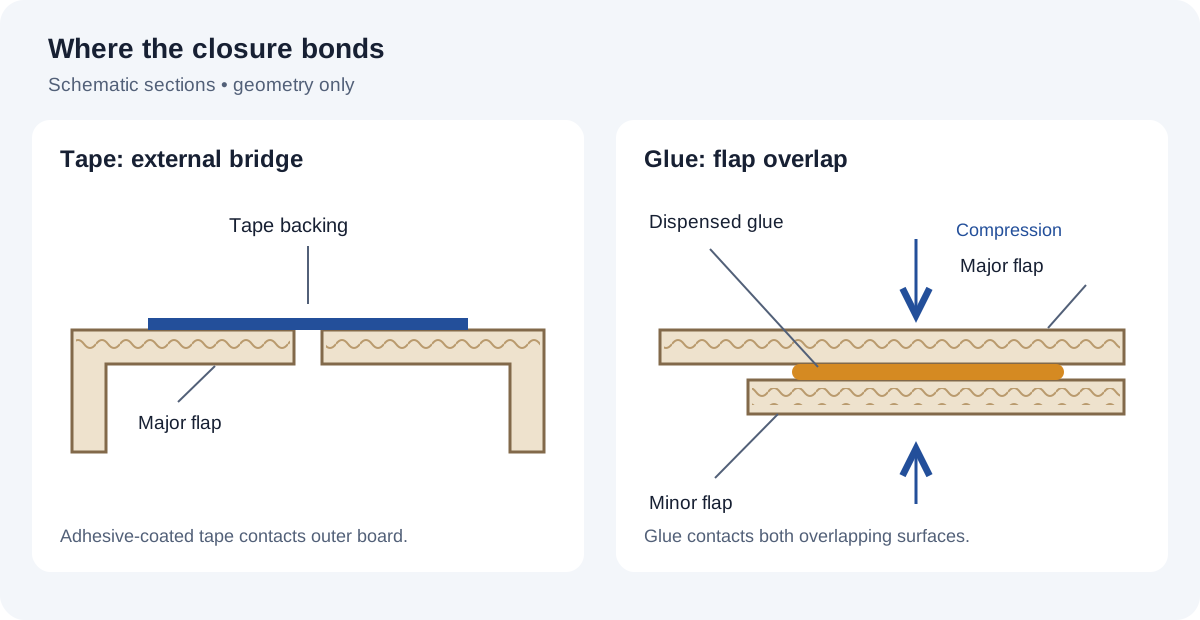
The word “hot melt” also appears on packaging tape data sheets. Shurtape HP 232, for example, uses a synthetic rubber/resin hot-melt adhesive coating. It remains a pressure-sensitive tape applied from a roll. That coating does not make it the same closure as molten adhesive dispensed between flaps. Record the actual tape or glue grade when comparing failures so the terminology does not hide a change of process.
Compare the failure mode before choosing the route
The table compares investigation paths. “Dominant Failure Mode” means the mechanism to investigate for the stated condition, rather than a ranking of failure frequency across all installations. Prevention measures need confirmation on the actual case and line.
| Closure and condition | Bond or load path | Dominant Failure Mode | Prevention |
|---|---|---|---|
| Tape applied to cold board | Adhesive contacts the outer board surface | Inadequate initial adhesion when application conditions fall outside the grade’s limits; dampness or contamination can also interfere | Check the named grade’s application range and actual board condition; use clean, dry surfaces and qualify the application |
| Tape applied before cold storage | The existing external bond enters its service environment | Later tape lift needs a review of initial adhesion, grade suitability, and exposure history | Verify application and service limits separately; inspect the closure after representative cold exposure and handling |
| Hot melt during sealing | Glue must contact the opposing flap and remain under suitable compression | Preset before flap contact, or an inconsistent bond from poor compression or dispensing | Review substrate temperature, application settings, adhesive amount, flap contact, movement, and compression |
| Hot melt after cooling and handling | A formed flap-to-flap bond sees cold service and package movement | Cold fracture, especially when fracture lines accompany a flattened bead and limited fiber tear | Investigate a grade qualified for the actual cold service; preserve failed bonds and review their timing and combined symptoms |
| Either closure in a heavy stack | The closed corrugated case participates in the pallet load | Case crushing or distortion can occur even with an intact closure | Qualify filled-case compression and closure integrity with the intended humidity, time under load, pallet pattern, and unitization |
Tape application checks follow Shurtape’s environment guidance. Glue failure clues follow Henkel’s pop-open troubleshooting guidance. Neither source establishes a universal closure winner for a cold room or heavy case.
Cold application and cold service are separate decisions
Record the board surface temperature where sealing takes place, the sealing environment, and any condensation or dust. Then record the subsequent cold-storage conditions. A case sealed before cooling and a case sealed while already cold present different bond-formation conditions, even if both eventually enter the same room.
Shurtape’s HP 232 technical data sheet states an application range of 20 F to 75 F / -7 C to 24 C and a service range of -20 F to 100 F / -29 C to 38 C. Those are HP 232 grade-specific reference conditions. The manufacturer presents this tape for medium-weight cartons in cold environments; the ranges do not qualify every heavy case or a loaded pallet. Its usage instructions also require clean, dry surfaces free of grease, oil, or other contaminants.
Rule of thumb: if the board at the tape head is below HP 232’s stated application lower endpoint, that grade’s service range does not authorize the application. Change the conditions or qualify another grade before relying on the colder service endpoint.
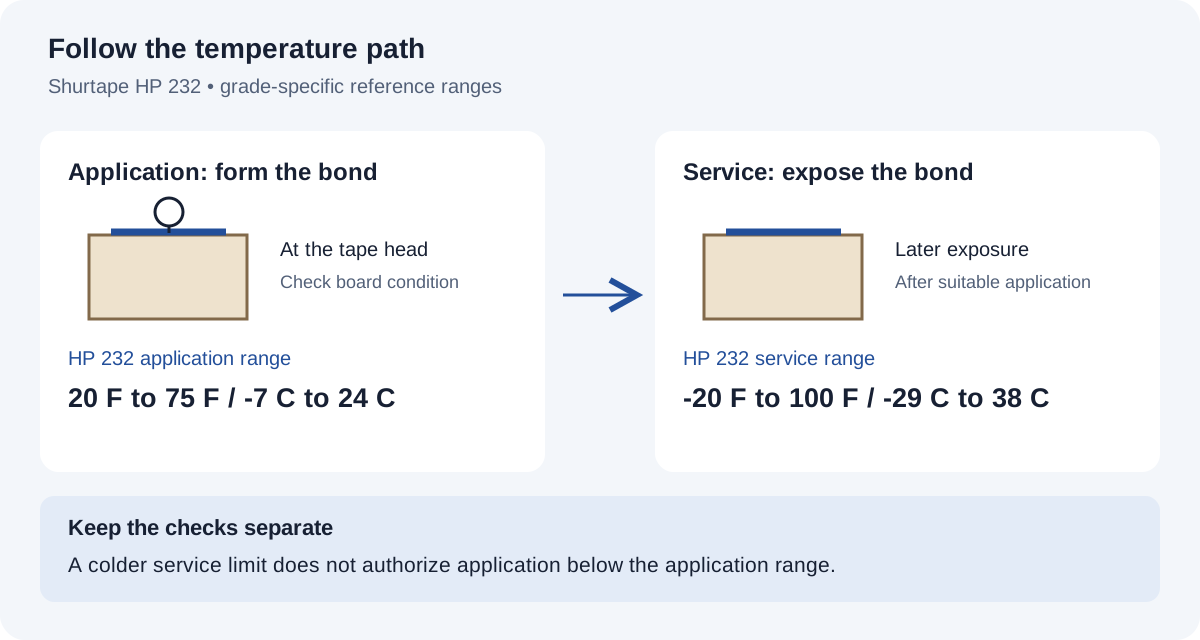
For tape already applied before cooling, review how the bond was formed as well as the later exposure. Retain examples from discharge and after cold conditioning so a later lifted seam is not automatically blamed on the cold room. Condensation should trigger a surface-condition check; the listed range does not establish adhesion to wet or frosted board.
For dispensed glue, obtain the actual grade’s service suitability as well as its application instructions. “Low-temperature hot melt” does not by itself establish freezer suitability. H.B. Fuller’s case and carton sealing guidance also distinguishes an adhesive’s melt or softening temperature from its in-service heat resistance. Keep processing properties and service properties separate in the specification.
Read glue failure timing and the opened bond together
A case opening at discharge may have a bond-formation problem. Henkel describes preset as adhesive setting before the materials are compressed together. Application temperature, adhesive amount, and cold substrate can contribute. Confirm these against the chosen adhesive’s instructions and the actual delay before flap contact, rather than diagnosing cold-service fracture from an open flap alone.
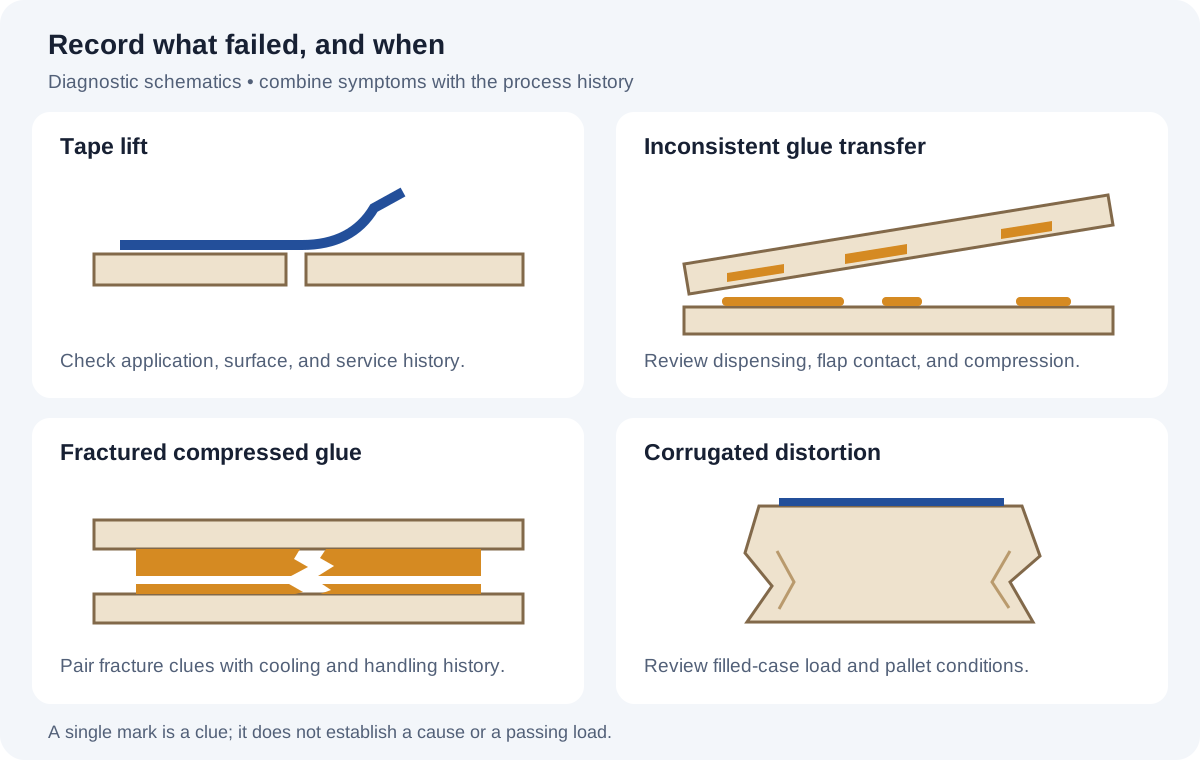
Poor compression presents another investigation path. Uneven bead width, inconsistent adhesive transfer, stringing, and inconsistent fiber tear are clues to examine together. Inspect dispensing consistency, contact between the flaps, substrate movement, and compression pressure and time. A symptom identifies something to investigate; it does not establish a single cause without the process history.
When a case survives discharge but opens after cooling and handling, inspect the formed bead for fracture lines. Henkel associates cold failure with a compressed bead, adhesive on both substrates, limited fiber tear, and fractures in the adhesive. Movement or dropping of heavy packages can reveal the failure. This combination supports an investigation of cold-resistant adhesive chemistry for the actual service conditions. Adhesive on both sides or fiber tear alone is insufficient to establish that conclusion.
Adding glue is not an automatic correction. H.B. Fuller warns that excess adhesive can slow setting and leave cases opening as they exit compression. Review the amount against the process before changing it. A larger deposit does not establish that preset, poor flap contact, or cold fracture has been resolved.
No cycle time is computed here because open time and compression dwell were not published for the reader’s line. Those inputs must come from the actual adhesive, substrate, application conditions, and machine sequence. An equipment rate or another installation’s settings cannot fill those gaps.
A heavy stack needs evidence beyond a closed seam
Glue-setting compression and pallet compression describe different demands. The machine’s compression section brings glued flaps into contact while the bond forms. Later, the filled corrugated case must resist the load and environment of its pallet stack. Passing the first demand does not establish performance under the second.
Endoline’s closure discussion describes a structural contribution from joining inner and outer flaps and calls for suitable compression when top gluing. That qualitative explanation supplies no numerical strength increase for the reader’s case. It also does not establish that tape cannot close heavy cases. Treat it as a reason to evaluate flap bonding, while retaining a separate assessment of loaded-case performance.
The Fibre Box Association pallet-pattern report explains that time under load, humidity, stacking pattern, palletization, and unitization affect corrugated load performance. Aligned corners carry compression effectively, but pattern selection also involves load stability. The report used hot-melt-closed cases and was not a tape-versus-glue experiment. Its results cannot supply a closure strength ranking or a safe stack height for another package.
For a heavy-stack decision, keep two records: whether the closure stays intact and whether the filled case resists compression under the intended conditions. A flattened or buckled wall with an intact seam points toward the corrugated and load arrangement. An opened flap needs its own bond investigation. If both occur, retain both observations instead of assigning the entire failure to the closure category.
Qualify the closure along the actual handling path
Use the following sequence as an engineering review plan. Agree on loads, exposure duration, sample count, and acceptance criteria with the packaging supplier or laboratory before testing; this is not a substitute for an agreed test protocol.
- Define the materials and case. Record board identity, surface treatment, filled-case configuration, flap fit, and the exact tape or glue grade and lot. Retain the relevant supplier limits with the trial record so a later material change is visible.
- Document bond formation. Record sealing-zone and board conditions, visible contamination or condensation, and the actual application settings. For glue, include delay to flap contact and compression contact and dwell. For tape, document the application method alongside the grade’s limits.
- Inspect at discharge. Record tape lift, glue transfer, bead flattening, fiber tear, and flap opening separately. This establishes whether the case leaves the sealer with a visible problem before cold service or stacking begins.
- Follow the service exposure. Inspect after representative cold conditioning and handling, then under the intended pallet pattern, humidity, and time under load. Keep glue fractures separate from corrugated crushing in the findings, and preserve failed cases for review.
- Resolve the failed mechanism before selecting. A bond-formation problem calls for application and equipment checks. Fracture after cooling calls for a service-suitability review. Stack distortion calls for a filled-case and unit-load review. Repeat the relevant qualification after a material or process change.
How the sealed case is handed onward belongs in the packaging line integration record. The strap that later holds the finished load is a separate check in the strapping machine and pallet banding guide.
The usable choice is the closure whose documented limits and observed performance cover that whole path. Complete the missing line-specific inputs before turning the comparison into a specification. The packaging guides index provides the surrounding equipment and line-planning context.
Keep the inspection sequence attached to each retained failure. If a case was already open before cooling, its later condition cannot by itself demonstrate cold-service fracture. If the seam stayed closed while the walls distorted under load, preserve that distinction in the acceptance record. This makes the next change address the observed mechanism and keeps a successful closure trial from becoming an unsupported stack rating.