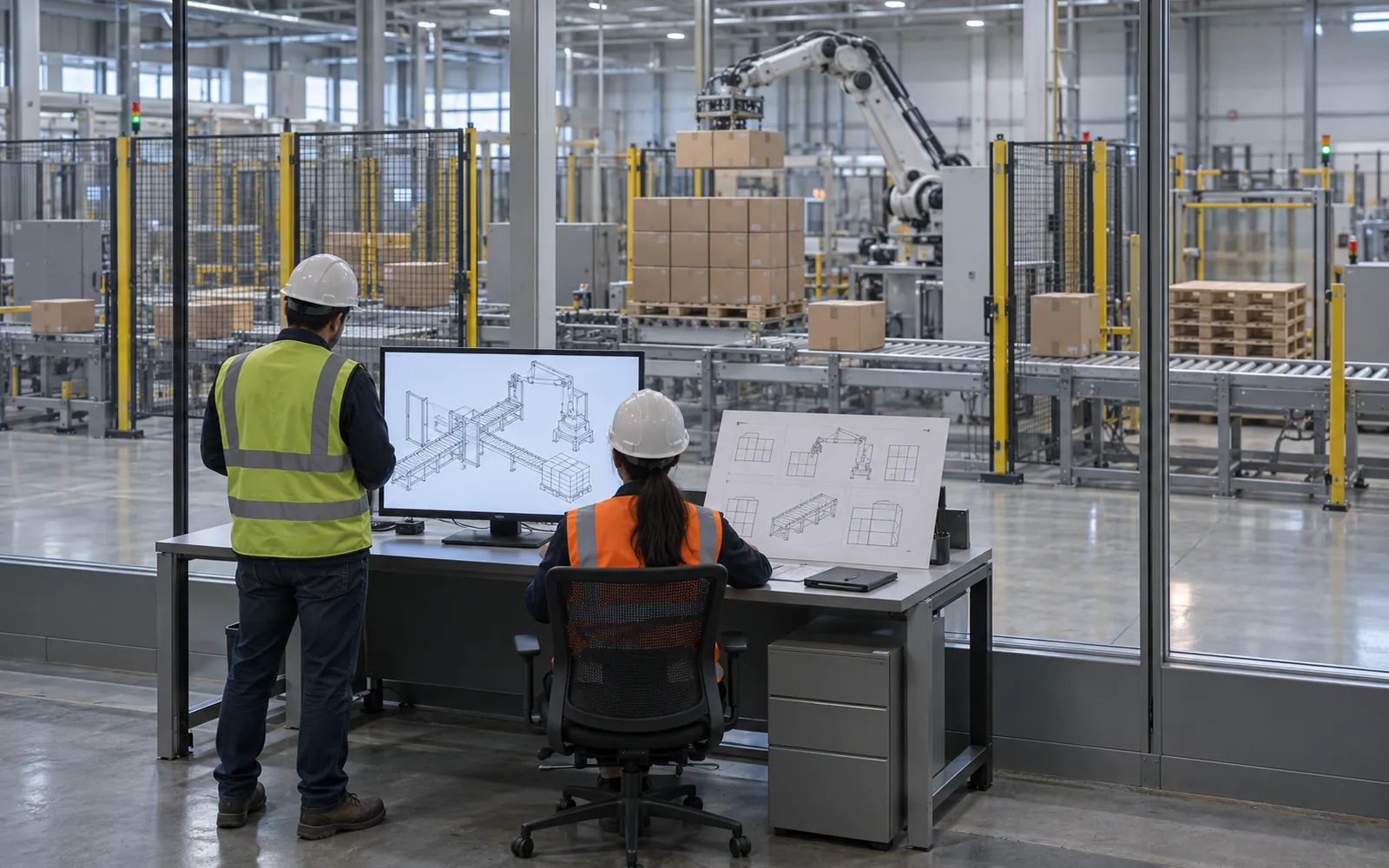
Quotes measured on different loads or incomplete scopes can conceal a bottleneck and later costs. Choose the palletizer architecture from the load, then compare full-cycle output and documented evidence on the hardest SKU.
| Type | How it works | Often suited to | Watch for |
|---|---|---|---|
| Conventional low-level | Product enters near floor level and layers are formed low on the machine | Operations that want most of the machine reachable from the floor and no lift on the infeed | Verify full-cycle output and match infeed height to upstream conveyors |
| Conventional high-level | Product enters at an elevated infeed, layers are formed above the load, and the pallet is lowered as it builds | Higher sustained case rates on uniform packages | Ceiling height, the lift or spiral that raises product, and access for maintenance |
| Robotic | An arm with an end-of-arm tool picks cases, rows, or full layers | Many SKUs, frequent pattern changes, bags and other difficult shapes, or more than one infeed line | Rate depends on how many cases are picked per cycle; tooling and guarding are part of the cost |
Jump to the reusable supplier scorecard, or compare robotic and conventional palletizers before preparing the specification.
Start with the load, not the machine
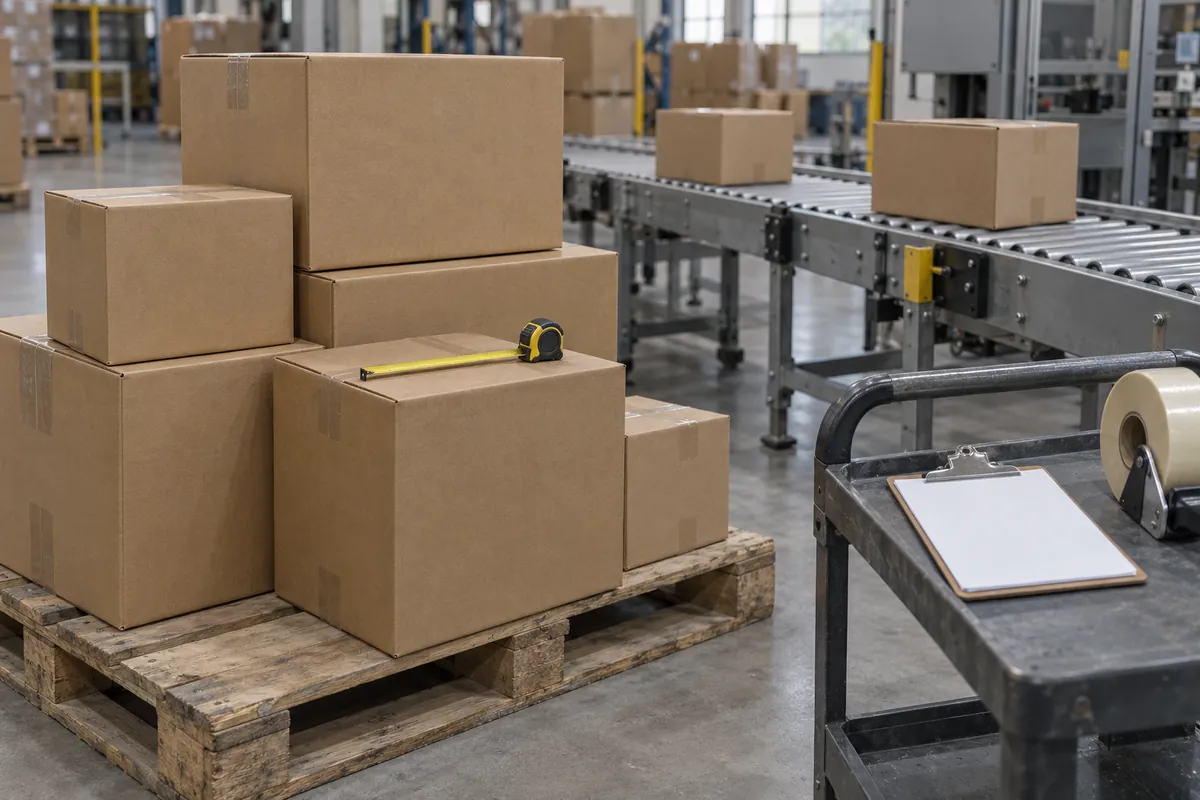
Define the product before you read a brochure. A useful written definition includes:
- Case or bundle dimensions and the weight range, from lightest to heaviest
- Package type: corrugated cases, shrink-wrapped bundles, trays, bags, or pails
- Pallet types and sizes, including any that are damaged or inconsistent in normal use
- Stacking patterns and the number of layers per load
- Maximum load height, including any limit set by trucks or storage racks
- Whether slip sheets, tier sheets, or top frames are used
- Required sustained output, and how many lines feed the palletizer
To check how many cases fit per layer, how many layers the height and weight limits allow, and whether the load stays inside the pallet edges, run the numbers through the pallet calculator before you write them down. Then separate hard requirements from preferences. A pallet size you must build every day is a requirement. A slightly faster cycle on a pattern you run twice a year is a preference. Suppliers can only be compared fairly against the same list, so keep this document and send it to everyone.
Know the main architectures
Most palletizers fall into one of three groups. The opening table is a general guide, not a ranking. The pages on conventional palletizers and robotic palletizers describe how each works.
Cybernetik’s public comparison, row “Infeed Height” in its low/high-level comparison (accessed October 8, 2026), gives 30–36 inches and 100–144 inches respectively. It names no model for those ranges, so treat them as that supplier’s orientation, not installation dimensions or category limits. Obtain a model-specific drawing for the building and conveyor design. The pages on low-level palletizers and high-level palletizers explain the difference in detail.
Key variables and how to size them
Throughput
Throughput is where quotes drift apart most often. Ask every supplier:
- Is the figure in cases per minute or layers per minute? Convert both to one unit by multiplying layers per minute by cases per layer.
- Is it a rated peak or a sustained rate over a full shift?
- At what case size, pattern, and number of picks per cycle was it measured?
- Does it include pallet change, empty pallet dispensing, and slip sheet insertion time?
Then size the requirement from your own line. Take the highest sustained output of the machines feeding the palletizer, add allowance for the time spent changing pallets and cycling the wrapper, and compare the total to the quoted rate on your hardest case. Last, ask for the expected rate on your most demanding SKU and pattern, in writing. The average product is rarely the one that limits the line.
Package compatibility
Conventional machines perform best with consistent shapes and sizes, because uniform packages allow maximum speed. A manufacturer comparison says flexible or nonrigid packages are often difficult for conventional machines without extra reinforcement, while robots can handle almost any package individually. Check the whole range, including the smallest and largest case, the heaviest package, and any packages with soft or damaged corners. For bags, test the grip or the layer compression with your own product.
Changeover and pattern management
Flexibility on paper can be slow in practice. Find out how new patterns are created: from an operator screen, or only by a programmer from the supplier. Ask which tooling or guides change between SKUs, who on your team can perform the change, and how long it takes in practice rather than in the best case. Multiply minutes per change by changes per week to see how much production time a slow changeover costs.
Space and building
Measure floor area, ceiling height, door and aisle widths, and the height of existing conveyors. High-level machines need ceiling clearance and a way to lift product to the infeed. Robotic cells need plan area for the arm’s reach, the guarding, and pallet staging. Ask each supplier for a layout drawing that shows plan, height, service clearances, and the path for forklifts. The vertical conveyors page explains how product is raised to an elevated infeed.
Environment and sanitation
Cold, wet, dusty, or sanitary conditions affect materials, lubricants, cabling, and enclosure design. State them in the specification and ask what each supplier proposes. If the area is washed down, ask which components are exposed to water and how the machine is cleaned.
Worked example: converting a requirement into a rate
Worked example, assumed inputs; not a manufacturer guarantee. Two lines deliver 30 cases/min each: 60 cases/min combined. At 10 cases/layer, demand is 6 layers/min. Assume 8 layers/pallet and a candidate rated at 8 layers/min during pallet building, excluding exchange. Assume a 15-second exchange during which no cases are palletized.
| Calculation | Assumed result |
|---|---|
| Cases per pallet | 8 layers × 10 cases/layer = 80 cases |
| Pallet build time | 8 layers ÷ 8 layers/min = 1 min = 60 s |
| Full non-overlapping cycle | 60 s build + 15 s exchange = 75 s |
| Effective pallets/hour | 3,600 s/hour ÷ 75 s = 48 pallets/hour |
| Effective cases/min | 48 pallets/hour × 80 cases ÷ 60 = 64 cases/min |
Demand is 60 × 60 ÷ 80 = 45 pallets/hour, so this assumed cycle has modest headroom. Wrapper, sheet insertion, rejects, or other non-overlapping delays could consume it. If exchange time is already included in a rated/tested rate, do not add it again. Confirm any claimed overlap from the actual sequence, then measure complete-cycle output. For a robot, convert cases/min to picks/min using the cases moved per pick and test the actual tool and case.
Finally, test the number against your hardest SKU. If the heaviest or smallest case forces a slower pattern, that rate, not the average, is the one that decides whether the line stays ahead of the palletizer.
Compare the complete cell
The palletizer is only part of the installation. Compare what each quote actually includes:
- Pallet dispenser and slip sheet dispenser (see the pallet dispenser and slip sheet inserter specification guide)
- Infeed conveyors and accumulation
- Interface to the stretch wrapper, or concurrent wrapping inside the machine
- Pallet labeling and tracking
- Guarding and safety devices
- Controls platform and spare parts compatibility with your plant standard
- Footprint and required ceiling height
- Installation, commissioning, training, and spares
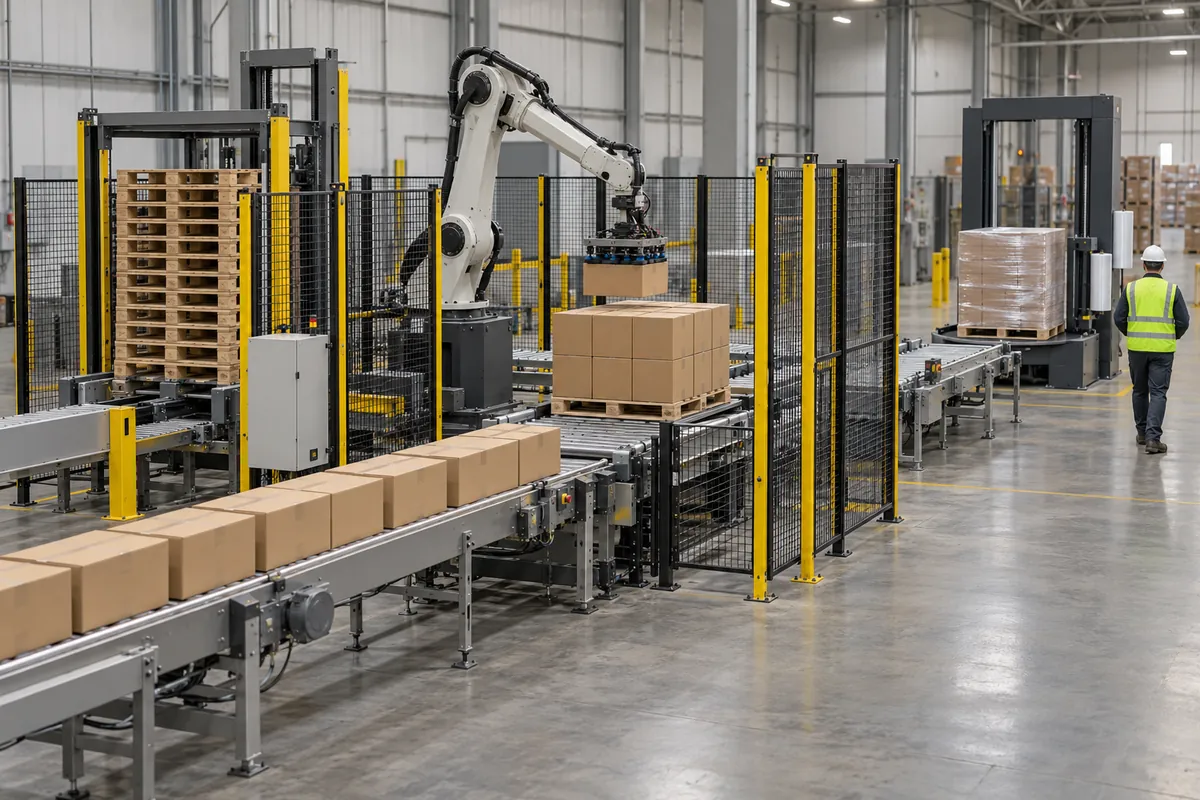
An item left out of one quote becomes a cost or an integration task later. A cost guide in the same section, palletizer cost, lists these items as separate lines so each can be priced. A published cost guide from a robot supplier makes the same point: quotes that show only the arm price can understate the real project cost, so ask for tooling, guarding, conveyors, programming, installation, and freight as separate lines.
A simple scoring approach
Once the quotes are normalized, score them against your own requirements rather than a generic checklist. Choose five to eight criteria that matter in your plant, such as sustained rate on the hardest SKU, changeover time, footprint, service support, and complete scope. Give each criterion a weight that reflects how much it matters, then score each supplier from the written answers. Leave a cell empty when the supplier has not given a written answer, and treat the gap as an open question rather than a pass.
An empty field in the comparison is useful. It shows what still needs an answer and keeps an assumption from becoming a commitment. Get answers in writing, and where possible, test with your actual cases and patterns before the machine ships.
How to evaluate palletizer manufacturers and suppliers
Searches for the best palletizer manufacturers or palletizer companies return directories and rankings. A list can tell you who exists, but not who fits your load, your building, and your maintenance team. This site does not rank suppliers. What it can do is turn “best” into criteria that any shortlisted company should be able to answer in writing, so the comparison rests on evidence instead of reputation.
The company you buy from may not be the only company involved. A robot palletizing cell is often built by an integrator around an arm made by another company, and a conventional machine may arrive with conveyors, dispensers, or a wrapper from other suppliers. Ask each bidder to name who is responsible for the complete cell, who designs the controls, and who answers the phone after start-up.
What to verify, and the evidence to ask for
- Application match. Ask for examples of similar loads: package type, weight range, patterns, and pallet types. Videos and site visits help, but a test with your own packages settles it.
- Rate proof on your hardest SKU. A sustained rate in one unit, as described earlier in this guide, with the conditions stated, and a willingness to demonstrate it during the factory acceptance test.
- Complete scope and interfaces. A written list of what is included and what is “by others”, covering the items in the complete-cell list above, plus the signals exchanged with upstream machines and the wrapper.
- Acceptance testing. A written factory acceptance test (FAT) and site acceptance test (SAT) protocol, with your packages, your patterns, measurable pass criteria, and who attends. The commissioning and acceptance checklist describes both tests.
- Safety approach. The standards and editions the supplier designs to, the risk assessment it delivers, and which guarding and safety devices are inside the quote.
- Documentation package. Electrical and mechanical drawings, the PLC and HMI programs with backups and access rights, manuals, and a spare parts list, with the format and language stated in the order.
- Service and parts coverage. Where service people and spare parts are located relative to your plant, what remote support is offered, which response terms are written into the contract, and what training is included.
- Controls platform. Whether the controller, drives, and safety devices match your plant standard, so your technicians can support and source them.
A supplier scorecard you can reuse
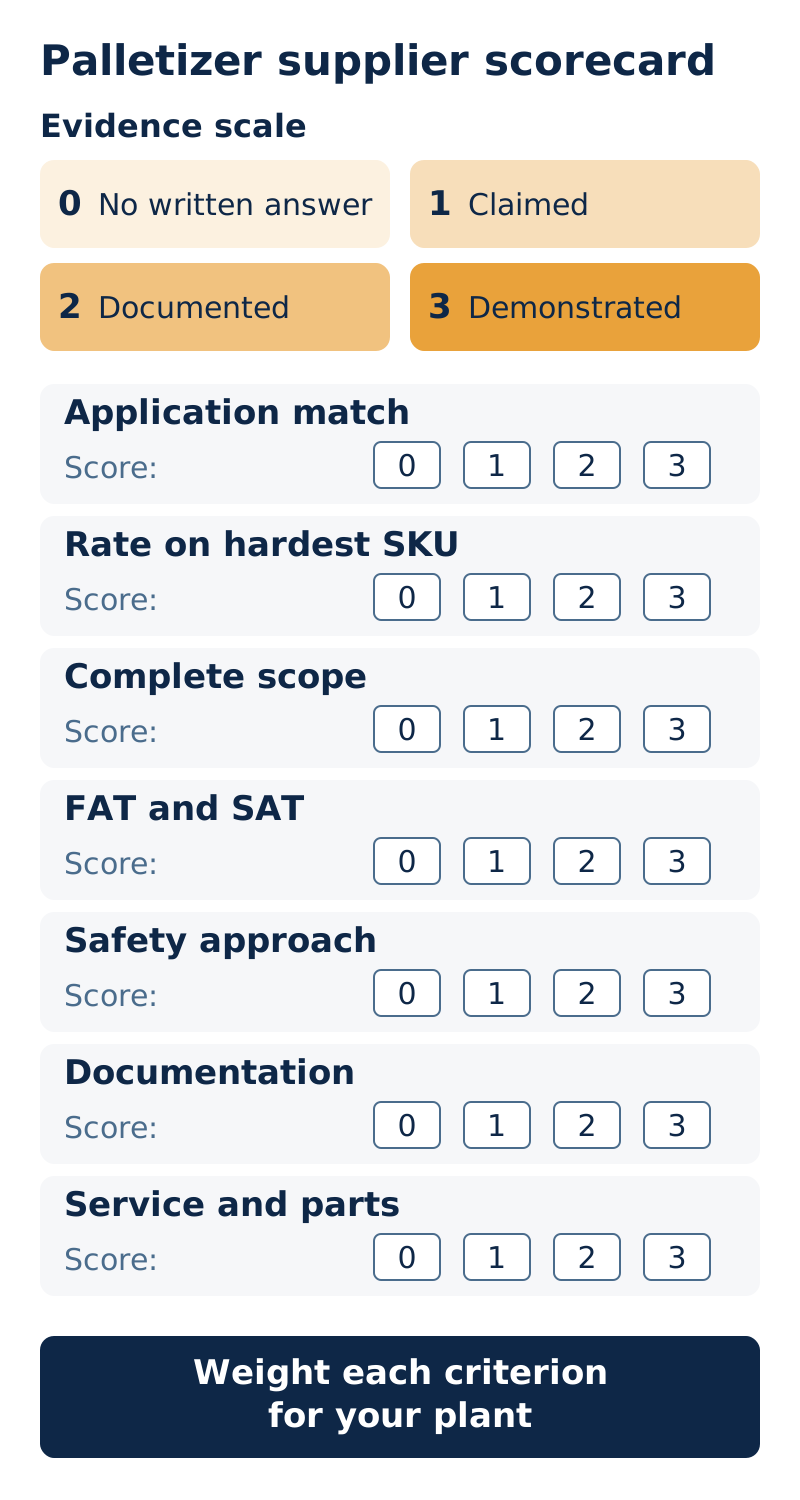
Score each criterion by the strength of the evidence, not by how confident the sales presentation sounded. One simple scale is shown below. Weight the criteria for your plant, as in the scoring approach above, and keep the written answer next to each score.
Copy one table per shortlisted supplier. Use the editorial evidence scale 0 = no written answer, 1 = claimed, 2 = documented, 3 = demonstrated; it is not an industry rating or endorsement.
| Criterion | Required evidence | Weight / score 0–3 | Evidence URL or file / date | Unmet item / owner |
|---|---|---|---|---|
| Application match | Similar loads, patterns, pallets | ___ / ___ | ___ / ___ | ___ / ___ |
| Rate on hardest SKU | Sustained rate with conditions | ___ / ___ | ___ / ___ | ___ / ___ |
| Complete scope | Inclusions, exclusions, interfaces | ___ / ___ | ___ / ___ | ___ / ___ |
| FAT and SAT | Protocol, pass criteria, results | ___ / ___ | ___ / ___ | ___ / ___ |
| Safety approach | Editions, assessment, guarding | ___ / ___ | ___ / ___ | ___ / ___ |
| Documentation | Drawings, programs, manuals, parts | ___ / ___ | ___ / ___ | ___ / ___ |
| Service and parts | Locations, written terms, training | ___ / ___ | ___ / ___ | ___ / ___ |
A supplier that scores well on claims but cannot document them has not yet answered the question. Watch for the usual warning signs: a rate with no conditions, important items marked “by others” without a named owner, no written test protocol, documentation promised “on request” without a list, and references that handled a different load. Cost questions belong in the palletizer cost guide, and the full buying process, from requirement to handover, is in the commissioning checklist linked above.
Safety and standards
Safeguarding is part of selection. Robot-based cells fall under the robot safety standards, which in the United States are published as ANSI/A3 R15.06 and align with ISO 10218, and control-system safety functions are commonly designed to ISO 13849-1. An article from the Association for Advancing Automation notes that these standards address the whole application, including the end-effector, the workpiece, and peripheral equipment, and that editions have been revised recently. Conventional palletizers are machinery with their own guarding and interlock requirements. Ask each supplier which standards and editions they apply and what guarding is included, and have a qualified person assess the complete installation.
Palletizer selection also affects the rest of the line, so read packaging line design alongside this guide.
Common mistakes
The most frequent error is a unit mix-up: reading layers per minute as cases per minute. Convert with cases per layer. A related one is accepting a rate without a test; ask for an acceptance test with your packages. Testing only the average package has the same weakness, since the most difficult case or bag sets the practical limit.
Others come from scope. Choosing high-level without checking the building can mean work on ceiling height, floors, and platforms. The conveyor that raises product to the infeed is part of the system, so do not ignore the lift. Concurrent wrapping changes layout and sequence, so leave nothing unspecified about the wrapper. Comparing the arm alone misses tooling, guarding, and conveyors, which can change the ranking.
Last, frequent format changes can erase a speed advantage, so do not underestimate changeover.
Selection checklist
- Define package dimensions, weights, and the hardest SKU.
- Calculate the required sustained cases per minute and the matching layers per minute.
- List patterns, pallet sizes, and expected changeovers per week.
- Measure ceiling height, floor area, and existing conveyor heights.
- Decide whether the infeed will be elevated and what lift is needed.
- Decide the number of infeeds and the room for expansion.
- Specify pallet dispensing, sheet handling, labeling, and the wrapper arrangement.
- State sanitation and environment requirements.
- Ask for the safeguarding approach and the standards applied.
- Confirm maintenance access, spare parts, and training.
- Request the changeover procedure and time on your hardest change.
- Request an acceptance test with your packages and write the pass criteria into the order.
- Score each shortlisted supplier on documented evidence, using the same criteria for every bid.
The commissioning and acceptance checklist covers the wider buying process, and the palletizing systems overview shows how the palletizer connects to the rest of the end of the line.