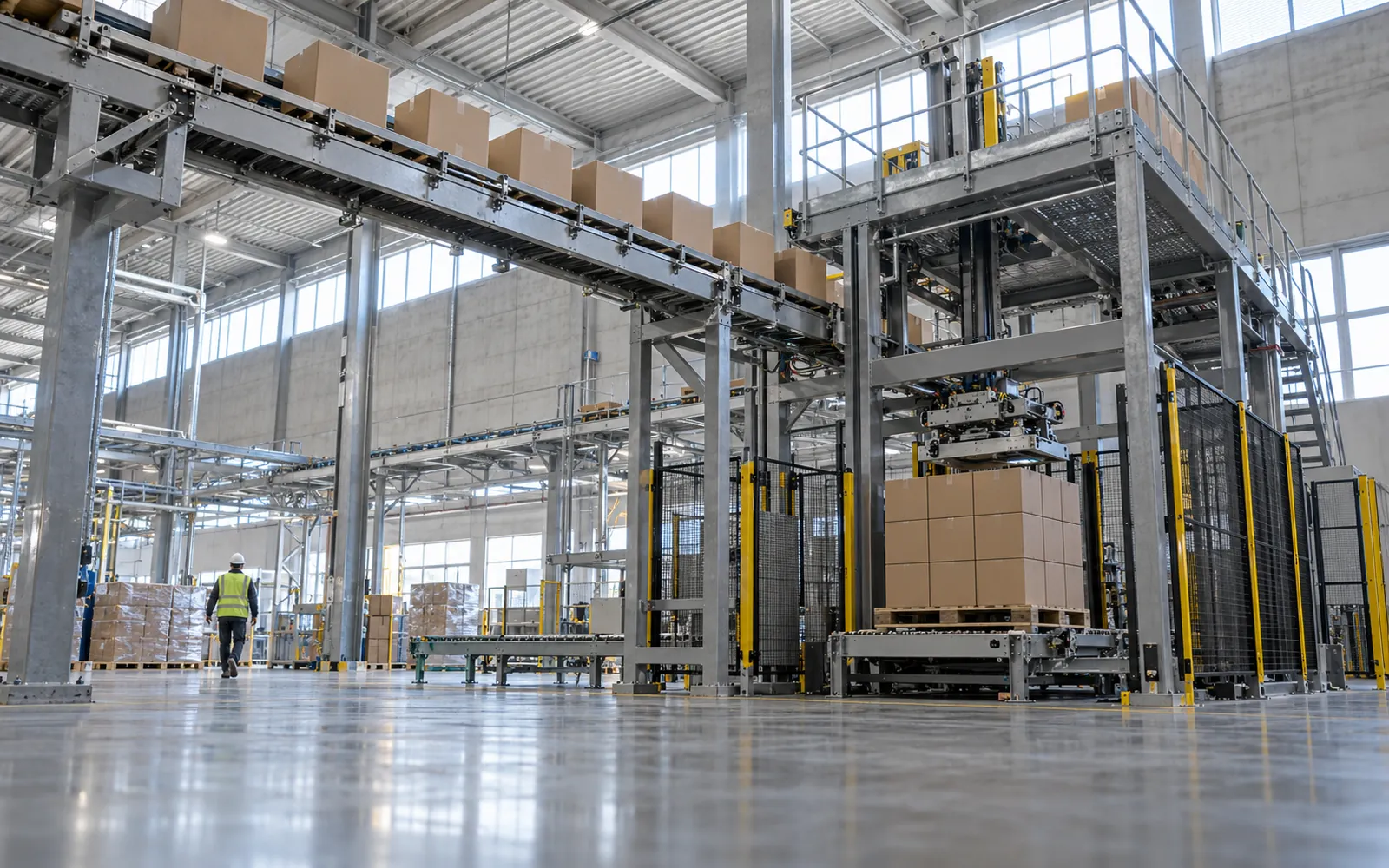
Overlooking building clearance or pallet-change losses can waste an equipment budget and stop production. A high-infeed palletizer is a candidate when its elevated forming bed, pallet-hoist travel and tested sustained case output fit the site. Use the inputs below before comparing conventional architectures, the low-level alternative and other palletizing systems.
| Input | Site or trial evidence | Decision |
|---|---|---|
| Existing conveyor height | Measured infeed elevation | Direct connection or a lift needed |
| Clear building height | Beams, lights, sprinklers and service clearance | Confirm full machine and load envelope |
| Hardest-pattern rate | Sustained cases/min over the agreed window | Compare with combined line output |
| Pallet-change buffer | Exchange time and usable case positions | Check whether upstream must slow |
| Lift and platforms | Capacity, travel and access drawings | Include both in the installed scope |
How it works
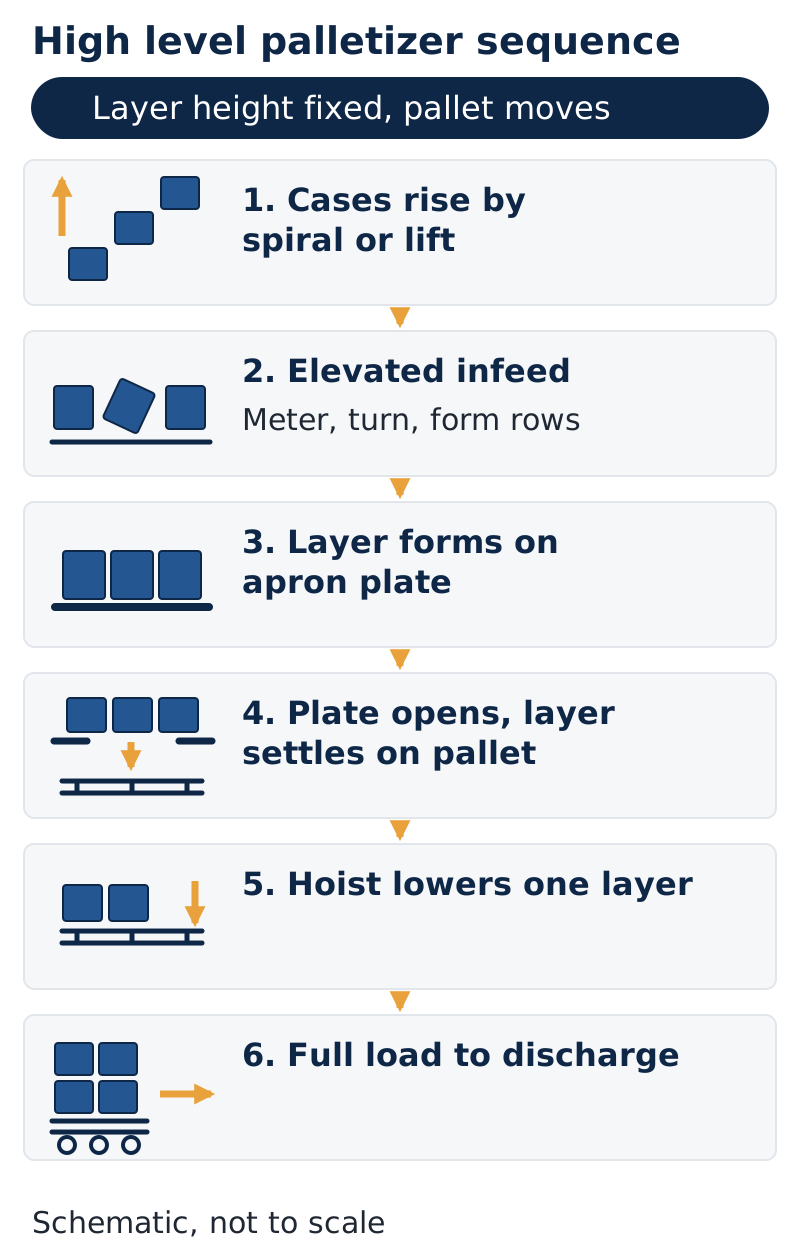
The layer-forming area stays at one fixed height while the pallet moves. That reverses the logic of a floor-level machine, and most of the design follows from it.
Cybernetik’s public guide gives high-infeed height as 100–144 inches, ceiling clearance as 5–7 meters, and layer rate as 5–10 layers/min (published July 23, 2026; accessed October 8, 2026; References). These are one guide’s broad ranges, not a model specification. Its 30–60+ cases/min discussion is an application example, not a rate derived from those layer figures. Confirm the actual pattern and timing window.
At the top, cases are metered, turned if the pattern needs it, and gathered into rows. A supplier describing its row-forming layer machine notes that a high-speed switch assigns each case a path, and pneumatic diverters guide cases into the right orientation. Cases that must be turned travel through a turning device before they reach the row-forming area.
A completed row is pushed onto the layer-forming area, and this repeats until the layer is complete. Some designs keep a second row waiting while the previous layer is released, which lets product keep flowing at the infeed and supports faster rates.
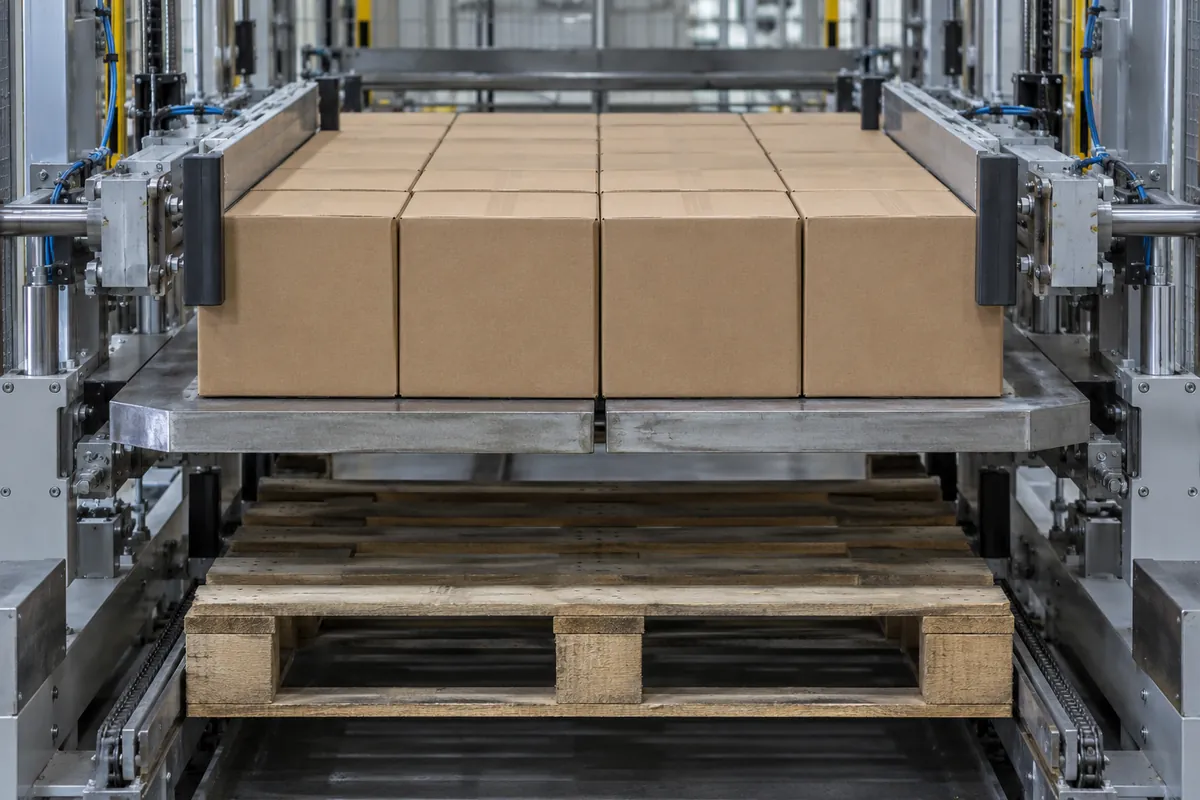
The layer sits on a fixed plate, often called an apron or stripper plate. The plate is usually split so it can open along a center line, and the layer waits there until the pallet is in position below it.
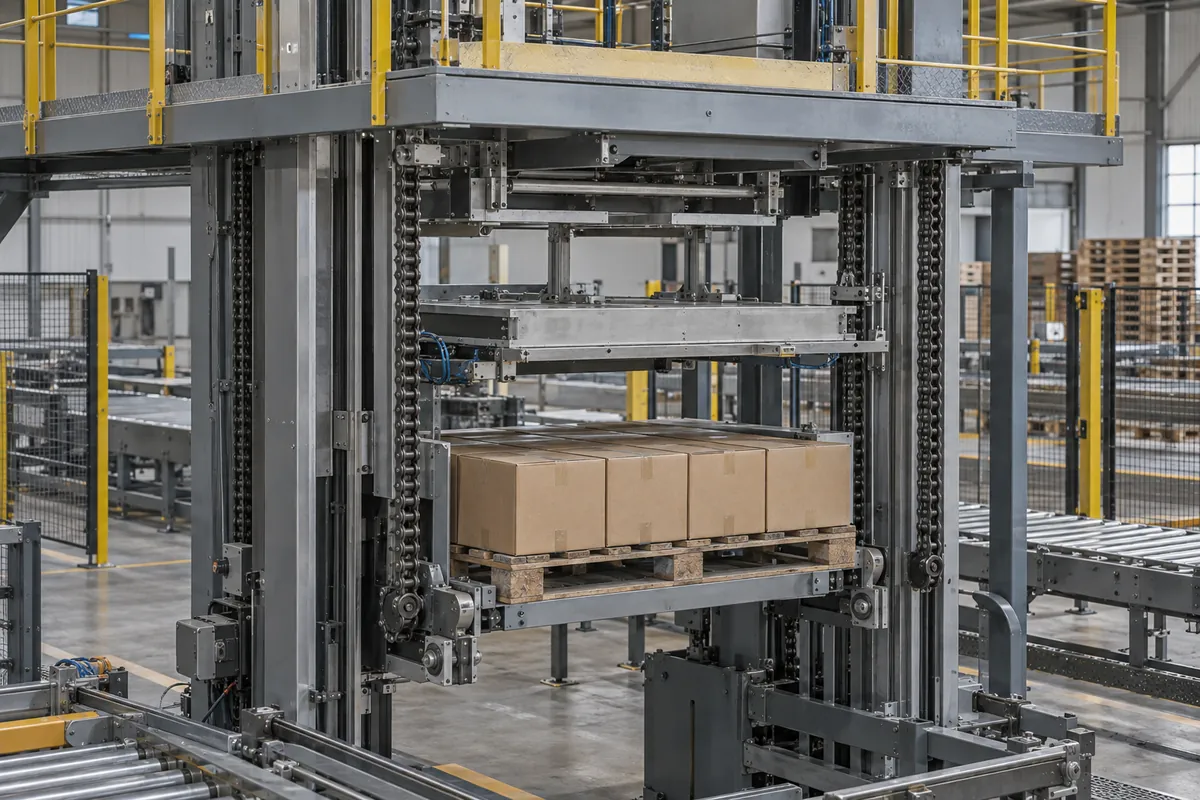
A hoist then raises the pallet to just under the apron. The plate opens and withdraws, the layer settles onto the pallet or onto the layer beneath, and the hoist lowers by one layer height. The cycle repeats until the pallet is full, and the finished load descends to a discharge conveyor. For vertical positioning, the pallet moves rather than the forming bed; compare the resulting cycle with a moving-layer design on the same pattern. That is one reason the architecture is described as the faster conventional design.
Many designs square the layer before release, and some compress it from several sides. One manufacturer describes four-point pneumatic layer squaring before the hoist lowers the load. Compression is often used for bags and compressible packs, and tuning it is part of commissioning for cartons too.
Types and configurations
High level machines differ in how they form the row, how many infeeds they accept, and how they move the pallet. These choices shape both rate and layout.
Row-forming and layer-forming variants
Some machines sweep complete rows onto the layer area with a pusher, while others use a continuous in-line approach that arranges product in motion. Ask any supplier how its machine forms rows, how many cases are moved per sweep, and how the next row is staged during layer release.
Infeed arrangements
A single-lane infeed is the simplest. Wider infeeds use a switch to divide cases between lanes so rows and turns form in parallel, which raises capacity. One supplier lists models intended for different speed classes, including a unit described as its fastest row-forming design, but that is a marketing claim. Ask for the rate on your case size and pattern, not the highest rate on the family datasheet.
Multi-line infeed
A high level machine can sometimes accept product from more than one line, which lets a single palletizer replace several manual stations. Each line needs its own conveyor into the machine, and the control logic must decide how to merge streams, which line has priority, and what happens when one stops. Compare the combined input in cases/min with sustained output in cases/min on the same timing window, including pallet changes. Running output is layers/min × cases/layer; measure exchange and waiting losses before calling it sustained output. Ask how the machine behaves when one line is starved and how mixed patterns are handled when each line runs a different product. If lines run different SKUs at the same time, a layer machine may be less suitable than a robotic cell.
Pallet and sheet handling
A pallet magazine or dispenser feeds empties to the hoist, and a sheet dispenser places slip sheets or tier sheets when the load needs them. Some machines place a sheet on top of every layer and some only at the base and top. Check the placement method and the effect on cycle time in the pallet dispenser and slip sheet inserter specification guide.
Takeaway: Specify merge priorities, the hardest pattern and sheet handling before comparing configurations.
High-speed palletizing: what to verify
High level machines are usually chosen because the line is fast. The question for a high speed palletizer is not its headline rate but whether it sustains your rate, on your cases and patterns, through every pallet change. This section explains what limits that rate and how to check it without relying on a datasheet number.
Where the rate is lost
A high level palletizer is a chain of stages, and the slowest stage for a given pattern sets the rate.
- Case turning and row forming. Patterns that need many turned cases make the top of the machine work harder. The pattern with the most turns is usually the hardest.
- Layer release. Each layer waits on the apron until the hoist is in position. Machines that stage the next row while the layer releases keep the infeed moving.
- Pallet change. The full load must leave and an empty pallet arrive before the next layer can drop. Product keeps arriving during that time, so it has to wait somewhere.
- Sheet placement. Slip sheets or tier sheets add a step to some layers.
- The lift and the wrapper. The spiral or lift feeding the infeed and the wrapper after the discharge can each hold back the machine.
How to verify the sustained rate
- State the rate on your terms. Give cases per minute for each case size and pattern, and remember that cases per minute equals layers per minute times cases per layer. A pattern with fewer, larger cases per layer needs a faster layer cycle for the same case rate.
- Name the hardest pattern. Ask for the rate on the pattern with the most turns and the smallest case, not only on the easiest one.
- Include pallet changes. Ask how long the infeed is blocked or slowed during a pallet change and sheet placement, and how much accumulation upstream absorbs it. The accumulation conveyors page explains how to size that buffer.
- Test before shipment. Ask for a factory acceptance test with production cases at the agreed rate, over a run long enough to include several pallet changes, and with agreed failure criteria such as jams, mis-formed layers, and operator interventions. The commissioning and acceptance checklist lists what to document.
- Test again on site. Repeat the test after installation, with the real lift, accumulation, and wrapper in place, since those are not present on the supplier’s floor.
Merging several lines into one machine
When two or more lines feed one high level palletizer, the controls have to answer questions that a single-line machine never faces. Which line has priority when both have product waiting? How much accumulation does each line have before it must slow down? What happens to a partly built layer when one line stops? Can the machine switch patterns between lines, and how are finished pallets identified by line? The combined case rate must stay within the sustained case output for the hardest pattern: layers per minute multiplied by cases per layer, accounting for pallet changes. Write the merge rules into the specification, and include a merged-line scenario in the acceptance test.
Copy this record for the commissioning and acceptance checks and repeat it at site acceptance (SAT):
Trial: FAT / SAT; date; equipment/configuration:
SKU / outside case dimensions / weight:
Hardest pattern / cases per layer / label turns:
Infeeds and total input cases:
Window start / end / elapsed minutes:
Completed output cases / elapsed minutes = sustained cases/min:
Pallet changes: count / blocked time:
Sheet and wrapper waits / stops / causes / interventions:
Agreed pass criterion / observed result:
SAT repeat with installed lift, buffer and wrapper / sign-off:
Takeaway: Accept the rate only after the hardest-pattern record meets the agreed criterion over the full window.
Specifications to evaluate
| Specification | Why it matters | What to ask the supplier |
|---|---|---|
| Infeed height | Sets the lift, conveyor design, and building clearance | What height does the infeed require, and does the quote include the lift or spiral? |
| Overall height and service clearance | Determines whether the building can host the machine | What is the total height, including access platforms and the hoist travel? |
| Layers per minute and cases per layer | Together they give the case rate | What is the sustained rate on my case size and pattern, and what is excluded? |
| Row-forming method | Affects rate, case handling, and accumulation | How many cases per sweep, and how is the next row staged during release? |
| Case turning capability | Sets which patterns are possible | How are cases turned, and what are the limits on size and aspect ratio? |
| Number of infeeds | Needed for multi-line operation | How many lines can feed the machine, and how are streams merged? |
| Layer squaring and compression | Affects load stability and product protection | What squaring or compression is provided, and how is it tuned? |
| Hoist and discharge | Determines pallet weight and height limits | What are the maximum pallet height and weight, and how does the load exit? |
| Pallet and sheet range | Pallet variation causes stoppages | Which pallet types and condition limits are supported? |
| Maintenance access | Elevated sections need safe reach | Where are the platforms, how are jams cleared, and what training is required? |
| Safeguarding | Determines how the area is entered | What guarding, interlocks, light curtains, and pallet-removal procedures are included? |
| Changeover | Defines downtime between SKUs | Which parts are adjusted, are tools needed, and how long does a change take on my hardest SKU? |
Package compatibility
High level palletizers are used with cases, cartons, trays, shrink bundles, and in some designs bags and cans in packs.
Corrugated cases are the core application. Uniform, rigid cases form rows and layers predictably, and the machine can run at its highest rates. Shrink bundles and trays are common in food, beverage, and tissue, and one supplier lists lightweight shrink bundles and heavy shipping cases among the formats its elevated machines handle.
Bags are possible with layer compression and squaring, but should be tested with the actual bag at the actual rate. Suppliers say lowering the layer is gentler than lifting it, which helps glass and thin cartons. Treat that as a design advantage to verify in a trial, not a guarantee. Irregular or frequently changing shapes are generally easier for robots.
Check the smallest and largest case, the heaviest layer, and the weakest case. Row forming and turning are sensitive to case length and aspect ratio, so very short or very long cases may need special tooling.
Integration upstream and downstream
Upstream, the palletizer needs a controlled stream. When the infeed is overhead, product travels from the packing line to the machine by spiral conveyor or vertical lift. That lift must carry more than the palletizer rate and must not become the bottleneck. The vertical conveyors page explains the types, and the accumulation conveyors page covers the buffer that lets the packer keep running during a pallet change. A comparison from one supplier notes that elevated systems can make better use of vertical space for accumulation, though with more complex mechanisms and maintenance needs.
If the plant already runs overhead conveyors, a high level machine connects at that height without a decline conveyor. That is one of the strongest reasons to select it.
Downstream, the load leaves the discharge conveyor toward a stretch wrapper, a pallet labeler, or an accumulation conveyor. Where a wrapper can be positioned in line, the pallet exit and pallet buffer matter, because a slow wrapper can hold back an otherwise fast machine. Plants that also unload pallets can compare case depalletizers for the reverse operation.
Takeaway: Assign capacity and handshake responsibilities to the lift, palletizer and wrapper before the site trial.
High-rate palletizing in a brewery is described in brewery packaging, and the general application in pallet handling.
Footprint, utilities, controls, and safety
Moving conveyors and the layer-forming stage overhead can free floor space for forklifts, pallet staging, and adjacent equipment, though the machine’s own floor footprint depends on the design, so ask for layout drawings. Use the single-guide ceiling range above only for initial screening; the machine drawing and service clearance govern the building check. Structure for platforms and the lift, floor loading, and sprinkler or lighting clearances belong in the building review.
Expect electrical power and compressed air. Hoists, plate drives, and pneumatic diverters differ between designs, so ask for connected load and air consumption. A PLC and drives coordinate the machine, with an HMI for pattern selection. Ask how patterns are built, stored, and changed, and how the machine communicates with the packer, the lift, and the wrapper.
According to one comparison, the elevated design may require extra safety measures during operation and maintenance. Typical elements include guarding, interlocked doors, light curtains at the infeed and discharge, controlled-entry access, and safe platforms with guardrails for clearing jams. ISO 13849-1:2023 covers safety-related control-system design; it does not choose the required performance level for this application. For a robot hybrid, also review ISO 10218-2:2025. Official scopes accessed October 8, 2026; confirm project applicability and editions. A site risk assessment of the whole installation, including work at height, should set the safeguarding.
Cost factors
This guide does not state prices; the palletizer cost guide explains how to compare them. Supplier comparisons describe high level machines as generally costing more than floor-level machines, and these drivers are the main reasons:
- Rate class and number of infeeds
- Row-forming method and layer squaring or compression features
- Spiral conveyor or vertical lift to the elevated infeed
- Mezzanine, platforms, or structural work for the elevated section
- Building changes for ceiling height, floor loading, or sprinklers
- Pallet dispenser, sheet dispenser, and discharge conveyors
- Safeguarding for the elevated area and access platforms
- Controls platform, patterns, and integration with line equipment
- Installation, commissioning, training, and spare parts
Compare complete scopes. A machine quote without the lift, platforms, and building work can look far cheaper than it is.
Takeaway: Compare installed scopes including lift, platforms and building work before choosing by machine price.
Selection checklist
- Measure ceiling height, structural clearances, and floor loading.
- Record whether overhead conveyors already exist and at what height.
- Define the sustained case rate for each line, the case sizes, and the patterns.
- Decide the number of infeeds, now and over the machine’s life.
- Define the lift or spiral capacity and who supplies it.
- Specify pallet, slip sheet, and tier sheet handling.
- Decide the wrapper and pallet buffer arrangement.
- Ask about squaring, compression, and fragile product handling.
- Request the safeguarding approach, including work at height.
- Confirm maintenance access and training requirements.
- Ask for the changeover method and the time on the hardest change.
- Request an acceptance test with production cases.
Common mistakes
- Choosing for the headline rate alone. Check the sustained rate on the actual pattern.
- Forgetting the lift. The elevated infeed needs conveyors that carry more than the machine rate.
- Skipping the building review. Ceiling, floor loading, and lighting can force costly changes.
- Underestimating maintenance at height. Jams and adjustments happen on platforms, so safe access matters. For older machines, see the guide on palletizer retrofit and upgrades.
- Ignoring changeover, when frequent format changes can cancel the speed advantage.
- Leaving multi-line logic vague. One line can starve another unless accumulation and priority rules are defined.
- Specifying the wrapper late, when a slow wrapper limits pallet output.
- Comparing partial scopes. Include conveyors, platforms, and building work in every quote.
Alternatives
A low level palletizer takes product at floor height and lifts each layer, which suits moderate rates, lower ceilings, and simple layouts, and it avoids the lift. A robotic palletizer suits many SKUs, mixed packages, and frequent pattern changes, and the robotic vs conventional palletizer guide compares them. For the wider decision, the guide to choosing a palletizer lists the factors, and the case palletizers page covers case handling that applies to every architecture. If the plant has one fast line, tall ceilings, and overhead conveyors, a high level machine is usually the first design to price.