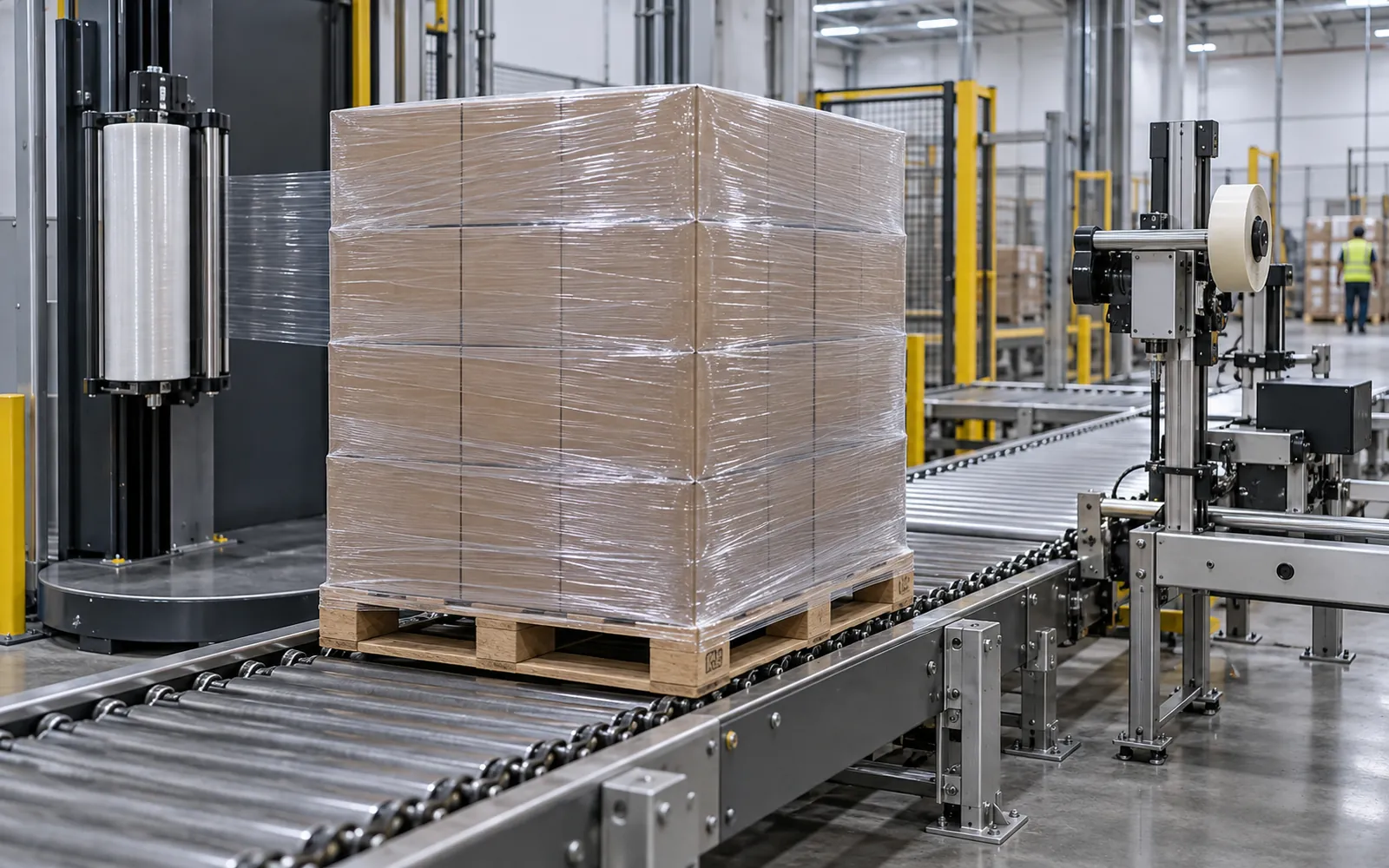
Three flows to check first
| Flow | Bottleneck to check | Inputs to record | Next article |
|---|---|---|---|
| Case infeed | Pallet change, grouping and pickup acceptance | Case size/weight, orientation, upstream rate, stop duration and free buffer positions | Case conveyors |
| Empty pallet supply | Magazine reload, inspection reject or late arrival | Pallet type/condition, reload interval and ready-position capacity | Pallet dispenser & slip sheet specs |
| Full pallet discharge | Wrapper cycle, film change or delayed pickup | Build interval, load weight/height, free holding positions and label side | Accumulation conveyors |
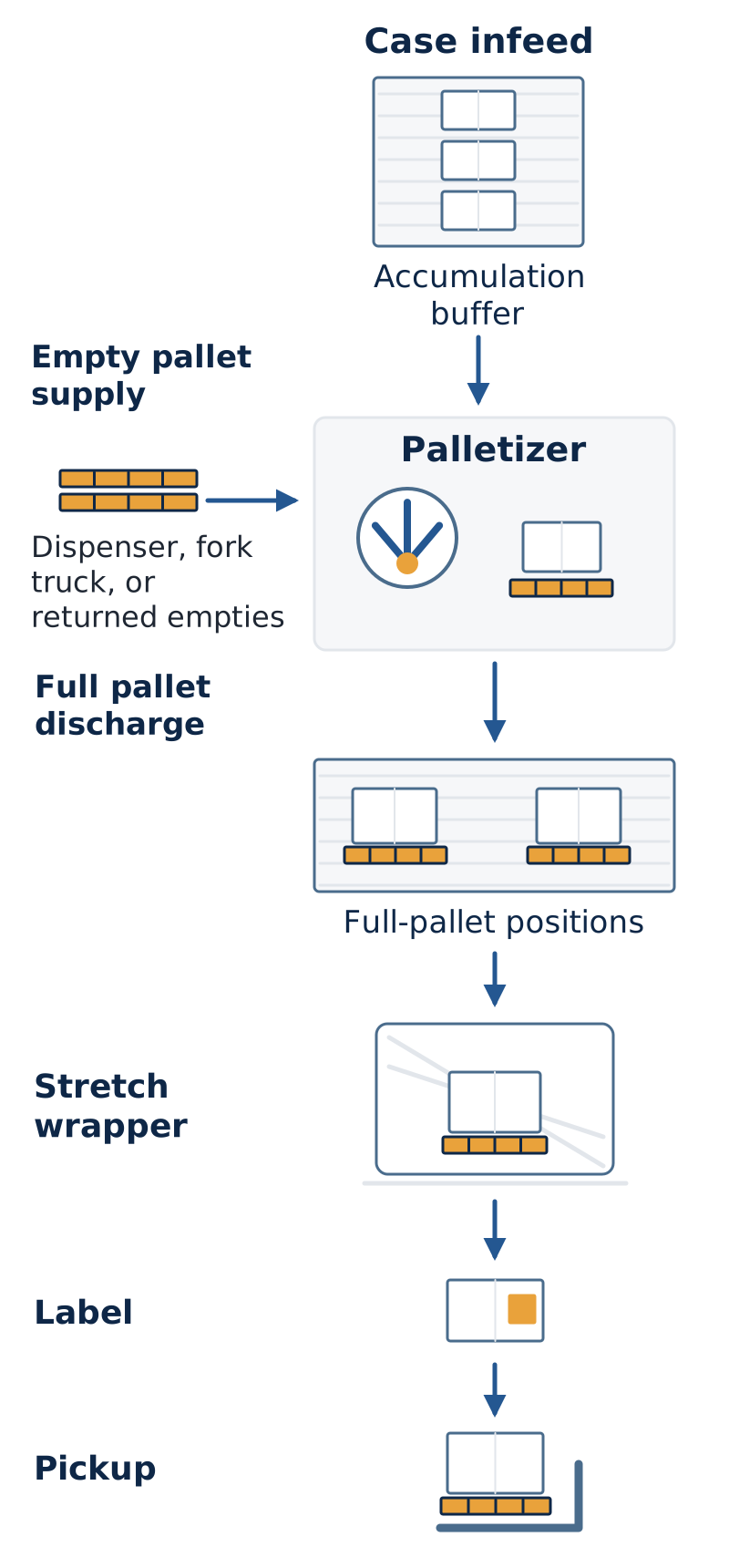
This guide follows the pallet from dispensing to warehouse pickup. Case handling and bottle handling cover the incoming product; the applications hub connects all three.
The pallet’s path at a glance
| Stage | What happens to the pallet | Main handling concern |
|---|---|---|
| Empty dispensing and stacking | One pallet is separated from a stack and placed on a conveyor, or empties are stacked | Stack stability, jammed or stuck pallets, mixed types |
| Inspection | Condition and size are checked, bad pallets are rejected | Broken boards, nails, size, moisture |
| Pallet conveying | Chain or roller conveyors carry the pallet to the palletizer | Orientation, pallet type, transfers |
| Sheet handling | Slip sheets or tier sheets are placed | Sheet pick-up, centering, double sheets |
| Palletizing | The load is built on the pallet | Pattern, stability |
| Transfer and wrapping | The finished load moves to the wrapper and is wrapped | Load shift, film tails, pallet orientation |
| Labeling | A pallet label is applied and verified | Placement, scan quality |
| Transport | Pallet goes to the warehouse | Fork truck, conveyor, or automated vehicle routes |
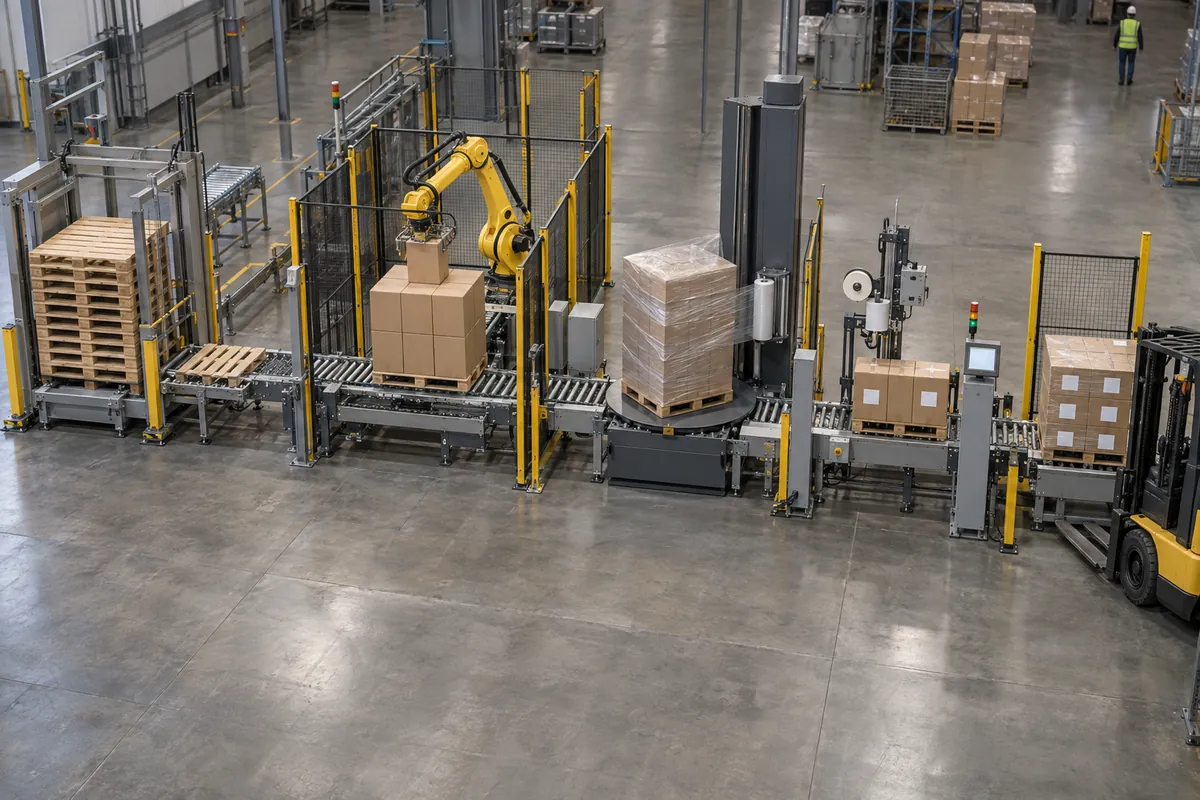
Stage by stage: problems and equipment
Empty pallet dispensing and stacking
A pallet dispenser holds a stack of empties and releases one at a time to the line. Most designs lift the stack, hold all but the bottom pallet, and lower the bottom pallet onto a conveyor. A magazine may hold a number of pallets and is usually loaded by a fork truck. A reverse unit, a stacker, picks pallets from a conveyor and stacks them, which is useful when a depalletizer produces empties or when a plant retrieves pallets after unloading incoming material. See the depalletizing hub for where empties often come from.
The problems are practical. Pallets stuck together by nails or splinters will not separate. Mixed pallet sizes or types in one magazine will misfeed. A stack that is not square can fall during lift. Fork trucks must load the magazine with care, or the stack leans. To reduce trouble, many plants limit the pallet types a dispenser handles, keep a separate dispenser for each pallet type, and put a pallet check at the dispenser outlet.
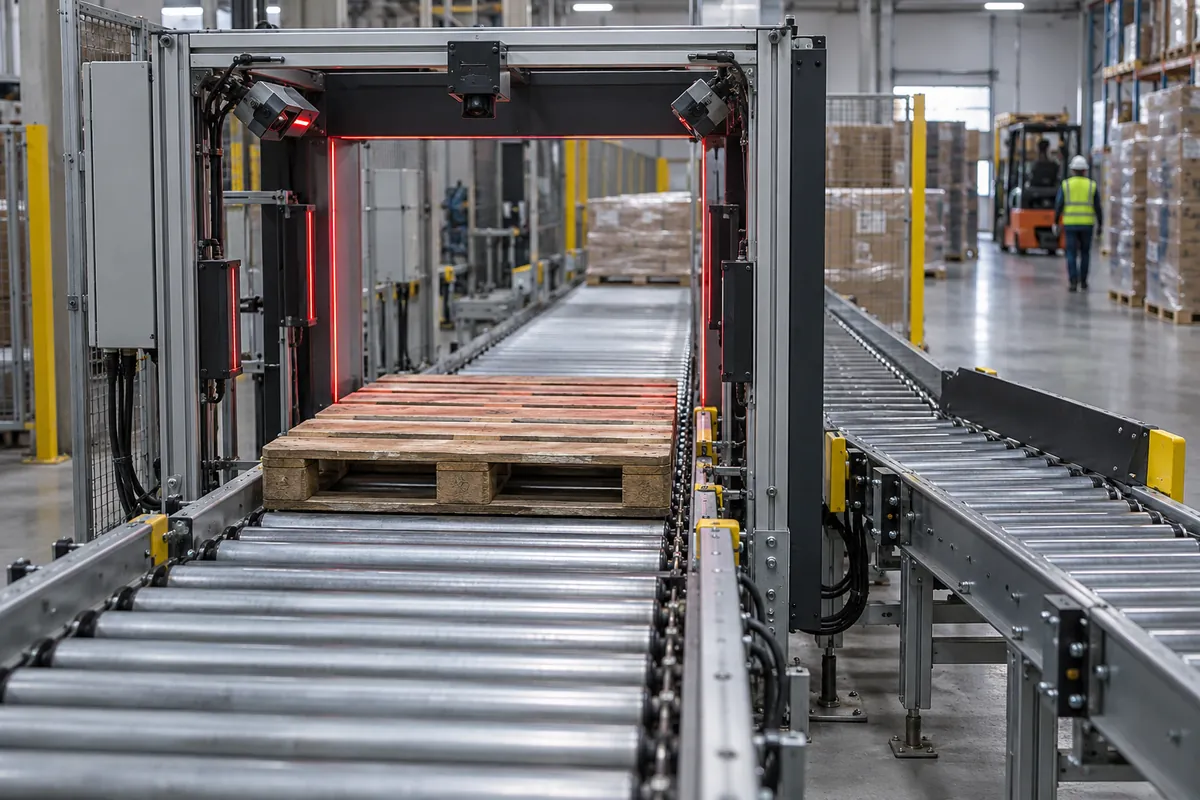
Pallet inspection
Automated machines depend on the pallet being what they expect. Pallet Enterprise states that automated equipment generally expects pallets to meet specific dimensional and quality requirements, and lists a protruding nail, missing board, damaged stringer, misaligned block, or dimensional variation as problems that can ripple through a system. One sensor maker describes its pallet inspection system as using 3D cameras and laser triangulation to scan a pallet as it moves, and lists cracks, missing or broken parts, twisted blocks, and protruding nails among the faults it detects. Both statements come from suppliers or trade media, so ask for detection results on your own pallet types.
An inspection station can combine simple checks and full scans:
- Photo-eyes and a light curtain check that a pallet is present and within a length, width, and height band.
- Cameras or lasers look for broken or missing boards and nails. Wet, dirty, or dark pallets make this harder, so test with real pallets.
- A bad pallet is diverted to a lane where an operator removes it or sends it for repair. The reject must not block the main line.
- Some plants log pallet faults by supplier to help control quality.
An inspection station is only as good as its reject path. Decide what happens to the bad pallet and who takes it away before specifying the scanner.
Pallet conveyors: chain or roller
Pallets move on powered conveyors between the dispenser, the palletizer, the wrapper, the labeler, and the pickup point.
Chain conveyors use pairs or sets of chain strands that carry the pallet on its stringers or runners. They suit standard wooden pallets whose bottom supports run along the direction of travel, and they handle heavy loads. A pallet with a damaged stringer or a bottom that does not meet the chains cannot ride reliably.
Roller conveyors use powered rollers that carry the pallet on its bottom boards, with the boards typically crossing the rollers. They suit pallets with bottom deck boards and can be driven by chain, belt, or motorized rollers. Short or broken bottom boards, or plastic pallets with rails, may need a different roller spacing.
Because many plants run a mix, they use chain on one section and roller on another, and transfer between them. The conveyors hub lists the families. Pallet conveyors also form accumulation zones where full pallets queue for the wrapper or pickup. Most conveyor designs for pallets rely on sensors at each zone so the pallet stops cleanly without touching the next.
Transfers and turns
A transfer moves the pallet from one conveyor to another at a right angle or onto a different type. A chain-over-roller transfer lifts a set of chains between rollers to move the pallet sideways. A turntable rotates the pallet to change its direction. A pallet that stops short or is not square at a transfer can catch on a frame and tip. Check the pallet’s stopping position and the allowed tolerance with the supplier, and make sure forks, chains, and guards do not conflict. The packaging line layout guide covers routing.
Slip sheet and tier sheet handling
Sheets are placed between the pallet and load or between layers. One tier-sheet supplier describes the main purpose of tier sheets as improving the stability of stacked products and packages, and notes that in the simplest form a thin sheet can help tie corrugated cartons together to make a sturdier load. Tier sheets also protect surfaces and, with glass and cans, separate layers.
A sheet dispenser picks a sheet from a stack, usually with vacuum, and places it on the pallet or a layer. A depalletizer uses the opposite action, lifting a sheet away. Typical problems are double sheets, sheets that do not center, curled or wet sheets that do not pick up cleanly, and static on plastic sheets. A sensor that confirms one sheet was placed prevents most trouble. For a layer palletizer, sheet placement is part of the cycle and can limit rate.
Slip sheets replace the pallet. They are thin sheets longer and wider than the load so a push-pull forklift attachment can grip the lip. Apex Material Handling’s guidance lists the tradeoffs: a push-pull attachment is heavy and reduces forklift lifting capacity, and the load must be strapped or wrapped to stay together. Slip sheets also require the receiving end to have the same attachments. Because a sheet-based load is dragged and pushed, the load’s base takes more shear than a palletized load, so it must be built tightly.
A line that uses slip sheets needs a sheet dispenser at the palletizer and a way to move the load onto a handling surface that the push-pull can reach. Palletizer suppliers can describe how they place a sheet and what loads they can build on one.
Palletizing
The load is built by a palletizer of one of several types. Robotic palletizers place single cases or groups and can follow many patterns. Conventional palletizers build rows or layers and suit steady, high-rate lines. Between them, high-level and low-level machines differ in where the pallet sits. The palletizer selection guide lists the questions to settle. From a pallet handling viewpoint, the palletizer needs an empty pallet at the right position and orientation, and it releases a finished pallet at a set point.
Transfer and stretch wrapping
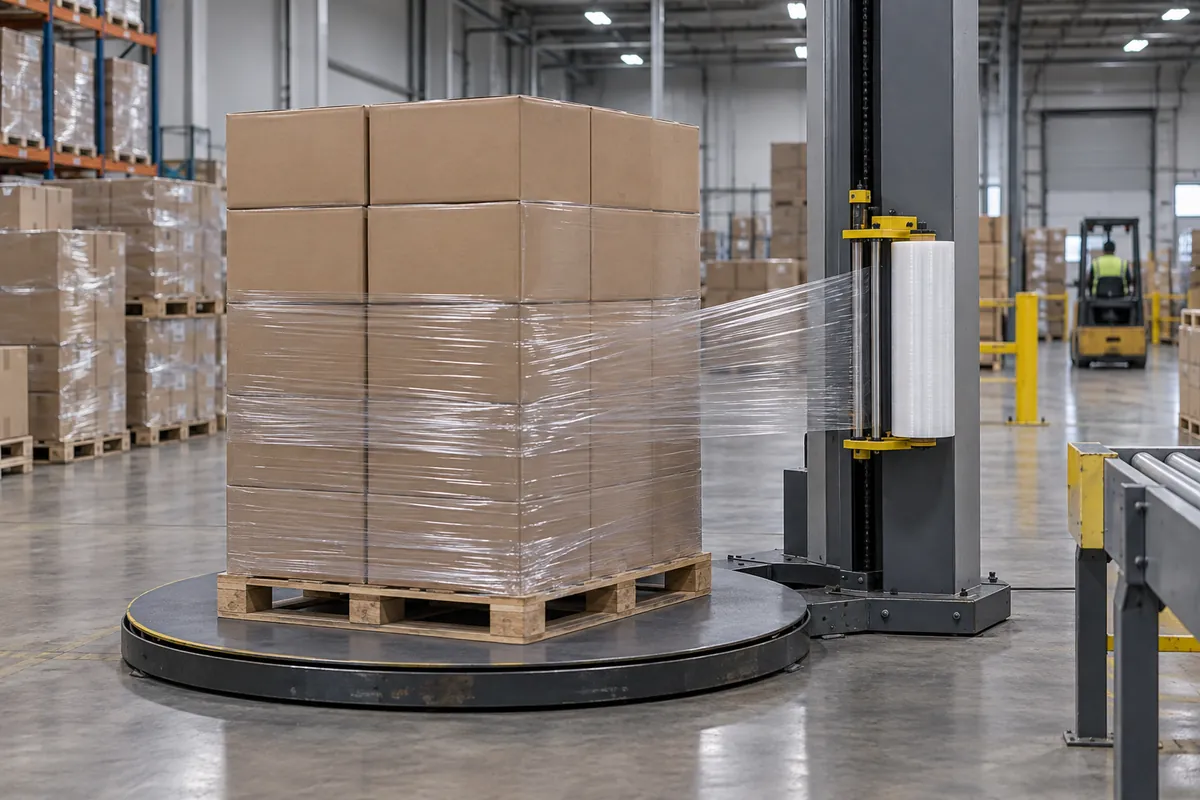
After building, the load moves to a stretch wrapper. A turntable wrapper rotates the pallet while a film carriage rises, and a rotating ring or arm wrapper wraps while the pallet stays still. Robotic or arm wrappers suit loads that should not rotate, and turntables suit steady, stable loads. A conveyor-integrated wrapper takes the pallet in and out on its own conveyor sections.
The wrap secures the load. A pilot study on stretch film found a linear relationship between the number of film turns, the degree of pre-stretching, and the stabilizing force on a load, which means wrap settings can be tuned and tested for a given load. The study’s authors present this as a way to optimize wrap parameters and reduce material use. Common practice is to secure the load to the pallet at the base, overlap each turn, and add extra wraps at the top and bottom, so the load cannot slide off. Check your load with an agreed shipping test before settling on a recipe.
Wrap problems include film breaks, a load that shifts as it rotates, poor film tails that catch on forks or conveyors, and film that covers the label location. A wrapper needs a defined start and end position for the film, a way to cut and tuck the tail, and sensors that confirm the load height.
Pallet labeling
Pallets carry a label that identifies the load. For a GS1 logistics-label project, confirm the identification, barcode placement, edge clearances and required label faces against the applicable guideline edition and receiver specification. These are label checks, not whole-line safety certification. Check that the applicator can reach the agreed position on every load height, and test reading after wrapping and any pallet turn. Film should not obscure or wrinkle the code; an adjustable applicator or additional station may be needed for the load range.
Transport to the warehouse
The finished pallet leaves the line by one of three routes.
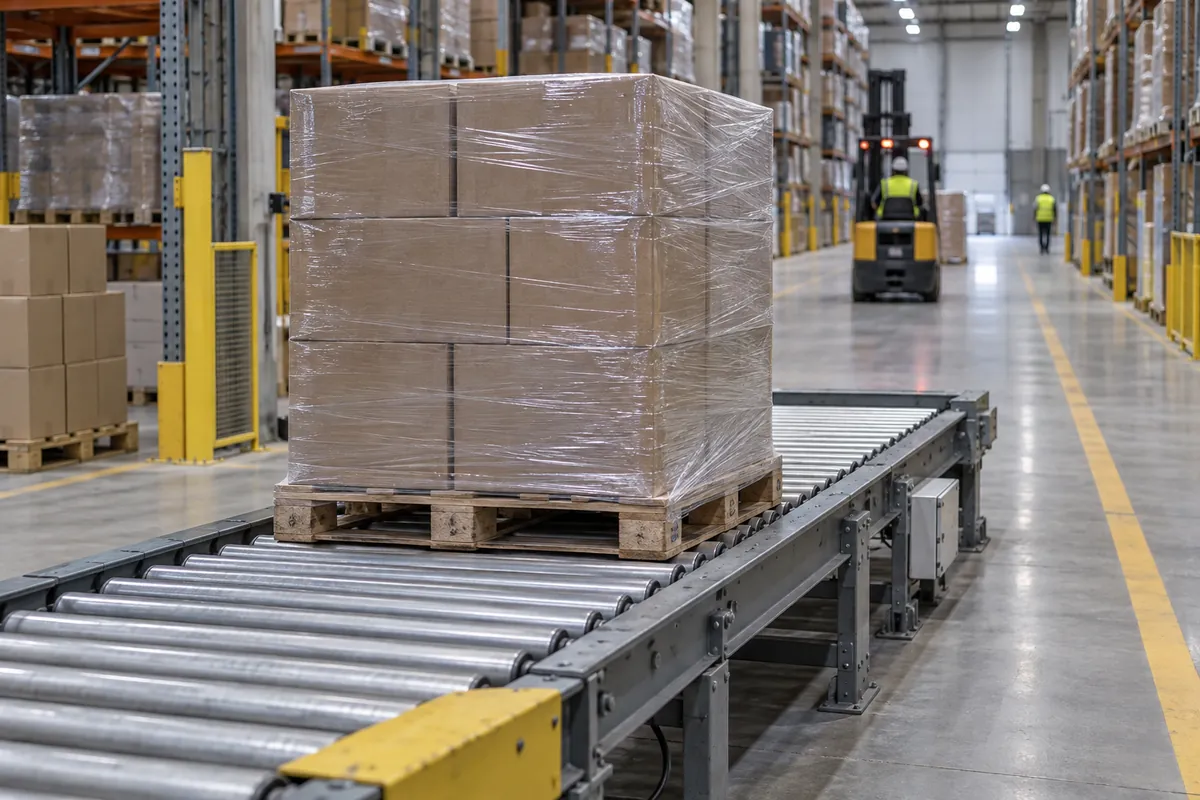
With a fork truck, the driver picks the pallet from a pickup station. This is flexible and uses equipment most plants own already. It depends on drivers, creates traffic, and needs a defined pickup position and safe clearance. A pickup station with a sensor tells the driver when a pallet is ready.
A pallet conveyor can carry the load across the plant to a storage or shipping area, with merges and diverts to feed multiple docks. It fits fixed routes with steady volume. A long run needs accumulation, guarding at crossings, and a plan for pallet recovery at faults.
Automated guided vehicles follow a fixed route, and autonomous mobile robots navigate around obstacles using sensors. The International Federation of Robotics notes that a robot of this kind can re-route itself to avoid an unexpected obstacle such as a stack of pallets. Both types can carry pallets to racks or dock areas. Their strengths are flexible routes and less driver labor. Their limits include traffic coordination with people and trucks, floor condition, charging, and the safety design. In the United States, industrial mobile robot safety is addressed by the R15.08 standard, with ANSI/ITSDF B56.5 covering guided industrial vehicles. A site-specific risk assessment should confirm what is required.
Palletizing conveyor systems around the cell
A palletizer only runs as well as the three conveyor flows that meet it: cases coming in, empty pallets arriving, and full pallets leaving. Specify them as one system, because a stop in any of the three stops the cell. The palletizer type decides the details, but the questions are the same for a robotic cell and a conventional machine. Case transport itself, including turns, diverts, and accumulation hardware, is covered in the case conveyors guide, and the choice of palletizer in the palletizing hub.
Case infeed and accumulation
A conventional palletizer usually wants cases turned and gathered into rows, while a robotic cell often picks one case or a group at a fixed pick point. Either way, the infeed has to keep accepting cases while the palletizer changes a pallet or recovers from a stop, otherwise the case packer and everything upstream stop too. A first estimate of the buffer comes from simple arithmetic:
additional free case positions = ceil(upstream case rate x stop duration)
                                 (cases/minute x minutes; round upward)
total case capacity = initial queued cases + additional free case positions
buffer length = total case capacity x (case length in travel direction + gap)
The estimate assumes the palletizer takes no cases during the stop, so the whole upstream flow must queue in positions that are actually free. Count initial occupancy separately; buffer length refers to total capacity. Use the longest case for the length and the fastest sustained upstream rate for the count. The stop to ride through is usually the pallet change, unless a longer routine stop, such as a sheet or pallet magazine reload, must also be absorbed. A buffer only covers stops it can recover from: after each stop, discharge must exceed input for long enough to clear the added queue before the next stop, by increasing palletizer output or reducing upstream flow. If its sustained rate, including pallet changes, is not above the upstream average, the queue keeps growing and no buffer length fixes it; that is a palletizer rate or line balance problem. The result is a starting point for the conveyor layout, not a guarantee of uptime, so ask each supplier how they sized the buffer and which stops it covers. Zero-pressure zones keep the queued cases from pressing on each other, as described in the accumulation conveyors guide.
Worked buffer example: assumed inputs
Assume case input is 40 cases/minute, the palletizer takes no cases for 1.5 minutes, and 10 cases already occupy the buffer. The added queue is 40 × 1.5 = 60 cases, so at least 60 positions must be free at the stop’s start. Total capacity is 10 + 60 = 70 cases. At an assumed single-file pitch of 0.60 m/case, the screening length is 70 × 0.60 = 42 m, before layout and zone allowances.
For the full-load side, assume one pallet is built every 1.5 minutes, the wrapper accepts none for 5 minutes, and one pallet already waits outside it. Required additional free positions = ceil(5 / 1.5) = 4; total external holding capacity = 1 + 4 = 5. Round fractional positions upward and exclude the occupied wrapper. Neither buffer fixes a sustained capacity shortfall.
Empty pallet supply options
There are three common ways to get an empty pallet to the build position, and they differ mainly in labor and in how many pallet types they tolerate.
- Placed by fork truck or by hand. The simplest option, with no dispenser to buy. It depends on a driver arriving in time, so it suits lower pallet counts and needs a sensor or interlock that confirms the pallet is in place before building starts.
- Pallet dispenser on the line. A magazine holds a stack of empties and releases one at a time onto a conveyor that indexes it to the build position, as described in the dispensing stage above. It removes the timing dependency on a driver, but it needs pallets of consistent type and condition, and someone must reload the magazine.
- Returned from elsewhere in the plant. Empties produced by a depalletizer or by unloading incoming goods can be stacked and conveyed back to the palletizer. This saves handling but brings every pallet quality problem back with it, so place inspection on this path.
Some robotic cells use two build positions so the robot keeps building on one while the finished load leaves and a new empty pallet arrives at the other, as noted in the robotic palletizers guide. Whatever the method, the empty pallet should be waiting before it is needed. A palletizer that waits for a pallet holds up the infeed buffer.
Full pallet discharge to the wrapper
The finished load has to leave quickly so the build position is free again. A discharge conveyor carries the pallet out, and one or more full-pallet positions hold loads when the wrapper is busy or stopped. A first estimate of how many positions are needed follows the same logic as the case buffer:
additional free holding positions = ceil(wrapper stop / pallet build interval)
                                    (minutes / minutes per pallet)
total holding capacity = initially queued pallets + additional free positions
The same limits apply: it assumes the wrapper takes no pallets during the stop, and it only works if the wrapper’s sustained cycle is faster than the pallet build rate so the held loads clear before the next stop.
Typical wrapper stops include a film roll change and clearing a broken film. Count wrapper infeed and outfeed only if those positions are usable and free during the stop; an occupied wrapper position is not spare holding capacity. Check three handshakes between the palletizer, the conveyors, and the wrapper: the palletizer releases a load only when the next position is free, the wrapper receives the recipe and load height for each pallet, and the label side faces the applicator after any turntable or transfer. After wrapping and labeling, the same accumulation logic applies at the pickup point, where a fork truck, a conveyor, or an automated vehicle takes the pallet away. The record for whether the pallet turns or stays still, and which attach, cut, and release steps stay with a person, is the automatic pallet wrapper line-fit guide.
Pallet quality issues
Pallet handling equipment faces a wide spread of conditions. Typical issues are:
- Broken or missing boards cause tipping at transfers and may let cases fall through.
- Protruding nails and splinters jam dispensers and injure workers, and they can tear film and cases.
- Pallets from different suppliers may differ by enough to catch on guides or push a load off center.
- Wet pallets weigh more and slide differently, and they can stain cases.
- A twisted pallet will not sit flat at the palletizer, and it affects layer build.
- Plastic, wood, and metal pallets differ in how they stack, convey, and wrap, and a line that must run several should say so at the start.
- In food and beverage settings, pallets need to be clean and dry. See the food packaging and beverage packaging industry pages for the context.
Controls include supplier specifications, receiving inspection, automatic inspection before the line, and a policy for repair or removal. Pallet Enterprise notes that vendors are moving automated inspection from simply catching broken boards and nails toward broader quality control and data.
Integration and controls
A pallet system is a series of stations with stops, so the control logic is about handshakes. Each station tells the one before it that it is ready, and each hand-off checks presence and position by sensors. Features worth planning include:
- Zones that allow an empty pallet to wait at the palletizer so it never starves.
- Zones that let a full pallet wait for the wrapper without blocking the palletizer.
- Logic that handles an empty pallet that arrives when a full pallet is still at the position.
- Pallet tracking, so that a pallet’s label, wrap recipe, and destination follow the load.
- An override or manual mode so operators can clear a jam and restart safely.
Safety needs early attention. ASME B20.1-2024 covers conveyors and related equipment, and in general industry OSHA’s machine guarding rule is 29 CFR 1910.212. Pallet areas combine heavy loads, moving chains, forks, and people, so guarding, light curtains, interlocked gates, and clear walkways need to be part of the layout. See the line design guide and the layout guide for integrating this section with the line.
Design considerations
- Write down the pallet types, sizes, weights, and the condition you will accept, and share it with every equipment supplier.
- Decide how many empty and full pallets each zone holds, based on how long the palletizer or wrapper may stop.
- Pick a recipe with testing, and size the wrapper for the tallest and heaviest load.
- Fix the label type, position, and one or two sides before choosing the applicator.
- Choose fork truck, conveyor, or an automated vehicle based on distance, volume, and how stored pallets are retrieved.
- Design the pickup station so a driver or vehicle can retrieve a pallet without entering a guarded area.
- Chain, rollers, and sensors collect dust and debris. Plan for access and cleaning.
- Pallet systems have many conveyors, so the conveyor cost guide is a useful starting point.
Illustrative example
This hypothetical pallet system serves one robotic palletizer and a single wrapper, illustrating how dispensing, inspection, palletizing, and wrapping connect in sequence.
- A pallet dispenser holds one standard wooden pallet type, with a presence and size check at its outlet.
- A scan station checks each pallet, and a reject lane diverts bad pallets to an operator-cleared area.
- A chain conveyor carries the pallet to the palletizer, with a transfer to roller conveyor near the cell.
- A sheet dispenser places a tier sheet between layers, with a sensor to confirm a single sheet.
- A robotic palletizer builds the load from the case line.
- The finished pallet moves to a conveyor-integrated stretch wrapper using a recipe tested for the load, then to a label applicator that places two identical labels on adjacent sides.
- The pallet waits at a pickup station for a fork truck. A plant that wants to automate this step could add a pallet conveyor or an AMR route, with safety design to the standards noted above.
See also the bottle handling guide for the product flow that feeds this line, and the palletizing hub for equipment options.
Where to go next
The equipment map lists the full set of machines. The palletizing hub and depalletizing hub cover both ends of the pallet’s life on a line, and the applications hub links to the bottle and case guides.