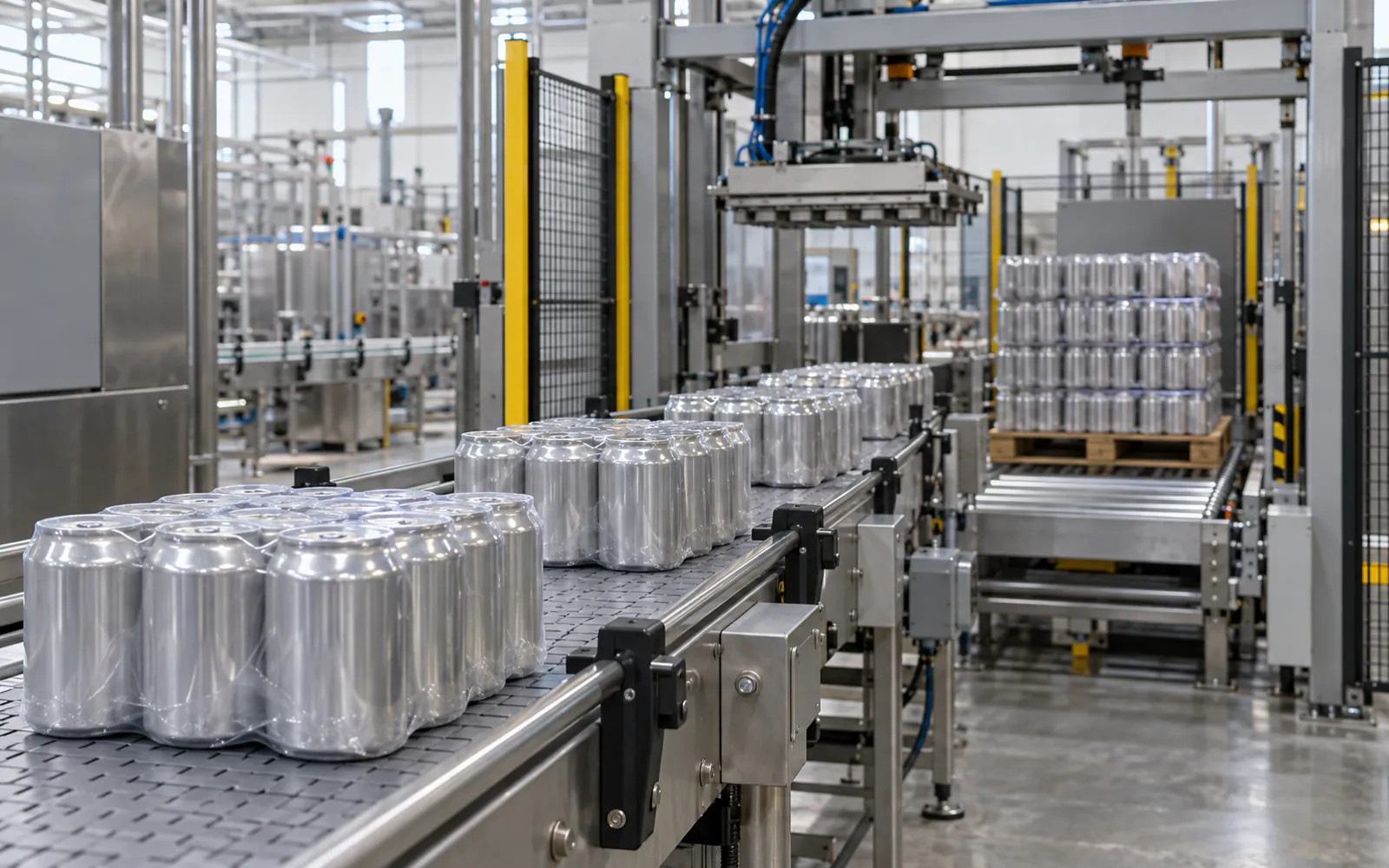
Beverage lines run fast, they run wet, and they handle containers that are either very light or very breakable. This page belongs to the packaging industries section, next to the pages on bottled water, breweries, and food packaging.
Container and secondary route
A case erector forms a slotted case from a flat blank. It belongs only on a route that uses that case. The case erectors guide defines the regular slotted case and the half-slotted case. A shrink-only multipack, or a tray-and-film pack that never forms a case, does not include an erector.
| Container | Infeed | Conveying | Secondary pack | Case erector |
|---|---|---|---|---|
| Can | Layer-sweep or bulk depalletizer for empty cans | Mass conveying. Filled cold cans can sweat before they are packed | Shrink multipack, tray and film, or a slotted case | Only if this route forms a slotted case |
| PET | Depalletizer. Many plants move empty bottles on air conveyors | Air or mass flow. The bottle surface scuffs if the guide material is wrong | Shrink, tray and film, or a case | Only on the case route, not on a film-only route |
| Glass | Layer depalletizer, often with slip-sheet removal | Gradual transfers and low back pressure | Partitioned corrugated case is the usual protection | Yes, on that slotted-case route |
Wet zones and the speed conversion
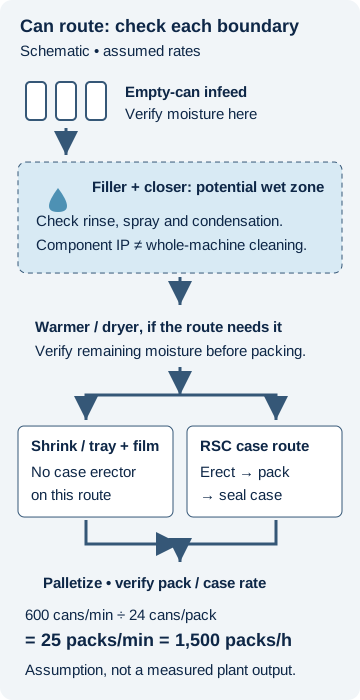
The route schematic marks the filler/closer as a potential wet zone and shows the unit conversion for an assumed 24-can pack. Confirm moisture at each boundary; the photographs are illustrative and do not locate a real plant’s wet zones.
| Zone | What is already happening | What to specify |
|---|---|---|
| Empty-container infeed | Cans or bottles leave the pallet toward the filler | Confirm whether this stretch is wet. Do not copy the filler’s washdown spec onto it without that check |
| Filler, closer, and cold cans | Wet floors, conveyor lubrication or rinse, and condensation on cold cans | Corrosion-resistant frames and sealed components. Take each IP code from the component maker and IEC 60529 or ISO 20653, and specify cleanability separately |
| After a warmer or dryer | Surface moisture is reduced before cartons or film | The pack method depends on the moisture that remains |
| Sealed packs to the palletizer | Cases or film packs leave the wet hall | Not automatically the same washdown spec as the filler |
The rate check is arithmetic on one assumed filler, not a recommended line. A filler delivering 600 cans per minute into packs of 24 cans needs the packer and palletizer to clear 600 ÷ 24 = 25 packs per minute. That is 25 × 60 = 1,500 packs per hour, and 600 × 60 = 36,000 cans per hour. Add margin for stops. The same division applies to PET or glass once you insert that container’s count per pack.
Packaging chain overview
A beverage line has three stages, and most of the engineering sits at the boundaries between them.
Primary packaging is the container that touches the drink. At the infeed, a depalletizer or bulk unloader strips layers of empty cans or bottles from the pallet, and conveyors carry them to the filler. Around the filler you find rinsing or inspection and a seamer or capper. Many plants add a labeler, a date coder, and a fill-level or seal check.
Secondary packaging groups the finished containers into the unit a store or distributor handles: shrink-wrapped multipacks, tray and film packs, paperboard carriers, or corrugated cases. It includes bundling or case packing, case erecting where cartons are used, and case sealing.
End of line turns cases and multipacks into stable pallet loads. A palletizer builds the pattern, a stretch wrapper secures the load, and a pallet conveyor moves it to the warehouse. The end-of-line packaging section covers each machine here, and the palletizing section goes deeper on the pallet build.
The filler sets the pace, so the rest of the line is sized from its rated speed. A depalletizer that cannot keep the filler fed, or a palletizer that cannot clear the case packer, turns a fast filler into a stop-and-go line.
Typical containers and packs
Beverage plants handle a wider range of containers than most industries, and each one stresses the equipment differently.
Aluminum cans are light when empty and stack in large layers, so they are usually unloaded with a layer-sweep or bulk depalletizer. Filled cans are stiff and stable and tolerate mass conveying and tight accumulation. They also sweat when filled cold, which is covered below.
Empty PET bottles are very light and move on air conveyors in many plants. Filled ones are sturdy enough for case packing. A supplier of air conveyors points out that PET has a delicate surface that scuffs easily unless the guide material is chosen with care, which matters most for dark-colored bottles.
Glass bottles and jars are heavy and fragile, and broken glass can contaminate equipment and product. Glass lines add partitions, careful transfers, and sometimes shatter-resistant guards at the filler. The bottle depalletizers guide shows how empty glass and plastic bottles come off the pallet. Aseptic cartons and pouches behave more like cases than bottles and are often packed by dedicated equipment.
Pack formats include open-sided or fully wrapped shrink bundles, tray and film packs with a corrugated tray under the product, paperboard carriers, wraparound cartons, and regular slotted cases. A bundler supplier describes pad-supported shrink packs as a way to keep containers from chiming or cutting through the film when the packs are stacked and palletized. Polypack’s public beverage page, in the section titled Corrugated Trays, states: “Tray and shrink packs represent up to 50% in cost savings when compared to traditional RSC’s.” The page was checked on October 11, 2026. The comparison on that page is tray-and-shrink packs versus traditional regular slotted cases. The page does not show the cost model, the date of the comparison, or a plant. That sentence is Polypack’s claim for its own tray-and-shrink packs. It is not a savings rate for every tray or shrink system. Compare board, film, damage, and stacking on the packs you actually run.
Key challenges
Speed and continuity
Beverage fillers are among the fastest machines in packaging, and the machines downstream must match that output without becoming the constraint. In practice that means continuous-motion bundlers and case packers, multi-lane infeed conveyors, and a palletizer sized to clear the end of the line during stops as well as normal running. A small stop in an unbuffered line can ripple back to the filler, so buffering matters as much as raw speed.
Wet and cold environments
Where the route is rinsed or washed, specify corrosion resistance, drainage and the actual cleaning duty. PackagingConveyor.com is an independent editorial resource, not an equipment maker; its washdown article is secondary background, not a basis for a universal minimum IP code. ADCO’s washdown-machine account, published August 25, 2025 and checked October 10, 2026, describes tailoring its own cartoners to chemistry, pressure and cleaning frequency. It also identifies hot-melt parts that need protection during cleaning. That is a component-specific example, not permission to wash every machine the same way.
Take each enclosure, motor and sensor rating from its manufacturer’s documentation and named test standard. An ingress rating describes enclosure protection under test conditions; it does not demonstrate hygienic design or whole-machine cleanability. Ask which parts need shielding, which chemicals are compatible, and which pressure, temperature and cleaning frequency the machine is designed for. Confirm those conditions separately from the IP code.
Sweating cans need their own note. Moisture weakens cartons, makes printed film and adhesive less reliable, and reduces the grip of vacuum and mechanical grippers. Plants handle it with can warmers, air knives, wet-rated packers, or a pack format that tolerates moisture.
Glass handling
Glass adds breakage risk and a hygiene concern. Hard stops, rail impacts, and uncontrolled transfers produce cracks that show up later as leakers. Glass conveyors favor smooth, gradual transfers, wide curves, plastic wear strips where appropriate, and low back pressure. Rejects and cullet need a plan, because broken glass cannot simply be pushed down the line.
Light and unstable containers
Empty PET bottles and thin-wall cans can tip, crumple, or jam at conveyor transfers. Careful rail setting, speed matching between conveyors, and gentle accumulation do more here than any single machine choice. The bottle conveyors guide describes how single-file and mass flow behave with light containers.
Format and SKU proliferation
Even large beverage plants rarely run a single package. Flavors, sizes, seasonal packs, and retail-specific variety packs multiply formats, so changeover time, recipe-driven adjustments, and pallet pattern flexibility become selection criteria.
Recommended equipment stack
For a typical filled-container beverage line, the stack in order from the infeed is:
- Depalletizer for empty containers. Use bulk depalletizers for cans and loose-packed bottles and bottle depalletizers for layer-based unloading of bottles and jars.
- Bottle and can conveying between the filling machines. See the bottle conveyors guide.
- Accumulation between the filler section and the packer so that short stops do not travel upstream. See accumulation conveyors.
- Case packing or bundling. Choose a case packer for cases and trays, a robotic case packing cell where formats change often, or a shrink bundler for film packs.
- Case erector and case sealer only on the slotted-case route. A shrink or tray-and-film route that never forms a case skips the erector. See case erectors and case sealers.
- Case conveyors to carry packs to the palletizer.
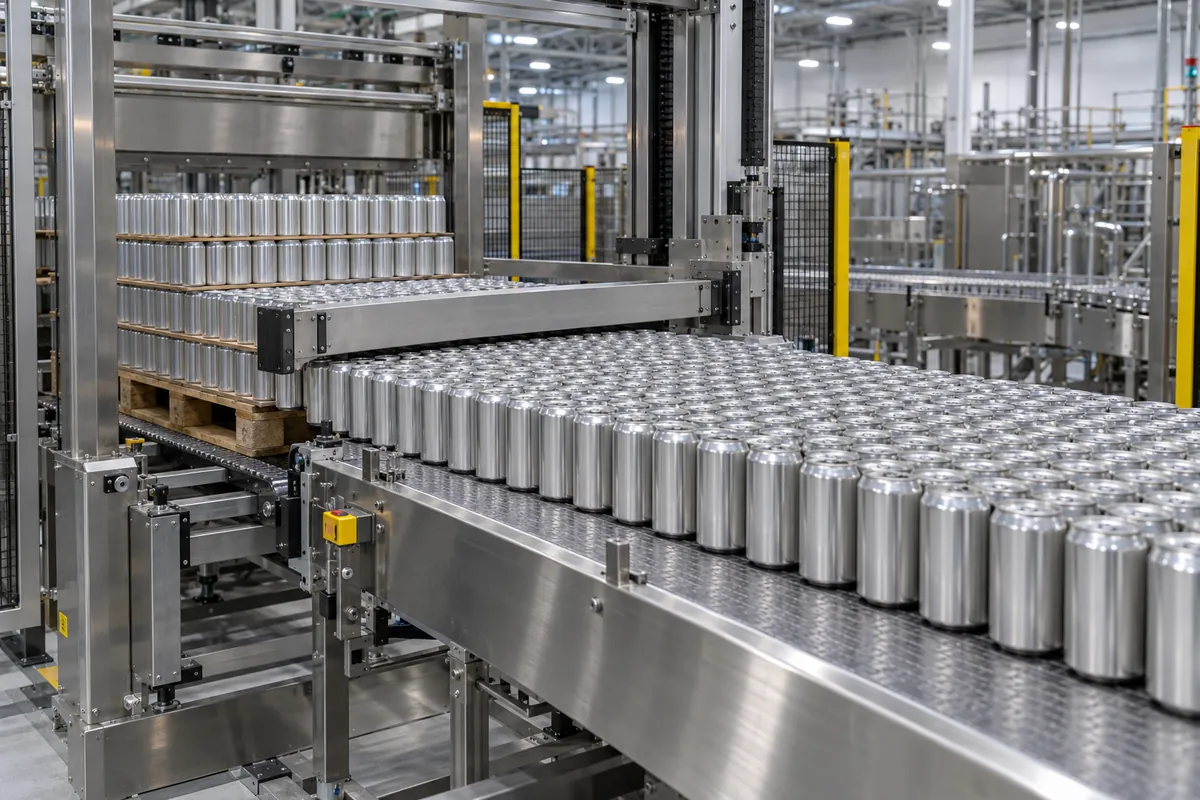
- Palletizer. High rates usually point to a conventional palletizer, either high-level or low-level. Mixed formats at moderate rates suit robotic palletizers.
- A stretch wrapper and pallet conveying to secure and stage the finished load. The pallet handling page covers that stage.
Design considerations
Line balance
Rate every end-of-line machine above the filler’s output so it can catch up after a stop. Use the container-per-minute to packs-per-minute conversion in the route table above, and keep the same pack count in both units.
Accumulation and buffering
Size accumulation by how long you need to ride through a downstream stop, multiplied by the filler output. A pack buffer after the packer protects the filler from palletizer stops, and a container buffer ahead of the packer protects it from packer stops. Where floor space is tight, a vertical or spiral buffer adds storage, and the vertical conveyors guide compares options.
Reject and rework
Plan rejects at the points where defects appear: low fill, missing cap, bad label, damaged pack. Reject conveyors need their own accumulation and a clear way to return good product to the line. Glass rejects should not travel back into the main flow.
Floor space
Palletizers, wrappers, and pallet storage take more room than many first layouts allow. Put the whole end of line on the layout early, including forklift paths, pallet staging, and service access. The packaging line layout guide and the layout page work through the trade-offs.
Controls and data
A line that shares status, counts, and fault states between machines recovers from stops faster and makes OEE tracking easier. Decide early which machine sets the pace and how the others are told to slow or stop.
Example line configuration (illustrative)
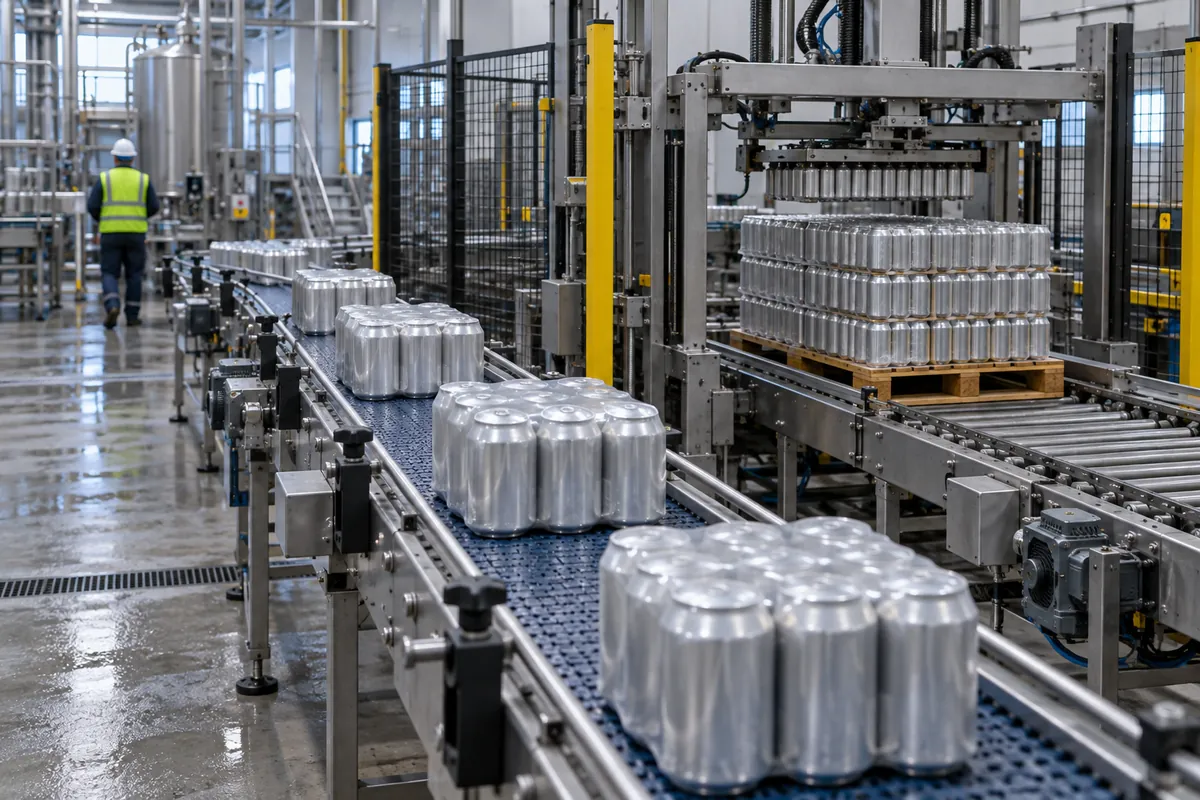
Illustrative example. Consider a canned-beverage line packing shrink-wrapped 12-packs. This route does not include a case erector. Empty cans arrive on pallets and are unloaded by a layer-sweep depalletizer onto a wide mass conveyor. A can rinser and filler/seamer sit in the middle, with a date coder and a fill-level inspection unit after the seamer. A can dryer or warming section removes surface moisture before the cans enter an accumulation table. From there, a shrink bundler forms 12-packs, with a pad inserter under each pack to protect the film during stacking. Packs travel on a case conveyor with a short vertical lift to a mezzanine, where a low-level palletizer builds layers directly from the conveyor stream and a stretch wrapper finishes each pallet.
A second version of the same line uses glass bottles and regular slotted cases. That route does include a case erector. The depalletizer is a layer-based bottle unit with a slip sheet remover, the filler is followed by a labeler, and a case packer places bottles into dividers inside erected cases. Case sealers close the flaps, and a conventional high-level palletizer stacks the cases. This configuration is a sketch to show how pack format changes the stack. It does not describe a real customer project.
Standards and references
In the United States, OSHA’s general requirements for all machines call for guarding against hazards such as point of operation, ingoing nip points, and rotating parts, and the lockout/tagout rule covers service work. Ingress ratings and machine cleanability are separate checks; ask the supplier to name the test standard and cleaning duty for each component. Ask for the cleaning pressure, temperature, and chemistry behind the rating, not only the code.
Beverages that fall under food regulations also need equipment that can be cleaned and kept sanitary. Where the product is classed as food, the food packaging page lists hygienic design references from 3-A and EHEDG and the U.S. FDA current good manufacturing practice rules. For the conveyor and bottle-handling side, see the bottle handling and case handling application pages. To select the pallet build machine, start with the how to choose a palletizer guide. When you are ready to put numbers on layout and throughput, read the line design page.