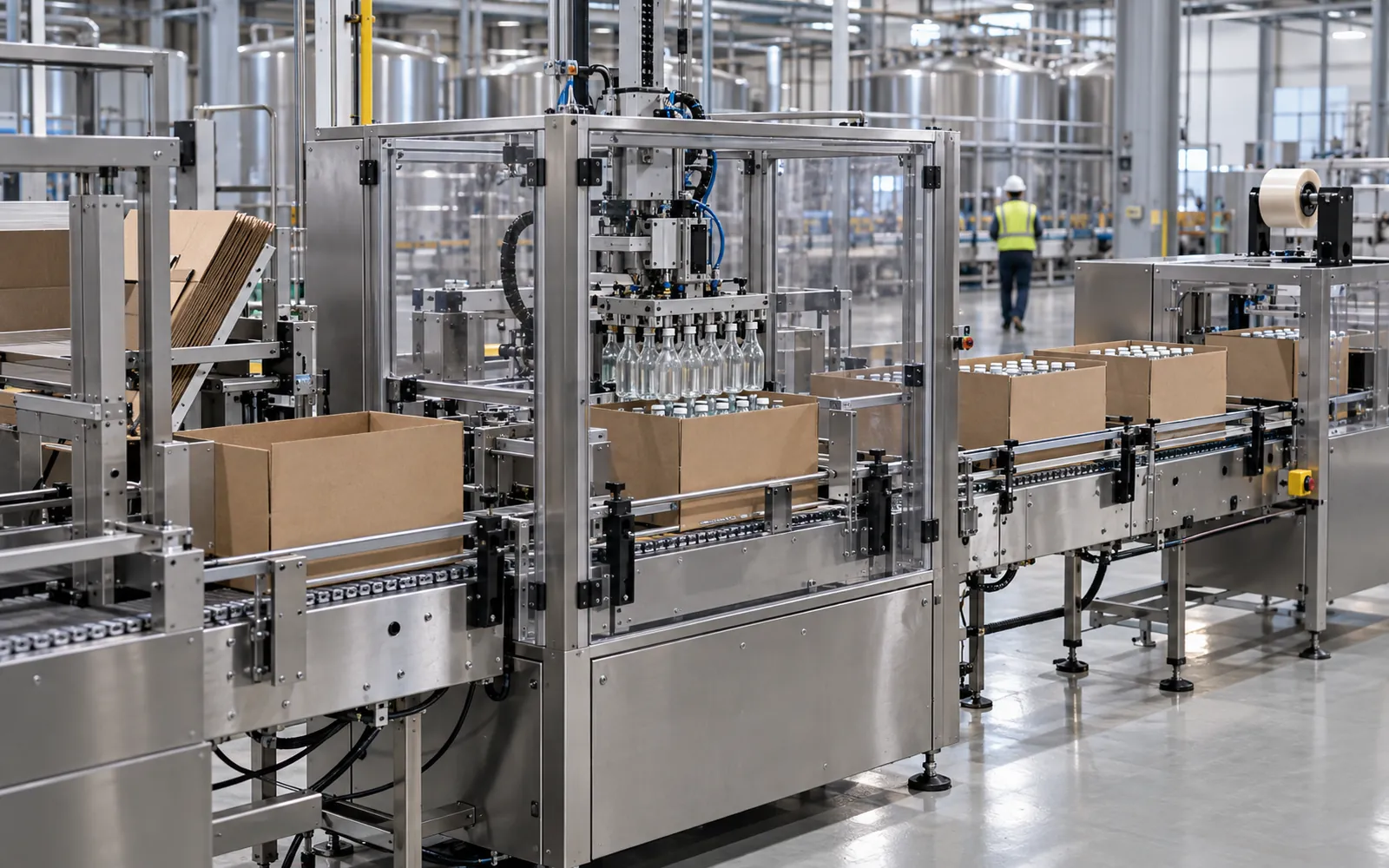
The wrong loading route can damage product or leave the line short of sustained output. Compare drop, soft placement, pick-and-place, side-load, wraparound, and tray packing on the same product, case, changeover, and full-system scope.
The end-of-line overview places the loader within the case-forming, closing, and palletizing route.
Quick comparison
| Type | Loading motion | Best fit | Flexibility | Height | Rate tendency |
|---|---|---|---|---|---|
| Drop packer | Vertical drop through a grid | Rigid, uniform containers; stable patterns | Moderate; simple changeover | Taller frame | Moderate to high |
| Soft-placement | Lowered placement | Products sensitive to a drop | Moderate | Taller frame | Moderate to high |
| Pick-and-place | Gantry or robot sets product | Fragile, mixed, irregular products | High; recipes | Taller; guarding | Lower to moderate |
| Side-load / end-load | Horizontal push or sweep | Cartons, flow-wrapped packs, stable rigid containers | Lower; more mechanical change | Low | Moderate to high |
| Wraparound | Case forms around product | Uniform product, high volume | Lowest for new formats | Varies | High |
| Tray packer | Tray formed around group | Retail-ready trays and bundles | Moderate | Low to moderate | Moderate to high |
How it works
Whatever its loading method, every case packer runs the same sequence.
Products arrive from the primary line on a conveyor, and lane dividers, gates, and sensors place them in rows or groups. The packer needs a consistent, oriented stream, so accumulation conveyors, lane dividers, and collating stations are often part of the installation. A machine can only pack what it receives, so presentation problems upstream show up as jams and mispacks at the packer. When that upstream station is a cartoning machine, record pack form, orientation, and the person who owns each end in the cartoning machine line handoff guide before you compare loader types.
Next the machine collates the count and layout for one case: a single layer or several, possibly with partitions, dividers, or layer pads. On rigid containers, collation often sets the maximum rate.
Cases arrive pre-erected from an erector, or the machine forms them from blanks. Either way the case must be positioned, held, and opened in the right orientation for the loading method. Then product moves in, by a vertical drop or placement from above, a horizontal push from the side or end, or a fold of the case around the group.
Finally the loaded case leaves toward a sealer, though some designs close the flaps themselves. The next machine expects a particular case orientation, so discharge direction matters for the layout.
A servo-driven machine stores patterns and formats as recipes and recalls them from a screen. A mechanical machine uses change parts and manual adjustments. Both are common, and the difference shows up mostly in changeover time and operator skill.
Case packing machine versus case packing system
A case packing machine is the loader: the station that moves a counted group of products into a case. A case packing system is everything that has to work for that loader to run unattended. Specifications and quotes often use the two terms loosely, so it pays to list the parts and decide who supplies each.
Use this scope record instead of assuming that “case packer” includes every station. Enter a supplier or plant name in each owner field and mark each function included, by others, or not required.
| Function | Included / supplied by | Interface owner | Acceptance evidence |
|---|---|---|---|
| Infeed, accumulation, laning, and collation | ___ | ___ | Product presentation and counted-group trial |
| Case supply / forming | ___ | ___ | Correct case available at required rate |
| Partitions / inserts, if required | ___ | ___ | Placement and loading trial |
| Loader | ___ | ___ | Good cases, damage, and faults over agreed window |
| Count verification / reject, if specified | ___ | ___ | Short case detected and contained |
| Closing / coding, as specified | ___ | ___ | Closure and identification checks |
| Shared controls and guarding | ___ | ___ | Ready/blocked/fault handoffs and task assessment |
Takeaway: Name an owner for every boundary before comparing system prices.
Types and configurations
The main categories are separated by loading axis. A white paper from one case packer manufacturer lists drop, rotary, wraparound, mechanical soft placement, robotic, side-load, and bottom-load styles; the sections below group related designs.
Top-load packers
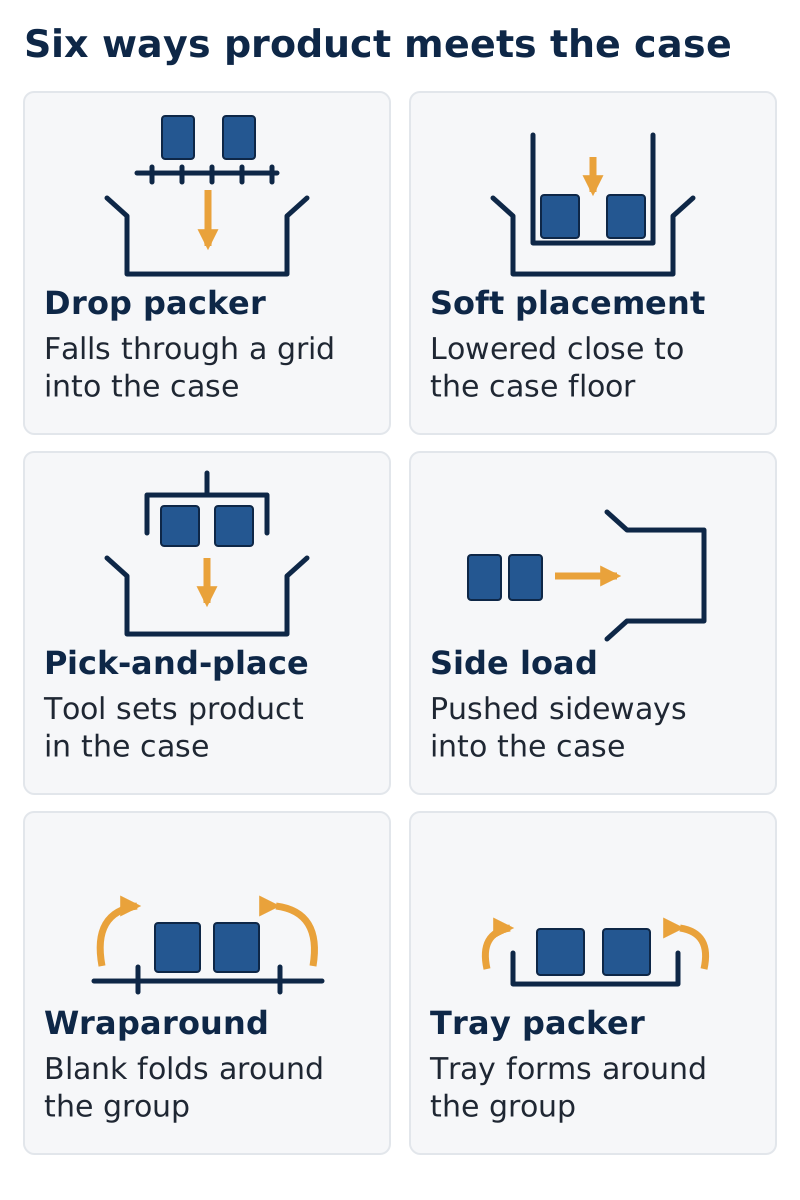
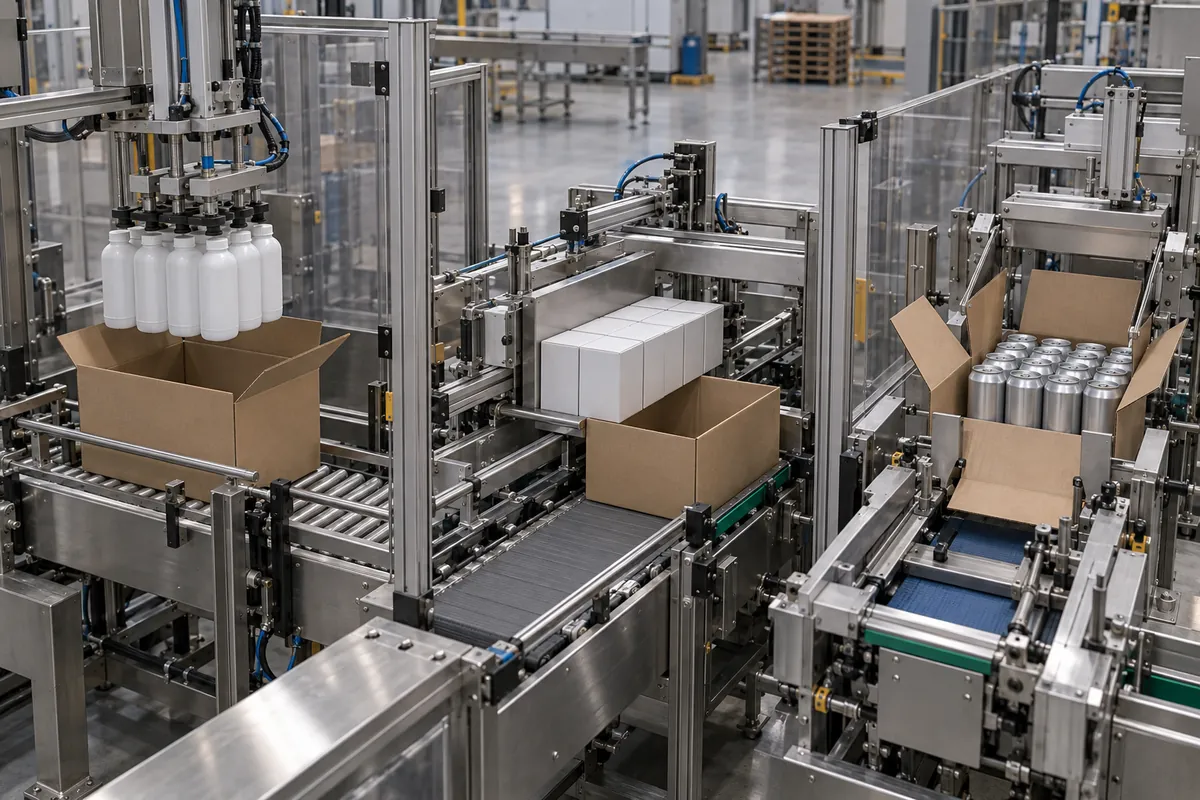
In top-load packing, product enters an open case from above. Because the motion is vertical, product keeps the orientation it had coming off the filler or capper. That suits upright containers such as bottles, jars, and cans, and pouches or bags that should not be rolled or pushed. The trade-offs are height and case handling. The loading station must sit above the case, so frames are usually taller than side-load machines of similar output, and standing a case open-end up is a more involved motion than opening it on its side. Top-load packing comes in three common styles.
Drop packers collate product above the case and let it fall through a packing grid into position. The design is simple and lower in cost, and works well on consistent, rigid containers in stable patterns where cost matters more than flexibility. Changeover is usually simpler than on other mechanical machines, and one manufacturer white paper ranks drop packers second after robotic machines for changeover ease. The drop can harm fragile product, which is the main limit.
Soft-placement packers reduce or eliminate the drop by lowering product close to the case floor before release, which suits products that tolerate a fall poorly. They tend to use more change parts than a plain drop machine.
Pick-and-place packers use a gantry or robot arm to pick product from an infeed, arrange the pattern, and set it in the case. Gantries use servo motion along three axes, and articulated arms carry an end-of-arm tool. Both can store multiple patterns and formats. They place delicate, irregular, or glass products gently and adapt to varied configurations, which makes them common in multi-SKU plants. The cost is tooling per product shape and, usually, a lower rate at a higher price than a drop machine. Request the proposed model’s rate with the product, count, case, and test window stated. For a closer look at robot-based machines, see robotic case packing.
Side-load and end-load packers
A side-load packer collates product into the pattern and pushes or sweeps the group horizontally into a case that stays in place. End-load machines do the same through the short end of the case. This method suits cartons, folded boxes, flow-wrapped products, and stable rigid containers that tolerate lateral contact. There is no drop, so product stays on a controlled surface. The machine is lower, which helps where ceiling clearance is limited, and the loaded case can pass directly into a closing station without turning over. One source says sweep-style side-loaders can keep up with line rates that are hard for robotic top-load systems to reach, and that they are usually easier to get at for cleaning, which helps in sanitation-heavy plants. Confirm the proposed side-load model’s sustained output under your loading and case conditions.
Side-load machines are less flexible for irregular shapes and complex patterns, and a large size change can need more mechanical adjustment.
Drop and side-load rate bands
Standard-Knapp’s public white paper, section “Line Speeds” (accessed October 8, 2026), suggests side/bottom/robotic routes below 20 cases/min, drop or intermittent wraparound at 20–35, and other designs above 35. These are its selection bands, not model ratings or category ceilings: no product, case count, or test duration is given. Validate the candidate on your production pack.
Wraparound packers (brief)
A wraparound machine does not use a pre-erected case. It feeds a flat corrugated blank, positions the collated product on it, folds the blank around the group, and glues it closed. The result is a tight-fitting case that can reduce corrugated use and may improve pallet stability. Compare blank storage from the actual palletized blank dimensions and quantities. The costs are mechanical complexity and limited flexibility for frequent new formats. Intermittent-motion wraparounds tend to be compact, while continuous-motion designs tend to be wide and long. They are most common on beverage and consumer goods lines with higher volumes and stable formats. Require a model-specific rate with the case and packing conditions stated.
Tray packers (brief)
Tray packers, along with tray-and-shrink combinations, form an open tray or a shallow case and may add shrink film. They suit products that go to retail in a display-ready tray or a bundle that needs only light protection. The case style differs from a full regular slotted container, so channel requirements, stacking strength, and pallet patterns should be checked before choosing a tray over a closed case. Many tray machines are wraparound variants with a lower side wall.
Bottom-load packers
Bottom-load machines lift product from below into a case. They are application-specific and less common than other types, and suit flexible, delicate, or awkward products that are hard to pick from the top, and large items where the case is pushed over the product.
High-speed case packing: verifying the sustained rate
A nameplate speed tells you what a machine can do on its best product. A high-speed line needs to know what it will do on yours, hour after hour. Verifying that takes a test method agreed before the order, not a number on a datasheet.
Define the rate. State it in cases per minute at the discharge and products per minute at the infeed, and name the product, count, pattern, and case size. A packer that runs a 24-count case at one rate will run a different rate on a 6-count case, because the collation and loading cycle change.
Separate sustained from peak. The packer has to keep up with the highest sustained output of the line upstream, and recover after short stops without holding back the filler. Upstream output, rather than the machine catalog, should set the rate requirement. A manufacturer white paper also warns that more speed than the line needs is unnecessary cost. The packaging line design guide explains how machine rates are staged along a line.
Test on production material. Ask for a factory acceptance test on the supplier’s floor with the plant’s own products and cases, including the hardest SKU and the worst case stock the plant receives. Agree in writing the test length, the rate, and what counts as a failure: mispacks, jams, operator interventions, and rejected cases. Repeat the test after installation, with the real infeed. The commissioning and acceptance checklist lists the documents to request.
Check the infeed, not just the loader. At higher rates the laning and collation in front of the packer often set the real limit, a point the same white paper makes directly. Ask how the infeed behaves when product arrives in gaps or bunches, and how much accumulation sits ahead of the packer.
Count changeover in the rate. A machine that runs fast but loses a long stop at each SKU change may deliver fewer cases per shift than a slower one. Ask for the changeover time on the hardest pair of formats, performed by plant staff, and include it in the expected output per shift.
Use the same proposed record for FAT and SAT; the commissioning guide explains how to agree pass criteria.
| Trial field | FAT record | SAT record |
|---|---|---|
| Date / SKU / case / pattern / material lots | ___ | ___ |
| Required rate / pass limits / test window | ___ | ___ |
| Elapsed minutes including agreed stops / good cases out | ___ / ___ | ___ / ___ |
| Sustained good cases/min = good count / elapsed minutes | ___ | ___ |
| Mispacks / rejects / damage / interventions | ___ | ___ |
| Case reload / consumable / format-change time included | ___ | ___ |
| Interface owner / evidence link / open actions | ___ | ___ |
Packing bottles: partitions, guides, and glass versus PET
Bottles are tall for their footprint, often slippery, and in the case of glass, breakable. Three decisions shape a bottle case packing application.
Partitions. Top-load regular slotted cases can carry partitions, which a case packer manufacturer describes as adding stacking strength and minimizing bottle-to-bottle contact. The same source says high-value bottles such as premium spirits require a partitioned case, which usually points to a drop packer or soft-placement packer. Partitions can be inserted by a separate station or built into the packer. Either way, the partition must be open and square when bottles arrive, so partition quality and insertion method belong in the trial.
Guidance into the case. Drop and soft-placement packers guide bottles through a grid so each bottle reaches its cell or its place in the pattern. Pick-and-place tooling grips bottles, often at the neck or shoulder, and sets them down. Either method needs a stable, single-file supply split into the right number of lanes. The bottle conveyors guide covers lane dividers and back pressure ahead of the packer.
Glass versus PET. The physical difference drives the choice.
- Glass is heavy and rigid. It tolerates guidance and a modest amount of pressure, but a hard drop or glass-to-glass contact can chip or break it. Partitions, gentle placement, and a clear plan for broken glass are the priorities.
- PET is light and flexible. Full bottles are stable enough for drop or side-load methods in many patterns, but a flexible bottle can deform under a pusher or a tight grid, and a partially filled or empty bottle tips easily. A manufacturer white paper lists large PET bottles among the products suited to top-load regular slotted cases.
- Cans are rigid and stable when full and suit high-volume drop, side-load, and wraparound packing.
Test with filled production bottles, labeled and capped, because a label, cap, or fill level can change how a bottle behaves in a grid. The bottle handling application page follows bottles through the rest of the line.
Fully automatic versus semi-automatic case packing
The line between the two is the operator’s role in each cycle. In a semi-automatic station, a person still places product into the case, or places the case, every cycle, and the machine does supporting steps such as erecting the case, folding flaps, or taping. In a fully automatic system, the machine counts, collates, and loads by itself, and operators supply cases or blanks, clear faults, and change formats.
Semi-automatic stations suit low rates, many short runs, products that are hard to grip, and plants automating one step at a time. Assess full automation when the pack station needs a person all shift, when count and pattern errors cause chargebacks, or when the rate is more than a person can sustain. Many plants move in stages: first an automatic case erector or sealer, then the loader. The end of line packaging automation page covers how to stage that path.
Comparing manufacturers and prices
This guide cites supplier materials as evidence and does not rank manufacturers. The useful comparison is not between brand reputations but between proposals for the same application.
When comparing manufacturers, ask each one for:
- A running reference on a similar product, count, and case style, which a manufacturer white paper recommends seeing in person.
- The loading method proposed, and why it suits the product.
- The test plan: factory acceptance test terms, test length, rate, and failure criteria.
- The controls platform and how it matches what the plant already maintains.
- Format parts per SKU, spare parts lists, and where spares are stocked.
- Service coverage, training, and remote support terms.
Case packing machine price varies with loading method, rate, number of formats, and scope. A price only means something next to the scope it covers. Send every manufacturer the same written specification and compare quotes line by line against the system list at the top of this page.
Specifications to evaluate
Get these in writing for the actual product and case, not a catalog example.
| Specification | Why it matters | What to ask the supplier |
|---|---|---|
| Cases per minute, sustained | Must meet the highest sustained upstream rate | What rate is guaranteed on the plant’s container, count, and pattern, and at what uptime? |
| Products per case and pattern | Defines collation and tooling | Which patterns are supported, and how many layers or partitions? |
| Case style and size range | Sets magazine, case handling, and flap control | What is the smallest and largest case, and which styles are covered? |
| Product size and weight range | Sets grids, grippers, and structure | What range of diameter, height, and weight is supported without hardware changes? |
| Changeover method and time | Drives lost time between SKUs | What changes automatically, which parts change, and what is the time for the hardest pair? |
| Infeed and laning | Becomes critical at higher rates | What lane layout and accumulation does the machine need, and who supplies it? |
| Case erecting and sealing | Decides stand-alone versus combined machines | Are erecting and closing included, and at what rate? |
| Reject and verification | Prevents short-count or empty cases | Which sensors confirm count and position, and how are rejects handled? |
| Footprint and heights | Affects layout | What are overall dimensions, infeed height, discharge height, and access clearances? |
| Utilities | Affects site preparation | What compressed air flow, pressure, and electrical load are needed? |
| Washdown rating | Needed in food and beverage | Which components are rated for the cleaning method, and how is the frame designed for cleaning? |
| Safety design | Sets guarding and operator access | What risk assessment was used, and how do guards and interlocks work during changeover? |
Package compatibility
Case packers handle many product types, but each loading method has limits.
Upright rigid bottles and jars work with drop, soft-placement, pick-and-place, side-load, and wraparound packers when collated into stable groups, and glass makes gentle placement and partitions more important. Cans are stable and rigid, and suit drop, side-load, and wraparound machines at high volume. Pouches and bags are flexible, so they often need top placement or bottom support to avoid deformation. Cartons and boxed goods suit side-load or end-load packing, where pushing is easier than top loading. Flow-wrapped products suit side-load or robotic loading, depending on shape and fragility. Large or heavy items may need wraparound or bottom-load designs, and mixed or variety packs usually point toward robot-based machines.
Case style also matters. Top-load regular slotted cases offer good stacking strength, allow partitions to increase strength or reduce container-to-container contact, and are preferred in some channels. A manufacturer white paper notes that liquor retailers strongly prefer regular slotted cases over wraparound, so the customer may decide case style. Where product protection is less critical, wraparound cases can be a good alternative and can sometimes use less corrugated.
Changeover
For plants with many SKUs, changeover is often the deciding specification. The same manufacturer ranks robotic packers best for changeover and drop packers second. Rotary and soft-placement machines fall in the middle because they have more change parts, and wraparound packers are the least flexible, especially for new packages added later. Another source describes recipe-driven servo machines as able to switch stored formats from a touchscreen in minutes, with physical tooling changes adding time depending on how different the formats are.
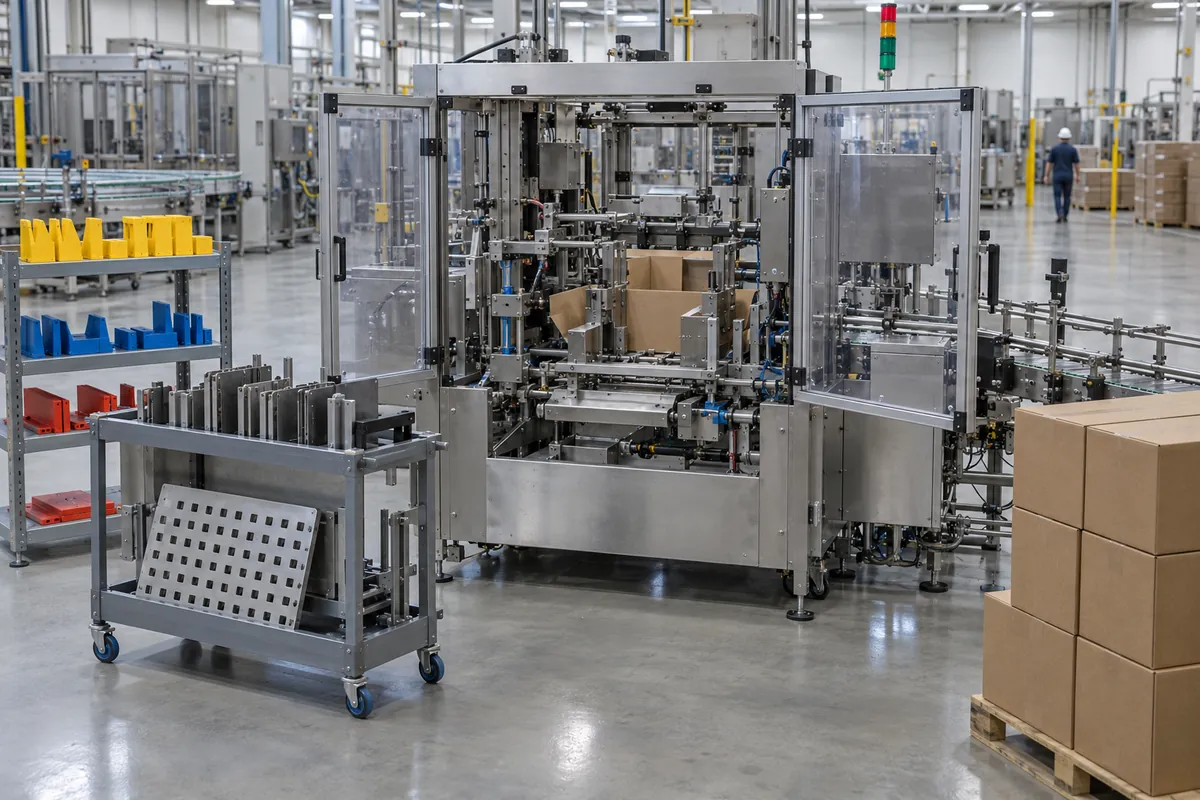
Questions to put to each supplier:
- Which adjustments are servo-driven, and which need tools?
- Does the machine guide the operator through the steps and verify settings?
- Which parts are format-specific, and where are they stored?
- What is the time for the hardest change, performed by plant staff, and how was it measured?
- How are new formats added later, and who programs them?
Integration upstream and downstream
A case packer rarely stands alone. Upstream it connects to fillers, cappers, labelers, cartoners, or flow wrappers through accumulation and collation. Downstream it hands cases to a case sealer, then to labeling, inspection, and palletizing. A typical sequence places a case erector ahead of the packer and a sealer behind it. Some machines combine two or three of those steps.
Plan the interfaces:
- Rate: the packer must sustain the primary line’s peak rate, with buffer for short stops.
- Orientation: case orientation at discharge should suit the sealer and the palletizer’s pattern. According to one source, a top-load machine may avoid a case-turning step that some side-load layouts need, but this depends on which case face must show on the pallet.
- Heights and transfers: match conveyor heights and check transfer gaps for short cases.
- Communication: define signals for running, blocked, starved, and faulted states, and recipe sharing with neighbors.
The case conveyors page covers transport between the packer and the rest of the exit. For system-level sequencing and line balancing, see end of line packaging automation, and for the pallet end, the case palletizers guide.
Footprint, utilities, controls, and safety
Confirm these values with each supplier and do not assume them.
Top-load frames need overhead clearance, side-load machines are lower, and continuous-motion wraparounds can be wide and long. Robot-based machines need guarding and a swept envelope. One source notes that drop and soft-placement packers have a narrow profile and can be arranged in several ways, such as inline, counter-flow, or right angle.
Utilities include compressed air for pneumatic motion and vacuum tools, electrical supply, and consumables such as hot-melt adhesive or tape if the machine closes cases. On controls, ask about the controller platform, recipe storage, diagnostics, remote support, and communication with other machines. Food and beverage plants also need washdown ratings, frame design, and cleaning access.
On safety, in the United States, packaging machinery is commonly assessed against ANSI/PMMI B155.1, which PMMI revised in 2023. Robot-based machines add robot safety standards. Safety control functions are commonly designed to ISO 13849-1. A qualified risk assessment of the complete installation should set guarding, access during changeover, and conveyor crossings, and the current edition of each standard should be confirmed.
Cost factors
Compare costs for a defined system scope; this guide uses no market price range. Loading route, required output, and the interfaces included in the quote are the starting cost drivers.
- Loading method and rate.
- Number of patterns, formats, and how much tooling each needs.
- Servo and recipe capability versus change parts.
- Built-in erecting, closing, or both.
- Infeed and laning equipment.
- Guarding, safety controls, and sanitation features.
- Installation, commissioning, training, and testing.
- Spare parts, service, and remote support.
Total ownership includes labor in the current method, mispacks, damage, chargebacks, and downtime. Another supplier guide recommends including energy and long-term maintenance, and notes that payback usually comes sooner on lines that pay a lot for labor and move a meaningful volume. For wider cost thinking in the line, see the palletizer cost guide and the packaging conveyor cost guide.
Selection checklist
- The product, primary package, count, and pattern are documented, including the hardest SKU.
- Case style is confirmed with the customer or warehouse.
- Sustained rate is set from peak upstream output.
- Number of formats and changeovers per week is known.
- Available floor space, ceiling height, and conveyor heights are measured.
- Erecting and sealing scope is decided.
- Fragility and orientation needs point to a loading method.
- Acceptance testing uses production product and cases, including worst-case samples.
- A risk assessment is planned for the complete installation.
- Training, spare parts, and support terms are written down.
Common mistakes
- Choosing by catalog speed without checking the rate on the real product and pattern.
- Ignoring case quality and size variation.
- Choosing a drop machine for fragile containers, or pick-and-place where a simple machine would do.
- Underestimating infeed and laning, which becomes critical at higher rates.
- Buying a combined packer when the line already owns an erector or sealer, or the reverse.
- Judging changeover by the easiest format change.
- Leaving out guarding and access in the layout.
- Skipping a visit to see a similar application running.
Alternatives
A robotic case packing cell may serve plants with many SKUs, mixed packs, or fragile products. Shrink bundling or tray-and-shrink machines may suit retail-ready packs that do not need a full case. Semi-automatic stations, where an operator loads and a machine closes, can bridge the gap for small volumes. Where one machine cannot meet a requirement, a plant may split the work, such as a robotic cell for variety packs and a high-rate machine for the core product. Industry pages for beverage packaging and food packaging describe sector requirements, and the case handling page covers what happens to cases after packing. The packaging line layout guide helps test any option against the available floor.