
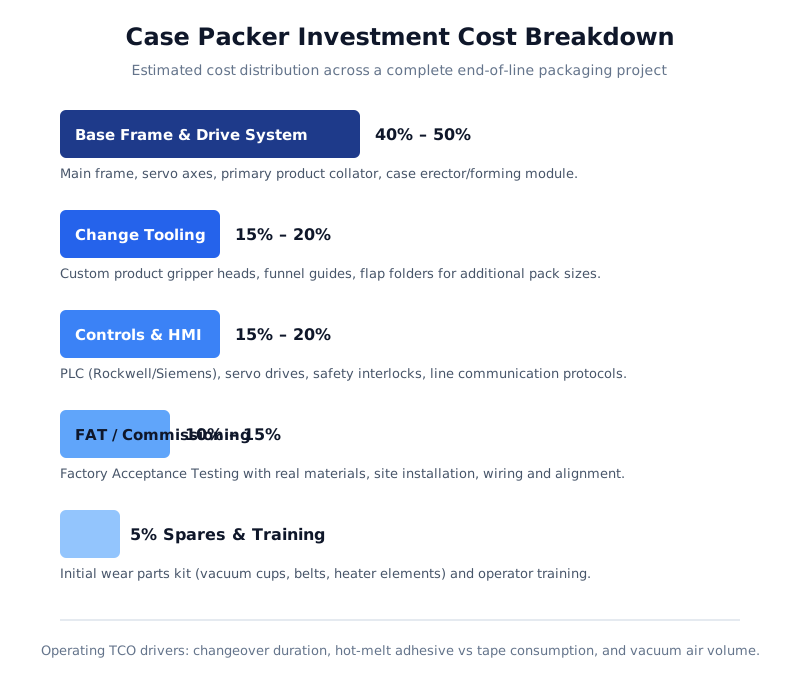
A machine-only quote can leave an approved budget short of the equipment and work needed to run production. Compare case packer cost by installed scope and actual operating duty, rather than by an unsupported price band or budget percentage.
| Scope | Cost to confirm | Evidence for comparison |
|---|---|---|
| Machine and infeed | Equipment and product collation included | Layout, package range and rate test |
| Format tooling | Every current format and planned addition | Parts list, recipe list and changeover demonstration |
| Controls and integration | Hardware, software and line interfaces | Controls specification, signal list and deliverables |
| Testing and installation | Factory trial, site work and acceptance | Test plan, responsibilities and exclusions |
| Spares and training | Named parts and training scope | Itemized list and agreed coverage |
This page helps engineers normalize proposals for the same package list, output and line boundary. It does not establish a market price, a standard cost allocation or a guaranteed return. Use the scope table first, then compare the mechanisms and payback assumptions below.
Machine Kinematics: The Primary Cost Driver
The forming, loading and closing method changes which equipment belongs in the proposal. It does not establish a price ranking on its own. Use the case packer specification guide to check the product and case compatibility before comparing costs.
1. Top-Load Pick-and-Place (Drop / Gantry / Delta Robot)
Top-load systems place products into an upright case. Ask which collation devices, gripping heads, guides and loading motions are required for the actual product. For glass, pouches or multiple tiers, require a production-material trial rather than treating the loading direction as proof of gentle handling.
Record the tool supplied for each format, how it changes and whether the rate trial includes every pick and placement. If one proposal includes a complete collation section and another expects existing equipment to provide it, reconcile that difference before comparing their machine totals.
2. Side-Load Horizontal Case Packers
Side-load systems push a collated group into the case opening. Confirm product orientation, support and resistance to the proposed pushing motion. A rigid rectangular carton may be a candidate, but suitability and speed need evidence from that package and pack pattern.
Record the included collator, pusher, guides and closure equipment. Ask for damage and jam criteria alongside output. Remove an incompatible method from the comparison before evaluating its price; a cheaper mechanism that fails the product trial is not an equivalent offer.
3. Wrap-Around Case Packers
Wrap-around systems form a case around the collated product using a corrugated blank. Check the approved blank, forming sequence and closure method together. Do not assume that a material-saving percentage from another package applies to the proposed design.
Compare delivered packaging cost per accepted case using actual blank and RSC offers, material usage, rejection rates and closure costs. Include format development and tooling in the installed scope. Keep any expected material saving provisional until the case design and production trial support it.
Takeaway: Choose the loading route with production materials, then compare the equipment needed to make that route work.
The Scope of an Itemized Case Packer Quote
Use the opening table as a scope checklist. Require each supplier to identify included equipment, exclusions and separately priced options. Assign an owner to work performed by the plant or another contractor, so an excluded item does not disappear from the project budget.
For controls, request the proposed platform, recipe coverage, program deliverables, backups and line-interface responsibilities. Name the safeguarding assessment and acceptance evidence needed for the installation; a panel label or component brand alone does not demonstrate that the complete cell meets the project requirements.
For testing, state the case formats, production materials, timing window and pass criteria. Identify who provides test materials and who resolves failures. Site installation should describe rigging, connections, alignment, startup support and training rather than leaving those activities under a single undefined allowance. The commissioning checklist helps make the factory and site evidence comparable.
Common mistake: Comparing a complete installed cell with a base machine while treating excluded conveyors, tooling and site work as zero cost.
Takeaway: Keep every exclusion visible until it has an owner, a cost basis and an acceptance responsibility.
Hidden Costs Often Excluded from Base Proposals
Check these omissions against the project boundary; their importance varies by installation.
- Additional format tooling. List every bottle, carton or pouch size and pack arrangement. Record included tools, recipe setup and future-format provisions separately. A format count is useful only when it maps to actual parts and changeover tasks; there is no standard tooling price in this guide.
- Upstream surge and infeed metering. Confirm how products reach the collator during gaps and surges. Compare the required buffer and transfer equipment with the existing line, using the packaging conveyor cost guide for interface scope. Specify the line conditions in the rate trial.
- Utilities and facility work. Obtain the proposed machine’s connected load, air requirements and duty basis. Check the plant’s available supply before budgeting an upgrade. The actual design and operating cycle set the compressed-air requirement.
- Closure and consumables. For tape and hot melt, record equipment, material consumption, replenishment interruptions, heating where applicable and maintenance tasks. Compare them over the same production volume. Require actual consumption evidence instead of using an unsupported annual-volume break-even threshold.
Before approval, also assign responsibility for freight, rigging, utility connections and startup losses where they apply. Ask whether the estimate includes tax and duties, and use the same currency and price year. Record an unpriced item as open for supplier clarification, not zero. A contingency is a separate project decision, not a substitute for resolving a known exclusion.
Takeaway: Resolve known omissions before adding contingencies or choosing the lowest quoted total.
Simple Payback & Total Cost of Ownership (TCO)
Simple payback divides installed capital by the annual net operating benefit. It does not account for the time value of money. Use it as an explicitly limited comparison, with finance reviewing the project’s investment criteria.
Simple payback (years) = Installed system capital cost
  / (Avoidable annual labor cost + realizable throughput and scrap benefit
     - incremental maintenance, energy and consumables)
Example, assumed inputs: USD, 2026 price basis. The following values are invented for arithmetic, not equipment quotations, wage benchmarks or a measured installation. Assume USD 390,000 installed capital and the same operating scope in both scenarios.
| Annual input | Higher-benefit assumption | Lower-benefit assumption |
|---|---|---|
| Positions actually removed or hires demonstrably avoided | 3 per shift × 2 shifts = 6; USD 45,000 each = USD 270,000 | 1 per shift × 2 shifts = 2; USD 45,000 each = USD 90,000 |
| Realizable scrap saving | USD 15,000 | USD 15,000 |
| Incremental maintenance, energy and consumables | USD 25,000 | USD 25,000 |
| Net annual benefit | USD 260,000 | USD 80,000 |
| Simple payback | 390,000 / 260,000 = 1.5 years | 390,000 / 80,000 = 4.875 years |
The labor line assumes the corresponding costs actually leave the budget or avoid documented hiring. Redeploying the same paid employees does not by itself create that cash saving. Include the labor that remains for replenishment, operation and exceptions. Both scenarios exclude extra throughput benefit, taxes, financing and residual value; do not add revenue as though it were profit.
If the net annual benefit is zero or negative, this formula gives no positive finite payback. If output improves but there is no demand or downstream capacity to sell the extra cases, do not count that improvement as cash benefit. Keep damage reduction separate from material savings so the same rejected case is not credited twice.
For TCO, use the same evaluation period and production volume across candidates. Record recurring consumables, utilities, maintenance, software/support where charged, residual labor and planned replacement work. Distinguish cash costs from separately estimated downtime or lost-output effects, and document the basis for each. PMMI’s specific TCO announcement supports evaluating acquisition and operating costs; it does not substantiate the numerical assumptions above.
Takeaway: Replace the assumed inputs with avoidable plant costs and compare a low-benefit scenario before using payback to justify the project.
Copyable proposal comparison worksheet
Copy this worksheet for each offer. Add the opening scope table’s line items and keep missing evidence visible. No data is submitted to this site.
Project / proposal / revision / date:
Currency / price year / tax and freight basis:
Package list / case design / pack patterns:
Required sustained output / agreed trial window:
Scope item / included, excluded or option:
Supplier amount / plant or contractor amount / basis:
Required drawing, parts list or test evidence:
Owner / unresolved question / action due:
Installed total / unresolved allowances:
Annual production / operating period:
Avoidable labor positions and shifts / evidence:
Scrap or contribution benefit / evidence / no double counting:
Maintenance / utilities / consumables / residual labor:
Net annual benefit / low-benefit scenario:
Simple payback / assumptions excluded:
TCO period / recurring costs / replacement assumptions:
FAT and site acceptance evidence / sign-off:
Retain the proposal revision with the comparison. Ask the reviewer to trace each installed-cost line to the matching proposal item or documented plant estimate before signing off. When a supplier changes scope or assumptions, update the worksheet before comparing the new total. For future formats, identify what is confirmed today and what remains a separately priced option. A blank cost field means unresolved scope; use zero only where the responsible party explicitly confirms that no incremental cost applies.
Takeaway: Use this worksheet with the case packer guide and commissioning checklist to compare complete, testable scopes.
Method and sources
Revised October 8, 2026. This is an editorial comparison checklist, not a market-price survey or tested cost model. PMMI’s TCO announcement describes a framework for acquisition and operating costs; the ISO 13849-1:2023 official scope identifies the control-system design subject, not proof of a supplier’s compliance. Manufacturer public descriptions from Pearson, Senzani and Tronrud document top loading, side loading and wrap-around forming respectively; these are mechanism references, not recommendations or site-tested performance. All are listed in References and were accessed October 8, 2026. No budget percentages, tooling prices, speed range or closure-volume threshold are inferred from those pages. The payback scenarios are expressly assumed inputs and reproducible arithmetic.