What end-of-line packaging equipment does
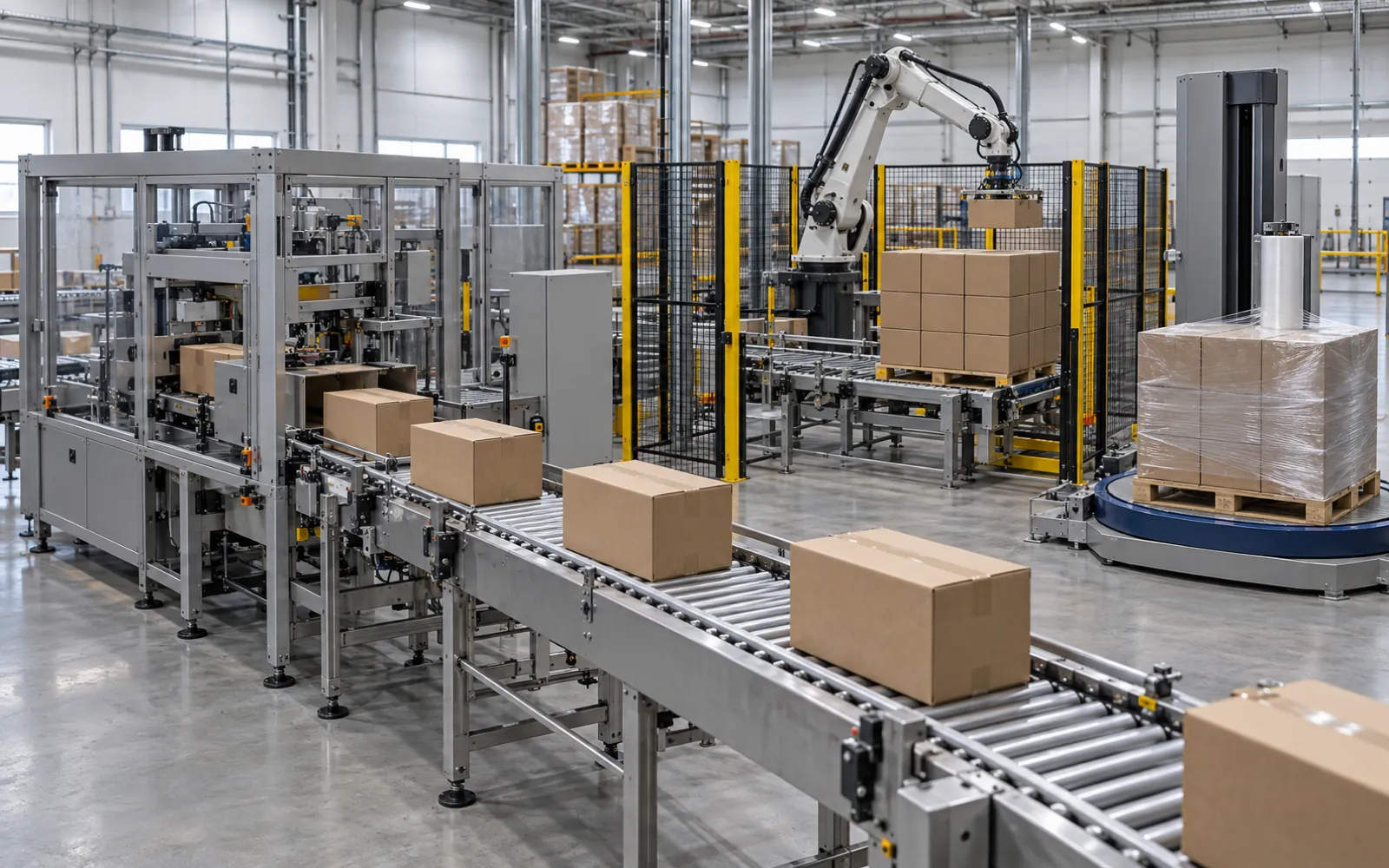
Packaging equipment is the set of machines that fill, close, label, group, and protect a product so it can be shipped. The end of the line is the stretch after the product is already in its primary container, where individual bottles, cans, pouches, or cartons become cases, then layers, then a unit load that a forklift or conveyor can carry out of the building. The work in this stretch is mostly about handling: orienting, grouping, buffering, and stacking, with a few closing and identification steps.
Performance depends on the product, the packaging materials, the facility, and the standards that apply to the site. Treat every general statement here as a starting point for a conversation with the equipment manufacturer and a qualified engineer, not as a ranking of machines.
Industry associations such as PMMI and MHI publish market and technology material that makes useful background, and A3 covers robotics and automation more broadly. All three are listed in the sources for this page.
Types of packaging equipment and their uses
Published lists of packaging machinery, such as the one in the Wikipedia article on the subject, name many machine types: filling, sealing, labeling, wrapping, inspecting, orienting and unscrambling, conveying and accumulating, and palletizing and depalletizing machines among them. For a buyer it helps to sort those types by the job each machine does: forming, filling, closing and sealing, labeling and coding, wrapping, inspection, handling, and the end-of-line machines that assemble unit loads. The grouping below is that sorting, not an official standard, with the main uses of each group and where this site covers it. Most lines use several groups in sequence.
| Equipment group | What it does | Common machines | Where this site covers it |
|---|---|---|---|
| Forming | Makes the package from flat stock or film before it is filled | Form-fill-seal baggers, thermoformers, carton and case erectors | Case erectors |
| Filling | Puts a measured amount of product into the package | Liquid fillers, powder fillers, weighers, counters | Outside this site’s scope |
| Closing and sealing | Closes the package so it holds and protects the contents | Cappers, seamers, heat sealers, case sealers | Case sealers |
| Labeling and coding | Identifies the package and the load | Labelers, coders and printers, print-and-apply units | Pallet labeling, this page |
| Wrapping and bundling | Groups packs or protects a load with film or straps | Flow wrappers, shrink bundlers, stretch wrappers, strappers | Stretch wrapping, this page |
| Inspection | Checks weight, contamination, and presence before shipment | Checkweighers, metal detectors, vision systems | Outside this site’s scope |
| Handling | Moves, feeds, orients, and buffers product between machines | Conveyors, accumulators, unscramblers, depalletizers | Conveyors, depalletizing |
| End of line | Groups product into shipping cases and builds unit loads | Case packers, palletizers, stretch wrappers, pallet labelers | Case packers, palletizing |
Read the groups as functions, not as separate purchases. A form-fill-seal machine forms, fills, and seals in one frame, and a case packer may erect, load, and close the case. That is also how to read a packaging equipment list from a supplier: identify which functions each item performs, and check that every function the product needs appears once.
Packaging machines versus packaging tools
Not every packaging step needs a machine. At low volumes, plants use packaging tools and equipment such as handheld tape dispensers, hand stretch film, manual strapping tools, bench scales, and pallet jacks. Machines take over when the rate, consistency, or physical strain of manual work becomes the limit, which is the same question this page uses below to decide where to start automating. A semi-automatic machine, such as a case sealer that an operator feeds, often sits between the two.
Where end-of-line equipment fits
End-of-line equipment is the handling-heavy part of this list. It begins once the product is in its primary package and ends with a labeled, wrapped pallet. This site concentrates on that stretch, plus the depalletizers that feed containers into the front of a filling line, because the machines share the same integration problems: rate matching, buffering, handoff positions, and safeguarding.
The flow of a packaging line
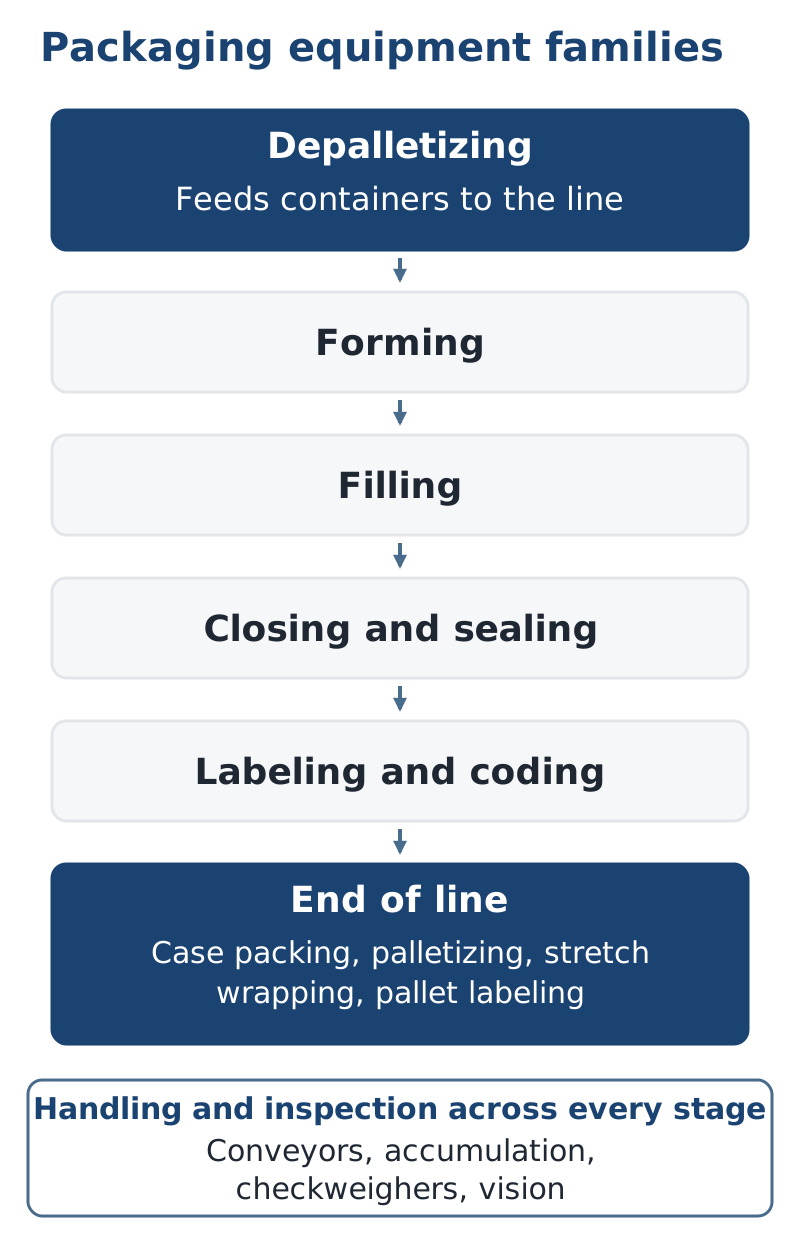
A line is a chain of handoffs. Each machine takes product in a defined state and returns it in the next defined state. When a handoff fails, the line stops or product is damaged, so most integration work is about the handoffs.
The usual sequence:
- Depalletizing removes empty bottles, cans, jars, or other containers from incoming pallets and places them on a conveyor.
- Primary packaging fills, caps, seals, and labels the individual container. These machines define the line’s nominal rate and are outside the scope of this page, except that their output rate and stoppage behavior set the conditions for everything downstream.
- Conveying and accumulation carry product between machines and buffer it so short stops do not propagate.
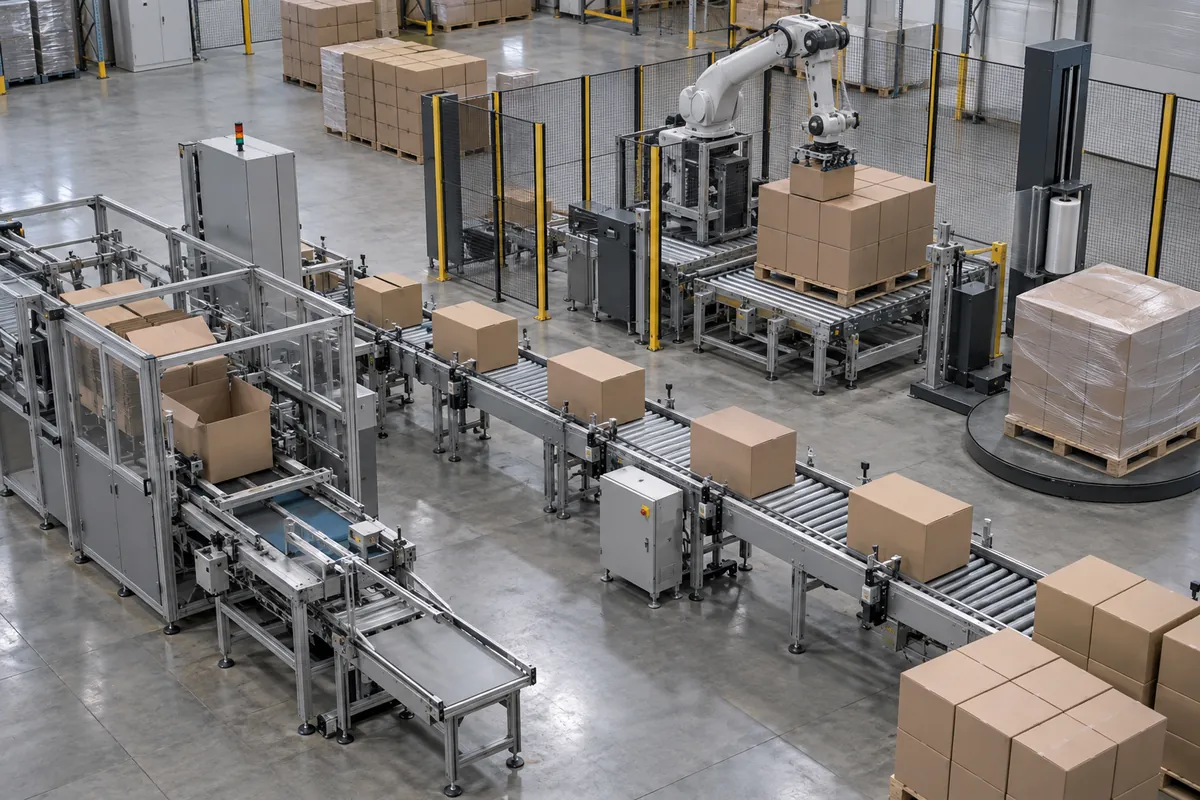
- Case erecting, packing, and sealing group the product, form a carton or tray, load it, and close it.
- Palletizing stacks cases or other units into a pattern on a pallet.
- Stretch wrapping secures the load with film so it survives handling and transport.
- Pallet labeling and transport identify the load and move it to storage or a truck, by conveyor, forklift, or automated vehicle.
Not every line has every step. A bagged-product line may skip case packing and send bags straight to the palletizer. A plant that receives product in pre-erected cartons may have no erector. A line that fills returnable containers may have a depalletizer at the front and a palletizer at the back, which is why both appear in this hub.
Equipment families and what each one does
Depalletizers
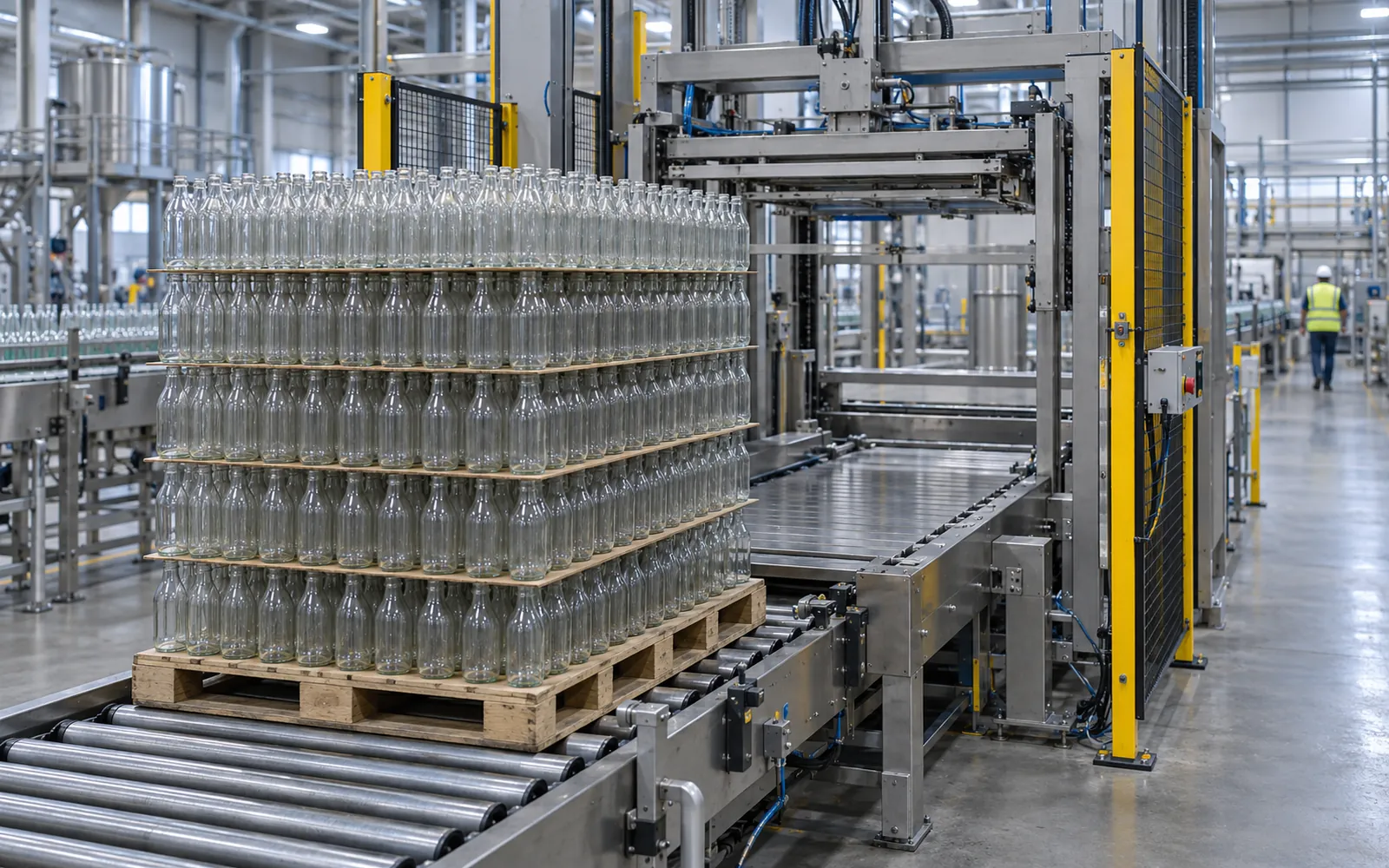
A depalletizer takes a loaded pallet and feeds its contents onto the line. Some machines remove a whole layer at a time, while others pick single containers. Sweep-style and layer-pick designs suit rigid containers that hold their shape. Lightweight or irregular containers may need different handling, tier sheets must be removed and stacked, and the pallet itself must be cleared. The guide on depalletizing explains the options, and the page on bulk depalletizers covers high-volume empty container handling.
Conveyors and accumulation
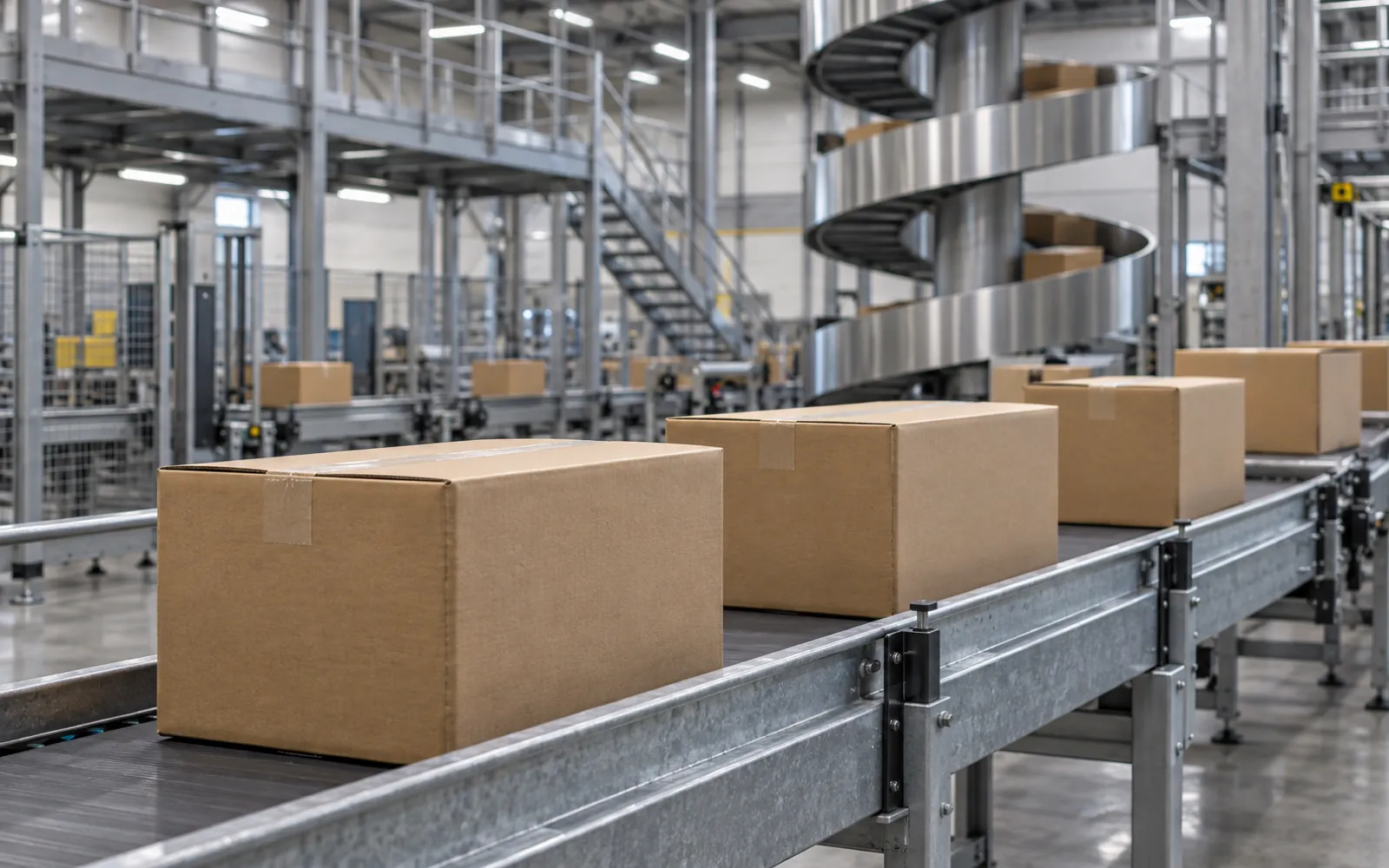
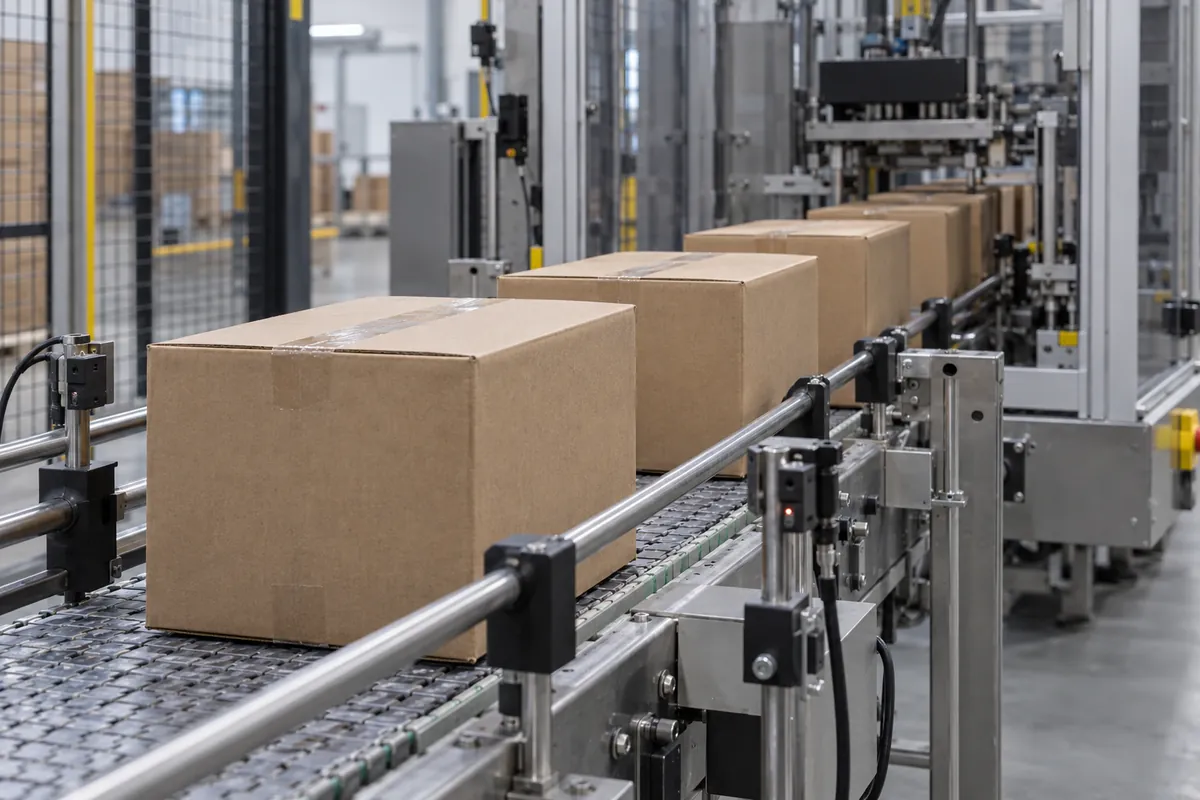
Conveyors transport product, set its orientation or spacing, and buffer it. A short buffer between two machines lets one machine recover from a jam without stopping the other. Accumulation conveyors hold product in a controlled queue, and pressure on the product depends on whether the design is zero-pressure or low-pressure. Elevation changes can be handled with inclined belts or with a vertical conveyor, which saves floor space when product has to change levels. See the overview of conveyors for the families and their trade-offs.
Case erectors, packers, and sealers
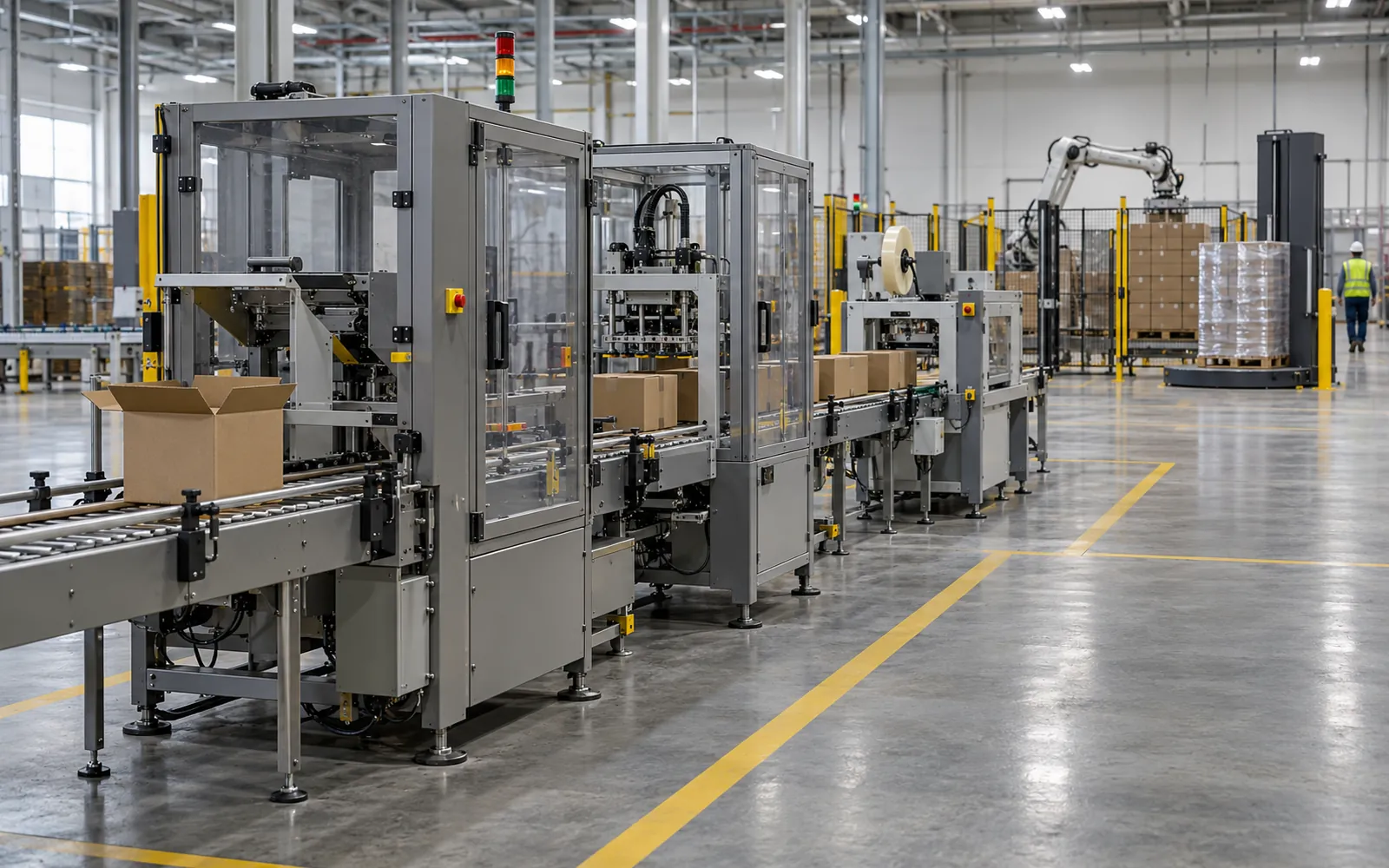
Case handling machines form flat blanks into cartons or trays, load product into them, and close them with adhesive or tape. Packing methods vary by product: top-load, side-load, drop, wrap-around, and pick-and-place with robots are all in use. The choice depends on package stability, how the product must be oriented in the case, and how many case sizes the line runs. The end-of-line packaging hub covers the group as a whole, with separate pages on case erectors, case packers, and case sealers.
Palletizers
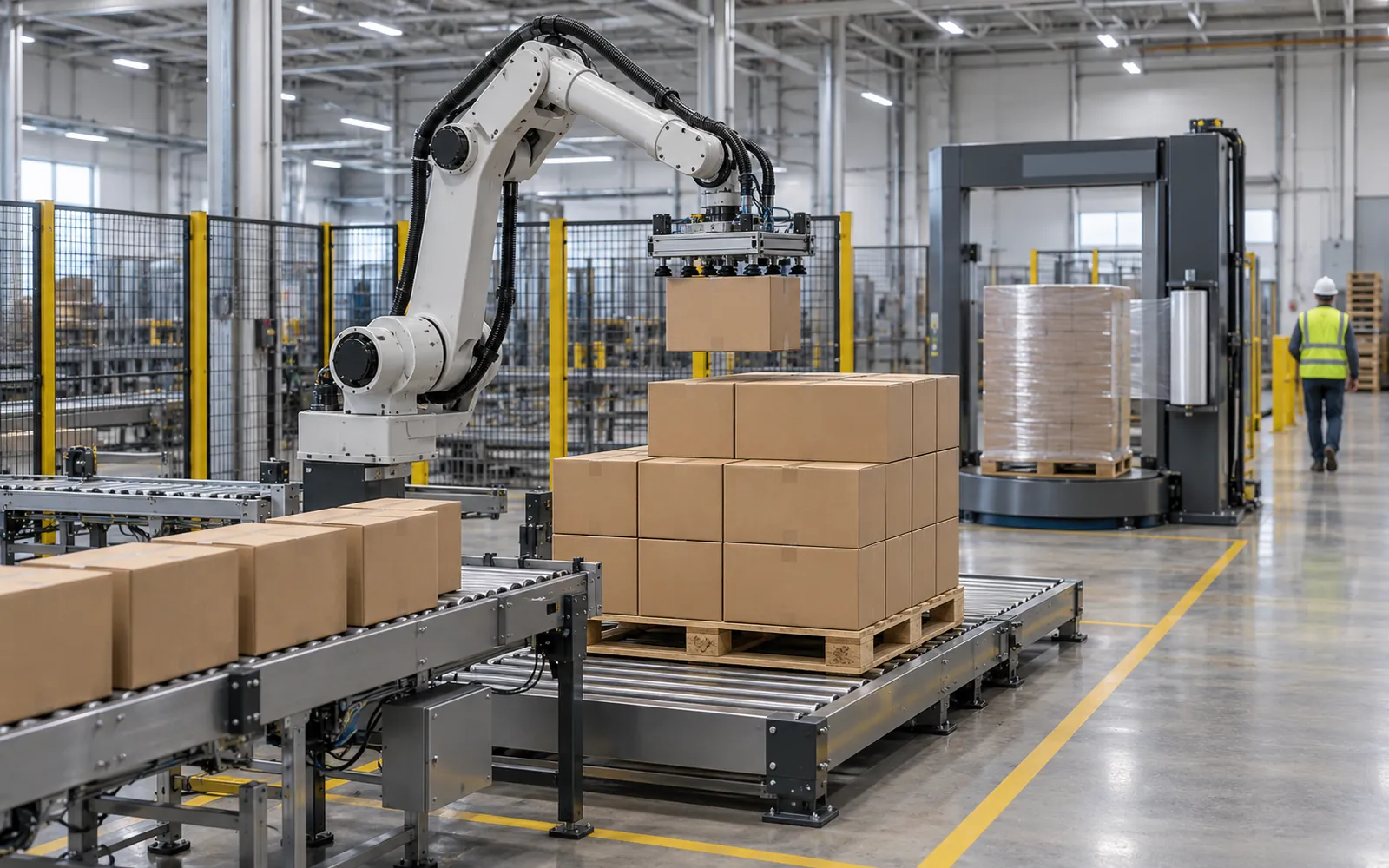
A palletizer stacks cases, bags, trays, or other units into a stable load on a pallet. Two broad architectures dominate. Conventional machines build a layer at a time and are often chosen for steady, high-rate, low-variety work. Robotic machines pick and place units and tend to suit mixed SKUs and frequent pattern changes. The page on conventional palletizers and the page on robotic palletizers go through each design in detail, and the hub for palletizing puts them side by side. For checking vendor numbers, the guide on how to choose a palletizer is a useful companion.
Stretch wrappers
After palletizing, a load is usually secured with stretch film applied by a turntable, a rotating arm, or a rotating ring. The wrapper has to match the load: its stability, its height, its corner strength, and the film’s stretch. Wrapping is also where load stability problems from earlier steps show up, such as an interlocked pattern that was not tight enough.
Pallet labeling and transport
Labels on a unit load carry the identification that warehouse and carrier systems read. Labeling can be applied manually, by a print-and-apply unit, or by a robot. After labeling, the load moves by pallet conveyor, forklift, or automated vehicle. The label placement, the data it carries, and the way it is checked against the order should be defined with the customer or the warehouse system, not left to the equipment alone.
How to choose where to start
Most plants cannot replace the entire end of the line at once, and the family worth tackling first depends on the problem. Three questions help sort it out.
Start with the bottleneck. Measure actual output at each machine over a representative period, including stops. A palletizer that waits for cases is not the problem; the case packer feeding it may be. Capacity claims in brochures are not a substitute for plant data, and a machine rated above the line rate may still limit output because of how it handles stoppages.
Next, look at where the labor pain sits. Manual palletizing, manual case packing, and manual unloading are physically demanding, repetitive tasks that are hard to staff. If turnover, absenteeism, or injury reports cluster around one station, that station is a candidate even when it is not the throughput limit.
Then look at safety exposure. Pinch points, forklift traffic in the packing area, awkward lifts, and unguarded equipment are reasons to act, regardless of cost. Any automated cell brings its own hazards, so design guarding, access, and safety circuits in from the start and check them against the standards that apply in your jurisdiction.
When the answers conflict, rank them by consequence: safety usually comes first, then the true bottleneck, then labor. A cheap fix, such as adding a buffer conveyor or correcting a transfer, can free up capacity that would otherwise justify a much larger purchase.
Integration and controls
Machines from different suppliers can work together, but only if someone owns the interfaces. Before purchase, define at least the following.
- Handoff positions: where the product leaves one machine and enters the next, at what height, in what orientation, and at what spacing.
- Signals that say a machine is ready, running, faulted, or starved, and who consumes them. Many lines use industrial Ethernet networks and standard fieldbus profiles, and the plant’s controls standard belongs in the specification.
- Rate matching. Size machines with headroom relative to the line rate, because each stop and restart reduces effective output, and state the efficiency assumption behind every capacity number.
- Where product accumulates and how long a stop each buffer can absorb.
Safety zones need coordination across machine boundaries: fencing, light curtains, scanners, and interlocks should be arranged so that an access point on one machine does not leave an open hazard on another. Data works the same way. Counts, reject reasons, and stop causes are most useful when they reach one system, so decide early what the plant wants to see.
Acceptance testing should use the real product, the real packaging materials, and the real pallets, at the stated rate, for a defined run. The commissioning and acceptance checklist offers a structure for specifying and testing before acceptance.
Selection factors at a glance
These factors most often change which equipment family or design fits. The table frames the decision but does not replace a supplier’s application review.
| Factor | What to define | Why it changes the choice |
|---|---|---|
| Package type | Cartons, cases, trays, bags, bottles, cans, pails; rigidity and surface | Stability and grip determine the handling method, such as layer, single pick, or bag placer |
| Rate | Cases or containers per minute, with a stated efficiency assumption | Sets the number of machines, buffer size, and whether a robot can keep up |
| Payload | Weight per pick, per layer, and per pallet | Limits tooling, conveyor rating, and the choice between robot sizes or conventional layers |
| Footprint | Floor area, ceiling height, access, and egress | Affects layout, elevation changes, and whether vertical conveying is needed |
| Changeover | Number of SKUs, pattern changes, and how often they happen | Favors flexible machines when changes are frequent, and fixed designs when they are rare |
| Sanitation | Washdown needs, allergen control, dust, and cleaning method | Influences materials, enclosures, and conveyor design |
| Integration scope | Who supplies controls, safety, and interfaces to other machines | Determines project risk, schedule, and who is accountable at acceptance |
Use the same table when comparing quotes. If one supplier assumes a different efficiency or pallet pattern than another, the numbers are not comparable until the assumptions match.
Specific conditions that change the answer
A few conditions shift the choice more than they appear to.
If pallets mix products or the pattern changes often, flexibility is worth more than raw speed. A robotic cell with changeable tooling and stored patterns is often compared against conventional machines for this reason.
Lightweight or fragile packages need care. Thin-walled containers, soft bags, and loose film wraps can deform under conveying pressure or under grippers. Test with real samples.
In washdown and food areas, equipment needs smooth surfaces, drainage, and materials that tolerate cleaning chemicals. Specify the cleaning method up front.
Tight rooms push the design toward vertical conveyors, compact cells, or a different layout of the same machines. Do a layout study before choosing machines.
An older machine may be worth keeping if it runs reliably. Integration with it can be the hardest part of a project, so confirm interface options early.
How this site is organized
This site groups its guides by equipment family. The hub for palletizing covers the machines that build loads, including robotic palletizers and conventional palletizers. The hub for depalletizing covers the reverse operation, including bulk depalletizers. The hub for conveyors covers transport and accumulation, including vertical conveyors. The hub for end-of-line packaging covers case forming, packing, and sealing. For how the machines are specified and joined into one system, see packaging line integration.
The guides section covers buying and costing questions that cross families, and the industries and applications sections show how the equipment is used in beverage, brewery, food, bottle, case, and pallet handling. Articles cover other evaluation topics, such as comparing specifications and building a purchase checklist. The about page explains who runs the site and how we write, and the home page lists everything.
Stretch wrapping and pallet labeling are described here in general terms only. Treat those short descriptions as orientation, and rely on manufacturer documentation and your own engineers for specifics.