Compare the four elevation routes
| Route | Flow | Load to confirm | Floor length / area | Landing arrangement | Maintenance limit to check |
|---|---|---|---|---|---|
| VRC | Batch platform travel | Goods plus any cart or deck equipment | Mast, platform and landing approach | Selected stops with gates | Carriage blocking, gate tests and drive access |
| Continuous lift | Repeated carriers in a continuous stream | Each case within the carrier envelope | Tower plus infeed/outfeed | Designed transfer levels | Chain, carrier and pusher access |
| Spiral | Continuous helical path | Stable supported packs | Tower plus entry/exit runs | Designed entry and exit | Belt access, cleaning and transfers |
| Incline | Continuous sloping path | Pack grip and stability on the slope | Length set by rise and chosen slope | Fixed low/high transfer points | Belt tracking, cleaning and under-run access |
Use load drawings, the required rate and a building survey to screen these routes. This page is part of packaging conveyor systems; case conveyors cover the connecting runs.
How it works
The four approaches differ in how they move product, and that difference drives almost every other decision.
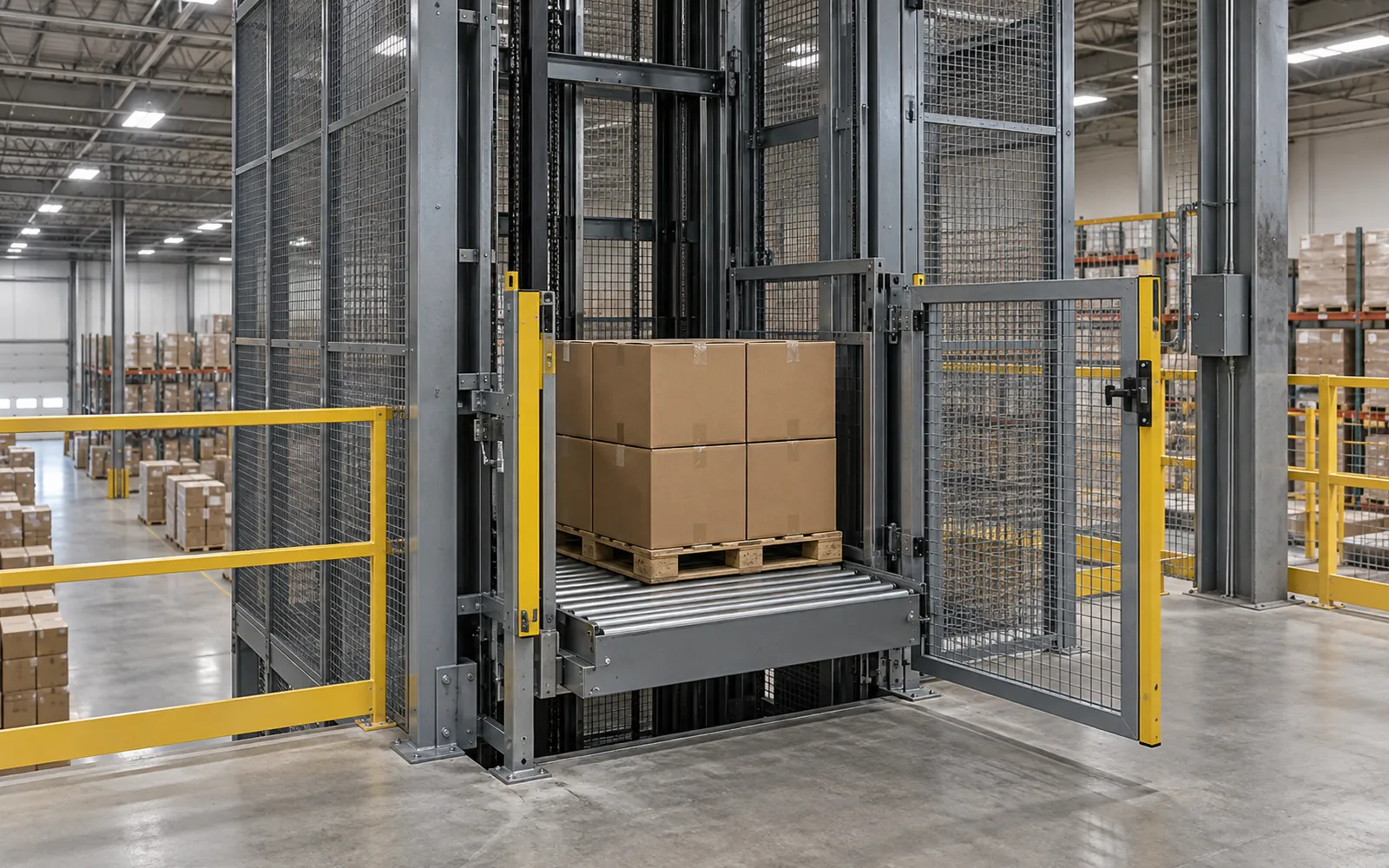
A VRC is a stationary lift whose carriage rides in guides between two or more landings. According to the industry application guide from the conveyor and sortation group of the Material Handling Industry, VRCs raise and lower materials, are mostly hydraulically or electro-mechanically powered, and are built under ASME B20.1. The carriage moves a load to one landing, stops, discharges, and returns, so product moves in batches. The carriage carries only goods. No one rides it, and the controls sit away from the platform, never on it.
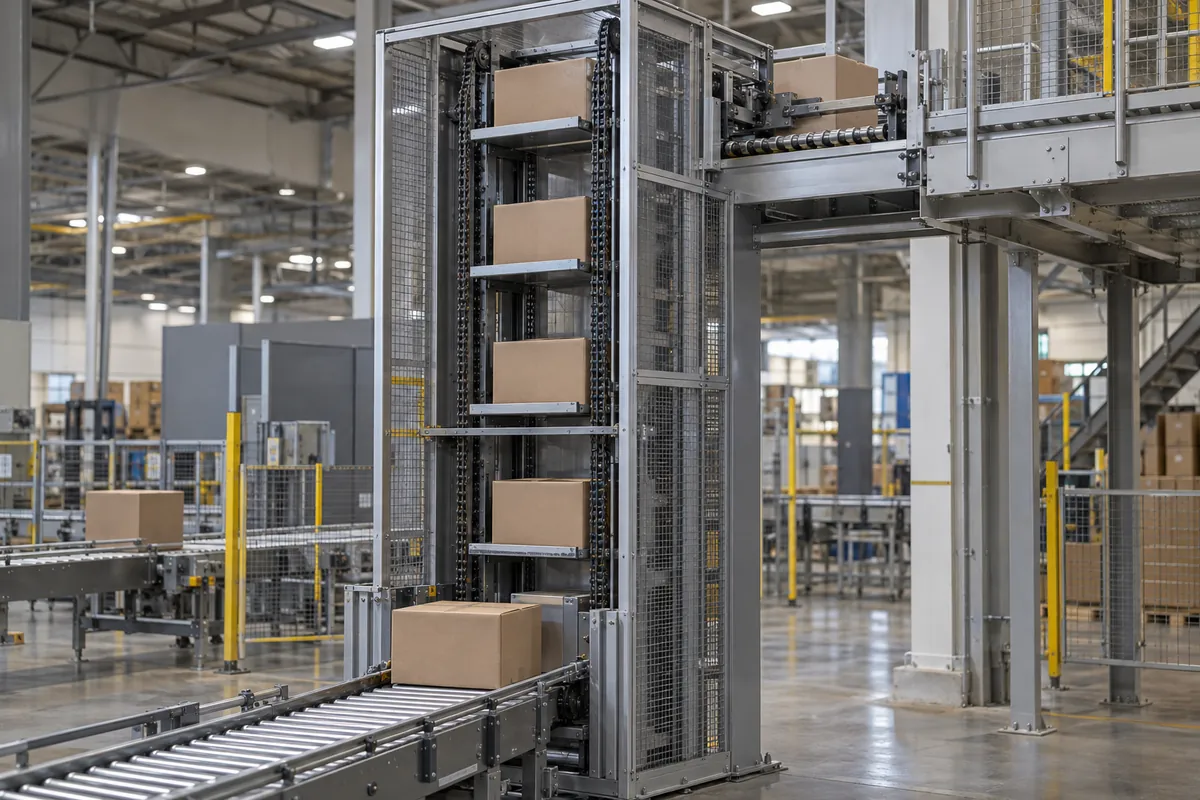
A case lift, also called a case elevator, takes cases, cartons, or bundles from an infeed conveyor at one height and delivers them to an outfeed conveyor at another. One manufacturer describes a design with two parallel flighted chains driven by a brake motor. A feed conveyor loads product sideways onto the chain, which lifts or lowers it, and a pusher unloads it onto the discharge conveyor. The same machine raises product as an elevator or lowers it as a lowerator. Several packs ride at once, so the flow is steady rather than batched.
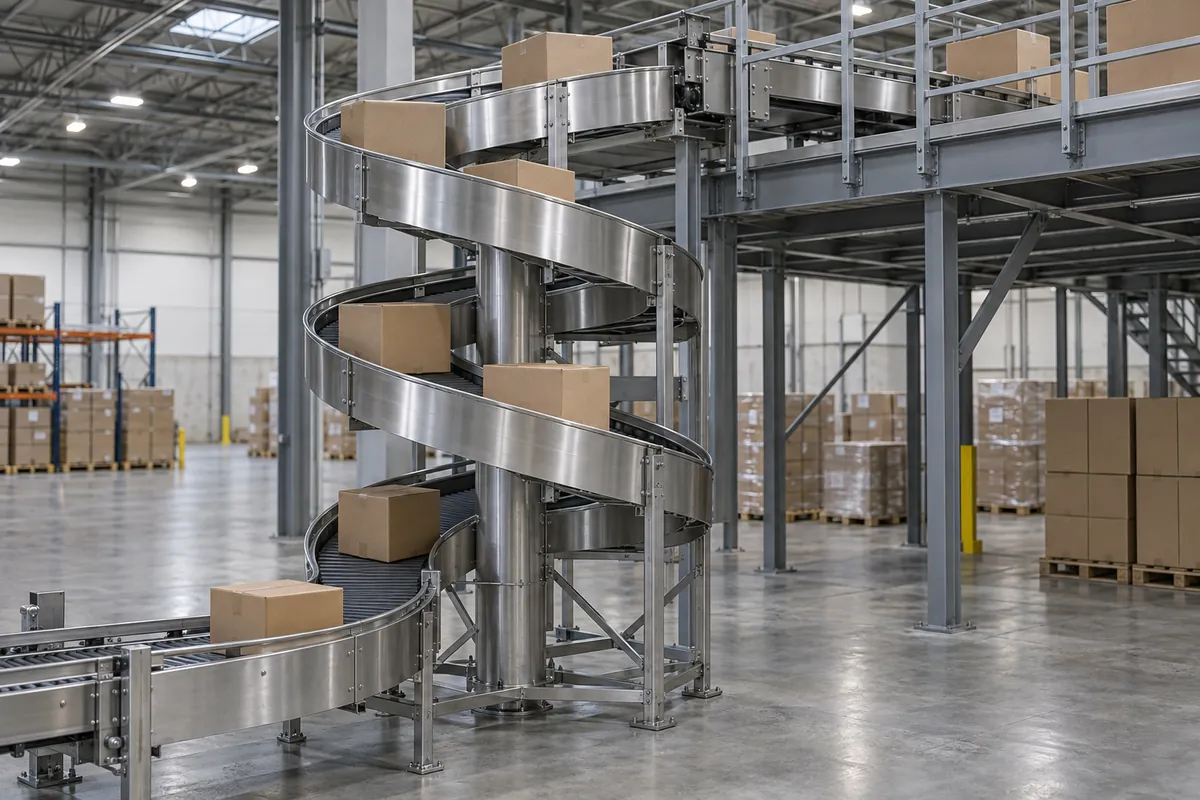
A spiral conveyor carries product around a helical path. One supplier article describes a continuous belt or modular plastic belt guided around a central rotating drum or tower, driven by a friction drum or sprockets, with rails keeping the belt in shape. Product enters at one end and exits at the other, gently and without stopping. Spirals can raise or lower product. Because the path can contain many turns, they can also act as a buffer or give product time to cool or cure.
An incline conveyor is a belt or roller conveyor set at an angle, and it changes elevation by using horizontal length. It is simple, continuous, and relatively easy to maintain, but it needs floor space to reach the required height, and its supports take up that space. When the room exists, it is often the simplest way to change level. It can also carry product across an aisle if the structure leaves enough clear height for traffic below.
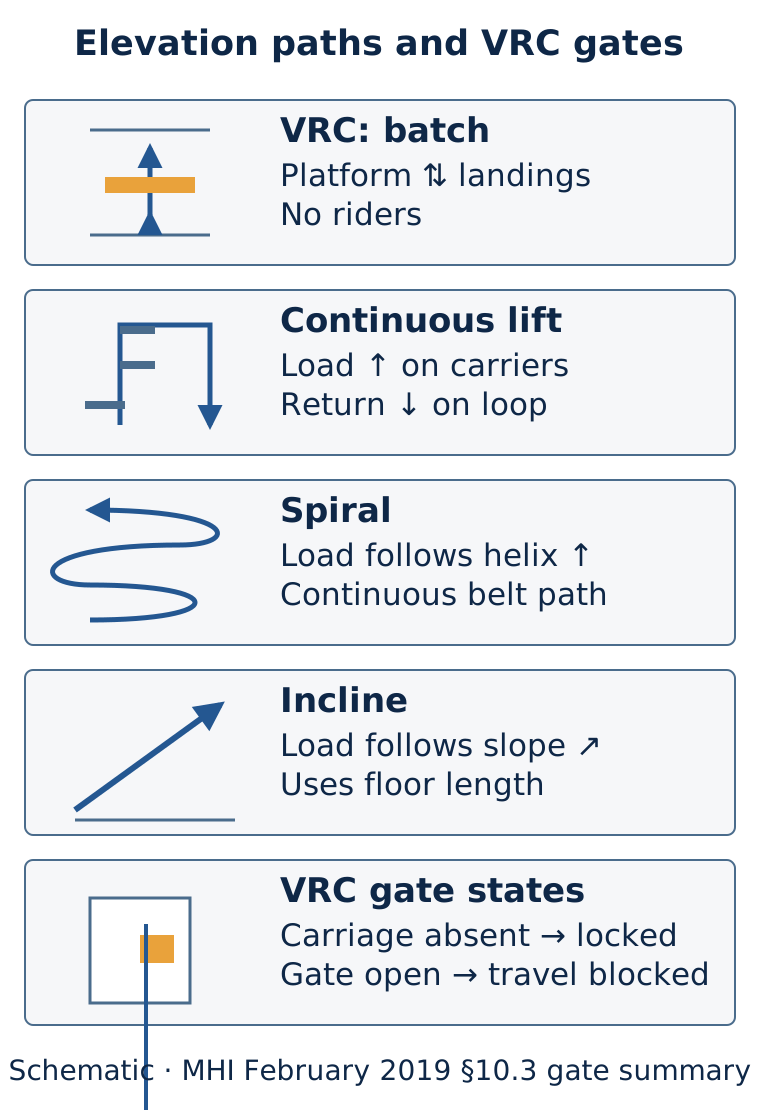
Which one makes sense depends on whether product can be handled in batches, whether it should flow continuously, and how much floor space is free. The diagram below separates the load paths and the VRC gate states.
Types and configurations
VRC mast and carriage designs
The MHI application guide lists four common VRC designs, each with trade-offs.
The straddle design rides the carriage between two masts on opposite sides. It allows greater capacities and larger platforms and tolerates higher forces during loading, but loading and unloading are limited to the two opposite ends.
The cantilever design projects the carriage out in front of a mast or guide beams. It gives access on three sides, may need less overhead clearance, and uses less floor area. Loading creates an overturning moment that has to be braced into the building, and platform size and capacity can be limited.
A four-post design sits the platform within four guide beams. It supports very large platforms and high capacities with access from all four sides, but it has a larger footprint and needs bracing.
A double-mast design also uses four guide beams, with the carriage cantilevered between two sets of masts. Platforms can be larger than on a two-post design and overhead clearance stays open. Loading is limited to the two ends, and platforms are smaller than four-post designs at the same capacity.
Load patterns
The pattern in which loads enter and leave the platform affects the choice. The guide describes a Z pattern, where the load goes on at one side and comes off at the opposite side; a 90-degree pattern, with loads leaving to the side; and a C pattern, where loads go on and come off the same side. The designs above support different mixes of these patterns, so settle the traffic plan before the platform style.
Drive types
Most VRCs are hydraulic or mechanical. The MHI guide says hydraulic units are economical and common but are typically designed for two-level operation, and they are not recommended for intermediate stops unless a positive stop or level-locking device is fitted. It describes mechanical chain-driven units as the usual choice for higher travel, three or more levels, automated systems, and high-cycle work. It also notes that hydraulic units can drift downward over time, which matters in automated systems that park the carriage at an upper level.
Continuous lifts, case lifts, and lowerators
Continuous vertical conveyors come in layouts that set where product enters and leaves. One manufacturer describes a C-flow layout, where infeed and outfeed are on the same side, and an S-flow or Z layout, where they are on opposite sides. Case lifts and lowerators are the packaging names for this family when it handles cartons, cases, and bundles. Gripper-style continuous lifts that hold product on its sides are also used for smaller containers.
Spiral conveyors, alpine conveyors, and accumulating spirals
A standard spiral is a continuous path that raises or lowers product, with entry and exit at different heights. An accumulating spiral, sometimes called a vertical accumulator or buffer, lets product queue on the spiral path, often in first-in first-out order. One manufacturer describes an alpine conveyor as a compact spiral configuration used as an accumulation or elevating buffer between machines, for cooling or drying, and for line balancing. It can be built as a single or double serpentine and may suit round, square, oval, or rectangular small products. Because alpine conveyors usually carry smaller containers, they are more common on primary packaging lines than on case lines.
Specifications to evaluate
Specification sheets from different suppliers rarely line up. This table lists the items that change the choice and the question that exposes each one.
| Specification | Why it matters | What to ask the supplier |
|---|---|---|
| Travel and floor-to-floor distance | Sets the lift stroke, mast height, and drive type | What is the travel measured from carriage top at the lowest level to carriage top at the highest level, and how does the design handle my floor-to-floor distance? |
| Rated capacity and load type | Defines the structure and drive, and includes loading equipment weight | Does the rating include pallet jacks, carts, or any platform-mounted conveyor? What is the assumed load distribution? |
| Platform size and load orientation | Determines mast design and which sides can load | Which designs support my Z, C, or 90-degree pattern? |
| Throughput | Batch lifts and continuous lifts behave differently | What is the cycle time for my load, including gate operation and conveyor transfer, and the rate at my duty cycle? |
| Drive type | Hydraulic and mechanical differ in stop accuracy and travel | How many levels does it stop at, and how is stop accuracy held loaded and empty? |
| Number of landings and gate arrangement | Each landing adds gate, interlock, and enclosure scope | Which gate type is proposed at each level, and what is the swing or opening clearance? |
| Platform conveyor and transfer | Powered deck, chain transfer, or pusher affects forces and controls | How are start and stop forces handled in the structure? |
| Enclosure and guarding | Sets the guard height, mesh opening, and strength | Which enclosure design meets the standard at each level? |
| Electrical and environment | Washdown, dust, and hazardous areas change enclosures and controls | What enclosure rating is proposed and where does power need to be delivered? |
| Fall protection devices | Suspended carriages need safety devices | What devices are fitted, how are they tested, and how often? |
| Installation structure | Masts transmit load into the building | What loads go to the floor, the mezzanine, and the building frame? |
| Controls and interfaces | Interlocks with upstream and downstream conveyors | What signals does the VRC exchange with my line controller? |
Load and package compatibility
What a lift can carry depends on how the load interacts with the carrier. Cases, cartons, totes, and bundles on a case lift or spiral are handled one pack at a time, so their base stability, weight, and surface matter more than the pallet pattern. A reciprocating lift carries those packs on a platform, often with a roller deck, but according to the MHI guide it can also carry carts, pallets on a pallet jack, drums, and automated guided vehicles.
Several checks apply to packs on any lift. Tall, narrow cases and loose packs can tip during starts and stops on a continuous lift or spiral. A platform lift lets packs rest on a stationary deck during travel, but loads can still shift. Soft sacks and floppy bags may not hold their shape on shelves or flights, so ask the supplier whether a belt-based spiral or a platform lift is the better match. Slick film wraps can slide on cleated or smooth surfaces, inclines, and spirals. For both questions, a supplier test with real packs is the best check.
A mixed run of case sizes pushes a case lift toward adjustable guides, pushers, and sensors, while a platform lift tolerates size variation more easily. The guide notes that rated capacity has to cover the loading device as well as the load, since a powered pallet truck or forklift entering the platform changes the structure. Where product is exposed, spirals with open frames and plastic belts are used in sanitary food production, according to one supplier article, because cleaning and drainage matter. Lifts that carry open product need the same discussion.
Integration
Infeed and discharge transfers
According to the MHI guide, a VRC platform can carry a powered roller section, a gravity conveyor with a stop, a chain transfer, a turntable, or a pusher, and it can interface with conveyor lines or racking. Each addition changes the load on the structure, because starting and stopping a loaded conveyor on a moving platform creates reaction forces the design has to handle. Transfers need matched heights, accurate platform stopping at each landing, and a controls handshake so a case is not pushed onto an empty platform or a closed gate.
On a continuous lift or spiral, the infeed and outfeed are fixed points. A case lift needs product to arrive in a form it can pick up, and a spiral needs consistent orientation. The conveyors before and after have to deliver and take away product at the lift’s steady rate, without bunching at the entry or starving the discharge.
Mezzanine and floor openings
For a VRC, the guide says the lift can sit at the mezzanine edge or pass up through an opening cut into the mezzanine floor. Floor hole sizes and edge clearances follow the manufacturer’s recommendations. Where those clearances cannot be met, a throw-over plate or an extended landing edge may be needed, and large openings can call for extra guarding for personnel safety. Mezzanine design should account for the loads the masts and platform place on the structure, and a building engineer should confirm that the mezzanine and floor can carry them.
Spirals and case lifts need openings for the product path and clearances for the conveyors that feed them. An incline that crosses an aisle needs clear height under the structure.
Controls interlocks
Whatever the type, wire a vertical conveyor so the line controller and the lift agree about state. The usual signals are carriage at landing, gates closed, load present, ready to receive, and fault. A VRC platform must not be released until the discharge path is clear, and the infeed must not release a case until the platform is present. The MHI guide notes that hydraulic VRCs in automated systems can drift and that mechanical VRCs are the first consideration there.
Fire and building code coordination
A vertical conveyor that passes through a floor creates an opening in a fire-rated floor assembly, and the building code treats that opening seriously. The MHI guide says recent adoption of the International Building Code in many jurisdictions includes recognition of VRCs and their governance under ASME B20.1 in chapter 30, and that state or local building officials may require special permitting and testing. It puts the responsibility on the customer to verify the need for those and to absorb any added cost. It also states that where fire doors are required, gates cannot substitute for them. An OEM information page notes that, depending on the local fire code, an opening that connects floors may need a fire-rated enclosure or sprinkler protection, and advises consulting the authority having jurisdiction.
Before the design is fixed, bring the supplier’s drawings to the local building and fire officials and ask which standard they apply and what inspections and permits they require. Practice varies by jurisdiction, and an elevator inspector may treat a lift differently than a conveyor inspector would.
Lifts often connect to case conveyors or accumulation conveyors at either landing. For cost and layout questions, see the packaging conveyor cost guide and the packaging line layout guide. Food plants that move cases between floors can read more in food packaging.
Footprint, utilities, controls, and safety
Footprint and structure
A platform lift needs its mast area, the platform, and a required enclosure. According to the MHI guide, a cantilever design uses less floor area than a four-post design for the same carriage, and the enclosure should be kept close to the equipment to reduce the chance of a person standing between them. A continuous case lift is compact in plan, and one manufacturer describes case elevators as taking less floor space than inclines or spirals. A spiral occupies a circular footprint plus its infeed and outfeed. An incline needs length.
Utilities
The guide says power must typically be brought to near the lift, the customer typically supplies a fused disconnect, and hydraulic power units can be remote. Mechanical chain-driven units cannot have the power unit located remotely. Enclosure ratings should match the area, from basic indoor to washdown to hazardous locations. Compressed air and other utilities depend on the transfer equipment.
Gates, enclosures, and interlocks
The February 2019 MHI VRC Application Guidelines, section 10.1.1, printed page 31, describe 96-inch floor-level enclosures, with exceptions at the top landing, and wire or metal mesh that rejects a 2-inch ball. These dimensions are historical guidance for VRC enclosures, not specifications for all vertical conveyors or a verification of the full 2024 standard.
Section 10.3, printed page 35 describes two landing-gate interlock functions: locking the gate closed when the carriage is absent and preventing VRC travel unless all gates are closed. Both sections were accessed October 8, 2026. Confirm enclosure, gate and approval requirements with the supplier and authority having jurisdiction using the applicable standard edition.
A back stop panel is recommended opposite the loading edge at upper levels when personnel or loads could fall to the lower level. Platform railings and kick plates, or snap chains, guard the platform sides.
Operation, riding, and controls
No person may ride a VRC. Only trained persons should operate it, with training that covers normal and emergency situations. The guide says operator controls are never accessible from the platform, emergency stops should be accessible and unobstructed, and limit switches, controls, and safety devices must not be altered or defeated. Labels at each landing and on the platform communicate these rules. The guide also says VRCs with suspended carriages require fall-protection devices that need periodic testing, and that directly acting hydraulic rams are treated differently, according to the manufacturer’s instructions.
Lockout/tagout and maintenance
OSHA’s lockout/tagout rule, 29 CFR 1910.147, covers servicing and maintenance in which unexpected start-up or release of stored energy could hurt employees. The MHI guide says that when a VRC is stopped for maintenance, main power should be locked or tagged out under a formal procedure, that most VRCs are serviced with the carriage lowered, and that carriage blocking and hydraulic pressure relief are specific hazards. Machine guarding on nip points, chains, and rotating parts falls under 29 CFR 1910.212, and ASME B20.1 covers conveyors in more detail.
Standards context
ASME’s public B20.1 catalogue lists the 2024 edition (accessed October 8, 2026); it does not expose all clauses for comparison with the 2019 MHI guide. It addresses hazards in conveyors and conveying systems across design, construction, installation, upkeep, inspection, and daily operation. It excludes conveyors used primarily to move people, and it excludes material lifts and platform elevators designed to carry passengers or an operator. The MHI guide states that the standard was revised in 2015 to add a mandatory appendix covering design, installation, commissioning, and periodic inspection of VRCs. Industry groups hold that VRCs fall under B20.1 and not under the elevator code, and the guide states that position firmly. Local officials do not always agree, so confirm the classification in writing with the authority having jurisdiction.
Building and load handoff record
| Item | Record / document | Handoff check |
|---|---|---|
| Building | Floor levels, opening, mezzanine edge and fire-rated assemblies | Building engineer and local authority review the proposed route |
| Load | Maximum goods weight, distribution, cart or deck weight and dimensions | Supplier states the rating basis and loading forces |
| Clearance | Headroom, enclosure, gate travel, approach and maintenance access | Check the full moving and service envelope on drawings |
| Transfers and approvals | Heights, landing layout, signals and governing edition | Agree transfer test, interlock test and required inspections |
Use this record with the commissioning checklist before fixing the layout.
Cost factors
Cost is project-specific, and published numbers are rarely comparable. The drivers are consistent, though.
Platform size, rated capacity, and load type change the structure and drive. More travel and more stops add structure, gates, and interlocks. Hydraulic and mechanical drives differ in first cost, stop accuracy, and fit for intermediate stops or automation. Full-height enclosures, back stop panels, and gate type vary widely in cost, and powered decks, pushers, and turntables add equipment and controls.
Environment matters too: washdown, dust, outdoor, and hazardous-area ratings add cost. Building work such as floor openings, reinforcement, fire protection, and mezzanine modifications can rival the equipment cost. Where officials ask for added testing, the customer bears it, per the MHI guide. Interfaces to line controllers and upstream equipment take engineering time, and site access, rigging, and start-up testing add to installation. Over the lifetime, count maintenance access, inspection effort, spares, and the cost of downtime when a single lift serves the whole line.
Selection checklist
- Define the move: level to level, floor to mezzanine, or over an aisle, and the distance involved.
- Describe the load: pack type, size range, weight, stability, and surface, and whether pallets, carts, or people-adjacent traffic touch the lift.
- Set the rate in packs per minute or loads per hour, including peaks and the buffer upstream and downstream.
- Decide whether batch or continuous flow suits the line. A single platform serves intermittent moves; a case lift or spiral suits steady flow.
- Check whether buffering or dwell is useful. A spiral or alpine can serve both purposes.
- Measure available floor area and overhead clearance, and mark columns, aisles, and fire rated assemblies.
- Confirm the structure: what the floor or mezzanine can carry and what bracing is needed.
- Choose the drive and number of stops, using the supplier’s guidance on hydraulic versus mechanical.
- Define the load pattern at each landing and the transfer devices on the platform.
- List safety needs: gates, enclosures, back stops, interlocks, emergency stops, labeling, lockout points.
- Review the environment: washdown, dust, hazardous areas, and cleaning method.
- Identify the authority having jurisdiction and get its requirements on the table before the order.
- Ask for a factory or site test with the actual packs where the lift is continuous or spiral.
- Plan maintenance access, inspection, spares, and training before commissioning.
The commissioning and acceptance checklist gives a broader list of supplier questions that apply to any packaging equipment.
Common mistakes
- Treating a VRC like an elevator, or the reverse. The two are regulated differently in many places, and rules vary by jurisdiction, so confirm classification and requirements before ordering.
- Letting anyone ride. A material lift is not a people mover, and gates, signage, and training are needed to prevent it.
- Ignoring the loading device. The platform capacity has to cover the pallet jack, cart, or forklift, not only the load.
- Underestimating transfers. Poorly matched heights, timing, or product orientation at the lift cause most real-world jams.
- Choosing a hydraulic lift for many stops. Hydraulic units are typically designed for two levels and may not stop accurately at intermediate levels.
- Overlooking the building. Floor openings, edge clearances, fire protection, and structural loads can force design changes late.
- Sizing for average rate only. A lift that cannot recover after a stop will starve or flood the line.
- Skipping maintenance planning. Chains, cables, gate interlocks, and fall protection need scheduled inspection and testing.
- Bypassing safety devices. Manual or override operation defeats the protection that gates and interlocks give.
Alternatives
The right alternative depends on the move.
An incline conveyor is best when floor length is available and the line must stay continuous. It is simple but uses space, and may not fit across an aisle at low clearance. A spiral suits continuous flow in a small plan area and can double as a buffer or cooling path. Its cost and plan area are higher than for a case lift, so check that the capacity is needed. A case lift or lowerator is compact and continuous and is used for cartons and cases, but product stability and pack size range need checking. An alpine or accumulating spiral serves primary containers, buffering, or line balancing as well as elevation.
If people must ride with the load, a freight elevator is the appropriate equipment, and it falls under the elevator code. A forklift or lift truck is common for pallet loads at low frequency, though it ties up equipment and operators. On a new line, putting palletizing or storage on the same level removes the need for vertical conveying.
For a broader view of how lifts fit among conveyors, return to the packaging conveyor systems hub. Lifts often sit near the end of a line, so see the palletizing section for what happens after cases reach the pallet area, and the depalletizing section for what happens at the front. The equipment overview shows where vertical conveyors fall in the larger machinery map.