Select from the incoming load
Object, removal method and automation scope are separate choices: a robot can handle cases or layers. The examples below screen proposals; they do not rank suppliers or establish a rate. For empty glass and PET bottle layer-sweep versus layer-pick sizing, tier-sheet removal, and single-filing accumulation math, see the bulk glass and PET bottle depalletizer selection guide.
| Incoming object / state | Removal method to evaluate | Automation scope to confirm | Limit to verify | Related guide |
|---|---|---|---|---|
| Uniform loose empty containers on tier sheets | Layer sweep | Layer positioning, sweep, sheet removal and empty-pallet exit | Layer stability and single-filer acceptance | Bulk depalletizers |
| Fragile or unstable empty-bottle layers | Controlled sweep or layer pick | Pick head, layer support and sheet handling | Bottle contact and retention with the actual shape | Bottle depalletizers |
| Uniform cases, trays or wrapped packs | Case or layer removal, mechanical or robotic | Pallet pattern, release and convey-away | Pack base, gripper fit and downstream orientation | Case depalletizers |
| Mixed cases or changing patterns | Robotic case/group pick | Identification, gripping and destination logic | Real load variation, pick access and sustained output | Case depalletizers |
| Low-volume loads | Manual-assist lift table | Operator tasks versus powered positioning | Load condition, handling assessment and required supply rate | Core types below |
Film and bands may still be removed manually before entry; top-frame removal and pallet stacking need an explicit scope check. For example, Sidel’s Sweepoff-A brochure describes wrap removal before entry, while A-B-C’s Model 108 brochure lists frame/sheet and empty-pallet handling options (sources and model limits below).
What does depalletizing mean?
Depalletizing means taking a palletized load apart: removing the layers, cases, or containers from a pallet so they can enter a process one by one or in a controlled stream. It is the reverse of palletizing. A depalletizer machine is the equipment that does this automatically or with operator assistance, and “depalletizing system” usually means the machine plus its pallet infeed, tier sheet and empty pallet handling, and the discharge conveyors.
A few nearby terms describe different jobs, and proposals sometimes blur them:
- Palletizing builds loads at the end of a line. The palletizing systems section covers it.
- Unscrambling or orienting takes loose containers that are already off the pallet and turns them upright and into a single file. It often follows a bulk depalletizer, but it is a separate step.
- Case unpacking removes product from inside cases. A case depalletizer only removes the cases from the pallet.
These descriptions overlap: “case” describes the load, “sweep” describes removal, and “robotic” describes the handling mechanism. Start with the incoming load, then specify the method and scope.
Where depalletizing fits
Depalletizing sits at the start of a line. The pallet arrives from a warehouse, a glass or can supplier, or a receiving dock, and the line needs its contents in an orderly stream. Doing that by hand is slow, repetitive, and a source of strain and breakage, so most beverage and food plants with steady volumes automate it.
The audience for this hub is plant engineers, packaging engineers, and buyers who need to pick a type of depalletizer before asking for quotations. For the most common design for empty containers, see the bulk depalletizer guide. For the opposite operation at the end of the line, see palletizing systems.
The trade uses the word loosely. “Depalletizer” can mean a semi-automatic lift table or a fully automatic line with film removal, empty pallet stacking, and single-filing. When you compare proposals, define the scope in plain terms: what arrives on the dock, in what state, and what the downstream equipment expects to receive.
Core types
Four families cover most applications. They overlap in practice, and many suppliers combine features.
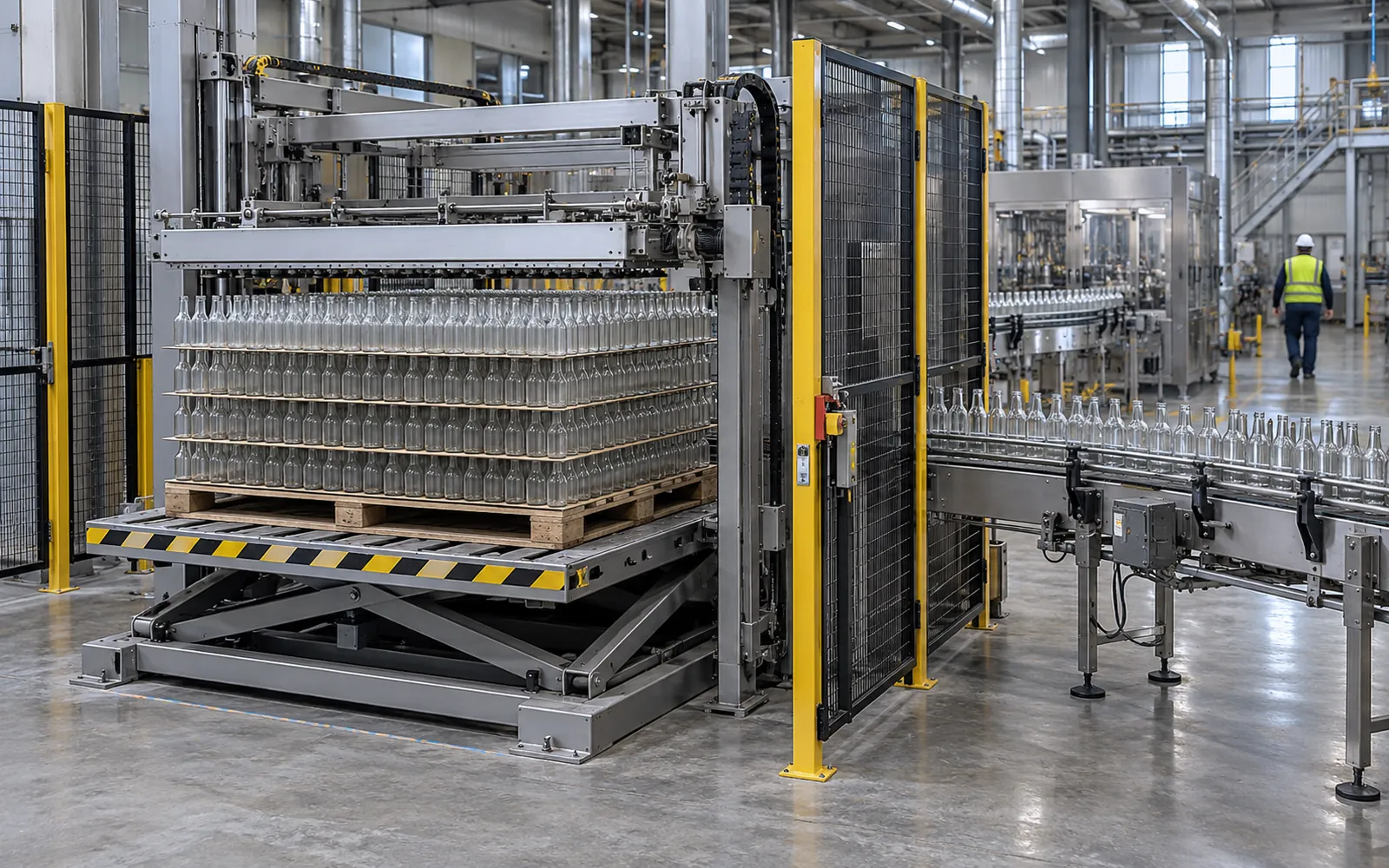
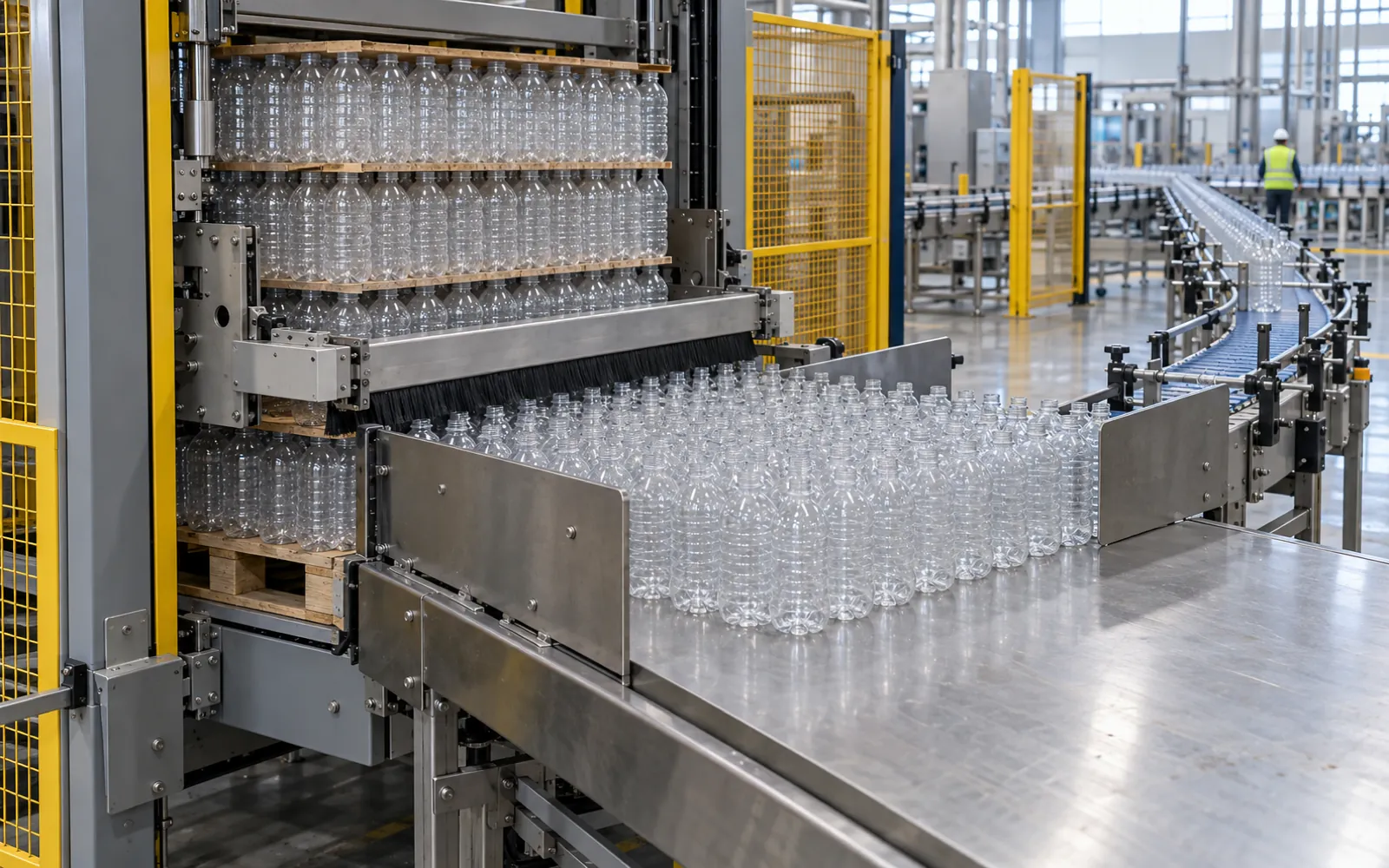
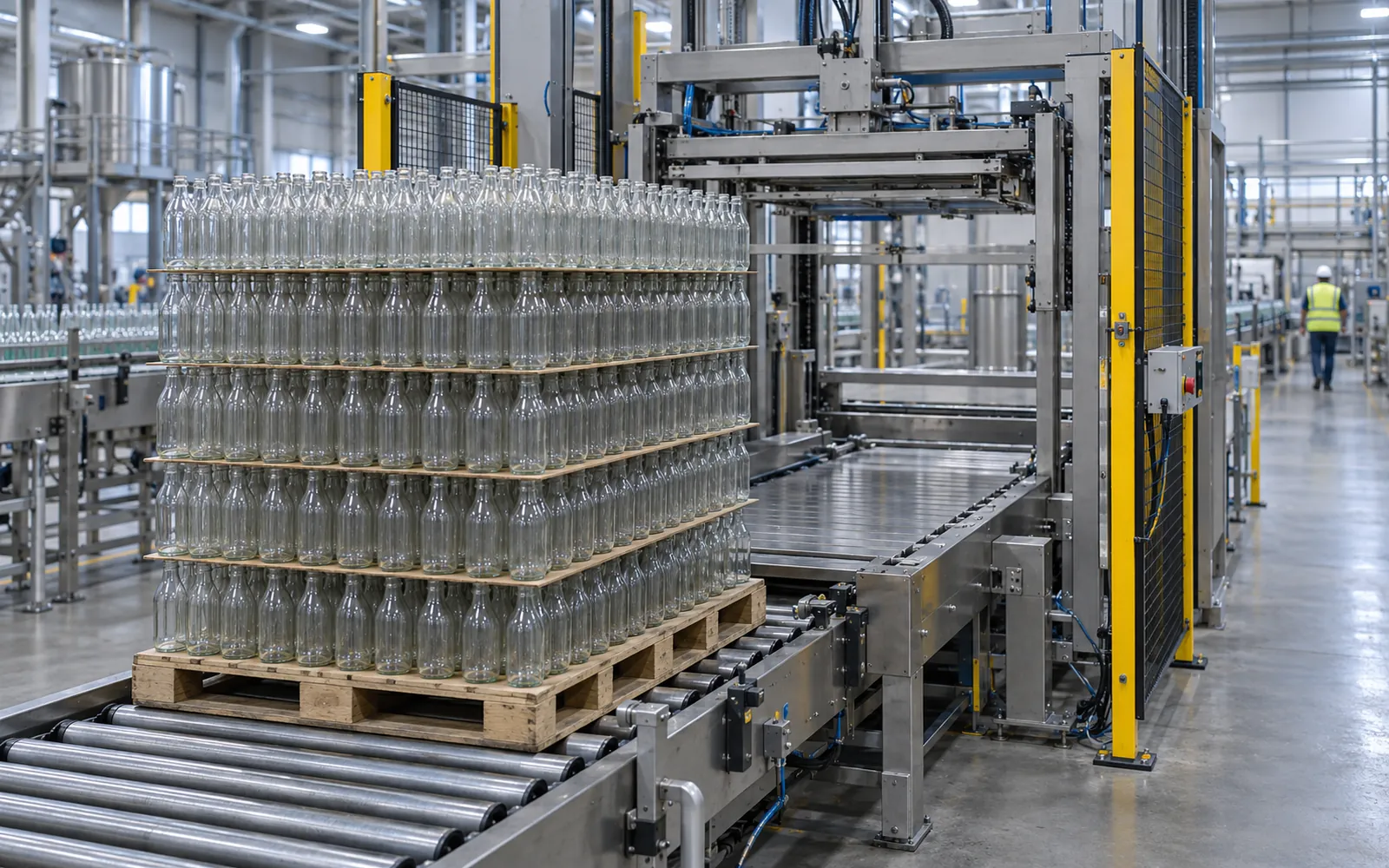
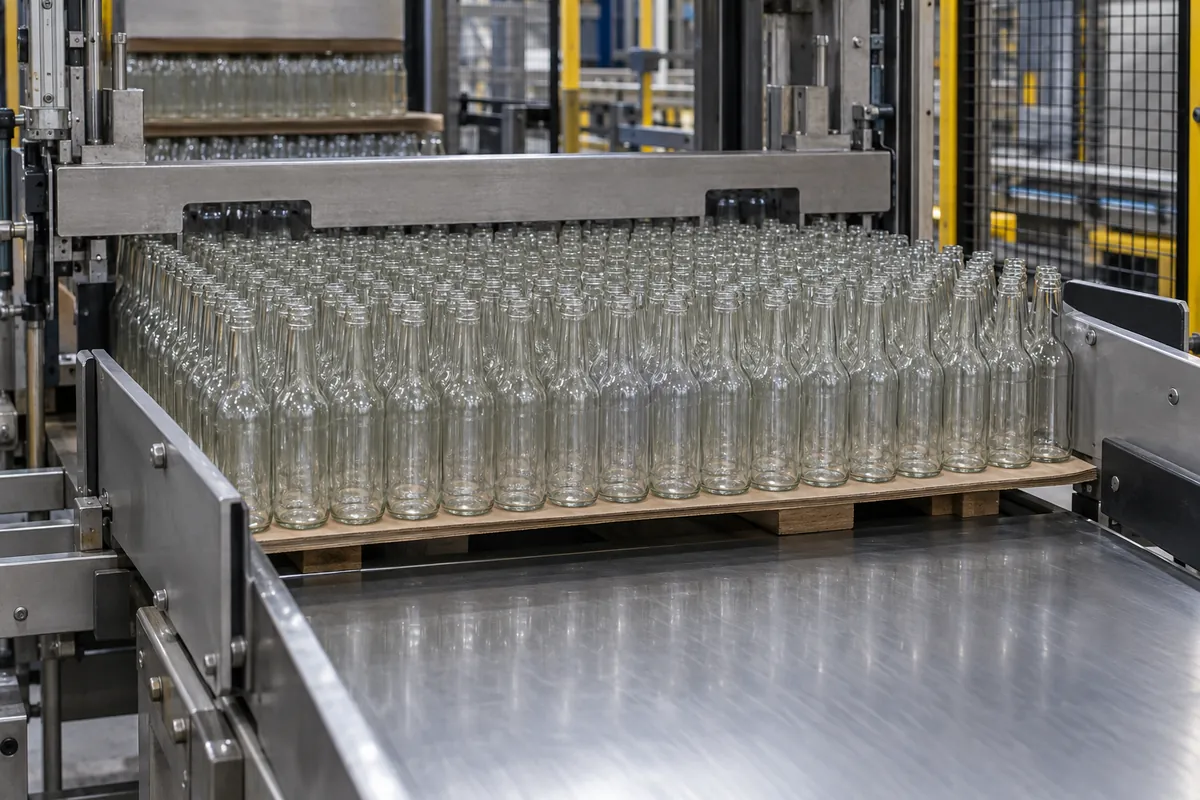
Bulk, or layer-sweep, depalletizers unload loose, uniform containers such as empty glass bottles, plastic bottles, cans, and jars. The machine lowers or raises the load to the working level, holds the layer beneath, and pushes the top layer onto a discharge table with a sweep bar. The tier sheet is lifted away and stacked, and the next layer follows. Sweeping is a widely used way to unload empties at line speeds. The bulk depalletizer guide has the working details.
Layer-pick machines lift the whole layer with a pick head that uses suction or inflatable membranes, then set it on the discharge conveyor. Supplier literature lists a suction head as one option for moving a layer to an aligner. They suit shapes or surfaces that should not slide, and containers delivered in trays.
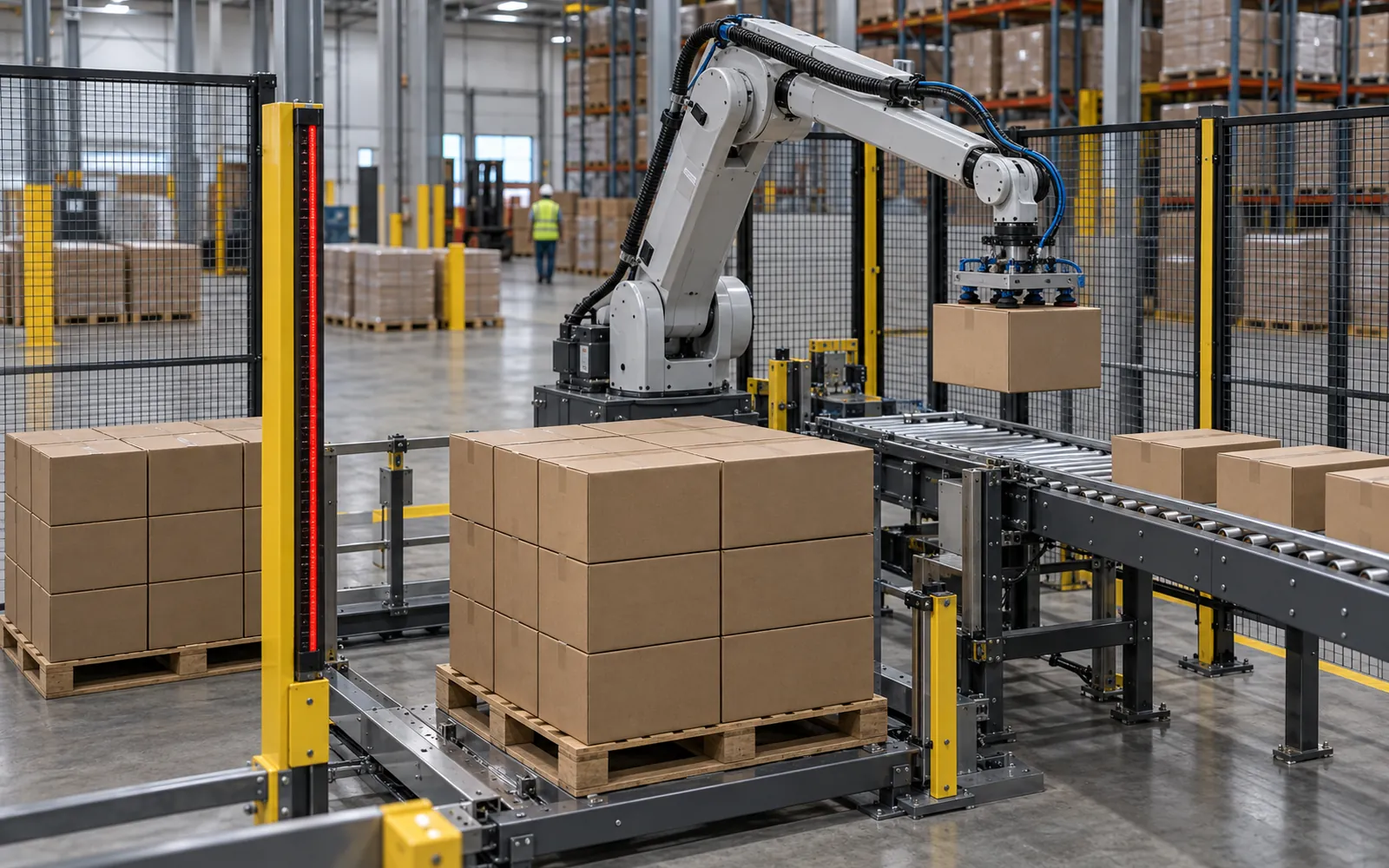
Case depalletizers remove cartons, trays, or shrink-wrapped packs from a pallet and place them on a conveyor. They turn up in distribution, in co-packing, and on lines that open cases for downstream processing. Conventional case machines use layer-handling mechanisms, and others use a robot.
Robotic depalletizers use an arm with a vacuum or clamp gripper, often guided by vision, to pick cases or layers. The gain is flexibility: mixed case sizes, changing patterns, and several destinations from one cell. Compare sustained output using the proposed gripper, load pattern, destination and pallet-change sequence; the robot label alone does not determine rate. The robotic palletizer guide covers robot cells in the stacking direction, and the cell design questions are similar.
Two variations cut across all of these. The first is discharge height. A high-level machine raises the pallet to a discharge height above the line and usually lowers the containers back to line height on a conveyor. A low-level machine unloads at or near floor level and discharges lower, sometimes with an option for a higher discharge. Low-level designs are often easier to reach for service and may need less structure around them, while high-level designs help when the discharge has to sit above other equipment. Confirm the required discharge and receiving-conveyor heights for the project rather than using a generic working height.
The second is manual assist. A lift table or pallet positioner brings the load to a convenient height while an operator removes the product. It costs less and suits low volumes, light loads, or frequent changes in container type.
Read model rates on the same basis
Sidel’s public Sweepoff-A brochure (PDF page 2, accessed October 8, 2026) states maxima of 7 layers/minute and 144,000 containers/hour for its high-level depalletizer. Its public Sweepoff product page separately states 3 layers/minute for Sweepoff-B, a low-level model. These are manufacturer statements for different models; the published maxima do not identify one shared bottle, layer plan or test window.
For an illustrative conversion, assume 343 containers/layer, uninterrupted discharge and no pallet-change loss:
7 layers/minute x 343 containers/layer x 60 minutes/hour
= 144,060 containers/hour (about 144,000)
The assumed 343 is the rounded implication of 144,000 / (7 × 60) ≈ 342.9; it is not a published layer count. The two catalogue maxima alone do not establish a production rate. Obtain actual containers/layer, pallet changes and sustained output before comparing Sweepoff-A, Sweepoff-B or any other model.
System architecture
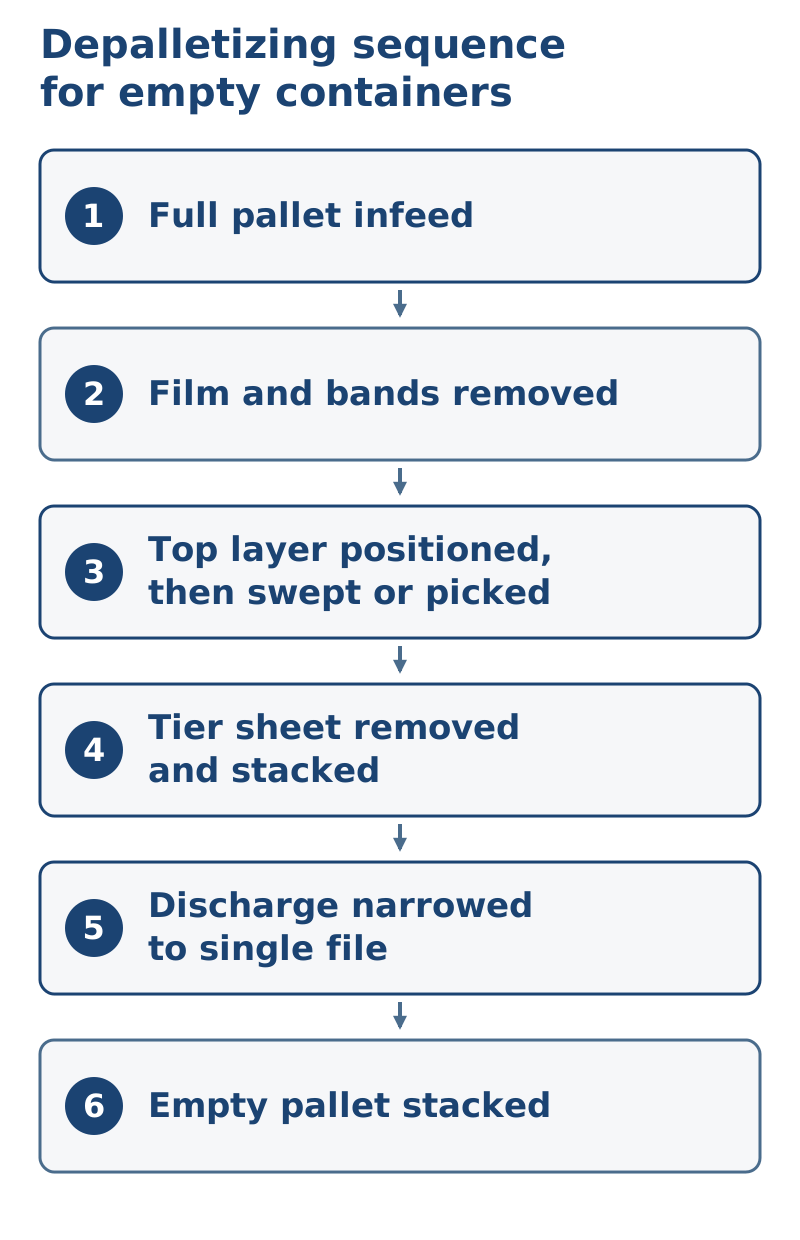
Most depalletizing systems for empties follow the same sequence, though suppliers name the steps differently.
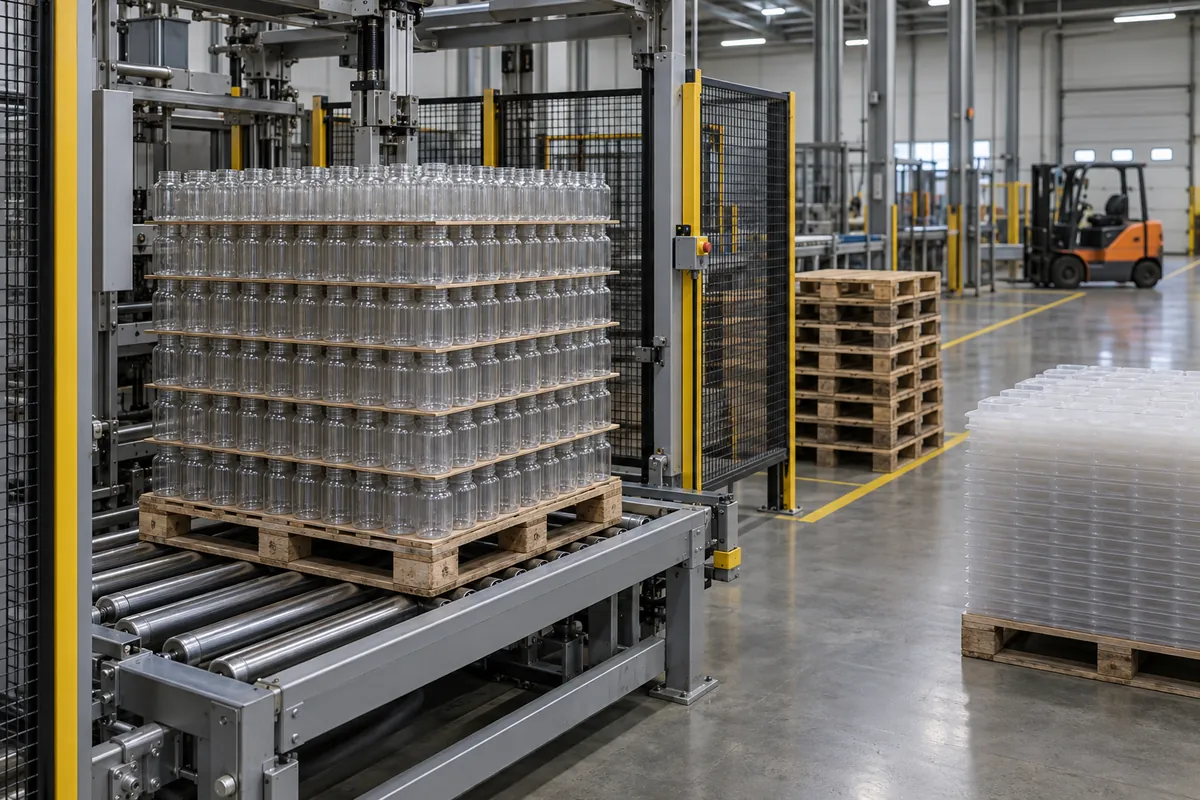
- At the infeed, a fork truck sets a full pallet on a powered conveyor, which carries it into the machine. A staging conveyor holds several pallets so the line keeps running while the operator reloads. Some systems add a lean detector that flags badly shifted loads.
- Stretch film, bands, and any top frame or cap come off before sweeping. Supplier literature commonly says film and bands are removed before the load enters the machine, and automatic top-frame removal is an option on some models.
- For the sweep or pick, the elevator positions the top layer at the working level. The machine squares the layer, holds the layer below, and moves the top layer by pushing, picking, or gripping.
- Once a layer leaves, vacuum or grippers lift the separator sheet and stack it in a magazine or hopper. Without this step, sheets contaminate the container stream.
- At discharge, the layer lands on a discharge table. Conveyors then narrow the flow, directly or through a hopper and positioner, into a single file for rinsers, filling machines, or other equipment. The conveyors section covers the transport side.
- At the end, empty pallets are stacked for a fork truck or moved to a magazine. A-B-C’s older Model 108 manufacturer brochure, marked C-138-12/01, lists 1,500 lb for optional empty-pallet removal/stacking (PDF page 3; accessed October 8, 2026). That is the stated stacker capacity in that document, not a full-load capacity or a rate comparison; confirm the current configuration and pallet mix. Size pallet and sheet removal for the weight and variety of pallets the plant receives.
Decision factors
Glass needs gentle layer control and smooth acceleration, and supplier literature for sweep machines describes variable frequency drives providing soft start and soft stop for this reason. Light plastic bottles and cans topple easily and need side containment. Heavy containers are not well suited to a fast sweeping motion.
Match the machine to the filler’s real rate, not only the nameplate. Check how the rate is stated (layers per minute, layers per hour, containers per hour) and whether pallet changes are included. Put accumulation between the depalletizer and the filler so pallet changes do not starve the line.
For changeover, count the container formats and pallet patterns the line runs. Some suppliers describe formats stored as recipes and set from the screen, without operator change parts. Others rely on adjustable guides and hand adjustments. Ask for the steps and the time.
Find out what the glass or can supplier ships: sheet material, top frames, pallet types, film, and bands. The incoming load may vary by supplier or by plant, so specify the machine for the worst case.
Low-level and high-level discharge change the mezzanines, lowerators, and conveyors needed around the machine, so include them in the comparison and not only the machine itself.
On sanitation, a machine ahead of a rinser carries dust and glass chips that the rinser should remove, but a clean frame, open access, and smooth surfaces are still easier to maintain. Covers over the discharge conveyor can help keep stray items out of open containers.
The hazards include falling containers, glass breakage, pinch points at the sweep carriage and elevator, and fork truck interaction at the pallet infeed. In the United States, 29 CFR 1910.212 requires guarding for operators and others in the machine area from hazards such as nip points and rotating parts, and 29 CFR 1910.147 covers lockout/tagout for servicing and maintenance where unexpected startup or stored energy could cause injury. Before a specification is final, a site-specific risk assessment should cover guarding, interlocked access, jam clearing, and traffic routes.
How depalletizing connects
A depalletizer is rarely a standalone purchase. Its discharge becomes the first conveyor of the line, so design that conveyor, the single-filer, and any rinser or inspection step together. When bottles must change elevation, vertical conveyors and other conveyors carry the load between levels.
At the other end of the packaging chain, palletizing puts finished goods back on pallets. Plants that run both often find shared requirements: pallet quality, pallet pattern data, and clear fork truck routes. A palletizing project can also reveal pallet and tier sheet standards that affect what the depalletizer will see next.
The equipment map shows the full site. When you are ready to compare suppliers, the commissioning and acceptance checklist helps organize questions on scope, utilities, and acceptance testing.
Where to read next
The bulk depalletizer page covers specifications, container compatibility, integration, and cost drivers for layer-sweep machines. Detail pages on bottle depalletizers and case depalletizers are also available. The packaging conveyor cost guide and the packaging line layout guide help plan the infeed. For plant use, see bottled water packaging, food packaging, and bottle handling.