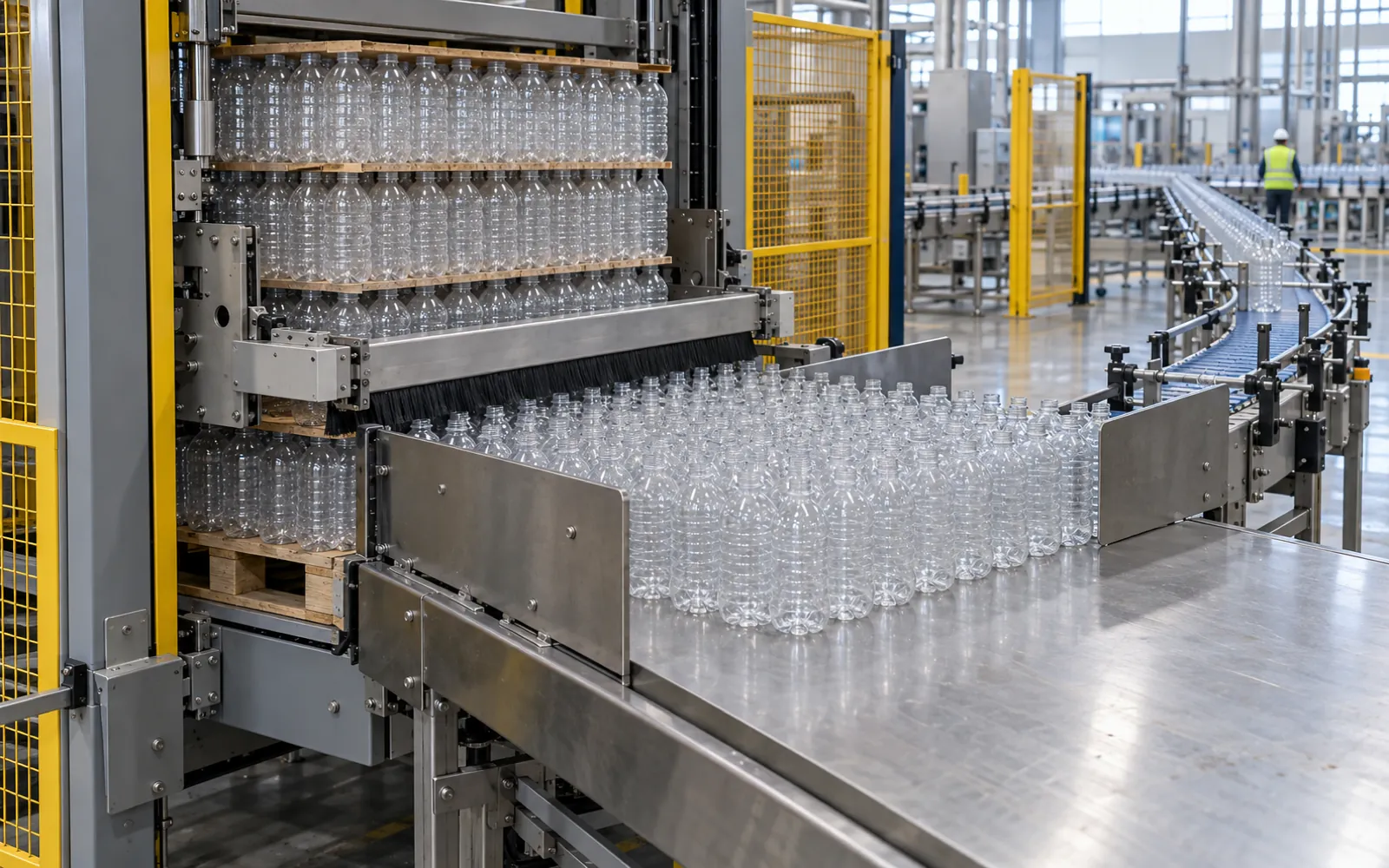
Bottle tipping or glass breakage can stop the filler. Choose sweep or layer pick from bottle contact limits, then prove containment, sheet removal, and single-filing with the hardest production samples.
| Method | Contact to check | Hardest sample | Acceptance action |
|---|---|---|---|
| Layer sweep | Base sliding and shoulder contact | Least stable PET; glass with vulnerable finish | Run complete pallets; record tipping, chips, and discharge jams |
| Layer pick | Tool contact and release into the layer pattern | Bottle shape or finish unsuitable for sliding | Demonstrate grip, release, and placement without damage |
| Material | Main risk to test | Sample to include | Record at acceptance |
|---|---|---|---|
| PET | Tipping during sweep and single-filing | Lightest, tallest narrow-base production bottle | Fallen bottles, transfer gaps, restarts, and lower-layer movement |
| Glass | Impact damage and fragments reaching discharge | Most fragile format and shifted incoming layer | Chips/breakage, stop response, and agreed cleanup procedure |
These are proposed trial checks, not test results. The depalletizing hub covers the family; the bulk guide covers shared layer handling, and the bulk glass and PET bottle depalletizer selection guide provides the throughput math and tier-sheet extraction criteria.
How it works
Bottle depalletizing repeats a cycle of positioning, holding, transferring, and clearing. The mechanics are the same for glass and PET, but the settings differ.
- A full pallet arrives by fork truck, usually onto a powered conveyor, and film and bands come off first. The load is centered and a sensor finds the top layer height, so every layer reaches the same working level even when pallet heights differ.
- Bottles shift in transit, so mechanical frames or plates square the layer that will move and the layer below it before any transfer. One supplier describes this squaring as a standard step ahead of each sweep.
- While the top layer slides off, the layer underneath has to stay still. Supplier literature describes side-mounted friction plates for the lower layer and grippers that pin the tier sheet. Without that hold, the sheet can drag the lower layer and tip bottles.
- The top layer moves from the pallet to a transfer or discharge table, either pushed by a sweep carriage or lifted by a head. Both methods are covered below.
- A vacuum or mechanical gripper lifts the tier sheet and stacks it in a magazine or hopper. Some designs use a pick-and-place arm for this.
- The layer moves off the table into conveyors that narrow the mass of bottles into one row, or into a hopper that feeds a bottle positioner.
- When the last layer leaves, the empty pallet is stacked in a magazine or left for a fork truck.
The cycle is simple to describe and unforgiving in practice. Because a whole layer moves at once, one leaning bottle or a damaged pallet can disrupt dozens of bottles.
Glass and PET: how the two behave
The same pallet pattern of empty bottles can be a different engineering problem depending on the material.
Lightweight PET and stability
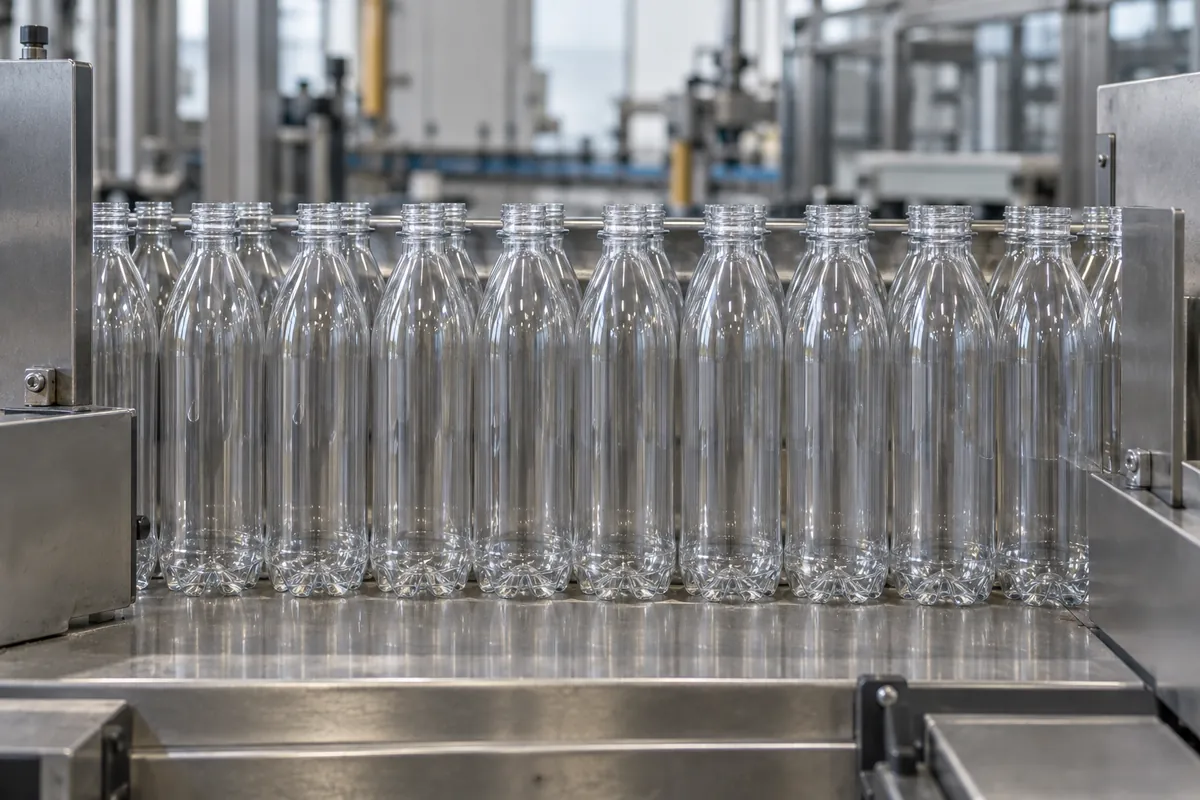
An empty PET bottle has little mass for its height. A tall, narrow bottle with a small base has a high center of gravity and weighs almost nothing, so friction against a tier sheet, a small pressure difference, or a slightly uneven push can tip it. Bottles that fall in the discharge area cause jams, and a jam stops the line.
Containment is the first defense. Supplier literature describes layers held on all four sides as they move from pallet to table, including for very small bottles. At the leading edge, check how bottles are supported so none drop into a gap between the pallet and the table.
Acceleration matters next. A fast sweep may be fine for compact, stable containers and unsafe for tall, thin ones, and variable frequency drives that ramp the carriage up and down give a gentler start and stop. Bottle condition also plays a part: PET bottles often pack tightly, with the layer held by contact between shoulders, and a layer compressed in a wrapped pallet may spring when released. Light bottles can also be affected by static on tier sheets or by air movement near the discharge, so ask how the supplier treats these on tall formats.
Sidel’s Sweepoff A public product page lists up to 7 layers/min and line output up to 144,000 containers/hour (accessed October 8, 2026). These are supplier claims for the high-level model; the page does not specify the bottle count per layer or a pallet-change test window. Confirm both for your format.
Glass and breakage
Glass can also tip; impact damage is the additional concern to test. Glass chips and breaks when bottles strike each other, the machine, or the table, and soft starts and stops, squared layers, and smooth transfer plates all reduce that. A broken bottle at the depalletizer can send fragments to the discharge conveyors and toward the rinser or filler, so the line needs a way to remove fragments and a plan for stopping when a bottle breaks.
The same Sidel page lists Sweepoff B at up to 3 layers/min, particularly for glass lines, and also for PET (accessed October 8, 2026). Confirm handling and sustained output with your glass samples.
Tier sheets between layers cut bottle-to-bottle contact on the pallet and during removal. A misaligned sheet can also cause a jam, so sheet gripping and magazine design are worth reviewing.
Noise is the last point. Glass moving on a metal or plastic table makes noise, and breakage makes more. One supplier describes a low noise level as a feature of its range. Ask for sound data measured at the operator position, and ask what surface treatment, table material, and layer speed that figure assumes. Noise also depends on the room, so a site measurement after installation is the proper check.
Mixed material plants
Some suppliers describe machines that run glass, plastic, aluminum, and steel containers interchangeably with no change parts, with formats stored on the control screen. That suits plants with seasonal or multi-product lines. It does not remove the need to confirm settings for each bottle, because the lightest PET and the most delicate glass set the machine’s limits.
Types and configurations
Layer sweep versus layer pick
A sweep carriage with side plates and a rear bar pushes a squared layer from the pallet to a table. It is mechanically simple and fits high rates. The bottles slide on their bases, so base shape and surface friction matter. Sweep is the default for most uniform, stable bottle formats.
A pick head lifts the entire layer with suction, inflatable, or clamping elements and sets it on the discharge. One supplier describes a suction head that lifts a whole layer and places it at an output aligner. Another describes a robot that picks layers and sets them on an accumulating table that launches bottles to the filler. Pick suits bottles that should not be pushed, formats with unusual bases, and bottles with fragile decoration or finish. It generally moves fewer layers per minute than sweep, and the head must match the layer pattern.
A third arrangement pushes bottles into a large-capacity hopper that feeds a bottle positioner. It fits plastic bottles that can be handled as a mass.
The opening table compares the contact and sample checks for these methods.
The table is a general orientation based on how supplier literature describes the two methods. Each machine differs, so use it to prepare questions, not to decide.
Low-level and high-level machines
A low-level machine unloads at or near floor height and keeps the operator, controls, and maintenance at ground level. A high-level machine raises the load and discharges above the line, so bottles must come back down on a conveyor. For glass, suppliers often point to low-level designs for gentle handling, and high-level machines are common on high-rate PET lines. Specify the lowering conveyor and discharge height from the actual line interface drawing.
Tray, sheet, and bagged loads
Bottle pallets arrive in several forms. Many use tier sheets between layers. Some use inverted trays, where the pallet is built from empty trays turned over each layer. Others use bagged bottles, which one supplier states reduces contact with cardboard. Each form changes how the machine separates layers, and bagged loads need a bag removal step, not a sweep. Confirm the incoming form before specifying the machine.
Level of automation
Common options include a full-pallet infeed conveyor, tier sheet and top frame removal, empty pallet stacking, a lean detector, and a single-filer. The more automation, the fewer hands near the machine and the more equipment to maintain.
Tier sheet handling
Tier sheets separate layers and protect bottles, and they create problems that are easy to overlook. Vacuum cups work on smooth sheets and may struggle with porous board, while mechanical grippers or a pick-and-place arm handle other types. Ask which sheet materials, sizes, and thicknesses were run.
The sheet must also stay put when the layer above moves. Supplier descriptions include four grippers that retain the sheet in position. Removed sheets stack in a magazine or hopper, and the capacity decides how often someone must empty it.
Dust or fibers from paperboard can reach bottles, which matters on a line that feeds a filler without a rinser. Pallets from different suppliers may also use different sheets, so the machine should cope with the range you receive, or you should limit the range.
Specifications to evaluate
Request every value in writing for your own bottles, pallets, and line.
| Specification | Why it matters | What to ask the supplier |
|---|---|---|
| Rate and its basis | Sets whether the machine can feed the rinser and filler | Is the figure in layers per minute, layers per hour, or bottles per hour? Does it include pallet change and sheet removal time? |
| Bottle range | Diameter, height, weight, and base shape set containment and sweep settings | Which bottles have been run? Which are the lightest and tallest, and what changes between formats? |
| Layer containment | Controls tipping and breakage during transfer | How are the layer above and the layer below held? How is the tier sheet pinned? |
| Transfer method | Decides contact and handling forces | Is it sweep, pick, or pusher to hopper? What are the limits for fragile or unusual bottles? |
| Tier sheet and top frame handling | Prevents sheets reaching the bottle stream | Which sheet types, sizes, and materials work? What is the magazine capacity? |
| Pallet size and load height | Fixes elevator and conveyor design | Which pallet footprints and total load heights, including the pallet itself, are supported on the proposed model? |
| Discharge height and direction | Fixes how it joins the line | What are the available discharge heights and outfeed directions? What conveyors are included? |
| Changeover method | Determines downtime between bottle formats | Are settings recipes or manual adjustments? How long does a change take in practice? |
| Noise | Affects operator comfort and compliance planning | What is measured at the operator position, at what rate, with which bottle? |
| Controls and diagnostics | Affects troubleshooting speed | What fault messages, sensors, and screens are provided? |
| Guarding and safety devices | Defines the hazards that remain | What guards, interlocks, and e-stops are included? What risk assessment documents are provided? |
When quotations are compared, convert all of them to bottles per hour using your own layer count. A layer of small bottles holds many more units than a layer of large ones, so the same layer rate gives very different outputs.
Bottle compatibility
Bottled water lines often run several sizes of PET on one filler, from compact single-serve formats to large multi-liter jugs. Small, light bottles are the most prone to tipping, and large ones put more weight on each layer, so specify both ends of the range. Carbonated and juice PET often use heavier or hot-fill designs with different base shapes, so check base contact with the table and the way the layer packs.
Glass bottles for beer, soft drinks, wine, and spirits have necks and shoulders that contact one another. Reverse-taper or unusual shapes may need pick rather than sweep, and decoration, embossing, or lightweight glass can affect handling. Very small glass bottles and vials can be held on all four sides as they move, and suppliers describe designs that handle them, though layers with many units also need careful single-filing.
Jugs, handled jars, and other irregular containers often need their own checks. Treat them as a separate application until the supplier confirms in writing.
Integration upstream and downstream
Full pallets arrive by fork truck. A powered infeed with space for more than one pallet gives the operator time to reload without stopping the machine. Plan the fork truck path, staging area, and film removal. Inspect incoming pallets for leaning, crushed layers, and damaged sheets, since a poor pallet is a common cause of tipped bottles. Where pallets come from a bottle blow-molding or glass supplier, agree on a pallet pattern, sheet type, and wrapping method so the machine sees consistent loads.
The discharge table delivers a mass of bottles, and the filler wants one row. The step between is where many lines lose efficiency. Options include line-up conveyors that narrow the flow gradually, a hopper feeding a bottle positioner, and an aligner at the output of a pick head. One supplier describes an example start of line in which a depalletizer for plastic bottles feeds a positioner that feeds a rinser, which delivers clean bottles to the filler and capper. Bottle conveyors are the usual connection, and the discharge table must match the infeed width and speed of the first one.
Questions to settle with the supplier:
- Does the single-filer reject fallen bottles or leave them for an operator?
- Is the bottle neck or the base the control surface, and does it suit the format?
- How are elevation changes handled, and what is the effect on light PET?
- Does the rinser or air cleaner need a specific infeed orientation, such as bottles upright or inverted?
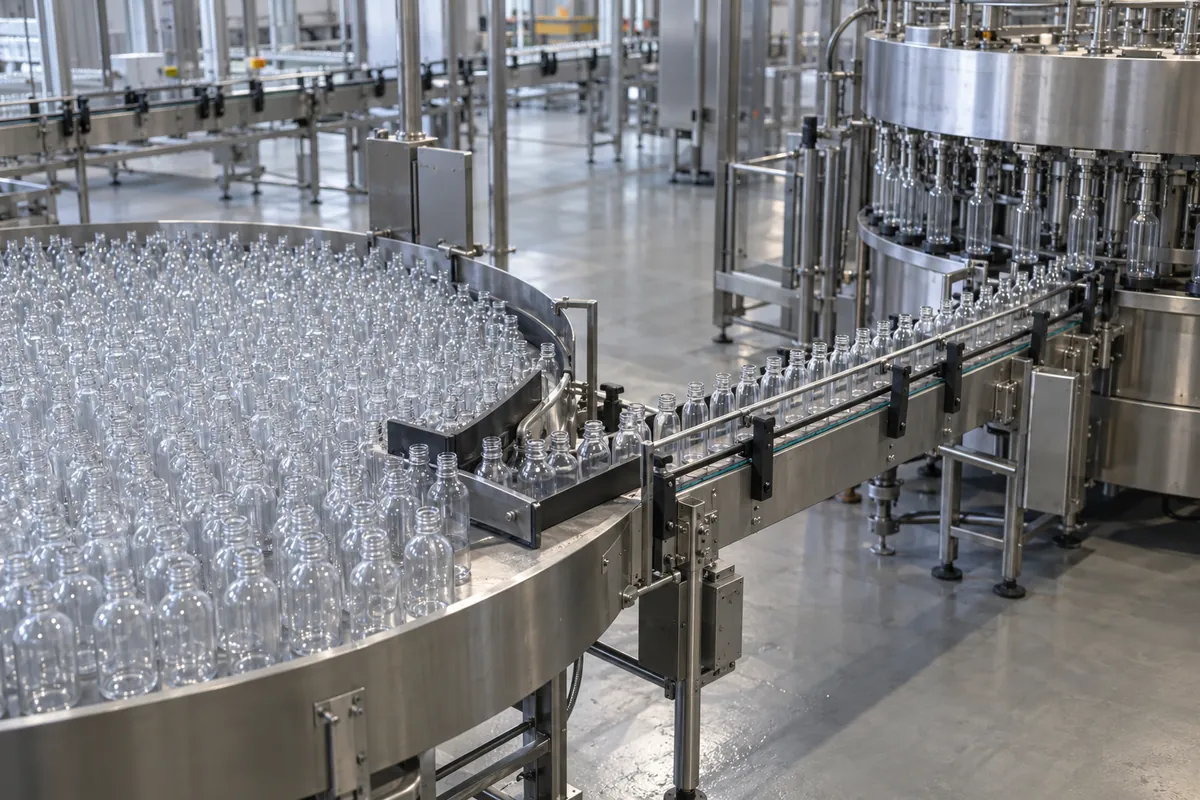
A buffer between the depalletizer and the rinser or filler lets the line keep running through pallet changes, sheet jams, and short stops. Accumulation conveyors hold that buffer. Size it from the time to change a pallet, clear a jam, and restart. Light PET bottles do not tolerate high line pressure, so check how the accumulation area limits pressure on the bottles.
In bottled water and other beverage plants, the depalletizer often sits at the head of a line that runs rinse, fill, cap, label, and pack. In a blow-fill arrangement, bottles may never be on pallets at all, and direct transfer from the blow molder replaces the depalletizer. Where bottles do come in on pallets, the filler rate sets the requirement. Water plants may run large numbers of identical bottles on one line, while multi-product beverage plants may have frequent format changes and bottle types, so define the changeover pattern as clearly as the rate. Related plant context is in bottled water packaging and beverage packaging automation.
Footprint, utilities, controls, and safety
Layout depends on discharge height, infeed and outfeed length, and sheet and pallet stackers. Request a drawing showing fork truck access, maintenance clearance, and ceiling height for the tallest pallet, and check it against your building before relying on it.
Typical utilities are electric power and compressed air for clamping and gripping devices, plus vacuum for sheet removal. Values vary by machine, so request them on the data sheet. For controls, look for a programmable controller, an operator screen with diagnostics, bottle recipes, and clear indication of jams. Define signals to the rinser, filler, and accumulation system so that stopping and restarting happen in an agreed order.
The main hazards are falling bottles and glass, pinch and crush points at the sweep carriage and elevator, moving pallets, stored energy in pneumatic and gravity-loaded parts, and fork truck interaction near the infeed and pallet stacker. Glass adds cut hazards when clearing jams and sweeping shards. Typical controls include fixed guards, interlocked access gates, emergency stops, and defined fork truck zones.
In the United States, 29 CFR 1910.212 requires one or more methods of machine guarding to protect operators and others in the machine area from hazards such as nip points and rotating parts. The lockout/tagout standard, 29 CFR 1910.147, applies to servicing and maintenance when unexpected startup or release of stored energy could injure workers, and it calls for an energy control program. Stored energy matters here, because a lifted elevator table or a pressurized air line can move after power is off. Supplier guarding does not replace a site-specific risk assessment, which should cover the whole installation, including the pallet infeed, discharge conveyors, glass cleanup, and maintenance access.
Cost factors
This page does not give prices. The main drivers of a quote are:
- Higher layer rates and taller pallets call for stronger drives, frames, and controls.
- Pick heads and robots usually cost more per layer-per-minute than sweep carriages, while sweep machines may need more guiding.
- High-level machines add structure and a lowering conveyor, and low-level machines can reduce that structure.
- More bottle formats mean more adjustability, recipes, or change parts.
- Automatic sheet removal, frame removal, and empty pallet stacking each add equipment.
- The path from table to rinser can be a large share of the project. The packaging conveyor cost guide shows how conveyor drivers add up.
- Guarding, interlocks, and documentation depend on the site, and installation covers rigging, utilities, commissioning, and training for operators and maintenance staff.
Compare installed cost together with breakage, downtime, and labor effects, not only the machine price.
Selection checklist
- List each bottle: material, size, weight, base shape, and the most unstable and most fragile items.
- Record pallet data: size, load height, layer count, pattern, and what holds the load together.
- Identify the form of the load: sheets, inverted trays, or bagged.
- Set the required rate in bottles per hour from the filler rate plus a margin.
- Count formats and how often they change.
- Decide on low-level or high-level discharge, based on the first conveyor and ceiling height.
- Define the transfer to the rinser or filler, including single-filing and accumulation.
- Plan pallet infeed, staging, and empty pallet handling.
- Confirm floor space, utilities, and fork truck routes.
- Set safety scope, guarding, and the site risk assessment.
- Agree acceptance tests with your own bottles and pallets, including the lightest PET and the most fragile glass.
Use this blank record for each format. Count good bottles leaving the single-filer over the complete timed window; do not subtract the same pause twice.
| Trial field | Fill in for this format |
|---|---|
| Bottle / pallet / sheet lot; test date | ___ |
| Layers × bottles per layer = bottles per pallet | ___ × ___ = ___ |
| Pallets run / total good bottles at discharge | ___ / ___ |
| Start-to-finish elapsed minutes, including stops | ___ |
| Sheet-removal pauses / pallet exchanges, minutes | ___ / ___; already included in elapsed time |
| Tipping / breakage / blocked outfeed events | ___ / ___ / ___ |
| Good bottles/hour = good count × 60 / elapsed minutes | ___ |
Takeaway: Accept the bottle stream at the downstream interface, not only a fast sweep cycle.
Use the commissioning and acceptance checklist to agree trial conditions and pass criteria.
Common mistakes
- Specifying by the average bottle. The lightest, tallest, and most fragile bottle sets the limits.
- Trusting a nameplate rate. Layer rate and bottles per hour differ, and pallet change time may not be included.
- Ignoring incoming pallet quality. Leaning layers, crushed sheets, and loose film are the usual causes of fallen bottles.
- Treating glass and PET alike. Glass needs gentle impact control and shard planning, and PET needs full containment.
- Forgetting the single-filer. A good depalletizer can still starve a filler if the narrowing step is wrong.
- Leaving out the buffer. Without accumulation, each pallet change stops the rinser and filler.
- Skipping noise and shard planning. Glass lines need a plan for noise measurement and for removing fragments safely.
- Adding guarding late. Jam clearing and fork truck access need design from the start.
Alternatives
If bottles arrive packed in cartons or shrink-wrapped trays, a case depalletizer handles the packs and a downstream unpacker handles the bottles. If the same line also runs cans or jars, the general bulk depalletizer is often specified for all of them.
A robot with a layer gripper handles unusual bottle shapes, changing patterns, and several products on one cell, usually at a lower rate than a dedicated sweep machine running one bottle at high speed. A lift table that holds the pallet while operators unload suits small volumes and trials, but it does not remove ergonomic load or keep pace with a high-rate filler.
Plants that make PET bottles on site can transfer directly from the blow molder to the filler and remove pallets from the process. That changes the equipment list rather than replacing the depalletizer one for one.
Browse the equipment map to see how depalletizing connects to conveyors and palletizing, or read the guide on how to choose a palletizer for the matching end-of-line decision.