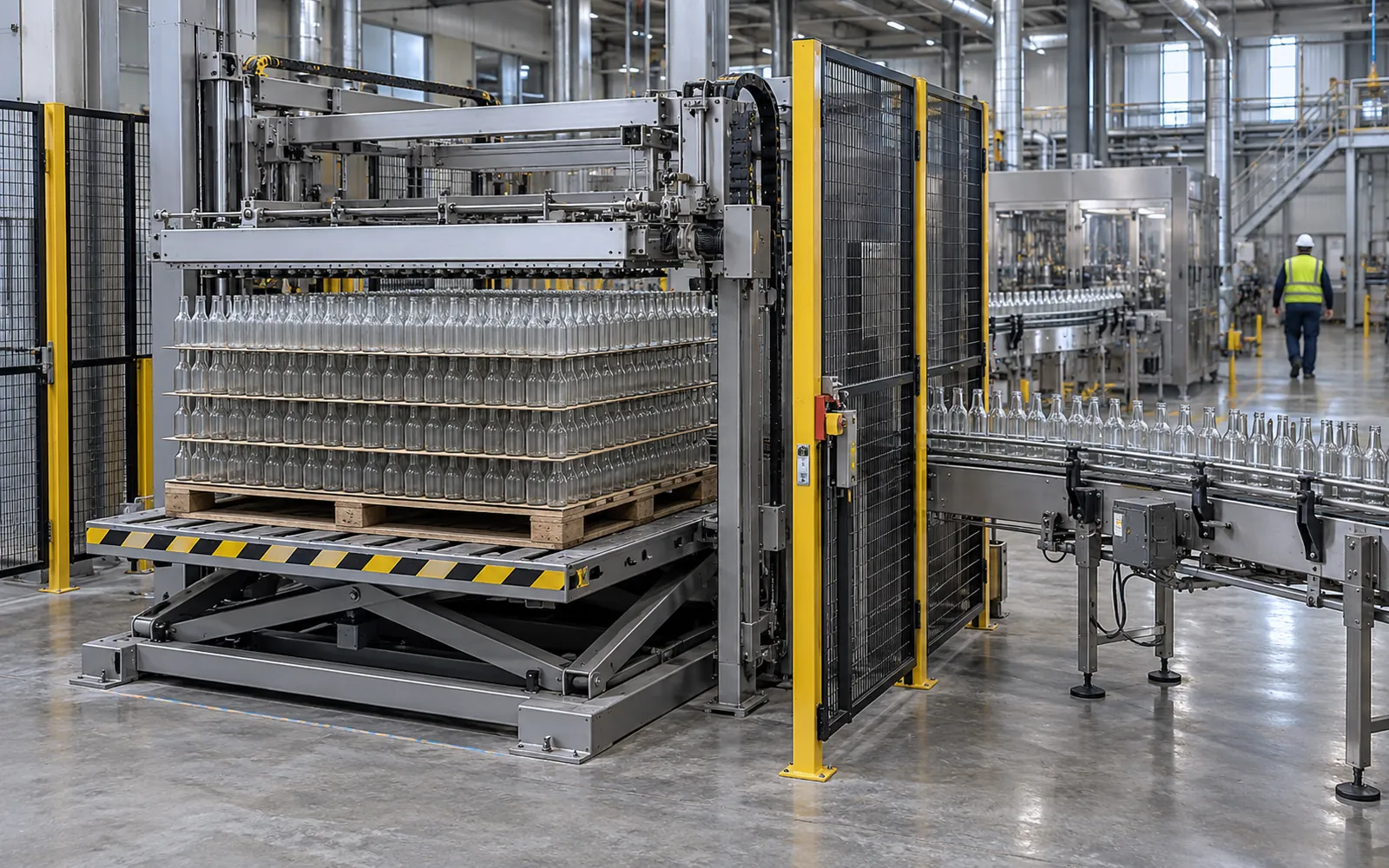
Selecting the wrong bulk depalletizer or bottle depalletizer by comparing brochure layer-per-minute ratings alone causes chronic filler downtime, fallen-bottle combiner jams, and glass cullet damage across the sweep table when pallet heights, tier-sheet porosity, and pallet-exchange pauses are ignored. Every depalletizer machine specification must lock four mechanical interfaces before supplier quotes are evaluated: pallet-to-discharge elevation architecture, four-sided container containment across the dead-plate gap, automated dunnage extraction for the plant’s sheet and tray mix, and mass-flow accumulation buffering ahead of the single-filer.
While the depalletizing systems hub maps incoming unit loads across cases, cans, and bottles, and the equipment references on bulk depalletizers and bottle depalletizers explain baseline operating principles, this engineering selection guide establishes the quantitative sizing equations, containment checks, and Factory Acceptance Test (FAT) criteria required to write a purchase specification. If containers arrive enclosed inside reshipper cartons rather than stacked in open layers on tier sheets, route the project to case depalletizers instead.
Match the bulk depalletizer and bottle depalletizer machine architecture to pallet height and discharge elevation
The primary structural split in bulk depalletizer selection is how the machine bridges the vertical distance between a tall incoming beverage pallet—commonly stacked to 2,400–2,900 mm (94.5–114.2 in) to maximize trailer cube with lightweight empties—and the downstream filling line’s working conveyor height of 1,000–1,100 mm (39.4–43.3 in). Choosing between a high-level mobile-pallet hoist, a low-level fixed-pallet machine with an intermediate lowering carriage, a low-level rising-platform direct sweep, and a full-layer pick gantry governs both sustainable cycle rate and floor footprint.
| Architecture | Published Reference Models | Published Cycle & Container Rate | Max Pallet Height & Envelope | Elevation & Transfer Mechanics | Dominant Failure Mode if Mismatched |
|---|---|---|---|---|---|
| High-Level Mobile-Pallet Sweep | Sidel Sweepoff-A (U & Z); BW Goldco Fortis 3000 | Sidel Sweepoff-A: up to 7 layers/min and 144,000 cph (2,400 cpm); typical bottles 1.5–4.5 layers/min (150–600+ bpm) | Up to 2,900 mm (114.2 in) on 1,120 × 1,420, 1,000 × 1,200, or 800 × 1,200 mm pallets | Full pallet lifted inside a 4-upright closed hoist to upper deck; requires a vertical conveyor or side-grip lowerator or air conveyor to reach filler height | Upper mezzanine cost and extra container transfers into and out of the lowerator on fragile glass lines |
| Low-Level Fixed-Pallet + Intermediate Table | A-B-C Model 108; Sidel Sweepoff-B; AND&OR DEPAL | Sidel Sweepoff-B: up to 3 layers/min; typical bottles 80–300 bpm (up to 18,000 bph on Traktech DPI) | Sidel Sweepoff-B: 2,900 mm pallet height, 1,100 mm (43.3 in) table; A-B-C Model 108: 110 in (2,794 mm); AND&OR DEPAL: 2,800 mm | Pallet stays on floor; counterweighted carriage climbs to top tier, sweeps layer onto intermediate platform, and lowers it to 1,000–1,100 mm table | Vertical reciprocating travel of the intermediate table between layers caps sustained speed at 3 layers/min |
| Low-Level Rising-Platform Direct Sweep | AND&OR DMAM-E | 1.0–2.5 layers/min (80–250 bpm) | Max pallet height capped at 1,500 mm (59.1 in) on AND&OR DMAM-E | Pallet indexes upward on a lift platform one layer per cycle, sweeping directly onto line-height launching table | Cannot accept 2,400–2,900 mm tall beverage pallets unless discharge table sits above standard line height |
| Full-Layer Grip-and-Lift (Suction / Robotic) | Autopack / Traktech DVI; AND&OR RDZ-DMAM | 1.0–3.0 layers/min; Traktech DVI rated up to 18,000 bph (300 bpm) | Traktech DVI: 1,000 × 1,200 mm up to 2,500 mm tall; AND&OR RDZ-DMAM: up to 2,700 mm | Gantry or robot lowers a full-layer suction plenum or columnar gripper head, lifts layer vertically, and places it onto outfeed table | Suction heads fail on downward-facing inverted trays; gripper tooling requires pitch matching across bottle diameters |
In a high-level mobile-pallet bulk depalletizer such as the Sidel Sweepoff-A or BW Packaging Goldco Fortis 3000, a four-upright closed lifting tower or four-chain hoist raises the 2,900 mm pallet load to a fixed upper sweep deck. Because the sweep carriage only travels horizontally while the hoist indexes one bottle height per cycle, the system reaches 7 layers/min and 144,000 containers/hour (2,400 cpm) on beverage packaging and bottled water packaging lines. Discharging at 2,600–3,200 mm requires an upper platform, stairs, and neck-supported air conveyors or a side-grip lowerator back to 1,000 mm line height.
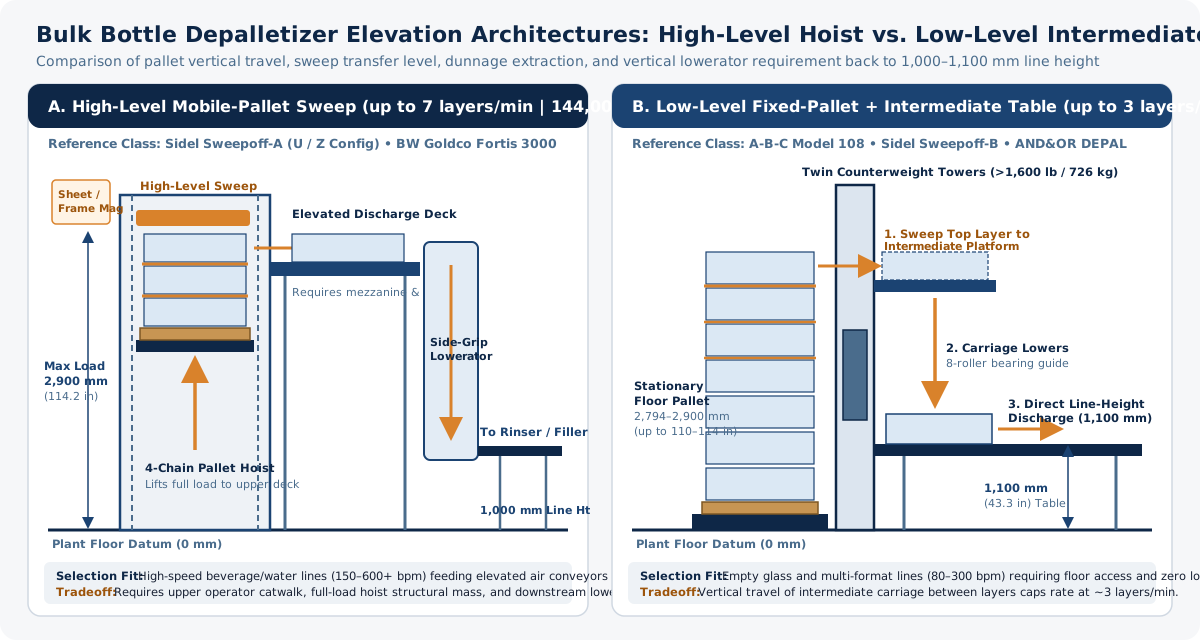
By contrast, a low-level fixed-pallet bottle depalletizer machine with an intermediate carriage—such as the A-B-C Model 108, Sidel Sweepoff-B, and AND&OR DEPAL—keeps the pallet at floor level. A counterweighted carriage climbs the twin towers to the top of the 2,794–2,900 mm (110–114.2 in) stack, sweeps the top layer onto the intermediate platform, and lowers it to a 1,100 mm (43.3 in) ground-level discharge table. This eliminates mezzanines and lowerators for glass lines up to 3 layers/min (80–300 bpm). Separate intermediate-carriage designs from rising-platform machines (AND&OR DMAM-E), where the pallet rises to sweep directly at line height and pallet height is capped at 1,500 mm (59.1 in).
Selection takeaway: Specify a low-level intermediate-carriage depalletizer when net demand is below 2.5–3.0 layers/min and floor-level glass handling is prioritized; select a high-level mobile-pallet hoist above 3.0 layers/min or when feeding overhead air conveyors.
Empty glass versus lightweight PET on a bottle depalletizer: stability physics, four-sided containment, and dead-plate transfer
Although multi-format brochures state that one bulk depalletizer handles empty glass, PET, and cans across diameters from 45 mm up to heights of 400 mm, empty lightweight PET and soda-lime glass fail through opposite mechanical mechanisms during transfer.
Empty lightweight PET stability and dead-plate snag mechanics
Empty 500 mL water and CSD PET bottles weigh 9 to 28 g with an aspect ratio (H / D_base) of 3.2 to 4.2. Because the neck finish (26–38 mm) holds a high share of bottle mass, the center of gravity (h_CoG) sits high while the gravitational restoring moment is small:
M_restore = m_bottle × g × (D_contact / 2)
On thin-wall PET bottles with a 5- or 6-foot molded petaloid base, the support polygon (D_contact) is narrower than the body diameter, and individual feet catch on any step at the tier-sheet edge. Inside stretch-wrapped loads, thin-wall PET bottles compress shoulder-to-shoulder and build triboelectric static charge against plastic or paperboard sheets. When unwrapped and accelerated by a rear pusher, base static drag and shoulder pack spring tip the leading row unless the layer is enclosed on all four sides.
Empty glass bottle friction drag, cullet hazards, and acoustic limits
Empty glass bottles (180 to 550 g for 330–750 mL formats) have a flat bearing ring and high restoring moment, so their primary vulnerability is horizontal Coulomb friction (F_f = μ_slide × N_layer × m_bottle × g) on the underlying tier sheet. A layer of 250 glass bottles at 350 g exerts 87.5 kg (858 N) of normal load. Without positive sheet restraint, base friction drags the sheet into the dead plate and tips the necks of the lower bottle layer.
Glass also suffers finish chipping and breakage at metal steps. A shattered bottle on an elevated deck drops cullet shards into open bottle mouths below or carries fragments into the single-filer and rinser. Un-damped glass-on-glass pressure combiners reach 86 to 92 dBA, exceeding the 85 dBA 8-hour TWA OSHA action level.
Four-sided layer clamping and synchronized front-bar containment
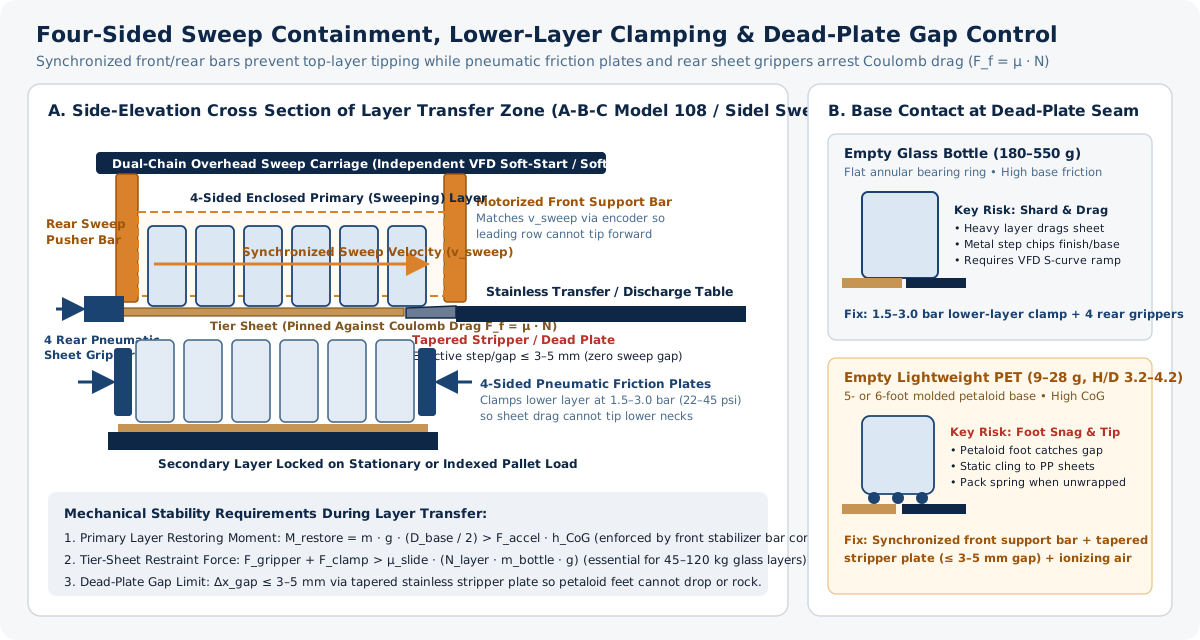
Industrial sweep systems (A-B-C Model 108, Sidel Sweepoff-A/B, and BW Goldco Fortis 3000) execute five mechanical locks per cycle:
- Dual-layer squaring: Mechanical plates square both the primary (transferring) layer and secondary (lower) layer before sweeping.
- Secondary-layer friction clamping: Pneumatic steel friction plates clamp all four sides of the lower layer (1.5–3.0 bar / 22–45 psi).
- Rear tier-sheet pinning: Four rear pneumatic grippers pin the trailing edge of the exposed tier sheet during the stroke.
- Synchronized four-sided sweep carriage: Two side plates, a rear sweep bar, and a motorized front support bar driven by independent VFD motors and encoders (A-B-C Model 108) enclose the moving layer with soft-start/soft-stop ramps.
- Tapered stripper / dead plate: A tapered stainless knife-edge stripper plate bridges the pallet edge to the transfer bed with an effective step ≤ 3 to 5 mm.
| Parameter | Empty Lightweight PET Bottles | Empty Glass Bottles | Required Machine Specification |
|---|---|---|---|
| Mass & Base Geometry | 9–28 g (500 mL); 5/6-foot petaloid base; aspect ratio H/D = 3.2–4.2 |
180–550 g (330–750 mL); flat bearing ring; brittle finish |
Recipe-stored VFD acceleration ramps and clamp pressure regulators per SKU |
| Transfer Vulnerability | Forward tipping; petaloid foot snagging at dead-plate seam; static cling to PP sheets | High Coulomb friction (F_f = μ · N) dragging tier sheet and tipping lower layer; cullet |
Encoder-synchronized motorized front support bar + rear sweep bar + side plates |
| Lower-Layer Clamping | Light clamping pressure (1.5–2.0 bar) so thin walls do not ovalize |
Firm four-sided pneumatic friction plates (2.0–3.0 bar) + 4 rear sheet grippers |
Independent pressure regulation on secondary clamp shroud + rear sheet grippers |
| Dead-Plate Transition | Tapered stainless stripper plate with effective gap ≤ 3–5 mm; anti-static bar | Flush stainless transfer plate with UHMW-PE wear guides and zero drop step | Tapered stripper plate overlapping tier-sheet edge; automatic transition leveler |
| Switch to Layer Pick | Ultra-light (< 10 g) or contoured PET inside upward-facing flanged trays |
Reverse-taper wine/spirits glass, embossed or screen-printed glass | Suction head (Traktech DVI) or columnar robotic gripper (AND&OR RDZ-DMAM) |
Selection takeaway: Never accept a single-bar pusher without an encoder-synchronized motorized front stabilizer bar, a tapered stripper plate (≤ 3–5 mm gap), and four-sided lower-layer clamping (1.5–3.0 bar) plus rear sheet grippers when running lightweight petaloid PET or heavy glass.
Tier-sheet, top-frame, and inverted-tray extraction on a depalletizer machine: vacuum cups versus mechanical grippers
Dunnage removal is the largest source of unscheduled operator interventions on an automated depalletizer machine. Bottle suppliers ship empty containers using four dunnage formats: porous corrugated fibreboard or kraft paperboard tier sheets, non-porous corrugated polypropylene (Coroplast/Akylux) or solid HDPE slip sheets, rigid picture-frame top caps (wood, steel/iron, or molded plastic frames), and 5-sided inverted cardboard trays.
| Incoming Dunnage Format | Material Behavior | Vacuum Suction Cup Performance | Mechanical Gripper Performance | Recommended Extraction Configuration |
|---|---|---|---|---|
| Corrugated Fibreboard / Kraft Paperboard | Porous fibers; humidity curl, creasing, and fiber dust | Standard flat cups leak vacuum across porous liners; needs regenerative blower and foam-lip bellows cups | Mechanical edge clamps and rear pin grippers hold warped or damp board positively | High-flow bellows vacuum cups paired with mechanical corner/edge grippers |
| Corrugated Polypropylene (PP) / Solid HDPE Sheets | Non-porous, slick, washable; high triboelectric static with PET | Seals tightly under vacuum, but static cling can lift empty PET bottles or double-pick stuck sheets | Mechanical grippers pin sheet edge cleanly; requires ionizing air bars or sheet-separating air knives | Vacuum + mechanical head with corner peel release and anti-static ionization |
| Wood, Steel/Iron, or Plastic Top Frames | Heavy perimeter frames (5–25+ kg) with open center windows |
Vacuum cups miss narrow frame rails or leak on rough wood and ribbed plastic | Mechanical frame clamps lift heavy top frames reliably into a floor magazine | Unified pick head combining vacuum cups and mechanical grippers (BW Goldco Fortis 3000 / Sidel Sweepoff-A) |
| Upward-Facing Trays (Bottles Inside Tray) | 40–80 mm vertical tray walls surround bottle bases |
Horizontal sweep bar cannot clear perimeter tray lip | Bottle layer must be lifted vertically out of tray by suction/bladder head (Traktech DVI) | Full-layer grip-and-lift depalletizer head + tray stacking magazine |
| Downward-Facing Inverted Trays (Hood Over Bottles) | 5-sided cardboard hood placed upside down over bottle tops | Suction-head layer-pick depalletizers (DVI) cannot grip bottles through cardboard hood | Hood remover strips inverted tray first or discharges via chute to press hopper (Sidel Sweepoff-A/B) | Sweep-off pusher (Traktech DPI/DPB or Sidel Sweepoff) with hood remover and chute |
Verify three dunnage handling details on every proposal:
- Unified vacuum-and-gripper pick heads: On the BW Goldco Fortis 3000, a single pick head integrates vacuum cups and mechanical pad grippers to remove top frames and layer pads between sweeps, consolidating sheets and trays to floor-level stacks alongside the empty pallet stacker.
- Alternating pad/frame remover and inverted-tray chutes: On the Sidel Sweepoff-A and Sweepoff-B, a pad/frame/hood remover alternates with the layer pusher and deposits wood, plastic, or iron frames and tier pads into dedicated magazines, while optional chutes discharge inverted trays to a press hopper.
- Upward vs downward tray orientation: As documented by Autopack / Traktech, a suction-head layer-pick bottle depalletizer (
DVI) only runs upward-facing trays, whereas a sweep-off pusher (DPIorDPB) runs flat sheets and downward-facing inverted trays once the top hood is stripped.
Selection takeaway: Specify a dual-mode pick head combining bellows vacuum cups with mechanical edge/frame clamps whenever incoming loads mix porous corrugated board, static-prone PP slip sheets, and rigid top frames.
Throughput math and single-filing handoff: normalizing bulk depalletizer layers per minute against pallet exchange stops
Evaluating a bulk depalletizer on its instantaneous sweep rate (layers/min during continuous sweeping) is the leading cause of undersized bottle-handling front ends. Every time a pallet empties, the machine stops discharging bottles while it indexes the hoist, stacks the empty pallet, feeds in the next full pallet, removes the top frame, and squares the first layer.
Effective sustained throughput equation
To verify whether a proposed bottle depalletizer machine sustains a filler rated at R_filler (bottles/min), calculate net output Q_eff across a complete pallet cycle:
Q_eff = (N_layer × L) / [L × (t_sweep + t_sheet) + t_exchange]
Where N_layer is bottles/layer, L is layers/pallet, t_sweep is sweep and hoist index time (min/layer), t_sheet is non-overlapped sheet pause (min/layer), and t_exchange is total pallet change stop (min).
Worked throughput and buffer sizing calculation
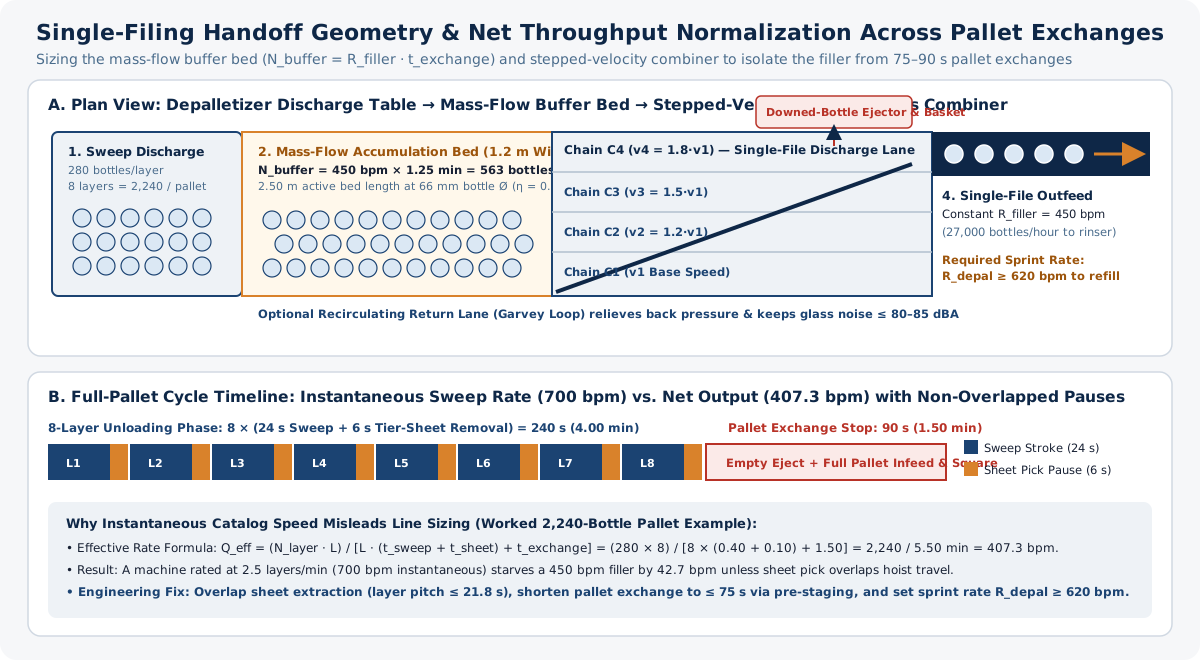
Consider a 1,000 × 1,200 mm (40 × 48 in) pallet carrying N_layer = 280 bottles/layer (66 mm diameter 500 mL bottles) stacked L = 8 layers high (2,240 bottles/pallet), feeding a filler rated at R_filler = 450 bottles/min (27,000 bph):
-
Instantaneous rate vs net pallet cycle: A machine quoted at 2.5 layers/min instantaneous (
t_sweep = 24 s = 0.40 min/layer, or700 bpmpeak) witht_sheet = 6 s (0.10 min)non-overlapped sheet pause andt_exchange = 90 s (1.50 min)pallet exchange yields:- Total pallet cycle:
T_pallet = 8 × (0.40 + 0.10) + 1.50 = 5.50 minutes (330 s) - Net sustained output:
Q_eff = 2,240 / 5.50 min = 407.3 bottles/min (24,436 bph)—starving the450 bpmfiller by 42.7 bpm.
- Total pallet cycle:
-
Minimum accumulation buffer (
N_buffer): Following the buffer math in our accumulation conveyor tables and line buffering guide, with pre-staged pallet infeed cutting exchange time tot_exchange = 75 s (1.25 min), active buffer storage must hold:N_buffer = R_filler × t_exchange = 450 bpm × 1.25 min = 563 bottles- On a
W = 1.20 mwide mat-top bed with packing efficiencyη = 0.82ford = 0.066 mbottles, capacity per meter isN_per_meter = (1.20 × 0.82) / (0.066)² = 225.9 bottles/m, requiringL_bed = 563 / 225.9 = 2.50 m (8.2 ft)of active mass-flow bed ahead of the combiner.
-
Required sprint rate (
R_depal) for buffer recovery: To refill563 bottleswithin the remaining2,240 - 563 = 1,677 bottles(3.73 minof filler run time) on the next 8-layer pallet:R_depal ≥ 2,240 / 3.73 min = 600.5 bpm(specify ≥ 620 bpm active sprint rate, or overlapped layer pitch≤ 27.1 s/layer).
Rule of thumb: If net active depalletizer sprint rate (R_depal) is below 1.25 to 1.35 times the filler rate (R_filler), the accumulation buffer cannot recover within one pallet cycle after a 75 to 90 second pallet exchange.
Selecting the single-filing combiner architecture
Downstream of the mass-flow buffer bed, the wide column of bottles merges into a single lane to feed bottle conveyors and accumulation conveyors.
| Single-Filing Architecture | Operating Mechanism & Reference | Back-Pressure & Noise Profile | Fallen-Bottle Handling | Best Container Fit |
|---|---|---|---|---|
| Pressureless Multi-Chain Stepped-Velocity Combiner | Parallel tabletop chains step up speed incrementally along an angled guide rail (BW Ambec Pressureless Combiner - Inliner) | Zero lateral squeeze; prevents bridging and scuffing; glass noise ≤ 80–85 dBA | Integrated automatic downed-container ejector drops fallen bottles into opposite-side basket | High-speed empty glass (150–600+ bpm), petaloid PET, and non-round containers |
| Recirculating Loop / Reverse-Lane Table | Wide multi-chain loop recirculates un-merged bottles around an inner return lane | Near-zero throat back pressure; absorbs layer-sweep surge waves | Operators or plough gates clear fallen containers on the low-density return loop | Fragile glass jars, tapered spirit bottles, compact buffer + combiner layouts |
| Converging Rail Pressure Combiner | Fixed converging guide rails narrow a multi-chain bed via longitudinal chain push | High lateral contact force and rubbing; glass noise > 85 dBA | Prone to arch bridging and throat jams if a single PET bottle tips sideways | Heavy, straight-walled cylindrical cans and standard heavy pint glass at low speeds |
| Bulk Hopper + Rotary Bottle Positioner | Pusher sweeps plastic bottles into a floor hopper feeding an elevator and rotary unscrambler (Traktech DPB / AND&OR RDZ-CPE) | Zero upright stability required during sweep; high bulk surge capacity | Rotary positioner automatically orients every bottle upright before air conveyor/rinser | Lightweight blow-molded HDPE and PET bottles up to 300 bpm (18,000 bph) |
Cross-check conveyor motor drives, VFD zone counts, and stainless frame multipliers in the packaging conveyor cost guide and verify VFD speed-ramping handshakes in packaging line design.
Selection takeaway: Pair glass and petaloid PET bulk depalletizers with a stepped-velocity pressureless multi-chain combiner equipped with an automatic downed-bottle ejector or a recirculating loop table rather than a converging pressure rail.
Tall beverage pallet hoists, floor layouts (U-flow vs Z-flow), and ANSI/PMMI B155.1 safeguarding
Structural hoist chains, counterweights, and vertical arresters
Because bulk empty glass and PET pallets stand 2,400 to 2,900 mm (94.5 to 114.2 in) tall—roughly 1,000 mm taller than standard 1,400–1,800 mm cased-goods pallets—the vertical hoist must resist overturning moments across a 600–1,100 kg load:
- Counterweighted dual-chain vs four-chain hoists: The A-B-C Model 108 encloses over 1,600 lb (726 kg) of counterweight inside its twin towers to balance the stainless elevator table, driving the carriage via a 1-1/2 in (38.1 mm) solid steel shaft, dual industrial roller chains, and 8 wide-faced roller bearings (
1-1/4 insolid shafts drive the pallet conveyor and dual-chain sweep bar). On high-level mobile-pallet systems, the BW Goldco Fortis 3000 uses a 4-chain pallet hoist in a four-post frame. - Vertical load arresters and pallet stacker payload: Both Sidel Sweepoff-A and Sweepoff-B include an automatic mechanical/pneumatic blocking device that arrests vertical load travel in an emergency. The A-B-C Model 108 brochure specifies a 1,500 lb (680 kg) empty pallet stacker capacity.
Floor routing: U-flow, Z-flow, and 90-degree discharge
Before freezing the packaging line layout, match pallet entry and bottle outfeed vectors to fork-truck staging aisles:
- U-configuration (
Sweepoff-A U) vs Z-configuration (Sweepoff-A Z): Sidel’s high-level Sweepoff-A offers U-flow (opposite-side container discharge) and Z-flow (same-side container discharge). - Inline vs 90-degree outfeed: Low-level systems (Sidel Sweepoff-B and A-B-C Model 108) offer inline (
180°) or90°discharge tables so fork trucks stage full pallets and retrieve empty pallets and dunnage stacks from one warehouse aisle.
Safeguarding under ANSI/PMMI B155.1-2023 and OSHA 29 CFR 1910.212 / 1910.147
Under ANSI/PMMI B155.1-2023 (Clauses 4–6 risk assessment and whole-body access safeguarding, normatively referencing ANSI B11.19), OSHA 29 CFR 1910.212, and OSHA 29 CFR 1910.147, specify four safety subsystems:
- Interlocked guarding and Category 3 PL(d)/PL(e) circuits: Full-height barrier fencing with solenoid-locking interlocked doors rated to Category 3,
PL(d)orPL(e)(A-B-C Model 108), plus external Grace Port PLC access. - Sequential muting light curtains: Four-sensor sequential muting light curtains on full-pallet infeed and empty-pallet exit conveyors so square loads pass while human entry trips an immediate safe stop.
- Whole-body access reset: Scanned floor presence sensing or an unobstructed external reset station per ANSI/PMMI B155.1-2023 so the hoist cannot restart with personnel inside clearing cullet.
- Gravity and pneumatic LOTO (29 CFR 1910.147): Mechanical hoist locking pins/pawls plus lockable pneumatic dump valves for clamp plates and sheet pickers per 29 CFR 1910.147.
Selection takeaway: Require Category 3 PL(d)/PL(e) safety circuits, 4-sensor sequential muting light curtains on pallet conveyors, and mechanical hoist locking pawls for LOTO on every tall-pallet depalletizer quote.
Specification and Factory Acceptance Test (FAT) qualification checklist for a bulk depalletizer
Before signing off on commissioning and acceptance, bind the supplier to a measured Factory Acceptance Test (FAT) using production pallets of worst-case containers and dunnage. See the packaging guides hub and bottle handling automation reference for line context.
| Qualification Boundary | Worst-Case FAT Input | Measurement Protocol | Binding Acceptance Criterion |
|---|---|---|---|
Net Sustained Rate (Q_eff) |
3 full-height pallets (2,400–2,900 mm) of highest-count bottle SKU |
Continuous timer across all layers, sheet picks, and 2 pallet exchanges | Net Q_eff ≥ 1.15 × R_filler; active sprint rate R_depal ≥ 1.30 × R_filler |
| PET Tipping & Dead Plate | Lightest petaloid PET (9–18 g, H/D ≥ 3.5) on PP slip sheets |
Run 20 layers at rated v_sweep; inspect dead plate and rear bar |
Zero fallen bottles; stripper gap ≤ 3–5 mm; zero lower-layer tipping |
| Glass Cullet & Noise | Heaviest layer (80–120 kg) and fragile/reverse-taper glass |
Inspect finishes/bases; measure dBA at operator stations |
Zero breakage or chips; lower shift ≤ 2 mm at 1.5–3.0 bar; ≤ 80–85 dBA |
| Dunnage Extraction | Curled corrugated sheets, porous kraft board, PP sheets, top frames | Run 30 extraction cycles without operator assist | 100% single-sheet pick (zero double picks, dropped sheets, or vacuum faults) |
| Single-Filer Ejection | Place 5 fallen bottles per layer onto mass-flow bed | Observe combiner throat and downed-bottle ejector at sprint speed | Fallen bottles ejected to basket in 100% of trials with zero throat bridging |
| Changeover & LOTO | Switch smallest (45–55 mm) to largest (95–115 mm) recipe |
Time recipe change; test 4-sensor muting, hoist lock, and dump valves | Changeover ≤ 1–5 min tool-free; CAT 3 PL(d)/PL(e) stop and hoist lock verified |
Selection takeaway: Attach this six-point FAT matrix to the purchase order and release milestone payment only after three consecutive full-height production pallets pass net rate, zero-breakage, dunnage pick, and downed-bottle ejection trials.