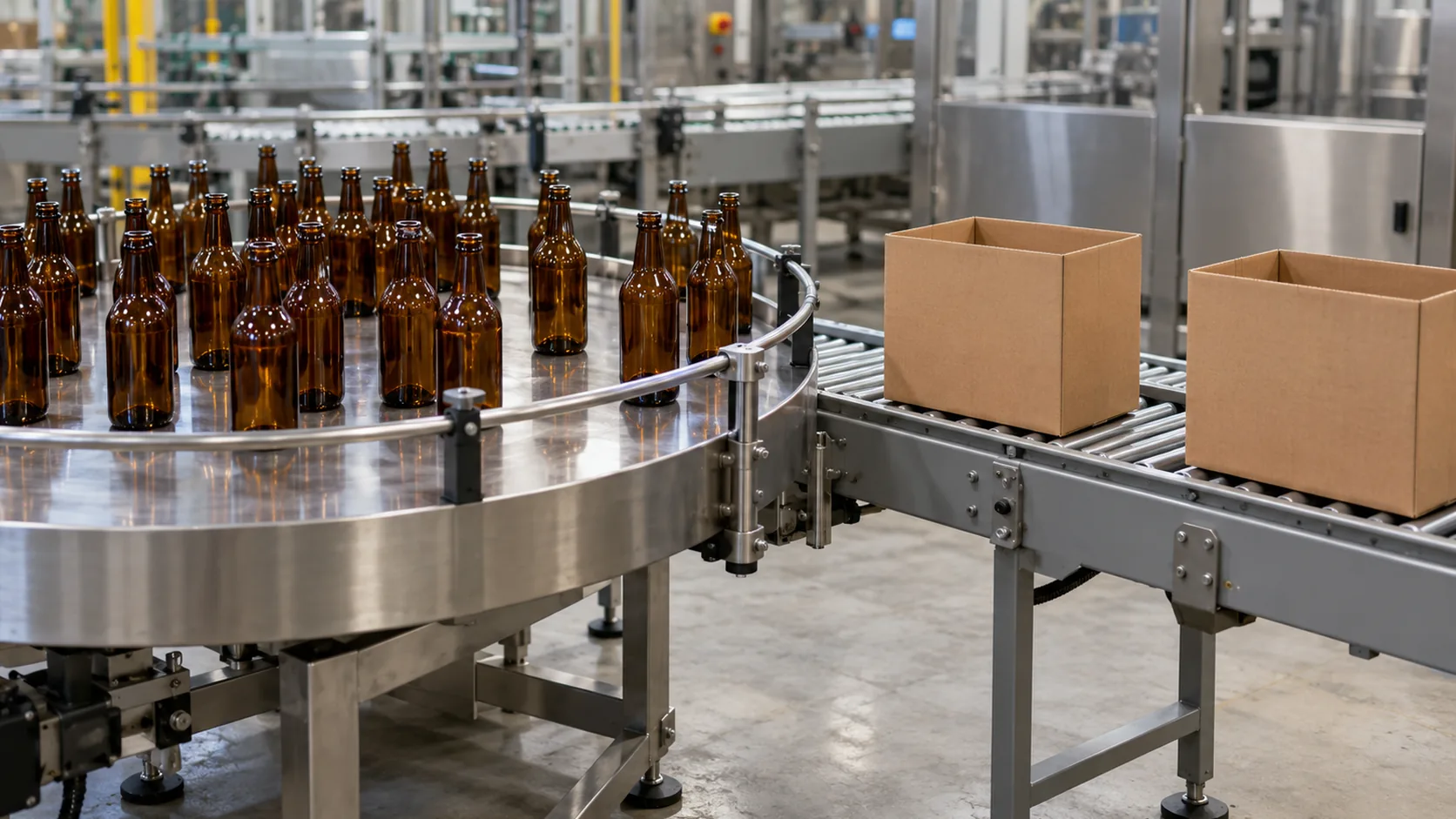
A filler that keeps running through a labeler stop needs a place for the containers that are still arriving. Without that place the filler stops with the labeler, and the restart is a second loss. The place is either a disk, which stores a mass, or a zoned conveyor, which stores a queue. The accumulation conveyor page describes the hardware families. This guide does the arithmetic that turns a stop into a disk area or a zone count, using catalog rows retrieved 20 October 2026.
The buffer count is the running machine’s rate multiplied by the stop you intend to ride through. A published containers-per-minute figure is a speed ceiling, not the number of containers sitting on the table.
Which published row matches the container?
Keep the order requirement next to the load. A round bottle that may touch its neighbors is a different buffer from a case that must not touch the case behind it.
| Buffer | Published baseline, retrieved 20 October 2026 | Dominant failure mode and prevention |
|---|---|---|
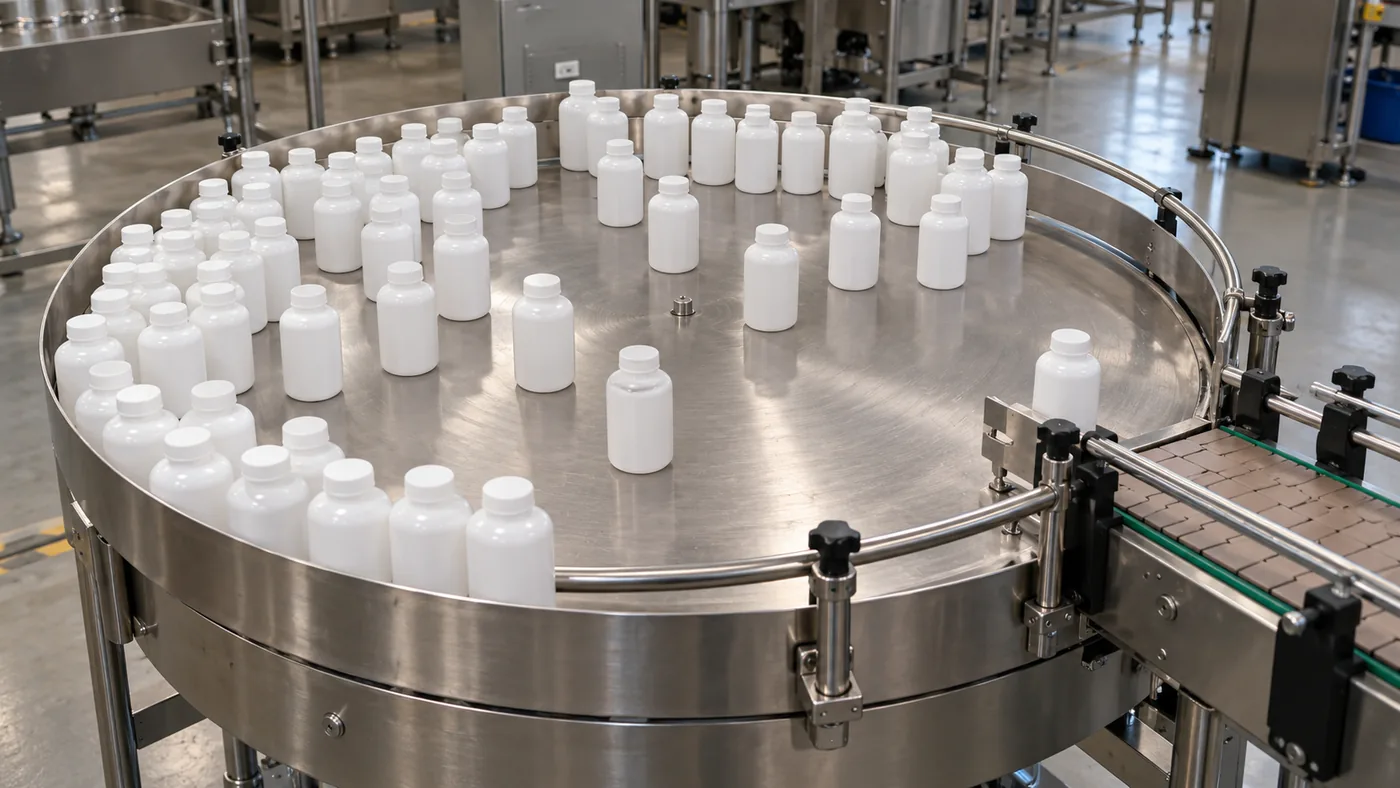
| DTM accumulating rotary table RA 3042 | 42 inch disk, 1/8 inch 304 stainless, backed by a 1/2 inch aluminum plate, 2 inch stainless square tube, covers on four sides, DC gear motor, potentiometer, variable speed up to 150 containers per minute | Treating 150 per minute as the number of bottles on the disk. Use it as a rate ceiling, then size the area from the container. |
| GlobalTek rotary tables, 2022 manual | Diameters 24, 36, 48, and 60 inches; 3/8 HP; 0–8 RPM; disk 1/8 inch (11 gauge); height 35–39 inches; guide rail 0–5 inches; 115 VAC, 5.7 A; max weight 800 pounds per square foot | Using 800 pounds per square foot after the enclosed-frame page has published a different load. That page says 200 pounds and a Bodine 1/11 HP motor at 8 RPM and 500 lb-in. Match the frame style. |
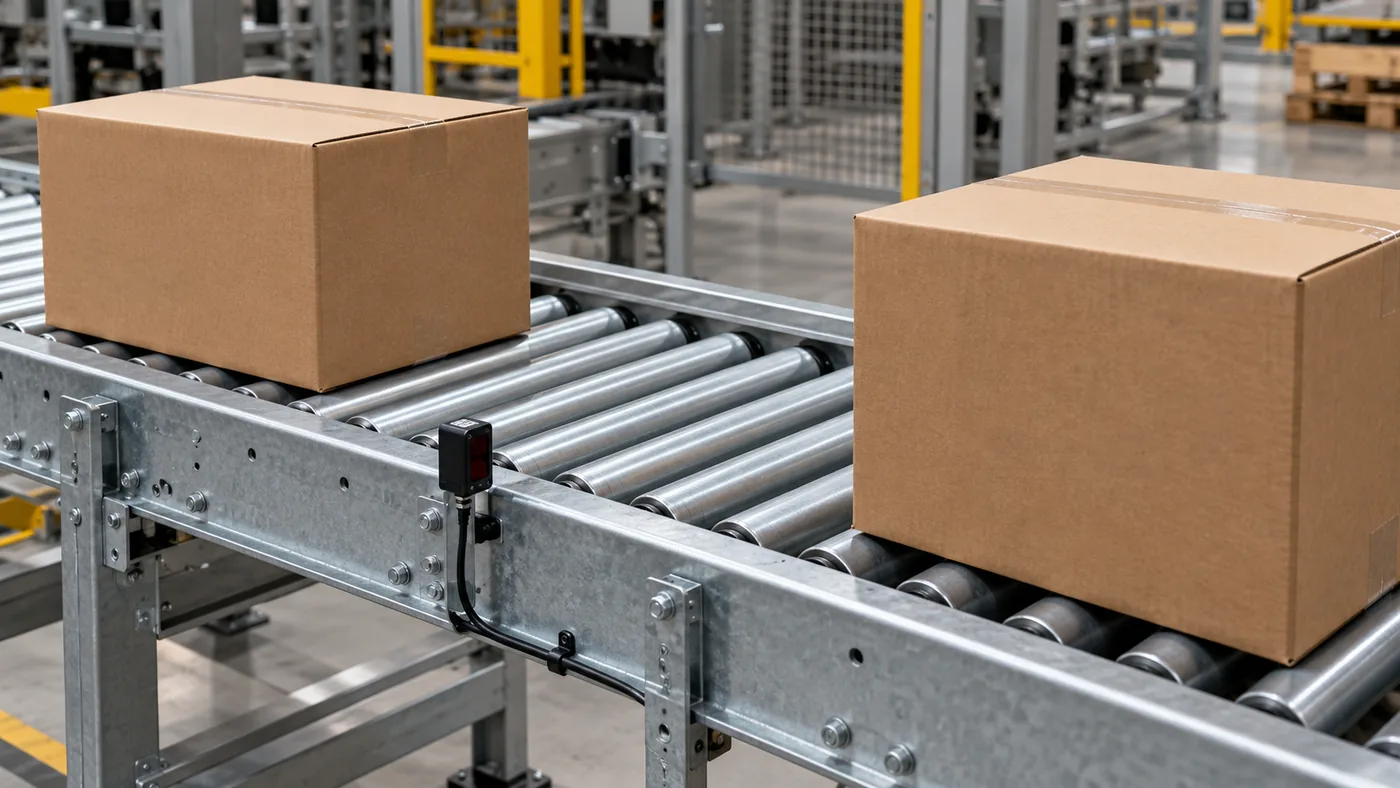
| Roach 596PRA | 24 inch photoeye zones, singulation, 1.9 inch × 16 gauge grooved rollers on 3 inch centers, rollers set high, 24 V DC powered roller, 60 FPM constant, 15 pounds per roller or up to 70 pounds per zone | Queueing a case heavier than 70 pounds and hoping a longer conveyor fixes it. The ceiling is per zone. |
| Trew Series 1500 MDR, 2023 manual | Zone lengths 24, 30, or 36 inches; between-frame widths 15, 21, 27, 33, 36 inches; up to 180 FPM; up to 75 pounds per zone; 24 V DC; minimum product 6×6 inches on 2 inch centers or 8×8 inches on 3 inch centers | Sending a train of cases with singulation release, or letting fragile cases touch under slug release. The manual says slug release is typically for palletizing or machine loading. |
How the rails on a disk decide collection versus single-file is already on the accumulation page. The choice here is whether the stop is stored as area or as zones.
How many containers does the stop require?
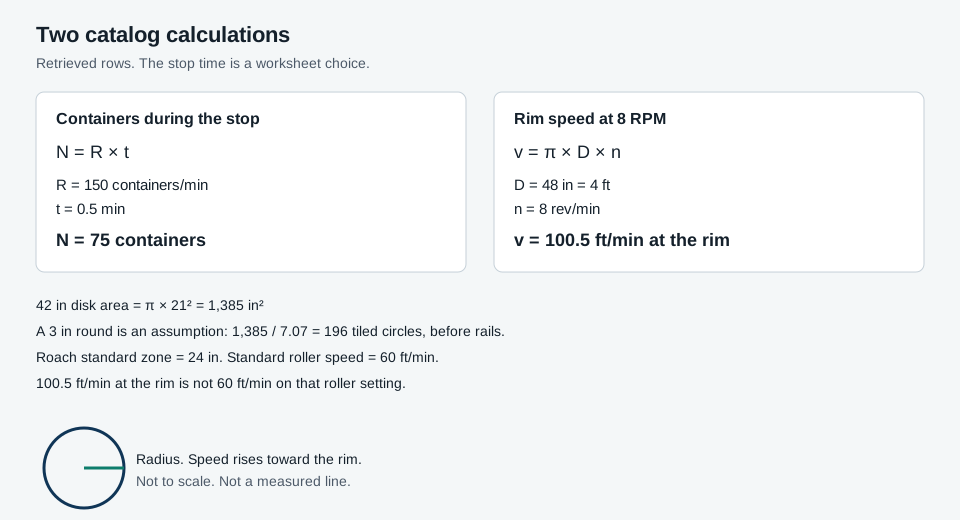
N = R × t
N is the number of units the buffer must hold. R is the rate, in units per minute, of the machine that keeps running. t is the stop, in minutes, that the line is supposed to ride through. If the machine that restarts cannot run faster than the feeder, the buffer does not empty. Emptying time is N / (R_out − R_in), and the denominator has to stay positive.
Worked example, with the rate taken from a catalog ceiling and the stop chosen for the worksheet:
- DTM’s sheet states up to 150 containers per minute. Use that as R. It is not a measured filler.
- Ride through a 0.5 minute stop.
- N = 150 × 0.5 = 75 containers.
The same 75 containers are not 75 linear pitches on a disk. Disk area is π × (D / 2)². For the RA 3042, D = 42 inches, so the radius is 21 inches and the area is π × 21² = 1,385 square inches. A container’s plan area is the buyer’s, not a number on the DTM sheet. For a worked geometry only, assume a 3 inch diameter round: plan area π × 1.5² = 7.07 square inches, and 1,385 / 7.07 = 196. That 196 is a tiled circle with no rails and no transfer opening. It is an upper geometric bound for that assumed diameter. It is not a DTM capacity, and 150 per minute does not mean the disk holds 150 bottles.
A zoned conveyor uses pitch instead of area. Take a separate case worksheet, again labeled as assumptions except for the zone length:
- R = 20 cases per minute, t = 1.5 minutes, N = 30 cases.
- Case length along travel = 18 inches. Roach’s standard zone is 24 inches, so one case occupies one zone.
- Zones = 30. Bed length = 30 × 24 = 720 inches = 60 feet.
- Case weight = 25 pounds, which is under the 70 pound zone ceiling.
- Roller centers are 3 inches, so an 18 inch case spans about six rollers. If the 25 pounds were shared equally, that is about 4 pounds per roller, under the 15 pound per-roller drive figure. Equal sharing is geometry to confirm on the case, not a load test.
Rules of thumb. If the unit must leave in arrival order, use photoeye singulation and do not use a loose disk. If one case weighs more than 70 pounds, the 596PRA zone rating is already exceeded; more zones do not raise it. Trew’s MDR nominal ceiling is 75 pounds per zone, so a case above that band is outside both published rows. If R_out equals R_in, emptying time is not a number. If the case packer in the worksheet can run at 30 cases per minute while the feeder stays at 20, the 30 cases drain at 10 per minute and the queue is empty in 3 minutes.
Where the mating speed and the load rating diverge
Rim speed, in feet per minute, is π × D × n, with D in feet and n in revolutions per minute. GlobalTek’s 2022 manual lists a 48 inch disk and a maximum of 8 RPM. D = 4 feet, so the rim at that maximum is π × 4 × 8 = 100.5 feet per minute. Halfway to the center the surface speed is half, 50.3 feet per minute. The Roach 596PRA standard speed is 60 FPM constant. Those two published speeds do not meet. A bottle at the rim of an 8 RPM, 48 inch disk is moving about 40 feet per minute faster than a case on that standard roller setting. The manual’s dial runs from 0 to 8 RPM, so the disk can be slowed. The failure is leaving it at the maximum and treating the transfer as if both surfaces were 60 FPM.
The same manual labels the rotating disk a pinch hazard and a shear hazard if hands or objects are placed in the disk’s path. A transfer opening is that path. The line layout guide is where the buffer’s footprint and the walkway are drawn; this page only fixes the count and the speed.
GlobalTek’s load lines disagree with each other, and they should stay apart. The 2022 manual says 800 pounds per square foot and a 3/8 HP motor. The enclosed-frame product page retrieved the same day says a maximum weight of 200 pounds and a Bodine motor of 1/11 HP, 8 RPM, 500 lb-in, with standard diameters of 36, 48, and 60 inches. Do not average 800 per square foot and 200 pounds into one rating. The frame in the layout gets the sheet that matches that frame.
What the wrong buffer costs after the purchase
These are separate losses. None of them is a price.
- Rate used as a count. Buying the RA 3042 because the sheet says 150 per minute, then discovering the disk cannot hold the 75 containers from a 30 second stop at that rate, stops the filler anyway. The table was sized to a speed, not to an area.
- Order lost on a disk. A lot or a date code that must leave in arrival order cannot be reconstructed from a loose mass. The rework is downstream, not in the drive.
- Zone overload. A case above 70 pounds on a 596PRA zone, or above 75 pounds on a Series 1500 MDR zone, is outside the published ceiling no matter how many zones are added. The conveyor cost guide is where a heavier frame shows up as a different conveyor type, not as a longer run of the same one.
- Release mode. Trew defines singulation as one product through the zone, and slug release as several products through without stopping. Slug release is described as typical for palletizing or machine loading. The wrong mode either starves that machine with gaps or lets cases touch.
- Power claim versus a nameplate. Trew’s manual says the Series 1500 uses 30 to 50 percent less energy than a typical belt conveyor. That is Trew’s comparison, not a watt-hour reading on a named belt. GlobalTek’s manual lists 5.7 A continuous at 115 VAC for the rotary table’s input. A zoned line adds a 24 V roller per zone. Count motors from the layout, not from the percentage.
- Recovery that never comes. With R_out equal to R_in, the first stop fills the buffer and the next stop passes through. The minutes of filler downtime are the part of the stop that N could not cover.
Record disk diameter, zone length, case weight, and the two rates on the layout before the buffer is drawn in as a rectangle. The equipment page remains the place for FIFO, spirals, and minimum-pressure hardware. This guide stops at the count, the zone ceiling, and the rim speed.