Accumulation types at a glance
| Type | Pressure / contact | FIFO condition | Suitable products to evaluate |
|---|---|---|---|
| Zero-pressure zones | Intended gaps between stopped units | Ordered single-lane release | Cases, cartons, fragile or mixed packs |
| Minimum-pressure roller | Contact with reduced drive force | Single lane without bypass or reordering | Sturdy cases that tolerate contact |
| Mass or rotary table | Contact depends on rails and stored mass | Do not assume order in a loose field | Stable bottles, jars and cans |
| Bi-directional / re-flow table | Depends on belt and return arrangement | Check inlet, outlet and return route | Containers needing a compact buffer |
| Spiral / vertical buffer | Depends on carrier and zone design | Verify one ordered path and release logic | Cases or containers within the tested envelope |
Jump to the free-capacity and recovery formulas before converting a conveyor length into buffer capacity. This page belongs to packaging conveyor systems; bottle conveyors and case conveyors cover the handling hardware.
How it works
Accumulation turns a continuous flow into a queue, then back into a flow. When the machine downstream slows or stops, product still arriving from upstream has nowhere to go, so the accumulation section stores it. When the downstream machine resumes, the stored product feeds it and the section empties.
Three things have to work together. The section needs room, in length, width, or height, for the product that arrives during a stop. Product that sits in a queue must not be crushed, scuffed, or tipped, and this is the main way accumulation types differ. And something has to decide when to stop, when to release, and in what order. That can be a mechanical design, sensors on each zone, or a line controller that also tells machines to slow down.
Why lines need buffers
Short stops are a normal part of packaging. Carton or label supply changes, jams, sensor trips, cleaning, pallet changes, and film roll swaps each last seconds to minutes. If every machine stopped the moment its neighbor stopped, a short fault anywhere would stop the entire line, and the restart would be a ramp-up of every machine in turn. A buffer decouples neighboring machines. The upstream machine keeps working while the downstream one is stopped, as long as the buffer has room, and the downstream machine keeps working after an upstream stop, as long as the buffer has product.
A buffer also changes what a stop costs. It does not remove the stop. It moves the stop from a machine that is costly to interrupt, such as a filler, to a place where interruption is cheap. Fillers and ovens, for example, run best when they run steadily, so they are often placed behind a buffer that absorbs stops from slower machines further along.
Line-speed relationships around the bottleneck
The slowest machine in the line, in steady running, sets the line’s output. That machine is the bottleneck. Machines before it can produce faster than it takes product, and machines after it can handle more than it delivers, so the buffers around it behave differently. Upstream of the bottleneck, the buffer tends to fill, because product arrives faster than the bottleneck takes it. Downstream, the buffer tends to run low, because the machines after the bottleneck can process faster than product arrives.
That is why a buffer before the bottleneck keeps the bottleneck fed when upstream machines stop, and a buffer after it keeps downstream machines running when the bottleneck stops. Placing a buffer on the wrong side, or sizing it for the wrong direction, is a common error.
Illustrative worked example
The numbers below use arbitrary time periods and assumed rates, with each buffer initially empty. They illustrate the logic and do not describe a real machine; an already occupied buffer needs the calculated additional positions to be free.
Suppose three machines run in sequence. Machine A can run at 100 units per time period. Machine B, the bottleneck, runs at 90. Machine C can run at 120.
- In steady running, the line output is limited by B, at 90 units per period. A is blocked or slowed for part of the time, since it can make more than B takes. The buffer between A and B fills until it is full, and then A must slow down or wait.
- If B stops for 3 periods, A keeps making product at 100 per period. The buffer between A and B must hold 3 times 100, or 300 units, to avoid blocking A. Without that space, A stops too.
- After B restarts, it runs at 90, while A makes 100, so the buffer does not empty at all. The buffer stays full, and the next stop of B stops A again after the buffer fills. The buffer helped only once.
- Now suppose B had spare capacity and could run at 120 for a short recovery period. The buffer drains at 120 minus 100, or 20 units per period, so 300 units take 15 periods to empty. During those 15 periods the line runs above its normal rate, and the buffer is ready again afterward.
- Between B and C, C is faster than B, so the buffer there stays near empty in steady running. When C stops for 2 periods, B keeps making 90 per period, and that buffer must hold 2 times 90, or 180 units.
The lesson is general. A buffer absorbs a stop only if it has room for the stop’s volume, and it recovers only while output exceeds input. Increasing downstream output or slowing the feeder can create that difference; equal operating rates cannot clear the added queue. In real lines the speeds also change with product and format, so the supplier needs the actual rated and sustained rates of each machine, not nameplate speeds alone.
Types and configurations
Zero-pressure accumulation
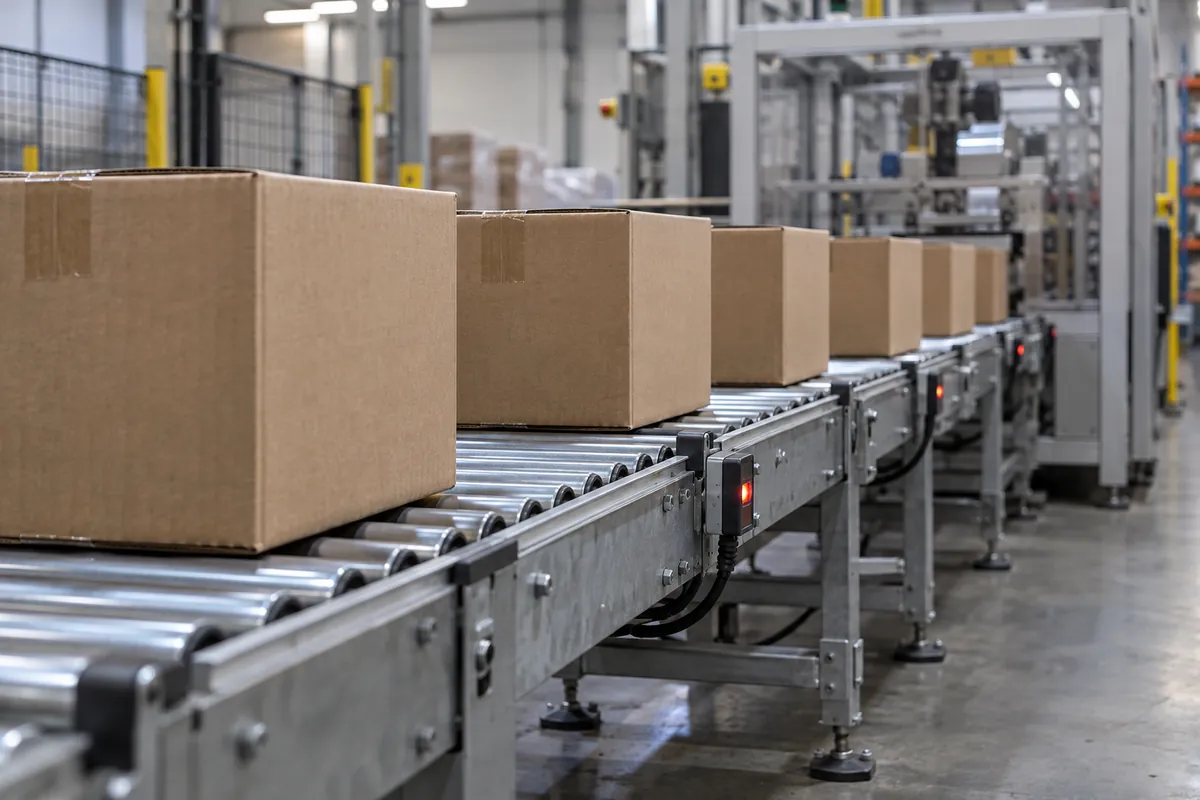
In zero-pressure accumulation, a conveyor is divided into zones, and each zone has a sensor, most often a photo-eye. When a case or container reaches the last zone, it stops and blocks the sensor, which tells the zone behind it to stop when the next item arrives. Items queue with gaps between them. One supplier states that, because products never touch, a large package cannot crush a smaller one, which matters for mixed weights and sizes. When the downstream blockage clears, the lead zone starts, then the next, and the release passes upstream, giving first-in first-out order. Zones can be built on motor-driven rollers, on line-shaft or belt-driven rollers with zone clutches or lifters, or on chain-driven rollers. Supplier descriptions also note that photo-eye zero-pressure designs have replaced older sensor rollers, which needed a minimum weight to trigger.
The cost is more sensors and more controls. In return, product is protected, and according to one supplier a motor-driven roller design runs only the zones that have product, which lowers energy use and wear. The case-handling details are on the case conveyors page.
Minimum-pressure accumulation
Minimum-pressure accumulation is usually a belt-driven roller conveyor with a mechanism that lets the rollers slip under queued product. A supplier describes it as a low-tech way to reduce back pressure on the load. Product still touches, but the force on the first item is far less than on a plain driven conveyor. It is simpler and often less expensive to install. Because the drive keeps rubbing under the stopped product, it can use more energy and wear belts and rollers faster, and it is less suited to fragile or lightweight packs.
Mass accumulation tables
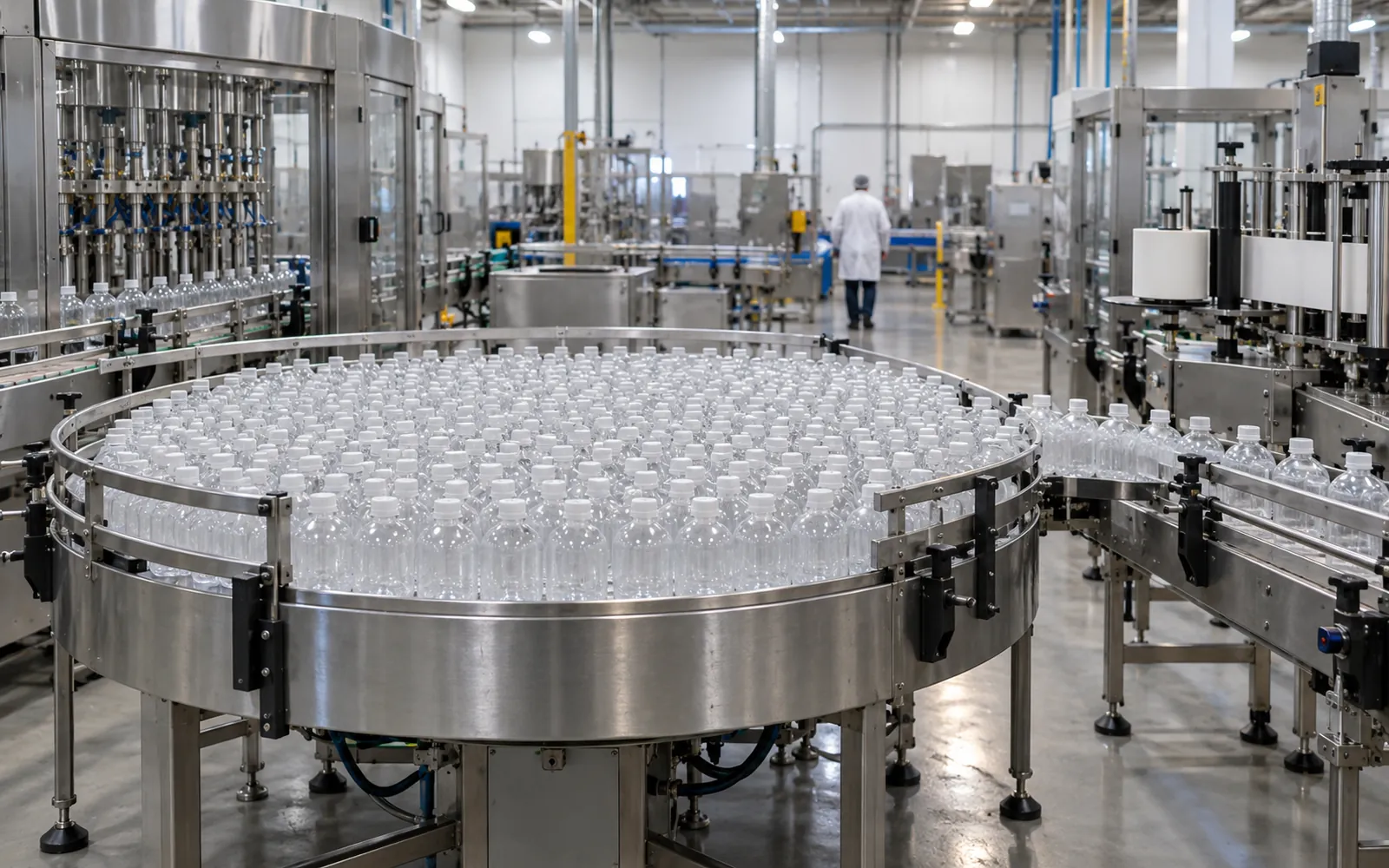
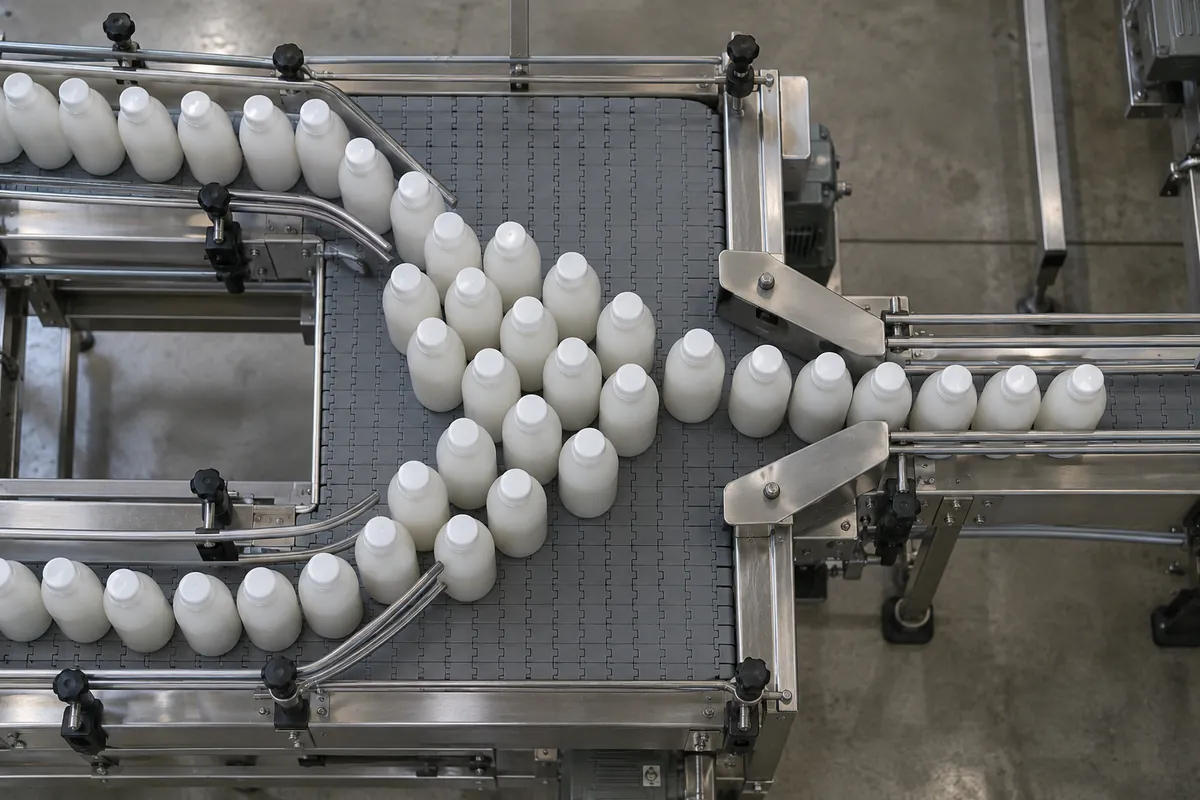
A mass accumulation table is a wide, flat surface, usually a plastic belt or chain, on which bottles, cans, jars, or packs sit many abreast. Product enters at one side, spreads out, and leaves at the other. When the machine downstream slows, the table fills. The table is simple and has no sensors per zone. The design questions are the width and length of the table, how product leaves it, and how it controls back pressure when full. Mass tables suit stable containers and are common between a filler and a labeler or between a labeler and a packer. The bottle conveyors guide covers the single-file sections that feed and empty them.
Bi-directional and re-flow tables
A bi-directional table has neighboring belts running in opposing directions. Multi-Conveyor’s public Bi-Directional Accumulation Tables description uses “filers” for the single-filing or guide-rail stage, not a filling machine, and describes its illustrated slug-return arrangement as LIFO (accessed October 8, 2026). A re-flow or loop layout can use a different return route. Record the entry, storage and exit paths and test release order; neither “bi-directional” nor “loop” by itself establishes FIFO, LIFO or damage-free handling.
Rotary accumulation tables (turntables)
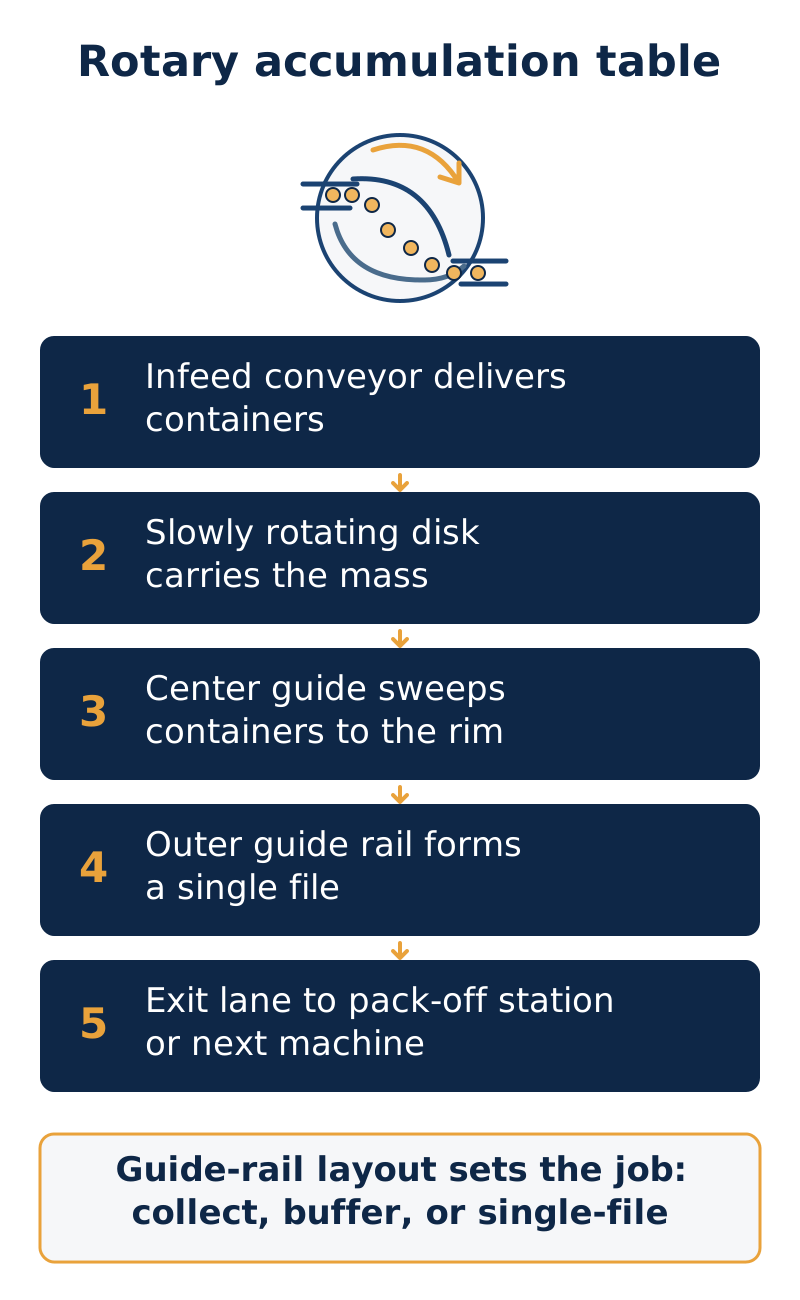
A rotary accumulation table, also sold as a rotating conveyor table or turntable, is a flat disk, usually stainless steel and sometimes plastic, that turns slowly on a base, with guide rails above it. Catalog diameters, zone loads, and the stop-to-count arithmetic are in accumulation tables and line buffering. One packaging equipment white paper points out that the same turntable can unscramble bottles, accumulate them at the end of a line, or buffer them inline, and that the only difference between the three jobs is the guide-rail configuration. That makes the rail layout, not the name on the quote, the thing to specify.
- End-of-line collection. The table receives bottles, jars, or cans from the last conveyor so the line can keep running while a person packs at their own pace. One supplier describes its rotary accumulating tables as placed at the end of a production line to receive containers and prevent backups and slowdowns.
- Inline buffer or surge table. A table between two machines holds a short reserve when the downstream machine pauses, then feeds containers back out through an exit lane.
- Manual feeding or unscrambling. An operator places containers on the disk, and the rails turn the loose mass into a single file for the next machine. The same white paper notes that the table also acts as a buffer, so the operator does not have to load containers one at a time.
The disk turns slowly, so, as the white paper explains, centrifugal force does little to move product toward the rim, and the guides do the work: typically a center guide sweeps containers away from the loading area toward the outer edge, and an outer guide forms them into a single file at the exit. Product moves as a mass, so a rotary table does not hold product in a fixed order. If lots or dates must stay in sequence, use one of the FIFO designs described below.
A rotary table is a reasonable choice when these conditions hold:
- The containers are round and stable enough to stand on a moving surface without tipping.
- People load or unload the table by hand, at a pack-off station, a short line, or a manual feed point.
- The buffer needed is small, and the table’s disk area, converted to containers with the sizing logic further down this page, covers the stops you want to ride through.
- The space allows a round footprint with access around the rim for the people working at it.
Look elsewhere when those conditions fail. Cases and cartons belong on zero-pressure or case conveyors. Small or unstable containers can fall over when they are placed onto a moving disk, and the white paper recommends a stationary loading tray beside the disk for that reason. When floor area is tight, the same source notes that a rectangular linear table makes more efficient use of the footprint and can be sized to the space, and higher-rate lines need automated transfer rather than hand loading. The term rotating conveyor is also used for powered turntables that rotate a roller or belt section to change the direction of a case or pallet. Those are transfer devices, not buffers.
Before buying, check these points with the supplier and your own containers:
- Disk diameter against the floor space and the reach of the people working at it.
- Guide-rail layout for the job (collect, buffer, or single-file), and how the rails adjust for each container size.
- Drive smoothness at low speed. The white paper warns that a DC motor turned down very slowly can stutter and tip bottles, and that a speed reducer gives a smoother slow disk.
- Disk support for heavy containers such as glass, for example low-friction wear strips or roller supports.
- Rotation direction and table height, so the table meets the infeed or exit conveyor.
- Loading aids, emergency stops, and pinch points between the rails and the moving disk.
Spiral, vertical, and alpine accumulators
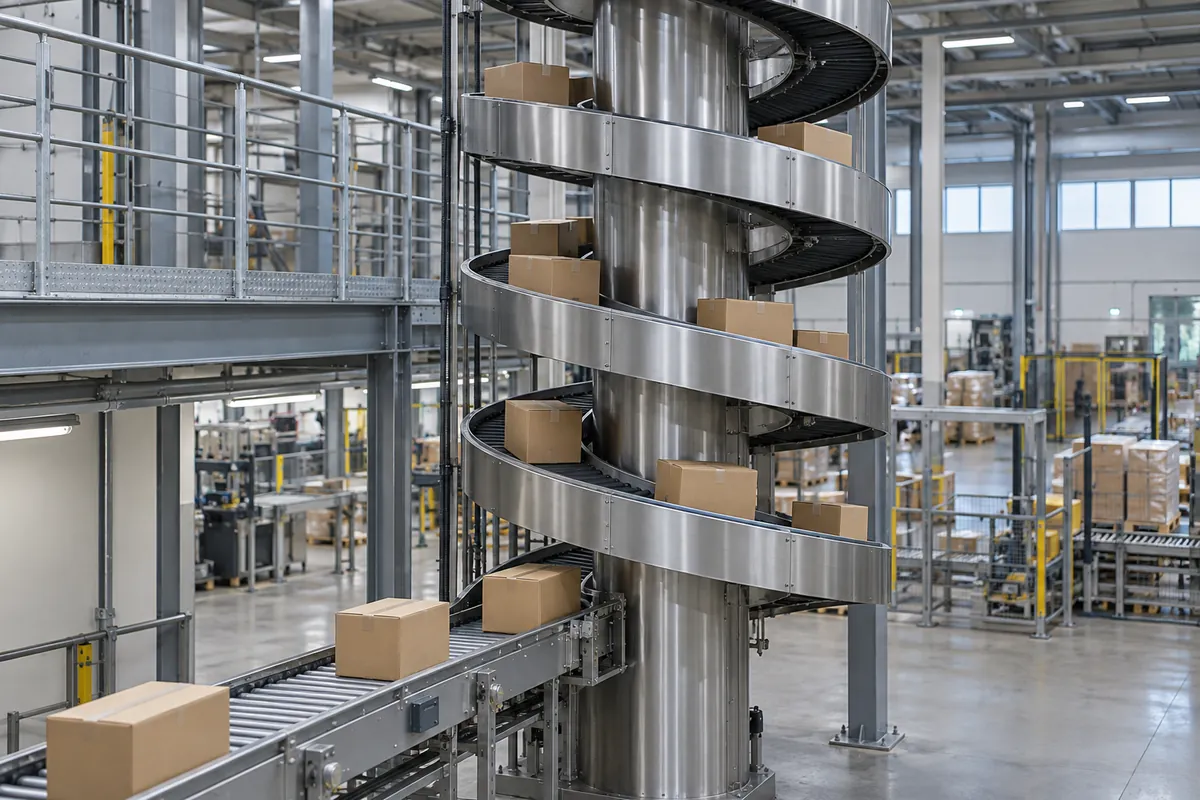
When floor space is short, accumulation can go up. A spiral conveyor carries product around a helical path, and a supplier explains that a belt or modular belt is guided around a central tower, with rails keeping the belt in shape. Because the path is long in a small footprint, a spiral can hold many cases or containers, and it can serve as a buffer or give product dwell time to cool. One supplier describes vertical spiral accumulators that suit bottles, cans, and other cylindrical items, with bi-directional versions that both accumulate and de-accumulate in one unit. Alpine conveyors, which carry product up and over on a belt, are another way to build a buffer in a small floor area. The vertical conveyors guide compares spirals with lifts and inclines.
FIFO and dwell accumulators
Some products need arrival order preserved for dwell time, lot tracking or date codes. An ordered single-lane path through roller zones, a serpentine or a spiral can preserve FIFO if the release scheme does not bypass or merge stored product out of order. Returning product from the same storage end can instead give LIFO, as in Multi-Conveyor’s described bi-directional arrangement. Trace the actual path and test marked units through accumulation and recovery before specifying order. For a cooling or curing duty, size for minimum dwell as well as the chosen stop duration.
Specifications to evaluate
| Specification | Why it matters | What to ask the supplier |
|---|---|---|
| Product type, size, and weight | Decides which accumulation types are possible | Which products has this design handled, and what is outside its envelope? |
| Buffer capacity in product units | The number that matters, not conveyor length | How many units does the buffer hold at our product size and pitch? |
| Fill and release rates | A buffer must fill and empty at rates the line can use | At what rate does it accept product when filling and release when emptying? |
| Pressure behavior | Back pressure damages labels, thin walls, and cartons | What force or contact does product see in a full queue? |
| Product order (FIFO or LIFO) | Matters for dwell and lot control | In what order does product leave, and can it be configured? |
| Controls and sensors | Decide how well the section reacts to stops | How does the buffer signal the machines upstream and downstream? |
| Footprint and height | The buffer must fit the building | What are the length, width, and height, and what clearance is needed? |
| Changeover | Formats change width, pitch, and zone logic | What changes per format and how are settings recorded? |
| Sanitation | Buffers hold open product for long periods | How is the unit cleaned, and what is rated for washdown? |
| Noise and wear | Idle drives still wear and make noise | What happens to drive and belt life in a long full queue? |
| Safety | Moving belts, zones that start unexpectedly | What guards, stops, and lockout points are provided? |
Sizing logic
Sizing a buffer starts with a simple relationship.
Additional free capacity Nadd (units) = ceil(stop duration x input rate)
Total capacity Ntotal (units)        = initial occupancy N0 + Nadd + explicit allowance
Buffer length                       = Ntotal x product pitch / units per row
Added-queue recovery time           = Nadd / (discharge rate - input rate)
These formulas assume zero discharge during the covered downstream stop, consistent time units and constant recovery rates. Round required positions upward. Nadd is the new free space required, not total capacity: if 20 units already occupy a 100-position buffer, only 80 positions are free. N0 belongs in total capacity, while the recovery formula measures time to return to that initial occupancy.
Product pitch includes the travel-direction length and gap. Units per row is one for single file; row capacity on a table needs its actual layout. During recovery, discharge must exceed input, by downstream acceleration or upstream slowdown. Record any sizing allowance separately. Sustained insufficient discharge cannot be fixed by adding buffer length.
For a real line, work through these steps:
- Identify the bottleneck and the rated and sustained rate of each machine. Use sustained rates under real product and format, not only nameplate speeds.
- Collect stop data: the typical short stops, how often they happen, and the longest stop you want the line to ride through. The supplier cannot invent this data, and the plant usually has records from machine controls or maintenance logs.
- Choose which stops to cover. A buffer sized for every possible stop becomes very large, so many lines size for the frequent short stops and let rare long stops stop the line.
- Calculate added free capacity, add initial occupancy and an explicit allowance, then convert total capacity using pitch and the actual row layout.
- Check recovery. Confirm that the machine after the buffer can run faster than the one feeding it, or that the line can slow the feeder, so the buffer empties between stops.
- Check dwell and order if the product needs time or sequence.
- Check the building. Compare the length or area with the space available, and consider vertical accumulation if floor area is short.
A line with many machines needs one calculation per buffer, each with the right stop and rate. The supplier should work from actual data, and the figures on this page only illustrate the method.
Product compatibility
Zero-pressure zones are the usual choice for cases and cartons with printed or fragile faces, since they stop without touching. Minimum-pressure designs suit sturdy corrugated cases. See case conveyors for detail.
For bottles, jars, and cans, mass tables, bi-directional tables, and loop tables are typical. The container’s tolerance to back pressure and to friction on a plastic belt sets the design, and light or thin-walled containers need loop or pressureless designs. Flexible and soft packs such as trays, bags, and pouches may need belts and gentle zone transitions, and bags often do poorly on rollers. Pallet conveyors can accumulate unit loads between a palletizer and a wrapper, with zones or stops sized for the pallet length.
Test the product in a full queue. The first item in a stopped queue sees the worst conditions, and a long dwell can mark labels or soften packs.
Integration upstream and downstream
Accumulation sits at joints between machines, so placement matters. On bottle lines it usually goes between the filler and labeler or the labeler and case packer, using mass or bi-directional tables. On case lines it goes between the case packer and palletizer, so pallet changes and wrapper stops do not stall the case packer. The palletizing hub and the case palletizers guide describe the palletizer’s feed needs, and the palletizer selection guide lists the questions to settle before the buffer is sized. A buffer after a depalletizer smooths the supply of containers, and the depalletizing hub describes how containers enter the line. Around a bottleneck, one buffer upstream keeps it fed and one downstream keeps other machines running.
Controls should let the buffer talk to the machines. A line controller can slow an upstream machine when the buffer is nearly full and speed it up when the buffer empties, so the machine runs steadily instead of starting and stopping. Interlocks stop feeding a faulted machine. Ask how the line restarts after a long stop, since a full buffer must empty in an orderly manner, and whether a restart needs manual clearing.
For how buffering fits a beverage line, see beverage packaging automation, and for the case-level view see case handling applications.
Footprint, utilities, controls, and safety
Buffers are space hungry. A zero-pressure conveyor is as long as the number of zones times the zone length, and a table occupies a rectangle. Spirals and vertical units reduce floor area but add height and need structure and clearance. A drawing with columns, aisles, and fire exits avoids rework.
Zone conveyors need power and sometimes low-voltage supplies, and pneumatic zone designs need compressed air. Tables need drive power, and may need air for sweep arms or gates. Control level ranges from stand-alone zone cards to PLC logic with recipes. Define the signals between the buffer and each machine, including fault, full, and empty states.
Accumulation conveyors start and stop automatically, and a section that looks idle can move when a downstream zone clears. ASME B20.1 is the U.S. conveyor safety standard, covering design, construction, installation, maintenance, inspection, and operation in relation to hazards. OSHA’s 29 CFR 1910.147 covers lockout and tagout during servicing, and it requires energy isolation before maintenance in the covered cases, which matters here because automatic restarts are normal. Guard pinch points at drives, transfers, and spiral entries, mark access for clearing jams, and agree emergency stops with the plant safety team.
Cost factors
Buffer capacity is the primary cost driver: the number of units sets the length, area, or height. Zero-pressure zones, minimum-pressure rollers, tables, and spirals differ in hardware and controls, and more zones mean more sensors and controller cards. Delicate product needs gentler and more expensive handling. Vertical or compact designs cost more per unit of storage but save floor area.
Stainless frames, drainage, and open designs add cost for sanitation, and line controls, recipes, and links to machine controls add cost for integration. Operating cost covers energy, belt and roller wear, and cleaning time. See the packaging conveyor cost guide for a wider view.
Selection checklist
- Identify the bottleneck and the rated and sustained rate of every machine.
- Gather stop data for the machines on both sides of the buffer.
- Decide the longest stop you want to cover and why.
- Calculate capacity and recovery time with the formula, adding a margin.
- Confirm discharge can exceed input during recovery, by speeding downstream, slowing upstream, or both.
- Choose the accumulation type from the product’s tolerance to pressure and contact.
- Decide whether FIFO order or dwell time is required.
- Check the available floor area and height.
- Define the controls link between the buffer and the machines.
- Test the product in a full queue and during release.
- Review guarding, stops, and lockout points with the plant safety team.
The commissioning and acceptance checklist lists questions that apply to every machine.
Common mistakes
- Sizing for the average stop. Stops vary, so size the buffer to a deliberate target.
- Ignoring recovery. A buffer that cannot empty is only a delay.
- Placing the buffer on the wrong side of the bottleneck.
- Using minimum pressure for fragile packs.
- Treating buffer length as capacity. Capacity is in product units, and it depends on pitch.
- Letting the buffer hide a chronic fault. If a buffer is constantly full or empty, find out why.
- Forgetting the restart. A full buffer feeding a restarted machine needs a controlled release.
- Leaving out FIFO. Product that needs order or dwell may not suit a LIFO table.
Alternatives
Sometimes a buffer is not the right answer. Improving the reliability of the machine that stops most often can be better than a larger buffer. Adding speed to the machine after the bottleneck gives recovery. Linking machines directly, with a block or monobloc design, removes the need for buffers between them, though it also links their stops. In the other direction, an operator-fed staging table or a robotic pick that works from a pile gives a simple temporary store. For product that must change level and wait, a spiral or vertical unit combines buffering and elevation. When the line moves pallets, a robotic palletizer with a case buffer can absorb some of the same stops.