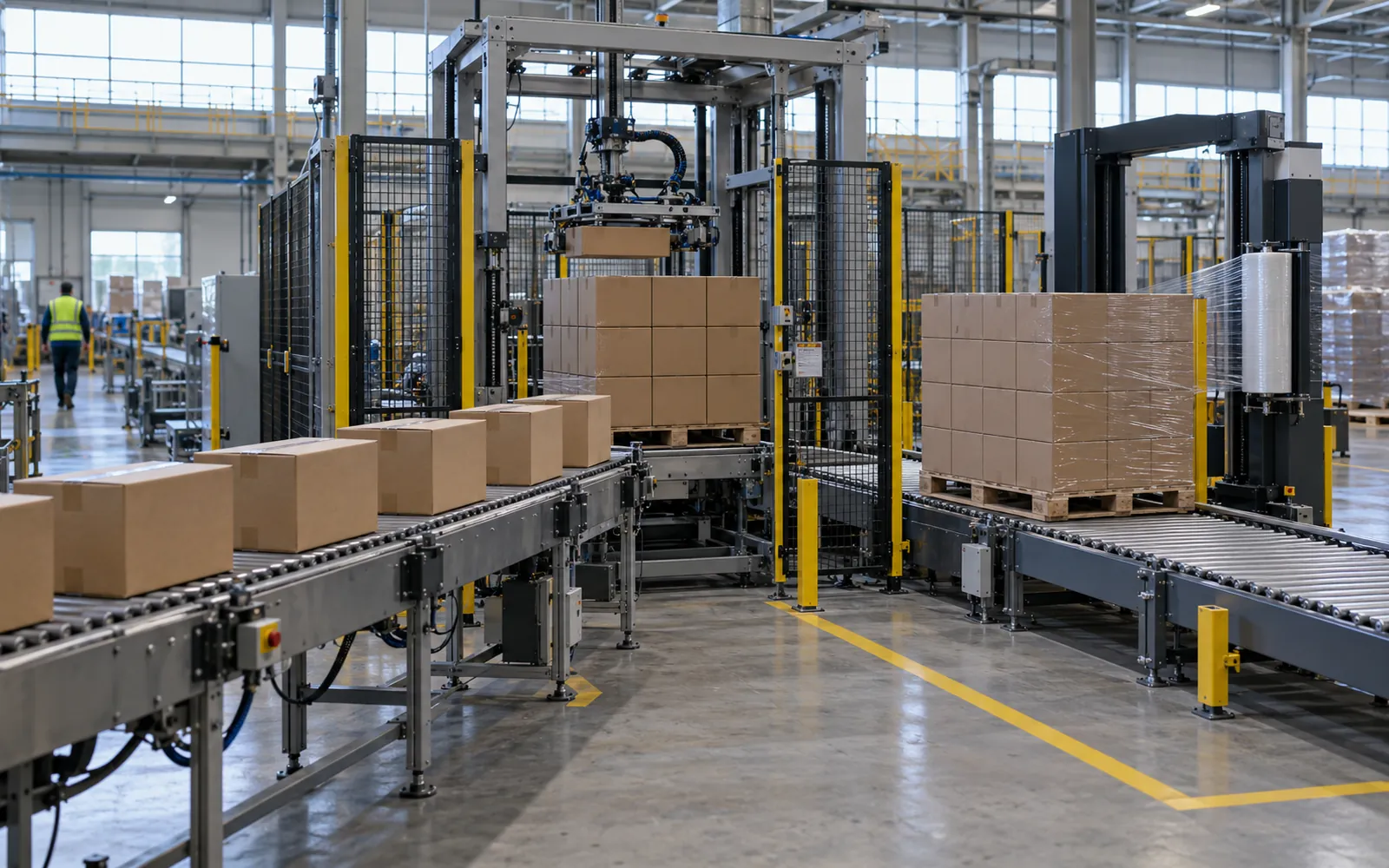
A case palletizer builds pallet loads from finished cases, cartons, shrink-wrapped bundles, and trays. The term describes the application rather than one machine design, so a case palletizer can be a layer-forming machine, a robotic cell, or a gantry. What the machines share is the job: take a controlled stream of rigid packages, turn each one to the right orientation, place it where the pattern says, and deliver a load that survives handling and transport. This guide focuses on the case itself and how it shapes the choice of machine. For the full set of system types, start with the palletizing systems overview.
| Input | Record from production | Architecture filter |
|---|---|---|
| Weakest case | Filled, sealed samples with soft corners or bulging | Exclude handling that damages or cannot grip them |
| Label faces | Required outward faces on each adjacent layer | Exclude patterns the turning or tooling cannot deliver |
| Case dimensions and weight | Full size range and heaviest pick | Check guides, layer area and loaded tooling limits |
| Sustained rate | Cases/min by SKU, including pallet exchanges | Require a run on the hardest case and pattern |
| Changeovers | Formats, frequency and physical adjustments | Compare recipe changes with mechanical work |
How it works
Every case palletizing system passes cases through the same five stages, whatever its architecture. Problems usually start in the first two.
Cases arrive from the case sealer, labeler, or a check weigher on a conveyor. One selection guide from a robotic palletizing supplier stresses that a palletizer is limited by the cases it is given. When cases show up rotated, crowded, skewed, or uneven in height, the machine loses time fixing problems that should have been solved upstream. The guide recommends controlled spacing before the pick or layer-forming area, guides that position cartons without crushing or dragging them, and matched conveyor speeds so cases transfer without sudden rotation. Short cartons need support across transfer gaps, and sensors should stay reliable across the whole size range.
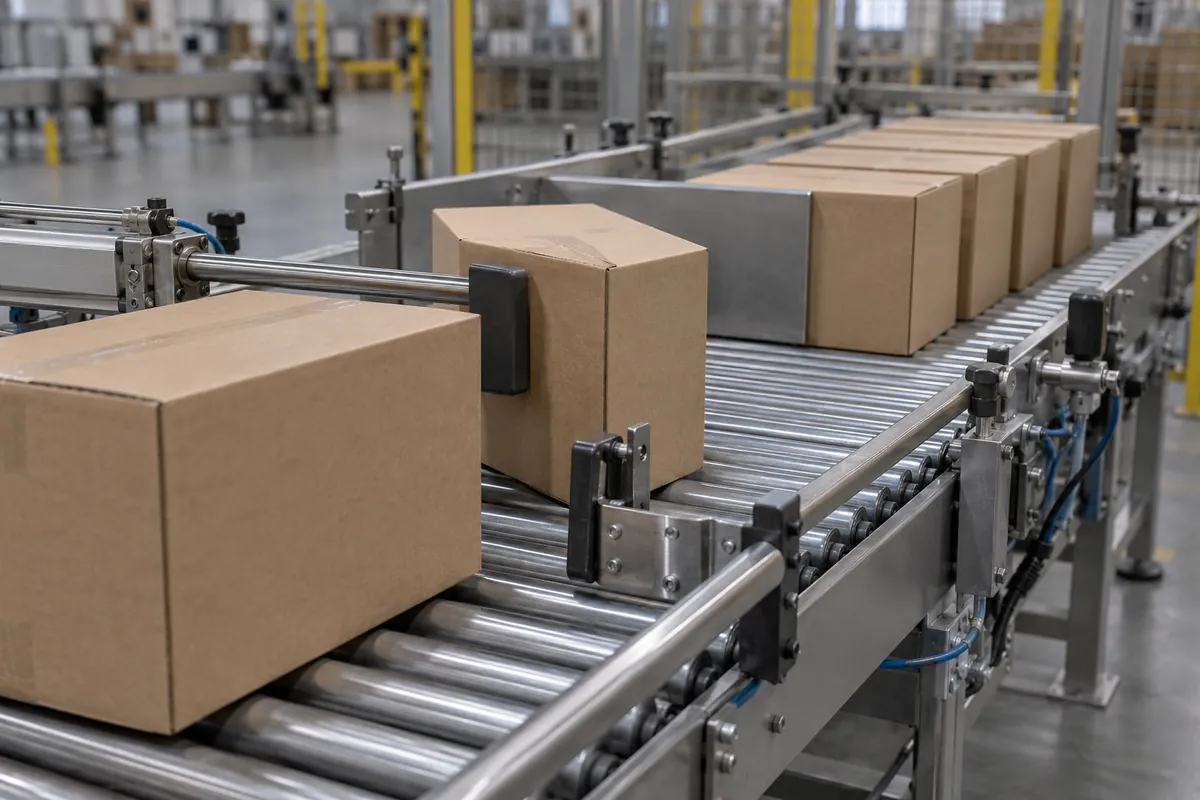
Next comes orientation. The pattern defines which way each case faces. Layer machines turn cases with diverters, turn lanes, or a rotation device, then gather them into rows. One layer-palletizer manufacturer describes a case switch that assigns each case a path, with pneumatic diverters guiding it into the right orientation. A robotic cell from another manufacturer uses a double-row collating station and a pusher that turns incoming cases 90 degrees when the pattern calls for it.
Layer machines then assemble rows into a full layer in a staging area, and that layer is swept onto a plate or table. Robots and gantries place cases or groups of cases directly onto the pallet. Either way, the controller holds the pattern as stored data.
Placement differs by machine. A layer machine lowers or raises the layer to the pallet, often squaring it first, and one manufacturer describes four-point layer squaring before the hoist lowers the load to the discharge conveyor. A robot or gantry sets each case down individually or in small groups, which allows overhang control and tight positioning.
The last stage is pallet management. An empty pallet magazine feeds the build position, tier sheets or slip sheets are inserted when the load requires them, and the finished load leaves on a discharge conveyor, usually toward a stretch wrapper.
Types and configurations
The right architecture depends on how uniform the cases are, how often patterns change, and how fast the line runs.
Layer machines
High-level and low-level conventional palletizers form a complete layer and place it in one motion. They suit uniform cases at steady rates. A guide from one palletizing supplier describes the elevated type as handling shrink-bundle and heavy corrugated formats across dedicated or multi-line operations, and trays and spot packs in refrigerated dairy settings. Each design is covered in depth in the high-level palletizer and low-level palletizer guides, and the conventional palletizers page compares them in general terms.
Row-forming and in-line machines
Some case palletizers sweep rows directly rather than collecting a full layer first. Ask whether a given machine forms rows or full layers, because the answer changes accumulation needs and how the pattern is built.
Robotic cells
A robotic palletizer uses an arm and an end-of-arm tool to pick one case, several cases, or a layer. It stores patterns as recipes, handles mixed case sizes with the same equipment, and tends to fit lines that change often. The same supplier guide notes that picking several cases per cycle may raise throughput, but it alters the size of the tool, the payload, the robot’s motion, the spacing of product, and the pattern logic. Test it with real cases and the real pattern rather than assuming it is faster.
Gantry and hybrid designs
A gantry moves along linear axes above the pallet and suits structured layouts and long reach. A hybrid pairs a robot with a layer-forming or compacting stage. Both appear when neither a pure layer machine nor a standard robot cell fits the case mix or the floor plan.
Case handling in detail
This is where a case palletizer differs from other equipment, and where specifications often fall short.
Case quality and condition
A selection guide from one supplier recommends designing around the case as it actually leaves the line, not an ideal sample. Corrugated grade, closure method, tape position, printed areas, perforations, and fill level all affect handling, and a lightly filled or flexible case needs different treatment from a rigid, well-sealed one. Contents can also shift under fast acceleration, which matters for bottles, pouches, and cans packed inside the case.
Common case defects deserve a place in the specification:
- Bulged or overfilled cases that exceed the nominal footprint.
- Leaning or tilted cases that arrive in a conveyor stream.
- Loose flaps, curled tape tails, and open lids that catch on guides.
- Soft or crushed corners from earlier handling.
- Weak cases that cannot carry the load stacked above them.
Orientation and label faces
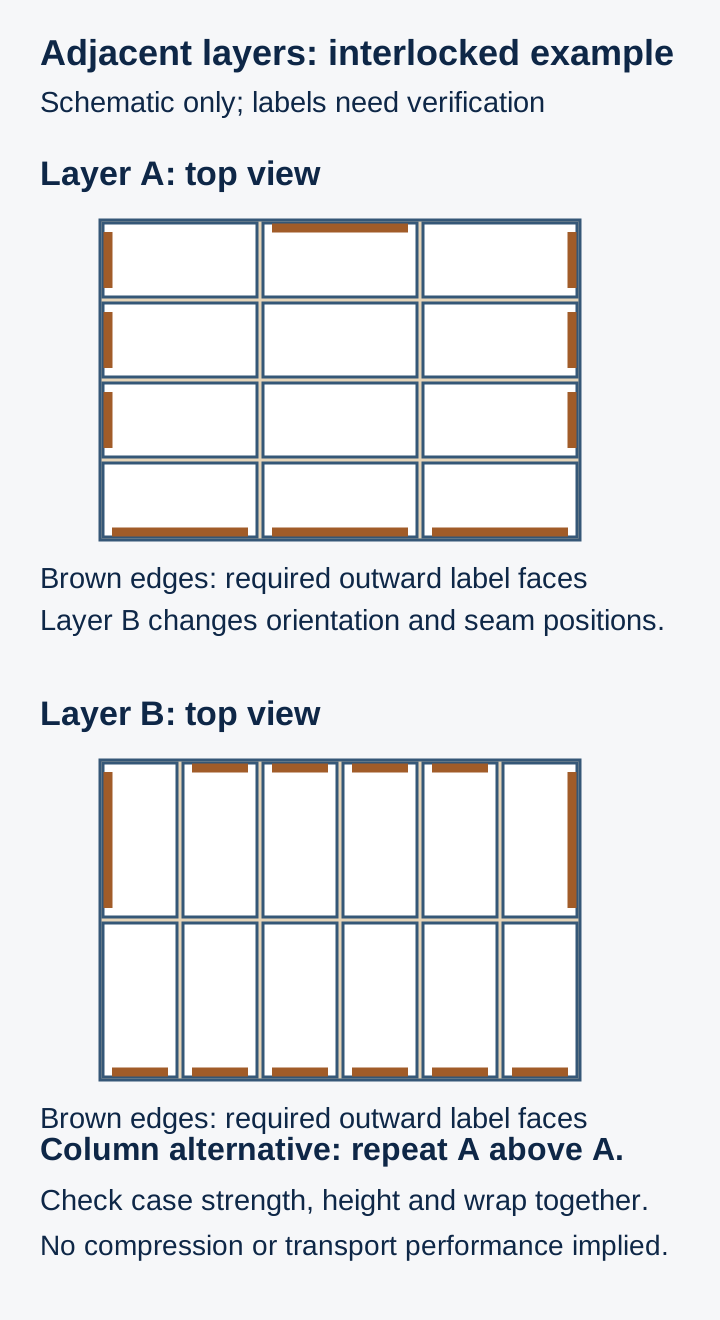
Many customers require labels, barcodes, or print to face outward, or require a particular face to show on the load. That requirement belongs in the specification, because it limits which patterns the machine can use and how much turning it must do. One supplier lists whether labels must face outward among the factors that influence pattern choice, alongside overhang, case compression strength, and wrapping needs. Ask for the pattern drawings with the labeled faces marked, and ask how the machine confirms case orientation before placement. Inconsistent label placement upstream turns a mechanical task into a data problem.
Interlocked patterns and stability
Compare compression and lateral stability separately. The Fibre Box Association/RIT report (revised May 2021, accessed October 8, 2026; References) found aligned columns strongest and interlocked stacks weakest in its tested corrugated unit loads. This does not establish a strength multiplier for your cases.
| Check | Column stack | Interlocked stack |
|---|---|---|
| Compression path | Corners align through adjacent layers | Staggered corners change the load path; verify stacking strength |
| Lateral stability | Separate columns may move relative to one another | Bridging seams can improve cohesion, subject to load geometry |
| Restraint | Verify wrap or strap containment for the handling route | Interlocking does not remove the need to validate restraint |
| Acceptance | Test production cases at full load height | Test the same cases, height and wrap method; do not assume stronger means more stable |
Takeaway: Approve the pattern and wrapping together after load-specific compression and handling checks.
| Pattern constraint | Record | Check before release |
|---|---|---|
| Labels | Required outward faces on layers A and B | Turning sequence and final visible faces |
| Overhang | Written allowance and issuer | Actual layer edges on both axes |
| Total height | Floor-to-top limit and source | Pallet, cases and sheets included |
| Wrapping | Film or strap specification and handling route | Containment, crush damage and load movement |
For the downstream handoff, use the strapping machine and pallet banding line integration guide to check strap routing, PP/PET head compatibility, and transfer controls before the load enters the wrap station.
Pallet size, usable deck area, allowable overhang, weight distribution, maximum pallet height, and maximum load weight all feed into the pattern. Tier sheets or slip sheets and corner protection may also be required. Validate these against the receiving customer’s rules, not only the plant’s own.
Mixed and changing cases
Plants that run several case sizes need to decide where the variety lives. Layer machines typically adjust mechanical guides, pushers, and stops, which takes time but suits long runs. Robots and gantries change through a recipe, subject to tooling limits. A recipe should store case dimensions, pattern, pick position, pallet height, and conveyor settings, and the controls should stop someone selecting an incompatible combination by accident. Decide early who may create or change patterns and how a new one is tested.
Mixed-case pallets, where different SKUs share one pallet, are a different problem again. They need sequencing from upstream, a buffer or sortation stage, and often a robot, and they are usually handled in a distribution setting rather than at the end of a single packing line.
Specifications to evaluate
| Specification | Why it matters | What to ask the supplier |
|---|---|---|
| Case range: size, weight, strength | Sets tooling, conveyor support, and pattern options | What are the smallest, largest, and heaviest cases, and how are weak or bulging cases handled? |
| Sustained rate by SKU | Peak figures hide pallet changes and wrapper waits | What is the sustained cases per minute on my hardest pattern, and what is included in the figure? |
| Pattern library | Defines orientation, interlock, and label faces | How many patterns are stored, which turns are needed, and can labels be kept outward? |
| Case turning method | Affects speed and reliability on the infeed | How are cases rotated, and what happens at the limits of case size? |
| Layer squaring or compression | Sets load tightness and stability | Is squaring included, and does it suit my cases and contents? |
| Changeover method | Determines downtime between SKUs | Which parts change, who performs the change, and how long does it take in practice? |
| Pallet and sheet handling | Pallet and sheet jams stop the whole line | Which pallet sizes and conditions are supported, and how are sheets handled? |
| Infeed accumulation | Prevents upstream stoppages during pallet change | How much buffer is assumed, and what rate must the upstream conveyor sustain? |
| Controls and recipes | Affects support and operator access | Which platform is used, and who can edit patterns? |
| Safeguarding | Determines access and entry method | What guarding, interlocks, and pallet-exit protection are included? |
Package compatibility
Case palletizers handle a family of rigid or semi-rigid packages, and each format has its own limits.
Corrugated shipping cases are the core application. Regular slotted cases, wraparound cases, and die-cut cartons are all common, and rigid, well-sealed cases form predictable rows and layers. Folding cartons packed in shippers are handled as the outer case, so check the strength of the shipper, not just the inner pack.
Shrink-wrapped bundles can slide, deform, or catch on guides. Layer machines may compress layers, while robots need a tool that grips film without tearing it. Open trays and shrink trays are common for beverages and dairy; check the tray rim and the load stability when stacked. Reusable and returnable crates need a pattern and tool suited to their shape. Very light cases can shift, tip, or ride up on conveyors, which affects row forming.
Test the whole range: the smallest and the largest case, the heaviest case, the softest corners, and any with dust, moisture, or glossy surfaces. Machines that rely on vacuum tooling need a surface that seals, so porosity, tape, print, and dust all matter.
Integration upstream and downstream
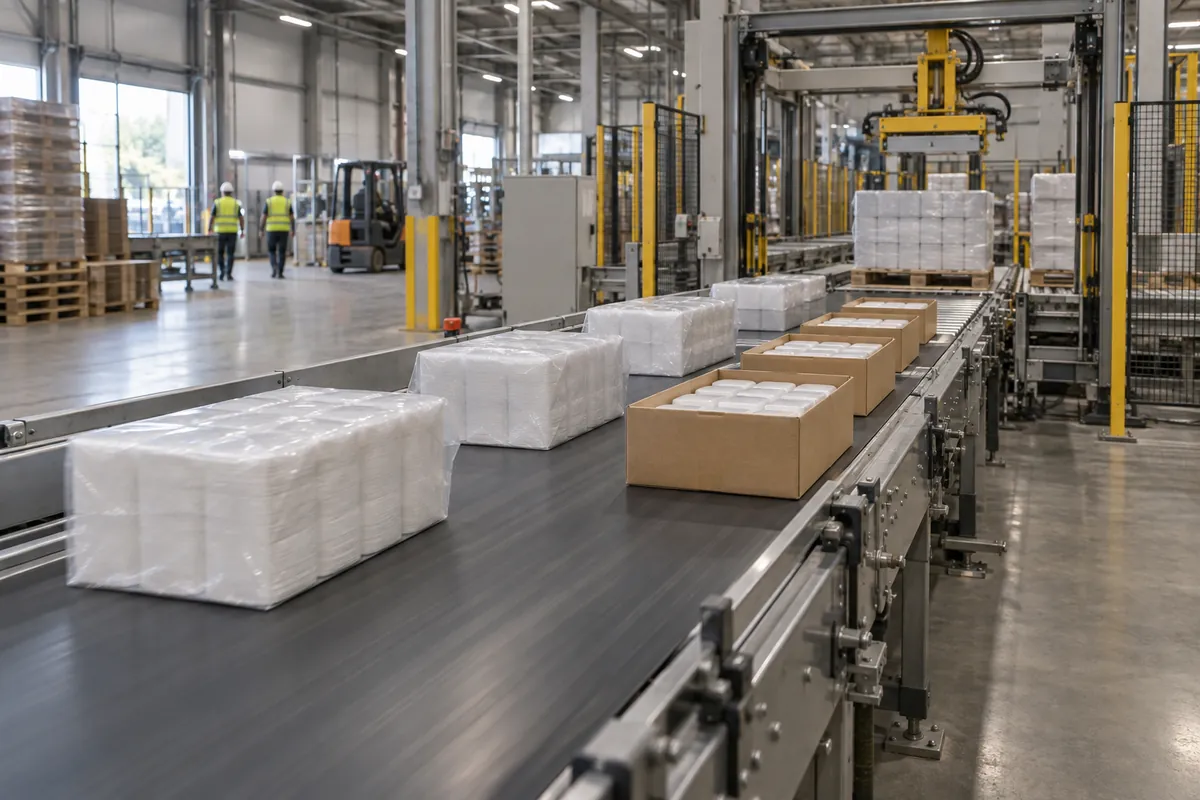
Upstream, the case palletizer connects to a case erector, packer, sealer, labeler, and often a check weigher or reject station. The handoff is both mechanical and electronic. Case quality, spacing, and stream consistency are mechanical, and status signals between machines are electronic, so the line can slow down, build a buffer, or stop in an orderly way rather than jamming at the palletizer. The case conveyors and accumulation conveyors pages cover how cases are transported and buffered between those machines, and why a short buffer can keep a pallet change from stopping the packing line.
Downstream, the finished pallet usually travels to a stretch wrapper, a pallet labeler, and then a pallet conveyor or a forklift pickup point. If pallets are inspected or weighed after building, that adds a stage. The wrapper often sets the practical limit on pallet rate, so size the discharge conveyor and the pallet buffer accordingly.
Plants that also unload pallets can pair this equipment with case depalletizers, which reverse the process for cases that arrive on pallets.
For industry context, see beverage packaging automation and pallet handling.
Footprint, utilities, controls, and safety
Layout drawings should show plan view, height, pallet staging, magazines, service clearances, and forklift access. A guide from one supplier warns that a tightly packed layout can save floor space and still prove expensive later if technicians have no way to get to sensors, drives, grippers, or transfer points.
Expect electrical power and compressed air; vacuum-based tooling and pneumatic diverters raise air demand. Ask for connected load and air consumption in writing. A PLC and HMI manage patterns and recipes, so ask who can edit patterns, how changes are tested, and how machine-to-machine signals with the packer and wrapper are configured.
Case palletizers combine moving conveyors, pallet lifts, layer plates or robot arms, and automatic pallet exits. Safeguarding usually includes guarding, interlocked doors, light curtains at the entry and exit, and controlled-entry procedures for removing finished pallets. For robotic and gantry cells, an A3 article says the standards family ISO 10218 and ANSI/A3 R15.06 addresses the whole application, including the end-effector, workpiece, and peripheral equipment. Safety-related control functions are commonly designed according to ISO 13849-1, which defines performance levels. Standards are revised periodically, so confirm which edition applies. A site risk assessment of the complete installation should set the safeguarding, including maintenance and fault recovery.
Cost factors
This guide does not state prices. These drivers most often separate one quote from another, and the palletizer cost guide covers how to compare them:
- Architecture and the sustained rate required
- Number of case sizes and patterns, and the changeover method
- Case turning and orientation equipment
- Layer squaring, compression, or sheet handling
- Pallet dispensing and the empty pallet magazine
- Infeed conveyors, accumulation, and any vertical lift
- Wrapper interface, discharge conveyors, and pallet buffering
- Guarding, light curtains, and controlled-entry access
- Controls platform, recipes, and integration with upstream machines
- Installation, commissioning, training, and spare parts
Also count what poor case quality costs: stoppages, rework, and damaged loads. These can outweigh a modest equipment price difference.
Selection checklist
- Record the full case range, including the hardest SKU.
- Photograph or sample real cases, including weak or overfilled ones.
- Define the sustained cases per minute for each SKU and the number of lines feeding the palletizer.
- List pallet sizes, maximum height, and maximum load weight.
- Decide which faces and labels must show on the outside of the load.
- Define the pattern type for each SKU, including any interlocked patterns.
- Estimate changeovers per week and who will perform them.
- Specify empty pallet, sheet, and discharge handling.
- Define the wrapper, labeler, and buffer arrangement.
- Request the safeguarding approach and the standards applied.
- Confirm maintenance access, spare parts, and training.
- Ask for an acceptance test with production cases.
Common mistakes
- Specifying around the average case. The hardest or weakest case sets the real limit.
- Treating label orientation as an afterthought. Add it to the pattern drawing at the start.
- Copying a pattern from a previous machine, when pallet size, case compression strength, and overhang rules may differ.
- Choosing the architecture before the case mix. A layer machine and a robot differ most when the case mix is wide.
- Leaving buffers out. Without accumulation, a pallet change stalls the packer.
- Ignoring upstream quality. Overfilled, leaning, or poorly sealed cases cause most jams.
- Skipping the acceptance test. Test with production cases at the stated rate.
- Forgetting maintenance access. Sensors, diverters, and tools need to be reachable.
Alternatives
If cases are uniform and the plant needs steady high output, a conventional layer machine in a high-level or low-level design is usually the first quote to request. If the plant runs many SKUs or changes patterns often, a robotic palletizer is typically worth pricing, and the robotic vs conventional palletizer guide sets out the comparison. The guide to choosing a palletizer helps weigh both against the same case list and rate. For manual or semi-automatic palletizing, such as a pallet lifter with a human loader, low rates and light duty may fit, though the safety and ergonomic burden remains. Ask each supplier to quote the same case list, patterns, and rate so the complete scopes can be compared. The palletizing systems overview lists the remaining system types.