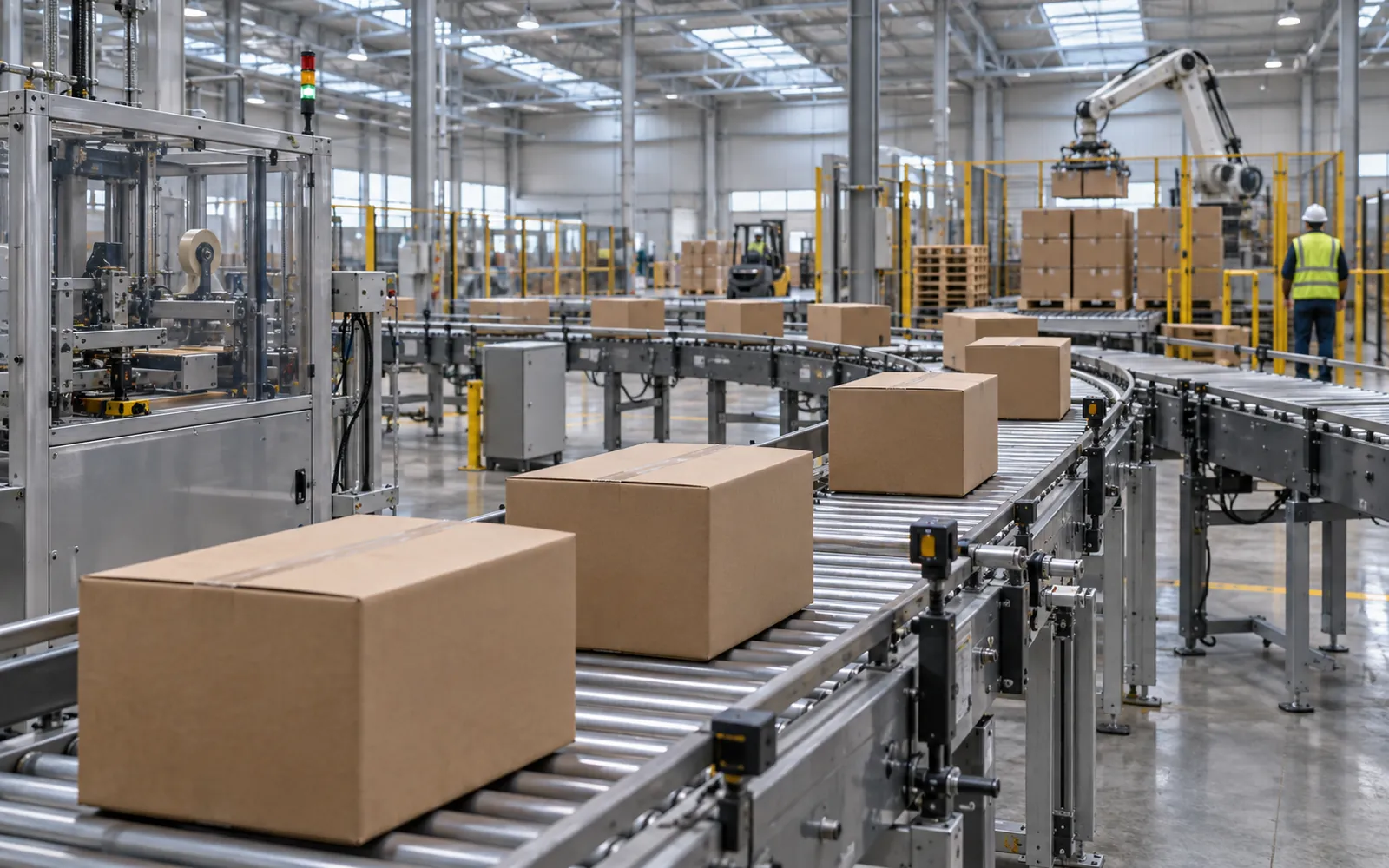
Choose the required turn first
| Method | What changes | Which face leads afterward | Typical fit | Watch for |
|---|---|---|---|---|
| Curved conveyor (belt, tapered roller, or MDR) | Line direction | The same face as before, because the case follows the curve | Layouts with room for the radius | The longest case sets the radius, and the case diagonal must clear the guides on the curve |
| Right-angle transfer (pop-up chain or belt) | Line direction, in a tight space | A side face, because the case moves sideways without rotating | Tight layouts, routing to parallel lines, reject lanes | The case stops its forward travel at the transfer, which limits rate |
| Bump turn | Case orientation only | The adjacent face, after a 90 degree rotation on its base | Simple, uncontrolled turning of cartons, trays, and cases | Impact force on the case, and matching conveyor speed to the bump |
| Dual-lane or dual-belt turner | Case orientation only | Turned 90 or 180 degrees by a speed difference between lanes | Gentler, continuous turning of light and medium cases | Needs even spacing at the input |
| Upender or tipper | The face the case rests on | Depends on the device; the case ends up lying on another face | Presenting a code face, or matching a palletizer or packer that needs another face down | Speed matching, spacing, and the full range of case sizes |
Record the required route, leading face and resting face at the downstream machine. This guide covers cases after packing in packaging conveyor systems; bottle conveyors cover primary containers before packing.
How it works
A case sits on a surface that moves, and the surface either carries the case continuously or starts and stops in sections. A case is easier to convey than a bottle because it has a wide flat base. The difficulty comes from variety and from the line around it. Cases arrive in different sizes, with bottoms that may be rigid corrugated, a soft shrink-wrapped film pack, or a tray. They must be spaced for scanners and sealers, aligned for turns and merges, and stopped without crushing.
Three things define a case conveyor system. The carrying surface is a belt, a set of rollers, or a chain, and its friction decides how well a case grips on inclines and how it reacts when held back. The drive can be gravity, a shared motor driving many rollers or a belt, or a motor in each zone, and it determines whether cases can queue without contact. The control scheme uses sensors, usually photo-eyes, to tell the controller where cases are, and logic decides when each section runs. That is where spacing, merging, and accumulation are controlled.
Types and configurations
Belt conveyors
A belt conveyor carries a case on a continuous belt supported by a slider bed or by rollers beneath. Belts are quiet and give uniform support to soft or irregular bases, which makes them a good fit for shrink-wrapped packs, bags, and trays. They are also the usual choice for inclines and declines, for inspection stations where a case needs a steady surface, and for transport over long distances. Their weakness is accumulation. The belt keeps moving under a stopped case, so friction pushes the stopped case against the one ahead unless the design adds zones or lifters. A belt is best where cases flow continuously or where short queues can tolerate some contact.
Gravity roller conveyors
A gravity roller conveyor has free-turning rollers, and cases move by hand or by a slight downhill slope. With no motor, it is simple, cheap, and silent. It is used for short runs, packing and staging tables, truck loading, and as a flow-through storage lane. It does not control spacing or speed, so it does not suit automatic lines. The pattern is to push cases by hand and stack them at the end of a lane.
Live roller conveyors
A live roller conveyor drives the rollers under the case. Older designs use a belt below the rollers, a shaft with elastic bands, or a chain, so a single motor turns many rollers. The conveyor can run continuously, and zoned versions add lifting or clutching so a section can stop independently. Live roller is a durable choice for cases with rigid, flat bottoms and for heavier loads. It is common in plants where mechanics are experienced with belt, shaft, and chain drive.
Minimum-pressure accumulation is a typical live-roller feature. One supplier describes it as a belt-driven roller design with a component that adjusts how strongly the rollers are driven, so back pressure on the front case is lowered. Another source describes the best versions as reducing back pressure to a small share of the total load. Cases still touch, but they press lightly.
Motor-driven roller (MDR) conveyors
An MDR conveyor places a small low-voltage motor inside selected rollers. Each motor roller drives a few neighboring rollers through bands, and a sensor and a controller card make up a zone. Because each zone is independent, a zone runs only when a case is present or about to arrive, and it stops when the zone ahead is occupied. Suppliers describe three states per zone: empty, occupied and running, and occupied and stopped. A stop signal passes upstream from zone to zone, filling the line with gaps between cases, and when the head clears, the release passes upstream in sequence.
Evaluate the proposed MDR system using the actual occupied/idle duty cycle, motor and controller configuration. Compare energy consumption and capital cost against conventional powered rollers on a common operating basis. Zone length typically follows the length of the case plus a gap, so a plant that runs many case lengths on one line should check how zones are sized.
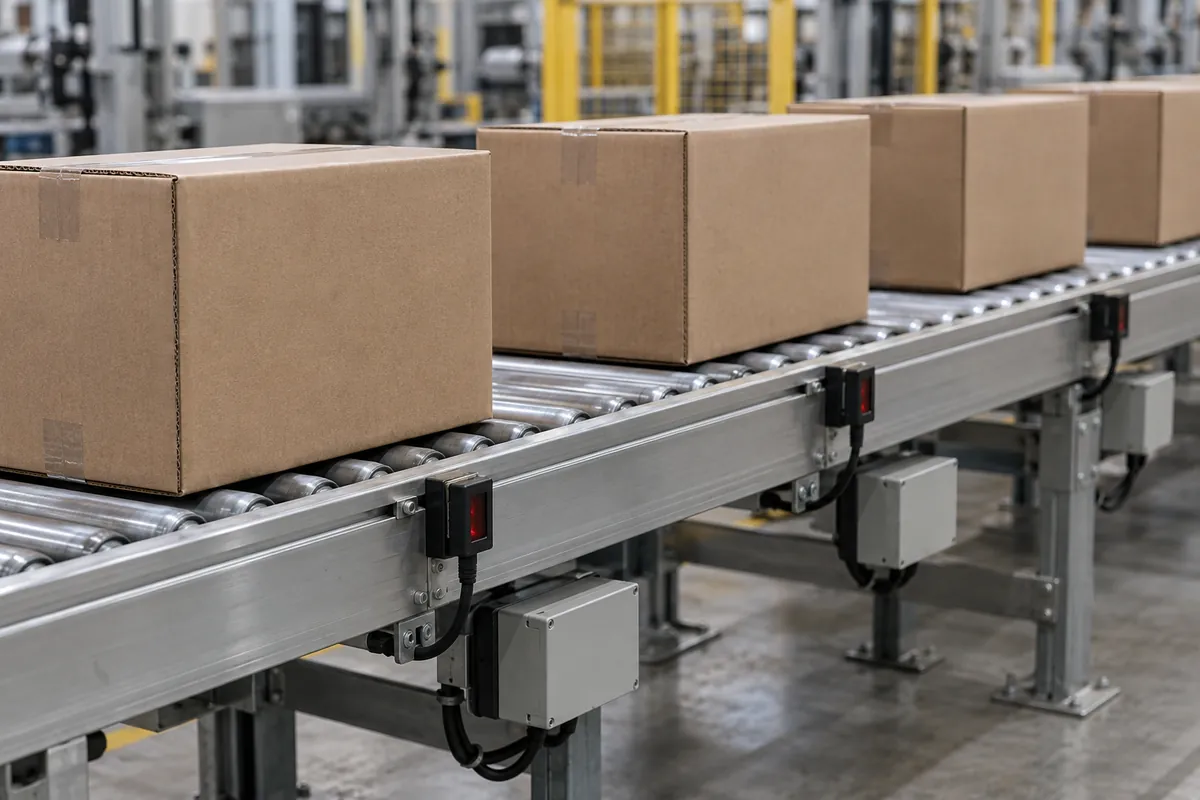
Zero-pressure accumulation for cases
Zero-pressure accumulation (ZPA) is a control method, not a conveyor type. It can be built on MDR, on shaft-driven or belt-driven live roller with zone clutches or lifters, or on chain-driven roller. The idea is that cases never touch while stopped. The first case runs to the last zone and blocks that zone’s photo-eye. That zone stops and tells the zone behind it to stop when the next case arrives. A trailing case halts in the zone behind its leader, and so on, with gaps between all of them. Suppliers contrast this with older designs that used sensing rollers, which needed a minimum case weight to trigger, and with photo-eye designs that can accumulate light or uneven cases. ZPA is the usual choice for fragile cartons, mixed weights, and packs with printed or glued flaps that should not be rubbed. The cost is more sensors, more controls, and, in some designs, more compressed air or more motors. The accumulation conveyors guide compares zero-pressure with minimum-pressure and buffer types and explains how to size the buffer.
Merges, diverts, and turns
A line of cases rarely runs straight from start to finish. Several case packers may feed one palletizer, one line may feed two palletizers, and rejects must leave the flow.
A merge joins two or more lanes into one. A good merge controls which lane goes first and leaves a gap so cases do not collide. Simple merges use a gate or a sensor-controlled stop on one lane, and more complex ones use zones and logic to alternate or to give priority. A merge is also a rate limit, because it can pass only as many cases as its logic and gap allow.
A divert sends cases to a different path. Types include a pop-up wheel or roller diverter that lifts and angles cases, a pusher or paddle for rejects, and a belt or chain transfer for a right-angle move. The method depends on case weight, rate, and how well the case tolerates side force. Reject diverts usually go to a separate lane or bin and are interlocked with checkweighers and inspection units.
A curved conveyor turns a case through an angle while it stays oriented in relation to the belt. Curves can be belt, tapered roller, or MDR. Tapered rollers keep the case straight on a curve, and the curve radius depends on the longest case. A right-angle transfer moves a case onto a perpendicular conveyor without a curve, which saves space but changes the case’s leading edge.
Case turners
A continuous case turner changes the orientation of a case while it moves, for example to turn short-side-leading cases to long-side-leading for a labeler, a scanner, or a palletizer pattern. Three designs are common.
- A bump turner puts a fixed bar, rail shape, roller, or plastic profile at an angle across the path. Each case hits it and rotates 90 degrees. One supplier describes it as a mechanical solution that needs no controls, notes that more than 90 degrees takes several bumps, and warns that matching conveyor speed to the impact matters because some cases cannot take much force.
- A dual-belt or dual-chain turner runs two conveyors on separate drives side by side with a small gap. One side runs faster than the other, so the case rotates as it passes. Suppliers describe this as turning cases without interrupting flow, typically for light and medium loads, and as an option for rotating 90 degrees clockwise or counterclockwise. One notes that tabletop chain and a roller transfer suit shrink-wrapped and flexible packs gently, and that the same unit often feeds a case palletizer or a labeling operation. Changing the speed of one lane lets a turner handle several case sizes.
- Activated roller belt and servo-driven turners use a belt with rollers that spin cases on command, or a servo-driven system with a bypass for cases that need no turn. They suit higher rates or tighter control and cost more.
Turners need a straight, evenly spaced input, so they usually follow a spacing section. Ask the supplier about the minimum case size, the gap needed between cases, and how the turner behaves after a stop.
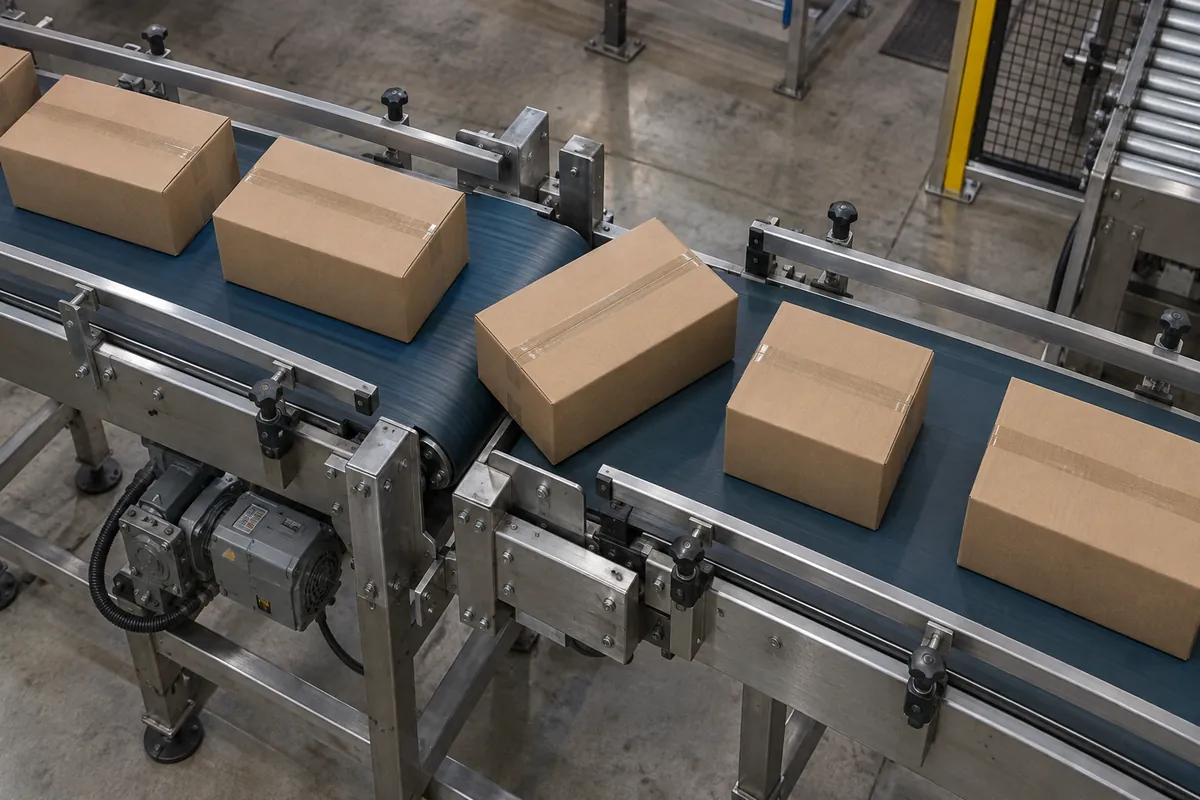
Turning, diverting, and upending cases: which method fits
A request for a “90 degree turn conveyor” can mean two different jobs. One is changing the direction of the line, for example to go around a column. The other is changing which face of the case leads while the line keeps running straight, for example so a label faces a fixed scanner. A third job, laying a case down on a different face, is called upending or tipping. Decide which job the downstream machine needs before choosing equipment, because the methods are not interchangeable.
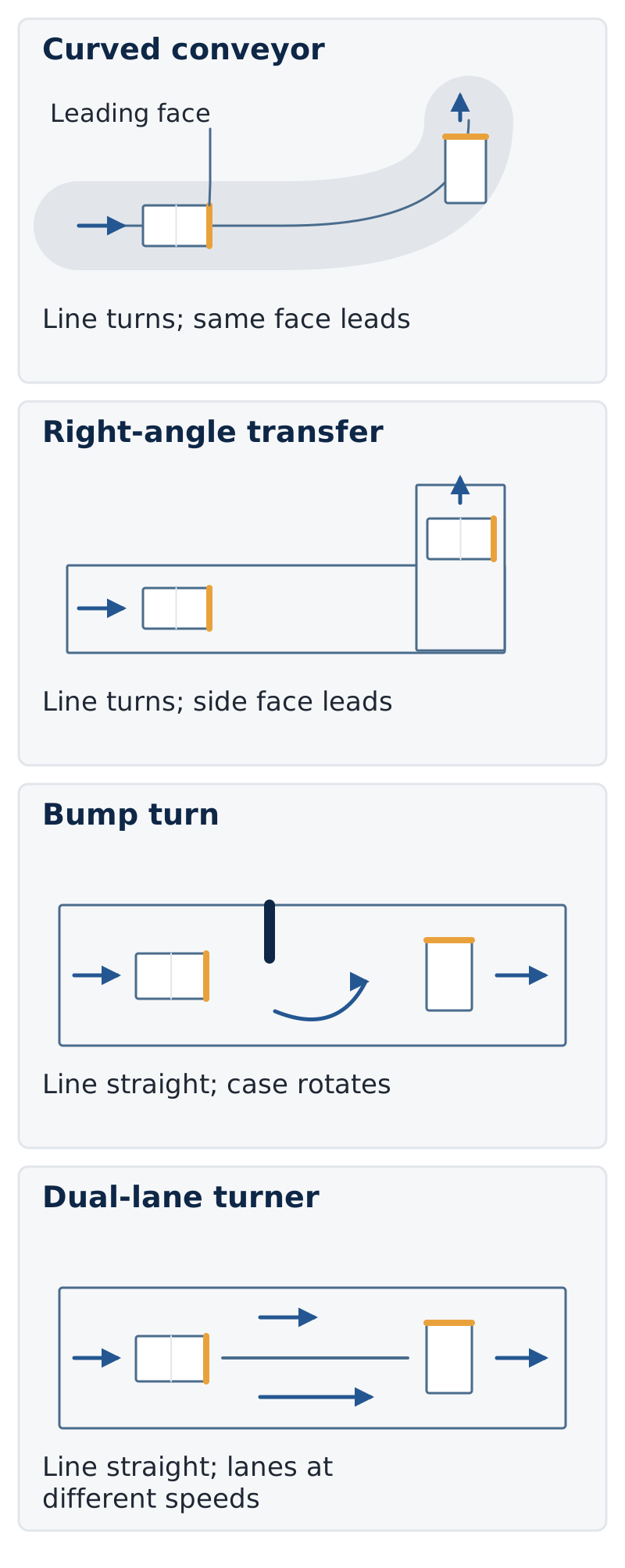
A right-angle transfer lifts a short section of chains or belts up between the rollers, carries the case sideways onto the next conveyor, and drops back below the roller surface. One conveyor manufacturer describes chain transfers as suited to rigid pallets and heavy loads in tight layouts that do not allow large radius turns, and v-belt transfers as giving controlled side movement for cartons and totes. A bump turn is a bar, guide-rail shape, roller, or plastic profile that the case strikes. One supplier describes it as a non-controlled mechanical solution that turns cases, cartons, and trays 90 degrees, needs several bumps for more than 90 degrees, and depends on matching conveyor speed to the impact the package can take. The same source describes dual-lane turners that run chains at different speeds to turn cases 90 or 180 degrees.
Upenders change the resting face. In an arm upender, the case is guided toward an angled arm beside the main conveyor and climbs it, which changes its orientation by 90 degrees. A helix or twist upender carries the case between two tabletop chains set at right angles, and twisting the chains rotates the case 90 or 180 degrees in either direction. Multi-Conveyor’s public orientation guide stresses speed matching for its Arm Upender and claims multiple-size operation without changeover for its two-chain Helix Upender design (accessed October 8, 2026). This is a manufacturer description of those devices, not a claim for every twist or case size. Test the smallest and largest cases on any upender, since a tall, narrow case and a flat case behave differently. Pattern and label-orientation rules for the pallet itself belong to the case palletizers guide.
Selection conclusion: use a curve or transfer to change the route, an in-line turner to change the leading face, and an upender to change the resting face; test the resulting scan and infeed presentation.
Diverter control logic
A divert is only as reliable as the logic that tells it which case to move. Most case diverts, whatever the mechanism, follow the same sequence:
- Decide. Each case receives a destination before it reaches the divert, from a scanner read, a checkweigher result, an inspection result, or the line schedule.
- Track. The controller follows that case to the divert, using zone positions or conveyor travel since the decision point. Gaps between cases must be large enough for each photo-eye to see every case separately, or the tracking slips by one case.
- Trigger. A photo-eye at the divert detects the tracked case and fires the mechanism at the right moment.
- Confirm. A sensor on the receiving lane confirms that the case actually left the main line. A case that should have diverted but did not is a fault, not a pass.
- Protect. A lane-full sensor on the receiving lane holds diverts, or stops the line, before cases back up into the mechanism.
Decide the default action early. A case with no read or no decision should go to a reject or recirculation path rather than continue as if it were good, and a full reject lane must be handled before it stops the line. Merges apply the same ideas in reverse, with gap and priority control as described above. For holding cases in a queue on the way to these stations, see the accumulation conveyors guide.
Buying a new or used 90 degree turn conveyor
A width, turn angle and drive listing does not establish fit. Use the same record for a new or used unit:
| Input | Record for this route and case range | Acceptance action |
|---|---|---|
| Route and radius | Left/right hand, available radius and guide envelope | Run the actual cases through the required path |
| Maximum case diagonal | Longest/widest combination, including loaded bulge | Check corner clearance through the turn |
| Transfer gap and heights | Infeed/outfeed height, gap and leading-edge support | Check for catching or tipping at each transition |
| Leading and resting faces | Required faces at scanner, packer or palletizer | Confirm code readability and downstream entry after the turn |
| Case spacing and queue | Minimum gap and occupied stopping positions | Test stop, restart and accumulation at the intended rate |
| Drive and sensor interfaces | Power, speed control, zone cards and signals | Demonstrate coordinated release and fault response |
| Used-unit condition | Belt/rollers, bearings, guides, guards, manual and rating basis | Resolve condition gaps before an acceptance run |
Use real filled cases at the target rate and record each result with the commissioning and acceptance checklist.
Inclines and declines
Changing elevation with a case conveyor is common when a case packer sits on a floor lower than the palletizer or when a line must clear an aisle. Belt conveyors are the usual choice, with a friction-top belt for modest slopes, a cleated belt for steeper slopes, and sidewalls where cases could slide. Roller inclines need grip from driven rollers and become harder as angle and weight rise. On a decline, cases can slide ahead or tip, so a brake motor, controlled speed, and sometimes a friction belt are used. The vertical conveyors guide covers lifts, spirals, and larger elevation changes, and it explains when an incline needs too much floor length to be practical. Settle the case material and weight, the angle, whether cases must stop on the slope after a power loss, and the transitions at the bottom and top. A transition that is too abrupt tips cases or catches the leading edge, so ask for a transition detail, not only an angle.
Photo-eye zone control
Zone control divides a conveyor into short sections, each with a presence sensor and a drive or a clutch, and logic ties the zones together.
The photo-eye sits near the discharge end of each zone, so a case stops cleanly at the end. According to supplier descriptions, retro-reflective photo-eyes are the most common type, and they do not need a minimum case weight. Zone length follows the longest case plus a gap, which means one length rarely suits every format. A line that runs very short and very long cases may need a compromise or a smart control that groups zones.
Release mode is the other choice. Singulation releases one case at a time with a gap, while slug release lets a group of cases leave together, which fits palletizer layers. For control, zone cards can talk to neighbors without a central controller, or a PLC can manage the conveyors over a network. A line with many zones, recipes, and tracking usually needs a PLC.
Ask what happens after an emergency stop, and whether the system recovers without clearing cases by hand. Dust, label glue, shrink film, and shiny surfaces can block or fool sensors, so mounting, cleaning, and sensor type matter.
Label and scanner tunnels
Cases carry shipping labels, product codes, and sometimes serialized codes, and the conveyor positions them for printing and reading. Common stations include print-and-apply labelers, inkjet coders, and barcode scanners.
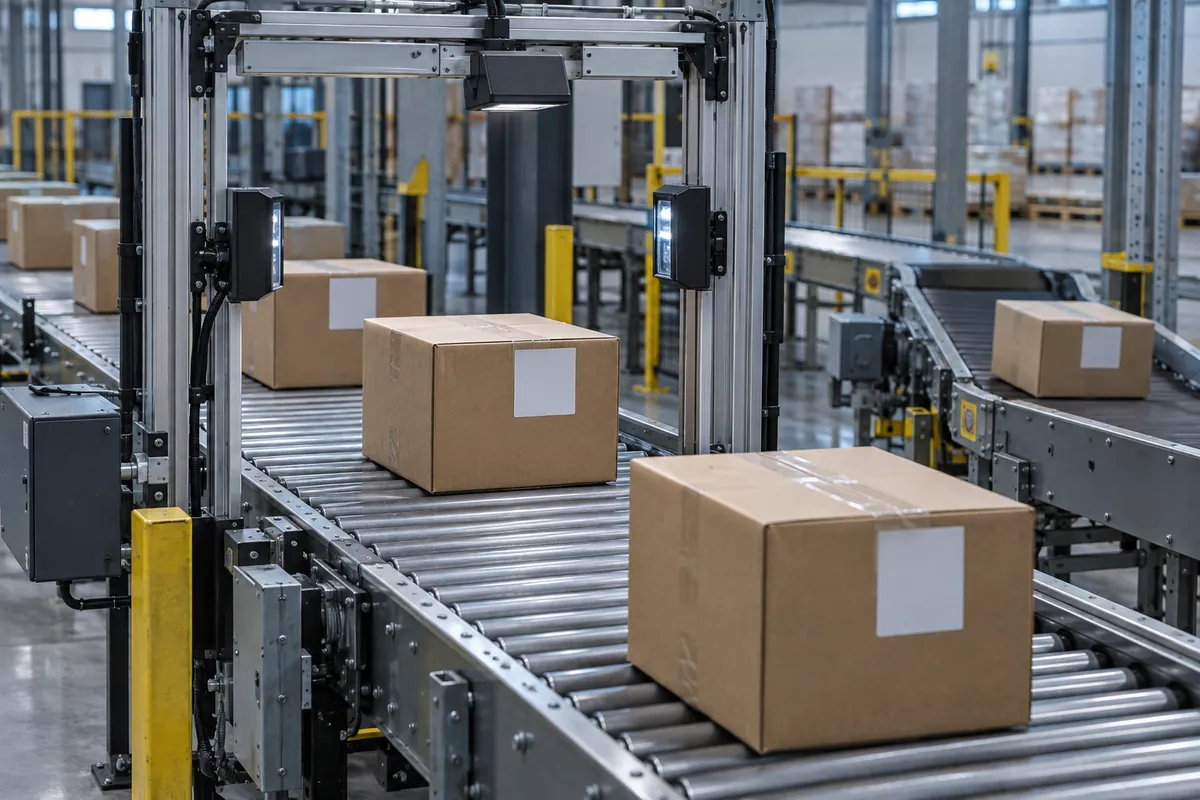
A scan tunnel is a frame over the conveyor with several scanners that read multiple sides at once, so a case can travel in nearly any orientation. Choose the number of reading faces from the actual label-location and orientation variation. Where both are controlled, evaluate a fixed-side scanner; where they are not, test the required tunnel coverage. Compare installed scope and trials rather than assuming a cost multiplier. The usual layout is a case turner upstream, a spacing section, and a scanner or applicator at a fixed side, with the conveyor holding cases against a guide rail so the label stays in the read zone.
Conveyor design matters for reading. Gaps between cases must be enough to separate codes, speed should be steady, and a case that sits on rollers can have a vibrating label. A bottom-reading scanner may require a gap between conveyors or a clear window, which has to be planned in the frame. Rejects from a failed read go to a divert lane or a stop, so interlocks between the scanner and the diverter are part of the conveyor scope.
Specifications to evaluate
| Specification | Why it matters | What to ask the supplier |
|---|---|---|
| Case size range and weight | Sets roller spacing, belt choice, zone length, and drive capacity | What are the smallest and largest cases, and the maximum weight per zone or per foot? |
| Case base | Soft film, wet, or flexible bases do not run well on rollers | Is the case suited to rollers, or does the design need a belt? |
| Rate and gap | Throughput depends on case length, gap, and speed, not only belt speed | What rate is achieved at our longest and shortest case with the required gap? |
| Drive type | Determines accumulation behavior, noise, and energy use | Is the design MDR, live roller with zones, or belt, and why? |
| Accumulation mode | Zero or minimum pressure changes damage risk and cost | How is pressure controlled, and how many cases queue in the buffer length? |
| Merge and divert logic | Merges limit rate and can collide cases | How do merges set priority, and what rate do they sustain? |
| Turners and spacing sections | Turners need steady input and spacing | What input spacing and case range does the turner require? |
| Incline or decline details | Angle, belt surface, and transitions affect stability | What surface and angle is proposed, and what happens at power loss? |
| Sensors and controls | Reliability depends on sensor type and logic | Which sensor type is used, how is it cleaned, and how are faults shown? |
| Washdown and finish | Dry case lines differ from washdown zones | Which areas are washdown rated, and what finish is standard? |
| Noise and energy | Rollers, motors, and impacts affect the hall and the bill | What sound level and power use do you expect at our duty? |
| Safety features | Guarding, stops, and crossovers | Which guards, emergency stops, and crossovers are included? |
Product compatibility
Corrugated cases with rigid bottoms run well on rollers, belts, and chain. The usual concerns are case squareness, flap condition, and tape or glue that catches on guides. Thin cartons and trays can flex between rollers, so a belt or closely spaced rollers is better, and trays with open sides need guide rails that do not catch the edge.
Shrink-wrapped and bundled packs have soft, slippery, or uneven bases. Belts handle them more steadily than rollers, and turners with chain and gentle transfer are preferred. Bags and pouches are also best on belt conveyors, since rollers can deform them and cause jams.
Plastic totes and returnable containers have rigid bases and run on rollers or belts. Check for runners or feet that interact with rollers, and for stacked containers that need extra guarding.
Always give the supplier real samples at the heaviest weight, since an empty or dummy case behaves differently from a filled one.
Integration upstream and downstream
Upstream, case conveyors take cases from a case packer, tray packer, or case erector and sealer. Cases come out in a rhythm set by the packer, often in bursts, and the first conveyor smooths that into an even stream. Bottles and other primary containers are handled by the bottle conveyor section before packing.
Downstream, the destination is usually a case palletizer, a robotic palletizer, or a high-level palletizer. Each wants cases in a specific orientation, spacing, and release pattern. A conventional palletizer may want a full row at once, while a robotic cell may pick one case at a time at a fixed point. Buffering before the palletizer lets the line ride through pallet changes and wrapper stops, and the same logic runs in the other direction when a case packer stops. The palletizing hub outlines the end of the line. For case-based depalletizing at the front of a line, see the case depalletizers guide.
Case flow on the floor of a food plant is discussed in food packaging, and the general application is covered under case handling.
Footprint, utilities, controls, and safety
Merges, turners, and accumulation zones add length. Inclines need floor length for the rise, and curves need radius. A drawing that shows column locations, aisles, and clearances prevents surprises.
Belt and live roller use conventional power. MDR uses low-voltage direct current, distributed from power supplies that the supplier should size. Pneumatic zones and diverters need compressed air, and scanners and labelers need power and network. On the controls side, decide early whether zones use stand-alone cards or a PLC, how the conveyor interlocks with the case packer and palletizer, and what the operator sees when a fault occurs.
ASME B20.1 is the U.S. safety standard for conveyors. Its published scope covers design, construction, installation, maintenance, inspection, and operation of conveyors in relation to hazards. OSHA addresses machine guarding in 29 CFR 1910.212 and lockout and tagout in 29 CFR 1910.147. Rollers, chains, belts, and transfers create nip and pinch points, and zoned conveyors can start without warning when a sensor is blocked, which is a hazard during clearing and maintenance. Agree zone-based starts, emergency stop placement, safe crossovers, and clear lockout points with the plant safety team and the supplier. Local rules and insurers may add requirements.
Cost factors
No price figures are given here. Drive type is the first driver, since MDR, live roller, belt, and gravity differ at purchase and over time. Total conveyor length, curves, merges, diverts, and inclines come next, along with the buffer length and zone count for accumulation. Special stations such as turners, scan tunnels, labelers, checkweighers, and rejects add to the total.
Controls and integration cover the PLC, networks, interlocks, and tracking. Washdown and stainless steel construction add cost, as do structure, supports, guarding, and electrical work at installation. Ongoing cost includes power, spare motors and rollers, sensor care, and downtime.
The packaging conveyor cost guide explains how these drivers combine, and the palletizer selection guide shows how conveyor choices connect to the palletizer.
Selection checklist
- List case sizes, weights, and base types, with samples of the heaviest.
- Set the required rate, and the gap that scanners, sealers, and palletizers need.
- Decide where cases must queue and for how long, then choose zero or minimum pressure.
- Map merges, diverts, and rejects, and the logic that rules them.
- Decide whether labels and codes will be read in a fixed orientation or in any.
- Check elevation changes and the space they need.
- Choose drive type for each section, not one type for the whole line.
- Confirm the sensor type, mounting, and cleaning plan.
- Plan guarding, emergency stops, and lockout points with the safety team.
- Ask for a test with real cases at the target rate.
The commissioning and acceptance checklist covers further questions.
Common mistakes
- Using belt for long accumulation. The belt keeps pushing queued cases together.
- Sizing zones for the average case. The longest case then spans zones and the shortest has large gaps.
- Skipping spacing before a turner or scanner. Both need steady gaps.
- Buying a scan tunnel before checking orientation. Compare the required reader coverage with a tested turn or positioning section.
- Ignoring transitions. Case edges catch at gaps and height steps between conveyors.
- Forgetting reject paths. A reject lane that is full stops the line.
- Underestimating sensor upkeep. Dust and film can cause false stops.
Alternatives
Where cases move short distances, gravity roller or a manual push may do. For very high rates or mixed products, a sortation conveyor or a robotic pick may be better. For elevation, a lift or a spiral can replace a long incline. For a full unit load, pallet conveyors take over after palletizing. If a robot packs cases onto pallets, the case flow may end at a single pick point, so check the robotic palletizers guide for what that pick point requires.