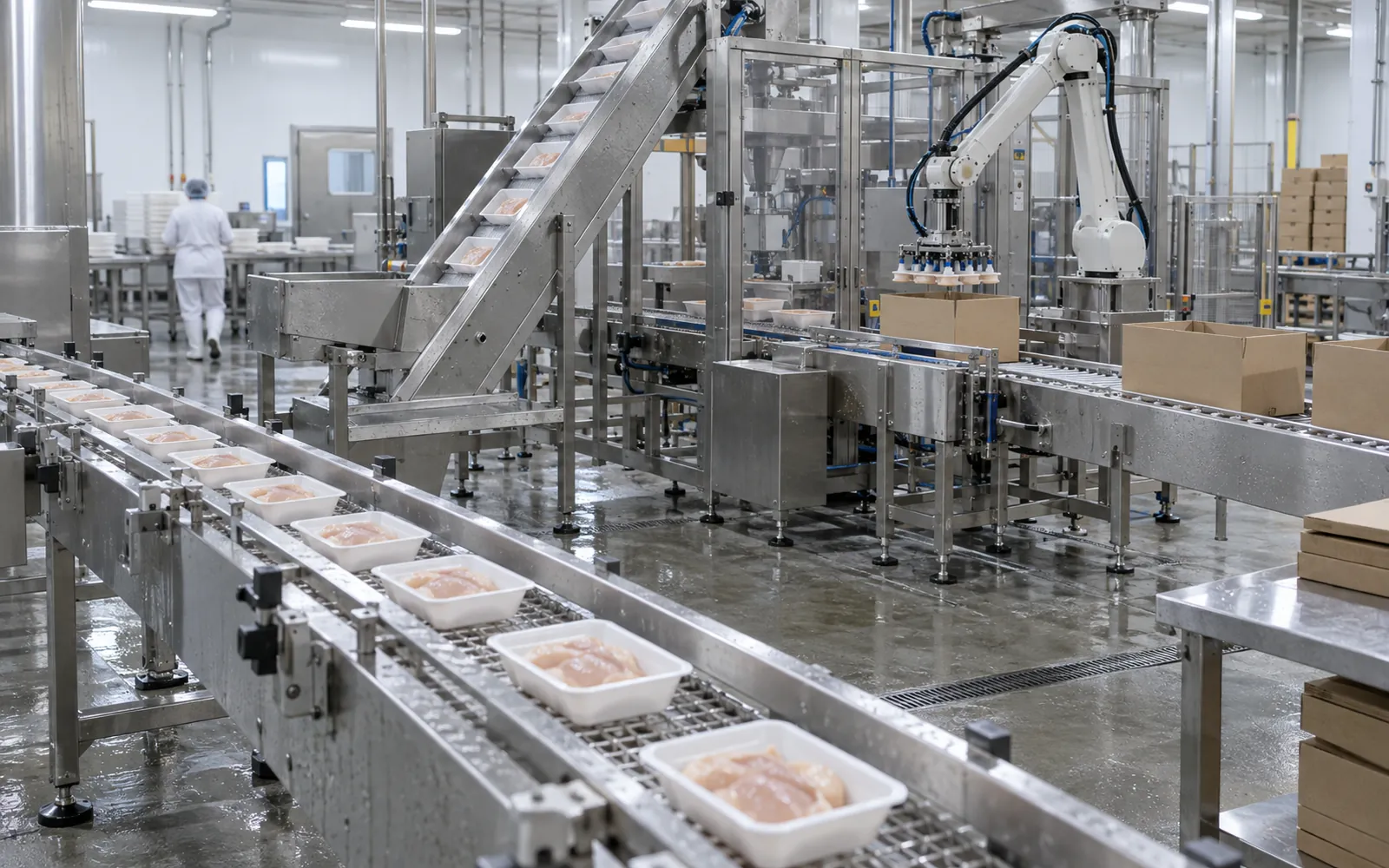
Food lines move a primary package into a case and onto a pallet. The cleaning spec follows the product and the hygiene plan. The page belongs to the packaging industries section and sits next to the beverage, bottled water, and brewery pages.
Dry, wet-wash, and cold rooms
EHEDG’s certification explanation evaluates open and closed equipment, and every evaluation includes a design review. After a successful design review, open equipment may be submitted directly for certification. Most closed equipment still needs in-place cleanability testing (CIP) under EHEDG Doc. 2, and is eligible only after at least three CIP tests. Equipment cleaned with liquids is Type EL. Dry-cleaned equipment is Type ED, and that route is a design review because a dry cleanability test is not currently part of the program. Open and dry-cleaned equipment cannot currently be tested, so those files are reviewed before acceptance. The split is a classification, not a plant cleaning procedure.
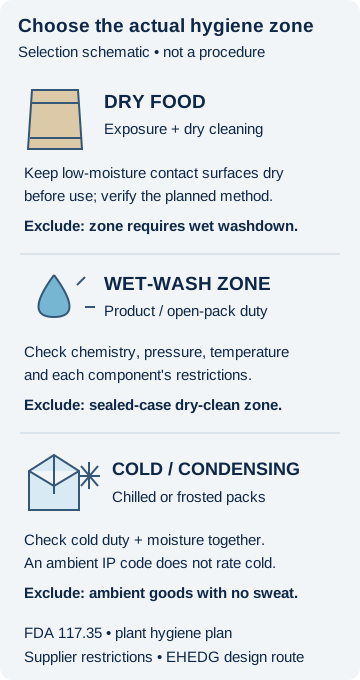
| Scenario | Product exposure | Cleaning method | Temperature | Contact materials | Does not apply when |
|---|---|---|---|---|---|
| Dry | Sealed dry goods, or exposed dry product that the plan cleans without water | The plant’s dry-clean method. No routine water | Ambient, without condensation | Materials that must stay dry. Water can be the hazard | The hygiene plan requires wet washdown of this zone |
| Wet wash | Exposed food, or open primary packs, in a zone the plan washes | The method the plan names: hose, foam, or chemistry | The room the plan actually runs, not a freezer setpoint | Surfaces the plan designates for that chemistry | The zone handles only sealed cases and the plan says dry clean |
| Frozen or condensation | Chilled or frozen packs that sweat or frost | The plan’s method. Condensation changes what “dry” means | The cold-room condition the plant runs | Components the supplier rates for that temperature and moisture | Ambient storage of shelf-stable sealed cases that do not sweat |
FDA 21 CFR 117.35(d)(1)–(2), checked October 10, 2026, separates low-moisture food-contact surfaces from wet processing. Low-moisture surfaces must be clean, dry and sanitary before use; when wet-cleaned they must, where necessary, be sanitized and thoroughly dried before reuse. Wet-processing surfaces require cleaning and sanitizing when needed to prevent cross-contact or contamination. The zone table translates these distinctions into selection checks; it is not a sanitation procedure.
Packaging chain overview
The three stages are the same as elsewhere, but each has its own hygiene profile, and the line is divided into zones. Where the plan exposes product and washes with water, washdown is the relevant design. Where the product is dry and the plan cleans without water, washdown is the wrong copy. Where only sealed cases move, many plants clean by dry methods. The first job is to place each machine in one of those zones.
Primary packaging is the package in direct contact with the food: a bag, a pouch, a tray with lidding film, a tub, a can, a jar, or a tray in a carton. Forming, filling, sealing, weighing, and coding happen here, often inside a high-care or controlled area. These machines are usually process-specific and outside the scope of this knowledge base.
Secondary packaging collects primary packages into the unit that goes to a retailer, a distributor, or a foodservice customer, through case packing, tray packing, bundling, and carton forming. Case packers and case erectors are often the most hygiene-sensitive machines in the end of line, because they handle the primary package.
The end of line covers case sealing, labeling, palletizing, and wrapping. In many plants it sits in a drier, less strictly controlled space where equipment can be cleaned by dry methods, and the main concern is loads that reach distribution intact and traceable.
Typical containers and packages
Bags and pouches are packed into cases, often by robots or pick-and-place machines that handle soft, irregular shapes. They slide, squash, and have limited rigid surfaces for grippers. Rigid trays with film lidding are used for fresh and ready-to-eat products, and they are usually packed in trays inside cases or in returnable crates. Tubs for dips, spreads, and yogurt-like products stack well, but lids and rims can be damaged in handling.
Metal cans and glass jars are common for shelf-stable products and follow the same logic as beverage containers, with the addition of pallet loads that can be heavy. See beverage packaging automation for container-handling parallels. Folding cartons carry dry goods and frozen foods, and they are packed into corrugated cases.
The main outer packs are regular slotted cases, wraparound cases, trays, and display-ready cases. Frozen foods often use cases rated for cold and damp conditions.
Because food products vary so widely, one plant often runs several of these in the same hall. The case handling page describes the transfer and orientation of cases, and the bottle handling page covers jars and bottles.
Key challenges
Hygiene and cleanability
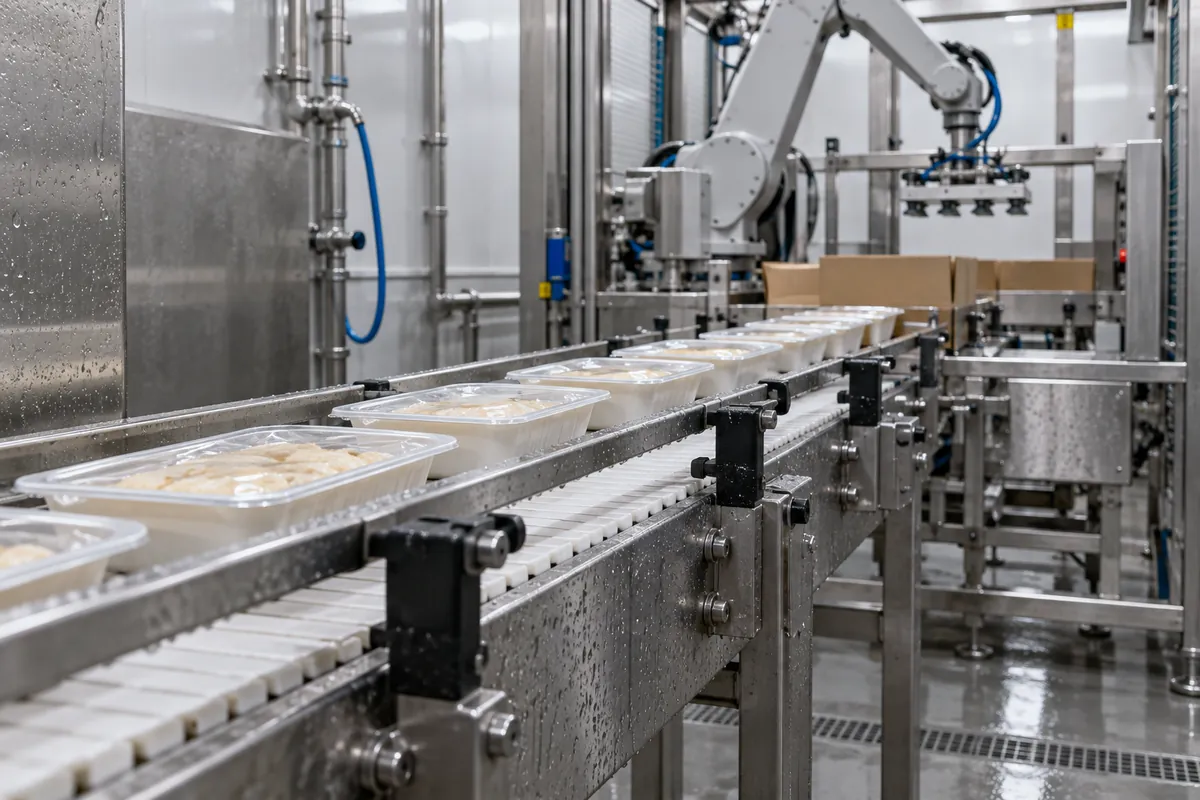
Many U.S. food facilities are subject to FDA’s current good manufacturing practice and preventive controls rule, 21 CFR Part 117, but the rule has its own scope, exemptions, and modified requirements; for example, some subparts do not apply to qualified facilities or to certain products covered by other FDA rules. Check 117.1 applicability and 117.5 exemptions for your facility; qualified facilities can have modified requirements rather than a blanket exemption. Among other things, it requires that people working directly with food, food-contact surfaces, and food-packaging materials follow hygienic practices to protect against allergen cross-contact and contamination. Equipment does not comply on its own, but its design makes compliance easier or harder. On a wet-wash zone, open frames, smooth welds, sloped surfaces, and few ledges reduce places where wet residue can hide. In a dry-clean zone, water resistance alone does not establish suitability for the planned dry method. Match the frame to the row in the scenario table.
Washdown
Use this subsection only for the wet-wash row. Do not copy it onto a dry-clean zone or treat it as the spec for a freezer.
PackagingConveyor.com is an independent editorial resource and supplies secondary background, not manufacturer approval of a cleaning procedure. ADCO’s August 25, 2025 washdown account, checked October 10, 2026, explains how its own cartoners are configured for cleaning chemistry, pressure and frequency. It describes corrosion from chloride-containing cleaner residue and hot-melt components that must be protected. These examples support asking for component-specific restrictions; they do not prescribe chemicals or shielding steps for another maker’s machine.
Obtain each component’s ingress rating, compatible cleaning agents, approved pressure and temperature, and any protection or drying steps from that equipment maker. An IP code does not establish cleanability or cold-temperature suitability. In dry zones, check dust protection as well as access for the planned dry method. Use the relevant 3-A or EHEDG design guidance and FDA sanitation requirements for the product and zone, then verify the actual machine against the plan.
Allergen changeover
Allergen control depends on cleaning, scheduling, and equipment design. The FDA rule defines allergen cross-contact as the accidental transfer of a food allergen into a different food. For packaging equipment, that has four practical consequences:
- Surfaces that touch product or packages should be cleanable without disassembly beyond what the sanitation team can manage.
- Format and recipe changeovers should be repeatable, with clear settings rather than operator judgment.
- Change parts should be easy to clean and store, and ideally color-coded or tagged by allergen group.
- Dry cleaning tools and wet cleaning steps should be separate and written into the procedure.
Plants decide how thorough the cleaning must be and how it is verified, as part of their food safety plan.
Chilled and frozen environments
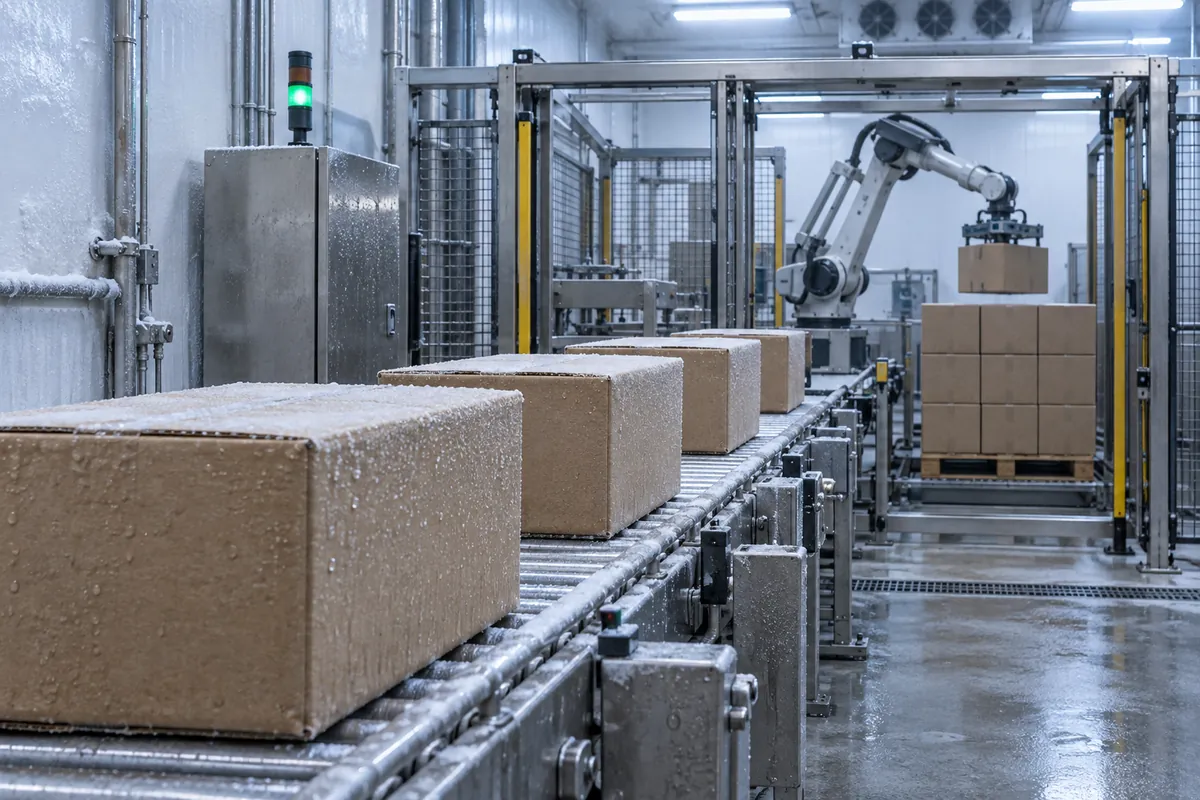
This subsection is only the frozen or condensation row. It does not describe an ambient dry-goods line.
Cold rooms bring condensation, ice, and stiff lubricants. Motors, bearings, and belts need to work at low temperature, and surfaces that sweat make cartons slippery and weak. Case packers using vacuum grippers or friction belts lose grip when product is wet or frosted. Frozen cases may be heavier and need interlocking palletizing patterns because the cases slide easily. Plan for dryers, air knives, or moisture-tolerant equipment where the plan calls for them, and leave enough space in the cold area for service access. Do not apply a dry-clean spec here just because the product is inside a closed case: condensation is still water.
Product variety and delicacy
Food products squash, break, stick, and shed, so packers must handle them gently and detect defects. Vision systems, weight checks, and metal detection or X-ray often sit near the end of the primary line to catch foreign objects or short packs.
Recommended equipment stack
For a typical filled-and-sealed product that is packed into cases and palletized, the stack looks like this:
- Infeed conveying that presents primary packages to the packer in an organized flow. See case conveyors for case-level conveying and accumulation conveyors for buffering. For jars and bottles, see bottle conveyors.
- Case erector to form cases or trays without manual folding. See case erectors.
- Case packer. Use a case packer for repeatable formats, or robotic case packing where product shapes and pack patterns change often.
- Case sealer, which closes cases with tape or hot melt. See case sealers.
- Elevation and transfer. Vertical conveyors carry cases between floors or to a mezzanine.
- Palletizer. Case palletizers suit stable cases at moderate to high rates, and robotic palletizers suit mixed-case, mixed-SKU operations such as distribution-style loads.
- Stretch wrapper and labeling, addressed with the pallet handling page.
- Depalletizer at the infeed when empty jars, cans, or trays arrive on pallets. See case depalletizers and bottle depalletizers.
Design considerations
Line balance
Rate the packer against the primary line, not only against the average. Food lines often have uneven flow because of upstream cooking, forming, or filling cycles, so a case packer must absorb bursts. Capacity above the rated primary rate is the usual answer.
Accumulation
Accumulation in food lines absorbs short stops and also separates the product zone from the case zone, so that a jam in one does not force a washdown in the other. Select buffer surfaces and access for the zone’s dry or wet cleaning method; open construction alone does not prove cleanability.
Reject and rework
Rejected packs may need to be destroyed, reworked, or quarantined, and each path should be traceable. Plan reject stations with their own bins and clear labeling. Open or opened product usually cannot rejoin the flow without procedures that the quality team approves.
Floor space and zoning
Where those zones exist, separate product handling, case handling and palletizing to prevent uncontrolled movement from dirty to clean areas; dry-food lines need their own zoning plan. Pallets, forklifts, and wood stay out of the product zone. The packaging line layout guide and the layout page cover these trade-offs.
Cleaning access
Leave room around each machine for cleaning crews and maintenance. Hygienic design works only if the surface can be reached. Tool-free belt removal, hinged guards, and drain paths matter as much as the stainless steel.
Example line configuration (illustrative)
Illustrative example. Imagine a plant that packs sealed trays of a chilled prepared food into corrugated cases. Trays leave the sealing machine on a stainless open-frame conveyor with a metal detector and a checkweigher, and a reject station removes failures into a bin. A short accumulation conveyor feeds a vision-guided robotic case packer built for washdown, which places trays into cases formed by a case erector. A case sealer closes the case, and a labeler applies the shipping label. The sealed cases leave the washdown room on a conveyor that passes through a wall opening into a drier, cooler area where a robotic palletizer builds pallets, and a stretch wrapper secures them.
The same plant runs a product that contains an allergen on certain days. For those runs, the packer uses a dedicated set of change parts and a written cleaning procedure that includes checks before the line restarts on a non-allergen product. The conveyor design allows the belt to come off without tools, so the sanitation crew can clean beneath it. This configuration is a sketch of how the pieces connect and not a real customer project. Speeds, zones, and the cleaning method depend on the product and the plant’s food safety plan.
Standards and references
The main U.S. food reference is FDA’s 21 CFR Part 117, the current good manufacturing practice and preventive controls rule under the Food Safety Modernization Act. Its applicability and exemptions, set out in subpart A and in the subparts themselves, decide which requirements apply to a given facility; one rule does not establish that a whole plant is compliant. It defines allergen cross-contact and sets hygiene and sanitation requirements. For equipment design, two bodies publish detailed hygienic criteria. 3-A Sanitary Standards develops standards and certifications for hygienic food equipment design, and EHEDG publishes a guideline catalogue that includes topics such as conveyor systems, packaging machines, and robotics. EHEDG’s certification explanation is the source for the Type EL and Type ED split used above. Neither body is a legal requirement for all equipment, and which document applies depends on your customers, product, and plant.
For machine safety, OSHA’s general requirements for all machines require guarding for hazards such as nip points and rotating parts, and lockout/tagout covers servicing. Washdown ratings follow IEC 60529 IP codes, and suppliers should state the cleaning conditions behind their rating. Your quality and regulatory teams decide how these references apply.