Choosing the wrong empty-bottle infeed adds handling and unstable transfers. For lightweight, nonreturnable PET water bottles, identify how bottles arrive before specifying conveying and packing. Large formats, returnable containers and glass need separate checks; this page covers packaging, not water treatment.
| Incoming form | Bottle type / scope | Infeed and conveying | Packaging route to check |
|---|---|---|---|
| Blown on site | Lightweight PET, suitable neck finish | Blow-to-fill block or compatible neck air conveyor; no depalletizer | Filled-bottle conveying to bundles, trays or cases |
| Ordered layers on pallets | Supplier-palletized empty bottles | Layer depalletizer → discharge/laning → compatible conveyor | Confirm bottle stability and selected pack format |
| Random loose bottles in bins | Empty plastic bottles validated for unscrambling | Bin/hopper feed → unscrambler → upright discharge; no layer sweep | Confirm orientation and transfers before filling |
| Large PET formats | Bottle-specific exception | Validate support, neck compatibility and filled-bottle stability | Cases, bundles or direct layers only as demonstrated |
| Returnable containers / glass | Outside the lightweight-PET default | Separate washing/inspection or breakage-handling design | See beverage packaging |
The packaging industries section gives context for brewery and food packaging lines.
Packaging chain overview
The chain for bottled water is short in product steps and long in bottle handling.
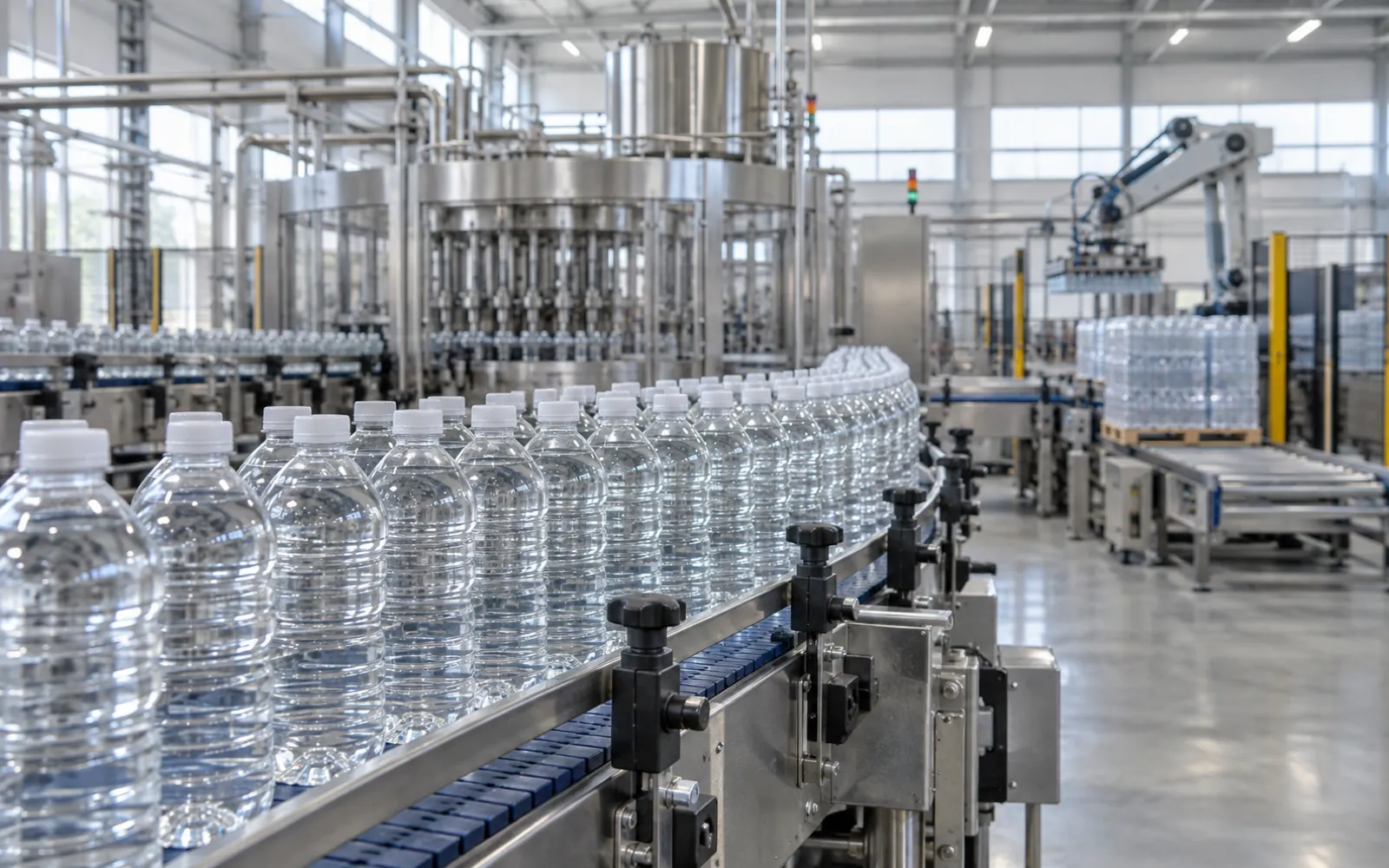
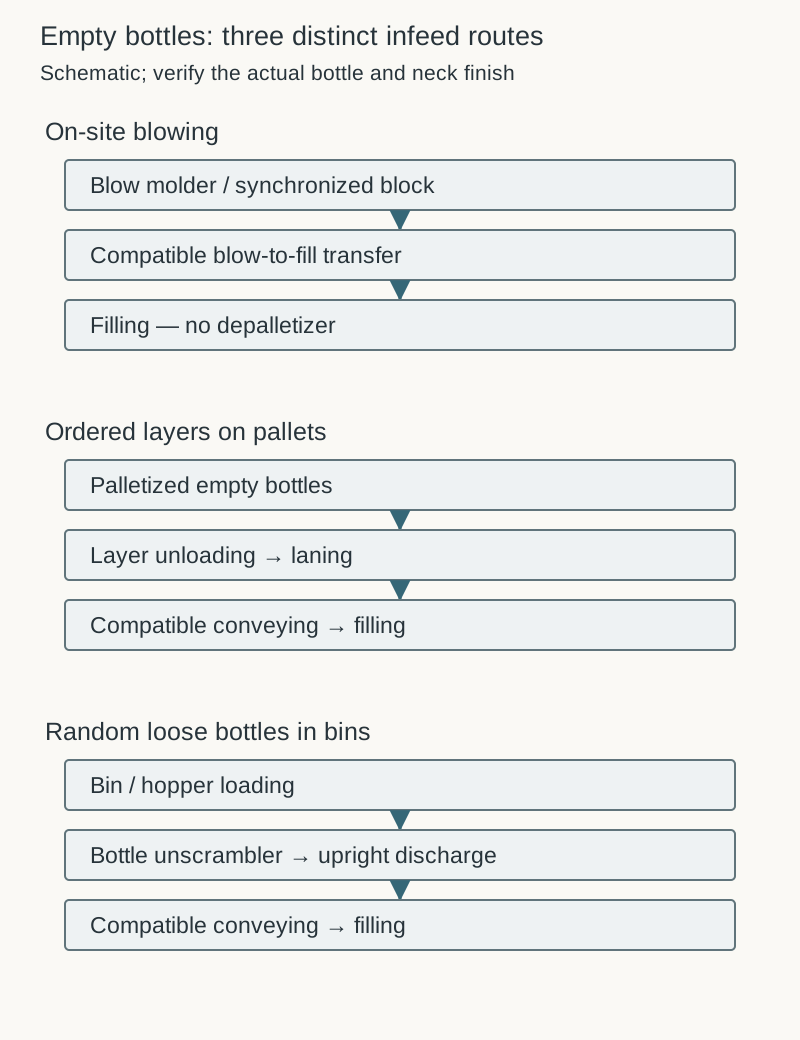
Primary packaging starts with the bottle. Some plants blow preforms into bottles in-house, and the bottles go straight to the filler on air conveyors or through a synchronized block that joins blowing, filling, and capping. Ordered layers of empty bottles on pallets instead call for layer depalletizing and laning. Random loose bottles in bins need a validated hopper/unscrambler route: Posimat’s public rotary-unscrambler brochure describes bulk hopper feeding followed by upright discharge. These incoming forms are different; “bulk” alone does not specify the machine. Container preparation, filling, capping, labeling and date coding then follow as applicable.
Secondary packaging groups the filled bottles into a sellable pack: shrink-wrapped bundles (sometimes with a handle), tray and film packs, or corrugated cases. Large bottles may go onto pallets as loose layers with no secondary pack.
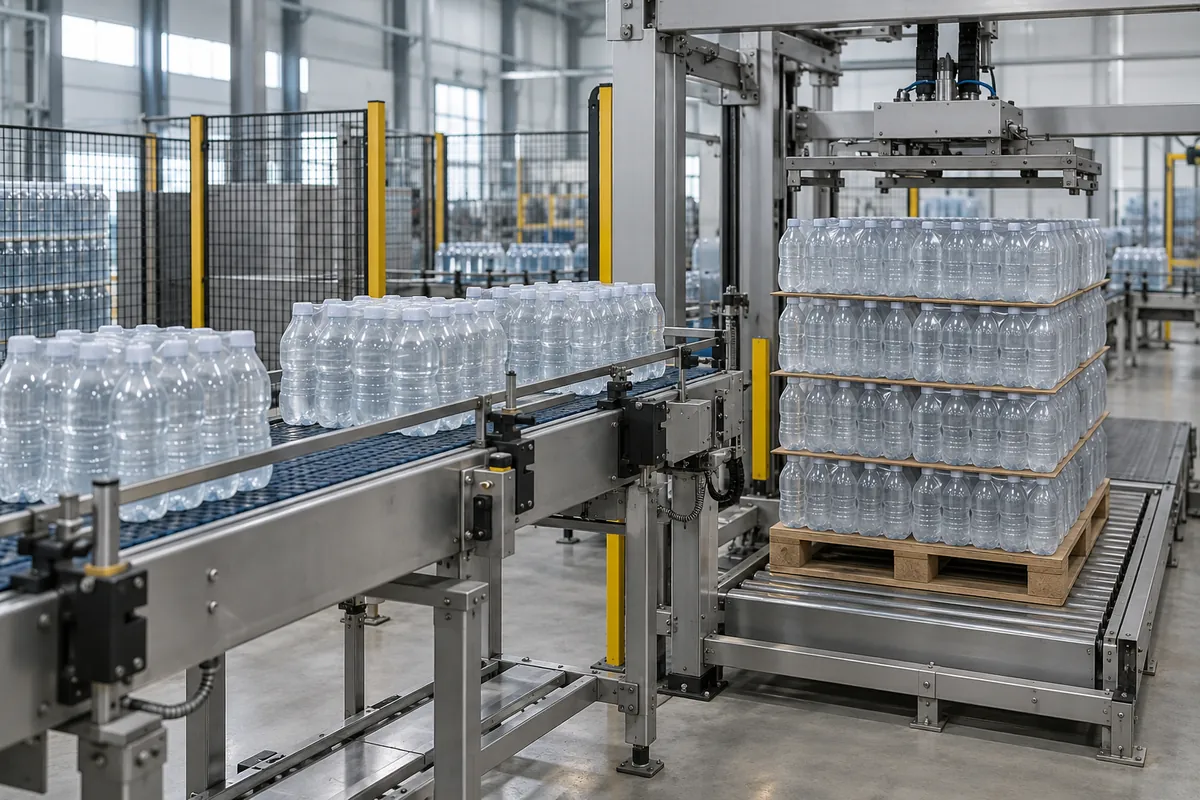
At the end of line, a palletizer forms layers, usually with slip sheets or pads between them, and a stretch wrapper secures the load. Water pallets are heavy and numerous, so pallet transport and storage take up more of the picture here than in many other industries.
For many plants the question is not how fast the filler runs but how many bottles must cross the line without a person touching them. The packaging chain is built around that.
Typical containers and packs
Each bottle size changes the equipment.
Small single-serve PET bottles, commonly in the half-liter range, are packed in film bundles or trays. They are the lightest and have the highest container count per pack, so conveyor transfers and bundle stability matter most. One- to two-liter bottles, packed in film bundles or cases, are heavier and more stable but taller, so guide height and rail setting need attention.
Multi-liter bottles are tall and narrow in proportion, and they often carry handles. STM Pack’s public “Special Palletizing Solutions” page, section 4, describes TES’s Masspol project for loose 5-litre PET water bottles: a synchroblock-based filling line, unusually light, tall and narrow bottles, layer preparation and wrapping at the stacking positions. This is that manufacturer’s project description, not our test or a general large-bottle design. The page is undated; accessed October 8, 2026. It gives no model identifier for this custom system.
Returnable multi-gallon containers such as water cooler jugs go through different equipment, with washing, inspection, and refill steps, and this page does not cover them. Glass water bottles exist in hospitality and premium segments. They add breakage and weight concerns that the beverage packaging page covers.
Film bundles are common because they use less material than a corrugated case. A bundler supplier notes that pads are normally added so that bottle rims do not chime against each other or cut the shrink film while the load is stacked and palletized. That is exactly the concern with lightweight, thin-walled bottles.
Key challenges
Lightweight PET stability
A lightweight PET bottle has little mass to keep it upright. A small lateral push from a rail, a neighbor, or a transfer edge can tip it. Filled bottles are steadier than empties, but a filled large-format bottle can still be tall and narrow, and caps and necks are thin spots in the structure. Design responses include air conveying for empty bottles, tight speed matching at every handover, low-friction dry-running conveyors for filled bottles, and bridge or transfer plates sized to the bottle base.
Air conveying and empty bottle quality
Air conveyors carry bottles by the neck ring and are widely used between a blow molder and a filler. One supplier cautions that an air conveyor is not a commodity and should be treated like the blow molder or the filler. That means attention to bottle surface quality, support through installation and start-up, and the cost of adding formats later. Plants that run several formats should ask whether the guide rails adjust quickly or need parts changed per format.
Hygiene around the container
For U.S. bottled drinking water, 21 CFR 129.80(b)(1) specifically addresses multiservice primary containers: cleaning, sanitizing and inspection before filling, capping and sealing, with unsanitary or defective containers reprocessed or discarded. Single-service containers and closures are addressed in 129.37(c), including examination and cleaning as necessary. These are applicable provisions, not a complete compliance checklist for every water plant.
Bundle and pallet stability
Film bundles of light bottles can shift on a heavy water pallet if the pattern, pads, or wrapping are wrong. Slip sheets, pattern selection, top frames, and stretch wrap programs all keep a load square. The pallet handling page covers those stages.
Low price per unit
Cost pressure reaches everything from film gauge to staffing. Equipment that changes formats without long stops, wastes little film, and needs few operators tends to win over equipment that is merely fast.
Recommended equipment stack
A typical water line uses this stack, with options noted:
- Choose the infeed by incoming form. On-site blowing needs no depalletizer. Ordered pallet layers use layer-based bottle unloading; genuinely random loose bottles use a bottle-specific hopper and unscrambler. Do not select a layer-sweep machine from the word “bulk.”
- Empty-bottle conveying compatible with the neck finish and bottle support needs. Neck air conveying is one option, covered in bottle conveyors; large or returnable formats need their own validation.
- Filler, capper, labeler, and coder, which are process equipment outside this page’s scope.
- Filled-bottle conveying with single-file chain and mass flow, as described in the bottle conveyors guide, and accumulation conveyors before the packer.
- Bundler or case packer. Use a shrink bundler for film packs, or a case packer with a case erector and case sealer where cases are specified.
- Pack conveying to the palletizer, covered in the case conveyors guide.
- Palletizer. Low-level machines suit stable, steady throughput with direct layer building from a pack stream. High-level machines suit space-constrained plants where packs arrive from above. See low-level palletizers and high-level palletizers.
- Stretch wrapper and pallet conveying for finished loads.
Design considerations
Line balance
The palletizer and wrapper have to keep pace with the filler plus a margin. Water plants often run a few large formats and a long list of small ones, so the end-of-line limit depends on which format is running. Size to the format that produces the most packs per minute at the filler’s rated speed.
Accumulation
Put accumulation on both sides of the packer, a bottle buffer ahead of it and a pack buffer after it, so that a pack jam does not stop the filler. For light bottles, favor low back pressure: wide mass-flow tables, pressure-relief devices, and long dry-running lanes all help.
Reject and rework
Rejects at the filler include low fill, cap defects, and misprinted labels. Rejects at the packer include collapsed bundles and bad film seals. Bottles rejected after filling still contain product, so they need a drain or a manual reclaim step. Bundles with film damage can be unwrapped and repacked, but manual unwrapping with open blades is a safety concern. One bundler supplier now offers automatic unwrapping equipment to reduce that task, which is a design option worth asking about.
Floor space
Water lines are long, because volumes are high and the product is cheap, and large formats add pallet storage. Check the layout for forklift travel and pallet staging, not only the machines. The packaging line layout guide and the layout page cover footprints and flow.
Choosing the palletizer type
Layer-forming palletizers fit best when bottle bundles are uniform and steady. Robotic cells fit when format counts are high and volumes per format are moderate. The robotic versus conventional palletizer guide sets out the trade-offs.
Example line configuration (illustrative)
Illustrative example. Picture a still-water plant that blows its own bottles. A blow molder feeds an air conveyor that carries empty half-liter bottles to a rinser, a filler, and a capper. A labeler and a date coder follow on a dry-running tabletop chain with a pressureless combiner where bottles narrow to a single file. A wide mass-flow table behind the labeler provides a buffer before the packer. A shrink bundler forms 24-bottle packs, with a pad under each pack. Packs ride a case conveyor to a low-level palletizer that builds layers from a continuous flow, and a rotary wrapper finishes each pallet. A vision-based reject station sits between the bundler and palletizer and removes any pack with film damage.
The same plant also fills a large format that does not bundle. A bottle-specific conveying system, subject to neck and support validation, delivers empty bottles to the filler, and the filled bottles are transferred to a layer preparation table where they are formed into a layer pattern and placed directly onto pallets. Wrapping stations are integrated at the stacking positions so that no full pallet needs to be moved before it is wrapped. The two flows share the pallet storage but not the palletizing equipment. This is a sketch of how format changes the stack, not a real customer project.
Standards and references
The 2025 annual CFR text of 21 CFR 129.80 is the processes-and-controls section within Part 129, not the whole part. Its container provisions are scoped above. 21 CFR 165.110 addresses bottled-water identity and quality. Sources accessed October 8, 2026; the annual edition is not a claim of a complete current compliance review. Quality staff should check current federal and local requirements for the plant.
OSHA’s general machine guarding requirements apply to conveyors, bundlers, and palletizers, and lockout/tagout rules apply to servicing. For the rest of the end of line, see the bottle handling and case handling application pages, and the equipment overview for a map of every machine type in this knowledge base.