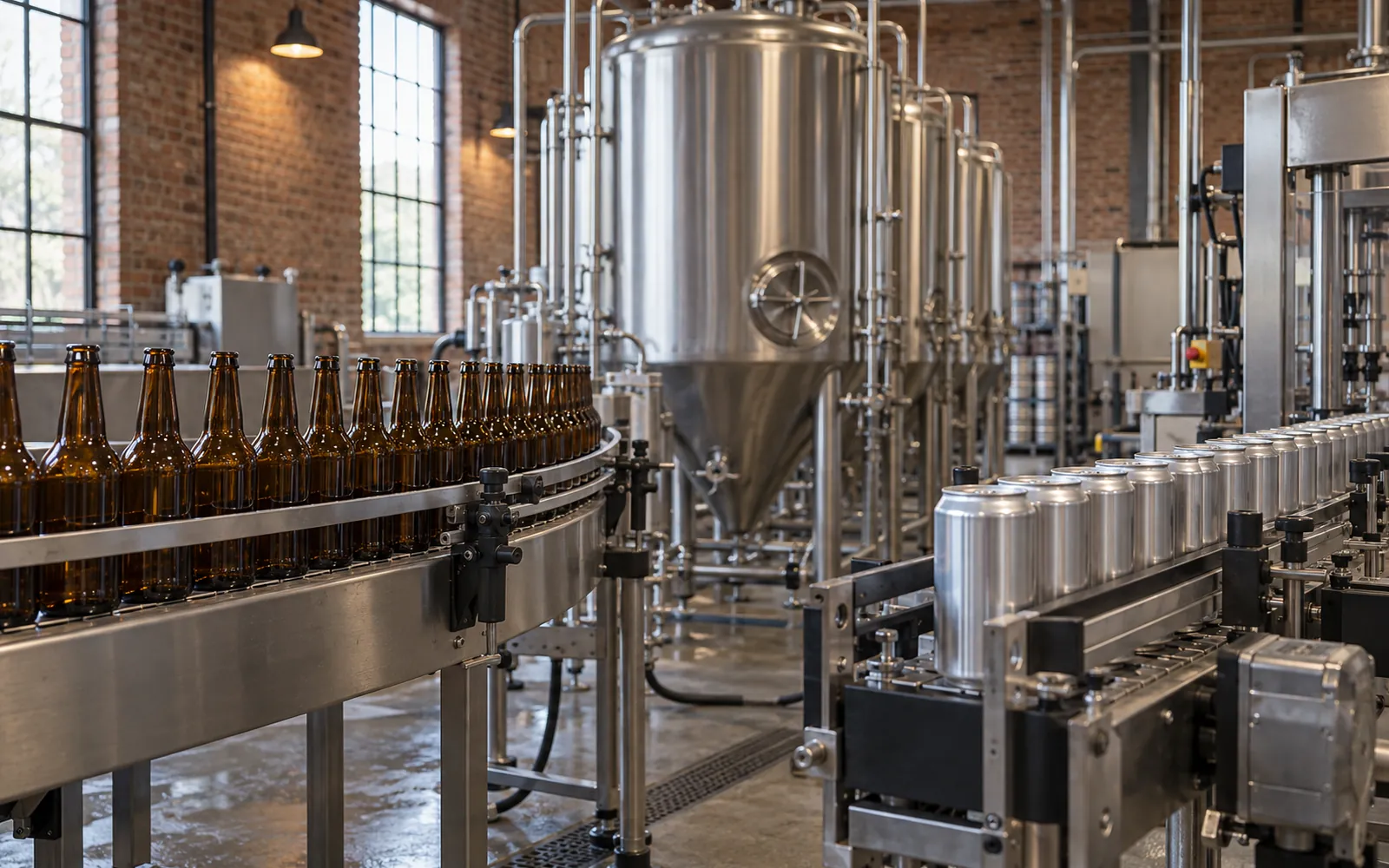
This page is for a craft or small-batch brewery: many package types in the same week, limited floor space, and a small crew. A large brewery that holds one can or bottle for a long run, and that sizes the end of the line to a fast filler, is the case covered in beverage packaging automation. Do not copy the craft staging order onto that plant. The page belongs to the packaging industries section.
What to automate first
Use four screens. Palletizing is the first machine only when the pallet row is the one that fails and the rows above it already pass. If empty-container supply or case packing fails first, fix that station. A palletizer installed against a starved infeed will sit idle.
| Screen | What to record | Palletize first when | Fix infeed or case packing first when |
|---|---|---|---|
| Manual handling risk | Case weight, lift height, reach, and lifts per minute, judged with NIOSH’s Revised Lifting Equation on that task | Pallet building is the heavy manual task, and sealed cases are already arriving | The heavy task is unloading empties or hand packing, not the pallet |
| Bottleneck loss | Good count divided by planned production time, same window and same unit at each station. The method is on the end-of-line automation page | Palletizing has the lowest effective rate, and the stop notes show the filler waiting on it | The filler is starved by empty-container supply, or the packer is the slow station |
| Changeover | Formats in a typical week, and whether the pattern change is mechanical or a stored recipe | The machine’s pattern method matches that week’s mix | A single-pattern setup would sit idle through changes the packer cannot follow |
| Space | Floor left after tanks, aisles, and forklift paths | A cell fits without blocking those paths | The only open pad would block the packer or the forklift |
Assumption example, with no return rate
These counts are assumptions, not a payback.
| Assumption | Value |
|---|---|
| Window | 60 minutes of planned production time |
| Manual palletizing | 360 good cases, so 6 cases per minute |
| Case packer | 720 good cases, so 12 cases per minute |
| Empty-can unload, in case equivalents | 900, so 15 cases per minute |
| Reading | Palletizing is the lowest rate, and sealed cases are already arriving, so palletizing is the first candidate |
| The other reading | If empty-can unload were 240 case-equivalents (4 per minute) and palletizing were 12, fix the infeed first |
| What this is not | Not labor savings, not avoided loss, and not a rate of return |
Do not read “industrial” as “one product only.” A conventional layer machine forms a full layer and places it in one motion. The conventional palletizers guide describes those pattern changes as mechanical adjustments, so confirm the method on the machine you compare. A robotic palletizer uses stored patterns and can run one product or several, within the tool, reach, and infeed. A long single-package run can suit the layer machine. A long pattern list in a small room can suit the robot.
Packaging chain overview
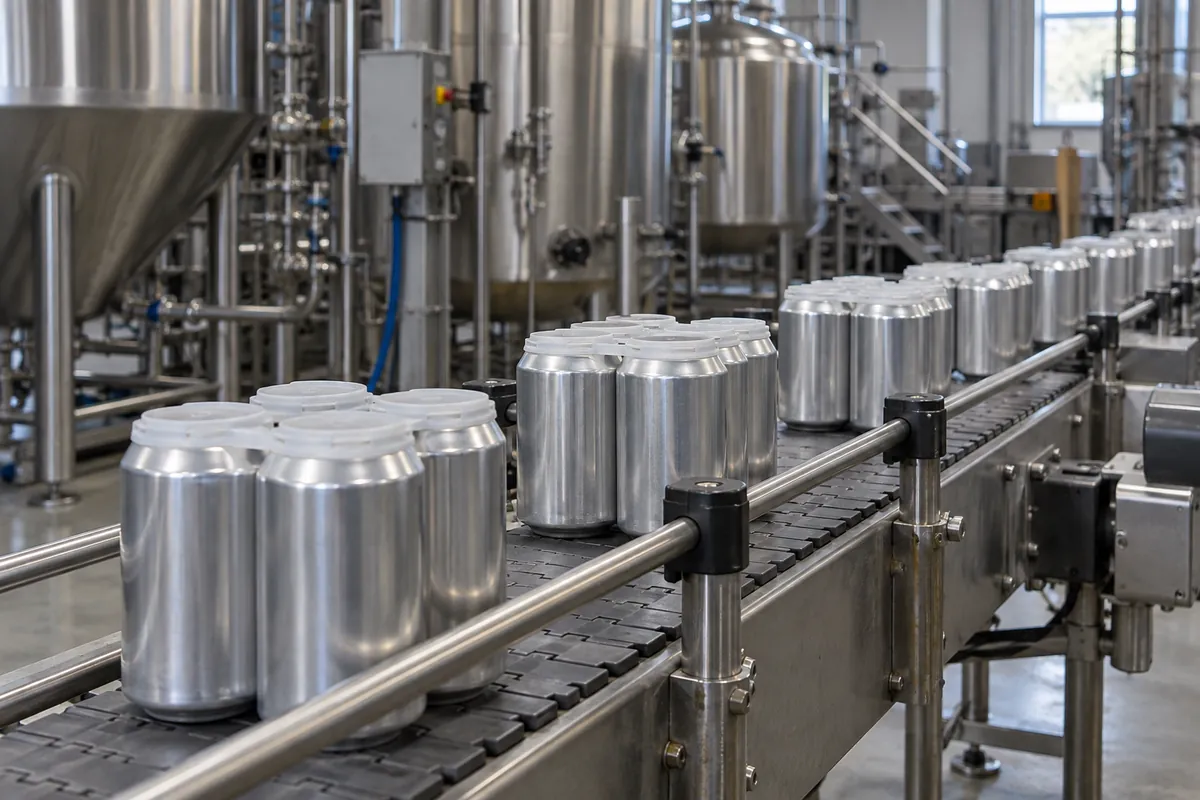
A brewery might run a can line, a bottle line, a keg line, or any combination. On the can side, empties arrive on pallets, go through a depalletizer or a manual unload into a rinser, and then reach a filler and seamer. Bottles are rinsed, filled, capped, and labeled. Many small breweries run one flexible line for both and change over between them.
The filled containers are then grouped into the unit a store, bar, or distributor handles. Four-packs, six-packs, and twelve-packs in carriers or cartons are common, as are shrink-wrapped multipacks of larger cans and corrugated cases with partitions for bottles. After that the end of line covers case forming, packing, sealing, labeling, palletizing, and stretch wrapping.
A trade source on craft beverage packaging describes the end of line as the steps from case forming through load stabilization, and notes that many producers add one step at a time. Choose the step with the four screens, and reserve space and controls for the later ones.
Typical containers and packages
Cans come in 12-ounce and 16-ounce sizes, with larger sizes such as 19.2-ounce and 24-ounce cans in use. A bundler supplier describes dedicated equipment for breweries packaging 3-packs and multipacks of large cans such as tallboys, stovepipes, and king cans. Print-registered shrink film is one way to make branded multipacks without cartons or trays.
Glass means standard longnecks and larger 750-milliliter bottles. They need partitions, careful transfers, and heavier-duty conveying. Kegs are filled on a separate line, are heavy, and are palletized as unit loads. This page covers them only briefly.
Paperboard carriers, plastic can carriers, and fold-over cartons hold four, six, or twelve cans or bottles. Regular slotted cases suit glass and mixed packs, and open trays with shrink film suit cans where retail display allows.
When pack formats are many, the pattern list for the case packer and palletizer becomes the real constraint. A case packer that handles two or three footprints quickly is worth more than one that is fast at a single case.
Key challenges
Small-batch changeovers
Large producers run one product for hours. A craft brewery, which is the scope of this page, runs short batches of several beers on the same line, each with its own label, carton, and sometimes container. A trade source notes that a typical craft brewery might handle 12-ounce and 16-ounce cans, 750-milliliter bottles, and four-pack, six-pack, and variety-pack formats, at times all within one week. Equipment designed for one format struggles with that mix, so tool-free or recipe-based changeover often matters more than headline speed.
Glass and cans on the same line
Cans are light, stackable, and tolerant of mass conveying, but they dent if packs are squeezed. Glass is heavier and fragile, with a breakage risk at every transfer. Lines that run both often need two sets of change parts or two dedicated conveyor paths. The bottle conveyors page describes how single-file and mass flow differ, and the bottle handling application page covers container-level considerations.
Partitions for glass
For glass bottle lines, a trade source calls partition inserters a critical companion to the case packer, since the dividers keep bottles from touching in transit and cut the product lost to hand handling. Where partitions are used, the case packer must place bottles into cells without chipping them, and the case erector must form cases accurately enough for dividers to seat.
Limited floor space
Many craft sites share the floor with tanks and a taproom. Use the space the screen recorded, and draw it before you buy.
Labor and ergonomics
Craft producers often staff the end of the line with part-time or seasonal workers, which leads to variable pallet quality and a higher risk of repetitive-motion injury. For an industry baseline, the BLS 2024 SOII Table 1 reports incidence rates of nonfatal occupational injuries and illnesses by industry and case type. Find the Breweries row. The industry code is NAICS 312120. Distinguish “Total recordable cases” from days-away and restricted-duty categories. This page does not copy a rate from the table. This is an industry rate, not a prediction for a particular task. To assess two-handed case lifts during manual palletizing, use the Revised NIOSH Lifting Equation and its applications manual with measured case weight, hand positions, travel, asymmetry, frequency, duration and grip. Other handling tasks need their own assessment. Both sources checked October 10, 2026.
Wet floors and cleaning
Where a brewery washes floors or machinery, specify the actual duty at the filler and adjacent machines rather than one ingress code for the whole room. PackagingConveyor.com is secondary editorial background, not a component manufacturer. Obtain each motor, sensor and enclosure rating from its maker. ADCO’s washdown-cartoner discussion illustrates why cleaning chemistry, pressure and component restrictions need separate checks; it is not a brewery-wide specification. An IP code describes enclosure ingress protection, while cleanability and cleaning access require their own review.
Recommended equipment stack
Build the stack in the order the four screens give you, not in a fixed craft sequence. The machines below are the usual set. Palletizing is item 1 only when the screen says so. If the screen points at empty-container supply or at case forming and packing, start at the depalletizer, the erector, or the case packer instead.
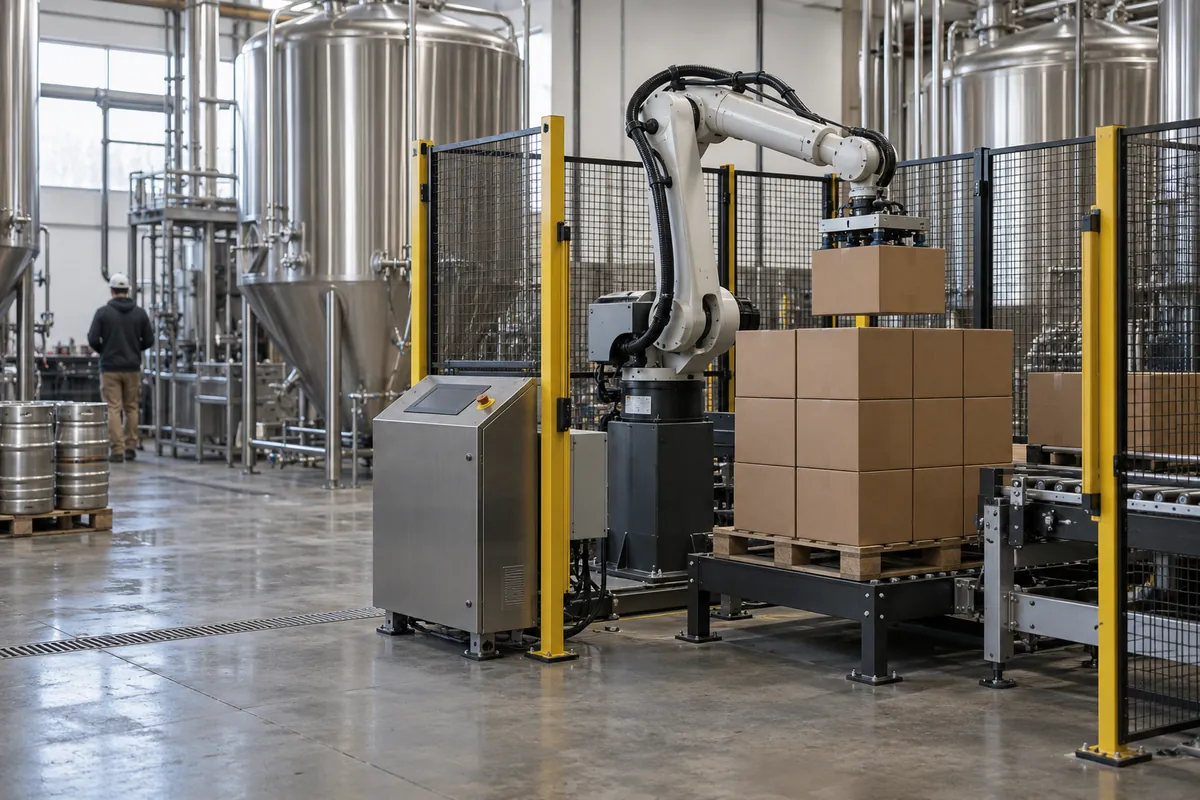
- Palletizing, when it is the measured limit. A compact robotic palletizer matches frequent pattern changes in a small room. A conventional palletizer can be the better match when one pattern runs for a long time, including in a larger brewery. A case palletizer matches a case or a tray with a stable top. Confirm the pattern method either way.
- Case erector. Forming cases by hand causes downstream jams and misaligned loads, and a case erector improves reliability before product reaches the case packer.
- Case packer. A case packer places filled containers into cases, with partition insertion for glass. For several formats and compact footprints, see robotic case packing.
- Case sealer. A case sealer closes cases with tape or hot-melt adhesive, which gives consistent presentation for wholesale and retail distribution.
- Conveying and accumulation. Connect machines with case conveyors and buffer with accumulation conveyors. A trade source calls both consistently underspecified in first automation plans, and notes that insufficient accumulation lets a short upstream stop stall the whole end of line.
- Depalletizer for empties. When volume grows, a bulk depalletizer or a bottle depalletizer removes a heavy manual task at the infeed.
- Stretch wrapper. It is easy to leave out and expensive to skip, because a load that fails in distribution can wipe out the savings from the automation.
Design considerations
Line balance
Rate each station against the filler and the longest changeover. There is no speed at which automation pays off by itself. Use the four screens: palletizing is first only when it is the measured limit.
Accumulation
Set up a short buffer after the filler or labeler and a pack buffer before the palletizer. Without them, a case jam stops the filler, and a filler stop wastes beer, which is usually the most expensive thing on the line. The accumulation conveyors page covers table, zone, and live-roller options.
Reject and rework
Plan for rejects such as underfilled cans, dented cans, missing labels, and bad seams. Each needs a reject path that does not mix with good product, and a rework path that keeps beer handling safe. Partially filled glass should leave the line without crossing the case packer.
Floor space
Choose machines that can sit against walls or in corners, and check pallet staging, forklift routes, and distributor pallet specifications. Modular equipment lets you reserve a space for a later machine without leaving a gap that has to be rebuilt.
Pallet requirements
Distributors specify pallet height, pattern, and wrap, and rejected pallets mean rework. Check those requirements before settling on a palletizer pattern.
Example line configuration (illustrative)
Illustrative example. A small craft brewery runs one combined can and bottle line. Empty cans are unloaded by hand at first and later by a small depalletizer. A filler and seamer feed a single-file conveyor carrying cans to a pack-forming station that places four cans into a plastic carrier. For 750-milliliter glass, a bottle filler, capper, and labeler feed the same single-file conveyor with a different set of guide rails. Both container types then move onto a conveyor with a short accumulation section. A robotic case packer picks packs or bottles into corrugated cases, with a partition inserter active only for glass. A case sealer closes the case, a short conveyor presents it to a compact robotic palletizer, and a stretch wrapper secures the finished pallet. Pattern changes are chosen from a recipe screen.
A later stage can add a bundler for larger cans.
Standards and references
Beer packaging machinery falls under the same worker safety rules as other industrial equipment. OSHA’s general requirements for all machines call for guarding against hazards such as nip points and rotating parts, which applies to conveyors, bundlers, case packers, and palletizing cells. Robotic cells also need perimeter or area guarding, and the supplier and your safety team decide which method suits your plant. Lockout/tagout rules cover maintenance work.
Alcohol labeling and tax matters sit with federal and state alcohol regulators and are outside the scope of this page. For the equipment side, see the how to choose a palletizer guide, the packaging line layout guide, and the case handling application page. Larger lines are covered in beverage packaging automation, and bottle-focused lines in bottled water packaging.