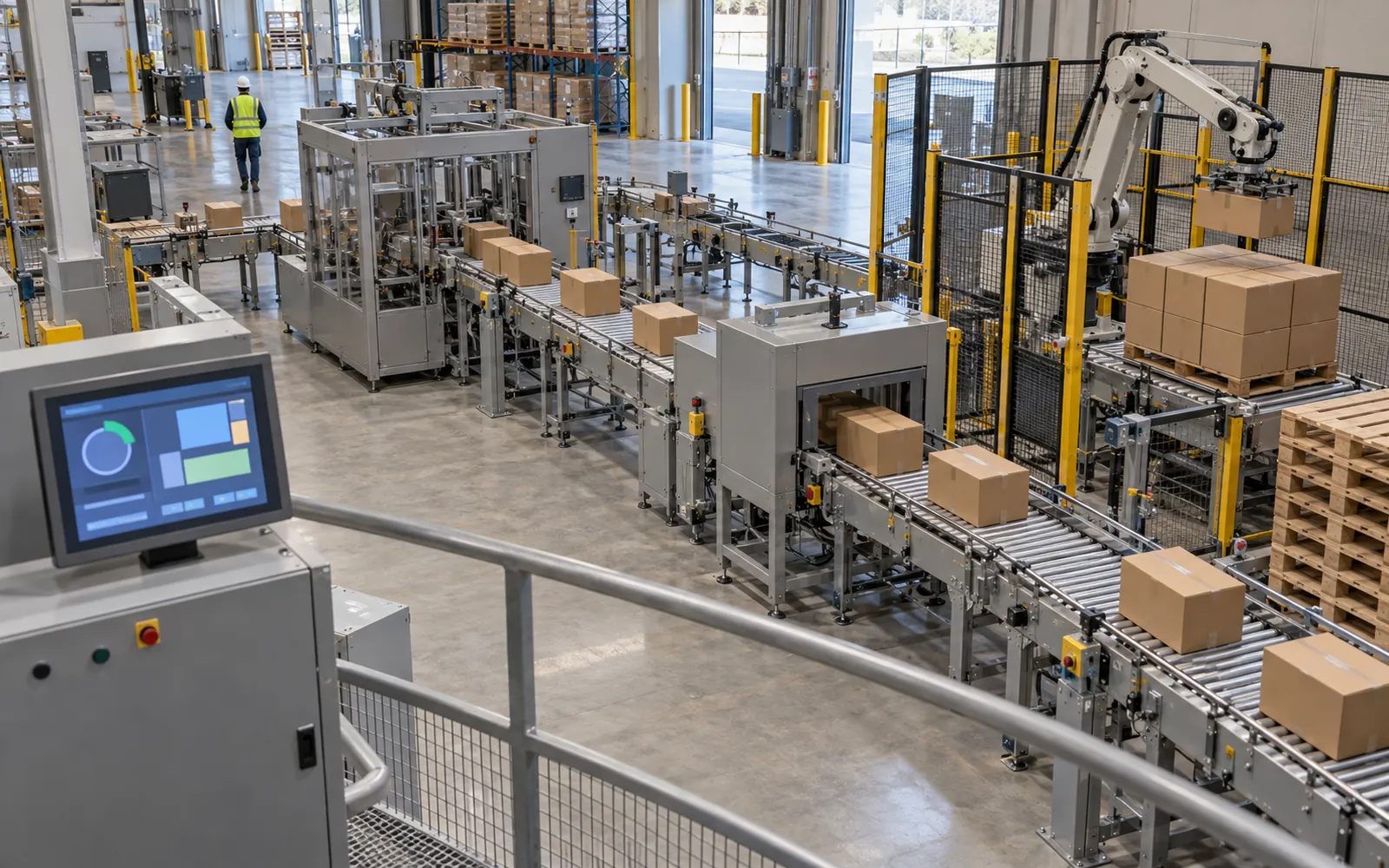
End-of-line packaging automation is a sequencing problem. The machines are described in the end-of-line packaging overview. The first choice is which station to automate, using the three inputs below.
Which step to automate first
Record these three inputs in one counting window before you pick a machine. The rate formula is the same one defined under line balancing: good count divided by planned production time.
| Input | What to record | How to use it |
|---|---|---|
| Measured station rate | Good count and planned production time, same window and same unit for every station | The lowest effective rate is the candidate constraint |
| Constraint evidence | Stop notes for that window: jam, changeover, pallet exchange, material refill, or an unstaffed job | A low count without a cause is not yet a reason to buy a machine |
| Adjacent acceptable rate | Measured rate of the station that feeds this one and the station that takes its output | The new machine helps only if those neighbors can feed it and clear it |
Supplier articles do not agree on one starting point. Some call palletizing the logical start because it is physically demanding. Others name case erecting because it stabilizes case supply. Others point at case packing because hand loading is slow. Each is right for some plants. Use the candidate table only after the three inputs exist.
| Candidate first step | Signs it should come first | What must already be true | Risk if chosen too early |
|---|---|---|---|
| Case erecting | Case forming limits hand packing; ergonomic complaints at forming stations | A stable supply of blanks of consistent quality | Little throughput gain if packing remains manual and slow |
| Case packing | Hand packing is the slowest station or most labor-heavy | Controlled product stream and collation; reliable case supply | A packer starved by upstream stops, or blocked by a slow sealer |
| Case sealing and labeling | Open or poorly closed cases cause pallet or shipping problems | Consistent case size and fill | Machine works, but the pallet step still limits output |
| Palletizing | Pallet building limits the line or labor is scarce | Stable case presentation; sealed, uniform cases | Robot cell idle because infeed is erratic |
| Wrapping | Wrapper queue holds up load exit | Palletizer output known | Wrapper idle if pallet build remains manual |
| Conveying and accumulation | Frequent blocking and starvation between stations | Layout allows added buffer length | Money spent on transport that hides a machine problem |
Station-rate example with labeled assumptions
The counts below are assumptions for one window, not a plant record and not a quote. Assume at least 180 good cases already wait between the packer and sealer at the start, and room for 360 additional cases between the sealer and palletizer. These queues explain the different counts at successive stations; counts alone would not prove a capacity limit. Check the stop evidence and repeat the measurement with adequate feed and clear discharge.
| Assumption | Value |
|---|---|
| Planned production time | 60 minutes, the same window for every station |
| Case packer good count | 900 cases, so 15 cases per minute |
| Sealer good count | 1,080 cases, so 18 cases per minute |
| Palletizer good count | 720 cases, so 12 cases per minute |
| Constraint evidence | The palletizer has the lowest good count. The stop note says pallet exchange and a pattern change, not a packer jam |
| Adjacent acceptable rate | The sealer’s measured 18 cases per minute is above the palletizer’s 12, and the packer delivers 15. Judge a replacement palletizer against those measured rates |
| First candidate | Palletizing |
The same formula can be split with a second set of assumptions, still not a measured line. Take a rated rate of 20 cases per minute, availability 80 percent, performance 85 percent, and quality 98 percent. Effective rate is 20 × 0.80 × 0.85 × 0.98 = 13.328 cases per minute. Leaving out performance gives 20 × 0.80 × 0.98 = 15.68, which is the overstatement from assuming performance is 100 percent.
When two candidates remain, ask which one the other depends on. Case supply feeds everything after it. Palletizing can often be added later, but the layout has to leave room for it from the start.
How the automation decision works
Automation at the end of the line replaces human effort at stations that are repetitive, physically demanding, or hard to staff: usually case forming, hand packing, case closing, label application, and pallet building. One equipment supplier lists the stages as collation, case packing, case sealing, labeling, checkweighing, pallet wrapping, and palletizing, and notes that the combination depends on the format leaving the primary packaging stage.
The same supplier warns about a common error: automating the most labor-intensive task first without checking that the equipment before and after it can support the change. A faster case packer does not raise output if product arrives inconsistently, and a palletizer does not help if the sealer behind the packer is already the slowest machine. The decision has four parts.
- Measure the current line, station by station, with the three inputs above.
- Choose the first step from the measured constraint and the labor situation.
- Confirm that neighbors can feed or accept the new rate.
- Plan the full system, including later steps, before the first purchase.
An integrated approach treats the line as one connected system. A throughput article from another supplier makes the same point: once upstream machines have been improved, the secondary and end-of-line equipment frequently becomes the constraint nobody had noticed.
Line balancing across end-of-line machines
A line runs at the pace of its slowest sustained station. Balancing means choosing machine capacities, buffers, and control logic so that no station waits for product (starvation) or cannot discharge it (blocking). Both cut effective output and add wear from repeated stopping and starting.
Nameplate speed misleads here. A station’s effective rate is lower than its rated speed because of changeovers, jams, material replenishment, slow cycles, and short stops. The most direct measure, over one counting window, is:
effective rate = good count / planned production timeThe same figure can be split into the three OEE factors to show where the losses are:
effective rate = rated rate x availability x performance x quality
availability   = run time / planned production time
performance    = (total count / run time) / rated rate
quality        = good count / total count
Availability covers stops long enough to log a reason, such as breakdowns and changeovers. Performance covers running below rated speed, including slow cycles and short stops. Quality covers rejects. Leaving out the performance factor assumes the station always runs at its rated speed whenever it is running (performance = 100%), which overstates the rate of any machine with micro-stops or slow cycles. Use counts and times from the same representative window, and the same unit, such as cases per minute, for every machine. The lowest effective rate in the sequence is the line limit, and each upstream station needs enough capacity above it to refill buffers after a stop. A source on throughput recommends measuring finished saleable output over a representative period rather than isolated machine speed, and comparing it with stoppage data, reject rates, and changeover time.
Buffers and accumulation
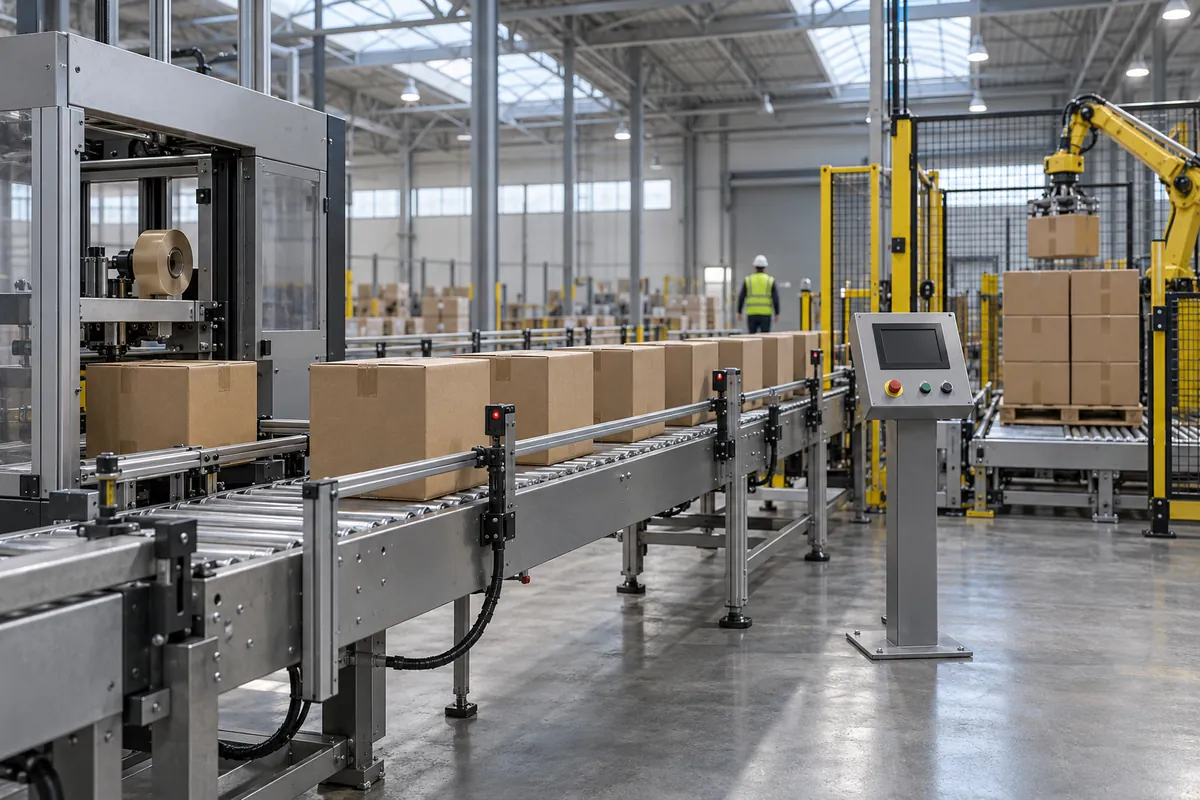
Short stops are normal, so a line needs buffer capacity at stations with natural pauses, such as case changes, label roll changes, and pallet exchanges. Accumulation lets upstream machines keep running through brief interruptions, and downstream machines keep going while upstream recovers. How much buffer to build depends on product stability, pack format, and floor space. Too little lets every short stop travel through the line. Too much can cause control problems, pack damage, or blocked operator access. Accumulation also needs logic so it does not turn into a traffic jam. See accumulation conveyors and case conveyors for the equipment itself.
Sizing for peak, not average
Upstream equipment may run at a higher peak than its daily average. End-of-line machines sized for the average will lose cases during peaks or force the filler to slow down. Define the highest sustained rate, then decide how much margin growth justifies. Speed costs money, and a source on case packer selection notes that more speed than the line needs is an unnecessary cost.
Controls integration
Machines in an end-of-line system need to agree on state. Each should report whether it is running, stopped, starved, blocked, or faulted, and respond when its neighbor changes state. An integration article describes the goal as interlocks and permissives, so that when one stage slows or stops, the upstream equipment slows, accumulates, or stops safely.
Control architecture options
There are three common approaches. A single controller family puts one platform and one set of programming conventions across all machines, which simplifies spare parts, training, and fault response but limits the choice of machine suppliers. Machine-level controllers with a supervisory layer let each machine keep its own controller while a line controller or software layer coordinates them; that allows mixed suppliers but needs clear interface definitions. Hardwired handshakes pass simple ready, run, and stop signals. They suit small systems but carry no recipe data or detailed diagnostics.
Whichever route is chosen, specify the communication protocol, the signals each machine will exchange, who owns the line-level logic, and who supports the interfaces after commissioning.
Recipes and data
When SKUs change, the whole line should change from one selection, not through many separate adjustments. Sharing recipes across erector, packer, sealer, labeler, and palletizer cuts changeover errors. Data matters too: counts, rejects, downtime reasons, and traceability records. A source on integration describes data as a third layer after physical and logical flow, and notes that performance indicators such as overall equipment effectiveness can feed management systems when needed. Decide what data is required before the design is fixed, because retrofitting sensors and network connections is harder than planning them.
Labor and ROI logic
Return on end-of-line automation is built from several drivers, not from a single price. What follows is a way to organize them, not a quote.
Current-state cost
Count the full cost of the manual method: direct labor on each shift, overtime, turnover and retraining, injuries and ergonomic issues from repetitive lifting, mispacks, chargebacks, transit damage, and output lost to stoppages. Several supplier sources point to labor shortages and ergonomic strain as reasons plants automate. Use the plant’s own data wherever it exists.
Future-state cost
Include capital recovery, maintenance and spare parts, utilities, consumables, operator time for supervision and changeovers, and any software or support contracts. Include the cost of floor space if the system displaces other uses.
Three benefits that must not share a case
Keep the annual cost as capital recovery, maintenance, utilities, and supervision. Split the annual benefit into three piles. An hour or a case goes in only one pile.
| Benefit | What counts | What does not count again |
|---|---|---|
| Realizable labor | Hours you can take off the schedule: a posted job or overtime that actually stops | The same hours counted again as extra cases |
| Loss avoided | Mispacks, damage, and chargebacks that stop | A case that is no longer damaged, counted again as new sales |
| Sellable output | Extra good units the plant can sell because the constraint moved | Any extra units sales do not need. That term is then zero |
annual benefit = realizable labor + loss avoided + sellable output
annual cost    = capital recovery + maintenance + utilities + supervision
For a deeper look at one of the largest cost items, see the palletizer cost guide, and for transport equipment, the packaging conveyor cost guide.
Phasing the investment
A modular route puts in one machine at a time, which lowers the first outlay and gives a team time to learn. A connected route deploys several machines together and removes manual interfaces earlier. One supplier presents these as a fully connected system or a modular rollout, noting that modular rollout lowers upfront cost and can be faster to deploy, while a connected system gives full-line efficiency at once. Either way, design the line as a whole.
Phasing a project
A phased plan works when each phase leaves the line stable and later phases already have space, power, and signals reserved.
Accept a phase only after the checks in that row. Then repeat the same-window rate measurement. The next phase follows the new constraint, not the original drawing.
| Phase | Work | Accept only when | Re-measure before the next phase |
|---|---|---|---|
| 0, measure and design | Station data, SKUs, patterns, and a full layout that includes later machines. Use the line design page and the packaging line layout guide. | The three inputs exist for every station, and the drawing reserves space, power, and signals | The named constraint is still the lowest effective rate |
| 1, constraint step | Install the machine that removes the measured limit, with conveyors, guarding, and a written interface to its neighbors | The acceptance run uses the plant’s own product, and the neighbors still feed and clear the new rate | Good count divided by planned time for the new machine and its two neighbors |
| 2, neighbors | Add the station the new rate exposes, often sealing, labeling, or accumulation | That station is no longer the limit, or the remaining gap is written down | The same window again. The constraint may have moved |
| 3, line exit | Add or upgrade palletizing and wrapping, and connect load exit to storage or shipping | Loads leave without a manual queue that cancels the gain | Good loads at the exit, not the palletizer nameplate |
| 4, tie together | Add line-level controls, shared recipes, and data collection if these were not done earlier | The specified signals and the recipe handoff work on a real changeover | Effective rate after the control change, on the same window as phase 0 |
Specifications to evaluate
This table covers system-level specifications. Equipment-level specifications are on the individual machine pages.
| Specification | Why it matters | What to ask the supplier |
|---|---|---|
| Sustained system rate | Sets output when all machines run together | What is the guaranteed rate at the system exit, on the plant’s case and pallet, and how was it tested? |
| Effective rate per station | Reveals the true constraint | What availability, performance, and quality are assumed for each machine? |
| Buffer capacity | Absorbs short stops | How many cases can accumulate between each pair of machines, and how is that controlled? |
| Changeover scope | Sets time lost between SKUs | Which machines change automatically, which need tools, and what is the time for the hardest change? |
| Control interface | Determines how machines coordinate | Which protocol and signals are used, and who owns line logic? |
| Recipe handling | Reduces errors at changeover | Can one selection set every machine, and where are recipes stored? |
| Safeguarding design | Affects layout and operator access | How are guarding zones, light curtains, and conveyor crossings arranged? |
| Fault and data reporting | Supports uptime work | What downtime reasons and counts are logged, and can the plant export them? |
| Expansion allowance | Controls cost of later phases | What space, power, and signal capacity is reserved? |
Package and case compatibility
Automation exposes variation that people used to absorb. Hand packers fix a crushed case, skip a leaning container, and re-turn a label. Machines cannot, so the package must meet a defined tolerance. Four inputs need checking.
Primary packages must be consistent in dimensions, weight, and stability across lots and suppliers, whether they are bottles, pouches, cans, or cartons. Cases matter just as much, since magazines and erectors depend on blank dimensions, scoring, flap behavior, and moisture sensitivity. A supplier on integration notes that irregular grouping or dimensional variation affects the case, that case weight variation can reduce pallet stability, and that pallet stability in turn creates shipping risk. Scanners and print-and-apply units need consistent label position and print quality on consistent surfaces. And broken, wet, or uneven pallets disturb robot and conventional palletizers alike.
Test production samples, including the worst ones, with every supplier before purchase, and ask for factory acceptance testing with the plant’s own product.
Integration with upstream and downstream equipment
Define the project boundary in both directions. Upstream, the line must deliver packages in a controlled stream. Downstream, loaded pallets must reach storage or shipping without manual routing. Pallets queued for hand wrapping, or wrapped off-line, can cancel the gains from a new palletizer.
Plan around the connection points:
- Primary line to collation: rate matching and a buffer between filler or wrapper and case packer.
- Packer to sealer to labeler: case orientation and spacing, plus any inspection stations.
- Case conveyor to palletizer: case turning, infeed height, and accumulation.
- Palletizer to wrapper to exit: load height, pallet tracking, and label data.
For project structures that span several of these points, see turnkey lines.
Footprint, utilities, and safety
Some constraints belong to the whole system, not one machine.
Floor space has to include aisles, forklift paths, maintenance clearances, and future phases. Utilities (compressed air demand, electrical load, hot-melt or tape consumables) should be stated by suppliers in writing. Food and beverage plants may need washdown-rated components and cleaning access.
On safeguarding, packaging machinery in the United States is commonly assessed to ANSI/PMMI B155.1, which PMMI revised in 2023. The release describes a formal, documented risk assessment process for suppliers and users, and clarifies responsibilities for modified and legacy machinery. Safety-related control functions are commonly designed to ISO 13849-1. A qualified risk assessment of the complete installation, including conveyor crossings, pallet exit points, and maintenance tasks, should set the final safeguards, and the current edition of each standard should be confirmed.
Safety design affects layout, so bring the safety reviewer in for the first drawing, not after equipment is ordered.
Cost factors
Prices vary too much to give here. These are the drivers:
- Number of machines and how many are standard versus custom-engineered.
- Required rate, since speed adds cost.
- Format flexibility and automatic changeover features.
- Robot or conventional palletizing choice and tooling.
- Conveyors, accumulation, and transfers between machines.
- Guarding, safety controls, and floor modifications.
- Control integration, programming, and data connections.
- Installation, commissioning, training, and acceptance testing.
- Spare parts and service arrangements.
Selection checklist
- Station-by-station data on rate, stoppages, and changeovers has been collected.
- The first step is justified by the measured constraint or a documented staffing problem.
- Each machine’s neighbors can support its rate.
- The full layout is drawn, with space reserved for later phases.
- Control interface, protocol, and recipe handling are written into the specification.
- Safety design follows a documented risk assessment.
- Acceptance tests use real products and cases.
- Training and spare parts are in scope.
- The return calculation uses plant data, keeps realizable labor, avoided loss, and sellable output in separate piles, and counts added output only if it can be sold.
Common mistakes
- Automating the most visible manual task without checking neighbors.
- Selecting by nameplate speed, not effective rate.
- Skipping buffers between machines with different cycle patterns.
- Buying machines from several sources with no plan for communication.
- Ignoring case and package variation that hand packers used to absorb.
- Treating safety as a final add-on.
- Counting capacity gains in the return case when sales do not need them.
- Leaving no space or utility capacity for later phases.
Alternatives to a full automation project
Not every site needs a connected system. One supplier notes that a single stand-alone case sealer or pallet wrapper can be the right step when it clears an obvious bottleneck, while partial automation elsewhere may only shift the problem. A plant with short runs and frequent changeovers may do better with modular, reconfigurable equipment. Semi-automatic stations, such as a manual-load erector with an automatic sealer, can bridge the gap. When product mixes are broad, a robotic case packing cell may reduce the number of machines the line needs. The case packers guide compares loading methods, and the beverage packaging page covers a sector where rate and sanitation often decide the answer.