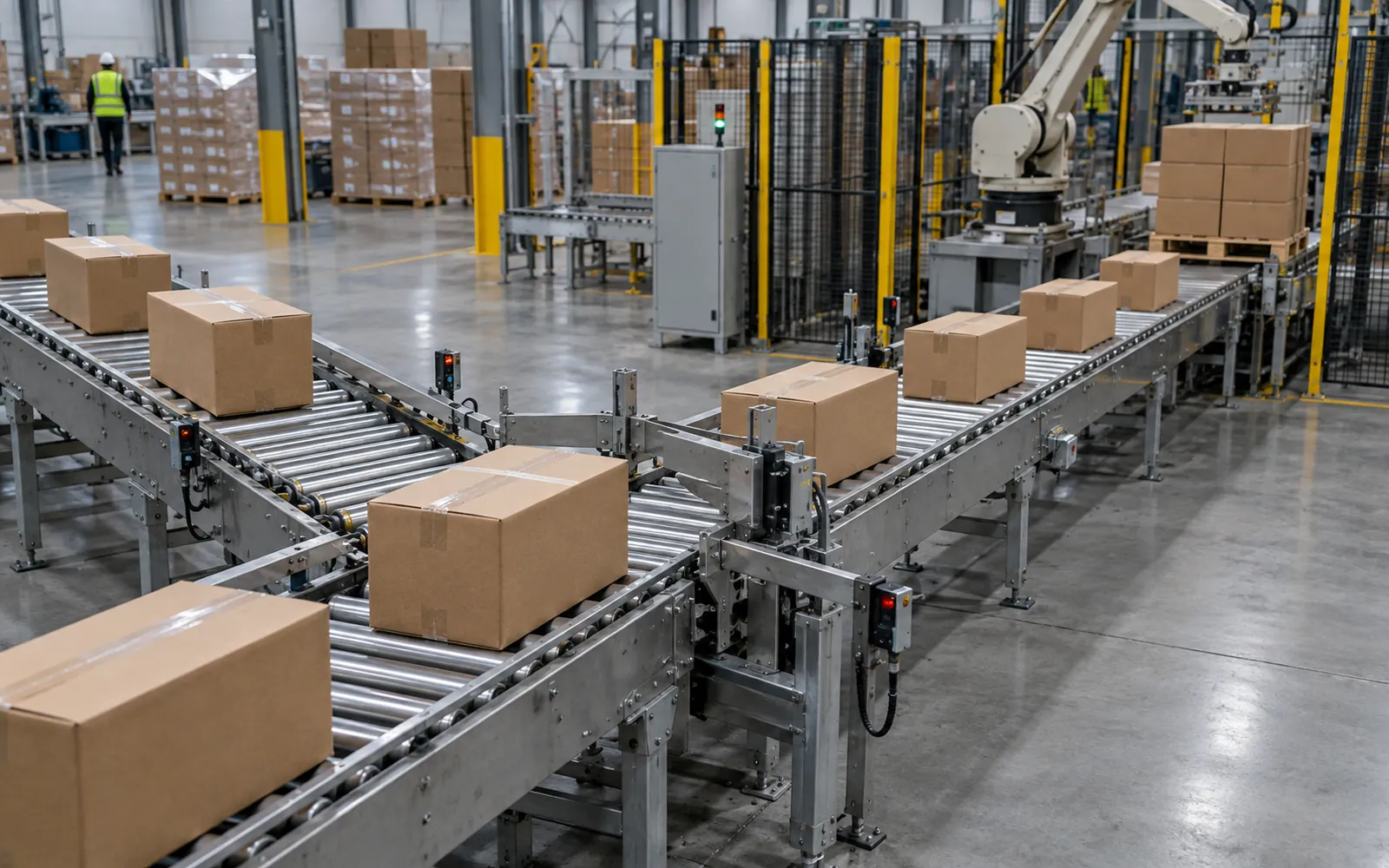
Case interfaces at a glance
| Input | Record before selection | Handoff to verify | Related guide |
|---|---|---|---|
| Case type and base | Size, weight, rigidity, flap and seal condition | Belt or roller support; reject damaged cases | Case conveyors |
| Required direction | Leading face and resting face at each machine | Turn changes match labeler and pallet pattern | Case palletizers |
| Merge | Each lane’s rate, priority and required gap | Release only into available outlet space | Accumulation conveyors |
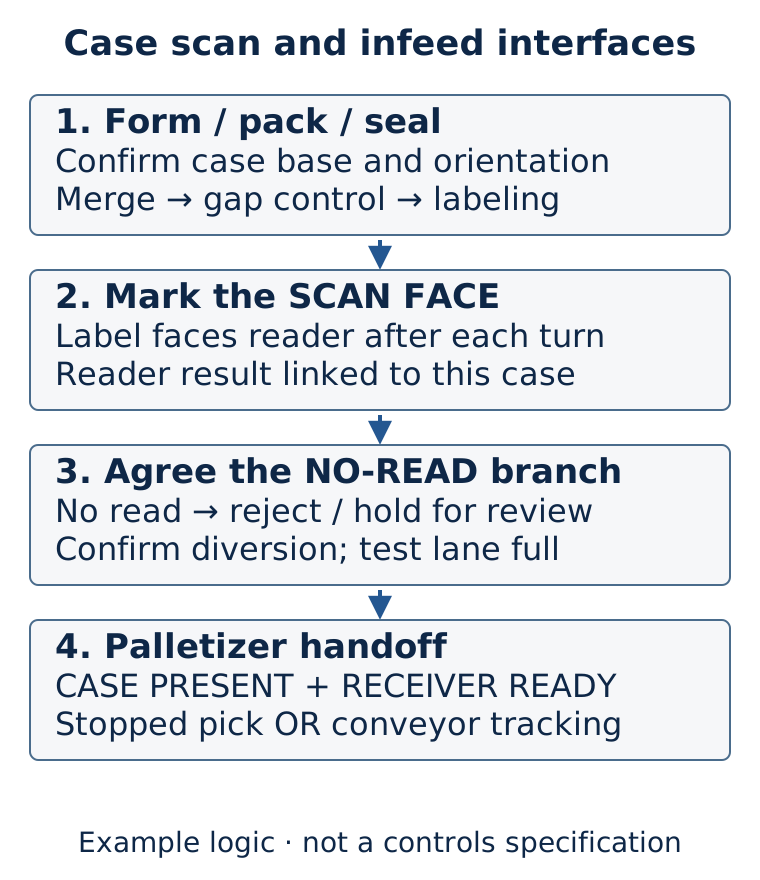
| Scan face | Label side and reader view after every turn | No-read action and reject confirmation | Coding and labeling below |
| Robot pickup | Stopped position or conveyor-tracking scheme | Case present, receiver ready and fault response | Robotic palletizers |
This guide follows cases through erecting, packing, sealing, coding, inspection and palletizer infeed. The applications hub connects it with bottle handling and pallet handling.
Stage by stage: problems and equipment
Erecting
A case erector pulls a flat blank from a magazine, opens it, folds the bottom flaps, and applies tape or hot melt to hold the bottom. Common faults are blanks that stick together, warped blanks, or blanks with a rough score that do not fold square. The problem often shows up later: an erected case that is slightly out of square will be hard for a packer to load and may jam in a sealer. Keeping blanks dry, flat, and stored in the right orientation, and keeping the magazine loaded steadily, prevents most feed trouble. Ask the supplier how the erector handles different sizes, and whether size changes are by hand or by recipe.
Packing
Packers load product into the case. A drop packer lowers groups into an open case. A wrap-around packer forms the case around the product group. Pick-and-place and robotic case packing pick single products or groups. The case packers guide covers the machine types. What matters for case handling is the state of the case when it leaves: flaps open or closed, the position of the top, and the level of fill. An overfilled case bulges and will not seal flat, while an underfilled case may be crushed in stacking.
Sealing
A case sealer closes the flaps and applies tape, glue, or both. Sealing problems are visible: an open flap, a tape that is crooked, a short tape tail, or a case sealed over a bulge. A weak seal is a hazard later, because cases can open on a conveyor or in a stack. Flap alignment at the sealer inlet is the first thing to check when seals vary. Some plants add a vision check for tape presence.
Coding and labeling
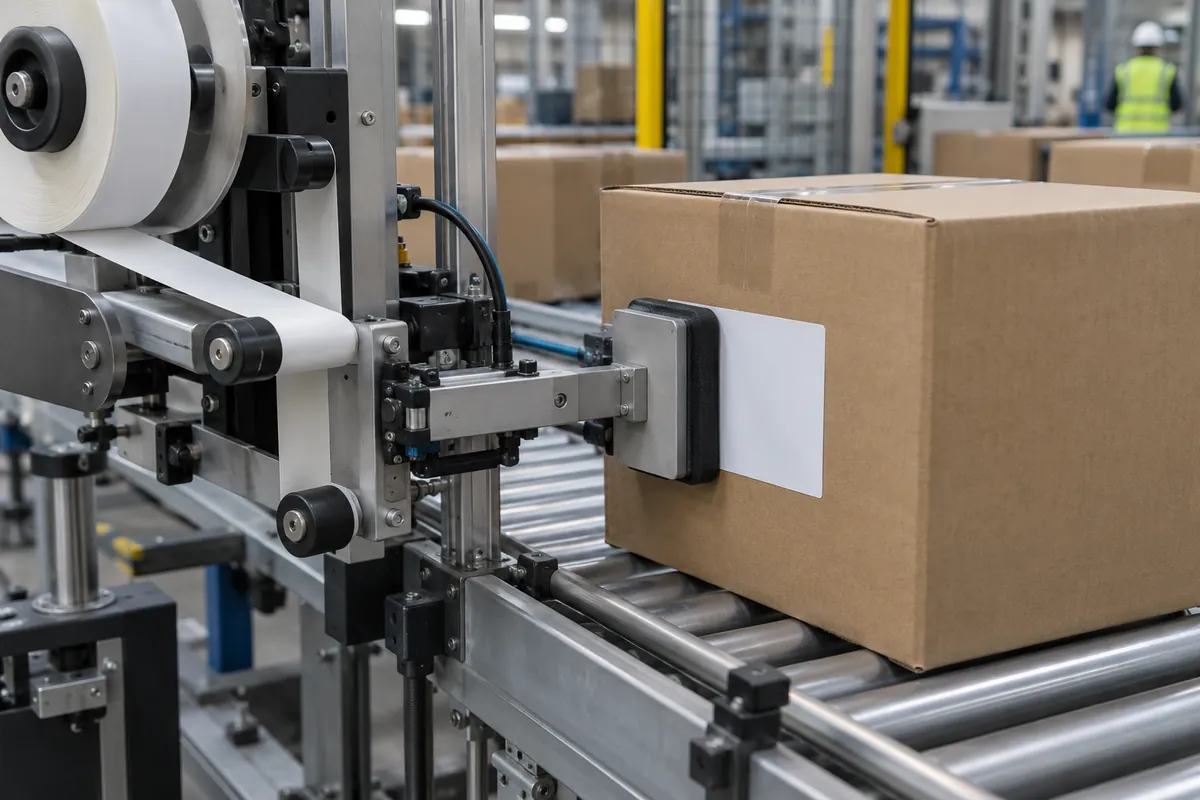
Cases carry date codes, lot numbers, and barcodes, and often a label with the product or customer. Methods include inkjet or laser coders that mark the case surface, and print-and-apply labelers that place a label by a swing arm or tamp. The face that carries the mark matters. A label applied to the side facing the conveyor guide cannot be scanned, and a label applied to a flap seam may tear. For logistics labels, record the barcode type, the case’s role as a trade item or logistics unit, the receiver’s label specification, and the applicable guideline edition. Confirm placement and quiet-zone clearances against that document and the applicator’s reach for every case height.
Check that the new label leaves any required existing code readable. If the agreed specification calls for labels on two adjacent sides, evaluate two stations or a case turn between them.
Checkweighing and inspection
A checkweigher weighs each case on its own short conveyor and rejects cases outside limits. This catches missing product, double-packed cases, and, depending on tolerance, a missing unit. Spacing matters, because two cases on the scale at once give a false reading. Reject methods include a pusher, a flap, a drop belt, and a diverting arm. Supplier literature from one manufacturer describes a drop belt for thin or unpackaged products and a fin or push option for large packaged products, which tells you that the rejector should be matched to the case. Ask how the checkweigher records rejects and whether it can confirm that a rejected case has left the line. Other inspection stations include case code readers, metal detectors where product requires them, and vision checks of the flap seal.
Conveying: accumulation, merges, diverts, and turns
Between machines, case conveyors carry the packs on roller, belt, or chain. The conveyor must handle the case’s weight and its bottom surface. Plastic wrap, wet bottoms, and soft corrugate affect grip.
Cases pause when the palletizer is changing pallets or when a sealer stops. Zero-pressure roller accumulation lets cases queue without touching or pushing, which keeps boxes from crushing and keeps the label face clean. See the accumulation conveyors guide for the types, and note the energy a long accumulation holds at a stop.
A merge brings several lanes into one. It needs either speed-controlled conveyors or a gate that releases cases in turn, so they enter the main line with a gap. A merge is the most common bottleneck on a multi-packer line, because the combined rate of all lanes must fit the single outlet. Photo-eyes at each lane, a controller that alternates lanes, and a short high-speed section that opens gaps after the merge are typical elements.
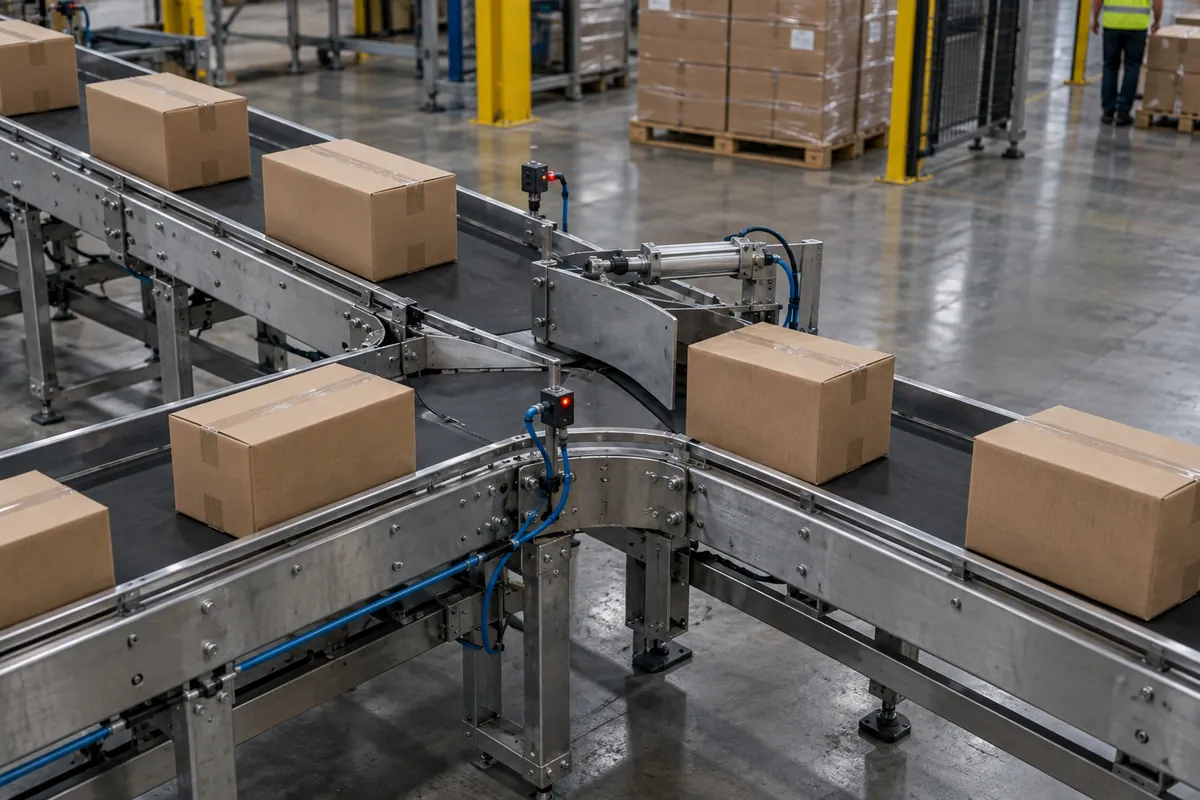
A divert sends cases one way or another. Examples are a sort to one of two palletizers, a pop-up transfer to a side line, and a reject lane. Diverters can be pop-up wheels, pushers, or swing arms. The choice depends on case weight, how fast cases arrive, and how much damage the plant will tolerate. A diverter that strikes a case on its corner can damage it, so a good design pushes at the case’s center of mass with a flat paddle.
Cases must reach the palletizer facing the way its pattern requires. A simple turn can use a curve or a pair of speed-different belts. A guided turn uses a stop and a pusher, or a rotating turntable. Skewed cases can be squared against a guide rail with a short squaring section before the palletizer. Orientation sensors or vision can check the result.
Where the line has to change level, a vertical conveyor can lift cases to a mezzanine or lower them. The case must be kept upright and the exit must hand off at the same spacing the entrance received.
Palletizer infeed
The infeed is where case handling meets the unit load. A case palletizer needs cases at a defined position, spacing, and orientation. A conventional palletizer typically builds a row or layer from the infeed, so the infeed prepares complete layers and any pattern turns. A robotic palletizer needs an infeed matched to its pickup scheme:
- Stopped pickup: position the case and confirm its presence before picking. Robotiq’s public setup note describes stopping the input conveyor when its box sensor detects a case (updated August 2025; accessed October 8, 2026).
- Conveyor tracking: select a robot and tracking interface designed for moving pickup. ABB’s public Conveyor Tracking Module documentation covers picking, packing and palletizing with sensor/encoder interfaces (accessed October 8, 2026). Verify synchronization and stop recovery for the proposed cell.
A stopped infeed is one option, rather than a requirement for every robot. Whichever machine is chosen, the case line should deliver cases at the rate the palletizer can accept and hold the extra cases in accumulation. The how to choose a palletizer guide lists the questions for that decision, and the comparison of robotic vs. conventional palletizers covers the tradeoffs.
Label-out requirements
Some customers require the shipping label, or a given face of the case, to point outward on the finished pallet. That requirement changes the line in several places. The label has to go on a known face, so the applicator must work on a consistent side relative to the case’s travel, for example the leading end or a long side. A case that enters the labeler in any other orientation will be marked on the wrong face.
The palletizer then has to place cases with that face out. In a layer pattern, some cases need to rotate between positions so the label faces outward on the pallet’s perimeter. A robot can rotate each case at placement, while a conventional palletizer may use turning stations before the layer is formed.
The pallet may also need its own label. Record how many pallet label faces the receiver requires and whether the selected logistics-label guideline applies to this load. Confirm visibility in the actual storage and scanning arrangement. A plant that applies a pallet label does not rely on cases facing outward, but customers may still ask for it.
Plan labeling and palletizing together. If the pattern changes, the label-out logic changes, and a line that runs many patterns will need recipes that include case rotation.
Case quality
Case handling equipment is tuned for a typical case. When the case varies, the line struggles.
- Cases that differ in height or width from the nominal size cause jams at guides and unstable layers. Ask the supplier for the tolerance the line can accept.
- Overfilled cases bulge, and weak or wet board crushes. Both produce unstable pallets and trouble at turns.
- An open flap catches on a guide rail, and a poorly taped case may open in transit.
- Smooth plastic wrap and wet bottoms slide, which affects accumulation and diverts. Rough or sticky surfaces cause the opposite problem.
- Dust from corrugate, spilled product, and label adhesive build up on rollers and photo-eyes. A cleaning plan and dust-resistant sensor housings keep the line running.
A checkweigher and a simple visual check at the erector and sealer remove most bad cases before the palletizer. For recurring quality problems, trace them back to the source: a blank supplier, an overfilled packer, or a sealer setting.
Integration and controls
A case line works as a chain of accumulation zones, each with a sensor that signals full or empty. A PLC coordinates the zones so that the line releases cases when downstream is ready, and merges and diverts follow logic that keeps lanes balanced. A good design includes:
- A shared spacing target at each hand-off.
- Photo-eyes at merges, diverts, and the palletizer pickup.
- A way to hold cases when the palletizer is in a pallet change, usually accumulation sized to that time.
- Reject lanes that do not interrupt the main flow.
- A restart sequence after a stop that avoids releasing a surge of cases at once.
Data from the case line can feed a plant system with counts, rejects, and downtime reasons. That helps a plant see which stage causes the most stops. See the line design guide and layout guide for how these sections fit a whole line, and the packaging line layout guide for floor planning.
Safety is part of the design. ASME B20.1-2024 is the United States safety standard for conveyors and related equipment, and in general industry OSHA’s 29 CFR 1910.212 covers machine guarding. Case lines have many pinch and nip points at transfers, turns, and diverters, and these need guarding and safe access for jam clearing. Crossover points for people also need design attention.
Design considerations
- List every case size, weight, and board grade, including the heaviest and the smallest. A line that handles a large range needs adjustable guides and wider conveyors.
- Size each stage for the peak rate, not just the average, and allow for stops.
- Decide where each turn happens and how orientation is checked.
- Capture the label position, the face to be outward, and the pallet label rule before choosing the labeler.
- Each merge and divert adds controls and a point of failure, so simplify the flow where possible.
- Roller lines with fast turns can be loud. Plan for guarding and, where needed, quieter belts.
- Turns, merges, and accumulation take floor space. The conveyor cost guide lists what drives price.
Illustrative example
This is a hypothetical case line for a plant that packs two products into the same case size and ships on one palletizer, illustrating how merging, labeling, and orientation connect ahead of the cell.
- Two case erectors feed two packers, one for each product.
- Each packer is followed by a case sealer and a coder that marks the case on the long side.
- A checkweigher on each lane rejects out-of-tolerance cases to a single reject conveyor with an operator station.
- The two lanes merge through a gate controlled by photo-eyes, then pass through a short high-speed section to open gaps.
- A print-and-apply labeler marks a shipping label on the leading face, followed by a code reader that confirms the label.
- A turn section rotates cases to match the pattern, and a squaring guide aligns them.
- A zero-pressure accumulation section holds cases ahead of a robotic palletizer, which rotates cases at placement so the label faces outward on the pallet’s perimeter.
A beverage version of this plant would add a bottle-side buffer ahead of the packer, as shown in the bottle handling guide. A food plant would add hygiene features and a metal detector, as described on the food packaging and beverage packaging pages.
Where to go next
The end-of-line packaging hub covers packers, erectors, and sealers. The conveyors hub and palletizing hub cover transport and the final load, and pallet handling picks up once the pallet is built.