| Question | Uniform sealer | Random sealer |
|---|---|---|
| Case sizes | One size per run | Different sizes in any order |
| Changeover | Manual adjustment between sizes | Automatic at the infeed |
| Best for | Long runs, stable formats | Mixed SKUs, frequent size changes |
| Complexity | Simpler mechanics | More sensing and adjustment |
| Risk | Wrong-size case handled poorly | Cases must be spaced and presented correctly |
| Factor | Tape | Hot melt |
|---|---|---|
| Where the bond forms | Outside of the seam | Between the flaps |
| Machine complexity | Simple head, no heating | Melter, hoses, applicators, controls |
| Bond check | Continuous tape contact across seam | Adhesive contact and set between flaps |
| Reopening | Cut or peel the tape | Flaps pulled apart |
| Typical use | Lighter products, mixed sizes, lower volume | Continuous high-rate lines, similar cases |
| Main hazard | Cutter blades | Hot adhesive burns |
| Common failure | Roll end, crooked strip | Flaps not held while glue sets |
These choices are independent of semi/fully automatic flap folding. See the end-of-line overview, case erectors, and case packers for the upstream route.
How it works
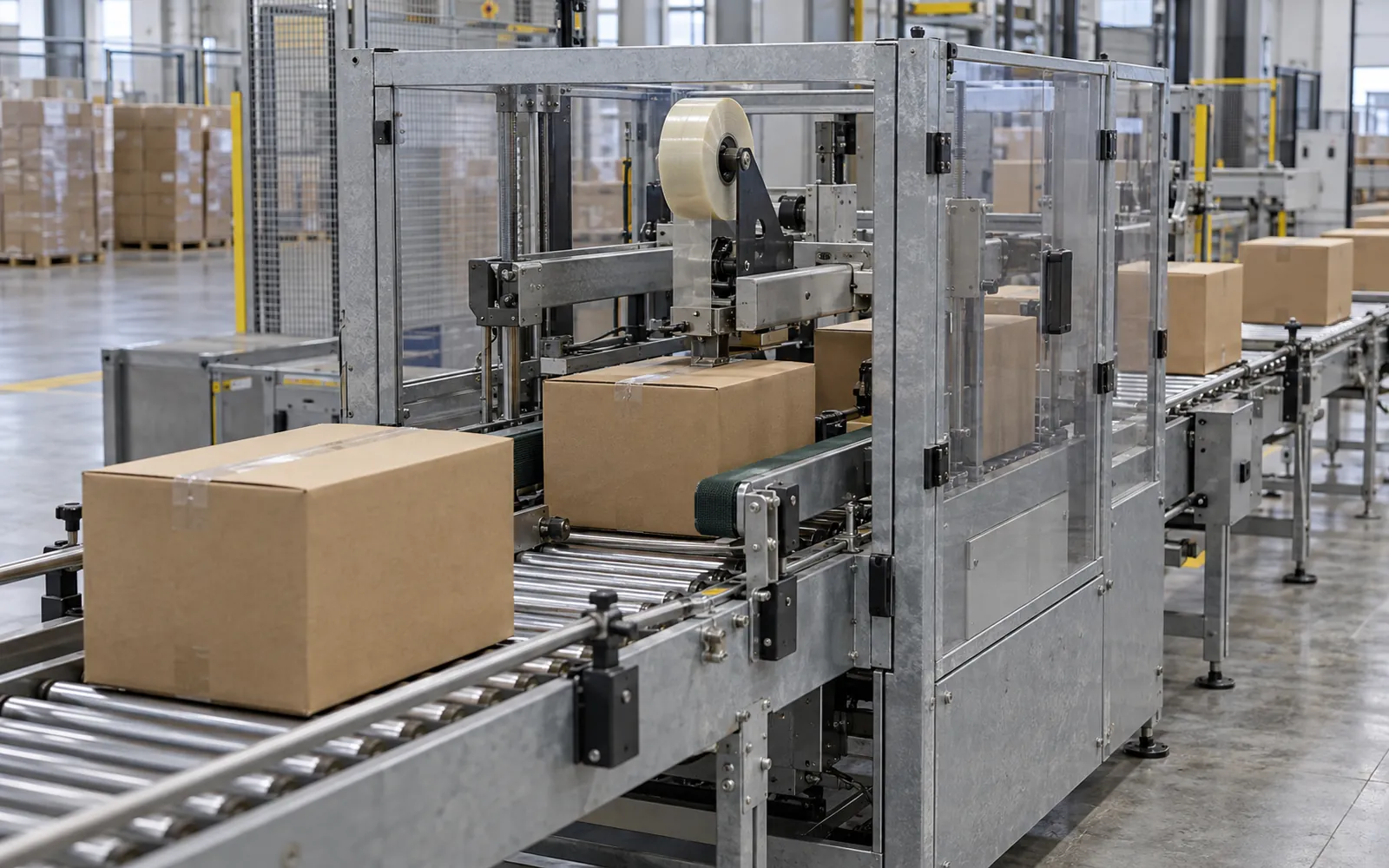
An automatic case sealer carries each case through the same three stages every cycle: transfer, flap folding, and sealing.
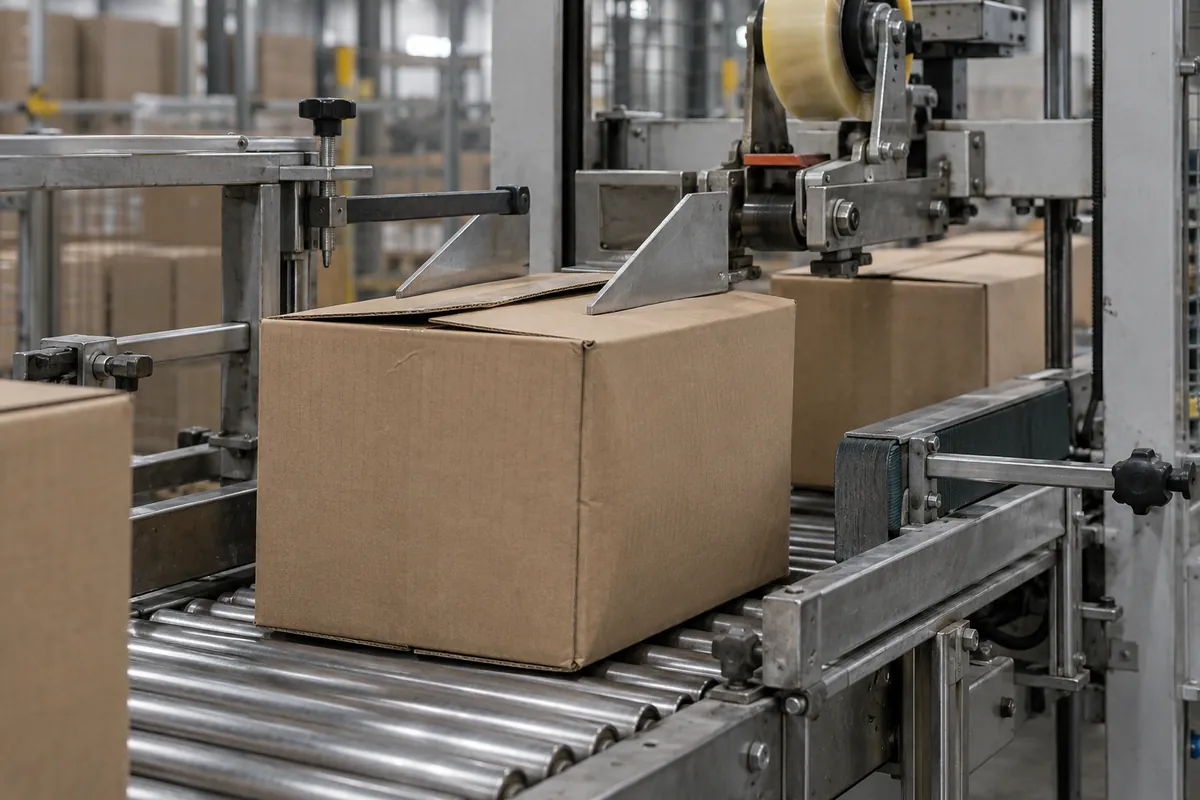
A case enters on a conveyor, and side belts, or belts above and below it, carry it through the machine at a steady pace. The belts grip the case, so it must be square enough to track straight. Upstream spacing matters, because cases that touch or overlap can jam the infeed.
The machine then closes the top flaps in sequence. Supplier descriptions give the order as the front flap, then the rear flap, then the two side flaps, which leaves the top closed before the case reaches the tape head. On a semi-automatic machine an operator folds the flaps by hand and feeds the case in.
Finally, a tape head applies a strip across the center seam, or an adhesive applicator deposits hot melt on the flaps. Some machines add a second head underneath, so top and bottom seams are sealed in a single pass.
No single stage sets the speed. They have to keep pace with each other and with the feeding conveyor: quick folding is wasted if the tape lands unevenly, and an accurate tape head cannot help if the flaps are not closed in time.
Types and configurations
Case sealers are classified by two separate questions: how much an operator does, and how many case sizes the machine can take.
Automation level
With a semi-automatic sealer, a person folds the flaps and puts each case into the machine. It costs less, and it suits operations moving beyond hand taping or running low volume. The machine standardizes tape application, which removes variation from hand pressure. A fully automatic sealer folds the flaps and moves the case on its own. Where cases come from an automated packer, a manual sealer creates a gap, because every other station then runs without an operator except that one.
Uniform and random sealers
A uniform sealer (also called adjustable or fixed-size) is set for one case size and runs a batch of that size before it is changed over. If a different size arrives, the folding arms and tape head are set for the wrong footprint, and the machine can handle it poorly. A random sealer accepts different case sizes in any order. Older designs use sensors to find the size and position of each case, and actuators move the folding and sealing parts to match. Newer machines measure each case at the infeed and adjust automatically.
Uniform versus random is independent of automation level, so any combination is possible, such as a uniform fully automatic machine or a random semi-automatic one. Supplier guidance gives a simple split. Operations running one case size for long runs tend to prefer a uniform machine for its speed, simplicity, and reliability. Operations with frequent SKU changes or mixed case sizes tend to need a random machine, because changeover time on a uniform machine costs more than the extra complexity of random handling.
Use the uniform/random comparison at the start of this guide.
A manual random machine still needs the operator to space and flap-fold each case so the machine does not jam. Ask the supplier what “random” includes in practice.
Top, bottom, and side sealing
Most sealers close only the top seam, and the bottom is closed earlier by an erector with a bottom seal. A top-and-bottom model seals both seams on formed, filled cases. Where the bottom is unsealed, confirm how the case and contents remain supported through loading and transfer. Flat blanks belong to the case erector or another forming route. Side sealers close the side seams of shipper-style and tray-style cases and are a different machine class, so confirm the case style first.
Tape and hot melt
Choose the closure method separately from uniform/random sizing. Treat conversion between tape and hot melt as unconfirmed unless the proposed model’s manufacturer documentation lists the conversion and required hardware.
Tape versus hot melt
Both methods close cases well, but they work differently and fail differently.
Tape wraps a pressure-sensitive strip across the outside of the flaps and closes the seam with pressure alone at room temperature. Operators know it well, the equipment is fairly simple, and upkeep is usually easier, so it is widely used. Nothing in a tape head needs heating, pumping, or hose maintenance, and a taped case is easier to reopen for inspection or return. Tape adds little structural strength, so supplier sources associate it with lighter products. It fails when the roll runs out or the strip goes on crooked, and many tape systems stop the line to change rolls.
Hot melt deposits molten adhesive, usually a synthetic resin, on the inner flaps, and the bond forms as it cools. The bond is strong and adds structure, so hot melt is often chosen for higher-rate lines or where a taped seam is less desirable. The adhesive supply is typically held in a melter and can be refilled while the line runs. The tradeoffs are a heating and temperature-control system, hoses and applicators that need cleaning to avoid char and clogging, and a burn hazard because the adhesive is processed at a high temperature. The flaps also have to be held under pressure while the glue sets, using the weight of the product or a compression section. If they are not held long enough, the bond fails.
Glue Machinery Corporation’s public comparison describes lower adhesive cost and higher hot-melt equipment/operating cost (accessed October 8, 2026); it does not state a case-specific consumption basis. Which comes out ahead depends on volume, size variety, and maintenance resources. Neither is automatically better. The decision depends on line speed, case material, plant conditions, and the handling the case gets after sealing. For cases entering cold storage or a heavy pallet stack, use the case sealer tape-versus-hot-melt selection guide to distinguish bond-formation problems, cold cracking, and case compression before choosing a closure.
Use the tape/hot-melt comparison at the start of this guide.
Cases from recycled board may reduce tape adhesion on some tapes, which may call for a different tape, not a different board.
Specifications to evaluate
Ask for the rate and seal quality on the plant’s own cases, not only the headline speed. A uniform machine and a random machine with the same rated speed can perform very differently once real SKU variety arrives.
| Specification | Why it matters | What to ask the supplier |
|---|---|---|
| Case size range | Sets which SKUs the machine can run | What are the minimum and maximum sizes, and what happens at the edges of the range? |
| Uniform or random | Decides changeover and flexibility | How is each case measured and adjusted, and what spacing is needed? |
| Automation level | Sets labor and fit with the packer | What does an operator still do, and who clears a jam? |
| Sealing method | Cost, strength, maintenance | Which heads are available, and can the machine change from tape to hot melt later? |
| Top only or top and bottom | Affects line layout | Can a second head be added, and what does that change? |
| Flap folding performance | Controls seal quality | How does the machine handle loose, bulging, or short flaps? |
| Tape width and consumables | Affects material cost and roll changes | Which tape widths are supported, and how are rolls changed? |
| Rate | Must match the packer and checkweigher | What rate is achieved with the plant’s cases, board, and tape or glue? |
| Controls | Affects diagnostics and integration | What signals and counters are available, and how does it connect to the line controls? |
| Guarding | Determines safe access | Where are the guards, interlocks, and cutter covers? |
Package compatibility
A case sealer is designed for regular slotted cases and similar styles, with flaps that meet or overlap on top. Other cases, such as full overlap, die-cut styles, and shippers, can need different folding or side sealing. Check the case style, the full size range, the board grade, the flute, and the case weight and rigidity.
The case also affects seal quality. Flute profile, recycled content, storage humidity, score quality, and squareness all change how flaps sit and how tape adheres. A board that scores unevenly folds unevenly, and an uneven flap leaves a gap or wrinkle the tape head cannot close, however well the machine is set. The same board can behave differently between batches, so tape head pressure and speed settings need regular adjustment and cannot be set once at commissioning. Supplier sources also note that poorly scored or glued blanks can produce a taped seam that does not fully cover the seam, so the corrugated quality section of the case erector guide applies here too. A sealer proven only with flat, dry sample cases can still jam on the variation of real production.
Overfilled or bulging cases are a separate problem. If the contents push the flaps up, the folding section cannot close them, and the fix is usually in the packer or the case size.
Integration upstream and downstream
A case sealer sits between the packer and the next downstream station. A packing error found before sealing is cheap to fix, while one found after sealing means opening a closed case.
Cases arrive from a case packer, a robotic packing cell, or a manual pack station, on conveyors with spacing and guides. They should arrive square, flaps up, and in a controlled position. Compare long-run good-case output with the packer, including consumable changes and faults. Extra running-rate capacity can clear a queue after a short stop when upstream accumulation has room and downstream equipment can accept the faster flow. It cannot compensate for a long-run average below the required output. Time tape-roll or adhesive-service stops under the actual replenishment arrangement, then verify recovery with the buffer initially occupied as expected.
An in-motion checkweigher takes its reading during a brief window while the case travels on the belt. If the sealed case is out of square or has loose flaps, it can rock or drag during that window, and the movement shows up as noise in the weight. The sealer should hand off a stable package, and the conveyor between the two machines should be long enough, and at a matched speed, for the case to settle. One supplier makes the point that a line’s ability to read weight accurately starts several stations before the scale. Where possible, also weigh before sealing, because an underfilled case found after sealing means cutting it open.
A print-and-apply labeler needs a case that arrives in a known position with a flat face. A seam of tape or a bulging flap on the labeled face changes where the label can land, so decide which face is labeled and check that the tape runs on the opposite or a compatible face.
Closed cases proceed on case conveyors to the palletizer. Palletized loads stress the flaps, so a marginal seal can open during stacking or transit. Confirm that seal quality holds through palletizing and shipping. The how to choose a palletizer guide explains how case quality affects palletizing.
Link the sealer to line controls so a missed seal, an empty tape roll, a low adhesive level, or a fault stops the case flow and alerts the operator. The packaging line layout guide covers the layout of these stations.
Footprint, utilities, controls, and safety
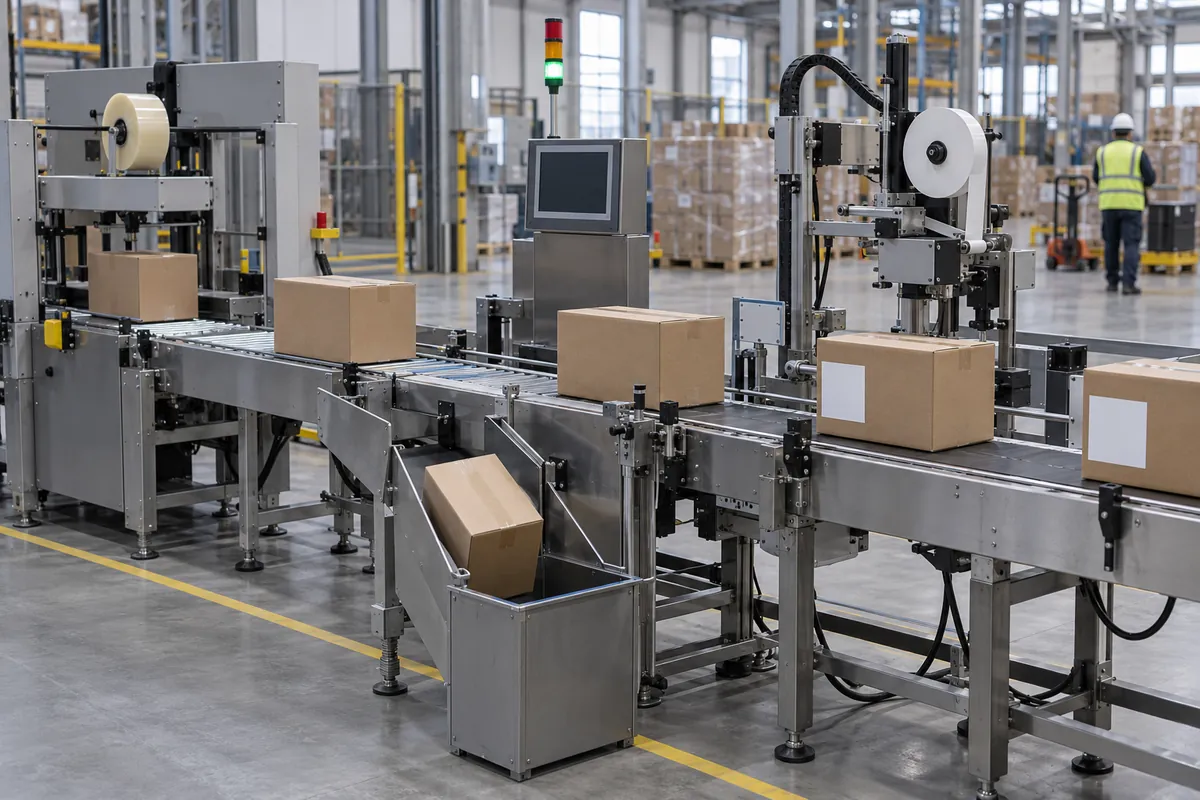
A top-only sealer is relatively short, and the footprint grows with a bottom head, a random infeed, a compression section for hot melt, or a long discharge. Allow clearance for roll changes and service access, and ask for a layout drawing.
Expect electrical power, and some machines use compressed air. Hot melt systems need electricity for the melter and may need ventilation or adhesive handling space. Ask for the electrical and air requirements, including the disconnect size.
Look for a programmable controller, a clear interface, counters, and fault messages. Random machines add sensing and positioning controls. Check which spare parts and settings the maintenance team can manage.
On safety, tape heads have cutting blades, and roll changes bring hands close to them. Melters, hoses, and applicators run at high temperature, and the adhesive can burn the operator if the machine is misused. Belts, folding arms, and adjusting mechanisms can trap fingers and clothing, and random machines move parts automatically. Hair, loose clothing, and gloves can be drawn into belts or rollers. Clearing a jammed case with a belt or head running is a common unsafe practice, and air and electrical energy can start a machine unexpectedly.
Typical controls are fixed guards, interlocked access doors, covers over tape cutters, emergency stops, and warning labels on hot surfaces. OSHA’s lockout/tagout standard at 29 CFR 1910.147 applies to servicing and maintenance where unexpected startup or release of stored energy could injure employees, so write procedures for jam clearing, roll changes, size changes, and adhesive service. The right controls depend on the site and the machine, so carry out a risk assessment that covers each task.
Cost factors
Prices vary by scope, so these are the cost drivers instead:
- Automation level: fully automatic machines cost more than semi-automatic ones and reduce labor.
- Uniform or random: random machines add sensing, actuation, and controls.
- Sealing method: tape heads and hot melt systems differ in purchase price, consumables, and maintenance.
- Top-only or top-and-bottom: a second head adds cost and floor space.
- Rate: faster machines have heavier construction and more drive capacity.
- Case range: larger or smaller cases and wider ranges need extra tooling.
- Construction: stainless steel and washdown features cost more.
- Integration: infeed and outfeed conveyors, controls, and communication with the line.
- Consumables and service: tape, adhesive, replacement parts, and maintenance time.
- Downtime from poor board: jams and rework add to cost, and a better board may cost less over time.
See the how to choose a palletizer guide for how end-of-line equipment costs combine into a project view.
Selection checklist
- Record every case size, style, board grade, and the heaviest filled weight.
- Decide how many size changes happen per shift and whether random handling is justified.
- Choose manual, semi-automatic, or fully automatic operation to match the packer.
- Choose tape or hot melt from the case weight, rate, handling, and maintenance skills.
- Decide whether a top-only or a top-and-bottom sealer is needed.
- Confirm the required rate and the rates of the machines on both sides.
- Check flap behavior on the worst production cases.
- Plan the checkweigher and labeler positions, and the conveyor lengths between them.
- Review guarding, tape cutter covers, hot melt hazards, and lockout points.
- Check utilities and floor space for service access.
- Agree on how seal faults and consumables are signaled to the line.
- Run an acceptance test with production cases, not samples.
Common mistakes
- Choosing a sealer in isolation. Specify it with the machines before and after, because an unexplained bottleneck often follows an isolated sealer decision.
- Buying on rated speed. The rate with the plant’s case and board is what counts.
- Choosing random when it is not needed. A single-size line gains nothing from random complexity.
- Choosing uniform for a high-mix line, where changeover time may cost more than it saves.
- Treating tape or hot melt as a price decision only. Maintenance, burn safety, and the case also count.
- Ignoring board condition. Humidity, scores, and squareness change the seal from batch to batch.
- Poor spacing upstream. Cases that touch can jam the infeed.
- Setting once and forgetting. Tape head pressure and speed need periodic checks.
- Skipping lockout planning. Roll changes and jam clearing are routine tasks that need procedures.
Alternatives
Hand taping or a tape gun suits very low volume, with variation in seal quality and more labor. A semi-automatic taper is a middle step for moderate volume or first-time automation. Splitting the work between an erector with a bottom seal and a top sealer is common; see the case erectors guide. Some case packers and wraparound machines close the case themselves, which can remove a separate sealer. For some products, bundles or cases are held together by strapping or stretch wrap instead of sealing, or by cases designed to lock mechanically without tape or glue.
The end-of-line packaging automation, food packaging, and case handling pages show where sealing sits in food and warehouse flows.