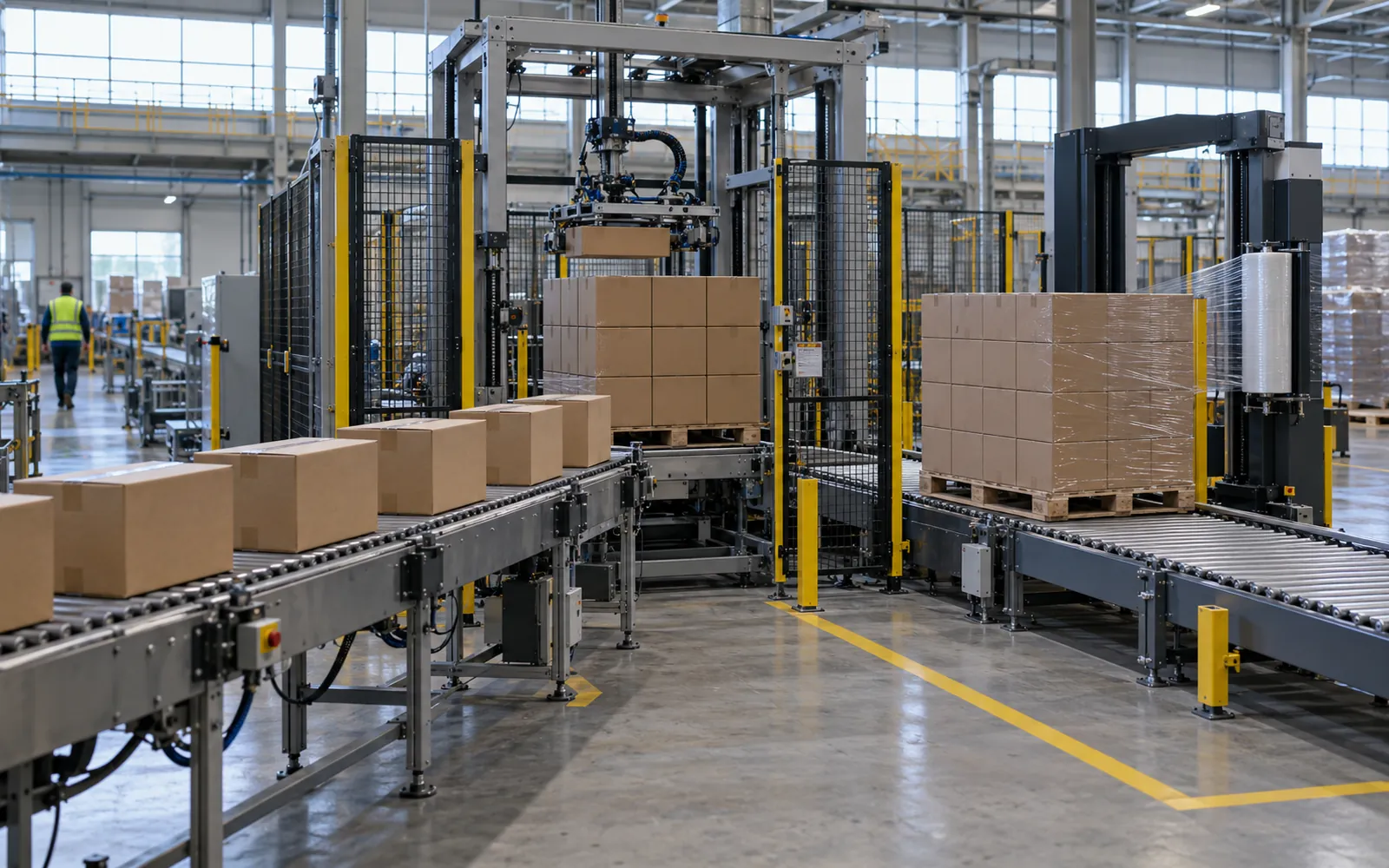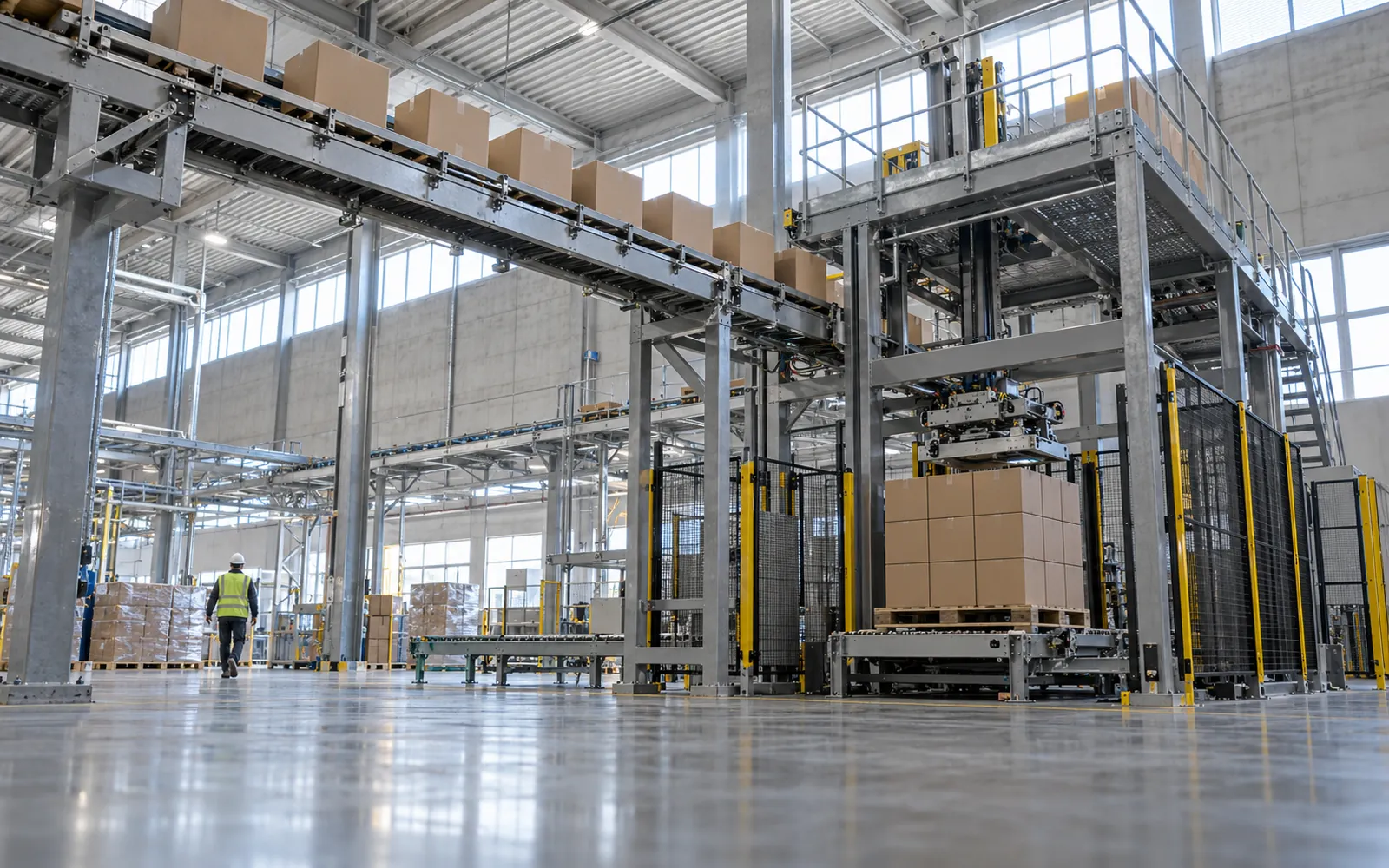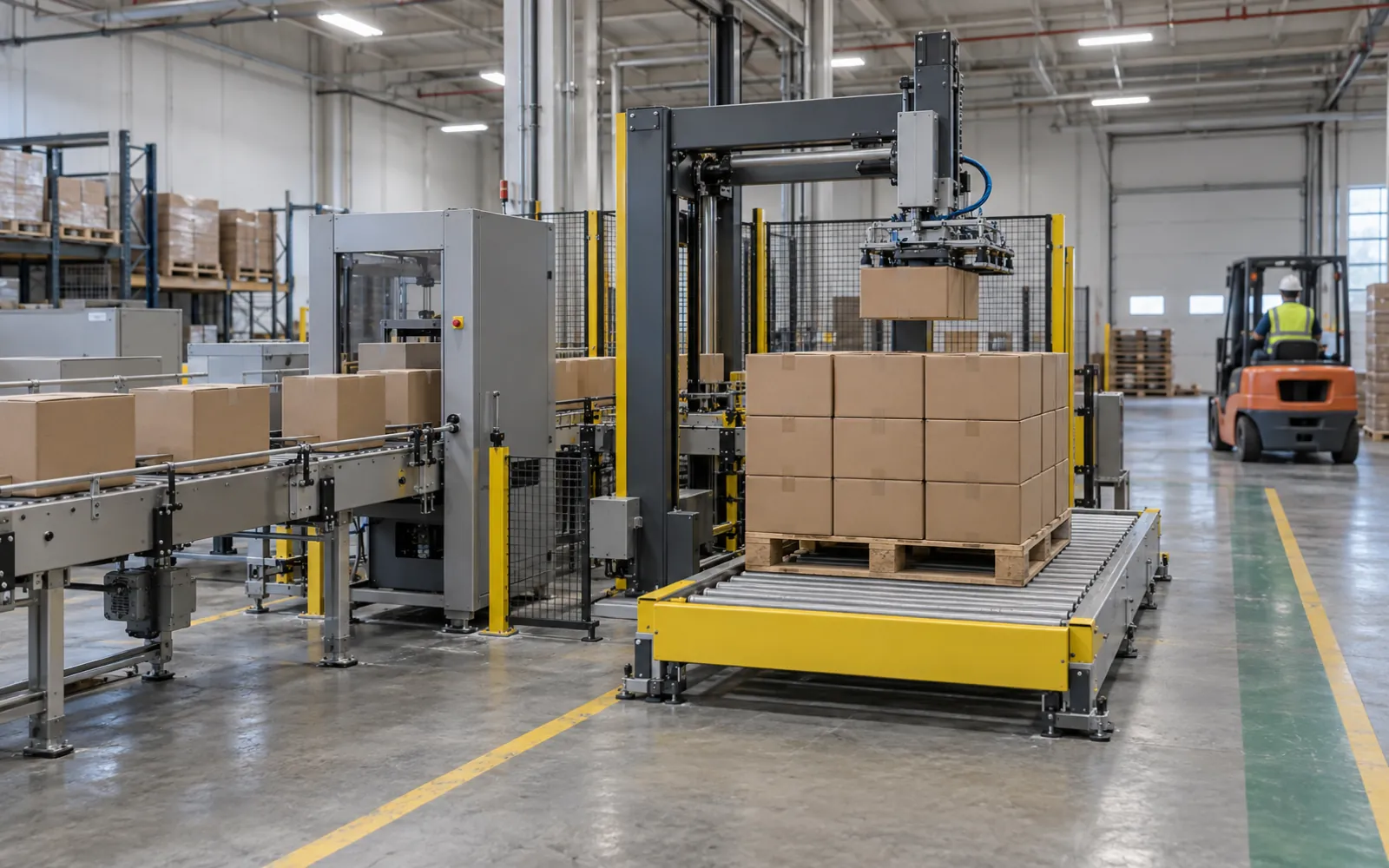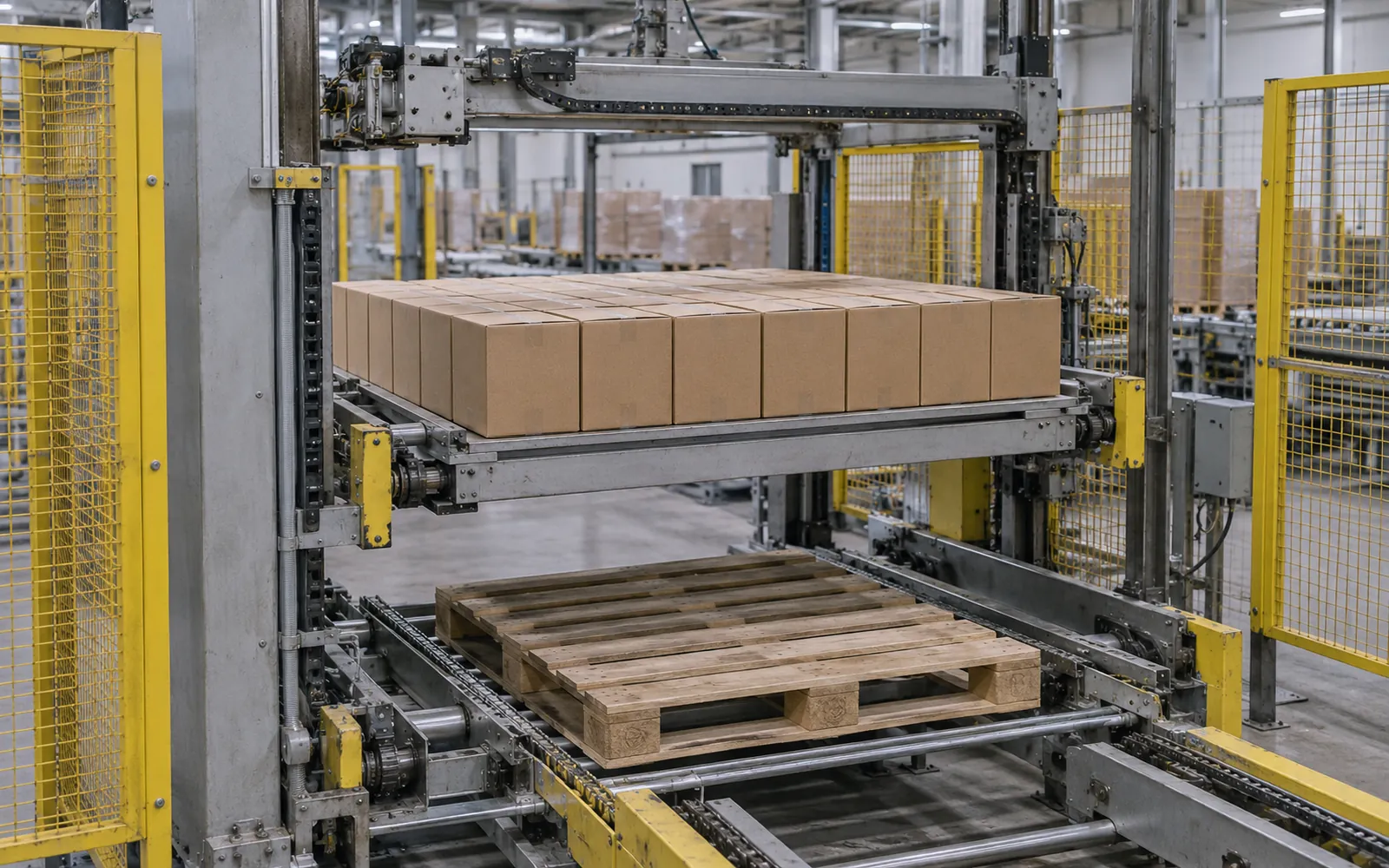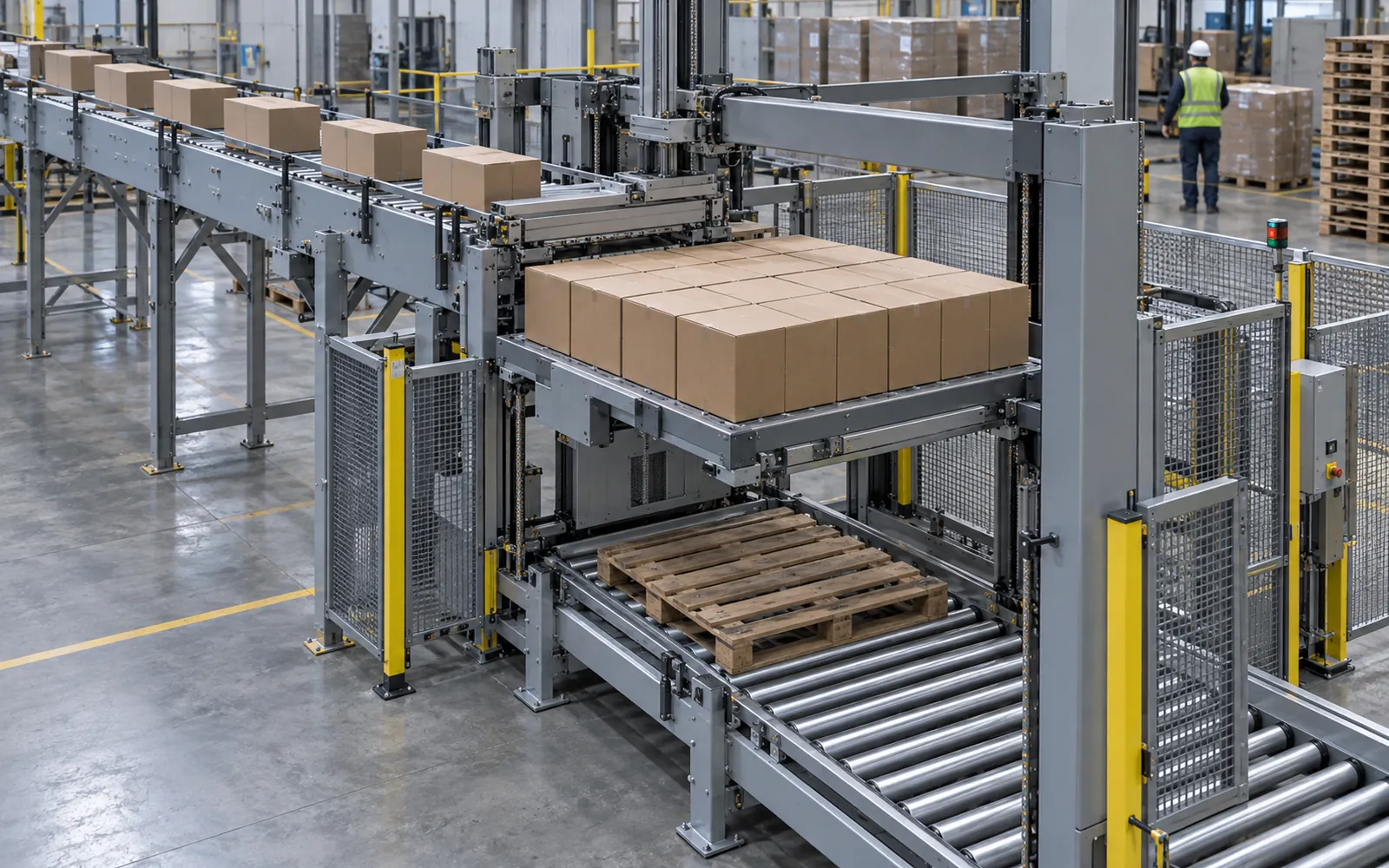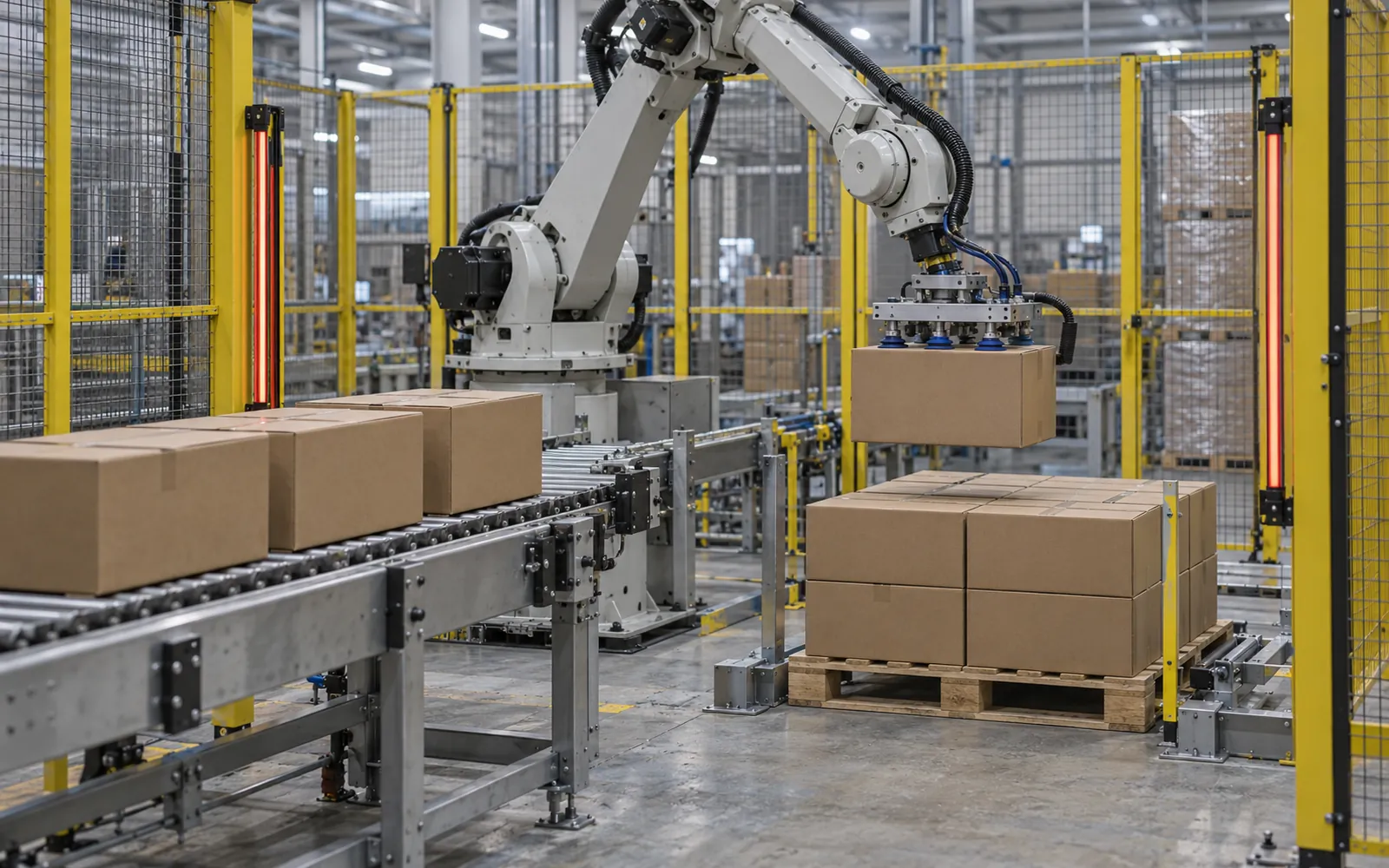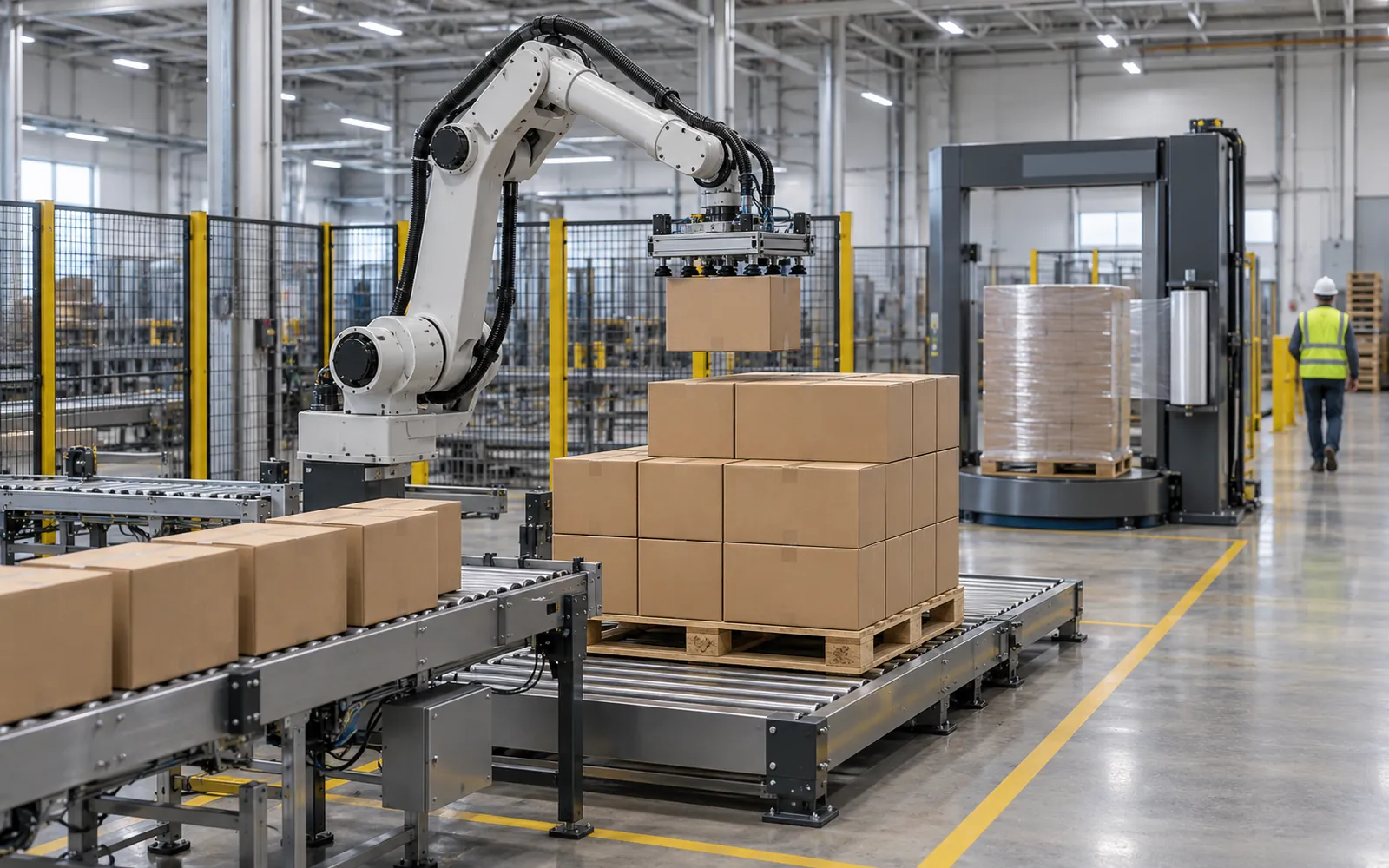
A palletizing system combines load building with infeed, pallet supply, safeguarding and discharge. Choosing the wrong rate or system boundary leaves upstream queues or missing equipment to resolve after installation. Compare the six routes below, then use the details to narrow a project specification.
Six-type comparison at a glance
The table describes tendencies, not guarantees, and any specific machine can differ. Confirm figures with a supplier using your own package, pattern, and pallet.
| Type | Package types | Relative rate | SKU and pattern flexibility | Floor space | Typical fit |
|---|---|---|---|---|---|
| Robotic | Cases, trays, bundles, bags, pails, mixed | Check picks/cycle and package | High; patterns stored in software | Moderate; the arm needs a swept envelope plus guarding | Many SKUs, frequent changeovers, mixed packages |
| Conventional high-level | Uniform cases, cartons, bundles | Check sustained layer rate | Lower; mechanical adjustments for new formats | Elevated infeed and service access to check | Single or few SKUs, high sustained output |
| Conventional low-level | Uniform cases, cartons, bags | Check the quoted format | Lower; mechanical adjustments for new formats | Compact in height, floor-level access | Moderate rates, limited ceiling height |
| Layer or hybrid | Cases, bags, delicate packs | Check quoted configuration | Check quoted configuration | Varies by design | Mixed flow with some delicate or bagged product |
| Gantry | Cases, bags, sacks | Check axis travel and duty | Check quoted configuration | Overhead structure and access to check | Tight floor plans, precise placement |
| Bag-specific | Valve, open-mouth, and film bags | Varies | Check the quoted format | Varies | Powders, feed, seed, fertilizer, aggregates |
For terminology, read what palletizing means; it distinguishes manufacturing output from warehouse load building.
What a palletizing system includes
The palletizer itself, whether a robot or a layer-forming machine, is only one part of the system. A complete installation also has infeed conveyors, devices that turn or orient packages, an empty pallet dispenser, sometimes a slip sheet or tier sheet dispenser, a discharge conveyor for finished loads, safeguarding around the load-building area, and a control system that ties it together. Most plants add a stretch wrapper downstream.
That breadth is why palletizing solutions are hard to compare by machine type alone. Two suppliers can quote different scopes under the same heading: one may include the pallet dispenser and wrapper interface, and another may list them as options. The guide on how to choose a palletizer shows how to put rate, pattern, and scope figures on the same basis before comparing offers, and the commissioning and acceptance checklist covers the wider buying process.
This page is the starting point for the palletizing section. The two detailed guides cover robotic palletizers and conventional palletizers, and the equipment overview shows where palletizing sits in the rest of the packaging line.
Manual, semi-automatic, and automatic palletizing
Palletizing is not an all-or-nothing choice between people and a machine. Plants usually move through three levels, and the right level depends on volume, package weight, product variety, and how hard the work is on people.
Manual palletizing with lift aids. Operators still place every package, but equipment removes the worst of the reaching, bending, and lifting. Common aids include scissor lift tables and spring or self-leveling pallet carriers that keep the top of the load near waist height, pallet turntables that bring the far side of the pallet to the operator, and vacuum tube lifters or other lift assists that take the weight of heavy cases and bags. These aids fit low or irregular volumes, very wide product variety, short runs, and plants testing demand before committing to automation.
Semi-automatic palletizing. A machine does part of the cycle and an operator does the rest. Typical splits are a machine that forms and places layers while the operator supplies empty pallets and removes finished loads, or a compact cell that the operator loads and unloads at defined points. This level reduces handling without the full scope of pallet dispensers, discharge conveyors, and wrapper integration.
Fully automatic palletizing. The system receives packages from the conveyor, builds the load, dispenses pallets and sheets, and releases the finished load to the wrapper without routine operator handling. The robotic and conventional types below belong here, along with the infeed, safeguarding, and controls described in the architecture section.
When are manual aids enough? A short checklist helps:
- Lift risk can be judged with an established method. NIOSH’s Revised Lifting Equation calculates risk for two-handed manual lifting tasks, and safety professionals use it to evaluate a task and to design safer ones. If an evaluation shows the risk stays high even with aids, the task is a candidate for automation.
- The rate and the number of shifts determine how many people the station ties up. One shift at a modest rate is a different problem from continuous operation.
- Frequent pattern changes and very mixed loads favor flexible solutions, whether people with aids or a robot, over fixed layer machines.
- Floor space for a fully automatic cell, with guarding and pallet handling, may simply not exist near the line.
This page does not attach rates to each level, because the threshold depends on the package, pattern and line. Selection check: choose the level only after documenting remaining operator tasks, handling risk and sustained capacity on the actual package.
Main palletizer types
Palletizers are usually grouped by how they move product from the infeed to the pallet. The boundaries blur, because many modern machines borrow ideas from more than one group, but the groups are still the most useful way to start a selection.
Robotic palletizers
A robotic palletizer uses an articulated arm, most often with a tool that grips by vacuum, clamping, forks, or a combination. The arm places individual cases, small groups, or whole layers on the pallet according to a stored pattern. Because patterns live in software, one cell can build many different loads, and one robot can serve more than one infeed or pallet position. Throughput depends heavily on how many packages are picked per cycle. The robotic palletizers guide covers tools, cell layouts, specifications, and safeguarding in detail.
Conventional high-level palletizers
A conventional palletizer forms an entire layer on a flat plate or table, then deposits that layer on the pallet in one motion. In a high-level design, products arrive on an elevated infeed conveyor, the layer forms above the pallet, and the pallet lowers as layers are added. Cybernetik’s public guide describes high-level infeeds at roughly 100–144 inches above the floor (source and scope, accessed October 8, 2026); this is that manufacturer’s description, not a dimension for every model. The layer only has a short distance to travel, which is why this architecture suits the highest sustained rates. It usually needs vertical conveying, such as a spiral or lift, to bring product up to the infeed. See conventional palletizers for how the two architectures work.
Conventional low-level palletizers
A low-level machine receives product near floor or waist height. The same Cybernetik guide describes low-level infeeds at 30–36 inches (source and scope, accessed October 8, 2026); verify the actual model drawing. Product is gathered into rows and a layer, and either the layer-forming head or the pallet platform moves vertically so each layer reaches the top of the load. The machine travels farther for each layer, so rates are generally lower than high-level designs. In return, installation is simpler, most parts can be reached from the floor, and the machine connects directly to existing floor-level conveyors without a lift.
Layer and hybrid palletizers
Hybrid designs combine conventional layer forming with robotic or mechanical placement. TopTier’s public comparison describes its hybrid arm-in-frame arrangement for bags and delicate packages. That manufacturer description is not evidence that every hybrid has a smaller footprint or higher safety level. Other layer-handling cells use a robot to pick a prepared layer from a forming table. Forming the layer first raises the effective rate, because the robot moves a full layer per cycle instead of one case.
Gantry palletizers
A gantry, or Cartesian, palletizer moves a gripper along straight axes above a stationary pallet. Gantries suit plants that need precise placement over a clear area, and they can be built with a compact floor footprint and overhead structure. Travel across the pallet area can limit speed, and the load hangs from a long structure, so engineers check structure stiffness, vibration, and maintenance access with the supplier.
Bag palletizing
Bags are flexible and shift as they are lifted, and a bag load gets its stability from how the bags settle against one another. Systems built for bags typically use grippers that support the bag from beneath or from the sides, and some include a compaction step to square the stack. A supplier article describes designs ranging from a turning-arm robot to a gantry-style arm with a vertical sliding gripper, built for sacks of paper, raffia, or plastic film. Conventional machines can also handle bags when layers are compressed and squared before placement.
Type decision: retain a route only when its package handling, sustained rate and complete layout pass the project requirements; the category name alone is insufficient.
System architecture
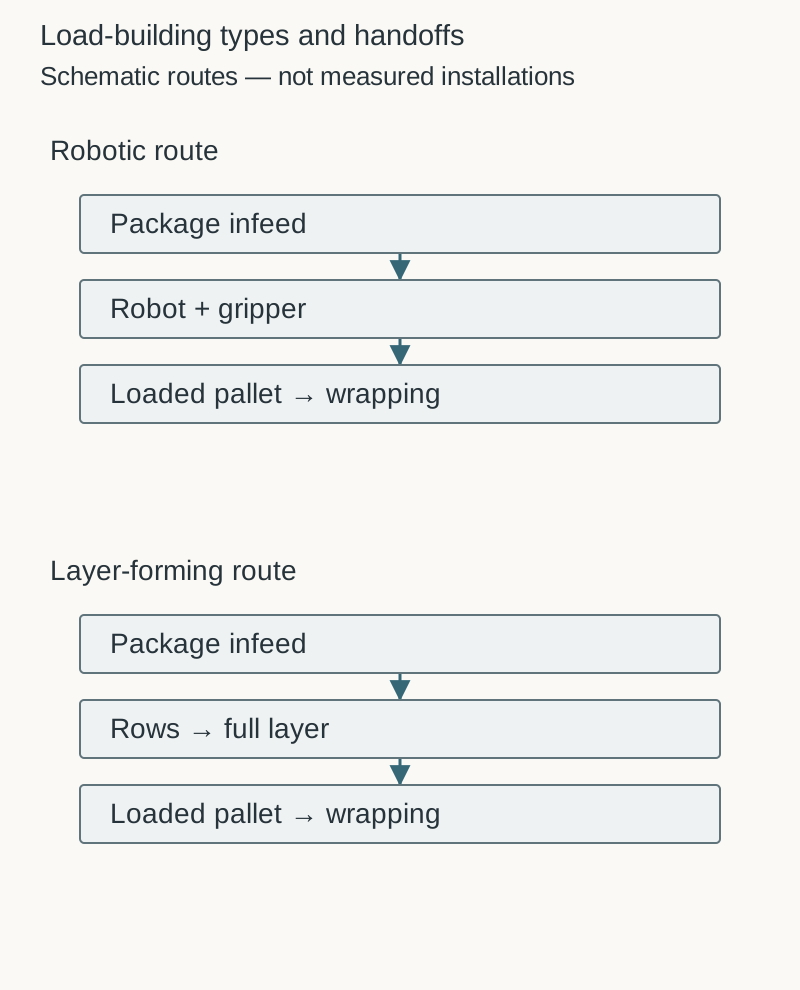
Most palletizing cells follow the same sequence, even when the machines look very different.
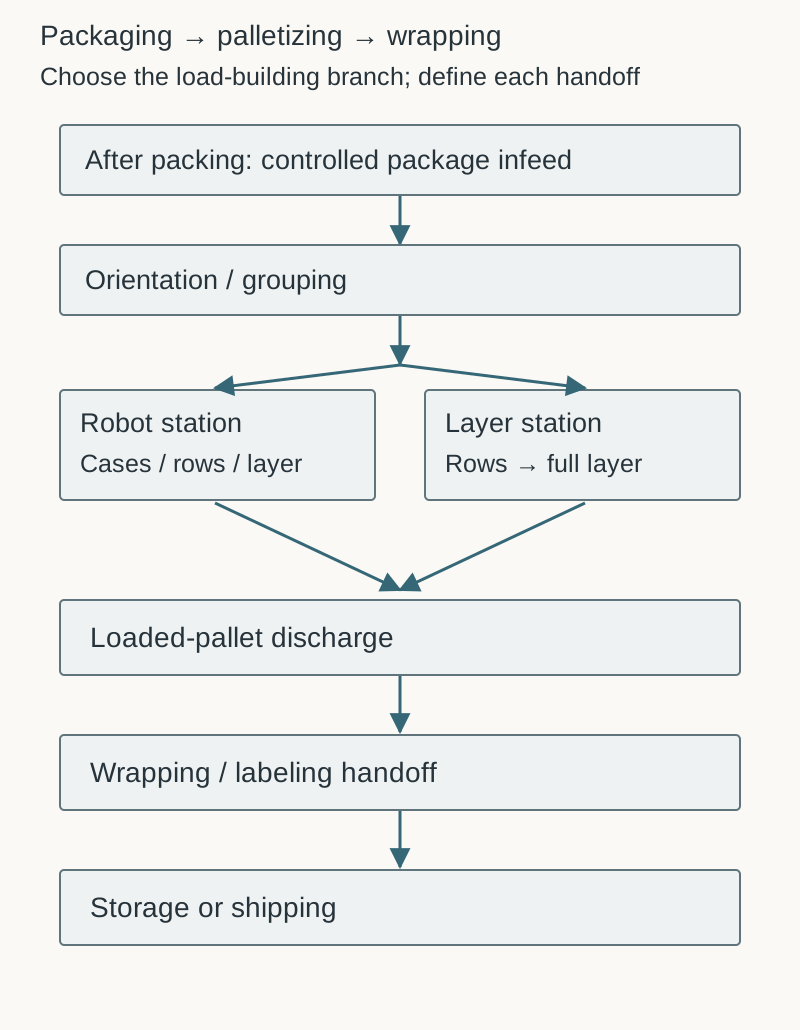
- Packages arrive from the case sealer, case packer, or bundler. The infeed conveyor must deliver them in a controlled, predictable stream. A palletizer sized for an average rate can still miss its target during surges, so gaps and surges matter.
- Cases may need to be turned, grouped, or aligned to match the pattern. On conventional machines, rotation and row forming happen in the layer-building stage. On robots, the tool or a simple turning station adjusts orientation.
- A conventional machine collects rows into a full layer. A robotic cell picks packages directly, or picks a layer prepared on a forming surface.
- A dispenser delivers an empty pallet to the build position, and a slip sheet or tier sheet unit adds sheets when the load requires them. Finished loads leave on a discharge conveyor.
- Most loads go to a stretch wrapper, a labeling station, or both. Some machines wrap while the next pallet builds, and TopTier’s public comparison describes concurrent wrapping inside its contained frame (source mapping). Confirm that function and its boundary on the quoted model.
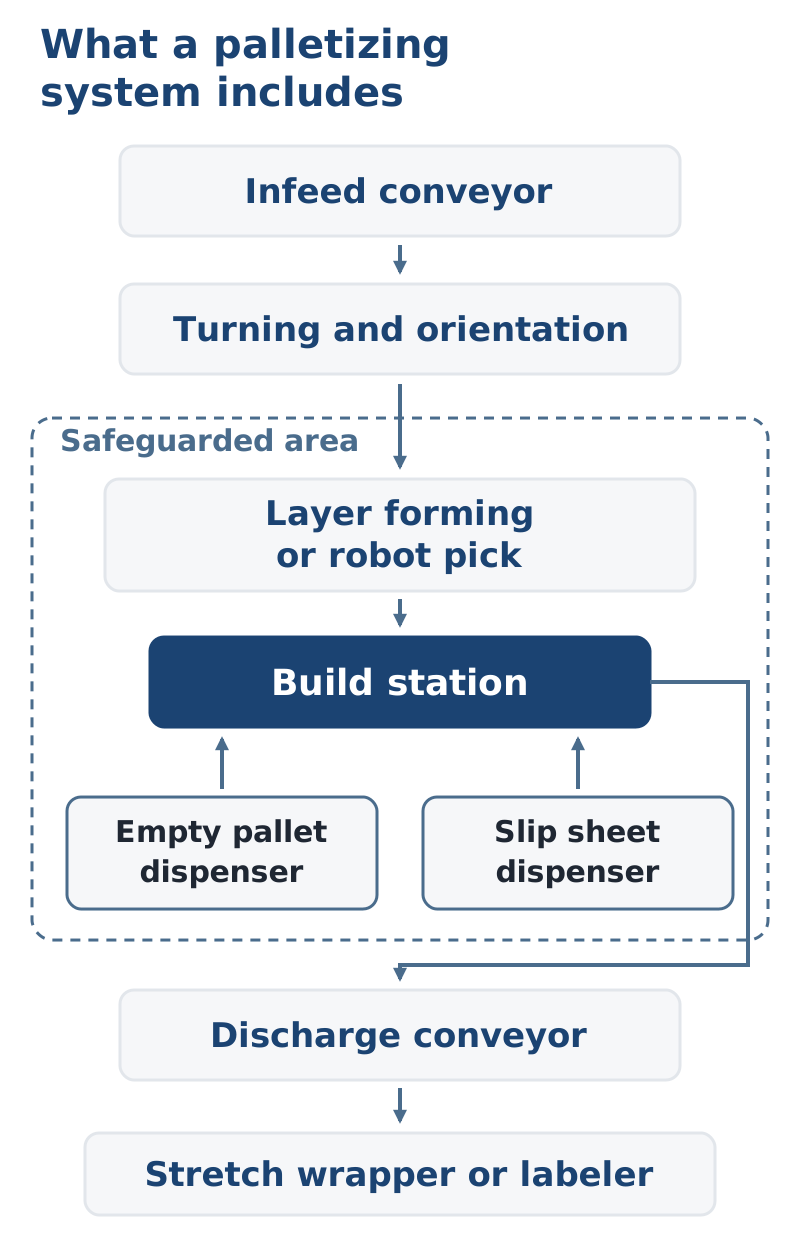
Any of these stages can limit the rate. A fast robot will not help if the infeed delivers cases unevenly, and a fast layer former will wait if empty pallets arrive late. This is why vertical conveyors and accumulation sections often appear in the same scope as the palletizer. Scope decision: include or exclude every supply, load-building and exit function explicitly before comparing two proposals.
Decision factors
Six factors do most of the work in separating one system from another.
Speed
Set the required rate from the highest sustained output of the lines feeding the cell, not from the average. TopTier’s public comparison describes sustained uniform-flow and variable-work trade-offs (source mapping); it does not supply a same-scope model-pair rate test here. Define the unit carefully: cases per minute, layers per minute, and pallets per hour describe different things and cannot be compared without conversion.
Pattern complexity
Count the patterns, pallet sizes, and layer counts the line must build. A cell that builds a single pattern all week makes different demands from one that builds dozens. Ask how new patterns are created, whether operators can do it from the screen, and whether the supplier must reprogram. Load stability checks, including how corners and layers interlock, belong with the pattern review. Use the pallet calculator to record case and pallet dimensions before reviewing a pattern; geometric counts do not prove load stability.
Changeover
Mechanical changeover on a conventional machine can involve adjusting guides and stops. Robotic changeover is often a recipe selection, plus a tool change if the package differs. What matters is how long it takes your operators on your hardest product change, and how often that change happens.
Sanitation
Food, beverage, and pharmaceutical environments may require washdown-rated components, smooth surfaces, and few exposed crevices. Palletizing usually sits after secondary packaging, so contact with product is rare, but dust, moisture, and cleaning chemicals still reach the equipment. Specify the cleaning method up front.
Maintenance
Conventional machines have more mechanical parts that wear, such as chains, gearboxes, and layer-forming mechanisms. Robots have fewer moving parts in the arm, but tools, vacuum components, and cables need regular attention. Ask for the recommended spare parts list, access to wear parts, and the training maintenance staff will need.
Safety
Safeguarding follows the complete application’s risk assessment, including load movement, pallet exchange and maintenance access. The following public edition and scope records were checked October 8, 2026; this is not a review of the paid standards’ full requirements or a site compliance assessment.
| Reference | Cited edition | Scope of the public description |
|---|---|---|
| ISO 10218-1 / ISO 10218-2 | 2025 | Industrial robots / industrial robot applications and cells |
| ANSI/A3 R15.06 | 2025 | A3’s U.S. adoption for industrial robots and applications |
| ISO 13849-1 | 2023 | Design and integration of safety-related control-system parts; not a universal required performance level |
See ISO’s application/cell scope, A3’s edition announcement and ISO’s control-system scope. Conventional palletizers also need machinery safeguarding; a robot standard is not a complete conventional-machine specification. Confirm the applicable edition, local requirements and validation plan for the project.
Decision check: shortlist only systems that pass package, rate, changeover, environment, maintenance and safety checks together.
How palletizing connects to the rest of the line
A palletizer is the last mechanical step of the production line and the first step of the warehouse. Upstream, it depends on consistent case sealing, accurate case dimensions, and a conveyor system that presents packages in the right order. The conveyors section covers the transport equipment feeding the cell, including the vertical conveyors that raise product to a high-level infeed.
Downstream, the loaded pallet moves to a wrapper, labeler, or accumulation conveyor and then to storage or shipping. The relationship also runs the other way. Plants that receive packaging or ingredients on pallets use depalletizing equipment at the head of the line, and plants that handle bulk containers can look at bulk depalletizers. A site that both palletizes and depalletizes can share pallet handling, empty pallet storage, and conveyor routes between the two.
When planning a new installation, treat the palletizer, its infeed, and its downstream wrapper as one project with one set of rate assumptions, so a limit in one place does not surprise the team after installation.
Method and sources
This guide organizes public mechanism descriptions into project checks; it does not report our equipment tests or a model ranking. Rates and footprints remain configuration-specific.
Cybernetik source mapping: the high/low infeed heights above come from its public low-level versus high-level guide, accessed October 8, 2026. The ranges belong to that description; they do not define all palletizers. Safety editions and scope are mapped in the table above.
TopTier source mapping: its public conventional/robotic comparison supplies the hybrid and concurrent-wrapping descriptions, accessed October 8, 2026. Model-specific dimensional and sustained-rate pairs are not established here.
Choosing a starting point
Before involving suppliers, work through these questions:
- What are the packages, weights, and pallet sizes, and which SKU is the hardest?
- What sustained rate does upstream output require, with room for growth?
- How many patterns and how many changeovers per week does the line expect?
- How much floor area and ceiling height are available, and how high are the existing conveyors?
- What sanitation and safeguarding does the plant and the insurer expect?
- Are the wrapper, labeler, and pallet dispensers in scope?
With those answers, the choice often narrows to two types. Robot cells tend to appear when variety and floor space dominate, and conventional machines appear when uniform packages and sustained rate dominate. Hybrid and gantry options come into play when floor space, package fragility, or bags change the answer.
For the individual machines, see case palletizers, high level palletizers, and low level palletizers. The palletizer cost guide and the robotic versus conventional palletizer comparison help with budgeting and design choice. To see palletizing in use, read beverage packaging automation and pallet handling.