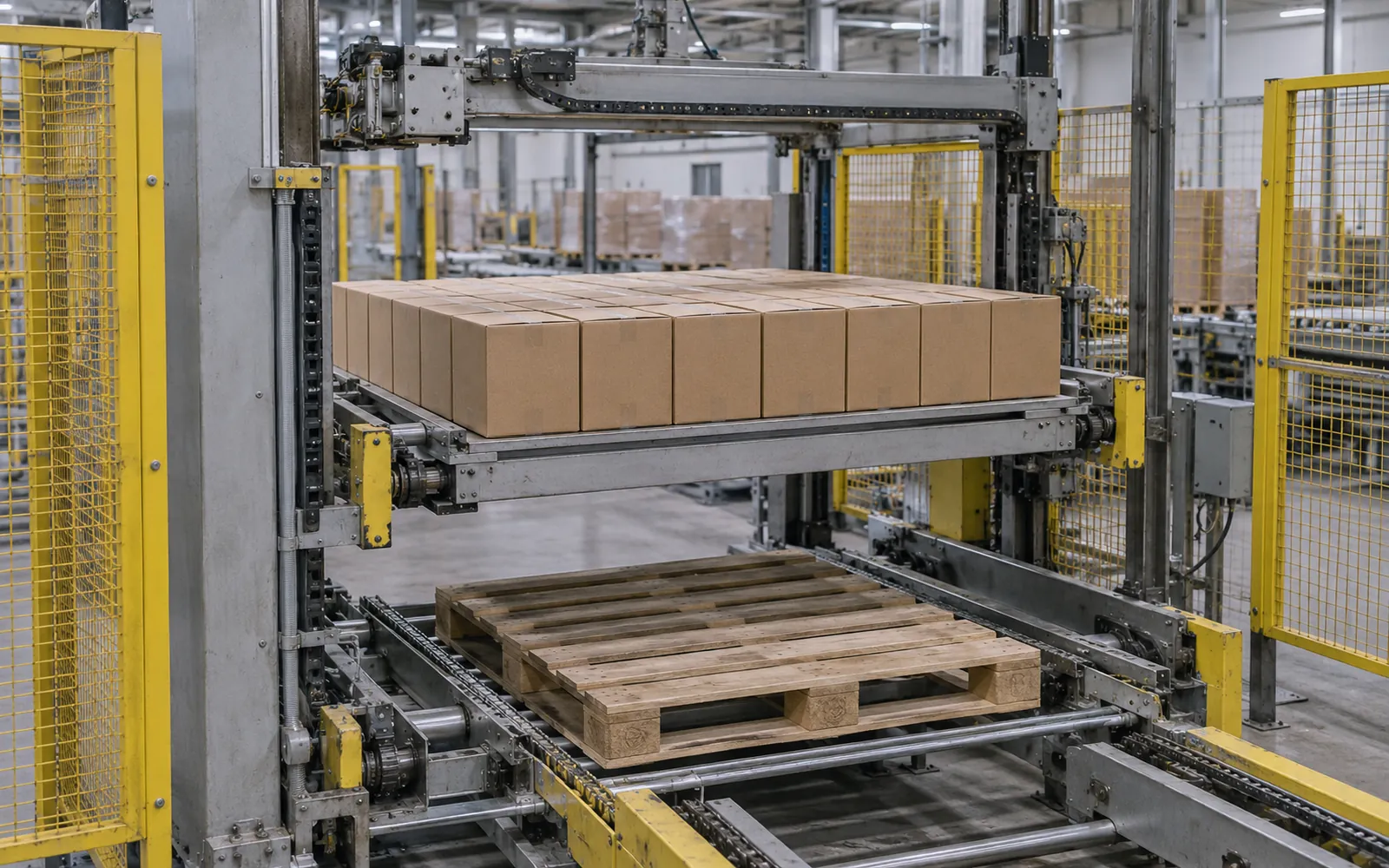
Keep an older palletizer only after checking the structure, future duty and supportable controls. This guide helps define an inspection and upgrade scope before comparing new high-level equipment within the wider palletizing section.
| Input | Evidence to collect | Next step |
|---|---|---|
| Structure | Frame, hoist and layer-table condition | Static inspection |
| Target rate | Hardest case/pattern and future output | Functional verification |
| Controls support | Models, programs and available replacements | Migration plan |
| Safety gaps | Access tasks, isolation and validation records | Safety design |
| Downtime window | Allowed outage and recovery plan | Compare retrofit and replacement |
How older layer-forming palletizers work
This is general background, not a description of one model. For a deeper treatment of the machine itself, see the high level palletizer guide. Machines that form whole layers before loading the pallet follow a common sequence.
- Cases arrive on a conveyor, usually from a case sealer or a wrapping station. A case switch or gapping section sets spacing so the machine can sense each case.
- Many patterns need some cases rotated 90 degrees. A turner, often a pair of belts running at different speeds or a mechanical arm, rotates cases in line without stopping the flow.
- Cases are grouped into rows. A lane divider or slat mechanism sends cases into parallel lanes, and a stopper or pusher collects the row.
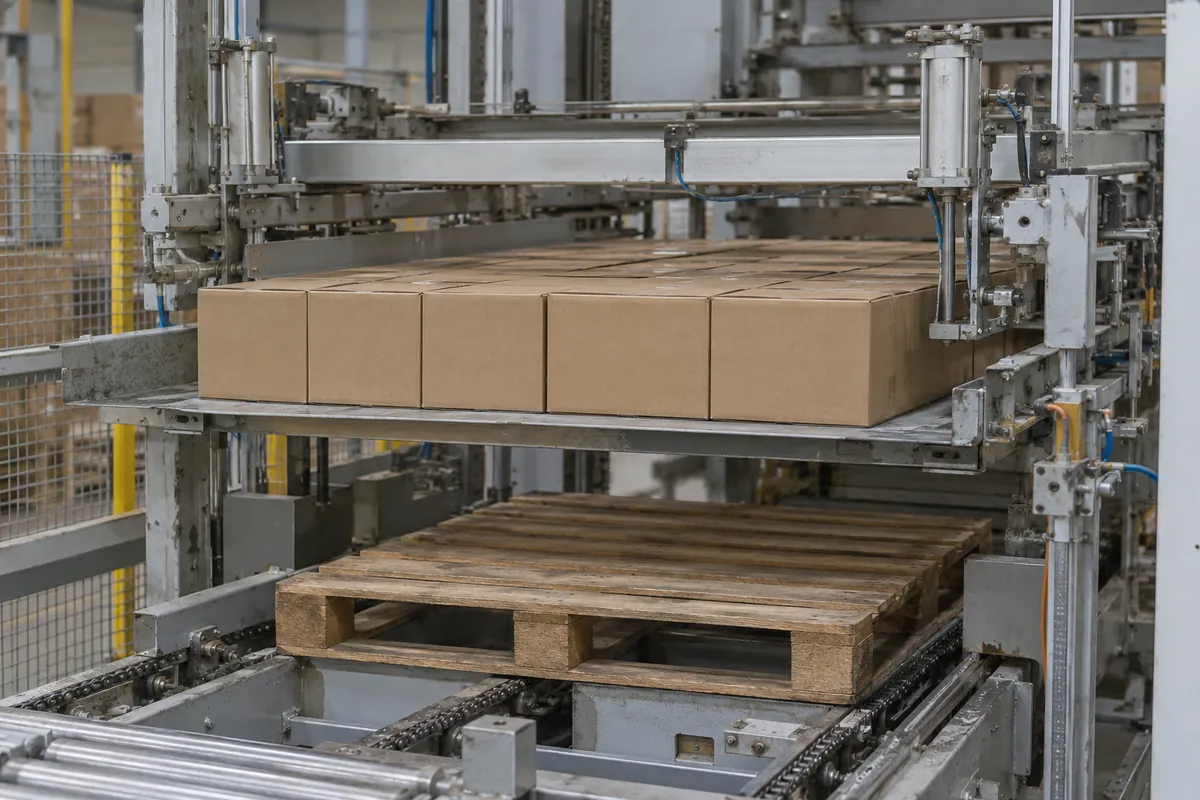
- Rows are pushed together on a layer table until a full layer matches the programmed pattern. Patterns with voids for stability can be built by moving the plate that supports the layer in sections.
- The completed layer is moved over the pallet. On a high level machine, a bi-parting plate or sweep carries the layer out while the pallet hoist brings the pallet into position, and the layer is released onto the load.
- A pallet dispenser supplies empty pallets and a discharge conveyor carries finished loads away. Tier sheets, if used, are placed between layers by a separate head.
- A PLC sequences the motions, stores the pattern recipes, and handles faults. Operator panels let staff select a recipe at changeover.
The Beverage Industries listing for a 2006 FLI labels it Mid Level and lists a PLC, case switch and metering belt (accessed October 8, 2026; References). This resale listing supports only those listed features; it is not a high-level model specification or proof of present condition.
In-line and right-angle arrangements
Layer-forming palletizers are commonly built in two arrangements. In an in-line arrangement, cases keep moving in the same direction from infeed to layer table, which suits fast lines that need a straight conveyor path. In a right-angle arrangement, the layer table sits at a right angle to the infeed, which can fit a tighter floor plan and lets the machine form rows from slower product streams. The arrangement affects speed, floor space, and where operators can reach, and it limits what a retrofit can change.
Vendors have never used the labels “low level,” “mid level,” and “high level” in exactly the same way. Treat the label as a rough description, and look at where the cases enter and where the layer is formed.
What to inspect on an older machine
Separate isolated inspection from powered verification. These are review categories for qualified personnel using the machine manual and site procedures, not a machine operating sequence.
Static inspection after isolation
Authorized personnel should follow the machine-specific energy-control procedure, including gravity restraint for raised loads, residual pressure and electrical stored energy, and verification of isolation. See OSHA 1910.147(d)(5)–(6), accessed October 8, 2026.
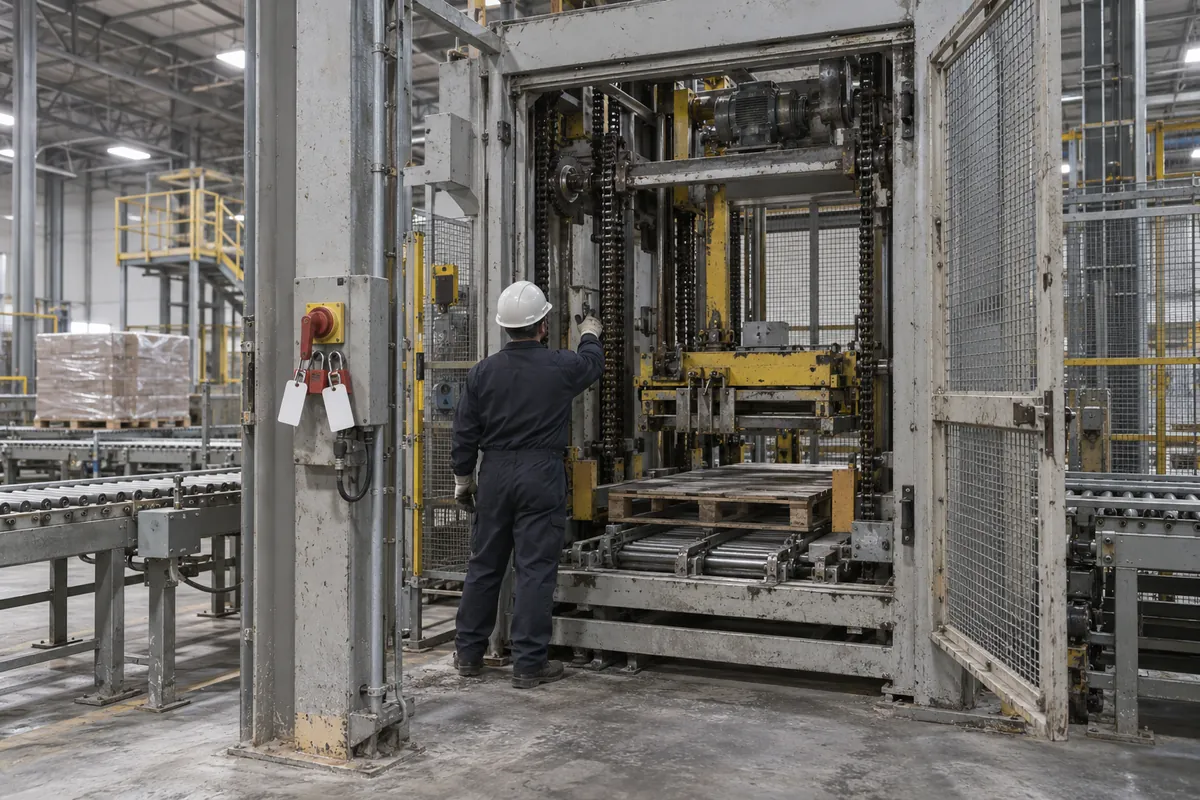
- Inspect frame welds, anchors, corrosion and undocumented structural modifications.
- Record hoist chains, sprockets, guides and brakes; inspect layer plates, rails and bearings against the manual’s wear criteria. Do not command motion during this inspection.
- Inspect infeed belts, rollers, diverters, pneumatic hoses and accessible sensors for damage or misalignment.
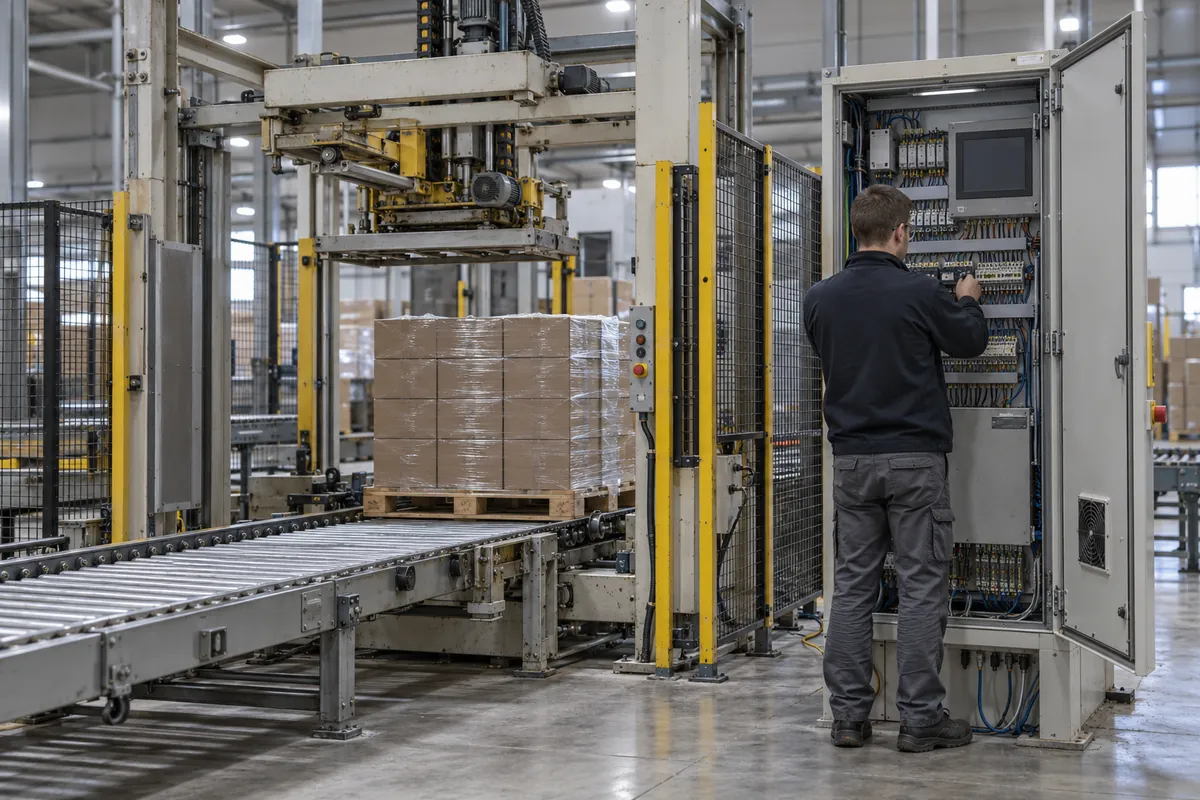
- Have qualified electrical personnel compare the cabinet, wiring and nameplates with drawings under the applicable electrical work procedure.
- Collect manuals, drawings, PLC/HMI source files, drive parameters and parts lists. Record missing or unreadable files.
- Inspect guard condition and undocumented bypasses; functional tests belong in the separate plan below.
- Record incoming case and pallet condition before attributing stoppages to the machine.
Authorized running and functional verification
Plan a separate test with authorized personnel following the manufacturer’s procedures and an assessed test environment. Observation of hoist noise or jerking, overtravel-limit checks, interlock response and recovery tests require the appropriate powered test state. Any temporary release from isolation and return to servicing must follow the site procedure; OSHA 1910.147(f)(1) addresses this transition (accessed October 8, 2026).
Verify program restoration first in a compatible offline or designated test system where feasible; document software versions, recipe checks and rollback before a controlled machine trial. Record test state, personnel, pass criteria, results and faults. Use production cases for the rate trial and include pallet changes.
Takeaway: Close each inspection finding with a named owner and evidence before accepting the upgrade.
Maintenance priorities
When the budget is limited, spend it in this order: safety first, then the parts whose failure stops the line, then the parts whose failure is hard to repair.
Interlock switches, guard doors, emergency stops, and light curtains deserve regular functional tests, with the results written down. A device that no one has tested in years should be treated as unproven.
Back up the software and store it off site. Save the PLC program, HMI project, drive parameters, and any recipe files, store copies away from the plant, and validate restoration in the planned offline or controlled test environment. A backup is useful only if the required software and files are available.
Make a list of controllers, drives, servo amplifiers, communication modules, and operator panels, and mark each as available, limited, or discontinued. Then decide which discontinued parts to stock as spares and which to replace on a schedule. Waiting for a failure is the most expensive way to find out a part is gone.
Use the manufacturer’s inspection criteria and the plant’s failure log for belts, chains, bearings, guide rails and cylinders. Keep a small stock of the common types, and replace in sets where uneven wear would cause trouble. Keep cabinet filters clean, make sure cooling fans run, and keep dust out of electrical enclosures, because heat shortens the life of drives and power supplies.
Operators who understand what a normal cycle looks like catch problems earlier, and maintenance staff need a clear procedure for jam clearing and changeovers that does not rely on defeating a guard. A simple log of stops, causes, and repairs shows which problems recur. After a few months, it often points to the real cause, whether that is a pallet issue, a worn guide, or a sensor in a bad spot.
Takeaway: Assign inspection intervals and spare-part decisions from the machine manual and recurring stop log.
Controls and safety upgrades
Controls and safety are the most common reasons to retrofit, and they are also where the work needs the most care. Every item below should begin with a risk assessment and end with documented validation.
PLC and HMI migration
An older PLC may still run reliably, but its programming software, memory cards, and communication modules can be hard to find, and fewer technicians know the platform. Migration means moving the logic to a current controller family. It can be a straightforward translation or a rewrite, depending on how the original program is structured and documented.
Questions to settle before starting:
- Who owns the existing program, and is the source available with comments?
- Will the sequence stay the same, or is the plan to improve it?
- Which sensors, valves, and drives connect to the controller, and can they be reused?
- Is a new operator interface part of the scope, and how many recipes must be stored?
- How will the changeover from old to new be tested, and how long can the line be down?
A new HMI can add fault messages that tell operators exactly which sensor is blocked, storage for more patterns, and simple recipe selection. Those features reduce downtime without touching the mechanics. Drives and motors can be handled in the same project, particularly when a discontinued drive is the reason for the work.
Safety-rated controls
Define each safety function and its required performance before selecting the architecture. ISO 13849-1:2023 gives a design methodology for safety-related control systems; its official scope does not prescribe the application’s safety functions or required performance levels (accessed October 8, 2026).
Safety relays or controllers, dual-channel inputs and monitored outputs are design choices under the risk assessment, required performance and applicable machine standards. Document the selected architecture, interaction with normal controls, stopping behavior and validation rather than treating a component list as compliance.
Guarding and interlocks
Check that every point of access is protected: fixed guards where access is not needed, interlocked doors where it is, and light curtains or area scanners at pallet entry and exit. Interlocks should be of a type that is hard to defeat, and the stopping time of moving parts, including the hoist and layer table, should be compared against the distance to the hazard. If a person can reach a moving part before it stops, the guard is in the wrong place or the stopping system is too slow.
Pay attention to the tasks that cause the most injuries: clearing jams, changing over, and cleaning. If those tasks require operators to reach into the machine, the guarding should allow it safely, for example through a controlled-entry system that stops motion and prevents an unexpected restart.
Risk assessment
A risk assessment covers normal operation, jam clearing, changeover, cleaning, maintenance, and fault recovery. It identifies the hazards, estimates the risk, and decides what protective measures are needed. For machines modified several times over the years, it should also search for undocumented bypasses and temporary fixes that became permanent. If a robot is added, review ISO 10218-2:2025, which covers industrial robot applications and cells, and confirm the editions applicable to the project (official scope accessed October 8, 2026).
Lockout and tagout
Each energy source on the machine needs a clear isolation point: electrical, pneumatic, hydraulic, and gravity. For covered U.S. servicing tasks, OSHA 29 CFR 1910.147 addresses procedures, training and inspection (accessed October 8, 2026). On a high level palletizer, pay particular attention to stored energy, such as a suspended layer, a raised hoist, a charged air line, or a drive that holds charge. The upgrade should make isolation points obvious and labeled, and the written procedure should match the machine as modified, not as originally built.
Takeaway: Make updated programs, drawings, the risk assessment and signed functional validation deliverables of the controls upgrade.
Retrofit vs. replace
The choice rarely comes down to one factor. The table compares the usual drivers.
| Factor | Points toward retrofit | Points toward replacement |
|---|---|---|
| Frame and mechanics | Sound, with only normal wear | Cracked, racked, or worn beyond economic repair |
| Required rate | Same as today or slightly higher | Well above what the layer cycle can deliver |
| Pattern and case range | Similar to what the machine was built for | Many sizes, mixed pallets, or frequent changeovers |
| Controls | Obsolete but replaceable within the existing wiring | Spread across several unsupported platforms with no documentation |
| Safety gaps | Can be closed with guarding and safety-rated controls | Structural, such as no safe access for jam clearing |
| Spare parts | Mechanical parts are standard or can be made | Key components are discontinued with no substitute |
| Downtime tolerance | Short planned outage is acceptable | Line cannot stop, so a new unit can be installed alongside |
| Floor space and building | Existing footprint works | Layout or ceiling height is changing |
| Total cost over the next several years | Retrofit scope is clearly less than a new machine | Retrofit scope approaches the cost of new equipment |
Use the table as a conversation starter, not a score. The deciding factor is often the first one: if the frame is sound, a retrofit can extend the life of the machine for years. If it is not, no controls upgrade will fix it. Be careful about hidden scope too. A retrofit that begins as a controller swap can grow to include drives, wiring, guarding, sensors, and a new interface once the cabinet is opened. Ask for a fixed scope with a list of exclusions, and compare it against a new quote on the same basis, including installation, commissioning, training, and warranty.
The palletizer cost guide explains the factors that move a quote, and the guide to how to choose a palletizer helps define the requirements that a retrofit or a new machine must meet. Pallet-related handling problems may sit upstream, so the pallet handling application page is worth a look if pallet quality is behind your stoppages.
Buying a used high level palletizer
A used machine can be a sensible choice, especially for a stable product and a plant with maintenance skills. It can also mean buying somebody else’s problems, so treat the purchase as a project, not a bargain.
Use the inspection groups above and the comparison table below to collect the purchase evidence. Require the product trial, programs and drawings, service history, parts availability and an itemized removal/reinstallation scope before deciding.
The listing price rarely includes those last items. A listing that shows a machine with a PLC, case switch, and metering belt tells you what the machine has, but not how well it runs, how it is documented, or how it will meet current safety expectations. The commissioning and acceptance checklist covers questions to ask any equipment supplier and applies to used machines as well. When the palletizer is part of a bigger project, see the guidance on turnkey lines.
Palletizing machine for sale: comparing new, used, and retrofit offers
When a palletizer comes up for sale, or a supplier sends a quote, the real choice is usually among three offers: a new machine, a used machine, or a retrofit of the one already on the floor. Each should come with evidence. The table lists what to ask for, so the three can be compared on the same basis. It does not replace the inspection and used-machine checklists above.
| What to check | New machine | Used machine | Retrofit of your machine |
|---|---|---|---|
| Proof it runs your product | Factory acceptance test with your packages and patterns, with pass criteria in the order | Power-on run with your product and pattern before purchase, not empty cycles | Validation run after the upgrade, before the machine returns to production |
| Documentation | Drawings, programs, manuals, and parts list listed as deliverables | Whatever exists today: drawings, PLC and HMI programs, backups that open | Updated drawings and programs for every change made |
| Safety | Standards and editions applied, plus the supplier’s risk assessment | Built to the practice of its time, so assess against current practice and price the gap | New risk assessment for the changed machine, with validation |
| Scope | Infeed, dispensers, wrapper interface, guarding, installation, training | Exactly which parts of the old line are included, and who removes and ships them | Fixed scope with a written list of exclusions |
| Warranty | Written terms | Confirm in writing, and expect that a listing may offer none | Written terms for the parts and work supplied |
| Parts and support | Parts and service availability for the controls platform | Which controllers, drives, and panels are still available | Parts strategy for the components that stay |
What sets the price of a palletizing machine
The listing or quote is one line in the budget, and the lines around it often decide which offer is cheaper. For a new machine, price moves with the type (conventional or robotic), the rate and pattern range, the size of the scope, the controls and safety content, and installation and commissioning. For a used machine, add removal, rigging, transport, reinstallation, a controls review, guarding updates, missing documentation, and the spare parts you will need to hold. For a retrofit, add the production lost during the outage and the scope that tends to grow once the cabinet is opened. The palletizer cost guide lists the cost lines to price separately.
Warning signs in a for-sale listing
- The seller cannot run the machine under power, or only with empty cycles.
- There is no PLC program or backup, or nobody can confirm that it opens.
- Drawings and manuals are missing, or the cabinet does not match them.
- Guards or interlocks have been bypassed or removed.
- The reason for sale or the machine’s recent history is unknown.
- The listing does not say which conveyors, dispensers, or lifts are included.
None of these rules out a purchase, but each one is a cost or a risk to price before you commit. To set the requirements that any of the three offers must meet, use the guide to how to choose a palletizer.
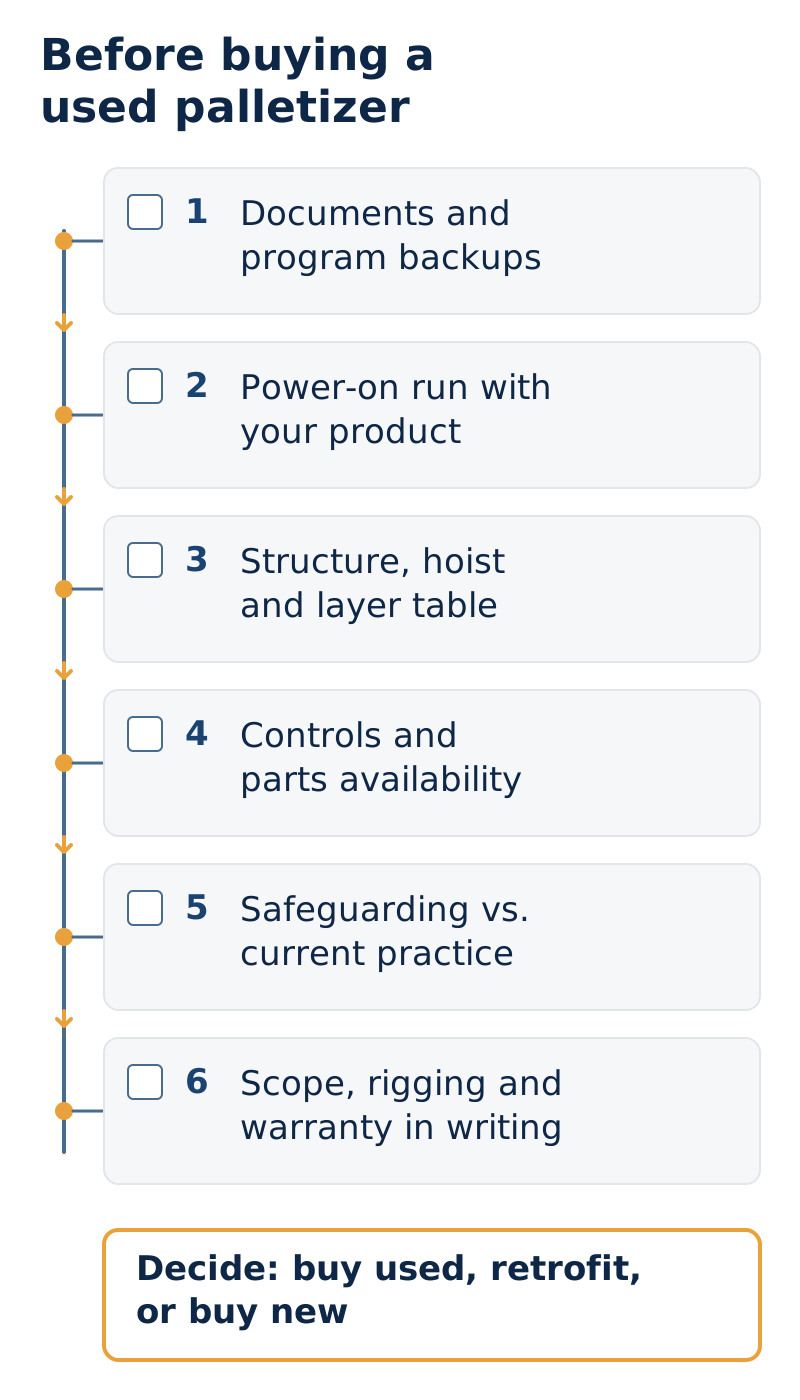
Inspection and acceptance record
Copy this record for each finding in the checklist flow, then carry unresolved items into the commissioning checklist.
Machine / model / location:
Finding / photo or drawing reference:
Inspection state: isolated static / authorized functional test
Procedure and revision / authorized personnel:
Energy controls or test safeguards confirmed:
Required rate / case / pattern / timing window:
Pass criterion / observed result / fault:
Action owner / scope / due date:
Restoration environment / program version / rollback:
Validation evidence / acceptance sign-off:
Takeaway: Compare new, used and retrofit offers only after assigning every unresolved finding and exclusion to a costed scope.
Modern alternatives
Layer-forming machines of this type still have a place. Current conventional palletizers refine the same idea with servo-driven axes, faster changeover, recipe management, and remote diagnostics, and they remain a natural fit for lines that run a few patterns at high rates. If the existing machine has done its job for years and the product mix has not changed, a new conventional machine can be a like-for-like replacement with better controls and safety built in.
When a plant handles many case sizes, mixed pallets, or frequent changeovers, robotic palletizers offer flexibility through programmable gripper motions, with rate and footprint to be checked for the complete safeguarded cell. They bring their own safeguarding requirements, since the robot standards apply to the whole cell. A robot can also be a reasonable answer when the old frame is sound but the product range has outgrown the layer table, because the cell can be placed in the same area after the old machine is removed.
Whichever route you take, define the requirements first: cases, patterns, rate, pallet types, safety expectations, and the maintenance skills in the plant. Then compare a retrofit scope, a used machine, and a new machine on the same basis.