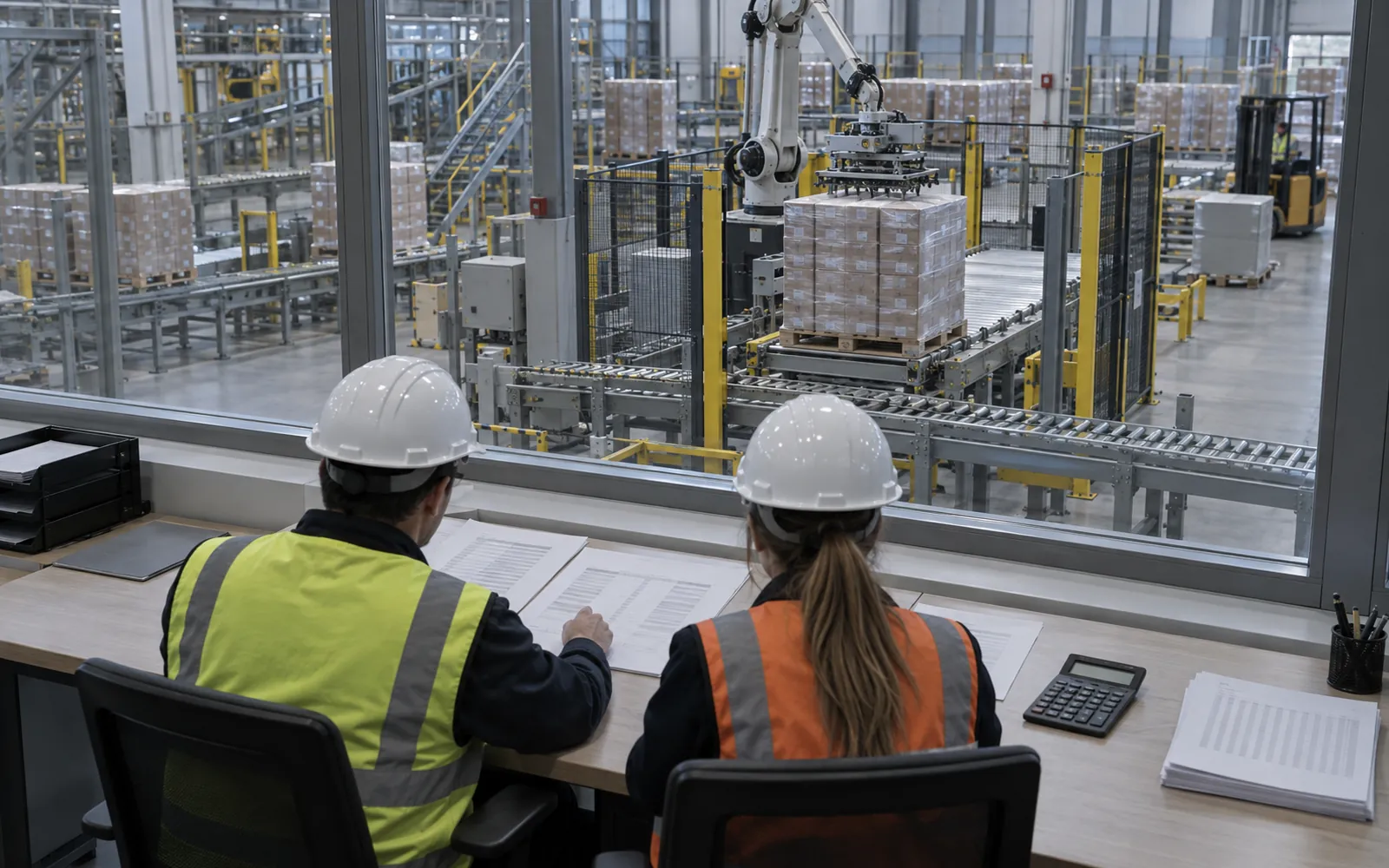
An equipment-only price leaves integration and operating costs outside the budget. Compare the installed system scope, then divide its investment by positive annual net cash savings to screen simple payback. Use the same currency and accounting boundary throughout.
| Measure | Basis | Check |
|---|---|---|
| One-time investment | Complete installed cost, including initial spares | Count each invoice once |
| Annual net savings | Cash costs avoided + realizable additional margin - incremental operating costs | Keep redeployment value separate |
| Simple payback, years | Investment / annual net cash savings | No finite simple payback when savings ≤ 0 |
Not a quote
This page is a budgeting aid, not a quote and not a price list. Real prices depend on required speed, the degree of automation, the packages, the pallet patterns, the building layout, the controls platform, safety requirements, and how the system connects to the rest of the line. Two suppliers can quote very different amounts for what looks like the same machine, because their scopes differ. The only reliable price is a written, itemized quote against your own specification.
Published cost guides show the problem. One supplier guide describes the total cost of a robotic palletizing system as the whole package of robot, tooling, conveyors, safety equipment, and integration, and says the arm is just one piece. Another says quotes showing only the arm price can understate the real project cost. Both are written by suppliers, so treat their ranges as marketing context rather than project benchmarks.
Cost components
Every palletizing project, robotic or conventional, breaks into the same lines. Ask suppliers to price each one separately so you can compare like with like.
| Component | What it covers | What moves it |
|---|---|---|
| Machine | The robot and controller, or the conventional layer-forming machine, frame, and drives | Payload, reach or layer size, speed, architecture, and build quality |
| End-of-arm tooling | Grippers, vacuum or mechanical tools, layer-picking tools, tool changers (robotic); layer plates and forming parts (conventional) | Package type, weight, number of formats, porous or fragile products |
| Conveyors | Infeed conveyors, accumulation, turning stations, lifts or spirals, pallet and discharge conveyors | Distance, elevation, number of infeeds, accumulation needed |
| Guarding | Fencing, light curtains, interlocked doors, scanners, controlled-entry access | Cell size, access method, standards applied, risk assessment results |
| Controls | PLC, drives, HMI, pattern software, line communications | Platform standard, number of patterns, data and tracking needs |
| Installation | Mechanical setup, electrical work, anchoring, utilities, rigging | Building condition, distance to services, downtime window |
| Commissioning | Start-up, tuning, acceptance testing with your packages | Number of SKUs, test duration, supplier travel |
| Training | Operator and maintenance instruction, documentation | Number of shifts and staff, language, on-site or remote |
| Spares | Recommended spare parts, wear items, consumables | Number of machines, plant standards, lead times |
Pallet dispensers, slip sheet dispensers, labelers, and the stretch wrapper interface cut across these lines, so decide in the specification whether they are in scope. The palletizing systems overview shows what a complete system includes. For the conveyor lines in the table, the packaging conveyor cost guide describes how conveyor cost is built.
Variables that move cost
Specify each of these before asking for quotes, because the same components cost more or less depending on them.
Speed and architecture set the base price. Higher sustained rates need faster machines, stronger drives, and more advanced controls; a supplier guide notes that faster cycle times call for stronger motors and advanced controls. Compare high- and low-level machines using the same output, site work and installed scope; there is no universal price ordering. Robots also vary by payload and scope. The robotic versus conventional comparison covers how the two differ.
The product drives tooling and programming. Bags, pails, and fragile products need specialized tooling or layer compression, and heavier loads need larger robots. Mixed-case or irregular patterns take more programming and integration effort than simple repeating layers. More formats mean more tooling, more test time, and more software work.
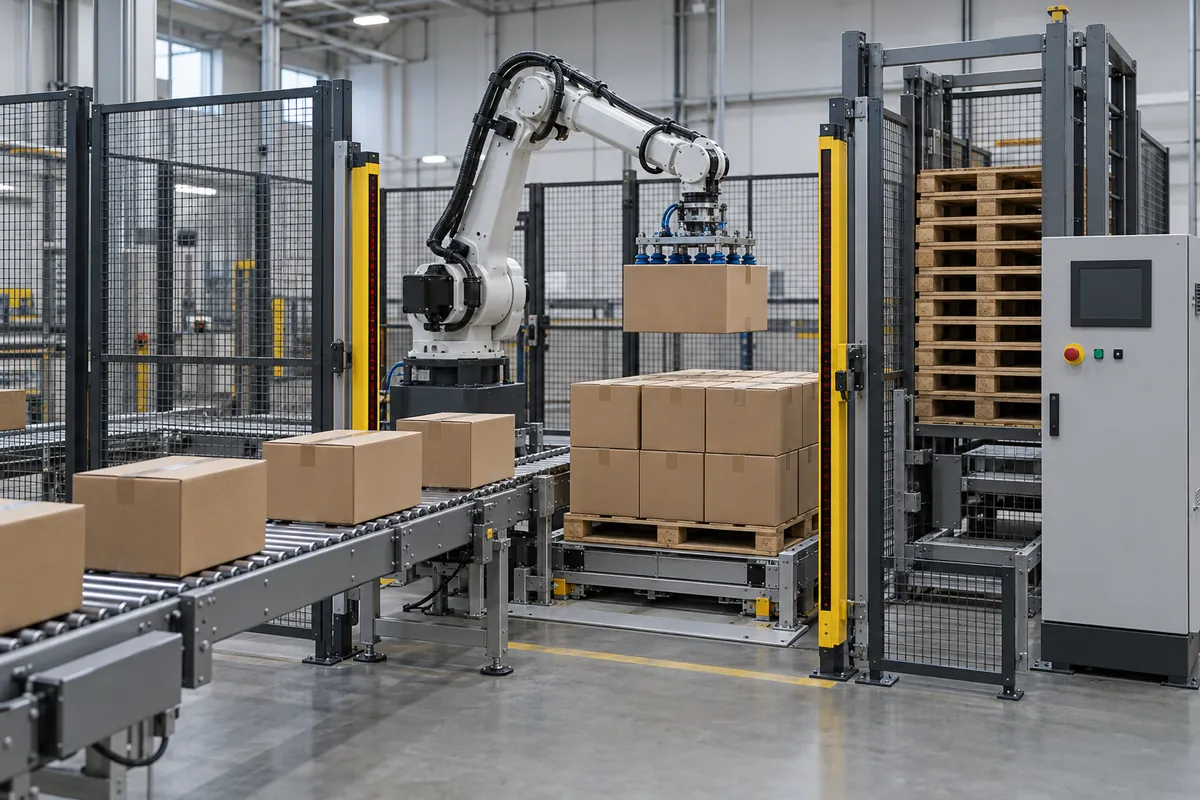
Layout and safety add equipment. An elevated infeed needs a lift or spiral, which adds equipment, footprint, and cost, and several infeeds add accumulation and control logic. Price safeguarding as the complete solution required by the application risk assessment, including installation and validation. There is no universal price ranking between fences, interlocks and light curtains. This is not advice to substitute a cheaper device for required protection. One supplier guide notes that a full budget includes the fencing and scanners required by the cell-level risk assessment. Cold, wet, dusty, or sanitary conditions require protective covers, rated components, and special materials. Floor preparation, ceiling clearance, platforms, and utility runs can add cost that is not on the machine quote.
Integration and service fill out the rest. Connecting to upstream machines, a warehouse management system, labelers, and the wrapper takes engineering hours. Warranty terms, remote support, preventive maintenance plans, and spares kits vary between suppliers.
How the cost structure differs: conventional, robotic, and cobot palletizers
The same cost lines apply to every design, but the money concentrates in different places. That is why a quote for one design cannot be compared line by line with a quote for another until both are mapped to the same components. The table shows where each design tends to put its cost. It describes structure, not price, and the actual split depends on the scope and the supplier. “Cobot” here means a cell built around a robot sold as collaborative; it says nothing fixed about the robot’s size, payload, or speed, so compare those from each quote.
| Cost line | Conventional layer-forming palletizer | Robotic palletizer | Cobot palletizer |
|---|---|---|---|
| Machine | The layer-forming machine, hoist, and frame carry much of the cost | The robot and controller are one part of a larger cell scope | The robot and controller; check the quoted payload and rate, because collaborative models vary in size and the label does not set either one |
| Tooling | Layer plates and forming parts, with little change per product | A gripper for each package family, plus changers if needed | A gripper is still needed, and its weight counts against the payload |
| Infeed and conveyors | Turning and row-forming conveyors; a high-level design adds an elevated infeed and a lift | Often a single pick point, with accumulation before it | Similar to a robotic cell; sized to the rate the quoted configuration is meant to reach |
| Guarding | Guards and interlocks around the layer former, hoist, and pallet exits | Perimeter fencing or scanners and light curtains at pallet exits | Set by the risk assessment of the whole application; can be reduced only where it allows |
| Building and layout | Ceiling height, platforms, and floor area for the machine and accumulation | Cell footprint and pallet positions | Cell footprint and pallet positions; a reduced fence line saves floor area only where the risk assessment allows it |
| Patterns and programming | Pattern changes through the machine’s software and mechanical settings | Patterns by recipe, with programming time for each new package | Patterns by recipe, with programming time for each new package |
| Rate and growth | Suited to steady high-rate lines; raising the ceiling later can mean a new machine | Rate per robot cycle; a second infeed or robot changes the scope | Rate per robot cycle, which can be limited by speed settings the risk assessment requires near people; if the quoted cell cannot reach the target rate, more output can mean a second cell |
Three points follow for cobot palletizer price questions. First, compare the robot on the payload, including the gripper, and the sustained rate it must reach on your pattern, not on the collaborative label. Second, a cobot cell still needs tooling, a pallet station, conveyors to a pick point, controls, installation, and a risk assessment, so the robot price alone understates the project just as it does for a larger robot. Third, the guarding line is not automatically small. A3 notes that robots sold as collaborative represent only power- and force-limiting collaboration and that integrators and users must consider whether the entire robot system, not just the robot, is collaborative. A palletizing cell adds a gripper, a heavy box, and a growing stack, so the risk assessment may still call for scanners, light curtains, or fencing. Ask each supplier which safeguarding the quoted price includes and which assessment it was based on. The robotic palletizers guide covers the safety side in more detail.
ROI model
Use a cash-flow boundary agreed with finance. This is an editorial screening model, not a return forecast.
annual net cash savings = payroll/overtime spending actually avoided
                        + realizable extra contribution margin
                        + damage costs avoided
                        - incremental maintenance and energy costs
simple payback (years) = installed cost / annual net cash savings
If annual net cash savings is zero or negative, there is no finite simple payback under these assumptions. Redeploying people may release useful capacity without reducing payroll. Record that operational value separately; add cash savings only when spending actually falls. Do not also count the same released hours as avoided labor and extra-output margin. Extra volume needs a realizable sales margin, and damage savings must not duplicate the reject losses already included in that margin.
Maintenance here includes service labor and wear parts; energy includes electricity and compressed air. Only the cost difference from the existing process enters this savings model. Financing, taxes and time value of money are excluded; finance should assess them separately.
Worked example
Illustrative example, not market pricing. The numbers below are round and hypothetical. They show how the formula works and are not an estimate for any machine or plant.
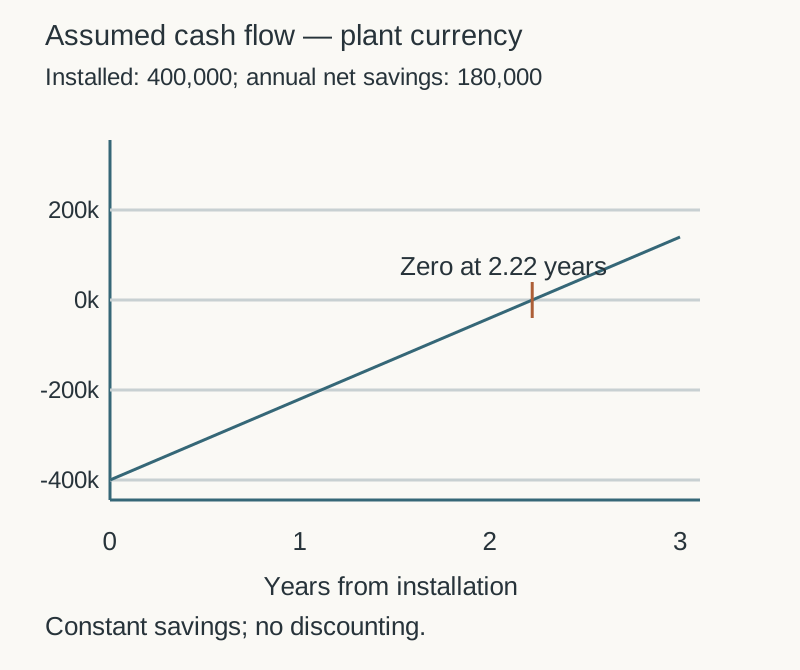
Suppose a plant runs two shifts and has four people building pallets by hand across both shifts. A proposed palletizing system has an installed cost of 400,000 in the plant’s currency. Annual figures are estimated as follows.
| Item | Annual amount |
|---|---|
| Payroll actually avoided (assumed 4 positions at 40,000 each) | 160,000 |
| Realizable extra margin (assumed separate from labor savings) | 30,000 |
| Damage reduction (fewer collapsed loads) | 10,000 |
| Incremental maintenance (service and wear parts) | 15,000 |
| Incremental energy | 5,000 |
Annual net benefit is 160,000 + 30,000 + 10,000 - 15,000 - 5,000, which equals 180,000. Simple payback is 400,000 divided by 180,000, or about 2.2 years.
Now test the sensitivity. If labor saved were 120,000 because only three positions were truly removed, annual net benefit falls to 140,000 and payback lengthens to about 2.9 years. A one-shift case needs its own payroll calculation; savings cannot be assumed to halve. If all four people are redeployed with unchanged payroll, the payroll cash saving is zero: the remaining assumed benefit is 20,000 per year and simple payback is 20 years. The point of the example is the discipline: change one assumption at a time and see which one decides the answer. For most projects it is labor and throughput, so check those against real plant data first.
Ongoing costs that follow the purchase
Installed cost is a one-time figure, but a palletizer keeps costing money for as long as it runs. Plan for these items so the payback model does not look better than the plant will experience.
- Gripper pads, vacuum cups, belts, chains, and filters wear at rates that depend on the package and the duty cycle. Ask each supplier for a list with replacement intervals.
- Preventive maintenance, remote support, and software updates are priced differently by each supplier, and some are included only for a period.
- A stopped palletizer can stop the line behind it. Estimate the cost of an hour of downtime and ask how quickly the supplier can respond.
- Frequent format changes consume paid hours, and the time per change differs by design.
- New operators and technicians need instruction over the life of the machine.
- New packages, patterns, or a second infeed can require tooling, software, or conveyor work later.
Include these in the comparison between options. A system with a lower purchase price can cost more over the years if it needs frequent tooling changes or slow manual changeovers.
Total cost of ownership formula
To compare options over their working life, extend the payback screen into a total cost of ownership (TCO). Keep every term as a plant-specific variable and fill it from quotes and your own records, not from published price ranges.
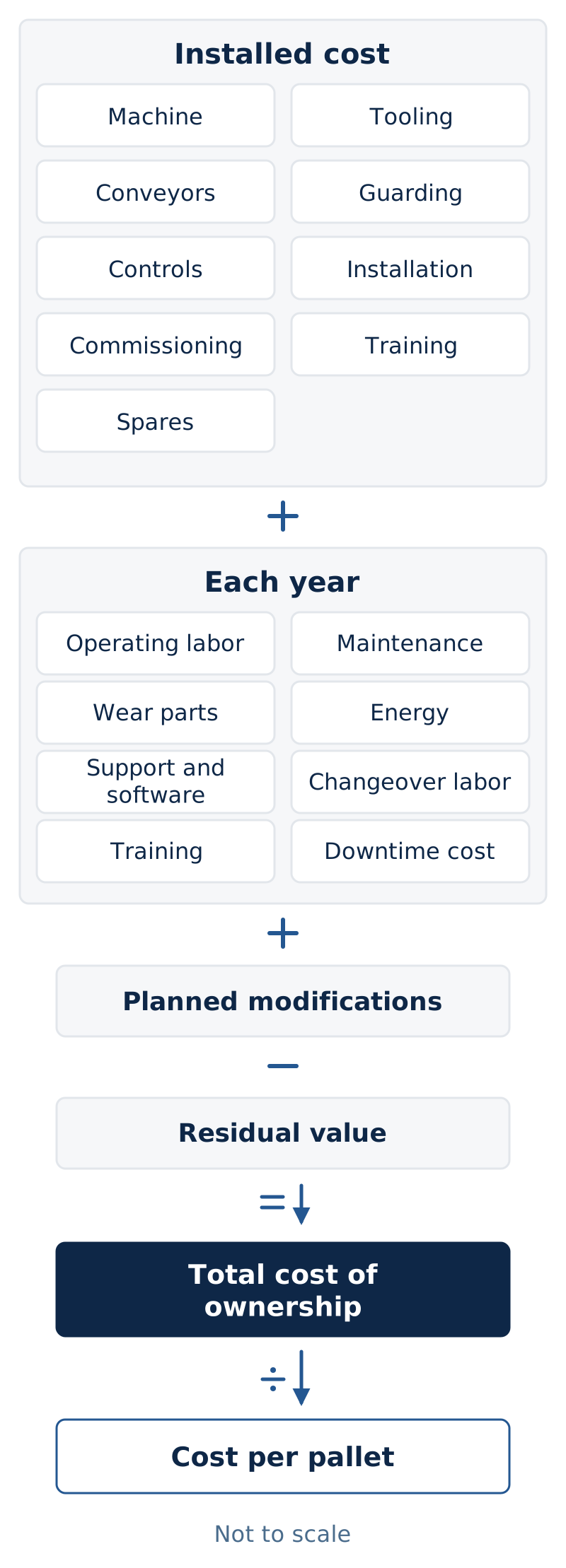
TCO over N years = installed cost
                   + sum over each year of (operating labor + maintenance
                     + wear parts + energy + support and software
                     + changeover labor + training + downtime cost)
                   + planned modifications (new tooling, patterns, infeeds)
                   - residual or resale value at year N

cost per pallet = TCO over N years / pallets built over N years
Keep TCO categories mutually exclusive. Maintenance excludes wear-part purchases; wear parts exclude the initial spares included in installed cost. Support excludes service already in maintenance. Operating labor excludes hours assigned to changeover, training or downtime. Downtime cost excludes wages counted elsewhere and uses lost margin, not sales revenue.
Operating labor is the loaded cost of the people who still attend the system in each option: operators who load pallets, sheets, and film, clear jams, and monitor the cell, counted as the share of their hours the palletizer actually takes. This is our cost-accounting scope for a whole-life comparison; if you drop operating labor to get an equipment-only figure, drop it for every option and say so, because designs that need different staffing will otherwise look equal. Use the same N, the same pallet count, and the same rate assumptions for every option. Downtime cost is the cost of one hour of stopped output multiplied by the expected stopped hours in that year, so ask suppliers for the basis of any availability figure. A design with a higher installed cost can still have the lower cost per pallet if its changeovers, wear parts, or stops cost less, and the reverse is also true.
How to request comparable quotes
Comparable quotes need a common specification. These steps follow the selection method in the palletizer selection guide.
- Write one specification. Include package dimensions and weights, pallet types and sizes, patterns, maximum height, sustained rate on the hardest SKU, changeovers per week, and building constraints.
- List the scope. State whether conveyors, lifts, dispensers, guarding, labeling, and the wrapper interface are inside or outside the quote.
- Ask for itemized pricing. Request separate lines for the components in the table above, plus freight, programming, commissioning, training, and spares.
- Get assumptions in writing. Rate basis, picks per cycle or layers per minute, availability, and operator tasks.
- Ask for layouts showing plan, height, guarding, pallet staging, and service access.
- Ask about ownership cost: recommended spares, wear-part intervals, service response, and training for your maintenance staff.
- Specify acceptance testing. Ask for a test with your own packages at the quoted rate and write the pass criteria into the order.
- If a supplier has not answered an item, mark it open rather than assuming it is included.
The commissioning and acceptance checklist covers the wider buying process and the documents to request from each supplier.
Related equipment and guides
Cost depends on the type of machine, so read the page for the design you are considering: robotic palletizers and conventional palletizers. To choose between them, use the robotic versus conventional comparison. For the transport equipment that feeds the palletizer, see the packaging conveyor cost guide.
Scope and cost also depend on how the cell is delivered, which is covered in turnkey packaging lines.