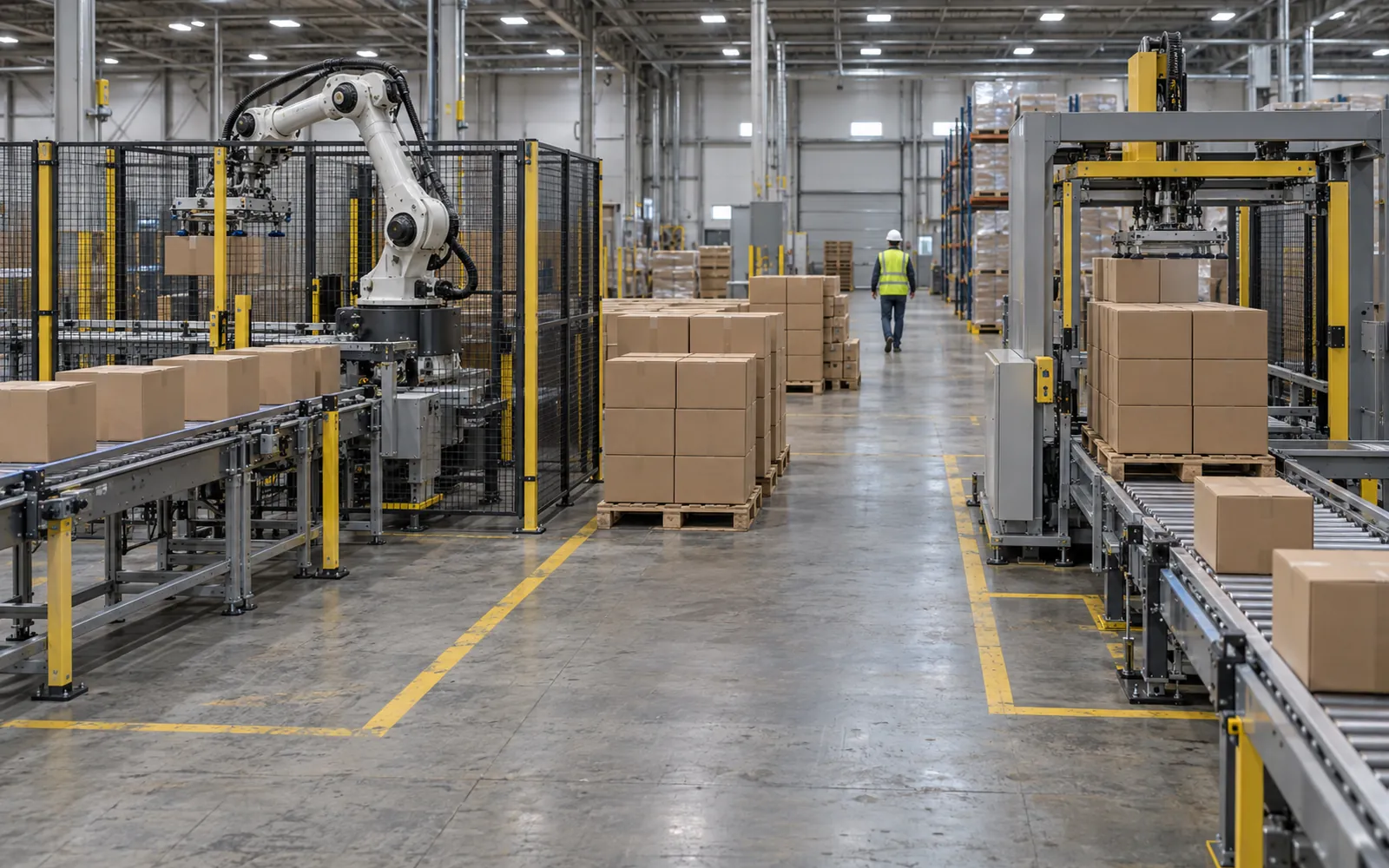
Choosing on SKU variety alone can leave a cell that cannot lift the load or fit the building. First screen payload, height, full system area, safety envelope and sustained capacity; then compare changeovers. This is a qualitative selection aid based on public descriptions, not our equipment testing.
| Candidate | Compare after hard constraints pass | Does not apply when |
|---|---|---|
| Conventional layer machine | Layer formation and sustained rate on uniform packs | The quoted frame, infeed height or package range fails the site requirement |
| Robotic cell | Gripper coverage, recipes and multi-infeed duty | Payload including tooling, reach or sustained combined rate is insufficient |
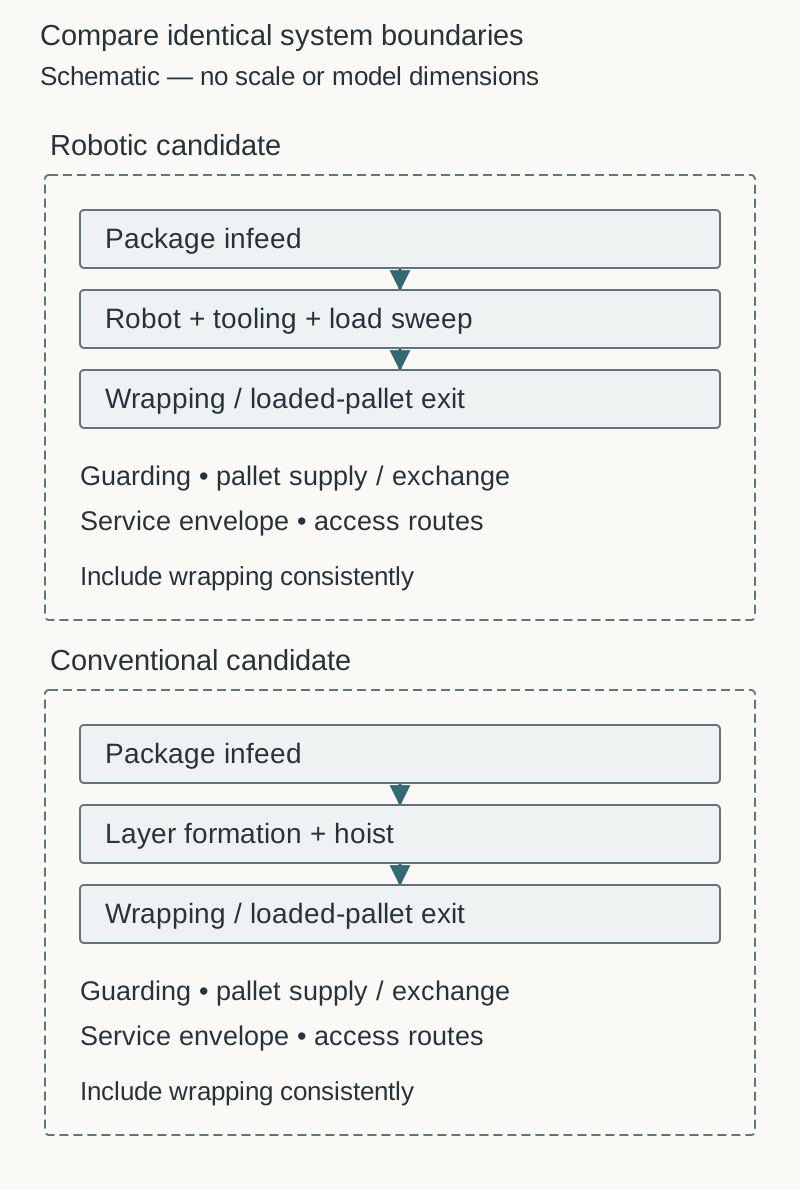
| Either | Same guarding, pallet supply/exit, wrapping boundary and service access | Any hard constraint remains unverified |
The conventional and robotic palletizer pages explain the mechanisms; the detailed matrix below lists the project questions.
What the choice depends on
Before comparing machines, write down the facts that decide the outcome.
Start with rate and variety. The rate that matters is the one the palletizer must hold over a full shift on the hardest SKU, not the brochure peak. Then count the case sizes, bag types, trays, or pails and how different they are, along with the number of pallet patterns and pallet sizes you build. Add how often the product changes per shift or per week, and how much downtime the plant can tolerate for each change.
Then look at the site. Note floor area, ceiling height, and the height of existing conveyors, plus any cold, wet, dusty, or sanitary conditions that affect equipment design. Finally, decide whether you have one line or several, and whether lines may be added later.
Reject a candidate that fails any hard constraint, even if its rate or changeover looks attractive. Write the payload including tooling, required stack height, available floor and ceiling dimensions, assessed safety boundary, and sustained rate on the hardest SKU before reviewing variety.
Side-by-side matrix
The matrix is qualitative. It describes general tendencies reported in manufacturer comparisons and engineering practice, and individual machines vary. Use it to decide which questions to ask, not to score suppliers.
| Factor | Conventional palletizer | Robotic palletizer |
|---|---|---|
| Speed | Generally higher sustained rate on uniform packages, because a whole layer is formed and placed at once | Rate depends on picks per cycle; layer-picking tools narrow the gap, single-case picking is slower |
| SKU and pattern flexibility | Lower; formats and patterns often need mechanical adjustment | Higher; patterns are usually software recipes and a gripper may cover a range of sizes |
| Footprint | Check frame, elevated infeed, guarding, pallet staging and service access | Check arm sweep, tooling and load, guarding, staging and service access; no generic area rank |
| Payload and package type | Best on rigid, uniform cases; bags and flexible packs may need extra reinforcement | Handles bags, pails, and irregular shapes more readily, within gripper and payload limits |
| Maintenance | Mechanical systems such as plates, hoists, and elevators; elevated sections need safe access on high-level designs | Fewer mechanical subsystems but wear items such as gripper parts, cables, and vacuum components; robot service skills needed |
| Changeover | Often slower and manual when sizes change | Often faster when only a recipe and tooling position change; a different gripper may add time |
| Integration | High-level machines need a lift or spiral to reach an elevated infeed; low-level machines connect to floor conveyors | Typically installed at floor level; needs infeed, pallet, and guarding interfaces designed together |
| Capital intensity | Compare complete installed scope; architecture does not set a universal price order | Include tooling, safeguarding and interfaces alongside the arm |
Two points stand out. Rate and flexibility pull in opposite directions, so one number never settles the choice. And the footprint and integration rows depend on the building: a tall conventional machine may be impossible under a low roof, while a robotic cell may not fit a narrow aisle.
Choosing by scenario
High-speed, single-SKU lines
When one package runs at high output for long periods, a conventional palletizer is usually the first design to price. Forming a layer in advance and placing it in one motion keeps the rate high, and a high-level machine generally reaches higher layer rates than a low-level one. Changeovers are rare, so slower mechanical changes cost little. Consider a robot only if layer picking can hit the rate or if floor layout rules out a conventional frame. The high-level palletizers and low-level palletizers pages explain how the two conventional architectures differ.
Mixed-SKU production
Plants that build many case sizes, patterns, or pallet types usually favor a robotic cell. A new pattern is generally a software recipe, and the arm can reach any position in its envelope. The costs to watch are the gripper, which may need to change between formats, and the picks per cycle, which set the rate. If a few SKUs make up most volume, ask whether a conventional machine could run those and a robot the remainder, or whether one robot with a good multi-format gripper covers everything.
Low volume or growing volume
At low volume, the question is rarely speed. It is capital, space, and the ability to adapt. A robotic cell is often a good match when volume is uncertain or product lines are expected to change, because the same cell can handle new packages with software and tooling changes. A conventional machine sized for peak rate can sit underused. If the plant expects steady growth in a single product, however, a conventional machine sized for the target may be the better long-term fit.
Cold, wet, or sanitary environments
Environment can overrule rate. Cold storage, freezer exits, washdown areas, and dusty bag lines affect lubricants, cabling, vacuum components, and enclosure design on either type. Ask each supplier what environmental ratings apply, how the machine is cleaned, and which components are exposed. A conventional frame may be easier to enclose because functions occur in one contained unit, while a robot may need protective covers and rated cabling. Neither answer is universal, so request specifics for your conditions.
Multiple lines
Several slow lines can share one robotic cell with multiple infeeds, which may replace more than one dedicated machine. This saves capital and floor space, but it concentrates risk: when the robot stops, every line it serves stops. Accumulation and control logic must stop one line from starving another. If lines are fast, a dedicated conventional machine on each may be necessary. Run the combined rate against the robot’s real capacity on the hardest mix. The case palletizers page covers case handling in more detail.
Total cost of ownership
Purchase price is one part of cost. Compare these elements for each option across the planned life of the machine.
Capital cost should cover the complete scope: conveyors, a lift for elevated infeeds, pallet and sheet dispensers, guarding, controls, and the stretch wrapper interface. A robot price that excludes tooling and guarding understates the project.
Running costs differ by design.
- Labor: operators per shift, changeover labor, and the skill needed to adjust or recover from faults.
- Maintenance: conventional machines have mechanical wear items and may need elevated access. Robots have wear parts in grippers, cables, and vacuum systems and may rely on specialist service.
- Downtime: the cost of each stop and how quickly a fault can be recovered. A shared robot stops several lines at once.
- Changeover time: minutes per change multiplied by changes per week. Frequent changes can erase the speed advantage of a conventional machine.
- Spares, energy, and utilities: ask for a recommended spares list and lead times for each option, and compare connected load and air consumption.
Flexibility has a value too. If product mix will change, a machine that adapts with software may avoid a second purchase.
The palletizer cost guide lists the components of a budget and shows a payback formula with an illustrative example.
Decision tree
Complete every hard-constraint check before retaining a candidate. A preferred route is provisional until all checks pass.
- Payload and product: confirm package weight plus tooling, gripper compatibility and load stability for every required SKU.
- Height and area: compare dimensioned drawings including stack height, overhead services, guarding, pallet supply/exit and maintenance envelopes. Rule out an elevated design only when its quoted height fails the available clearance.
- Safety and capacity: review the complete application risk assessment and sustained rate including pallet changes. For shared infeeds, use their combined demand and accumulation requirements.
- SKU and changeover: among candidates that pass, compare layer formation for steady uniform flow with robot recipes and tooling for varied formats. Test the hardest changeover on both.
- Candidate conclusion: retain the conventional, robotic or hybrid option only if all hard constraints pass. If several pass, compare identical scopes with the palletizer selection guide and cost guide; do not stop at the first attractive feature.
Safety and integration across both designs
Safeguarding belongs in both complete-system scopes. Neither architecture has an inherent higher safety rating. Specify the application hazards, entry and pallet exchange behavior, and validated protective measures before comparing cost or area. OSHA’s machine guarding rule addresses guarding of machinery hazards; it does not rank palletizer types.
TopTier’s public comparison discusses its contained conventional and hybrid arrangements. It is a manufacturer’s description, not our test, and is not a paired set of model-specific drawings with identical guarding and infeed/outfeed scope. No comparable dimension pair is established here, so footprint remains a qualitative project condition. Request manufacturer, model, revision and system boundary on each proposed drawing.
Integration matters equally. A high-level conventional machine needs product delivered to an elevated infeed, and the lift that does this is part of the system, as the page on vertical conveyors explains. A robotic cell is usually installed at floor level and needs a conveyor interface for infeed, pallet exit, and often a separate wrapper. Whichever design you choose, define pallet dispensing, sheet handling, labeling, and wrapping in the written scope so quotes can be compared fairly.
Common mistakes in this comparison
Peak rates are the most common trap. A conventional rate quoted in layers per minute and a robotic rate quoted in cases per minute are not the same unit, so convert both and ask for the sustained figure on your pattern. Closely related is ignoring the hardest SKU: the heaviest bag or the smallest case often sets the practical limit for either machine.
Scope errors come next. Pricing the arm or the frame alone leaves out tooling, guarding, conveyors, and the wrapper interface, which can decide which option is cheaper overall. A choice that fits today’s product list may also not fit a new package next year, so ask what a new format costs in time and money on each design.
Last, skipping an acceptance test. Ask each supplier to run your own packages at the quoted rate before shipment.
Equipment and cost guides
Once the type is clear, continue with the equipment page for that design, then compare specifications and budgets.
- Robotic palletizers and conventional palletizers for how each machine works.
- How to choose a palletizer for the specification and quote comparison method.
- Palletizer cost for budget components and payback.
- The palletizing systems overview for the full range of designs, including gantry and layer-hybrid options.
For the surrounding line, see packaging line integration.