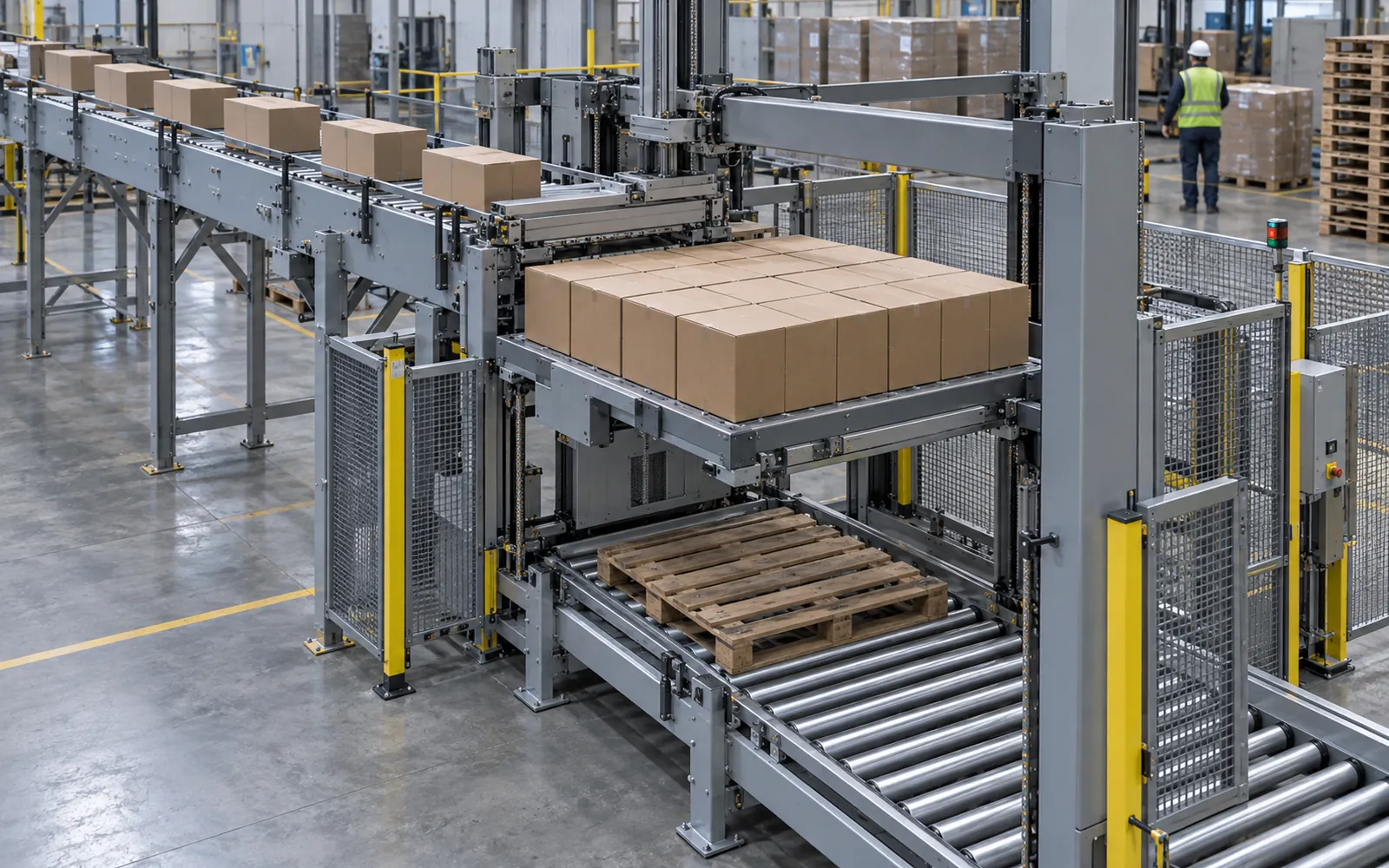
A conventional palletizer builds a pallet one complete layer at a time. Packages are gathered into rows, the rows form a full layer on a flat plate or table, and the machine deposits that layer on the pallet in a single motion. It is the traditional architecture for sustained, high-volume output, and it comes in two main forms, high-level and low-level. For the wider range of options, see the palletizing systems overview.
| Factor | High-level | Low-level |
|---|---|---|
| Product entry | Elevated infeed | Near floor height |
| Layer movement | Fixed elevated bed; pallet descends | Moving layer plate in the documented example; verify other layouts |
| Layer rate, Cybernetik guide only | Higher; about 5 to 10 layers per minute | Lower; about 1 to 3 layers per minute |
| Infrastructure | Check total height, full load, service clearance and product lift | Check total height, full load and service clearance |
| Maintenance access | Elevated sections | Mostly floor level |
| Installation | Confirm lift and platform scope | Confirm conveyor match and service access |
| Typical fit | High sustained output, multiple lines, floor space limits | Moderate output, simple layouts |
Cybernetik’s public guide gives these layer rates as broad comparisons, not model guarantees (published July 23, 2026; accessed October 8, 2026). Check machine height, maximum load height and maintenance clearance for both architectures.
How it works
A conventional palletizer repeats the same sequence on every cycle, with the mechanical details depending on the architecture.
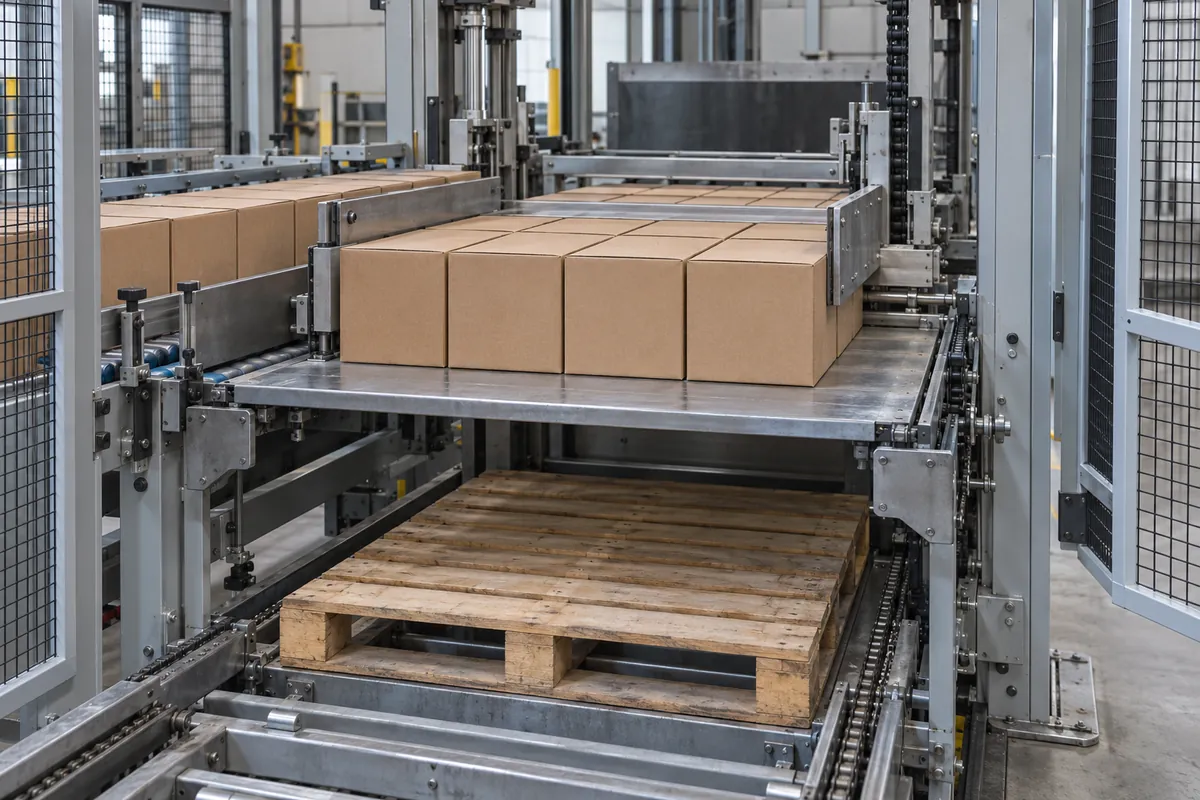
- Packages arrive from the line on a conveyor. The machine needs a consistent, controlled stream.
- Packages are turned or grouped to match the pattern. Rotation devices turn cases to the required orientation, and the machine forms a row of the correct count.
- Completed rows are pushed together until a full layer sits on the layer-forming platform. Many designs use a stripper plate or apron that holds the layer until it is released.
- The layer moves over the pallet, and the plate withdraws or opens so the layer sets down. Some machines compress or square the layer first, which helps with loads that need tight, uniform edges.
- A pallet dispenser provides empty pallets, a hoist or elevator positions the pallet at the right height, and a slip sheet or tier sheet unit adds sheets when the load calls for them.
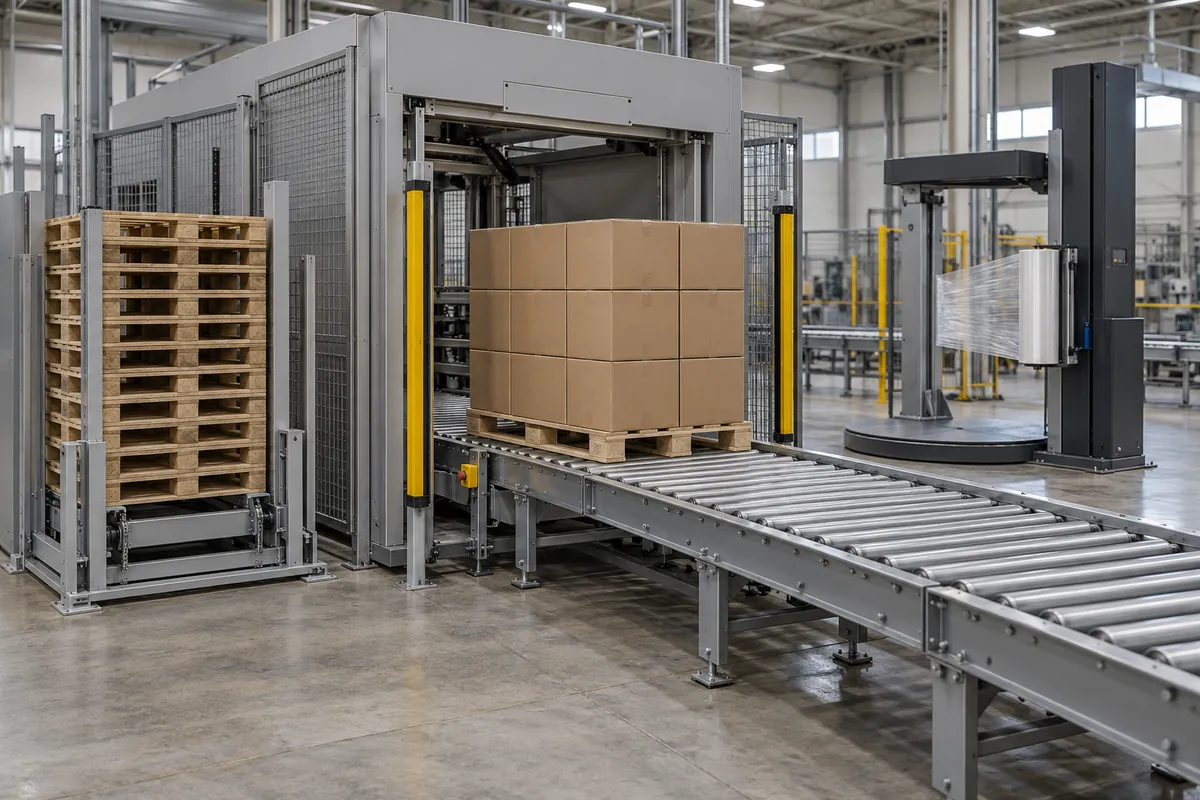
- Finished pallets leave on a discharge conveyor. Some machines wrap the load while the next one builds, which is called concurrent wrapping.
Because the machine forms a layer in advance and places it in one motion, its rate scales with layers per minute and cases per layer. A pattern with more cases per layer gives a higher case output at the same layer rate. This is why layer-based machines are often described as faster than robots handling one or two cases per cycle.
Types and configurations
The two conventional architectures differ in where product enters and how a layer reaches the stack.
High-level palletizers
In a high-level design, product enters on an elevated conveyor. Cybernetik’s public guide gives 100–144 inches for high infeed (guide range only; accessed October 8, 2026). Product travels up by spiral conveyor or vertical lift, forms a complete layer on a bed at that height, and is lowered onto the pallet. The pallet itself descends one layer at a time, so the layer-forming mechanism does not have to travel upward on each cycle.
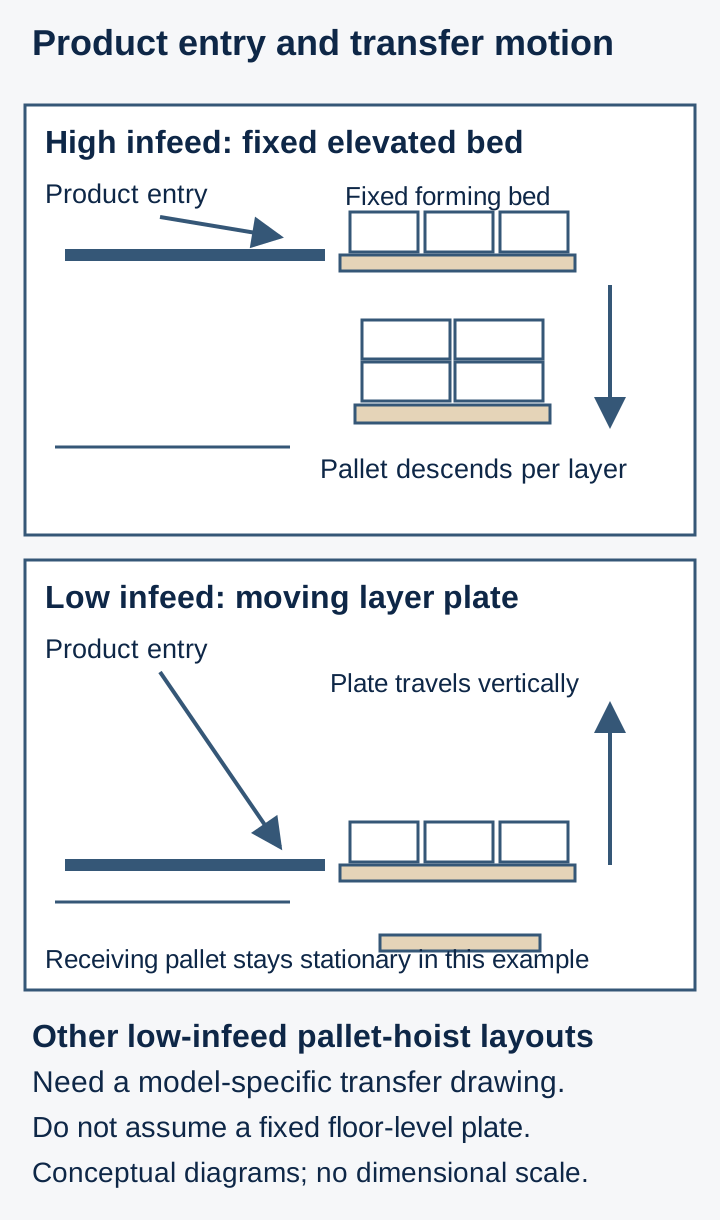
Lowering a layer a short distance is faster than lifting it, so high-level machines generally reach higher rates. Compare the guide’s layer rate with cases per layer and the measured exchange losses below. Moving the infeed and layer-forming platform above the floor can also free ground space for forklifts or shuttle vehicles.
For product handling, one manufacturer states that lowering the layer is gentler than lifting it, which can help with fragile packages. Another describes squaring and compressing layers on the bed, which helps bags form tight, stable loads.
The costs are in the building and the access. The building needs enough ceiling height, and the plant needs a way to raise product to the infeed. Installation is generally described as more involved, and operation may require trained staff. Elevated sections may need platforms for maintenance and jam clearance, so ask about safe access.
Low-level palletizers
In a low-level design, product enters near floor or waist height. Cybernetik’s guide gives 30–36 inches for low infeed (guide range only; accessed October 8, 2026). Alligator Automations’ public low-level description has a formed layer on a plate moving vertically to a stationary pallet. A pallet-hoist arrangement needs its own cycle drawing; do not infer a fixed floor-level bed from the low-infeed name.
The mechanism has to travel farther as the pallet grows, so rates are generally lower than high-level designs. Confirm the actual cycle at the maximum load height.
When the proposed infeed matches the line conveyor, a direct connection may avoid an elevated product lift. Check the service-access drawing instead of assuming all components are reachable from the floor. The machine is generally described as less expensive than a high-level equivalent, with lower installation cost where no elevated conveyor is needed. The catch is that if the plant already runs elevated conveyors, a low-level machine needs a conveyor to bring product back down.
Other conventional variants
Some conventional machines use inline or row-forming approaches rather than a stripper plate. Others add a robot within a conventional frame. One manufacturer says this hybrid keeps the footprint, controlled-entry safeguarding, and concurrent wrapping of a conventional machine while handling bags and delicate packages. The robotic palletizers guide describes the robot-centered approach.
Check sustained rate on one timing window
Layer rate × cases/layer gives a case rate only for the same pattern and time window. If the layer rate excludes exchanges or waiting, it is a running rate. Measure completed cases divided by total elapsed minutes for sustained output.
| Record | Include in the timing window | Evidence |
|---|---|---|
| Pattern and cases/layer | Hardest production case and pattern | Pattern drawing and count |
| Layer cycles | Forming, squaring and plate withdrawal | Cycle log; do not deduct withdrawal twice |
| Pallet exchanges | Full discharge and empty placement | Count and blocked time |
| Sheets and wrapping | Sheet placement and wrapper waits | Included or excluded, with reasons |
| Sustained cases/min | All completed cases / elapsed minutes | Start/end times, stops and interventions |
Example, assumed inputs: 10 cases/layer at a running rate of 4 layers/min gives 40 cases/min while cycling. Completing 200 cases takes 5 minutes of cycles (including plate withdrawal); one exchange and wrapper wait add 1 minute. Sustained output is 200 / 6 = 33.3 cases/min. A buffered or concurrent arrangement needs its own measured window rather than the same deduction.
Takeaway: Use the commissioning checklist to repeat this record at FAT and on site with the actual conveyors and wrapper.
Technical specs to evaluate
| Specification | Why it matters | What to ask the supplier |
|---|---|---|
| Layers per minute and cases per layer | Together they determine the case rate | What is the sustained rate on my package and pattern, not the peak? |
| Infeed height and type | Sets the conveyor design and cost | What height is required, and is a spiral or lift included? |
| Ceiling clearance | High-level machines need height above the pallet | What overall height does the machine need, including service access? |
| Pattern range | Mechanical adjustments limit variety | How many patterns can be stored, and what physical adjustments does each need? |
| Changeover method | Defines downtime between SKUs | Which parts change, who performs the change, and how long does it take in practice? |
| Package range | Weight, size, and rigidity affect layer forming | What are the minimum and maximum case size and weight, and how do bags perform? |
| Pallet range | Pallet variation causes stoppages | Which pallet sizes and condition limits are supported? |
| Layer compression | Affects load tightness and stability | Is compression or squaring available, and does it suit my product? |
| Sheet handling | Needed for some loads | Are slip sheets, tier sheets, or top sheets handled, and at what rate? |
| Wrapping | A separate wrapper uses more floor space | Is concurrent wrapping available, and does it affect the layer rate? |
| Safeguarding | Determines access and entry method | What guarding and interlocks come with the machine, and how are pallets removed? |
| Controls platform | Affects support and spare parts | Which PLC, drives, and HMI are used, and do they match plant standards? |
See also the guide on how to choose a palletizer for ways to put these figures on the same basis across quotes.
Package compatibility
Conventional machines perform best with consistent shapes and sizes, according to one manufacturer comparison, because uniform packages allow maximum speed and efficiency.
Corrugated cases and cartons are the core application. Rows and layers form predictably when cases are square, rigid, and the same size. Shrink-wrapped bundles and trays work well if the bundle holds its shape and slides without catching. Bottles and cans in packs are typically handled as packs or trays, and glass and other impact-sensitive formats may benefit from the gentler layer lowering described for high-level machines.
Bags and sacks are harder. One comparison says flexible or nonrigid packages are often difficult without additional reinforcement. Some designs compress layers before placement, which can help, but test your bags at the proposed rate. Pails, odd shapes, and frequently changing sizes are generally easier for robots.
Check the whole range, including the smallest and largest case, the heaviest package, and any packages with soft or damaged corners. A machine tuned for one case size may need substantial mechanical adjustment for another.
Integration upstream and downstream
Upstream, the conveyor must deliver a steady stream with enough accumulation. If the infeed is elevated, the project includes the vertical or spiral conveyor, and its capacity must exceed the machine rate. The conveyors section covers transport equipment, and vertical conveyors describe how product is raised to a high infeed.
Machines with multiple infeeds can accept product from more than one line, though the accumulation and control logic must keep one line from starving. Decide this early, because it shapes the machine design.
Downstream, the finished load leaves toward a stretch wrapper, labeler, or accumulation conveyor. Concurrent wrapping inside the frame, which one manufacturer says saves the footprint of a separate wrapper, changes the layout and the sequence of events. Decide whether the wrapper is part of the machine or a separate station before comparing quotes.
The equipment overview shows how palletizing connects with the rest of the line, and plants that also unload pallets can look at depalletizing equipment for the reverse operation.
Other layer-forming designs are on the high level palletizers and low level palletizers pages. Cost and comparison questions are covered in the palletizer cost guide and the robotic versus conventional palletizer guide. For plant context, see beverage packaging automation and pallet handling.
Footprint, utilities, controls, and safety
Compare complete layouts: machine, infeed, pallet staging, wrapping, safeguarding and service access can change the footprint comparison. Layout drawings should show plan, height, access platforms, service clearances, and pallet staging.
Expect electrical power and compressed air. Some designs add other drive types for layer movement, so ask which. Ask for connected load, air consumption, and any special requirements. A PLC and drives coordinate the machine, with an HMI for pattern selection. Ask how patterns are created, stored, and changed, and whether technicians can do it without the supplier.
Conventional palletizers have moving layers, pallet lifts, and automatic pallet exits. Safeguarding typically combines guards, interlocked doors, light curtains at load entry and exit, and controlled-entry access. One manufacturer says conventional machines can reach the highest safety rating through controlled-entry protection, which is a claim to verify against your own assessment. Safety-related control functions are commonly designed to ISO 13849-1, which defines performance levels. The robotic standard family, ISO 10218 and ANSI/A3 R15.06, applies when a robot is part of the machine, as in hybrid designs. An A3 article notes that those standards address the whole application, including the end-effector, workpiece, and peripheral equipment. A qualified risk assessment of the complete installation should set the safeguarding, and the edition of each standard should be confirmed, since several have been revised in recent years.
Cost factors
This guide does not state prices. These factors most often separate one quote from another:
- Architecture, with high-level machines generally described as costing more than low-level
- Layers per minute required, and the number of infeeds
- Layer forming and compression features
- Pallet dispenser, slip sheet handling, and tier sheet equipment
- Vertical or spiral conveyors for elevated infeed
- Building modifications, such as ceiling height, mezzanines, or platforms
- Concurrent wrapping or a separate wrapper
- Guarding, light curtains, and controlled-entry access
- Controls platform and pattern software
- Installation, commissioning, training, and spare parts
Total installed cost also includes the conveyors and building work the machine requires, not only the machine, so compare complete scopes. If the plant runs many formats, add the cost of changeover time, because mechanical changes consume production hours.
Selection checklist
- Define package dimensions, weights, and the hardest SKU.
- Calculate required sustained cases per minute and the corresponding layers per minute.
- List patterns, pallet sizes, and the expected number of changeovers per week.
- Measure ceiling height, floor area, and the height of existing conveyors.
- Decide whether the infeed will be elevated and what lift is needed.
- Decide the number of infeeds and future expansion.
- Specify pallet dispensing, sheet handling, and wrapper arrangement.
- Check sanitation and environment requirements.
- Request the safeguarding approach and the standards applied.
- Confirm maintenance access, spare parts, and training. If you are weighing an older or used machine, the palletizer retrofit guide covers inspection and upgrade questions.
- Ask for the changeover procedure and time on your hardest change.
- Request an acceptance test with your packages.
Common mistakes
- Reading layers per minute as cases per minute. Convert with cases per layer.
- Choosing high-level without checking the building. Ceiling height, floors, and platforms may need work.
- Forgetting the lift. The conveyor that raises product to the infeed is part of the system.
- Underestimating changeover. Frequent format changes can erase a speed advantage.
- Testing only the average package. The most difficult case or bag sets the practical limit.
- Leaving the wrapper unspecified, when concurrent wrapping changes layout and sequence.
- Skipping maintenance access. Elevated sections need safe platforms and clearances.
- Assuming guarding is standard. Ask what is included and how pallets are removed safely.
Alternatives
A robotic palletizer places packages with an articulated arm. According to one manufacturer comparison, robots generally suit variable product mixes, frequent pattern changes, difficult package shapes such as bags and pails, and tighter plant layouts. They generally trail conventional machines at sustained rate on uniform packages unless layer picking is used. Hybrid cells combine layer forming with robotic placement, and gantry designs suit tight floor plans with precise placement.
If the plant runs one or a few products at high sustained output, a conventional machine in the architecture that matches the building is typically the first option to price. If product variety is high, price a robot. When the answer is unclear, ask both types of supplier to quote the same package list, patterns, and rate, then compare complete scopes. The palletizing systems overview lists the remaining types.