Screen the product, queue and cleaning method
The labels below describe different axes: structure, function, layout or load. A roller structure can provide accumulation, and a belt system can include a spiral; the rows are not mutually exclusive hardware choices.
| Family / classification | Product base or support | Queue need | Cleaning check and selection conclusion |
|---|---|---|---|
| Belt — structure | Soft, flat or irregular pack base | Check force on stopped packs | Choose continuous support; confirm belt and frame cleaning access |
| Live roller / MDR — structure | Firm carton or tote base | Evaluate zoned accumulation | Choose for cases needing queues; verify motors and sensors for the cleaning method |
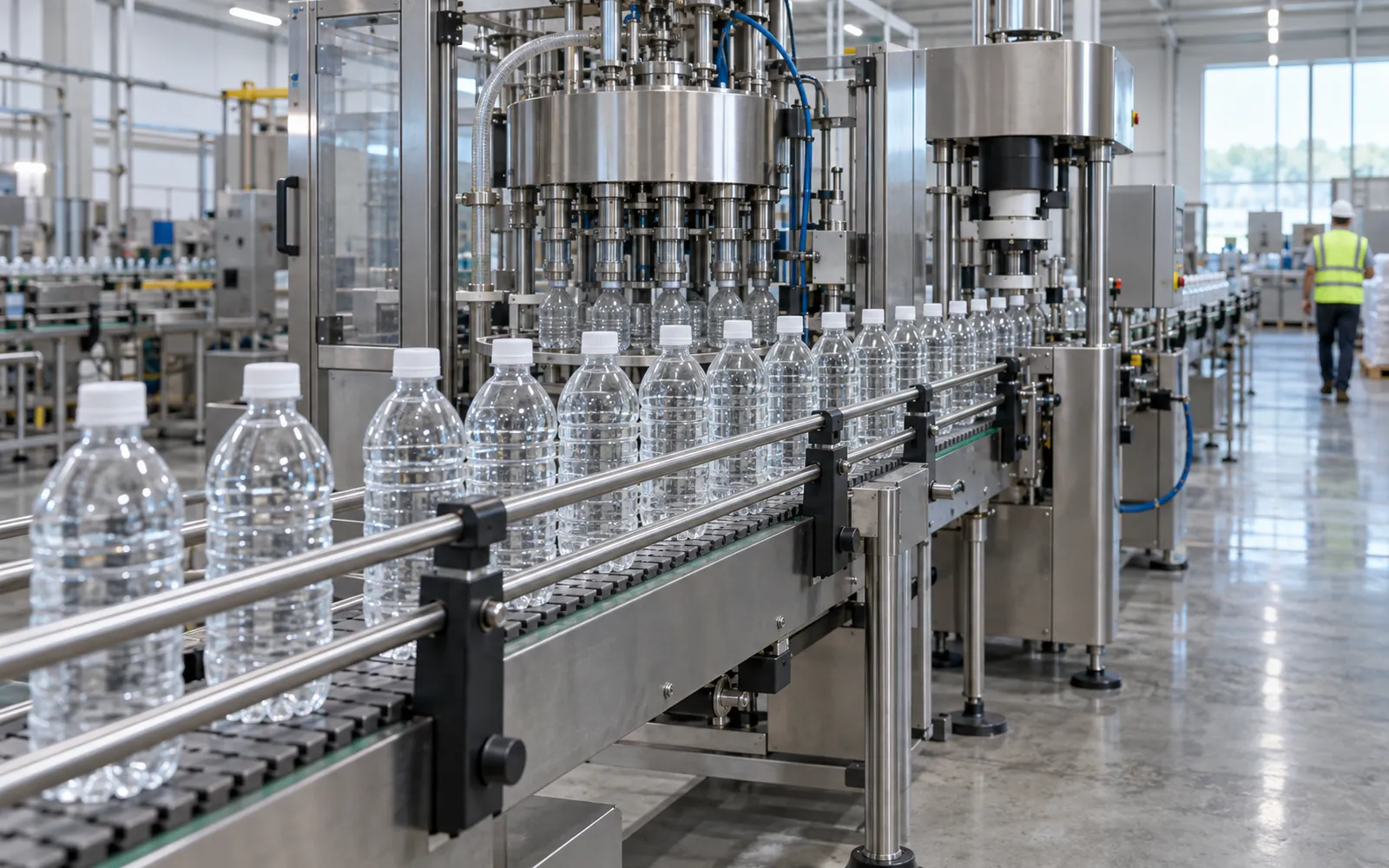
| Tabletop chain — structure | Upright bottle, jar or can | Check contact and back pressure | Evaluate for single file; match chain, guides and lubricant to cleaning |
| Modular belt — structure | Packs or containers over a wider surface | Evaluate mass flow and buffers | Consider for wider flow; verify belt openings, drainage and cleaning access |
| Accumulation — function | Same product as the connected line | Define pressure and FIFO needs | Add only with usable capacity and recovery; retain access to the stored product |
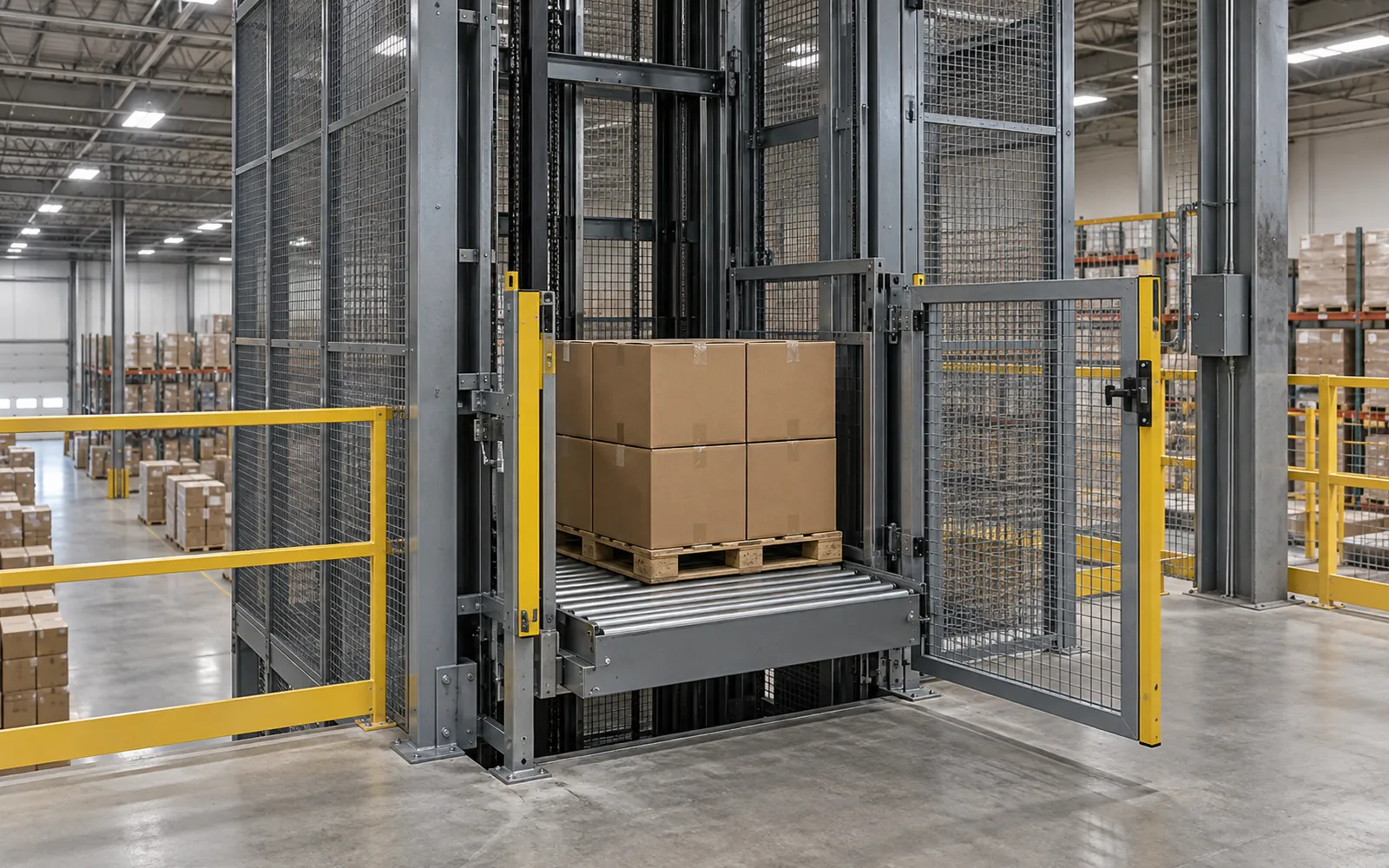
| Vertical lift — layout | Platform load or supported cases | Batch or continuous, by design | Compare lift duty and transfer method; verify enclosure and cleaning access |
| Spiral — layout | Stable pack on a continuous path | Buffer only if designed for it | Evaluate where floor length is limited; check entry, exit and belt access |
| Pallet conveyor — load | Pallet runners or bottom boards | Count free holding positions | Match chain/roller support to pallet orientation and cleaning regime |
| Air conveyor — structure | Empty bottle with compatible neck ring | Confirm gap and stop response | Consider neck support for suitable empties; verify guide and air hygiene |
Use this table to screen options, then confirm actual product behavior and the cleaning procedure. Bottle conveyors, case conveyors and accumulation conveyors cover the next checks.
Main packaging conveyor types
No single conveyor suits every package, and most real lines combine several families.
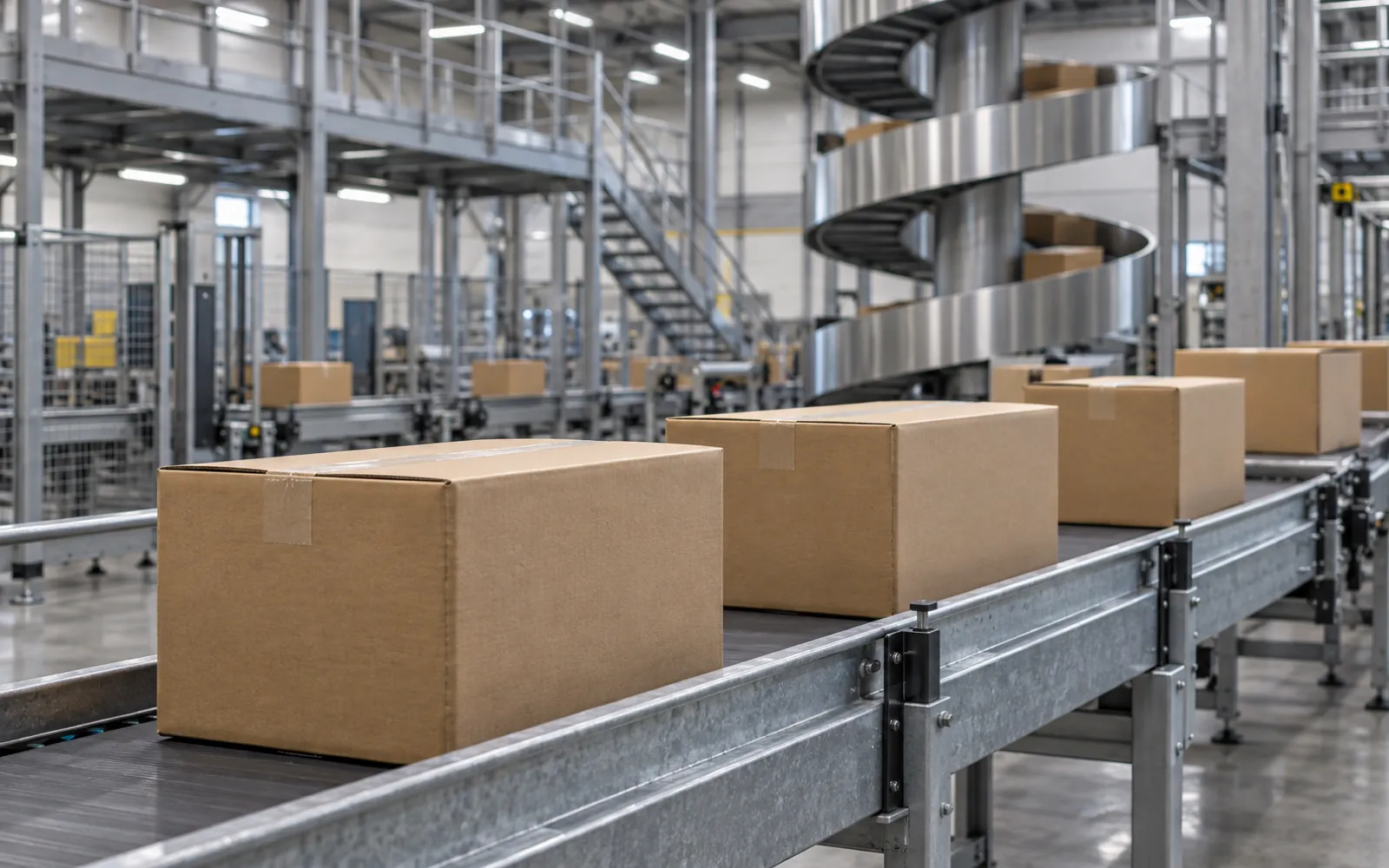
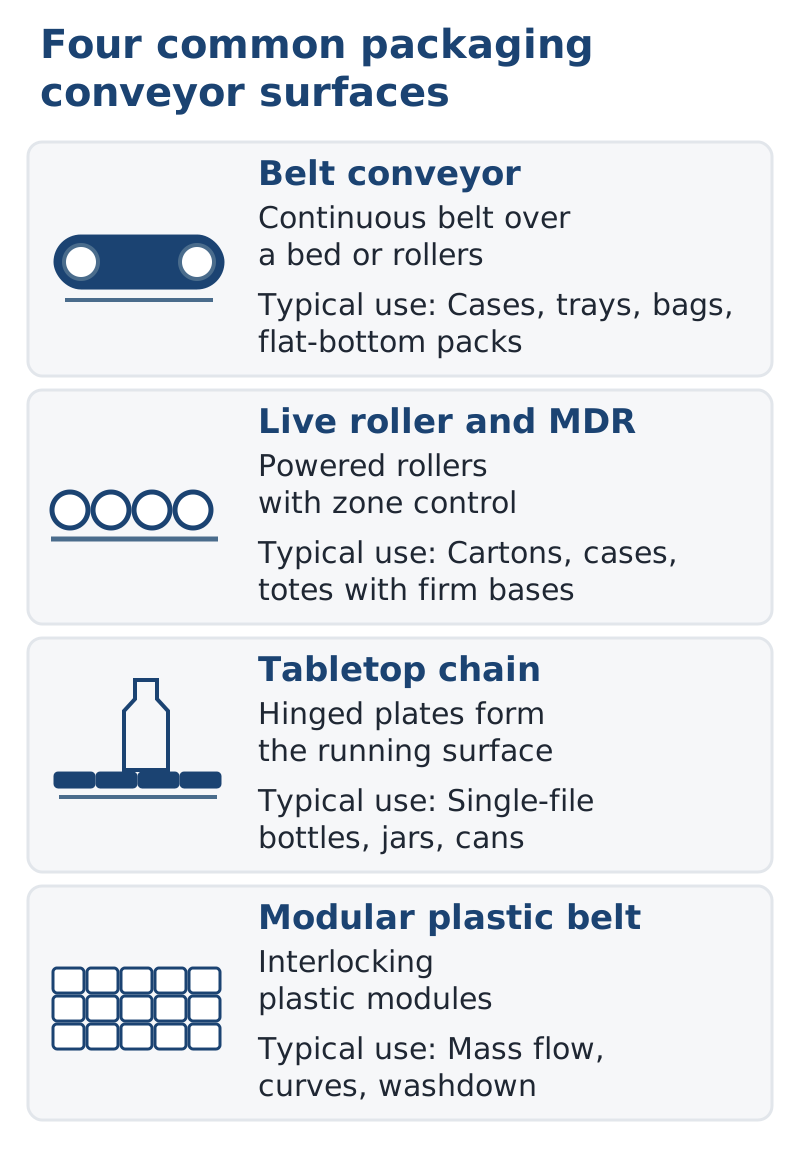
Belt conveyors run a continuous belt over a bed or slider and carry cases, trays, bags, and other packs with a flat or stable base. They are quiet, gentle on product, and easy to inspect. They suit transport, inclines, declines, and merges, and a belt with a suitable surface can climb a modest slope without cleats. They are a poor fit for long accumulation, because moving belt friction pushes against queued product.
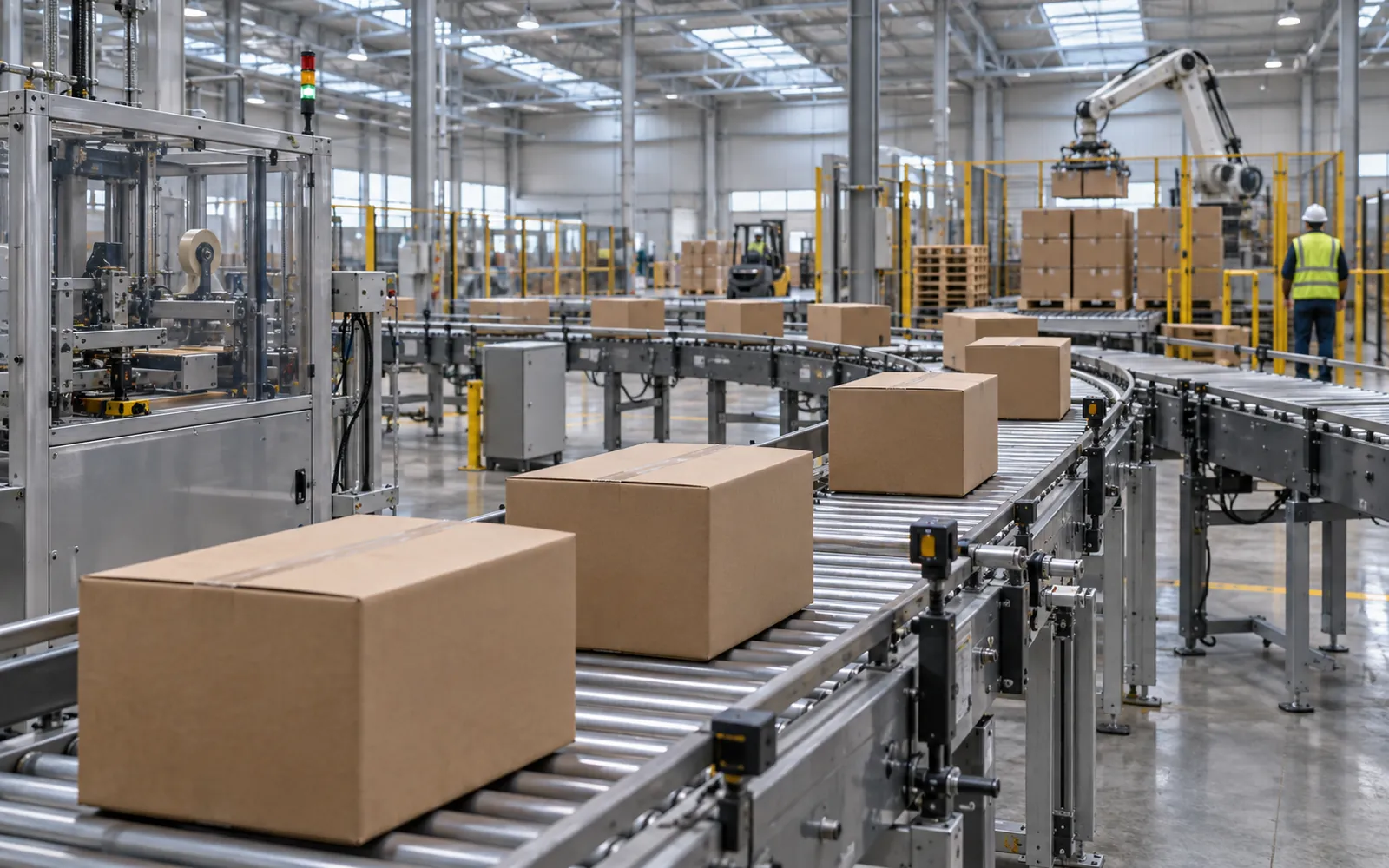
Live roller conveyors turn powered rollers under the product. Older designs drive many rollers from a shared shaft or belt. Motorized driven roller (MDR) designs put a small motor inside selected rollers so each short section can start and stop on its own. Roller conveyors are the usual choice for cartons, totes, and cases with a firm, flat bottom, and zone-by-zone control makes them the common platform for zero-pressure accumulation, merges, and sortation.
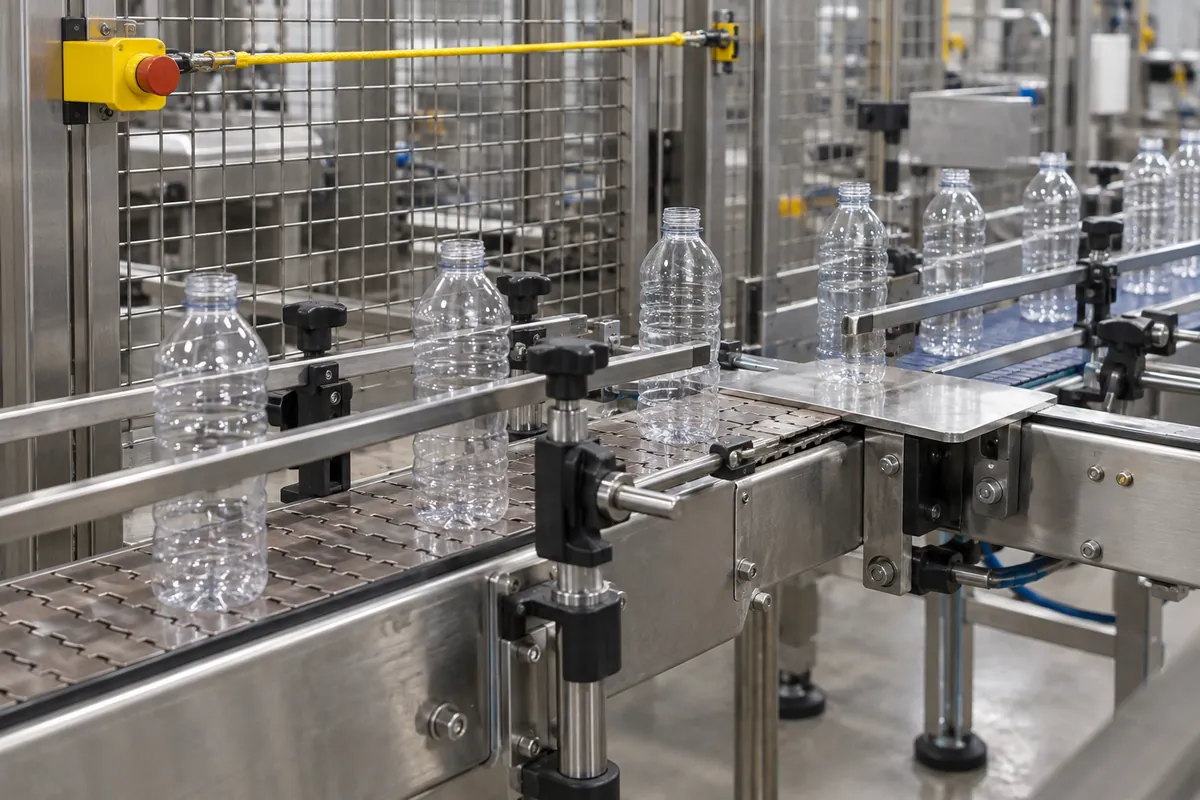
Tabletop chain conveyors use a chain of hinged plates as a flat running surface. The narrow, low-friction surface is built for single-file upright containers such as bottles, jars, cans, and cartons moving through filling, capping, labeling, and coding. Container stability depends heavily on guide rail setup, so changeover between container sizes has to be designed in from the start.
Modular plastic belts are assembled from interlocking plastic modules joined by rods, so they come in many widths and surface styles. They tolerate curves, wet areas, and frequent washdown, and open styles drain. Many lines use tabletop chain for single-file flow through a filler and modular belt for wider mass flow and accumulation downstream.
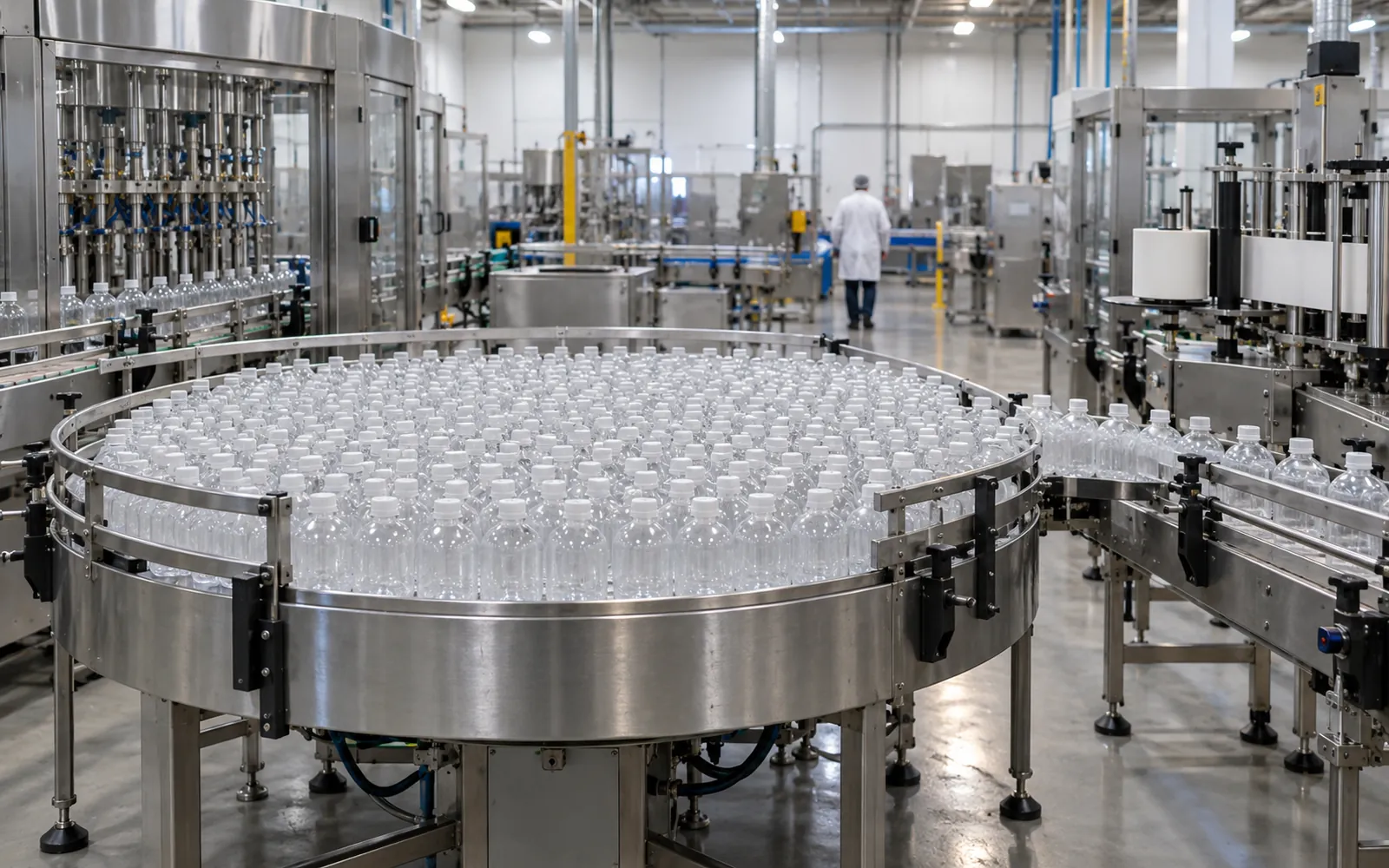
Accumulation is a function rather than a hardware type. Zero-pressure roller zones, accumulating tabletop sections, and rotary or spiral buffers all let product queue. The right form depends on product fragility, how long a stop the line must ride through, and whether first-in first-out order matters.
When product has to change level, the options are vertical reciprocating conveyors, continuous vertical lifts, case lifts, spirals, and inclines. Each affects throughput, footprint, and safety guarding differently. The vertical conveyors guide compares them.
Pallet conveyors, usually chain or roller based, carry unit loads between palletizers, stretch wrappers, labelers, and warehouse handoffs. They are heavier duty than case conveyors, and the condition and orientation of the pallet drive the design.
Air conveyors carry lightweight empty plastic bottles with a neck ring from a blow molder to a filler, hanging from neck guides while air moves them along. One supplier guide notes that layout, bottle shape, speed control, and guide material all matter, especially for bottles with easily scuffed surfaces.
Belt conveyor construction and belt selection
A packaging belt conveyor has the same basic parts whatever it carries. A gearmotor turns a drive pulley, usually at the discharge end, and the belt returns around an idler or tail pulley at the other end. Between them the belt rides on a flat slider bed or on carrying rollers, and it comes back underneath on return rollers. A take-up, either screw-adjusted or gravity-weighted, keeps the belt at working tension, and tracking adjustment keeps it centered on the pulleys. Side guides or rails hold product in its lane.
Each part answers a selection question. A slider bed gives a stable, quiet surface for small or unstable packs, while a roller bed lowers friction on longer or heavier runs. A center drive or a drive at the head end changes where the motor sits and how the belt can be reversed. The take-up style affects how much tension adjustment maintenance staff have to make, and on a short conveyor near a machine it decides how much room there is for a belt change.
The belt itself is chosen for the product and the area:
- Surface. A smooth top suits sliding transfers and accumulation of light packs. A rough or textured top grips cases on a modest incline, and cleats or flights hold product on steeper slopes.
- Material. PVC and polyurethane fabric belts are common on case and carton lines. Modular plastic belts suit wet areas and curves, as covered above. Rubber covers appear on heavier-duty and abrasive applications.
- Food contact. Where a belt touches exposed food, the belt supplier, not the conveyor builder alone, should state which food-contact rules the material meets. Ask the supplier for the applicable food-contact declarations and regulatory basis for the actual material, food and market. Confirm their scope with the plant’s food safety team; a general conveyor description does not establish material compliance.
Belt conveyors are the right choice when packs need a continuous supporting surface, gentle handling, or a modest incline. Roller conveyors fit better when product must queue without pressure, and tabletop chain fits better for single-file upright containers through filling and labeling. Carton-specific belt details are on the case conveyors page.
Chain conveyors: tabletop chain versus pallet chain
“Chain conveyor” covers two quite different machines on a packaging line. Tabletop (flat-top) chain uses hinged plates that form the running surface itself, so the product sits on the chain. It carries single-file containers and narrow mass flow through fillers, cappers, and labelers, and its guide rails and transfers do much of the work. Pallet chain conveyors use two or more parallel strands of heavy roller chain running in tracks, and the pallet rides across the strands on its bottom boards. They move unit loads to and from palletizers and stretch wrappers, and they are often paired with roller sections and transfer units at turns.
| Question | Tabletop (flat-top) chain | Pallet chain |
|---|---|---|
| What rides on it | Bottles, jars, cans, cartons, usually upright and single file | Pallets and unit loads |
| Running surface | The chain plates themselves | The pallet bottom boards spanning two or more chain strands |
| Typical location | Filling, capping, labeling, coding | Palletizer discharge, wrapper infeed, dock handoffs |
| Key setup items | Guide rails, transfer plates, chain material for the cleaning method | Pallet type and condition, board orientation relative to the strands, transfers at turns |
Both wear, and wear shows up as chain elongation, worn plates, and noise. Lubrication practice differs by chain material, wearstrip, and speed. Rexnord’s public Rex TableTop Chain Maintenance Manual V1.1, maintenance page MM-TT-22 (PDF page 24; accessed October 8, 2026), recommends lubrication when compatible with the application and distinguishes cases where lubricant cannot be used. That is guidance for the covered chains, not permission to run every chain dry. Follow the chain-specific maintenance instructions and confirm lubricant compatibility near food. Bottle-specific chain and rail details are on the bottle conveyors page.
Naming questions: three types, conveyor belts, and compact conveyors
Buyers often ask what the three types of conveyors are. There is no standard list of three. The usual answer is belt, roller, and chain, because those carrying surfaces cover most packaged goods, but a packaging line also uses modular plastic belt, vertical and spiral, and air conveyors. A conveyor belt is the belt component, or loosely a belt conveyor; a packaging conveyor is any conveyor used to carry product within a packaging line, whatever its carrying surface.
Frame material follows the area and the cleaning method. Stainless steel frames are common in wet and food areas, painted carbon steel is common in dry case and pallet handling, and aluminum extrusion frames appear on light-duty and short conveyors. The cleaning plan, not appearance, should decide.
Small and compact conveyors have their own place. Short belt conveyors are used as takeaway conveyors under a filler, weigher, or bagger, as inspection or packing tables, and as bridges between two machines. Portable and flexible (expandable) conveyors are used for temporary routes such as truck loading. Short conveyors are still part of the line: the same guarding, speed-matching, and transfer questions apply.
Evaluating a packaging conveyor supplier
This site does not rank suppliers. These are checks a buyer can verify for any of them:
- Application experience. Ask for examples of similar packages, speeds, and areas, and whether a test with your own product is possible.
- Integration scope. Confirm who supplies controls, sensors, and the signals to the machines on either side, and who is responsible for stop and restart behavior.
- Documentation. Expect layout drawings, electrical schematics, a manual, a recommended spare parts list, and the safety information for installation and maintenance.
- Safety approach. Ask how guarding, emergency stops, and lockout points are handled and which standards the design references, such as ASME B20.1.
- Service and parts. Check parts availability, standard components the plant already stocks, training, and how remote or site support is arranged.
- Acceptance. Agree how the conveyor will be tested before acceptance, with real product and the stated rate.
Pricing factors are covered separately in the packaging conveyor cost guide.
System design topics
Line layout and transfers
Layout starts with the sequence of machines and ends with the building. Straight runs are cheapest and easiest to maintain, but real plants have columns, aisles, and walls. Turns, merges, and diverts add transfer points, and each transfer is a place where product can tip, jam, or lose spacing. A good layout keeps transfers few, keeps product orientation consistent, and gives each machine a clear infeed and discharge. Transfers between different conveyor types, such as tabletop to belt, need attention to height, speed match, and the gap the product bridges.
Settle elevation changes early. A line that has to cross an aisle, go to a mezzanine, or move between floors will rule some conveyor options in or out before any other detail is chosen.
Accumulation and buffer sizing logic
Buffer sizing balances how long the downstream machine can stop against how much product the upstream machine keeps making in that time. Three questions frame it. How long are typical stops, and how often do they happen? How fast does the upstream machine keep running, and can it be told to slow or stop? How much product space is there between machines? The buffer has to hold what arrives during a stop, then empty again once the downstream machine resumes at a rate above the upstream rate. If the downstream machine has no spare speed, the buffer fills and stays full, so it only delays the stop.
Accumulation form follows product behavior. Fragile cartons favor zero-pressure zones so nothing pushes on the pack in front. Containers that slide on a smooth running surface can queue on a tabletop or belt with a low-pressure design. Where first-in first-out order matters, such as products that need dwell time, spiral buffers fit. A calculation for a real line should come from the supplier using actual stop data.
Controls: zone control, photo-eyes, and line-speed coordination
Zone control divides a conveyor into short sections, each with its own presence sensor. A section runs only when the section ahead is clear, so product stops without contact and moves forward in sequence once the head of the queue is released. Photo-eyes are the usual sensors, and delay timers can adjust behavior for different speeds. Release modes decide how product leaves a queue: some release one item at a time with a gap, others release a group together.
Line-speed coordination works across machines. A packaging line often has a slowest machine that sets the pace, and the conveyors around it should let faster machines run without overrunning it and let slower ones avoid starving. Controllers can slow upstream machines as a buffer fills and speed them up as it empties. Interlocks between conveyors and machines stop feeding a machine that has faulted. A supplier should show how stops, restarts, and fault recovery are handled, and whether the system can restart a full line without manual clearing.
Sanitation and washdown
Food, beverage, and pharmaceutical lines clean their conveyors, and the design has to allow for that. A hygienic design guide from one supplier lists smooth surfaces free of crevices, stainless steel in common grades, open frames for access, and tool-free removal of belts and covers. Open belt styles drain better than closed ones. Motors, bearings, and electrical enclosures need ratings that suit the cleaning method, whether dry cleaning, wet wipe, or high-pressure rinse. Dry packaging areas such as case and pallet lines can use painted steel in many plants, but the cleaning plan should say so.
Noise
Conveyor noise comes from drives, chains, roller bearings, product impact, and transfers. Chain and modular belt sections add link movement noise, and roller conveyors add bearing noise, so the mix of conveyor types changes how a hall sounds. On a bottle line, containers hitting guide rails and each other is often the loudest part. Noise control comes from drive selection, guide design, damping materials, and spacing control. Noise targets should come from the plant hearing conservation program, and the supplier should be asked for expected levels at the specified speed.
Maintenance access
Conveyors fail slowly when ignored. Lubrication points, chain wear, belt tracking, roller bearings, and drive components need inspection and scheduled replacement. The design should put them within reach without forcing crews to remove guards in a way that creates a hazard, and should give maintenance safe access to jammed product. Spare parts commonality matters too: a plant that mixes many chain types, belt styles, and drive brands carries a larger spares inventory than one that standardizes.
Guarding and safety
Conveyors present pinch points, nip points, rotating parts, shear points, and falling product. ASME B20.1 is the safety standard for conveyors and related equipment in the United States. Its 2024 edition addresses hazards across a conveyor’s life, from design and construction through installation, upkeep, inspection, and daily operation, and it excludes conveyors used primarily to move people. In general industry, OSHA requires machine guarding under 29 CFR 1910.212 and control of hazardous energy under 29 CFR 1910.147, which governs lockout and tagout during servicing. Emergency stop placement, guarding at transfers, safe crossovers over conveyors, and clear walkways are layout items to decide with the plant safety team. Local rules and the plant insurer may add requirements.
Where packaging conveyors usually need guards
OSHA 29 CFR 1910.212(a)(1)–(2) addresses protection from machine hazards and guards that do not introduce another hazard (official text accessed October 8, 2026). On a packaging conveyor, the places that usually need attention are:
- In-running nip points where a belt meets a drive, tail, or snub pulley, and where a chain meets a sprocket.
- Exposed drive shafts, couplings, and gearmotor ends.
- Take-up assemblies and return rollers under the conveyor.
- Transfers between conveyors, where a gap or a plate can trap fingers or product.
- Overhead and elevated runs, where falling product can strike people below and where crossings need guards or netting.
- Areas operators reach into to clear jams, which call for a defined access and lockout method rather than reaching past a guard.
This list is a review aid, not a compliance determination. The guarding method for each location comes from the risk assessment, the current edition of ASME B20.1, and the plant safety team.
From depalletizing to palletizing
A typical flow starts at the receiving end, where pallets of empty containers are broken down by a depalletizer. Layers or loose containers then feed a conveyor, such as an air conveyor for empty plastic bottles or a tabletop line for glass and cans, that carries them to the filler. Behind the filler, capping, labeling, and coding stations are linked by conveyors that control spacing and orientation. A case packer or tray packer then forms secondary packs, and case conveyors carry those packs, often through accumulation, to a palletizer that builds unit loads. Pallet conveyors move finished pallets to wrapping, labeling, and the dock.
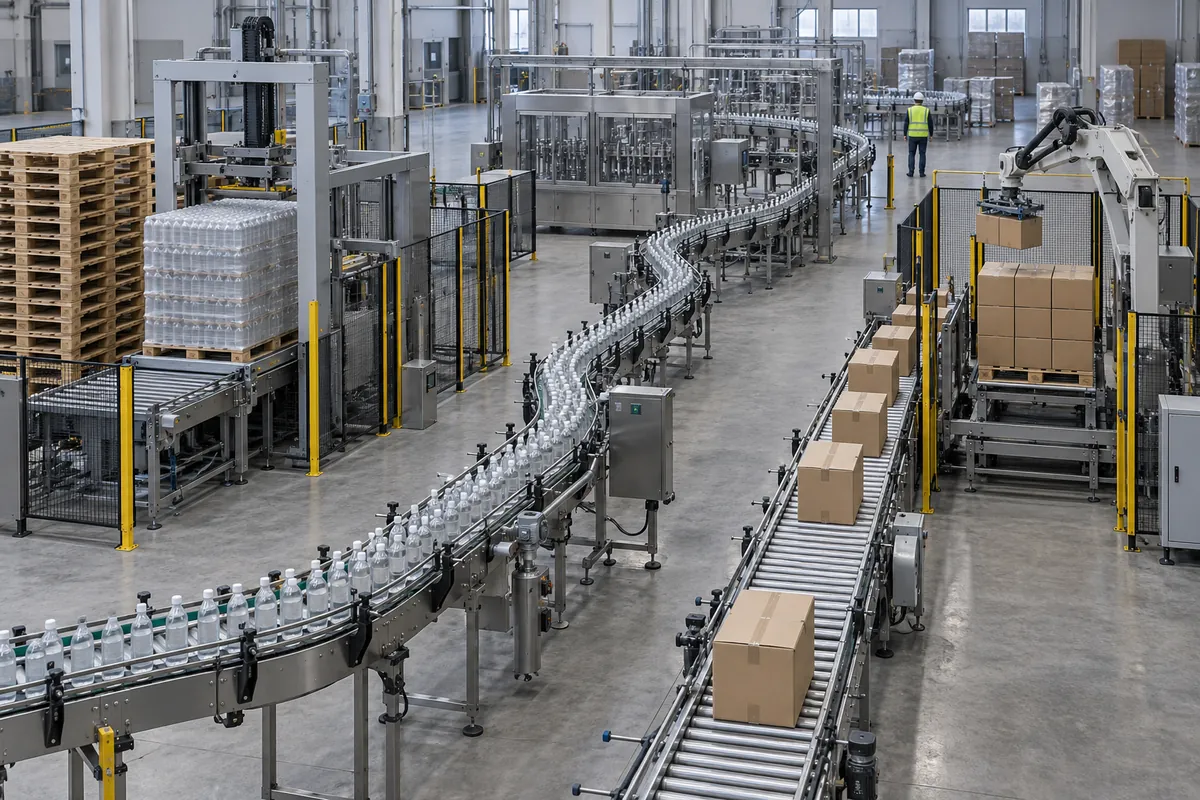
Several of those joints decide whether the line runs smoothly. The hand-off from depalletizer to container conveyor sets how steadily the front of the line is fed. The buffer between the case packer and palletizer decides whether a pallet change or a wrapper stop halts the entire line. Each joint needs a speed match, a space plan, and a stop and restart plan. The equipment overview places conveyors in the full set of packaging machinery, and the commissioning and acceptance checklist lists the questions to settle with suppliers before ordering.
Decision factors
Most buyers can answer these questions before talking with a supplier:
- What is being carried? Weight, base shape, stability, surface finish, and sensitivity to scuffing set the conveyor family.
- How fast, and with what variation? Average line speed matters, but so do peaks, stops, and changeovers.
- Does product need to queue? If so, choose between zero-pressure, low-pressure, and buffer forms.
- How is the area cleaned? Dry sweep, wet wipe, and pressure rinse call for different frames, belts, and motors.
- Where does the line have to go? Aisles, columns, mezzanines, and floor openings limit routes.
- How many formats will it run? More container or case sizes mean more adjustment, and some conveyors adapt faster than others.
- Who maintains it, and with what spares? A conveyor the plant cannot maintain will cost more than its price suggests.
- What safety rules apply? Guarding, emergency stops, and building code coordination belong on the first drawing, not added late.
Where to go next
The vertical conveyors guide covers lifts, spirals, and inclines for moving product between levels. Related sections cover depalletizing at the front of a line and palletizing at the end.
The detail pages cover bottle conveyors, case conveyors, and accumulation conveyors. Budgeting is covered in the packaging conveyor cost guide, and floor planning in the packaging line layout guide. For plant examples, see beverage packaging automation and case handling.