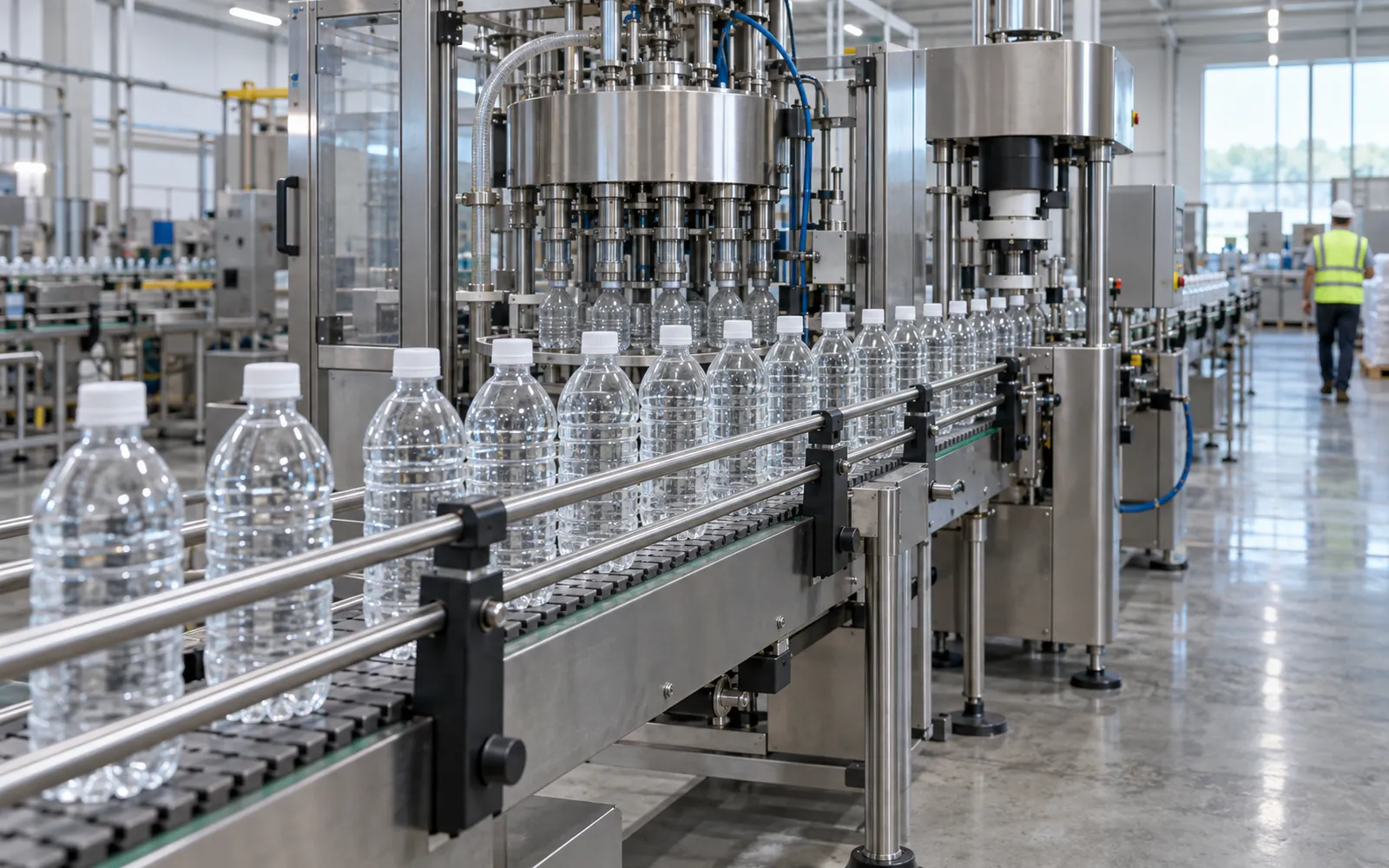
Bottle state and contact checks
| State / material | Duty to evaluate | Contact risk to test | Format parts to confirm |
|---|---|---|---|
| Empty PET / plastic | Neck-supported transfer or supported feed into an inverting rinser | Neck-guide fit, wall squeeze and rail scuffing | Neck guides, twist set and timing screw for the proposed container |
| Empty glass | Base-supported transfer; inversion only if the rinser requires it | Entry collision, rail impact and broken-glass access | Guides and container-specific twist / screw set |
| Filled PET / plastic | Convey upright; inversion only for a defined downstream process | Squeeze, label contact and stop/restart stability | Rail settings, spacing and any approved inverting parts |
| Filled glass | Convey upright; confirm suitability before any inversion | Bottle contact, rail load and entry impact | Guides / grippers and the proposed size-specific parts |
The table is a trial checklist, not a guarantee for either material. This guide covers primary containers in packaging conveyor systems; cartons and shipping cases use case conveyors.
How it works
Most bottle conveying is friction and geometry. A bottle sits on a moving surface and is held upright by side guides. The surface carries it forward, the guides keep it on path, and every contact point can help or hurt. With too little grip, bottles slip back at transfers. With too much friction against a guide or a neighbor, a bottle drags, tilts, or falls.
Two flow patterns appear on almost every line. In single file, bottles travel one behind another in a lane only slightly wider than the container. Fillers and labelers take bottles this way, usually through a screw, a star wheel, or a gripper, so the conveyor in front of them has to deliver a steady, evenly spaced stream. Single-file conveyors are narrow, run at higher speed, and are sensitive to rail setting. In mass flow, bottles travel many abreast on a wide belt or table, touching or nearly touching. It is slower and gentler, and it gives the line room to store bottles between machines. It is the natural form for accumulation, which the accumulation conveyors guide covers in more depth.
Conversions link the two patterns. One supplier describes a typical high-speed line this way: after the filler and capper, bottles are massed together, held on a mass conveyor or an accumulation table, and then fed through a combiner into single file for the labeler. After labeling, the bottles are single-filed again and massed once more ahead of the case packer. Most bottle jams happen at that repeated narrowing and widening, so the conversion points deserve more engineering attention than the straight runs.
Why bottles tip
A bottle falls when the sideways force on it, from a rail, a neighbor, or a transfer edge, creates a moment about its base larger than its own weight can resist. Tall, narrow, light, or empty bottles have the least margin. A bottle full of liquid sits lower and steadier than the same bottle empty, which is why empty-bottle handling is often a separate and more delicate task. Transfers at different heights, gaps between conveyors, and speed mismatches add the sideways kicks that tip containers. Good design reduces each of these, instead of fixing them afterward with extra rails.
Types and configurations
Tabletop chain conveyors
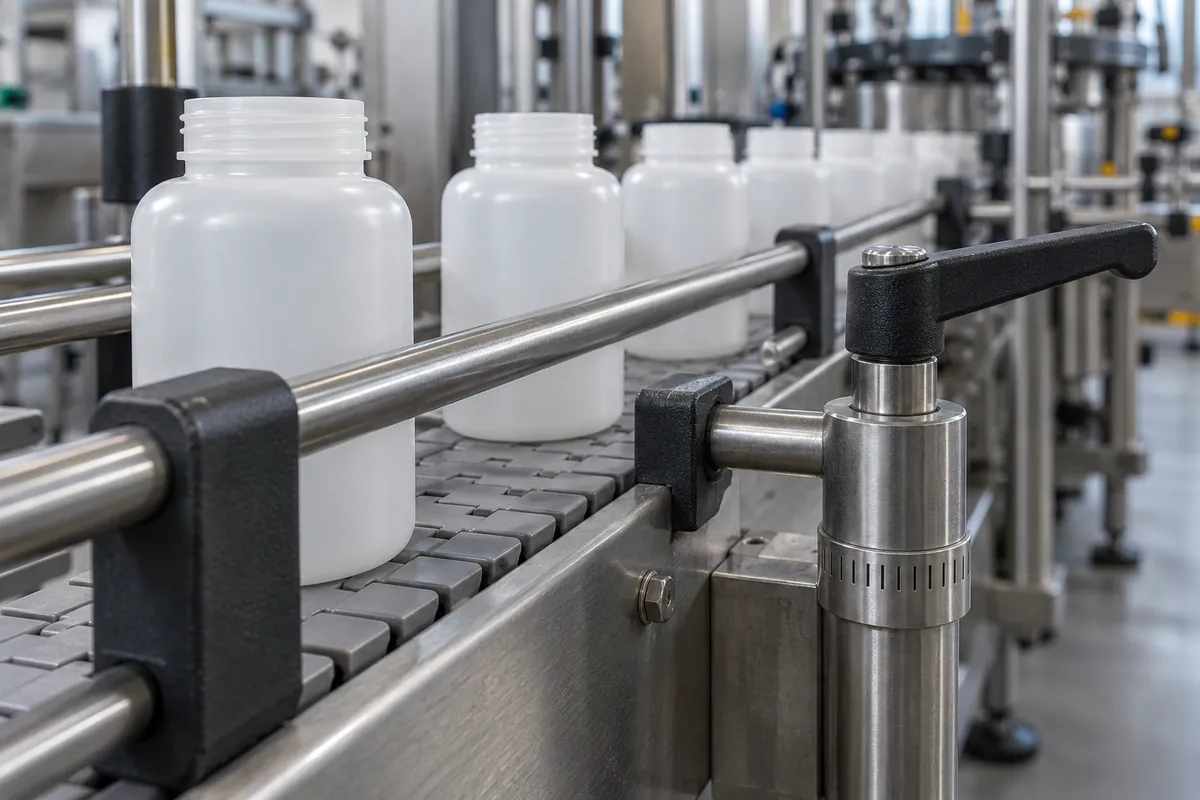
Tabletop chain is the standard single-file surface. A chain of hinged plates, made of stainless steel or plastic, runs on wear strips inside a frame, and bottles ride on the flat top of the plates. The chain is narrow, which suits single file, and the plates can be a low-friction plastic that lets bottles slide sideways against rails without grabbing. Stainless chain is common for heavy glass and abrasive duty. Plastic chain is quieter and gentler on the container. Chain width, plate surface, and pitch all change how a bottle behaves, so choose the chain with the container in mind.
Modular plastic belt
A modular belt is made of interlocking plastic modules joined by rods. It can be built wide, so it is the usual choice for mass flow, accumulation sections, and curves. Surfaces range from flat and smooth to open grid for drainage, and some have a friction top for inclines. Plastic belts are easy to repair by replacing modules. They are less common than tabletop chain for single-file duty, although some single-filer designs use belts with guide rails that shift bottles toward a lane.
Combiners and single filers
A single filer takes mass flow and turns it into one lane. Two designs are common, and the difference matters.
A low-pressure or conventional single filer uses guide rails along a conveying surface, often a plastic belt, to funnel bottles toward the narrow lane. One supplier notes that this style generates a fair amount of back pressure, so it works better with dense, solid, stable containers that tolerate being pressed together. Because the stream is squeezed through a narrowing opening, bridging can occur, where bottles lock into an arch across the lane and stop.
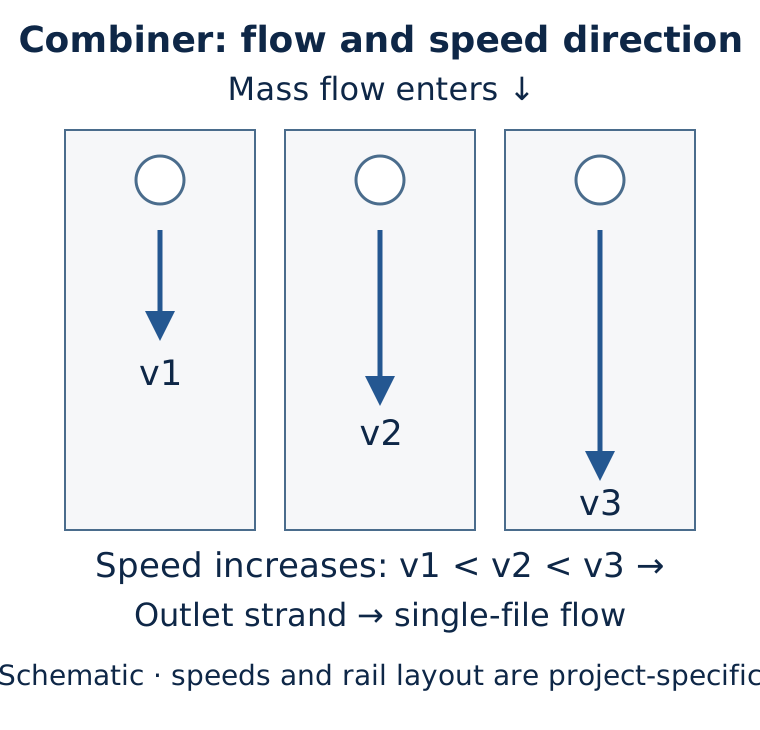
Nercon’s public Pressureless Combiner / Single Filer description explains progressive acceleration across multiple chain strands to separate containers into one lane, and claims reduced container and label damage with limited rail adjustment (accessed October 8, 2026). That describes its design; verify scuffing, stability and required rail settings with the proposed bottles rather than treating “pressureless” as a universal damage guarantee.
Lane dividers
A lane divider does the opposite job. It takes a single lane or a pair of lanes and splits the stream into several, for example to feed a multi-lane shrink wrapper, a multipack former, or a case packer that loads several rows at once. A simple divider uses a pneumatic gate that swings between lanes, sometimes with a small brake that holds bottles for a moment while the gate moves. A dynamic divider uses an arm that extends forward in step with line speed and guides bottles across to the target lane without stopping them first. Larger systems divide into many lanes. Sensors count bottles in each lane so the divider can balance them, and back-up and anti-jam photo-eyes protect the machine downstream. Rail width can be fixed, manually adjusted, or driven by motors for format changes.
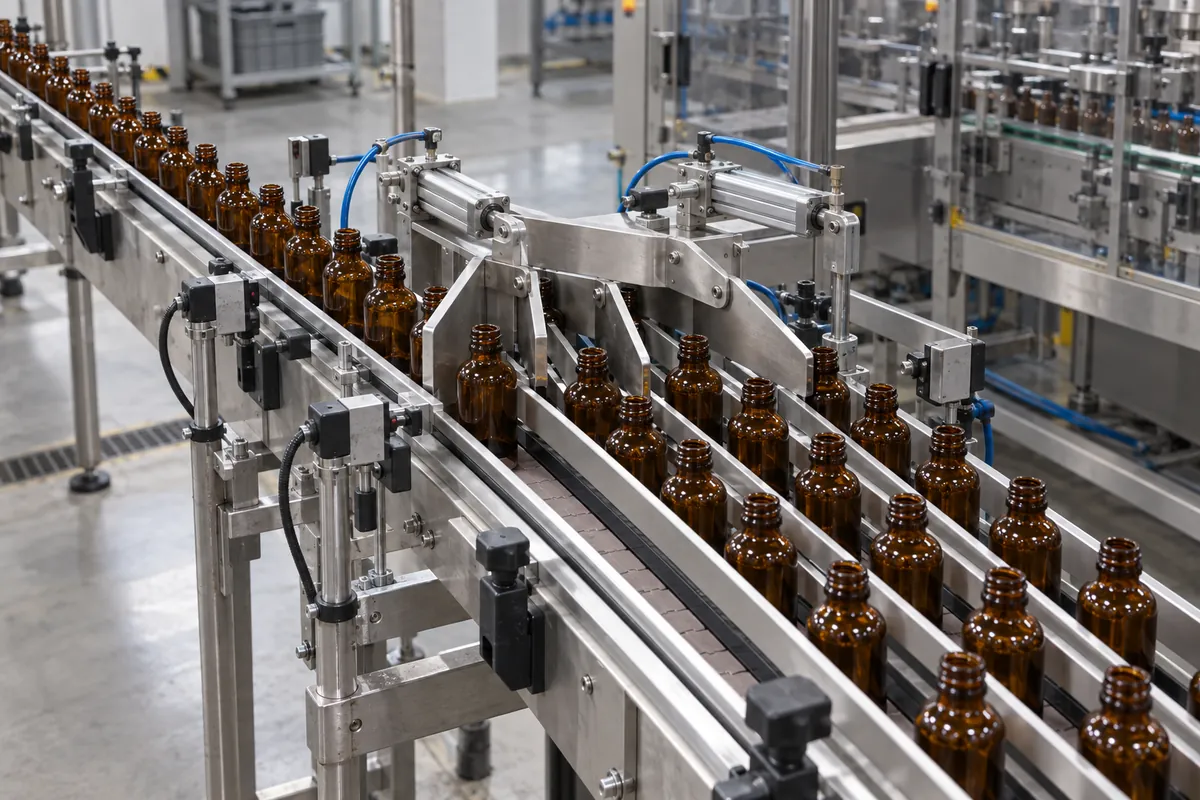
Accumulation tables
Where a line needs a larger buffer for bottles, a bi-directional accumulation table is common. A supplier describes it as a table whose belts shift product continuously from upstream or downstream direction, so bottles stay on the table until a filer or rail guides them to the next machine. The same description notes that bottles are reintroduced on a last-in first-out basis. Other tables loop the stream so that no back pressure builds. The accumulation guide linked above covers these.
Guide rails and changeover parts
Guide rails look like the least interesting part of a bottle conveyor, and they decide whether the line runs. A rail has to hold the bottle upright without pressing it.
Position comes first. Set too wide, rails let bottles wobble and zigzag. Set too tight, they add friction and make the bottle drag. The right width is a small clearance beyond the bottle’s widest point, and it changes with every format. Height matters as well. One rail at a single height works for a stable bottle, but a tall or light bottle may need two rails, one low and one high, so it cannot pivot.
Rail material is chosen with the container. Plastic rails are easy on labels and finishes, and metal rails last longer on heavy glass. A rail that scuffs PET or marks a printed label causes rejects.
Adjustment method decides how repeatable the setup is. Manual rail clamps are cheap and slow, and operators set them differently from shift to shift. Quick-release brackets, scaled rail positions, hand cranks that move both rails together, and motor-driven rails reduce changeover time and make settings repeatable. Star wheels, screws, neck guides, and special chain or rails for odd shapes are format parts. A supplier should list them for each container on the quote, because forgotten format parts are a common source of changeover cost.
Conveyor makers treat changeover as a design question. A pressureless combiner, for example, is promoted partly because it needs little rail adjustment. Ask how many adjustment points a changeover has, which tools are needed, and how settings are recorded.
Low back-pressure handling
Back pressure is the force bottles exert on each other when a stream is stopped or squeezed. It shows up as scuffed labels, dented thin-wall bottles, rubbing marks on glass, and tilted bottles at the front of a queue. It also pushes bottles into guide rails, which raises friction and makes the chain stutter.
Low back-pressure design combines several tools. Each section downstream runs a little faster than the one before, so the stream thins out gradually instead of being forced to narrow. Pressureless combiners and loop tables replace squeezing rails with spreading chain speeds or looping flow. Wide mass sections give bottles room, and the stream is narrowed only when a machine is ready. Brakes and gates hold bottles without impact. Photo-eyes watch for build-up and tell the upstream section to slow, so a queue never presses hard against a machine infeed.
Whether a line needs this depends on the container. A thick, round glass bottle tolerates a moderate amount of pressure. A lightweight, thin-wall PET bottle or one with a paper label usually does not.
Lubrication: wet, dry, and lube-free
Lubricants lower the friction between the chain and the bottle, and between the chain and the guides, so bottles slide instead of grabbing and tipping. A supplier sorts the available systems into four groups: wet systems based on chemicals and water, semi-dry systems that are more concentrated, dry systems based on oil, silicone, or PTFE, and micro-lubrication that doses very small amounts. In qualitative terms the options differ as follows.
Wet lubrication sprays a water and chemical mixture onto the chain. It lowers friction effectively and also washes the chain, but it uses water and chemical, wets the floor and the outside of containers, and adds drainage and waste handling. Wet containers also affect downstream labeling and case packing.
Dry lubrication places a small dose of lubricant, often oil or PTFE based, on the chain or the guides at timed intervals, using brushes, shoes, nozzles, or direct-contact injectors. The film is thin and the area stays dry, which reduces water and cleaning effort. The cost moves to the dosing equipment, the lubricant itself, and keeping the dosing points working.
Some lines, mainly with PET, run lube-free on low-friction chain and wear strips with no added lubricant. Whether that works depends on bottle shape and stability, chain material, and conveyor length, because friction adds up along a long run. Suppliers publish friction guidance for their own chain, and the practical check is a trial with the actual container on the actual chain.
None of these is universally best. Wet lubrication is established and forgiving, dry lubrication cuts water and mess, and lube-free is the cleanest when the container allows it. When comparing quotes, ask what the lubrication assumption is, because a lube-free design may be sensitive to a bottle change that a lubricated one would absorb. If the line is in a food or beverage plant, ask about the lubricant’s food-contact rating too.
Air conveying for empty PET
Empty plastic bottles with a neck ring, such as most PET bottles, are commonly moved on air conveyors between a blow molder and a filler. Fans blow air that pushes the bottles along neck guides while the bottles hang by the neck ring. One supplier explains that the container must have a neck ring or another shape that lets it hang from the guides. The same source says that curves and inclines in the wrong place can produce jams, that the guide material matters for scuff-sensitive and dark-colored bottles, and that electronic speed control and a trial with the customer’s bottles are worth asking for. Air conveying is a specialized product, and this page covers it only briefly. The conveyor overview describes where it fits in a line.
Twist conveyors: inverting bottles for rinsing or redirection
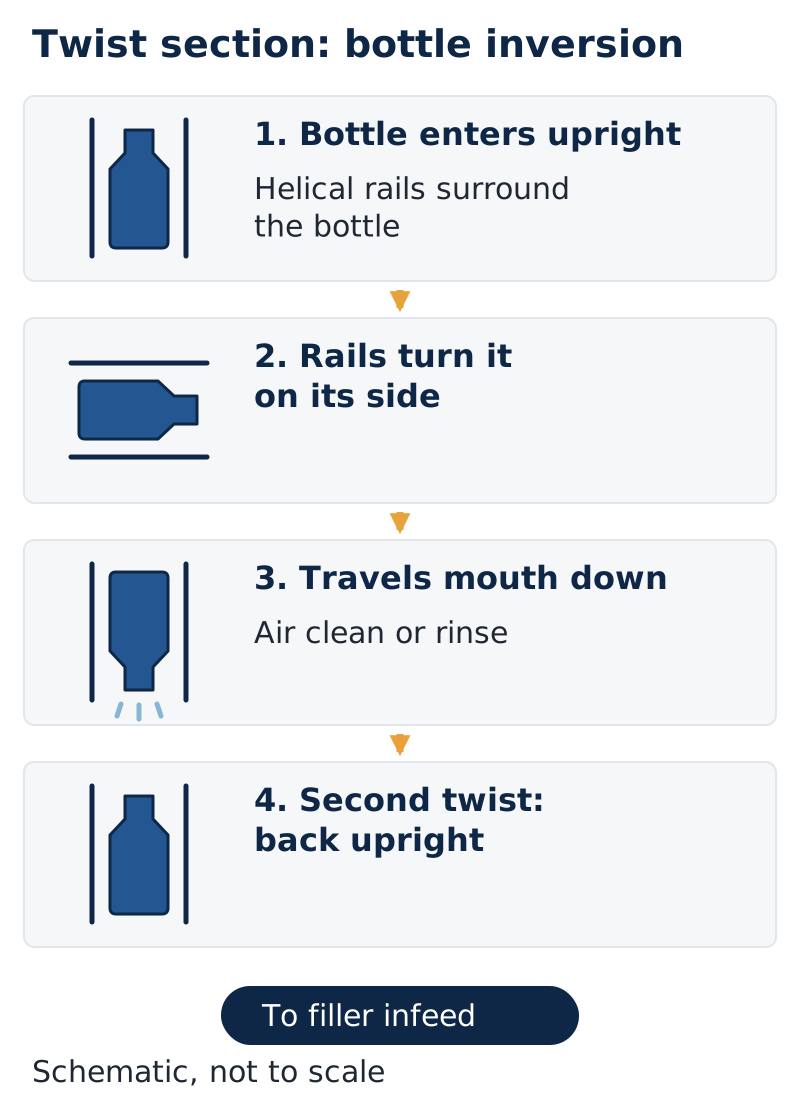
A twist conveyor turns containers end over end while they keep moving. The usual form is a set of rails bent into a helix around the container path. The rails surround the bottle on several sides, so the rails support and guide the bottle as the path rotates. A conveyor belt or gravity pushes containers through the twist. One twist turns a bottle upside down, and a second twist further along turns it upright again. Turning cartons and shipping cases is a different job, covered in the case conveyors guide.
Where twists are used
The most common job is rinsing. Empty containers are inverted so the open mouth faces down, cleaned with air or water while inverted, and turned back upright before the filler. Inline Filling Systems’ public Twist Air Rinser description specifies dedicated UHMW twists for each container size and ionized-air cleaning with vacuum extraction; it also describes a wet-rinse option (accessed October 8, 2026). A container-handling supplier lists other inverting jobs as well: turning containers for the next machine, lifting them so a code can be printed on the exposed face, inverting hot-filled jars so the sauce heats the cap, and inverting one lane on top of another for stacked or multi-pack products. The rinser itself is outside the scope of this page. What matters here is how the conveying side presents bottles to it and takes them away.
Twists are not only for empties. One manufacturer sells a horizontal twist for full cans and jars that rotates each container 180 degrees using only the push of the conveyor belt beneath it. Ask whether a proposed twist is designed for empty or full containers, because the forces on the rails differ.
Keeping empty bottles under control
An inverted empty bottle is held only by the rails. The bottle needs controlled spacing and feed pressure at the twist; excessive back pressure can force a bottle against the rails and jam the stream. For that reason twists are often paired with a timing screw that spaces each container before the inverting section. The entry and exit of the twist, where the bottle changes from riding on the chain to riding in the rails and back, are the usual jam points. Those transitions deserve the same attention as combiners.
The Inline Filling Systems Twist Air Rinser uses size-dedicated twist modules. Morrison’s public inverting article describes container-specific UHMW or metal twists and screws that can become change parts on multi-format lines (both accessed October 8, 2026). Confirm the parts list for the proposed design instead of assuming all inverters share one format rule.
PET versus glass in a twist section
The difference comes from weight, stiffness, and surface, not from the twist principle.
- Lightweight PET. An empty PET bottle has very little weight holding it against the rails, so neighboring bottles, air currents, and the cleaning air itself can move it. Thin walls can deform if rails are set tight, and glossy or dark bottles scuff where they slide on the rails. Plastic rail surfaces, steady spacing, and a rail setting that holds without squeezing matter most. If empty PET travels on an air conveyor, ask the supplier how bottles stay controlled at the neck through the inverting section.
- Glass. A glass bottle is heavier and rigid. It carries more momentum into the twist, presses harder on the rails as it turns, and can chip or break if bottles collide at the entry. Wear-resistant rails, gentle entry, and a way to clear broken glass from the twist matter most.
- Cans. Empty cans are very light, like PET, but have rigid walls and rims. Rim contact and dents at the entry are the points to check.
What to ask before buying a twist section
- Which containers will run through it, and which twist set covers each one?
- Is it designed for empty or full containers?
- How are containers spaced before the twist, and what happens if a bottle arrives early?
- How are twist sets changed, and how is alignment checked afterward?
- How is a jam cleared, and how is the twist guarded while it runs?
- Can the supplier run the actual bottles, empty, at the target rate before the order is final?
Inverting trial record
Record observations for every container format before using the commissioning and acceptance checklist.
| Container size / ID | Empty or filled | Twist / rail contact | Trial result | Acceptance action |
|---|---|---|---|---|
| Record diameter, height, finish | Record state and weight | Part IDs, contact points and guide setting | Scuffs, tipping or jams at entry / exit | Confirm agreed result or revise setup |
| Repeat for smallest format | Record actual trial state | Check support through inversion | Record stop and restart behavior | Repeat after changeover |
| Repeat for largest format | Record actual trial state | Check clearance and collision points | Record rate and inspection findings | Sign off only against agreed criteria |
Sanitary conveyor construction on bottle lines
Bottle lines are often wet. Rinsers, wet lubrication, spills, and washdown all put water and product on the conveyor frame. A sanitary conveyor is built so that residue has nowhere to collect and every surface can be reached for cleaning. Gough Econ’s public hygienic-design article describes cleanable joins, open access and drainage, and discusses 316L for chloride-rich wet processing (Strategic Material Selection section; accessed October 8, 2026). This is that manufacturer’s guidance, not proof that a grade alone ensures cleanability or chemical resistance. Confirm material compatibility with the actual cleaner, concentration, temperature and exposure, as well as the frame and drain details.
Sanitary construction costs more, so match it to the cleaning method the area actually uses. Ask which guideline the design follows and how that is documented, which parts can be removed without tools, where water drains, and what ingress rating the motors and sensors carry. A twist section or rinser infeed in a washdown area needs the same treatment as the rest of the conveyor.
Specifications to evaluate
| Specification | Why it matters | What to ask the supplier |
|---|---|---|
| Container range (diameter, height, weight, base shape) | Sets chain width, rail design, and whether a single fixed setup can cover every format | Which containers has the design run, and which formats are outside the design envelope? |
| Line rate and peak rate | Single-file speed, chain speed steps, and combiner capacity depend on the rate the line really runs, not an average | At what rate was the design tested, and how does it behave at the peak and during recovery after a stop? |
| Conveying surface (tabletop chain, modular belt, other) | Chain material and plate style determine friction, noise, and scuffing | Which chain and wear strip material do you propose, and why for this container? |
| Back-pressure tolerance | Thin-wall, light, or labeled containers cannot take much pressure | How is pressure controlled in mass sections and combiners, and can you show a trial? |
| Lubrication approach | Affects water use, floor condition, cleaning, and sensitivity to format changes | Is the design wet, dry, or lube-free, and what happens if a format changes? |
| Guide rail system | Controls stability, label contact, and changeover time | How are rails adjusted, how many points are there, and are settings repeatable? |
| Changeover parts and time | Format parts and manual steps drive downtime and spare cost | Which parts change per format, and what is the expected changeover procedure? |
| Combiner and divider capability | These are the usual jam points | What is the jam recovery sequence, and which sensors detect a blockage? |
| Sanitation and materials | Frame, chain, and motors must suit the cleaning method | Which parts are rated for washdown, and how is the frame cleaned and drained? |
| Noise | Bottle impact and chain noise affect the hall | What noise level do you expect at the quoted rate, and with which options? |
| Controls and interlocks | Stops, restarts, and rejects must be coordinated with machines | How do the conveyor controls communicate with the filler and the labeler? |
| Trial or test | Container behavior is hard to predict on paper | Can you test our actual bottles at the target rate before we commit? |
Product compatibility
When evaluating a new shaped-bottle grouping stage, the RoboSELEX integration review explains the receiving-packer interface, stop response and published changeover-time discrepancy.
Glass
Glass bottles are heavy and stable, tolerate more back pressure, and usually run on stainless steel or heavy-duty chain. The risks differ from PET. Glass touching glass can chip or mark, noise is high where bottles collide, and a broken bottle sends fragments into the chain and the machines. Rails and wear strips need to resist abrasion, and the line usually needs a way to clear broken glass safely. Friction between neighboring bottles can rise when glass is wet, which increases the chance of bridging at conventional single filers.
PET and other plastic
Plastic bottles are light, can be thin-walled, and scuff easily, especially in dark or glossy colors. Empty PET bottles are unstable and are often moved by air. Full PET bottles are steadier but still prefer low back pressure and plastic contact surfaces. Lightweight bottles are also sensitive to air currents, speed steps, and transfer gaps. Friction is a design variable, which is why lube-free running is mostly discussed for PET.
Cans
Cans are round, light, and stable once full, and they have rigid rims. They roll if they tip, and empty cans are very light, so they are often moved on air or on narrow dedicated conveyors. Filled cans run on tabletop chain or belt much as bottles do, with attention to rim contact, scuffing of labels or printed surfaces, and the dent risk from impact.
Other containers
Jars, vials, and non-round bottles each bring their own problems. A non-round container has a preferred orientation, tips more easily on its narrow axis, and may need pressureless combining so it is not forced to rotate in a rail. Give the supplier drawings or samples.
Integration upstream and downstream
Upstream, a bottle conveyor usually takes containers from a bottle depalletizer, a bulk feeder, or an air conveyor, often through a rinser. The first conveyor after a depalletizer has to accept a layer of bottles, spread them out, and send them toward single file. That handoff sets how steadily the line is fed.
Downstream, the conveyor serves the filler, capper, labeler, inspection station, and finally a case packer or tray packer. Each handoff needs speed matching, a height match, a minimal transfer gap, and a plan for stops. After the case packer, the flow moves to case conveyors and on toward palletizing. The section on palletizing covers the end of the line, and the palletizer selection guide shows what a palletizer expects from the conveyors that feed it.
Buffers between machines keep a stop on one machine from stopping the entire line. The accumulation conveyors guide explains the sizing method. Bottle buffers typically sit between the filler and labeler and between the labeler and case packer, since those machines stop independently.
Bottle conveying is also covered from the application side in bottle handling, and from the plant side in bottled water packaging.
Footprint, utilities, controls, and safety
Combiners, dividers, and accumulation tables take floor space that straight conveyors do not. A conventional single filer often needs extra length to narrow a wide stream, while loop tables and vertical spirals trade floor space for height. Ask for a layout drawing that shows all transfers, the accessible side of each machine, and walking paths.
Tabletop and belt conveyors need electrical power for drives. Dividers and gates may need compressed air. Wet lubrication needs water and drainage, and dry lubrication needs a dosing unit and a lubricant supply. Air conveyors need fans and filtered air. Confirm each utility and its quality with the supplier.
Photo-eyes and drives communicate with the filler, labeler, and case packer so the conveyor slows when a machine slows and stops when a machine stops. Ask about jam detection and the restart sequence after a stop, because a clean restart without manual clearing saves time.
Chains, sprockets, transfer points, and drives create pinch and nip points. ASME B20.1 is the conveyor safety standard in the United States, and its published scope addresses hazards across the life of a conveyor, from design and construction through installation, upkeep, inspection, and daily operation. In general industry, OSHA requires guarding under 29 CFR 1910.212 and control of hazardous energy under 29 CFR 1910.147. Lockout and tagout apply to servicing and maintenance. OSHA states that normal production operations are covered under a different subpart, with servicing during production covered when a guard is removed or bypassed or when a person must reach into a danger zone. Bottle lines add specific items: glass breakage needs a safe cleanup method, wet floors need drainage and slip control, and lubricant and cleaning chemicals need safe handling. The supplier and the plant safety team decide how the rules apply to the installation.
Cost factors
This page does not give prices. Conveying length and the number of transfers set the base, since more length and more handoffs mean more frames, drives, and rails. Chain material, belt style, and frame material (stainless or painted steel) change the price. Combiners, dividers, and tables are specialized machines whose cost scales with lane count and rate.
Format flexibility trades purchase price for changeover time: motorized rail adjustment, recipe-driven setups, and quick-change parts cost more up front and less at each changeover. The lubrication system carries different equipment, consumable, and water costs depending on whether it is wet, dry, or lube-free. Washdown and sanitary design add cost through stainless frames, drainage, and sealed motors. Sensors, PLC work, and links to filler and labeler controls make up the controls and integration cost, and testing, installation, and training come on top.
The packaging conveyor cost guide breaks these drivers down further.
Selection checklist
- List every container you will run now and in the next few years, with drawings or samples.
- State the target rate, the peak rate, and the longest stop the line should ride through.
- Mark where the line needs single file, mass flow, and buffers.
- Decide how containers tolerate back pressure and whether combiners are needed.
- Choose the lubrication approach with the supplier and test it on your containers.
- Define how rails will be adjusted and how settings are recorded.
- List the format parts for each container and who stocks the spares.
- Confirm the cleaning method and the frame, motor, and drain design that goes with it.
- Ask for a trial on your containers at the target rate.
- Review guarding, emergency stops, and lockout points with the plant safety team.
The commissioning and acceptance checklist covers questions that apply to any machine on the line.
Common mistakes
- Choosing the conveyor for the average bottle. The odd format runs a week a year and then stops the line, so include the worst case.
- Squeezing mass flow through rails. A narrowing funnel that works at low rates bridges at high rates, and each jam is a stop.
- Ignoring friction. A lube-free assumption without a test can make bottles drag, while an over-lubricated chain can make them slide off at inclines and transfers.
- Skipping the trial. Bottle behavior is hard to calculate, and trials expose problems that drawings do not.
- Leaving out format parts. The quote covers the first container, and each new one needs more parts.
- Treating transfers as an afterthought. Gaps, height steps, and speed mismatches at transfers tip more bottles than long straight runs.
- Forgetting the operators. If rail setup is hard to repeat, settings drift between shifts.
Alternatives
An air conveyor replaces chain for empty plastic bottles with necks. A star wheel or screw transfer handles short moves between machines. A gripper conveyor holds bottles by the neck for unstable shapes and for transfer through rinsers and over level changes. Vertical accumulators and loop tables suit buffer duty with little floor area. For bottles already in cartons or trays, a case conveyor is the right choice, and for bulk container delivery at the front of the line, bulk depalletizers feed containers onto the first conveyor.