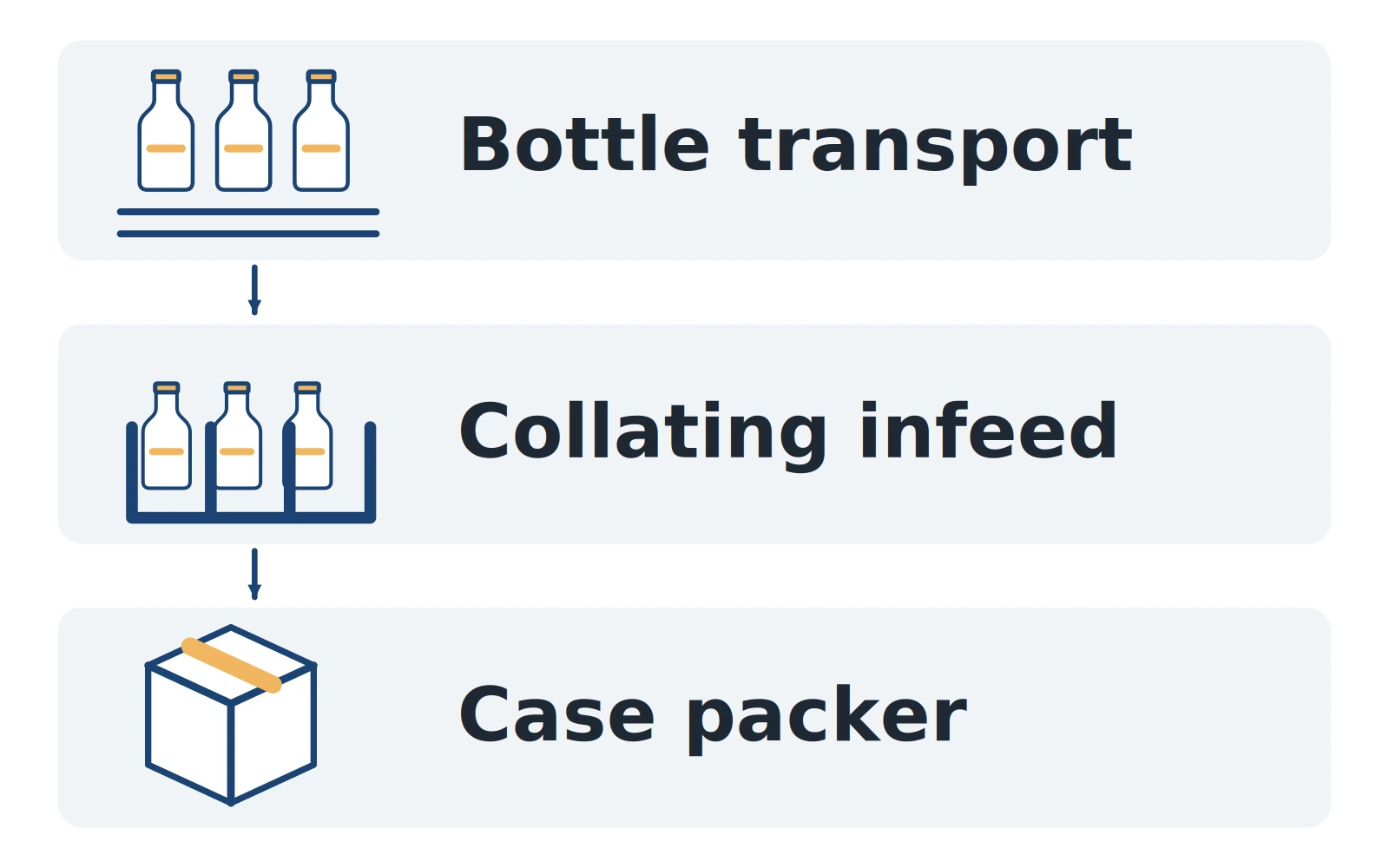
An unresolved handoff at the case packer can cause downtime after an infeed upgrade. Evaluate Sidel Cermex RoboSELEX as a bottle-collating interface, with the bottle transport and receiving packer defined separately.
RoboSELEX is a robotic collating infeed for case packers, not a complete case packer. Sidel’s announcement and product page describe a continuous-motion system for shaped, lightweight bottles. For a US end-of-line project, the decision is whether your bottles can reach the grouping system, remain controlled through transfer and enter the packer in the required arrangement. Start with actual filled bottles and the packer’s receiving conditions, then agree how the upstream line reacts to a downstream stop. Published speed and changeover figures remain manufacturer claims, not verified whole-line results.
Key points:
- Keep bottle flow separate from finished cases per minute.
- An accumulation-free grouping stage does not define the whole line’s stop strategy.
- Same-bottle collation changes and different-bottle changes are different tasks.
- Confirm the receiving-packer interface and any proposed removal of bottle carriers.
What was announced, and which projects should investigate?
Sidel’s March 10, 2026 announcement said RoboSELEX would premiere at Interpack 2026. The announcement describes Food, Home and Personal Care applications. The product page identifies a collating system using two Delta robots. This is a reason to investigate bottle grouping, not evidence that a particular installation is complete or available locally.
| Public record | Date | What it establishes |
|---|---|---|
| Sidel Interpack announcement | March 10, 2026 | Manufacturer’s plan to introduce RoboSELEX |
| Official product page | Checked October 8, 2026 | Manufacturer’s published features and conditions |
| US supply, installation and acceptance | Subject to supplier quote | Requires a project-specific supplier schedule |
For an edible-oil or sauce line, record the filled bottle rather than relying on the empty-container drawing. For home or personal care, record the closure, label and surface condition used in production. These are our proposed sample-review inputs, not claims about successful processing of those products.
| Reader’s project | Interface question | Evidence to request |
|---|---|---|
| New lightweight bottle | Can it be conveyed and transferred as intended? | Demonstration with production-representative bottles |
| More case arrangements | Can the required groups be delivered to the packer? | Format matrix and receiving specification |
| Existing line retrofit | What changes at the infeed and controls boundary? | Drawing and responsibility schedule |
The bottle-handling overview provides the handling context. The robotic case-packing guide covers the later loading operation; the presence of robots at the grouping stage does not merge those scopes.
Takeaway: Investigate the proposed bottle route before assuming an existing packer can accept it.
How should bottles per minute translate into the packer’s demand?
Compare the published bottle rate with the count in your case recipe. Dividing bottles per minute by bottles per case gives a theoretical case equivalent. That calculation helps check units, but it does not include transfer losses, interrupted flow or the packer’s available operating time. Keep the counted output point visible in the specification.
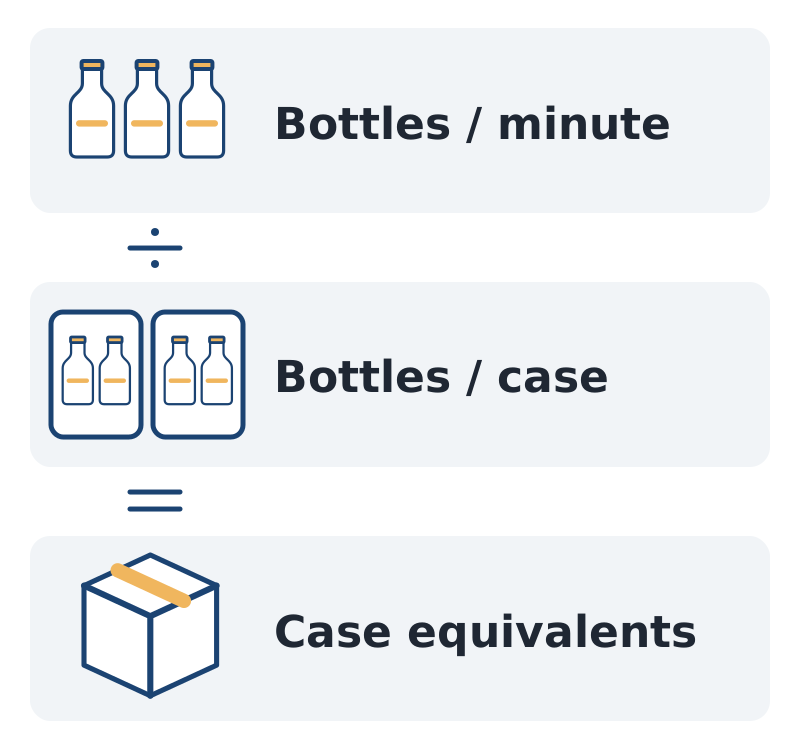
Sidel’s product page, checked October 8, 2026, publishes 80–320 bottles/minute and arrangements from 3 × 1 to 8 × 6 products, depending on product size. Those are manufacturer-stated ranges; the endpoints are not a demonstrated performance combination.
Theoretical cases/minute = bottles/minute ÷ bottles/case
| Rate record | Source of input | What to compare |
|---|---|---|
| Required bottle inflow | Production plan | Filled-bottle flow during the chosen run |
| Bottles in each case | Approved packing recipe | Actual arrangement and transfer orientation |
| Required good-case output | Production target | Count at the agreed finished-case point |
| Receiving-packer capability | Written supplier offer | Same bottles, group and operating conditions |
Do not divide the top speed by the largest arrangement and publish the answer as system capability. The case-packer guide helps define loading requirements. Check the case-erector guide when empty-case supply is part of the project: adequate bottle grouping cannot compensate for a missing receiving case.
Common mistake: Treating the maximum published bottle rate and maximum group size as one verified operating point.
Takeaway: Ask for a supported operating point for each recipe, not separate maxima.
What does accumulation-free operation leave to the line designer?
Sidel describes the collating stage as continuous-motion and accumulation-free. That statement does not identify where bottles wait elsewhere in a stopped line. Request the response to packer unavailability and the conditions for resuming infeed, including what happens to bottles already between the upstream equipment and the group transfer point.
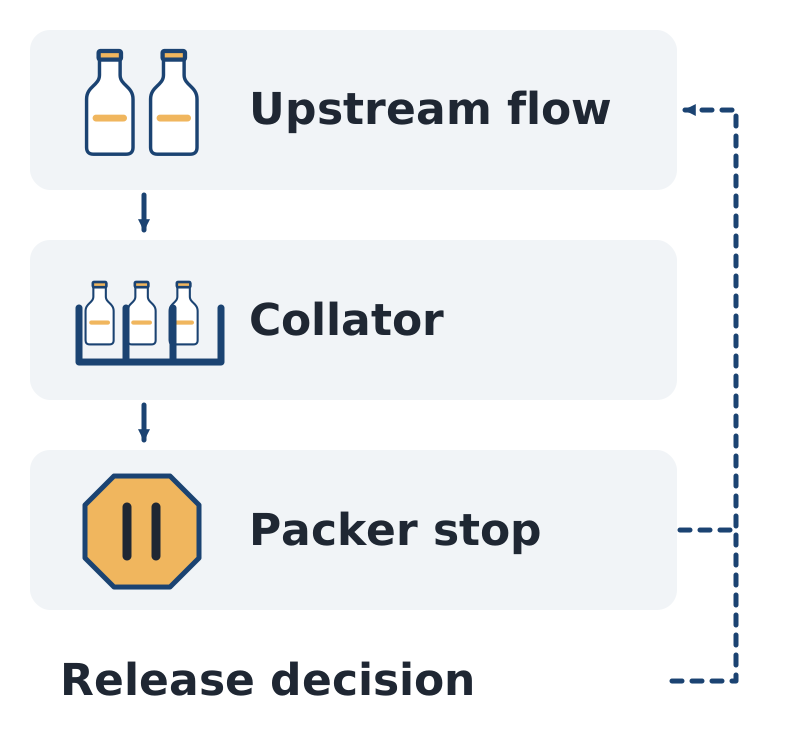
| Disturbance to review | Decision needed | Responsible parties to identify |
|---|---|---|
| Packer cannot receive the next group | Stop or slow upstream discharge; handle current bottles | Infeed and packer suppliers |
| Bottle flow becomes irregular | Restore agreed spacing and release sequence | Upstream transport and infeed suppliers |
| Group is incomplete or misplaced | Detect, hold or reject using agreed criteria | Controls and quality teams |
| Line restarts | Decide who releases bottles and accepts the first group | Operators and integration lead |
The bottle-conveyor guide helps separate ordinary transport from grouping. Use the accumulation guide to frame the holding question, without assuming that the bottle is suitable for pressure accumulation. A photograph of a buffer cannot establish suitability for the proposed shaped bottle.
Takeaway: Write a disturbance sequence for the entire bottle path, even when the collator itself does not accumulate.
Which changeover time should be used in the schedule?
The public documents describe different changeover operations and give different figures for changing bottle format. Preserve both statements and ask the supplier to define the timed task. For production planning, record a full-line interval between accepted outputs, rather than adopting an infeed-only figure as the time for every machine to change.
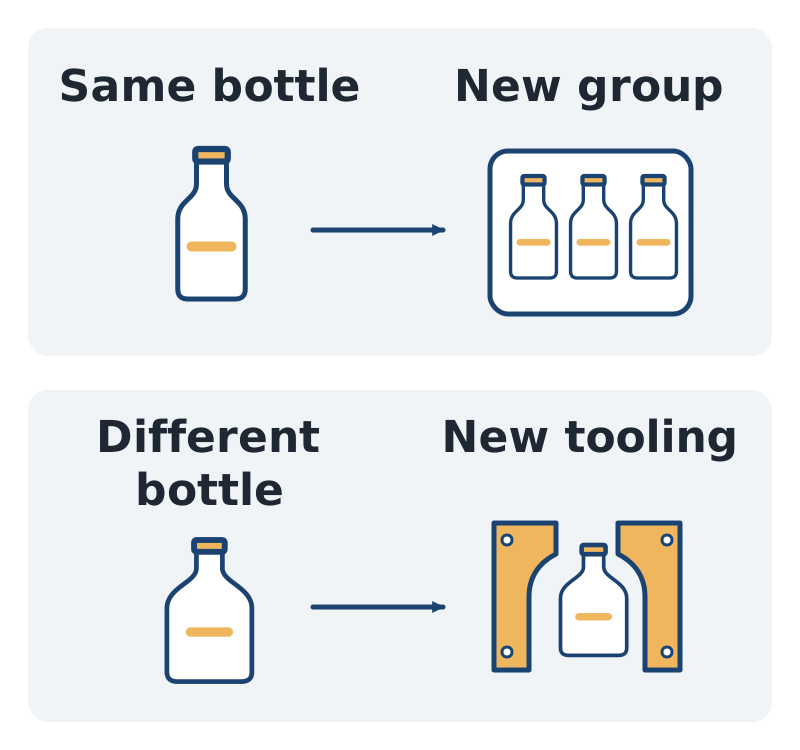
| Changeover task | Manufacturer’s published figure | Source and status |
|---|---|---|
| Same bottle, different collation | 1 minute | Official product page, checked October 8, 2026 |
| Different bottle | 2 minutes 30 seconds | Official product page, checked October 8, 2026 |
| Different bottle format | As little as 2 minutes | March 10 announcement; boundary needs clarification |
The table reports source statements, not independently timed results. Obtain the definition for each: which tools change, whether guide adjustment is included, whether upstream equipment is ready and where the timer stops. Do not average the conflicting figures or silently choose the shorter one.
The line-design guide can help assign changes by equipment owner. The layout worksheet provides a place to record access for changing tooling and guides. Arrange the review around the actual route taken by an operator, not only the nominal equipment footprint.
Takeaway: Compare the timed work and acceptance boundary before comparing the minutes.
Can the system replace bottle pucks or fit the existing packer?
Treat both questions as conditional integration studies. A puck is a carrier used to support a bottle during handling. The product page says puck removal may be possible for conveyable, non-accumulable shaped bottles; that wording does not establish that your bottles can run unsupported or that every current packer needs no modification.
For a proposed puck-free route, request the bottle sample evaluation, the unsupported-transfer drawing and the stop/restart description. Include the actual fill, closure and label. If the bottle cannot follow the proposed route, retain a supported handling option in the scope review rather than inferring suitability from a promotional phrase.
For the receiving packer, list group dimensions, orientation, transfer height and motion, ready-to-receive signals and handling of an incomplete group. Ask each supplier to identify its boundary on the same drawing. Use the integration overview to organize that handoff and the commissioning guide to define the demonstration record.
Common mistake: Reading “designed for case packers” as confirmation of a retrofit to a specific existing machine.
Takeaway: Require a supported bottle route and an agreed receiving interface before removing carriers or approving a retrofit.
What should be confirmed before procurement?
Investigate during the bottle-format or packer-interface review, before the equipment scope is fixed. The reviewed documents do not establish a US delivery date, regional service plan or project price. Turn the missing information into named document requests, with unresolved items kept outside the accepted scope until the responsible supplier answers them.
| Unresolved item | Who can confirm it | Document or demonstration |
|---|---|---|
| Rate for each bottle and group | Equipment supplier | Format-specific performance commitment |
| Existing-packer modifications | Both equipment suppliers | Coordinated interface drawing |
| Changeover boundary and timing | Supplier and operations | Timed task definition and test record |
| US supply and support | Regional supplier organization | Offer and service responsibilities |
| Price and included scope | Supplier and buyer | Itemized commercial offer |
| Whole-line improvement | Project acceptance team | Defined before/after measurement plan |
Takeaway: Ask for the missing operating point and scope, rather than buying a headline range.
When this does not apply
This article does not select tooling, approve machine safety or establish suitability for beverage bottles. The reviewed announcement specifically discusses Food, Home and Personal Care; broader product use needs supplier confirmation. It also provides no independent OEE, damage-rate or cost-saving evidence. Keep those outcomes as project acceptance questions.
Takeaway: The public description narrows what to investigate; it does not approve the application.
Method and sources
This article is part of the packaging equipment guides. This explanation uses Sidel’s March 10, 2026 release and official RoboSELEX product page, reviewed October 8, 2026. Both are manufacturer sources, counted as one origin for the announcement. The changeover discrepancy is retained. Unit conversions and project checklists are editorial interpretation; no independent trial, local availability, retrofit compatibility or full-line output is claimed.