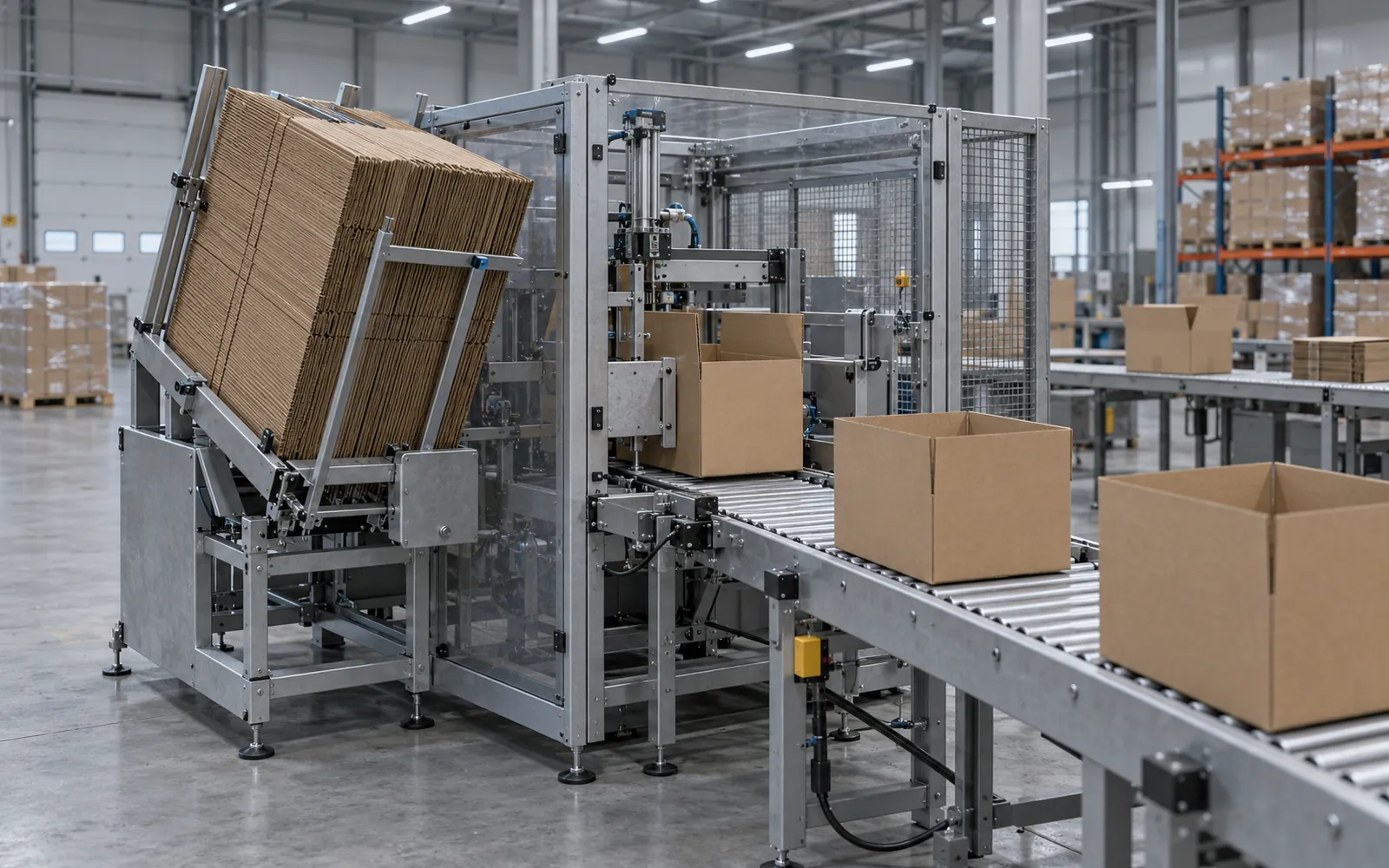
An out-of-square case can block loading and sealing. Choose a case erector from RSC/HSC style, bottom closure, size sequence, and changeover frequency, then test production blanks through the downstream handoff.
| Input | Choice / evidence to record | Why it matters |
|---|---|---|
| Case style | RSC has top flaps; HSC has no top flaps; confirm drawings and supported styles | HSC needs a separate lid or other top-closure route |
| Bottom closure | Tape, hot melt, or a compatible mechanical-lock blank | Sets consumables and forming/closure scope |
| Size sequence | One size per batch or a specified random-size set | A standard size change and random forming are different tasks |
| Change frequency | Formats/shift and timed last-good to stable-next-good change | Reloading, adjustments, and checks affect case availability |
| Blank condition | Production lots, warp, scores, joint, and caliper | Square opening and reliable pickup need a proven blank range |
See the end-of-line overview, case packers, and case sealers for the connected stations.
How it works
Most automatic erectors follow the same cycle for a regular slotted container, or RSC, which is the common shipping case with four flaps on top and four on the bottom.
Knocked-down blanks are flat, folded once at the manufacturer’s joint, and stacked in a magazine. The magazine may hold the stack vertically or horizontally, and the operator reloads it from the side or the top. Longer magazines or extensions allow more running time between reloads, at the cost of floor space.
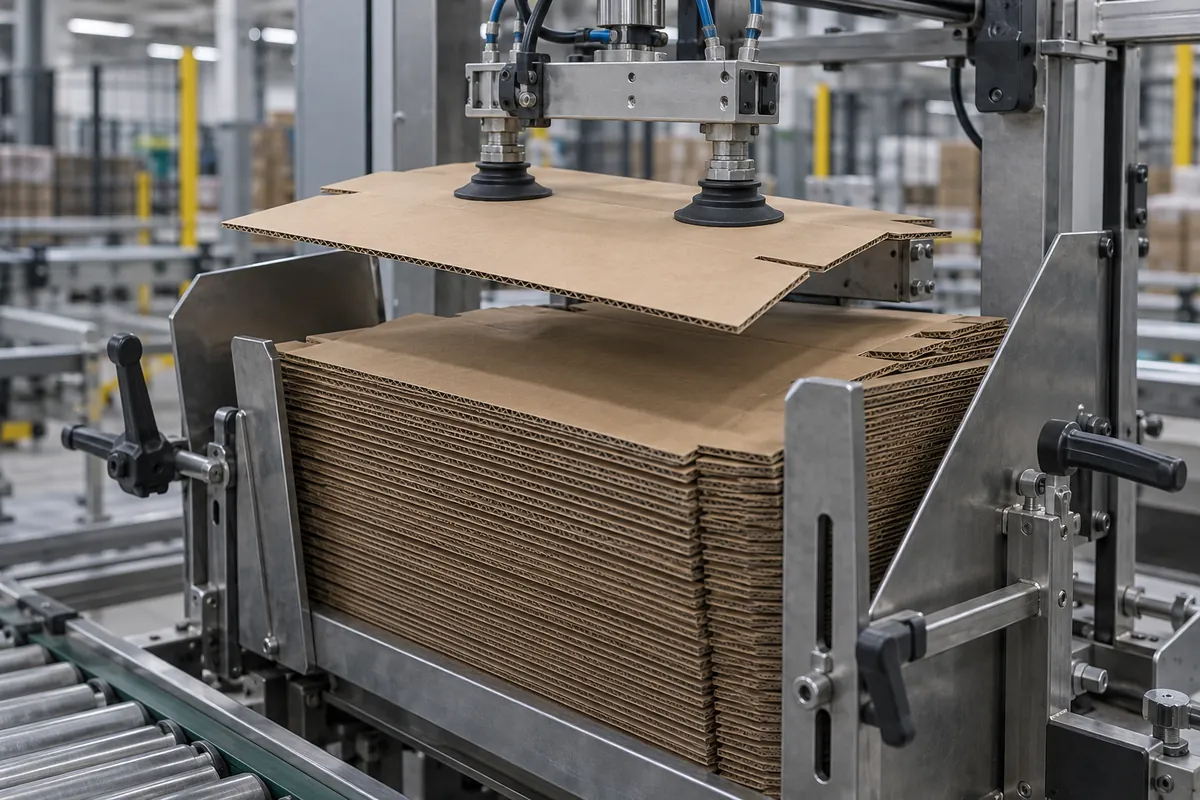
A pick-up device removes the front blank from the stack. Vacuum cups are the most common method, though some machines use mechanical pickers such as pins. The blank has to separate cleanly from its neighbors, and this is where warped or damp blanks cause misfeeds.
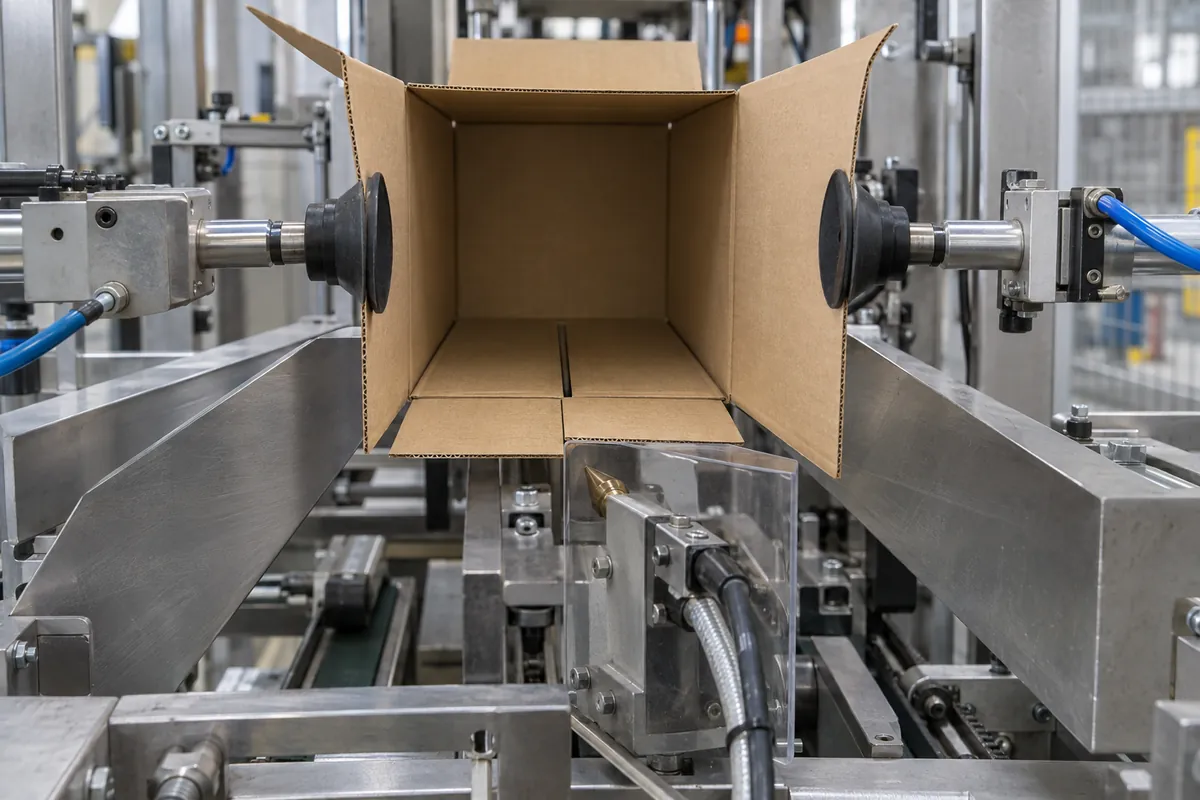
The machine then opens the folded blank into a tube. Some designs draw it against fixed plows or guides, and others use opposed vacuum on both sides. One supplier describes dual opposed vacuum that grips the case from both sides for consistent opening, and lugs that hold the case square as it travels through the closing section.
Minor flaps fold first, then the major flaps close over them. The order matters, because a flap that closes out of order will not meet the seal. Depending on the model, the bottom is closed with pressure-sensitive tape, hot melt adhesive, or interlocking tabs in a self-locking style. With hot melt, the glue is applied while the major flaps are plowed down, and the flaps are compressed until the glue sets.
The open case then leaves on a conveyor to the packing point, where a person, a robotic case packer, or another machine loads it.
Types and configurations
Erectors differ in how they feed, open, and seal cases, and in how they handle size changes.
Semi-automatic erectors
In a semi-automatic erector the operator presents or opens the case, and the machine helps with bottom forming and sealing. These suit lower volume, frequent size changes, and compact pack stations. The labor remains, but the setup is lighter and cheaper than a full automatic unit.
Automatic erectors
An automatic case erector takes blanks from the magazine, opens, squares, folds, and usually seals the bottom without an operator. It suits consistent case flow, repeatable sizes, and higher rates, with changeovers planned between runs.
Vacuum and mechanical forming
Vacuum forming is the most widespread. Cups pull the blank from the magazine and help open it, and the system relies on a clean vacuum supply and blanks flat enough to seal against the cups. Mechanical or pin-style forming uses pins or hooks to pick and open the blank without a vacuum system. One supplier highlights a vacuum-less pin-pick erector for a compact footprint and for avoiding speed loss when air pressure is low. Vacuum is simple and flexible, while mechanical pickup may be more reliable when air supply or blank condition is poor. Ask which method suits the corrugated and compressed air on site.
Horizontal and vertical magazines
A horizontal magazine lays the blanks flat in a stack, and a vertical magazine holds them upright. A vertical magazine can save floor width, while a level-placed stack allows easy replenishment without stopping, according to one supplier. The right choice depends on case size, a comfortable loading height for operators, and floor space.
Hot melt and tape bottom sealing
Hot melt machines apply adhesive to the flaps and compress them. Tape machines fold the bottom flaps and apply a strip along the seam. Some machines have no bottom seal and send an open-bottom case to a separate sealer. The tradeoffs are discussed below, and the case sealers guide covers sealing further.
Robotic random case erectors
A robotic random case erector uses a six-axis robot with a flexible end-of-arm tool and several case magazines to pick and erect different sizes, with a bottom flap folder and a tape head in the discharge path. It avoids the need for several separate erectors and the downtime of changing sizes. It generally runs at a lower rate than a dedicated erector and needs the guarding of a robotic cell.
Tray formers
A tray former is a related machine that forms open trays or specialty corrugated structures from flat blanks. It is a separate category from an RSC erector, and the case style usually decides which one applies.
Bottom sealing: tape, hot melt, and mechanical closure
The closure affects the machine, the consumables, and the case. Supplier descriptions agree on a few qualitative points.
Tape is common because it is familiar, relatively simple, and easy to maintain. A tape head has no heating element or pump, and cases are easier to reopen. A tape roll runs out, and many tape systems stop the line to change rolls unless the head has automatic splicing or a second roll. Tape adds little structural strength.
Hot melt bonds the flaps from the inside and can add strength, which matters for heavy packages or long bonds under shipping stress. It is used extensively for high-speed case assembly, and the adhesive tank can often be refilled while the machine runs. The system needs heat control, hoses, and applicator maintenance. The adhesive is processed at a high temperature, and one supplier warns that it can burn the operator if the machine is misused. Hot melt generally needs the flaps held under compression until the glue sets.
Some machines instead form self-locking (tab-lock) cases that close mechanically, with no tape or glue on the bottom. That depends on the case design, so the blank must be made for it.
Glue Machinery Corporation’s public comparison describes adhesive as less costly than tape and hot-melt systems as more costly to purchase and operate (accessed October 8, 2026). Its cost comparison is supplier guidance without a stated case/consumption basis; calculate consumables and equipment costs for the project rather than treating it as a universal saving.
Changeover
On mixed lines, changeover is often the deciding feature. Supplier materials describe three approaches.
In manual adjustment with guidance, the technician moves guides and magazine rails using scales, pointers, a changeover map, and quick-release handles, often with prompts on the screen. Time the proposed machine with a named operator, from the last good case of the old format to stable good output of the next. Servo and recipe-driven machines set the guide positions with motors from a stored recipe, which cuts hand work and the chance of error. A third group needs no changeover within a defined set of sizes: robotic random erectors with multiple magazines, or machines described as needing no change parts for a certain range.
Changeover time also includes more than the machine. The operator must unload the old blanks, load the new ones, and adjust the glue or tape. Then the first cases must be checked and the downstream machines set for the new size. Ask the supplier to demonstrate a complete changeover, including the packer and sealer, with the plant’s own cases.
Corrugated quality: warp, scores, and other issues
Combi’s April 1, 2024 troubleshooting article, reviewed October 8, 2026, describes material-related faults in its supplier experience. It does not establish the share of faults across all erectors. Compare blanks with the agreed specification and inspect machine settings too.
Use this proposed diagnostic record. Inspect removed blanks at a bench. Before reaching into pickup, folding, or closure mechanisms, authorized personnel should isolate energy under the machine and site procedure; hot-melt equipment also needs its specified cooling/service precautions. No running-machine adjustment is implied here.
| Symptom / item | Check on removed blank or isolated equipment | Box supplier action | Equipment team action |
|---|---|---|---|
| Pickup failure / warp | Blank flatness, storage condition, and lot comparison | Confirm blank flatness specification and storage instructions | Check magazine separation and pickup settings after isolation |
| Flap misfold / score | Fold sample; compare score position and cracking with drawing | Correct score against agreed drawing | Check folding sequence and guides on accepted blanks |
| Blank will not open / joint glue | Look for bonded inner faces or a crooked joint | Investigate joint alignment and adhesive application | Confirm squaring on conforming blanks |
| Tight passage / caliper | Measure thickness against agreed blank range; no universal tolerance assumed | Confirm board lot and thickness specification | Confirm machine clearance for the approved range |
Record lot, photos, observed fault, action owner, and retest result. Run production lots through the erector, packer, and sealer under the commissioning and acceptance checklist.
Takeaway: Separate a blank defect from a setup fault using the same production lot and a documented retest.
Specifications to evaluate
Rated speeds depend on the case style and size, so ask for the rate with the plant’s case on its tape or hot melt setup.
| Specification | Why it matters | What to ask the supplier |
|---|---|---|
| Case styles | RSC, half-slotted, and other styles need different handling | Which styles and sizes does the standard machine form, and what is the extended range? |
| Minimum and maximum case size | Limits the SKU range on one machine | What are the limits in length, width, and height, and how does performance change at the edges? |
| Rate | Must match the packer and the sealer | What rate is achieved with my case and closure method, and what slows it down? |
| Forming method | Vacuum and pin pick react differently to warp and air supply | How does the machine respond to warped blanks, and what are the air requirements? |
| Magazine capacity and reload | Sets running time between operator visits | How many blanks does it hold, can it be reloaded while running, and what extensions exist? |
| Bottom closure | Tape, hot melt, or lock changes cost and strength | Which closures are available, and can the machine be converted later? |
| Changeover method and time | Drives uptime on mixed lines | Which steps are manual, which are recipe-driven, and can you demonstrate it? |
| Controls and interface | Affects training and diagnostics | What PLC and operator interface are used, and are recipes stored? |
| Construction | Matters in washdown or wet areas | Is the frame mild steel, painted, or stainless, and what washdown rating applies? |
| Guarding and access | Defines safety and reload convenience | Where are the doors, interlocks, and emergency stops? |
Package compatibility
An erector works with corrugated shipping cases, most commonly the regular slotted container and the half-slotted container. Other cases, such as full overlap or special formats, may need dedicated tooling. Display trays, produce trays, and shipper styles are usually the job of a tray former. Check every case style and the full size range, plus the board grade, flute, and recycled content.
The case also has to suit what comes next. A case that forms well but is too weak for the product weight will bulge, and one that is too tight will stop the packer. Specify the erector, packer, and sealer together, and check dimensional tolerances across all three machines. Cases right-sized to the product use less corrugated and give the sealer a more stable package, so review the case design before buying a machine.
RSC and HSC: what changes for the erector
Box style names are standardized, so use them on drawings and in quotes instead of local shorthand. The Fibre Box Association’s box-style summary, which uses the international FEFCO case codes, defines the two styles an erector most often handles:
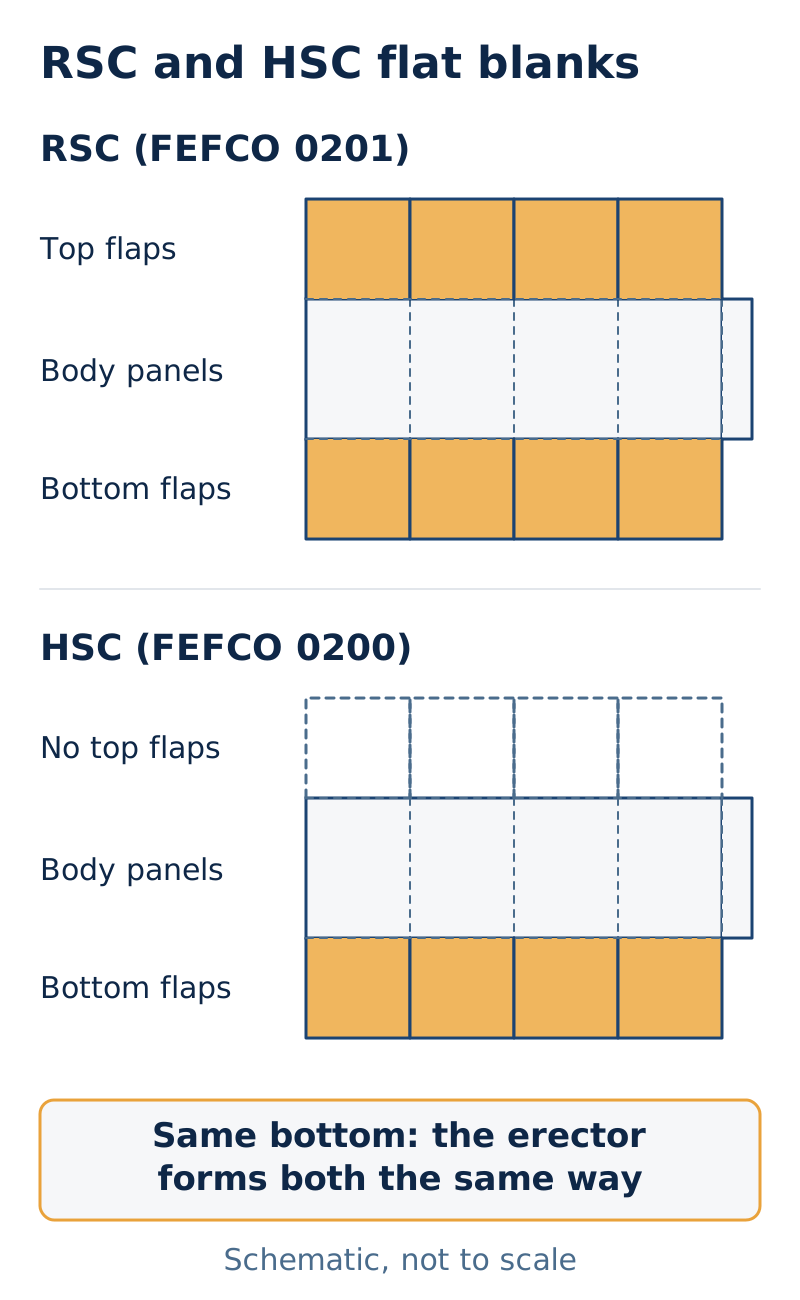
- RSC, regular slotted container (FEFCO 0201). All flaps have the same length, and the two outer flaps are half the container’s width, so they meet at the center when folded. The case has four flaps on the bottom and four on the top.
- HSC, half slotted container (FEFCO 0200). An RSC without the top flaps. The body and the bottom flaps are the same as an RSC, and the top is open.
For forming, the bottom of an HSC is built like the bottom of an RSC, so the erector’s basic sequence is the same: pick the blank, open it into a tube, fold the minor flaps, then the major flaps, and seal or lock the bottom. What changes is everything around the open top:
- Top closure moves elsewhere. With no top flaps, a downstream sealer has nothing to fold. The case is closed by a separate lid or telescoping cover, or it stays open as a tray or display. Plan that station when you plan the erector.
- Blank and size range. Without top flaps the blank is a different shape, so check that the erector’s magazine, pick-up, and size range accept the HSC blank, not only the RSC version of the same case.
- Guides and settings. Ask the supplier whether the machine’s opening, squaring, or discharge tooling uses the top flaps, and whether an HSC needs different settings or change parts.
- Trial with real blanks. Ask for a run with your own HSC blanks in the board grade you buy, since the warp and score issues described above apply to every style.
If the case range also includes overlap styles or special formats, list those separately, because the same summary treats them as different styles with different flap dimensions.
Integration upstream and downstream
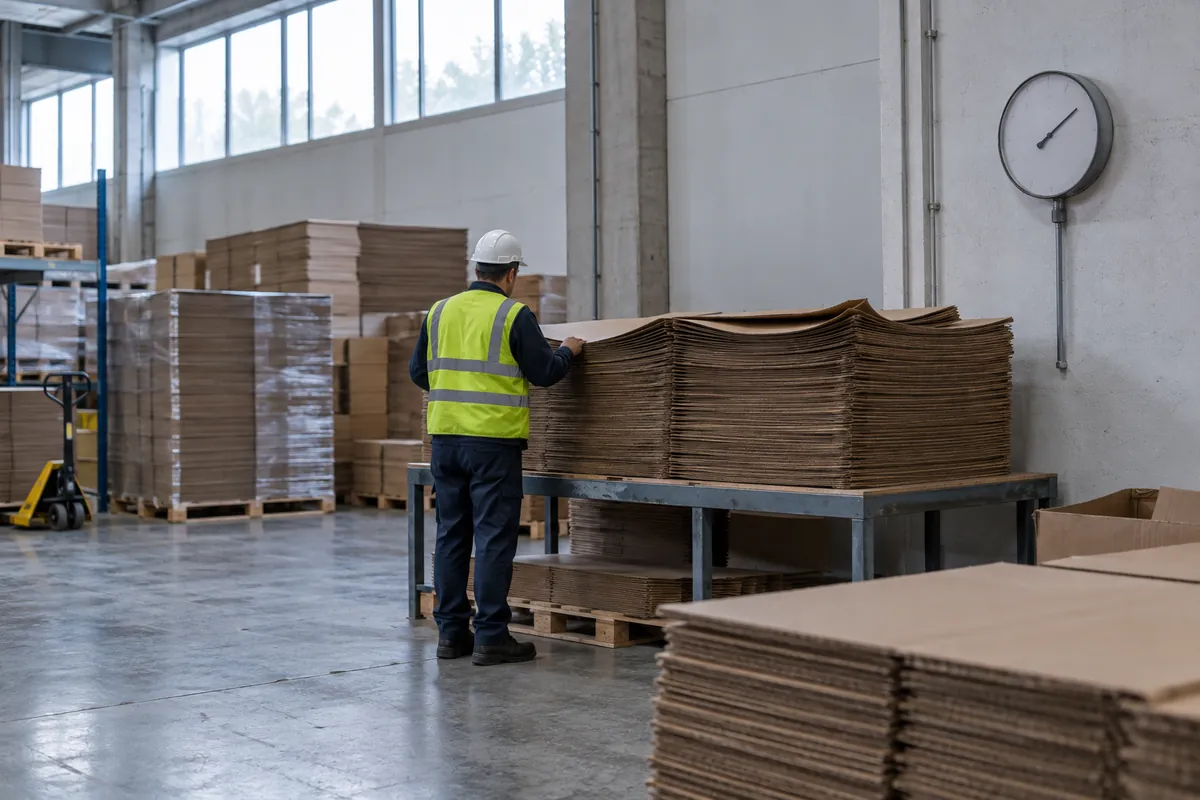
Upstream, a case erector needs a steady supply of blanks and a place to store them. Allow space for pallets of blanks near the machine, and plan the forklift path and reload height. Some plants feed blanks from an overhead or staged supply to cut operator trips.
Downstream, the formed case moves to the packing point. For manual packing, the discharge should be at an ergonomic height and the case should stop at a known position. For robotic or mechanical packing, the case must arrive in the right orientation, with flaps held open as the packer needs. The loaded case then goes to a case sealer to close the top. On some lines a single machine forms, packs, and seals.
Match the speeds. If the erector is slower than the packer, the packer starves. If case discharge is too fast, cases queue and can be damaged. Conveyors between machines need guides that keep the case square, as the case conveyors guide explains, and the packaging line layout guide helps with positioning the erector in the overall arrangement.
Footprint, utilities, controls, and safety
Allow room for the machine, the magazine and any extension, a pallet of blanks, the discharge conveyor, and the operator access doors. Vertical magazines and wall-mounted designs save width. Ask for a layout drawing with service clearance.
Expect electrical power and compressed air, since vacuum systems use air to create suction. Hot melt systems need electricity for heating and a way to supply adhesive, and tape heads need space for roll changes. Ask for the air consumption, the electrical disconnect size, and any ventilation needs.
A programmable controller with a touch screen is typical. Look for stored recipes, fault messages that guide recovery, counters, and communication with the line. Some suppliers also offer cooling or heating for the control cabinet in extreme temperatures.
On safety, pick arms, plows, lugs, and the closing section have pinch and crush points. Tape heads have cutters that can cut skin, and roll changes put hands close to them. Hot melt runs at a high temperature, so hoses, guns, and tanks can cause burns, and molten adhesive can splash or drip. Stored energy in compressed air and vacuum can move parts when released. Reloading and jam clearing are routine tasks that put hands inside the machine.
Controls include fixed guards, interlocked doors that stop the machine on opening, emergency stops, and guards on tape cutters. Where the machine’s access doors can be opened while operating, check that they stop motion. The OSHA lockout/tagout standard, 29 CFR 1910.147, applies to servicing and maintenance where unexpected startup or release of stored energy could injure employees, so include electrical, pneumatic, and thermal energy in the procedures. A site risk assessment should cover reload, jam clearing, glue refilling, and changeover as separate tasks. Robotic erectors add the hazards and safeguarding rules of a robot cell, and the robotic case packing guide covers those standards.
Cost factors
Prices vary too widely to publish a general range. The main drivers are:
- Rate: faster machines usually mean heavier construction, servo drives, and a higher price.
- Case range: a wider range of sizes and styles adds adjustment mechanisms or extended tooling.
- Closure method: hot melt systems add a melter and applicators, tape heads add their own cost, and some machines have both.
- Changeover automation: servo recipes and multiple magazines add cost, and may save labor and downtime.
- Magazine size and automatic reload: bigger magazines and adhesive feeders reduce operator visits.
- Sanitary construction: stainless steel and washdown ratings cost more.
- Guarding and safety devices: more access and more operators raise the need.
- Robotics: a robotic random erector costs more than a conventional erector for the same number of sizes.
- Consumables: tape, adhesive, and spare parts add to ownership cost.
- Corrugated: tighter specs may raise the price per blank but cut jams and rework.
For a view of how ownership costs are built on adjacent equipment, see the packaging conveyor cost guide.
Selection checklist
- List every case style and size, with board grade, flute, and recycled content.
- Decide the rate needed at the packer, with a margin for stops.
- Choose uniform or random sizing and how often sizes change.
- Choose a closure: tape, hot melt, lock, or none with a separate sealer.
- Decide the forming method and ask how it behaves with your blanks.
- Check magazine capacity and the reload approach.
- Ask for a timed changeover on your cases, including the glue or tape.
- Check how the case is presented to the packer and whether orientation matters.
- Review the guarding, interlocks, hot melt and tape-cutter hazards, and lockout points.
- Check utilities: air, power, and any heating or cooling needs.
- Agree on blank specifications with the box supplier.
- Request a factory acceptance test using production blanks.
Common mistakes
- Blaming the machine. Jams are often corrugated issues, so check the blanks first.
- Testing on hand-picked blanks, which run well. Test the worst cases from the supplier.
- Ignoring storage. Humid, cold, or poorly stacked blanks cause warp and misfeeds.
- Buying on peak speed. A rated speed with an ideal case may not hold with yours.
- Overlooking changeover. The sum of all changes counts, including the sealer and packer.
- Choosing hot melt without maintenance skills. It needs temperature control, cleaning, and burn safety.
- Ignoring case design. A case that fits the product better is easier to form and seal.
- Forgetting reload ergonomics. Heavy stacks and awkward loading cause delays and strain.
- Skipping the lockout plan. Air, heat, and glue add energy sources.
Alternatives
The right alternative depends on volume and the number of sizes.
Manual forming with a tape gun or a semi-automatic former suits low volume or many sizes, though it adds labor and variation. A semi-automatic erector, where the operator opens the case and the machine forms the bottom, is a middle step for moderate volume. Many case packers include forming, and a combined machine can save floor space. A robotic random erector is useful for many sizes with little changeover, at a higher cost and lower rate. Wraparound or tray machines form the case around the product from a flat blank, which removes a separate erector but changes the case style. High-mix operations that need cases cut to size on demand may use a right-sizing made-to-measure box machine instead of forming stock cases. Buying cases already glued and formed saves a machine but increases storage and freight volume.
In beverage operations, where cases are often formed, loaded, sealed, and palletized at high rate, the erector is typically part of a larger arrangement. The beverage packaging and case handling pages show where it fits, and end-of-line packaging automation describes the overall system.