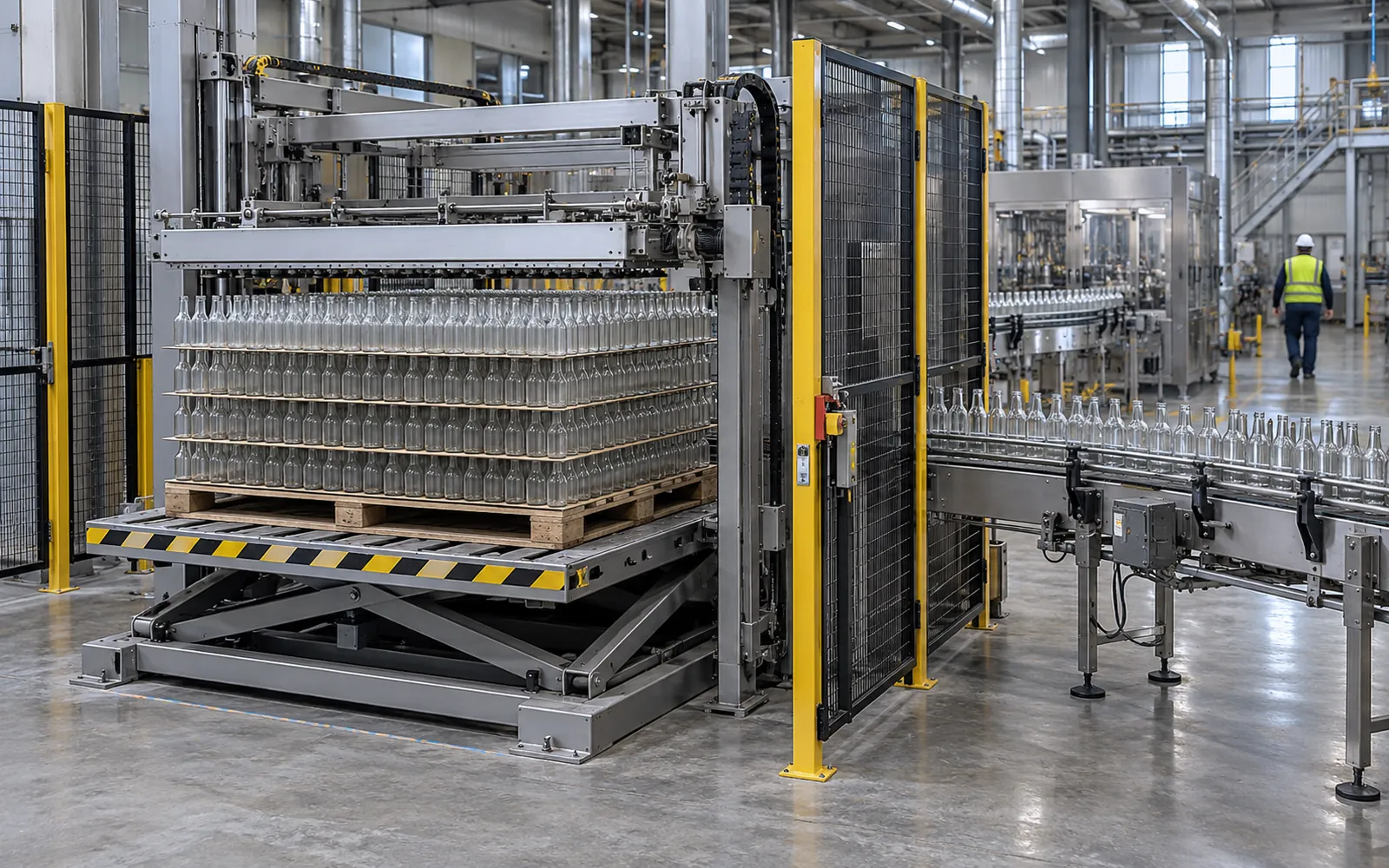
Applying a loose-container sweep to bagged bottles or packed cases leaves the wrong unloading task at the line entrance. Use a bulk depalletizer for layered loose empty containers, and define pallet, sheet, exchange, and single-filer conditions before comparing rates.
| Incoming load | Bulk layer-sweep scope | Route to check |
|---|---|---|
| Loose empty bottles, cans, or jars in layers | Candidate; prove the container and sheet combination | This guide, bottle-specific handling, and bulk glass and PET bottle depalletizer selection |
| Bagged bottles | Bag opening/removal is a separate task | Confirm debagging before the bottle line; see bottle loads |
| Packed cases or trays | Use package unloading rather than loose-container sweep | Case depalletizers |
| PET preforms in boxes or other bulk packaging | Do not assume a layered-bottle machine fits | Confirm preform-feed handling separately |
The depalletizing systems hub explains the wider family.
How it works
A layer-sweep cycle is easy to describe, and each step is a place where problems can start.
- A fork truck places a full pallet on a powered conveyor. The stretch film and bands are generally taken off before the load enters the machine, and one supplier’s brochure says so explicitly. Some systems add a lean detector at the infeed that identifies loads that have shifted badly.
- The pallet moves into the depalletizing station and the elevator table goes to the top layer. A height sensor finds the top of the load, so the layer always reaches the same working level even when pallet heights vary.
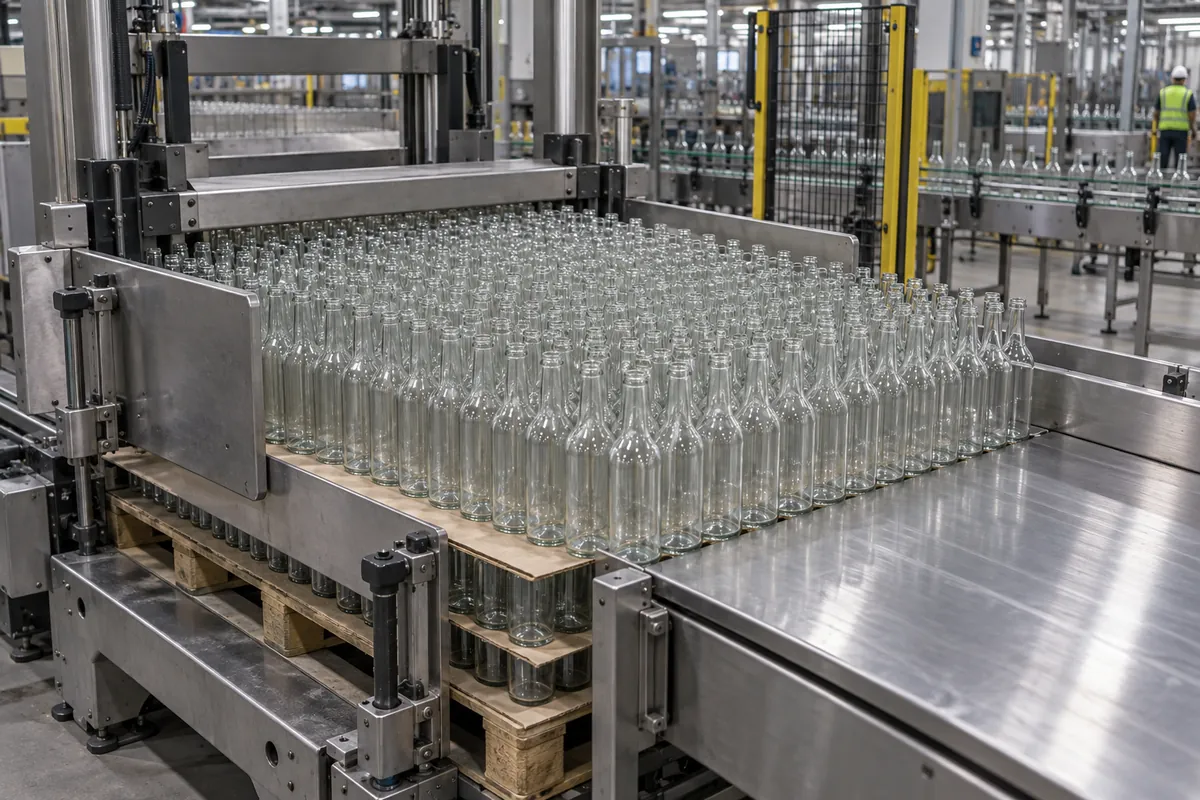
- Before the sweep, the machine squares the layer. As the top layer moves, the layer below is held on its sides, for example by pneumatic friction plates, and grippers at the rear keep the tier sheet from sliding. Without this, friction between the container bases and the sheet can drag the lower layer and knock bottles over.
- A sweep carriage with side plates and a rear sweep bar pushes the layer onto a dead plate or transfer table. A support bar at the front keeps the containers contained so there is no gap for them to fall into. Variable frequency drives give a soft start and soft stop, which matters most for glass.
- The sheet that sat under the swept layer is removed by vacuum cups or mechanical grippers and stacked in a hopper or magazine. In one design, the discharge table pauses briefly while the sheet comes off. A top frame, if present, is removed in a similar way.
- The layer moves from the transfer table onto the discharge table, then onto conveyors that channel the containers toward a single-filer, a hopper and positioner, or a rinser.
- When the last layer leaves, the empty pallet is conveyed out and either stacked in a magazine or left for a fork truck.
Because the sweep moves a whole layer in one stroke, the pallet pattern must be consistent. Poorly stacked, unevenly wrapped, or transit-damaged loads are the usual cause of downed containers.
Types and configurations
The main split is between high-level and low-level machines. A high-level machine raises the load to a discharge height above the line, so the containers usually need a conveyor that lowers them to line level. A low-level machine unloads near floor level and can discharge low, sometimes with an optional higher discharge for plants with elevated lines. Low-level machines often keep pallet loading, operator view, and service points at ground level. High-level machines can suit plants with limited clear floor area, but they add structure and the means to bring containers back down. One supplier says its low-level model is designed for glass lines where gentle handling is a priority, while its high-level model targets high-volume lines.
Most bulk machines push the layer with a sweep bar. Some suppliers also offer a pick version, where a suction head lifts the whole layer and sets it on the discharge, which suits containers that should not be pushed. The choice depends on container shape, surface, and whether the containers can take shoulder-to-shoulder contact.
Discharge arrangements vary too. One supplier describes three forms: a suction head to an output aligner, a pusher to a simple conveyor or aligner, and a pusher into a large-capacity hopper that feeds a bottle positioner. The word “bulk” refers to the mass flow of containers off the pallet. Machines are available with inline discharge or with a 90-degree turn, which helps fit the layout of the room.
Standard machines handle the sweep and tier sheet. Options commonly include a full-pallet infeed conveyor, picture-frame and slip sheet removal, empty pallet stacking, a lean detector, and a single-filer. Choose the scope based on how many people you want near the machine and how often pallets arrive.
Specifications to evaluate
Request all values in writing for your own containers, pallets, and line. The table is a starting point.
| Specification | Why it matters | What to ask the supplier |
|---|---|---|
| Rate and how it is stated | Decides whether the machine can feed the filler without starving it | Is the rate in layers per minute, layers per hour, or containers per hour? Does it include pallet change time? |
| Maximum load height and weight | Sets the tallest pallet and heaviest load the elevator can handle | What are the proposed model’s rated load height and weight, including the pallet itself? |
| Pallet size and type | Different pallet footprints and styles change guide spacing and conveyor design | Which pallet footprints and total load heights are supported, and can they be mixed? |
| Container range | Diameter, height, weight, and shape change containment and sweep settings | Which containers have been run, and which settings change between formats? |
| Layer containment | Controls how many containers fall during the sweep | How are the layer above and below held, and how is the tier sheet secured? |
| Tier sheet and top frame handling | Prevents sheets from entering the container flow | Which sheet types (plastic, board, other) and sizes work? What is the stacker capacity? |
| Changeover method | Determines downtime between formats | Are settings stored in recipes or changed by hand? Time the complete format change on your loads. |
| Discharge height and direction | Fixes how it connects to the line | What are the discharge height and outfeed options? What conveyors are included? |
| Empty pallet stacking | Affects fork truck frequency and labor | What pallet types, stack height, and stack weight does the proposed pallet stacker support? |
| Controls and diagnostics | Affects troubleshooting and downtime | What PLC and screen are used? What fault messages and sensor diagnostics are available? |
| Guarding and safety devices | Defines the hazards that remain | What guarding, interlocks, and emergency stops come with the machine? What risk assessment documents are provided? |
Published specification status (reviewed October 8, 2026). The A-B-C document is a manufacturer-authored brochure hosted by an equipment reseller; its printing date is not established, so its ratings need current model confirmation:
| Item | Supplier / model and source status | Original unit / timing scope |
|---|---|---|
| Maximum load height | A-B-C Model 108: 110 inches, manufacturer-authored brochure, PDF p. 3, “Features to ensure peak performance” | Original unit: inches; pallet-inclusion basis not stated; confirm current model rating |
| Empty-pallet stack capacity | A-B-C Model 108: 1,500 lb, same brochure p. 3, “Choose your level of automation” | Original unit: lb; optional empty-pallet removal/stacking, not elevator payload |
| Pallet footprint / total height | Original model attribution not recovered; confirm on project drawing | mm; include pallet in total height |
| Automatic format change | Sidel Sweepoff A & B public page claims under one minute without mechanical intervention | Supplier claim; full material swap and downstream restart boundary not specified |
These are source-specific historical ratings and a supplier changeover claim, not general bulk-depalletizer specifications.
Compare containers per hour using your own layer count and the full exchange cycle, not unmatched brochure units.
Container compatibility
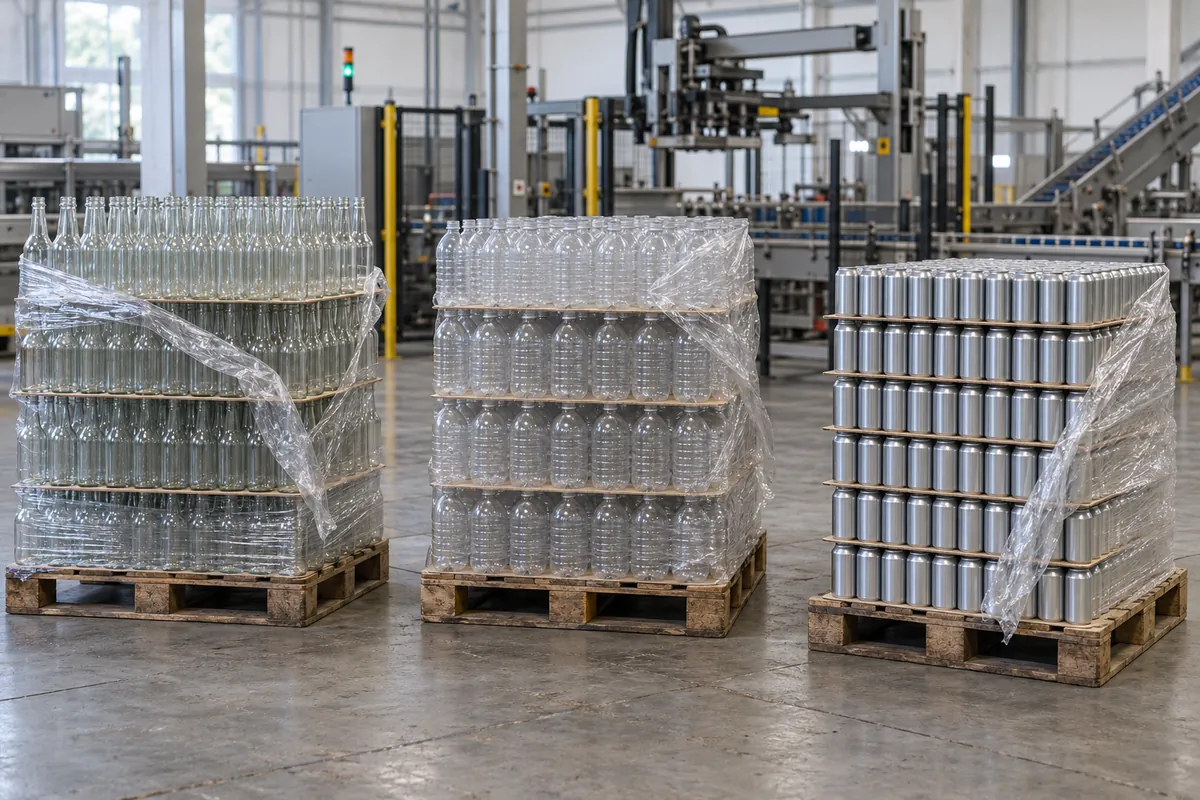
Container material changes containment and handling; use the glass/PET sample and acceptance table for those checks. For cans and jars, record the actual container dimensions, weight per layer, top frame, and sheet arrangement, and prove the proposed settings on production loads. PET preforms remain outside this guide’s layered-container comparison.
Integration
A bulk depalletizer is the head of the line, so its limits pass downstream.
Full pallets arrive by fork truck. A powered infeed conveyor with room for more than one pallet gives the operator time to reload without stopping the machine. Define the fork truck path, the staging area, and how film and bands will be removed before the pallet enters.
The discharge table delivers a mass of containers, and a single-filer or bottle positioner narrows that into one row. The depalletizer and single-filer should be matched for container size and speed, so compare how the supplier handles that interface. Conveyors carry the containers from there.
Where the discharge height differs from the line height, a lowerator or elevating conveyor is required. Vertical conveyors are one way to change level in a tight footprint. Confirm the target height against the first line conveyor rather than assuming a standard filling-line height.
Containers usually pass through a rinser or air cleaner before filling, so make sure the discharge supports the rinser’s infeed requirements. If the line includes inspection or a sensor for leaning or fallen containers, plan space and signals for it. A buffer between the depalletizer and the filler lets the line ride through pallet changes, tier sheet jams, and short stops. Size it from the time needed to change a pallet, clear a jam, and restart.
On controls, define signals for start, stop, fault, and accumulation, and decide who owns the interface between the depalletizer and the rest of the line. When the filler stops, the depalletizer and conveyors must stop in a controlled order, and the reverse on restart.
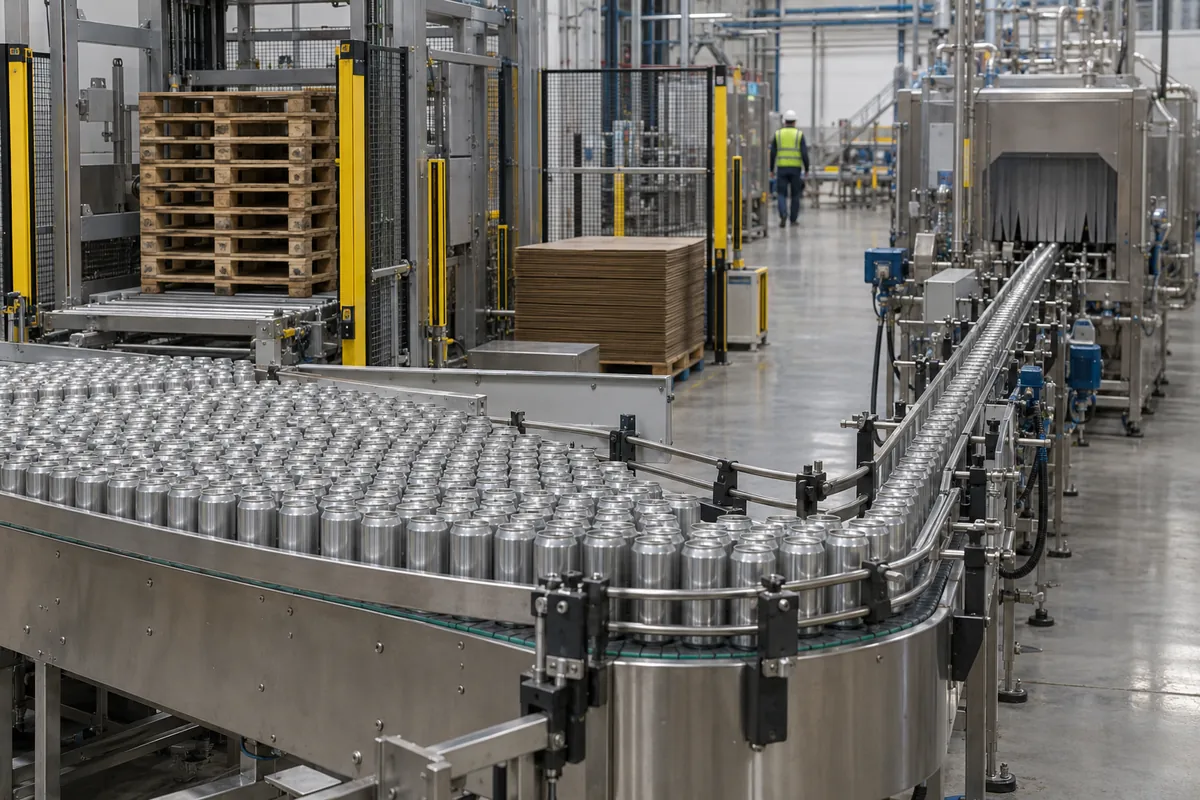
Many plants also run a palletizing operation downstream of packing and share pallet standards between the two. Pallet quality and the type of tier sheets in use are worth aligning.
Neighboring pages cover bottle depalletizers and case depalletizers. Conveyor budgeting is in the packaging conveyor cost guide, and the packaging line layout guide shows how an empty-container infeed fits the floor. For use in a filling plant, see beverage packaging automation and bottle handling.
Footprint, utilities, controls, and safety
Footprint depends on discharge height, infeed and outfeed length, and whether pallet and sheet stackers are included. High-level machines need more structure, and low-level machines may need less. Request a layout drawing that shows pallet turning space, fork truck access, and maintenance clearance, and check it against your building, including ceiling height for the tallest pallet.
Typical utilities are electric power and compressed air for the pneumatic clamping and gripping devices, plus vacuum if sheet removal needs it. The values depend on the machine, so get them from the supplier’s data sheet.
For controls, look for a programmable controller, a touch screen with diagnostics, non-contact sensors with indicators, and stored settings for each format. Ask how faults are shown and how a jam is cleared.
The main hazards are falling containers and glass, pinch and crush points at the sweep carriage and elevator, moving pallets, stored energy in pneumatic and gravity-loaded parts, and fork truck interaction near the infeed and pallet stacker. General controls include fixed guards, interlocked access gates, emergency stops, safe zones for fork trucks, and a clear procedure for clearing jams.
In the United States, 29 CFR 1910.212 requires one or more guarding methods so that operators and anyone else working near the machine are protected from hazards like nip points and rotating parts. The lockout/tagout standard, 29 CFR 1910.147, covers servicing and maintenance in which unexpected startup or release of stored energy could cause injury, and it requires an energy control program. It also notes that normal production is not covered unless a guard is removed or bypassed, or someone enters the point of operation or danger zone. The supplier’s guarding does not replace a site-specific risk assessment, which should cover the full installation, including the pallet infeed, the discharge conveyors, and maintenance access.
Cost factors
This page does not give prices. Several variables drive the quoted cost:
- Higher rates and taller loads call for stronger drives, frames, and controls.
- High-level designs add structure and a lowering conveyor, while low-level designs can reduce that structure.
- A powered infeed conveyor, tier sheet and frame removal, empty pallet stacking, lean detection, and a single-filer each add cost but cut manual labor.
- More container types and weights mean more adjustability and sometimes change parts. Wide variation in pallets and tier sheets complicates removal and stacking.
- Conveyors, elevation changes, accumulation, and controls to the filler can be a large share of the project.
- Guarding, interlocks, and documentation depend on the site.
- Rigging, power, air, commissioning, and operator and maintenance training add to the total.
Compare total installed cost and the effects on labor, breakage, and downtime, not only the machine price.
Selection checklist
Use this proposed check record with your own loads; blanks are project inputs, not recommended limits.
| Check | Input / observed result | Owner / acceptance evidence |
|---|---|---|
| Pallet condition | Footprint, total height, lean, overhang, damage: ___ | Incoming-load specification / lot photos: ___ |
| Sheet removal | Material, curl, hold method, missed/double sheet: ___ | Timed removal trial / fault response: ___ |
| Pallet exchange | Last container to first good container on next pallet, minutes: ___ | Complete cycle log including exchange: ___ |
| Single-filer interface | Width, height, good containers/hour, fallen-container route: ___ | Interface drawing / full-pallet trial: ___ |
| Format change | Old format last good output to new format stable output: ___ | Named operator / timed trial: ___ |
| Site and safety | Utilities, access, fork truck route, guarding: ___ | Layout and task risk assessment: ___ |
Takeaway: Record pallet exchanges and sheet delays in the same output window as the single-filer result. Use the commissioning and acceptance checklist to define that window.
Common mistakes
- Rating by nameplate. Layers per minute may not include pallet change time, and the container count per layer decides the real output.
- Ignoring the incoming load. Pallets vary by supplier and shipment, and film, bands, caps, top frames, and different sheet types can all appear.
- Underspecifying the container range. The lightest, tallest, and most fragile container sets the limits for containment and sweep settings.
- Forgetting the discharge. A well-chosen depalletizer can still starve the line if the single-filer or accumulation is wrong.
- Guarding added late. Access for jam clearing, fork truck routes, and pallet stacker removal need design at the start.
- No acceptance test on real product. Test with your own pallets, sheets, and containers.
- No buffer. Without accumulation, every pallet change and jam stops the filler.
Alternatives
Robotic and layer-pick depalletizers lift layers or individual items instead of pushing them. That suits mixed loads, changing patterns, or containers that should not be pushed, while a single product at a high rate is generally better served by a dedicated sweep machine. See the depalletizing hub for how these compare, and the robotic palletizer guide for how robot cells are built and guarded.
A lift table or pallet positioner holds the pallet at a comfortable height while an operator unloads. It can serve low volumes, trial runs, or products that suit hand handling, but it does not remove the ergonomic load and may not keep up with higher line rates.
If the incoming product is packed in cartons or trays rather than loose containers, a case depalletizer is a better fit than a bulk machine.
Browse the equipment map to see how depalletizing connects to conveyors and palletizing.