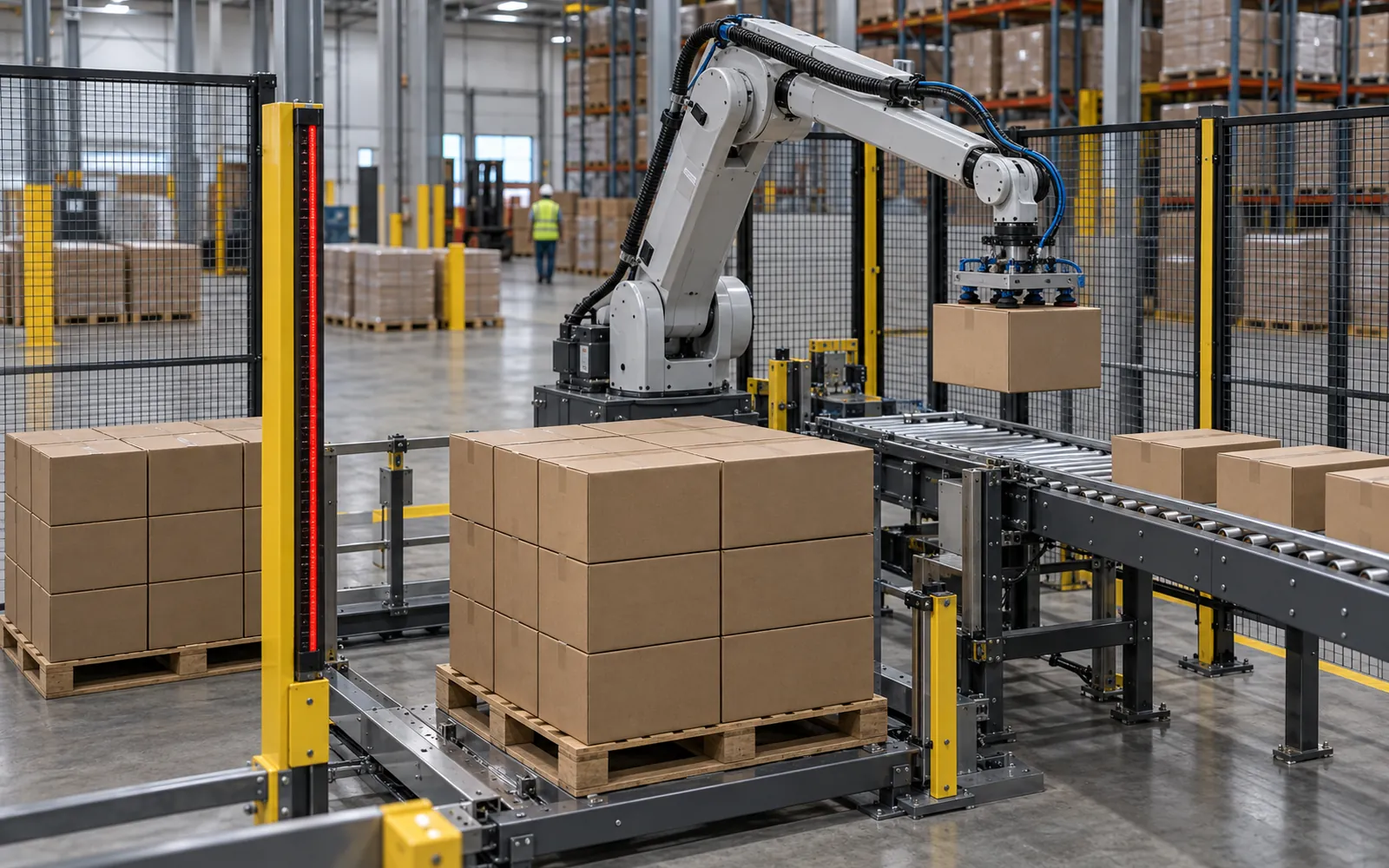
A demonstration pallet can hide damaged-case and recognition stops. Choose single-case, row, or layer unloading from the real uniform, rainbow, or mixed load, then test the exception route as well as the normal cycle.
| Pallet pattern | Pick unit to evaluate | Critical acceptance check |
|---|---|---|
| Uniform: same case and known pattern | Row or layer; single-case if the downstream flow requires it | Group integrity, release, and outfeed orientation |
| Rainbow: each layer uniform, layers differ | Row/layer only after each layer’s format is confirmed | Detect layer change and select matching tooling/recipe |
| Mixed: sizes or products vary within a layer | Single-case with a proven recognition and gripping strategy | Unknown cases, damage, and unintended multiple picks |
This is a trial-planning table, not a capability guarantee. The depalletizing hub covers the family; bulk and bottle machines handle loose empty containers.
How it works
A case depalletizer has to find the load, separate cases, move them, and clear the empty pallet. The steps below describe a typical cell, and details vary by machine.
- A fork truck or pallet conveyor delivers the pallet. Stretch film, bands, and corner boards are removed first, either by hand or by a film cutter or destrapper upstream.
- A sensor, light curtain, or vision system finds the top layer and, in robotic cells, the position of each case. A fixed machine relies on the pallet pattern being the one it expects.
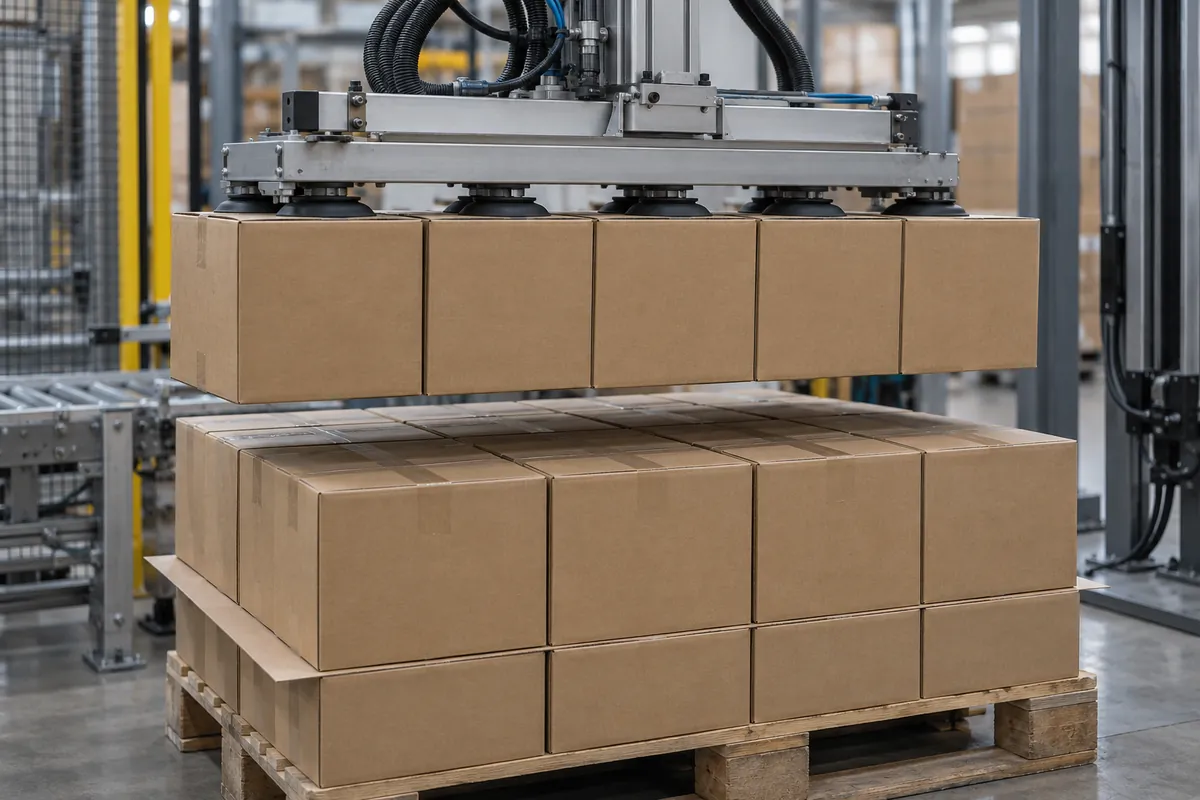
- A gripper removes cases from the top layer. Depending on the design, it takes one case, a row, or a complete layer, and a conventional machine may push or lift a whole layer instead.
- The cases are set on an outfeed conveyor. A robot may place each case in a set position and orientation, while a layer machine places the layer on a table that then feeds a conveyor.
- A slip sheet or tier sheet between layers is lifted away and stacked. Supplier literature notes tools that handle slip sheets and top sheets.
- Some cells check that only one case was placed, to avoid putting two on the conveyor at once. One supplier describes imaging the place zone for this purpose.
- When the last layer is gone, the empty pallet leaves the cell for stacking or pickup, and the next full pallet enters.
A well-designed cell takes the top layer completely before starting the next one. One supplier describes this as a way to reduce the risk of toppling.
Types and configurations
What is being unloaded
Full cases are sealed cartons or shrink-wrapped trays of filled product. They supply a distribution center flow, feed a case unpacker at the start of a repack line, or move finished goods to a sorter. Case strength, weight, and surface matter, because the gripper must hold the case without crushing it.
Empty shippers and carton blanks arrive on pallets and feed a case erector, a packer, or a sleeve loader. They are light, may be open or collapsed, and often shift in their pallet pattern, so gripping them without deforming them takes careful tooling.
Trays, with or without film, are common in food, beverage, and produce packaging. Supplier literature lists wrapped and unwrapped trays and cartons in trays among products that robotic cells handle. Open trays have fewer flat surfaces to grip, so they may need fork-style or clamping tools.
Some suppliers offer a single cell for cases, trays, pails, and jugs. Treat bags, pails, and jugs as separate applications until the supplier confirms the grip method and rate.
Row, layer, and single-case unloading
The unit taken from the pallet changes the rate and the risks.
| Method | What moves | Strength | Watch for |
|---|---|---|---|
| Single case | One case per pick | Most flexible, works on mixed and irregular pallets | Lowest rate per pick, needs vision or a very predictable pattern |
| Row | A line of cases in one pick | Faster than single-case on uniform layers, less gripper complexity than a full layer | Row must be clean and aligned, and the gripper must open or release correctly |
| Layer | The whole layer in one move | Highest rate for uniform pallets | Needs a regular pattern, rigid cases, and a layer that holds together |
Supplier literature describes cells that handle products individually, by row, or by full layer depending on production goals and product mix. The choice depends on throughput needed, case rigidity, and whether the pattern can be recognized and handled in groups. Rows and layers may also be rotated or split after pickup, so a layer cell can still feed a single-file conveyor.
Conventional versus robotic case depalletizing
Conventional case depalletizers are fixed-motion machines, usually layer or row based. They work best when pallets always hold the same product in the same pattern, and for plants that need a steady, high rate. Because the motion is dedicated, changing to another pattern usually means adjusting guides, recipes, or tooling. They are generally simpler to program and maintain, and cheaper to run for a single product.
A robotic case depalletizer carries a gripper on an arm and may use vision to see the load. Supplier literature describes vacuum, clamp, fork-style, magnetic, and layer-gripping tools, and tool changers for plants that run several case types. Robots handle variable patterns and can run many SKUs without hardware changes. They tend to have a lower rate per cell than a dedicated layer machine, and they depend on vision and software, which need setup and care.
| Factor | Conventional | Robotic |
|---|---|---|
| Pallet variety | Uniform, known patterns | Mixed or changing patterns |
| Rate | Often higher for a single product | Depends on cycle time and picks per case |
| Changeover | Mechanical adjustments or recipes | Mostly software and tool changes |
| Case condition | Needs regular, rigid cases | Vision can tolerate skewed or offset cases |
| Exception handling | Operator clears jams | Vision can flag unknown cases, sometimes with remote help |
| Footprint | Frame and elevator | Cell with robot reach and guarding |
| Maintenance skills | Mechanical and PLC | Mechanical, robot, vision, and software |
The comparison is a general starting point drawn from how suppliers describe the two approaches. Rates and capability depend on the case, the pallet, and the cell design, so ask for tests on your own loads. The robotic palletizer guide discusses the same robot cell issues in reverse, since many robotic cells can both palletize and depalletize.
Hybrid and manual-assist arrangements
Some plants add a lift table, pallet positioner, or vacuum assist so an operator can unload cases at a good height. These suit low volume and do not remove the ergonomic load of repeated lifting. A hybrid cell may use a layer machine for standard pallets and a manual station for odd loads.
Mixed-SKU and incoming-goods applications
The hardest case depalletizing is not a fast uniform pallet. It is an unpredictable one.
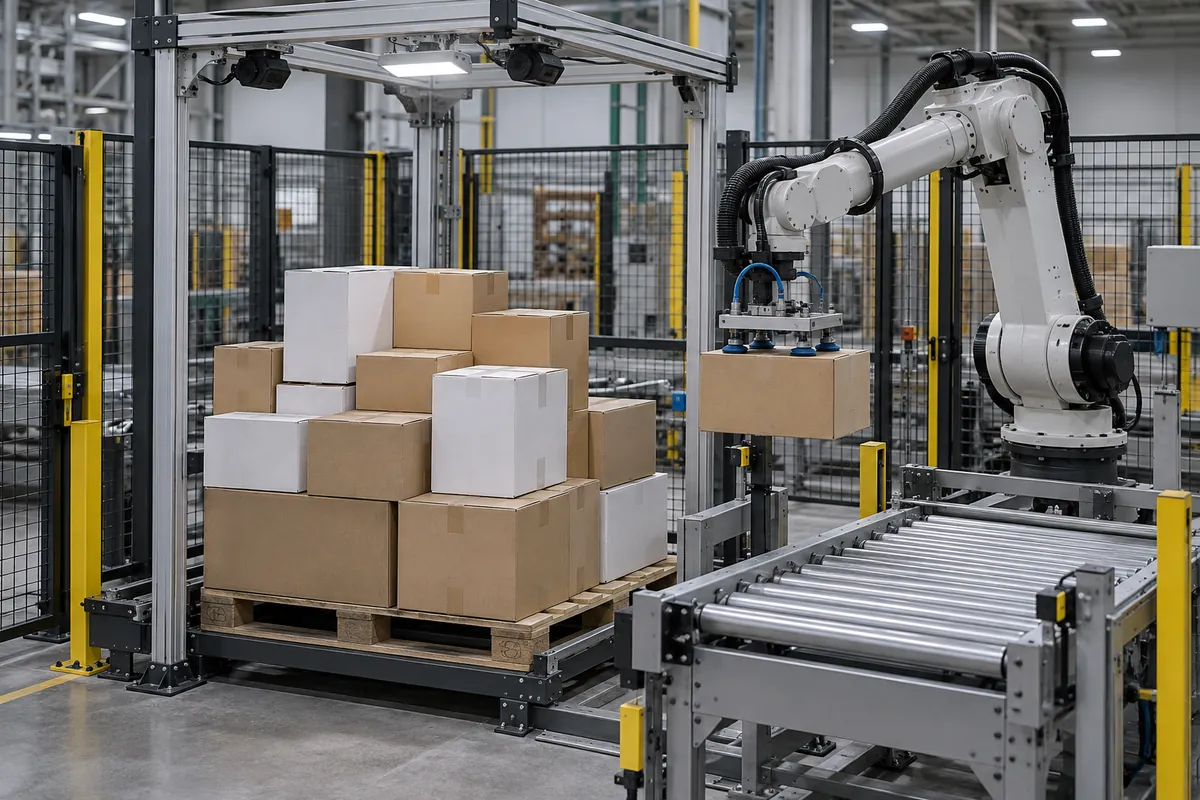
Single-SKU pallets hold identical cases in a known pattern, and a conventional layer machine or a simple robot with a pattern library handles them. Rainbow pallets have a different single product on each layer. One supplier describes rainbow depalletizing as handling rows of homogeneous layers where each layer can differ in shape, size, and weight, so the machine has to detect the change between layers.
Mixed-case pallets combine products and sizes within a layer with no pattern. Mixed-case palletizing is more common as plants and distributors ship many different SKUs in smaller quantities, and unloading these pallets needs vision to find each case and decide where to grip. Pallets from outside suppliers vary in pattern, wrap, case condition, and label position, which is why supplier literature says vision systems are deployed mainly in warehouses and distribution centers.
Supplier descriptions of mixed-case cells share some features:
- The system analyzes the pallet and sends picking commands for each pickable case. It may find skewed layers and compare the case count with what it expects.
- Flat black cases, cases with alternating colors on the flaps, banded cases, and cases with reflective tape or gaps can be hard to see. One supplier lists these among conditions its software is built for. Another describes a light array that shields the camera from overhead light.
- If a case is not recognized, some systems start a remote call for a person to help, while others eject the case for manual reintroduction.
- Pearson’s RDPC-MX case study, published October 4, 2022, reports a 6,500-cases/day requirement and capacity up to 10,000 cases/day for that installation. Daily operating hours are not stated, so these figures cannot establish a general hourly rate. Source text reviewed from the October 8, 2026 audit capture; the live page returned an access restriction on recheck.
- In that case study, cases move to an orientation inspection station that scans the labels. Cases found in the correct orientation continue downstream, and any case that cannot be identified is ejected.
Proposed exception trials: agree limits and disposition before testing; record the sample, result, time lost, and responsible person.
| Sample | Pass route | Reject / hold route |
|---|---|---|
| Black case under production lighting | Correct recognition and single-case placement | No confident recognition: hold for approved review |
| Reflective tape at several orientations | Correct case boundary and verified grip | Ambiguous boundary: no automatic pick; review |
| Crushed or torn case | Only pick if agreed damage and grip limits are met | Isolate to the defined manual handling route |
| Case absent from taught set / unreadable label | Confirm identity and required orientation | Approved review or reject; do not guess identity |
| Overlapping cases / attempted double pick | Place verification confirms the intended single case | Stop/hold or divert under the validated exception logic |
Specifications to evaluate
Request every value in writing for your own cases, pallets, and line.
| Specification | Why it matters | What to ask the supplier |
|---|---|---|
| Rate and its basis | Decides whether the cell feeds the next machine without starving it | Is the rate in cases per minute, cycles per minute, or layers per minute? Is it measured on your pallets, with pallet change and unrecognized cases included? |
| Case size and weight range | Sets gripper design and payload | What are the smallest, largest, and heaviest cases? What happens at the limits? |
| Case construction and surface | Affects how well vacuum or clamp grips hold | Which case materials, coatings, and wraps have been run? How are open trays or flaps handled? |
| Pallet pattern and variety | Determines whether pattern libraries or vision are needed | How many patterns, and how are new ones taught? Can the cell handle mixed and rainbow pallets? |
| Pick unit | Changes rate and flexibility | Can it pick single, row, and layer? Can it change between them by recipe? |
| Tier sheet, slip sheet, and top sheet handling | Prevents sheets entering the case flow | Which sheet types are supported and where do removed sheets go? |
| Pallet height and weight | Sets elevator, reach, and conveyor design | Maximum load height including pallet, and weight limits? |
| Orientation and spacing at discharge | Must match the next machine | Can the cell turn, space, or label-scan cases? What accuracy is stated and measured? |
| Exception handling | Defines what happens when a case is unknown or damaged | Are bad cases ejected, queued, or reviewed? Is remote assistance required? |
| Changeover method | Determines downtime between products | Are settings recipes or manual? How long does a change take in practice? |
| Controls and diagnostics | Affects troubleshooting | What fault messages, camera views, and logs are available? |
| Guarding and safety devices | Defines remaining hazards | What guards, light curtains, interlocks, and emergency stops are included? What risk assessment documents are supplied? |
Quote comparisons only make sense on the same basis. A robot rated by cycles per minute moves different numbers of cases per hour depending on whether each cycle picks one case, a row, or a layer.
Container and package compatibility
Corrugated shipping cases are the most common load. Check board strength, case condition, and whether the top surface is flat enough for a vacuum gripper, since printed or glossy coatings change vacuum performance. Shrink-wrapped trays and film-wrapped packs may have loose or wrinkled film that affects vacuum sealing. Clamp or fork-style tools can help, and the supplier should confirm the wrap type.
Empty cases and blanks are light and sometimes open or collapsed. Layer squaring and a gentle grip help. Confirm the pattern can be recognized and that cases do not nest or stick.
For heavy cases, the payload limits of the robot, gripper, and conveyor become important. Confirm the heaviest case and whether the gripper can lift it with a margin. Incoming pallets also often hold damaged or crushed cases, so decide in advance whether the cell should pick them, reject them, or stop.
Bags, bales, pails, and drums need their own tooling. Some suppliers list these among products their robots can handle, but each deserves a separate check.
Integration upstream and downstream
Pallets arrive by fork truck, pallet jack, or conveyor. Plan film removal, banding removal, staging space, and a way to present the pallet in a repeatable position. For robotic cells, light protection for the vision system and clear pallet visibility matter. Incoming pallets should meet an agreed specification, such as pattern, overhang, and wrap type, so the cell sees consistent loads.
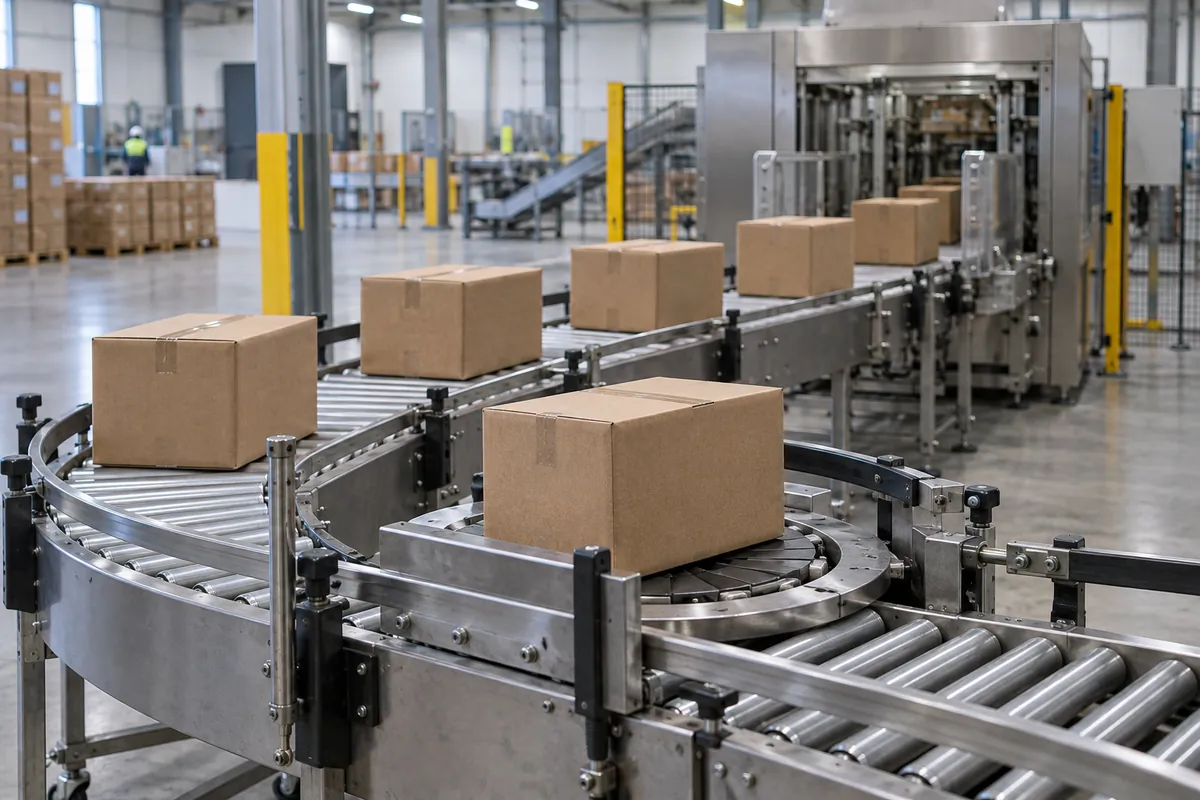
Next in the line may be a case unpacker, an uncaser, a case opener, or a packing machine. These often need the case in one orientation and at a set spacing, and a case that arrives sideways, upside down, or with the wrong face forward may jam the unpacker or keep it from opening the case. There are several ways to meet this need:
- A robot can rotate each case before setting it down. A layer machine often has fixed orientation, so the pallet pattern must match.
- A guided turn, rotating section, or pop-up diverter can turn cases after they leave the depalletizer. Supplier literature mentions roller or belt conveyors that unscramble, singulate, orient, and position products after depalletizing. See case conveyors for the usual hardware.
- A scan station can read labels and verify that cases are right side up, with unreadable cases ejected for manual handling.
- Unpackers have a cycle time, so the feed needs consistent gaps. An accumulation area lets the depalletizer and unpacker run at different rates, and accumulation conveyors hold the buffer.
Agree on orientation, face, flap direction, spacing, and rate with the supplier of the next machine, and write the agreement into both specifications.
Define start, stop, fault, full, and starved signals between the depalletizer, conveyors, and the next machine. When the downstream machine stops, the depalletizer should stop placing cases in a controlled order and resume without lost or doubled cases.
Incoming-goods use in food plants is covered in food packaging, with the general application in case handling.
Footprint, utilities, controls, and safety
A conventional machine needs space for the elevator, layer table, pallet infeed, empty pallet exit, and sheet stacker. A robotic cell needs room for robot reach, fencing, pallet stations, and often two pallet positions so one pallet can be changed while another is worked. Request a layout drawing showing fork truck access, door openings, and maintenance clearance.
Electric power is standard, and compressed air or vacuum is typical for grippers and sheet handling. Values depend on the machine and gripper, so ask for them on the data sheet. For controls, look for a programmable controller, a clear operator screen, recipes for pallet patterns, and diagnostics. Vision-based cells add camera views, image logs, and setup tools.
Main hazards include falling cases, robot and elevator motion, pinch and crush points, moving pallets, fork truck interaction near pallet stations, and stored energy in pneumatic or gravity-loaded parts. Typical controls include perimeter fencing, interlocked gates, light curtains, safety-rated scanners, emergency stops, and controlled pallet exchange zones.
In the United States, 29 CFR 1910.212 requires one or more methods of machine guarding to protect operators and others in the machine area from hazards such as nip points and rotating parts. The lockout/tagout rule, 29 CFR 1910.147, applies to servicing and maintenance in which unexpected startup or release of stored energy could injure workers, and it requires an energy control program. A suspended gripper or raised elevator can carry stored energy after power is removed. Supplier guarding does not replace a site-specific risk assessment, which should cover the entire installation, including pallet exchange, downstream conveyors, and maintenance access.
Cost factors
This page does not give prices. The main drivers of a quote are:
- A robot cell adds the arm, gripper, vision, and guarding, while a layer machine adds a frame, elevator, and drives.
- Higher rates and layer handling need more capable drives and grippers.
- More patterns, case types, and mixed pallets need more software, tooling, and testing. Vacuum, clamp, fork, and layer tools differ in cost, and plants with many case types may need a tool changer.
- Sheet removal, empty pallet stacking, and film or strap removal each add equipment.
- Turning, scanning, spacing, and accumulation can be a large share of the project. The packaging conveyor cost guide lists drivers for the conveyor side.
- Guarding, scanners, and documentation depend on the site, and installation covers rigging, utilities, programming, commissioning, and training for operators and maintenance staff.
Compare installed cost together with labor, ergonomics, damaged-case losses, and downtime, not only the machine price.
Selection checklist
- Define the load: full cases, empty cases, or trays, with dimensions, weights, and construction.
- List pallet patterns, load heights, and variation, including mixed and rainbow pallets.
- Describe the incoming condition: film, bands, sheets, damaged cases, and label positions.
- Set the required rate in cases per minute, based on the next machine plus a margin.
- Decide the pick unit: single, row, or layer.
- Specify the orientation, face, and spacing needed at discharge.
- Count products and how often they change.
- Plan pallet infeed, staging, and empty pallet handling.
- Confirm floor space, utilities, and fork truck routes.
- Set the safety scope, guarding, and the site risk assessment.
- Agree acceptance tests on your own pallets, including the worst incoming loads.
The commissioning and acceptance checklist covers scope, documentation, and acceptance testing from the buyer’s side.
Common mistakes
- Planning on the demonstration pallet. Real incoming pallets are messier than a test load.
- Mixing up rate bases. Cycles per minute, cases per minute, and layers per minute are different measures.
- Ignoring orientation. A fast depalletizer that delivers cases at random only moves the problem to the unpacker.
- Underestimating case variety. Surface finish, wrap, and construction change grip performance.
- Having no plan for exceptions. Decide what happens when a case is crushed, unreadable, or missing.
- Skipping the buffer. Without accumulation, each pallet change stops the downstream machine.
- Choosing a robot for a uniform pallet. A dedicated layer machine may give a higher rate for a single product.
- Adding guarding late. Pallet exchange and jam clearing need safe access from the start.
Alternatives
If the load is loose empty containers rather than packed cases, use a bulk depalletizer or a bottle depalletizer. Where all pallets follow one pattern, a layer machine without a robot gives high rate and simple operation. A lift table or vacuum hoist reduces strain at low volume, though it does not remove the need for labor.
Some plants avoid depalletizing by delivering cases to the line on conveyors from the supplier or an upstream packer. That changes the supply chain, not the equipment.
If the same plant builds pallets, the pattern and case choices at the palletizing end affect how easily they can be unloaded later. See case palletizers and the guide on how to choose a palletizer.
Browse the equipment map to see how depalletizing connects to conveyors and palletizing.