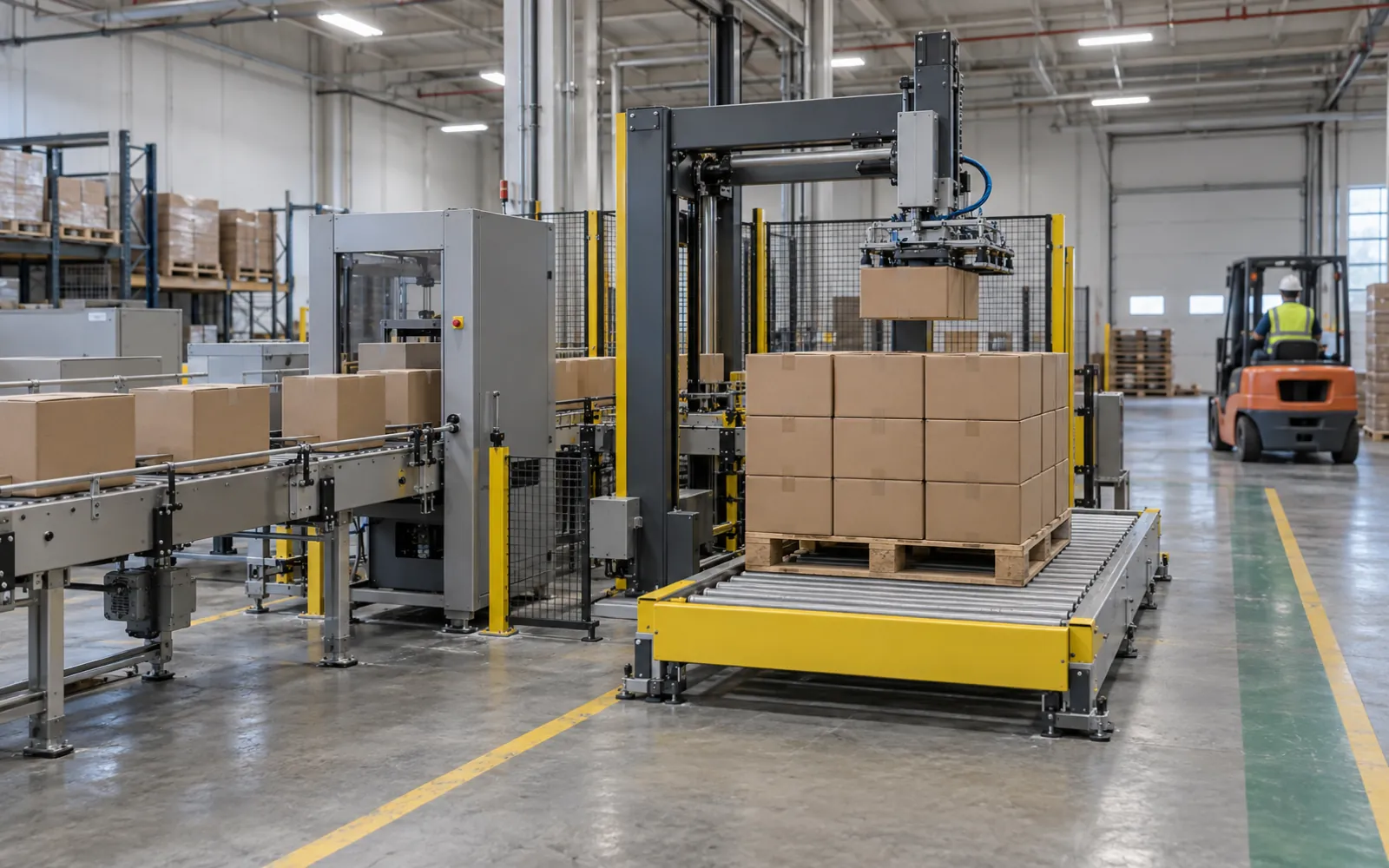
Persistent case accumulation can stop the packing line, while untested growth assumptions can force early replacement. Shortlist a low-infeed machine only when its conveyor connection, full-height cycle and measured sustained rate fit the current and planned duty. Compare the conventional designs, the high-level alternative and the wider palletizing options against the inputs below.
| Input | Record | Decision check |
|---|---|---|
| Conveyor height | Measured infeed elevation | Confirm direct connection or transition |
| Building clearance | Clear height under beams and services | Compare complete machine and service envelope |
| Sustained rate | Hardest SKU, cases/min, full timing window | Include pallet exchanges and wrapper waits |
| Pallet height | Floor-to-top limit, pallet and sheets included | Check transfer travel at the top layer |
| Growth plan | Future SKU mix and output | Verify upgrade, second-cell or replacement scope |
| Maintenance access | Tasks and required clearances | Check each service point and isolation procedure |
How it works
The machine does its work at or near conveyor height, so the sequence looks different from an elevated design.
A low infeed describes the product entry, not a universal pallet-lift mechanism. Confirm its actual elevation against the existing conveyors; the public guide comparison below is only an initial screen.
On the infeed conveyor, cases are re-oriented as the pattern requires. A supplier of a floor-level machine describes the sequence this way: product is rotated for correct orientation before the row-formation area, and completed rows are pushed onto a layer-forming area, which may be a table depending on the design. Rows accumulate into a complete layer. Case size, count per row, and pattern matter most at this stage, and the machine may square or compress the layer here.
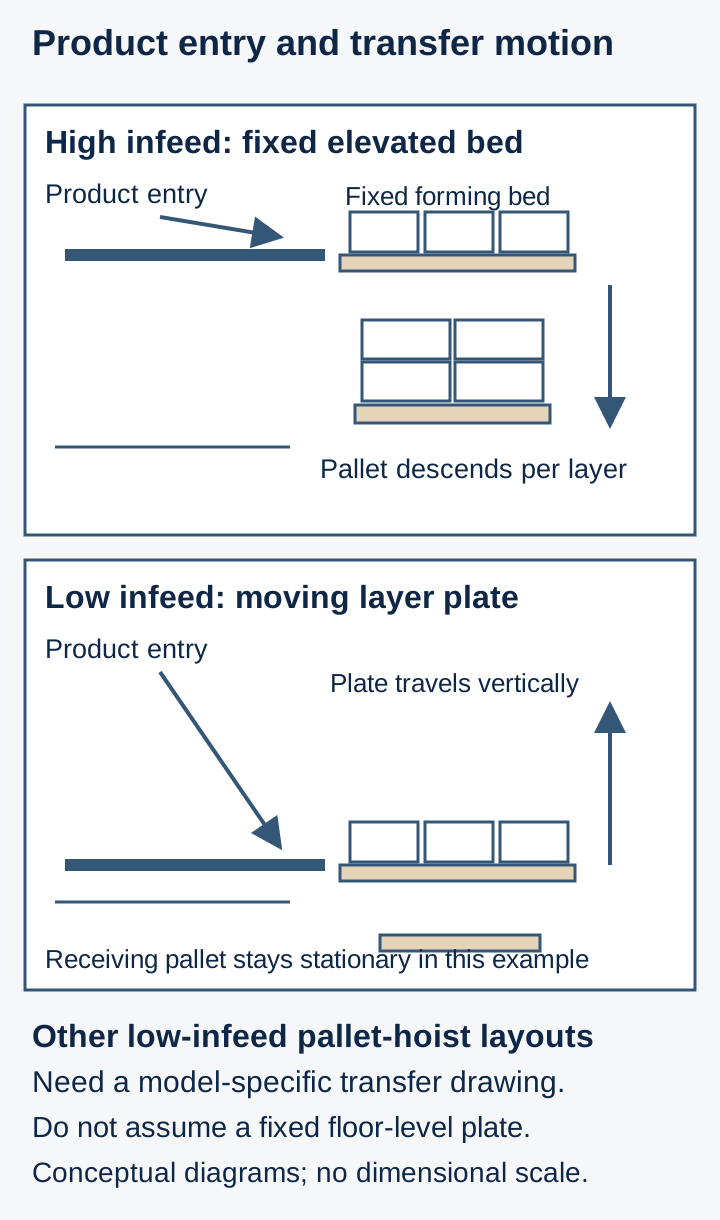
Alligator Automations’ public low-level description says the formed layer advances to a plate that moves vertically to align with a stationary pallet or the previous layer (accessed October 8, 2026; References). Ask for the plate’s travel, transfer clearance and cycle at the full load height. Do not assume the layer-forming area and transfer plate are the same moving assembly.
An empty pallet is supplied from a magazine or by an operator, sheets are added if needed, and the finished pallet leaves on a discharge conveyor. One supplier notes that its discharge conveyor is elevated, with the load then moving on to storage or wrapping.
Types and configurations
Low level machines vary mainly in how the layer moves and how product is collected.
Moving layer plate with a stationary pallet
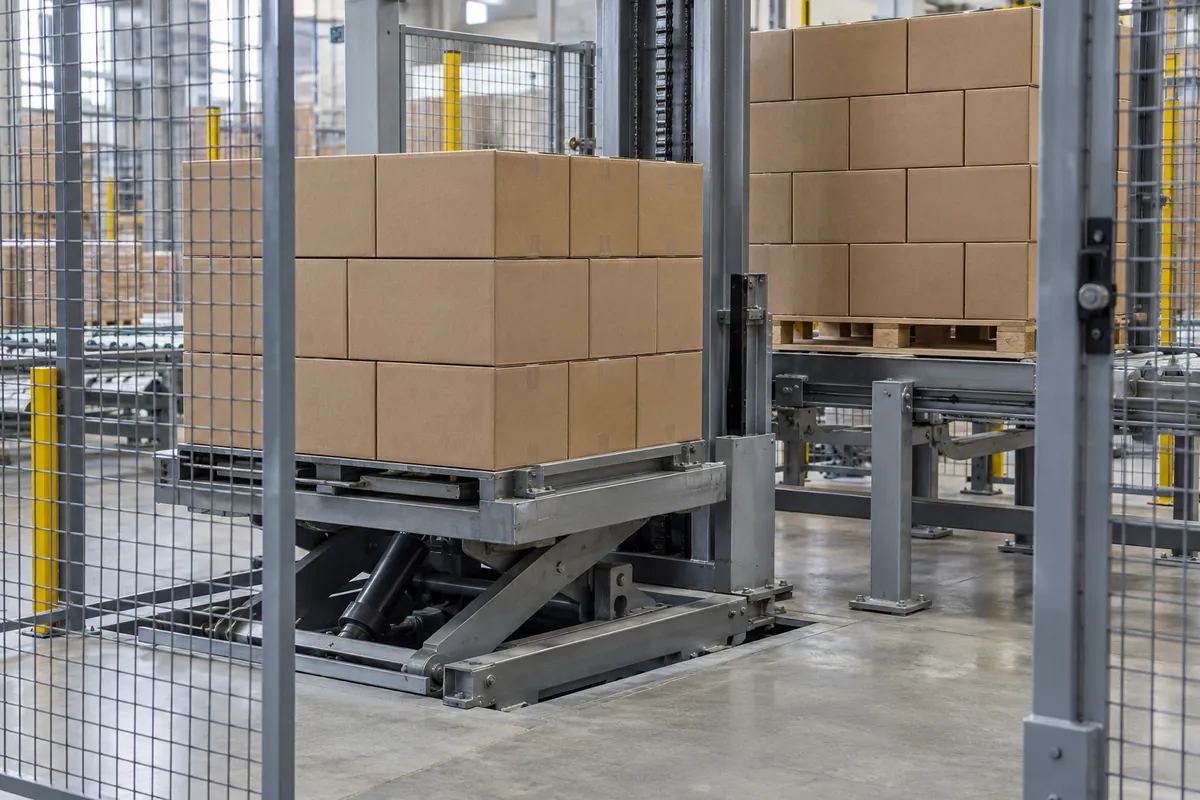
Alligator Automations describes this arrangement without a named model: the layer-forming area feeds a vertically moving transfer plate while the receiving pallet remains stationary. The manufacturer does not publish the full motion envelope there. Require a cycle drawing showing the plate, receiving stack and discharge height before applying it to a project.
Pallet-hoist arrangements: verify the drawing
Cybernetik’s general guide mentions a pallet-platform hoist, but does not establish a model-specific fixed floor-level plate arrangement. That description alone cannot explain the transfer at every stack height. Obtain a drawing identifying what moves, where the forming bed sits and how the full load clears it. This guide therefore does not present the former fixed-low-plate sequence as a verified operating mechanism.
Row-by-row designs
Qimarox’s published Lowrunner LR1 description builds the load row by row (accessed October 8, 2026; References). Its manufacturer says placing completed rows directly on the stacking plate keeps floor space small, and that the plate withdraws in two directions. Confirm sheet needs on the actual load. Such designs may also place empty pallets and sheets using the same plate, which avoids a separate magazine.
Single and multi-infeed machines
A single infeed is simplest. Some low level machines accept more than one infeed, which can help a plant combine two lines in one footprint. Comparisons note that the horizontal layout of a low level machine can need more floor area than an elevated design, while compact models exist, so require a drawing for every design.
Low level vs high level: the checkable differences
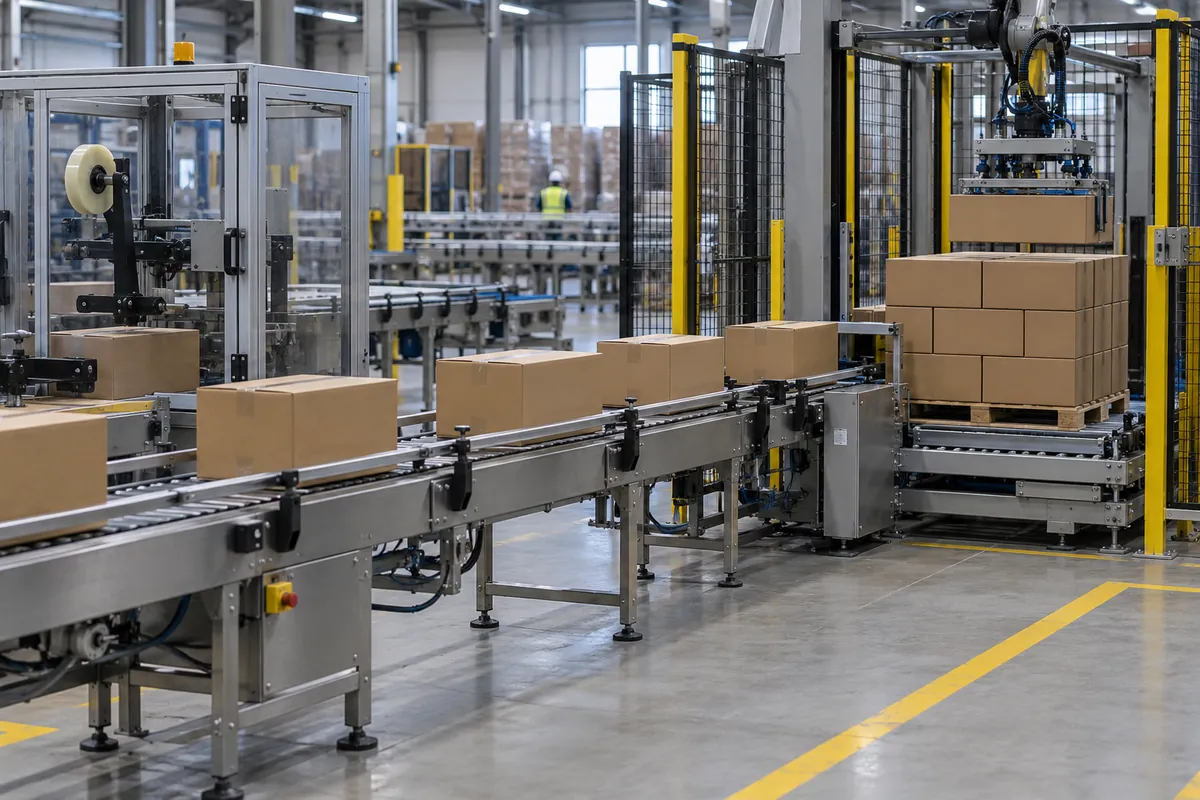
The two conventional designs do the same job, so compare them on dimensions you can measure in your own plant and confirm in a quote, rather than on general claims. The numeric comparisons below come only from Cybernetik’s public guide (published July 23, 2026; accessed October 8, 2026), not model specifications. Use the high-level guide for the elevated-layout checks.
| Dimension | Low level palletizer | High level palletizer | How to check it |
|---|---|---|---|
| Infeed height | 30–36 inches in the Cybernetik guide | 100–144 inches in the same guide | Measure your existing conveyor height and ask for the required infeed height |
| Where the layer forms | Low infeed; moving layer plate in the documented example | At the top of the machine, then the layer drops onto a pallet that lowers as the load grows | Ask how cycle time changes with pallet height |
| Connection to the line | Direct connection if conveyor elevations match; otherwise confirm transition | Needs a lift, incline, or spiral unless product already travels overhead | Count the conveyors and lifts included in each quote |
| Building height | 4–6 meters, guide range only | 5–7 meters, guide range only | Measure clear height under beams, sprinklers, and lights |
| Floor area | Depends on design; horizontal layouts and floor-level accumulation can need more area, while compact models exist | Depends on design; overhead conveyors can free floor space, but the lift and platforms take room | Compare layout drawings with accumulation, pallet staging, and forklift paths |
| Rate | 1–3 layers/min, guide range only | 5–10 layers/min, guide range only | Ask for sustained cases per minute on your pattern, including pallet changes |
| Operator access | Confirm floor access and any raised service points | Check platforms and stairs for the elevated section | Ask which tasks need a platform, tools, or lockout |
Read the rate row with care. Cases per minute equals layers per minute times cases per layer, so a large pattern can give a low level machine a useful case rate, and a small pattern can leave a high level machine underused. Use your own pattern for both.
When to choose a low level palletizer
A low level machine is usually the first design to price when all of these are true: the case sealer or line conveyor already runs at floor height, the clear ceiling is limited, the sustained rate sits comfortably inside the supplier’s stated rate on your pattern, and maintenance staff prefer to work from the floor. Price a high level machine as well if any of these are true: the line already runs overhead, the sustained rate is near the low level machine’s limit, several lines must feed one palletizer at a high combined rate, or output is expected to grow. Price a robotic palletizer if the product list is wide or patterns change often.
Takeaway: Shortlist low infeed only after checking conveyor match, full-height cycles and growth margin.
Judging price, reviews, and “best” claims
There is no neutral ranking of low level palletizers, and a machine that is best for one case, pattern, and rate can be wrong for another. Treat “best” lists and star ratings as marketing until they are tied to a product and a rate like yours. Better evidence comes from three places: a reference site running a similar case and pattern at a similar sustained rate, a trial or acceptance test with your own production cases, and an itemized quote that states what is included. Price moves with the drivers listed under cost factors below, so compare quotes only after mapping each one to the same scope, as described in the palletizer cost guide. For a used machine, ask for its original rated pattern and rate, its maximum layer weight and pallet height, the condition of the hoist and layer plate, and whether its controls and guarding can be brought up to your current requirements.
Rate, described qualitatively
Use sustained cases/min on the actual pattern, including pallet exchanges, to decide whether the machine keeps up. Guide layer rates are initial comparisons. Alligator Automations’ unnamed low-level product page lists 10–20 cases/min (accessed October 8, 2026); it does not state the pattern or exchange window, so that figure is not a sustained-rate guarantee.
Example, assumed inputs: a line sends 20 cases/min and the pattern has 10 cases/layer, requiring 2 layers/min during uninterrupted cycling. If a trial completes 200 cases in 12 elapsed minutes including exchanges, sustained output is 16.7 cases/min and does not meet that assumed input. Repeat with the planned growth rate rather than assuming buffering fixes a permanent deficit.
| Trial record | Entry |
|---|---|
| SKU / pattern / cases per layer | Production sample and drawing |
| Elapsed window / completed cases | Include pallet exchanges and all waiting |
| Sustained cases/min | Completed cases divided by elapsed minutes |
| Stops and exchange losses | Count, duration, cause and intervention |
| Growth recheck | Planned input, tested output and required next step |
Takeaway: Carry the record into the commissioning checklist and reject a persistent rate deficit before ordering.
Specifications to evaluate
| Specification | Why it matters | What to ask the supplier |
|---|---|---|
| Infeed height and adjustment range | Determines whether existing conveyors connect directly | What infeed height is needed, and can it be set to match my conveyors? |
| Sustained rate on my pattern | Moderate rates leave little margin | What are the sustained cases per minute and layers per minute, including pallet changes? |
| Layer movement method | Affects cycle time and wear | Does the layer lift or does the pallet rise, and how does cycle time grow with pallet height? |
| Accumulation needs | Layer forming needs a buffer to keep the line moving | How much accumulation is required before the infeed, and how much floor space does it use? |
| Plan footprint and height | Floor use varies by design | Can I see a layout drawing with infeed, accumulation, pallet staging, and forklift access? |
| Case and layer weight limits | Defines the lifting duty | What are the maximum case weight, layer weight, and pallet height? |
| Pattern range and changeover | Defines variety and downtime | How many patterns are stored, which parts are adjusted, and how long does a change take in practice? |
| Pallet and sheet handling | Pallet condition causes stoppages | Is a magazine included, and what pallet and sheet types are supported? |
| Operator access | Floor access is a main benefit | Which service points are reachable from the floor, and what needs tools or platforms? |
| Safeguarding | Determines how the area is entered | What guarding, interlocks, light curtains, and pallet-removal procedures are included? |
| Expansion path | Rate ceiling is harder to raise | What happens if line speed rises, and can the machine be upgraded or must it be replaced? |
Package compatibility
Low level machines handle a broad range of packages, and that breadth is part of their appeal.
Corrugated cases and cartons are the standard use, and rigid cases at moderate rates form clean layers. Shrink packs and trays are common, subject to the grip and sliding behavior of the film. Some suppliers list bags among the handled products, and bag-specific low-level machines exist. Compression and layer squaring help, but test with the real bag at the real rate. One manufacturer lists buckets, crates, and jerrycans for its row-by-row design. Pails and irregular shapes are often better suited to robots, though specialty machines exist.
Check size limits. Alligator Automations’ unnamed low-level page lists 100–600 mm product length and width and 5–200 kg “payload” (accessed October 8, 2026). It does not define whether payload means a case or a layer: confirm that object before sizing. For the proposed model, record case dimensions, case weight and layer weight separately.
Integration upstream and downstream
Because the infeed sits at conveyor height, the machine usually connects directly to a case sealer, labeler, or check weigher, which is a main reason plants choose it. One supplier says it works well alongside case packers and sealers at the same height. The case conveyors page explains how cases move between those stations, and the accumulation conveyors page covers the buffer that keeps the packer running while a pallet changes. Since low level machines form layers on the floor, the accumulation area is often horizontal, and one comparison warns that it may take more floor space and have a limit on how much it can hold.
If the plant already uses overhead conveyors, product must come back down to the infeed height on a decline conveyor, which adds cost and complexity.
Downstream, the finished load leaves toward a stretch wrapper, labeler, or pallet conveyor. Check the discharge height and pallet buffer, because a slow wrapper can hold up a moderate-rate machine just as it does a faster one. Forklift traffic matters too: one supplier notes that forklift operators can watch the case infeed while handling pallets, which can be a benefit if the layout allows it.
For plants with lower ceilings and mixed products, see food packaging and pallet handling.
Footprint, utilities, controls, and safety
Check actual machine height and service clearance against the building rather than assuming a standard ceiling fits. Qimarox’s Lowrunner LR1 specification table lists 9 m² footprint (accessed October 8, 2026; References), for that modular row-building model only. Add staging, accumulation, guarding and forklift access when comparing the complete installation.
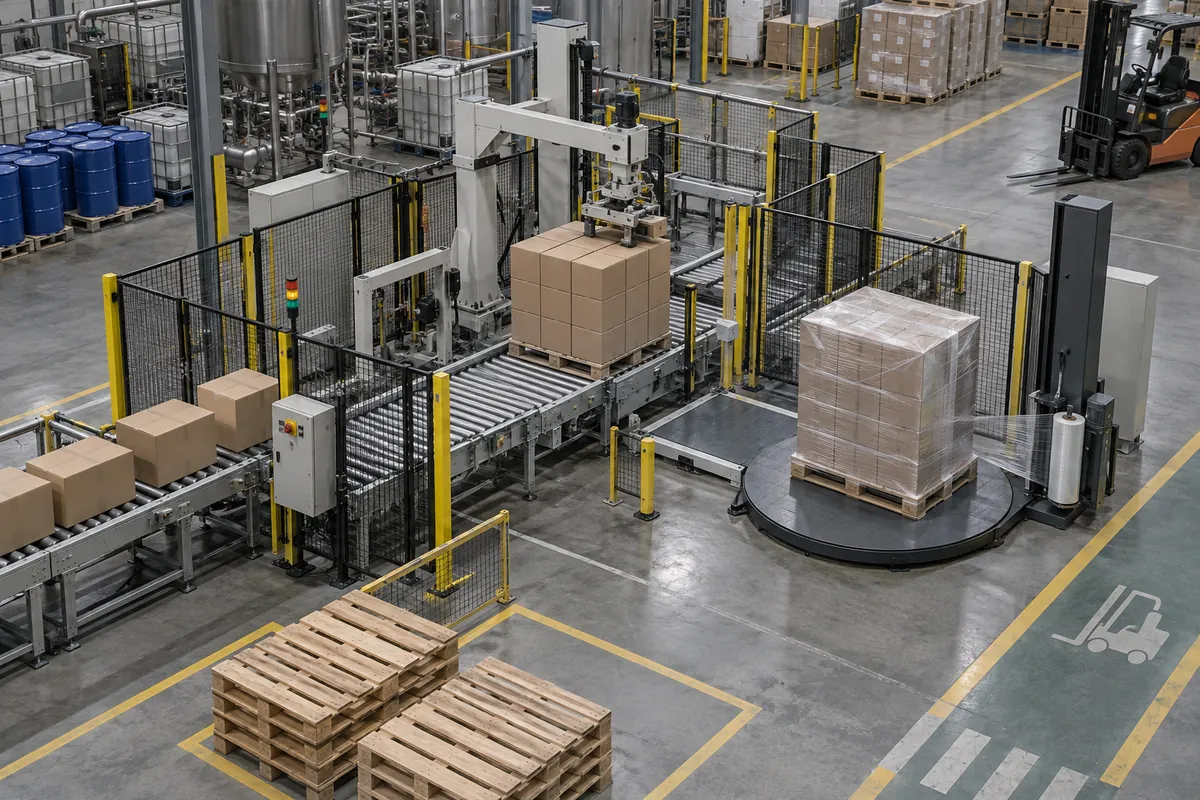
Floor access can simplify some tasks, but confirm which service points need platforms or special clearance. Accessible machinery still requires the relevant isolation procedure and safeguarding.
Expect electrical power and compressed air, so ask for the connected load and air use. A PLC and HMI manage the pattern and recipe. Ask how patterns are created, stored, and changed, and how the machine signals the packer and wrapper.
Layer plates, pallet lifts, and pallet exits are hazards even at floor level. Safeguarding commonly combines guards, interlocked doors, light curtains, and controlled-entry procedures. ISO 13849-1 defines performance levels for safety-related control functions, and a design with a robot adds ISO 10218 and ANSI/A3 R15.06. Editions change, so confirm which apply. A site risk assessment of the complete installation should set the safeguarding.
Takeaway: Verify service access on the full layout; low product entry does not establish safe floor-level access to every task.
Cost factors
This guide does not state prices. Suppliers generally describe low level machines as less expensive than high-level equivalents, with lower installation cost where no elevated conveyor is needed, and the palletizer cost guide explains how to compare quotes. The main drivers are:
- Rate class and the number of infeeds
- Layer movement method and hoist capacity
- Layer squaring or compression features
- Pallet magazine and sheet handling
- Accumulation conveyors and any decline conveyor from overhead lines
- Guarding, light curtains, and controlled-entry access
- Controls platform, patterns, and integration with line equipment
- Wrapper interface and discharge conveyors
- Installation, commissioning, training, and spare parts
Because the rate ceiling is harder to raise later, include the cost of replacement or a second machine if line speed is expected to grow.
Takeaway: Include the growth scenario in both the installed-cost comparison and acceptance criteria.
Selection checklist
- Measure the existing conveyor height and ceiling clearance.
- Define the sustained cases per minute at the highest line speed.
- List case sizes, weights, patterns, and pallet sizes and heights.
- Convert required cases per minute into layers per minute.
- Decide the number of infeeds and the accumulation space available.
- Request a layout drawing that includes pallet staging and forklift paths.
- Specify pallet and sheet handling.
- Confirm which service points can be reached from the floor.
- Request the safeguarding approach and the standards applied.
- Ask about the changeover method and time on the hardest change.
- Ask what happens if line speed grows.
- Request an acceptance test with production cases.
Common mistakes
- Assuming the rate will keep up with the line. Check the highest sustained rate, not the average.
- Ignoring tall pallets, since cycle time grows with the vertical travel.
- Forgetting accumulation. The layer-forming stage needs a buffer and floor space for it.
- Treating floor-level access as a safety case. Guarding and lockout still apply.
- Skipping the layout drawing. Floor use differs between designs, so verify.
- Overlooking existing overhead conveyors, since a decline conveyor adds cost.
- Underestimating changeover. Mechanical changes consume production time.
- Buying for today only. The rate ceiling can be hard to raise later.
Alternatives
A high level palletizer forms layers at an elevated infeed and generally reaches higher rates, fits plants with overhead conveyors and tall ceilings, and needs a lift and platforms. A robotic palletizer suits many SKUs, mixed shapes, and frequent pattern changes, and the robotic vs conventional palletizer guide sets out the comparison. The guide to choosing a palletizer helps weigh them against the same package list and rate, and the case palletizers page covers case handling that applies to every architecture. If the plant has low ceilings, floor-level conveyors, and moderate output, a low level machine is usually the first design to price.