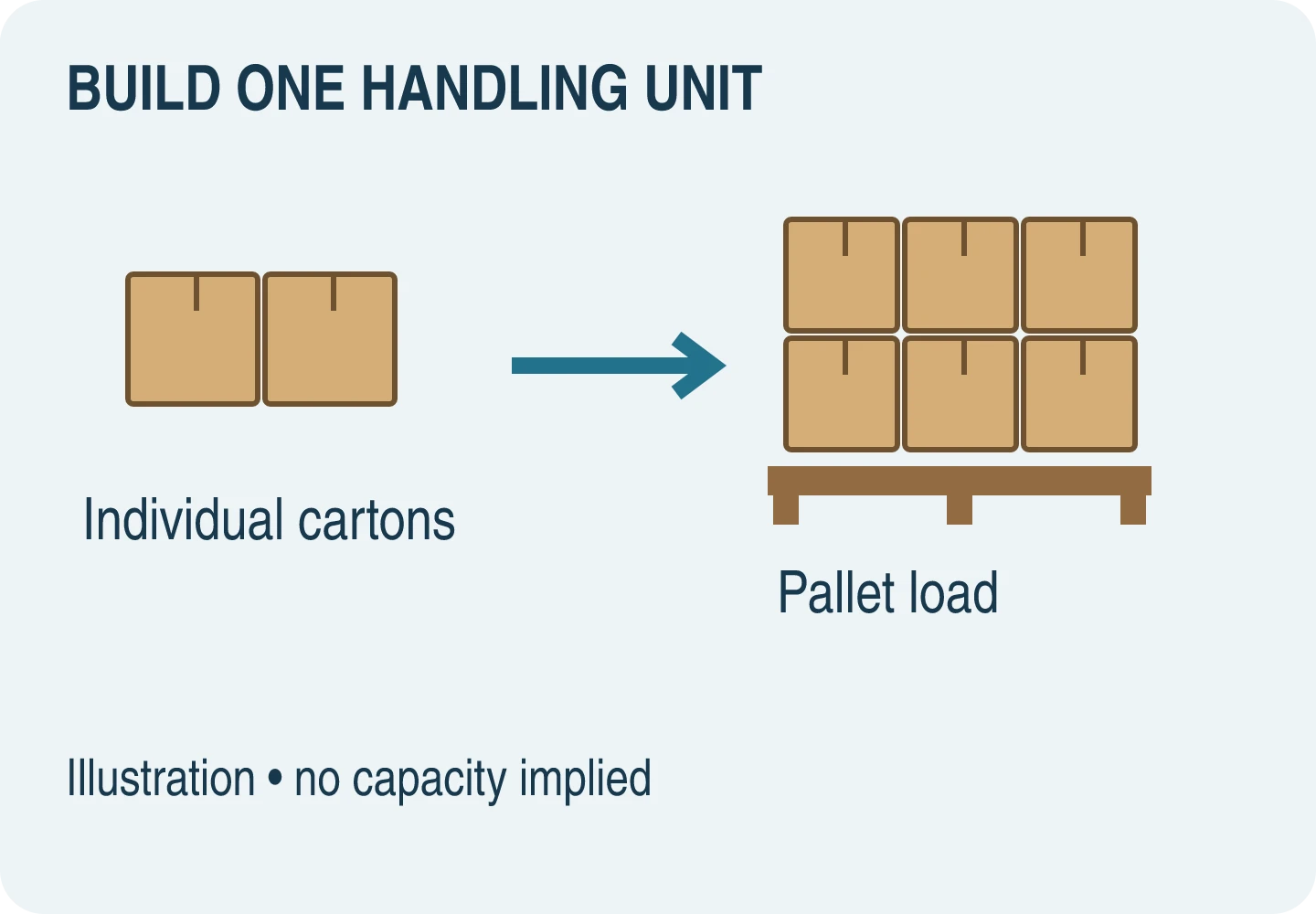
Confusing load building with wrapping can leave a packaging project missing an entire operation. Palletizing means arranging goods on a pallet to form a load that can be handled together for storage or transport.
- Palletization names the process; palletized goods are its output.
- A palletizer forms the load; a wrapper helps secure it.
- People, assisted equipment or automatic machines can perform the stacking.
- Warehouse order building and manufacturing output create different requirements.
This explanation separates warehouse and manufacturing load-building terms before an equipment discussion.
Palletizing describes an operation, not one machine
Wiktionary defines palletization as the act or process of palletizing. MHI’s material-handling taxonomy describes palletizers as load-formation equipment. Together, these definitions separate the operation from the equipment used to carry it out.
| Term | Meaning in this guide | Do not confuse it with |
|---|---|---|
| Pallet | A platform supporting goods with access for suitable lifting equipment | The goods alone |
| Palletizing or palletization | Building a load on that platform | Transporting an already built load |
| Palletized goods | Goods arranged on a pallet for handling | A guarantee that a receiver will accept them |
| Palletizer | Equipment that forms the load | A forklift or a stretch wrapper |
| Palletizing system | The load-building equipment and its supporting interfaces | A robot arm considered on its own |
The palletizing systems overview maps the equipment and supporting functions. Start there after identifying the operation you want to change.
Common mistake: Specifying a “pallet machine” without saying whether the job is building, moving or securing the load. Those verbs lead to different equipment.
Takeaway: Name the operation first, then identify the equipment that performs it.
Follow cartons from packages to a secured load
A useful process description starts with the incoming package and ends with the handoff. The sequence below is a conceptual carton example, not a machine operating procedure.
- Identify the cases and the intended pallet. Record the package orientation and the receiving requirements.
- Arrange cases in a planned layer pattern. Decide where each case sits before repeating the pattern through the load.
- Build the load. Place packages or completed layers onto the pallet using the chosen manual or automatic method.
- Secure the completed load with the specified restraint method, then check it for the next handling stage. Stretch wrapping is one option; it is a separate function from forming the stack.
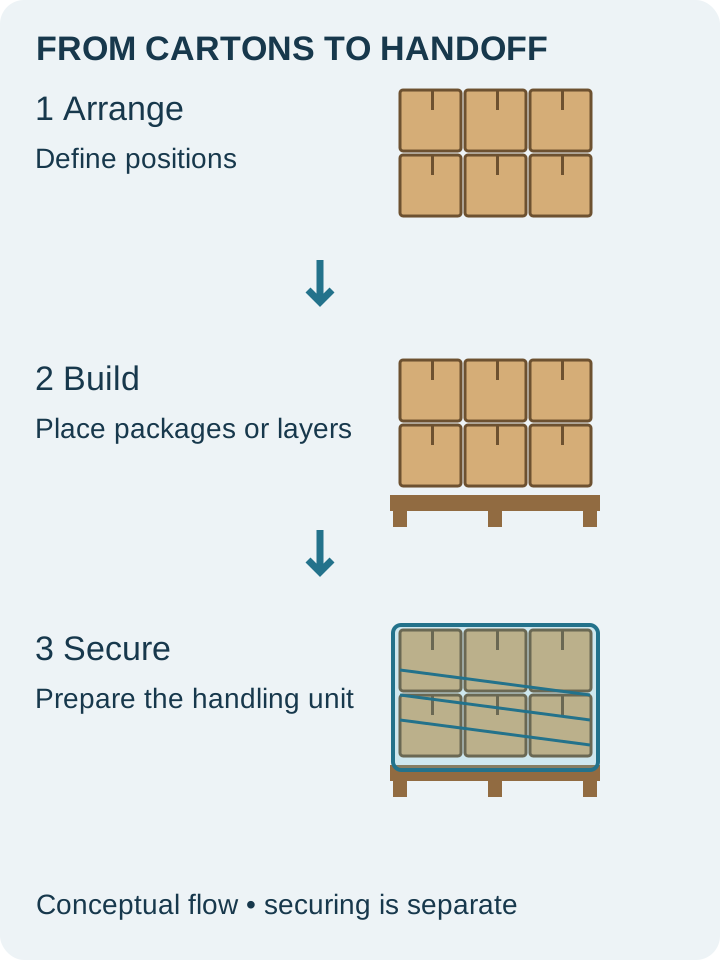
A manufacturing line may supply closed cases from case sealing equipment. The case handling guide explains that upstream interface. Downstream, pallet handling covers how the completed load moves away. Recording these handoffs makes the process boundary visible without choosing a particular machine.
FedEx’s packaging guidance treats securing a stacked load as a distinct task. Its examples include stretch wrap and other restraint materials; the choice belongs to the load and transport plan.
Takeaway: Include both load formation and the secured-load handoff in the process description.
Separate the stacking method from the pattern
“Type” can refer to who moves the packages, the machine mechanism or the arrangement of cases. Keep those meanings separate. A layer pattern describes package positions; it does not identify how those positions were achieved.
| Method | Who or what forms the load | What this classification tells you |
|---|---|---|
| Manual | People position packages | The stacking work depends on the workstation and handling task |
| Assisted or semi-mechanized | People arrange packages while powered equipment performs part of the movement | The division of tasks needs to be stated |
| Robotic pick and place | A robot and gripping tool position packages or groups | Package presentation and gripping matter |
| Conventional layer formation | Equipment forms and deposits a layer | The layer and its transfer mechanism are central |
MHI’s educational taxonomy supports these distinctions. It is an older teaching reference, so this guide does not use its historical rate figures as current performance benchmarks.
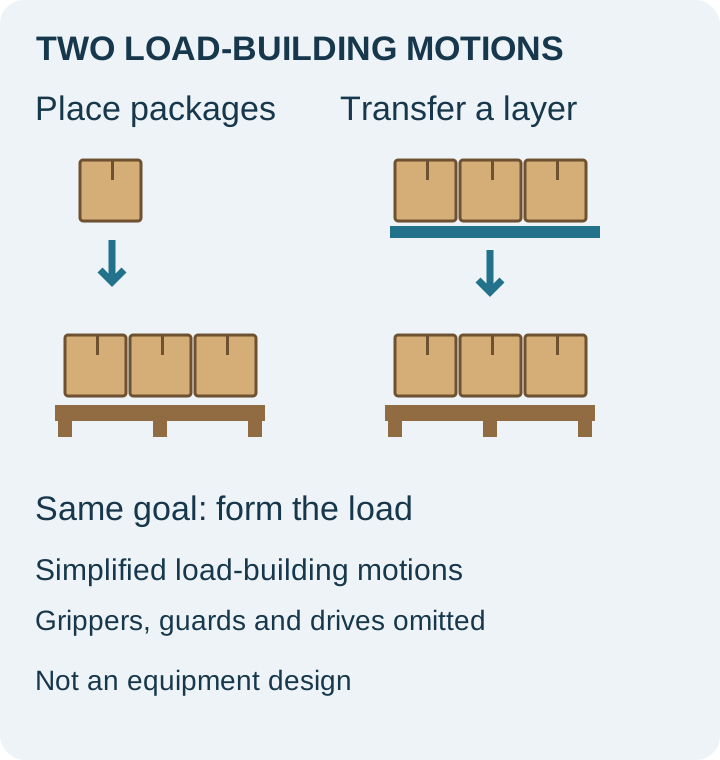
For the mechanisms, read robotic palletizers and conventional palletizers. The robotic versus conventional comparison handles the deeper tradeoffs. No method wins from its name alone.
Common mistake: Calling an interlocking case pattern a “robotic pallet.” The case arrangement and the stacking machine are separate decisions.
Takeaway: Describe the stacking method and the package pattern in separate fields.
Distinguish warehouse work from manufacturing output
A warehouse may rebuild received loads, consolidate orders or assemble mixed products for dispatch. A manufacturing line may repeatedly stack the finished packages arriving from production. These are examples of different work, not a rule that warehouses are manual or factories are automatic.
| Question | Manufacturing-line example | Warehouse or distribution example |
|---|---|---|
| What triggers the work? | Packages leaving production | An order, replenishment or dispatch requirement |
| What enters the operation? | Finished packages from an upstream line | Selected goods from receiving or storage |
| What defines the load? | The production SKU and required pallet pattern | The order contents and receiver requirements |
| What is the handoff? | A completed load leaving the line | A load ready for its next storage or dispatch stage |
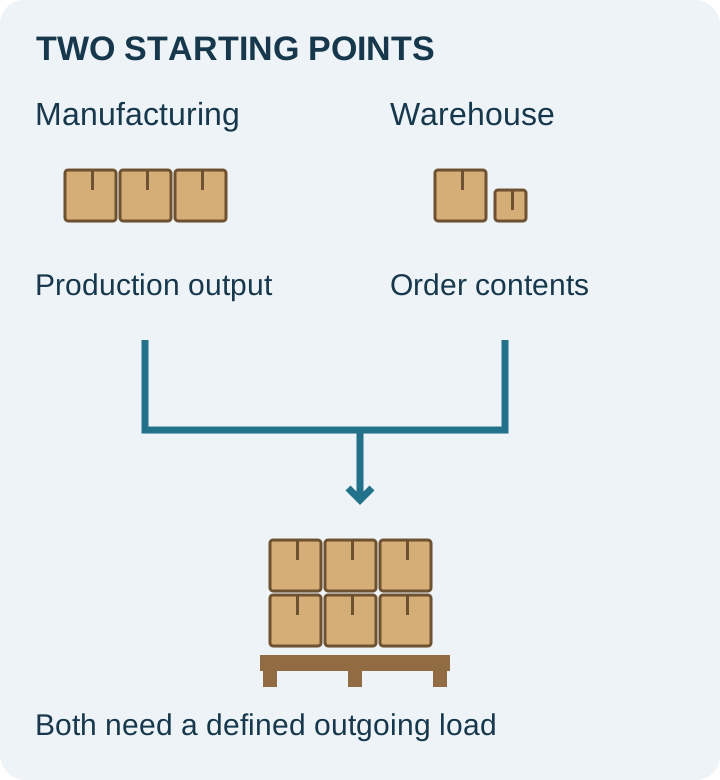
Record the actual variation rather than assigning a machine by building type. A warehouse with repeatable loads and a factory with frequent format changes may need different approaches from the examples. The palletizer selection guide addresses those project inputs; packaging line design covers connected equipment.
Takeaway: Describe the incoming work and required outgoing load, not just the name of the facility.
When this does not apply
This explanation does not certify a pallet load, select lifting equipment or authorize anyone to enter a machine cell. Unusual goods, hazardous materials, cold-chain requirements and export packaging need their own assessment. A stable-looking stack alone does not establish safe lifting, rack storage or transport performance.
Loose goods can also be grouped using other load carriers. MHI lists slipsheets, containers and other unit-load approaches alongside pallets. This page uses palletizing for building on a pallet and does not treat every grouped shipment as palletized.
For the reverse operation, use the depalletizing guide. Removing goods from a pallet raises a different process question from building the load.
Takeaway: Use this page to define the task, then obtain the load-specific handling and acceptance requirements.
Methods and sources
Sources compiled October 7, 2026; opening order revised October 8, 2026. Based on the dictionary entry, MHI’s educational taxonomy, FedEx’s public packaging guidance and a manufacturer’s published explanation of carton palletizing interfaces. The diagrams are original explanatory illustrations, not equipment drawings or evidence of a tested installation. We have not tested a palletizer or a shipping load for this article.
The FAQ combines questions in the October 6 US search snapshot with published FedEx and Soontrue help questions. Those manufacturer and carrier questions are identified as published help content, not independent survey findings. Answers stay within the basic terminology and route detailed costing or engineering work to the relevant guide.
Takeaway: The sources support definitions and process boundaries, not machine performance guarantees.
Related reading
- Pallet calculator estimates geometric fit from package and pallet dimensions.
- Palletizer cost guide separates equipment from the installed project scope.
- Palletizing systems shows the supporting equipment around load formation.
Takeaway: Choose the next guide according to the specific decision you need to make.