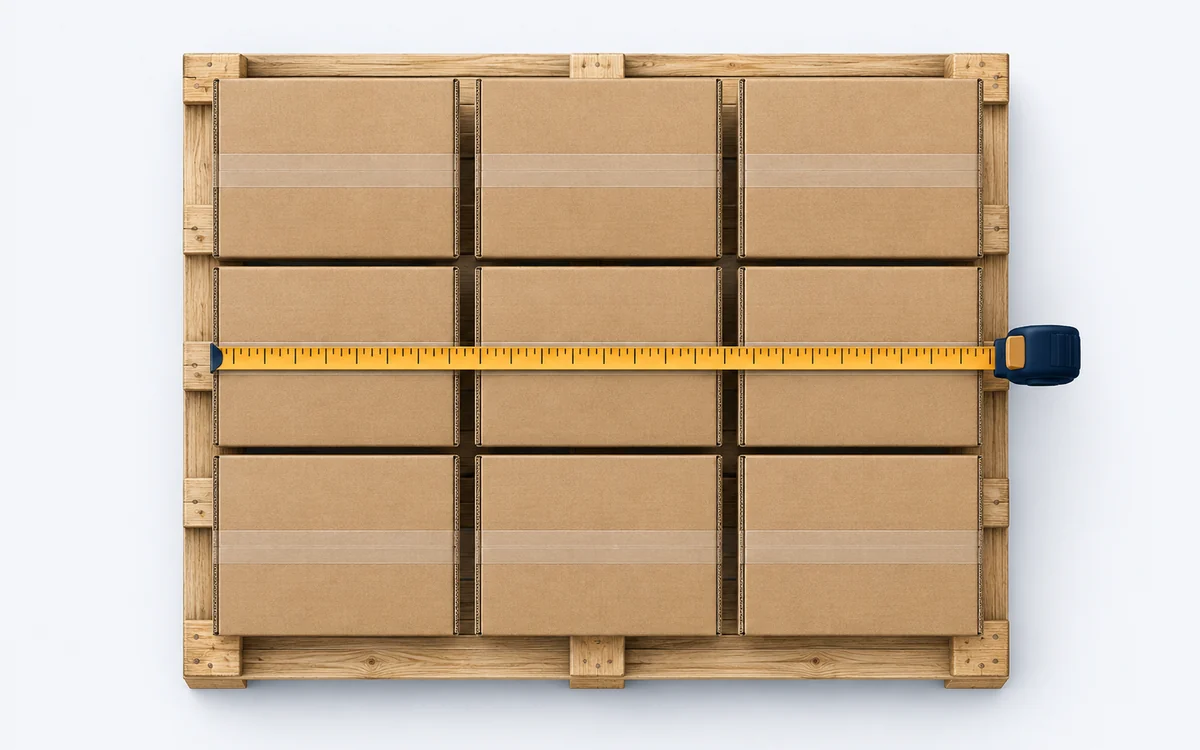
Use the calculator below for rectangular cases and identical column-stacked layers. Replace the assumed inputs with measurements and written limits; record the sources of height, weight and overhang allowances before sharing the result. Read the formulas after calculating.
Pallet calculator
The fields are filled with the worked example (example, assumed inputs). Replace every value with your own measurements: outside case dimensions measured on filled, sealed cases, and the height and weight of the pallets you actually ship on.
Read the result from the top. The two single-orientation counts show what a simple block pattern gives. The best layer can mix rows or columns in both orientations; if it says “lengthwise” and “crosswise” together, the machine or the operator must turn some cases. The last four rows are the ones to check against your limits.
How do you calculate how many boxes fit on a pallet?
Take the larger of the two single-orientation counts and the best mixed layer as cases per layer. Then take the smaller of the layers that fit under the height limit and the layers the weight limit allows, after subtracting the pallet’s own height and weight. Multiply the two. Everything else is a check on that result.
Work in one unit system and use outside dimensions. Call the pallet length L and width W, the case length l, width w and height h. If overhang is allowed, add twice the allowance to L and W before counting; if the load must stay inside the deck, use the deck size or a smaller one.
| Variable | Meaning | Unit | Where it comes from |
|---|---|---|---|
| L, W | Pallet length and width, plus 2 x allowed overhang | in or mm | Pallet specification; customer or carrier rule for overhang |
| l, w, h | Case outside length, width and height | in or mm | Measured on filled, sealed cases, not the blank or inside size |
| Case weight | Weight of one filled case | lb or kg | Weighed, using the heaviest normal fill |
| Pallet height and weight | The empty pallet | in or mm; lb or kg | Measured or from the pallet supplier |
| Max load height | Floor to top of the finished load | in or mm | Customer, racking, trailer, palletizer and wrapper limits |
| Max gross weight | Load plus pallet | lb or kg | Pallet rating, handling equipment, customer and carrier limits |
The calculator applies five formulas. Each one can be checked with a pocket calculator.
- Lengthwise layer: floor(L / l) x floor(W / w).
- Crosswise layer: floor(L / w) x floor(W / l).
- Two-block mixed layer: for each possible number r of lengthwise rows, add floor((W - r x w) / l) crosswise rows in the space left, giving r x floor(L / l) + floor((W - r x w) / l) x floor(L / w). Repeat with columns along the pallet length, and keep the highest result.
- Area ceiling: floor((L x W) / (l x w)). If a pattern reaches it, no other pattern of these cases can hold more.
- Layers: the smaller of floor((max load height - pallet height) / h) and floor((max gross weight - pallet weight) / (cases per layer x case weight)). Total cases equal cases per layer times layers.
Two more numbers come out of the same inputs. Overhang per side is (layer footprint - pallet size) / 2, measured on each axis with the load centered; a negative value means the load sits inside the edge. In a column stack, each bottom case carries (layers - 1) x case weight.
Floor means round down. A row of 3.9 cases is a row of 3.
Takeaway: Keep the units and pallet deductions with the result so another person can reproduce it.
Worked example: 16 x 12 x 10 inch cases on a 48 x 40 inch pallet
With a 60 inch height limit and a 2,000 lb weight limit, a 16 x 12 x 10 inch, 25 lb case fits 10 per layer in a mixed layer, 5 layers high, for 50 cases. Height, not weight, sets the limit.
Example, assumed inputs. These are not measurements from a real line. Pallet 48 x 40 inches, 6 inches high, 40 lb. Case 16 x 12 x 10 inches, 25 lb. Maximum load height 60 inches from the floor. Maximum gross weight 2,000 lb. No overhang allowed.
| Step | Calculation | Result |
|---|---|---|
| Lengthwise layer | floor(48 / 16) x floor(40 / 12) = 3 x 3 | 9 cases, footprint 48 x 36 in, 2 in inside each long edge |
| Crosswise layer | floor(48 / 12) x floor(40 / 16) = 4 x 2 | 8 cases, footprint 48 x 32 in, 4 in inside each long edge |
| Mixed layer | 2 lengthwise rows (2 x 12 = 24 in) + 1 crosswise row (16 in) = 40 in; 2 x 3 + 1 x 4 | 10 cases, footprint 48 x 40 in, flush |
| Area ceiling | floor(1,920 / 192) | 10 cases, so the mixed layer cannot be beaten |
| Layers by height | floor((60 - 6) / 10) = floor(5.4) | 5 layers |
| Layers by weight | floor((2,000 - 40) / (10 x 25)) = floor(7.84) | 7 layers |
| Layers used | smaller of 5 and 7 | 5 layers, height governs |
| Total | 10 x 5 | 50 cases |
| Load height and weight | 6 + 5 x 10; 40 + 50 x 25 | 56 in; 1,290 lb |
| Bottom case load | (5 - 1) x 25 | 100 lb on each bottom case |
The example shows why testing only one orientation is a mistake: the lengthwise layer leaves a 4 inch strip that holds nothing, and the crosswise layer leaves 8 inches. Turning one row uses the full deck and adds one case per layer, five per pallet. It also shows that height, not weight, limits this load, so a lighter fill would not add a layer, but a taller allowance or a shorter case would.
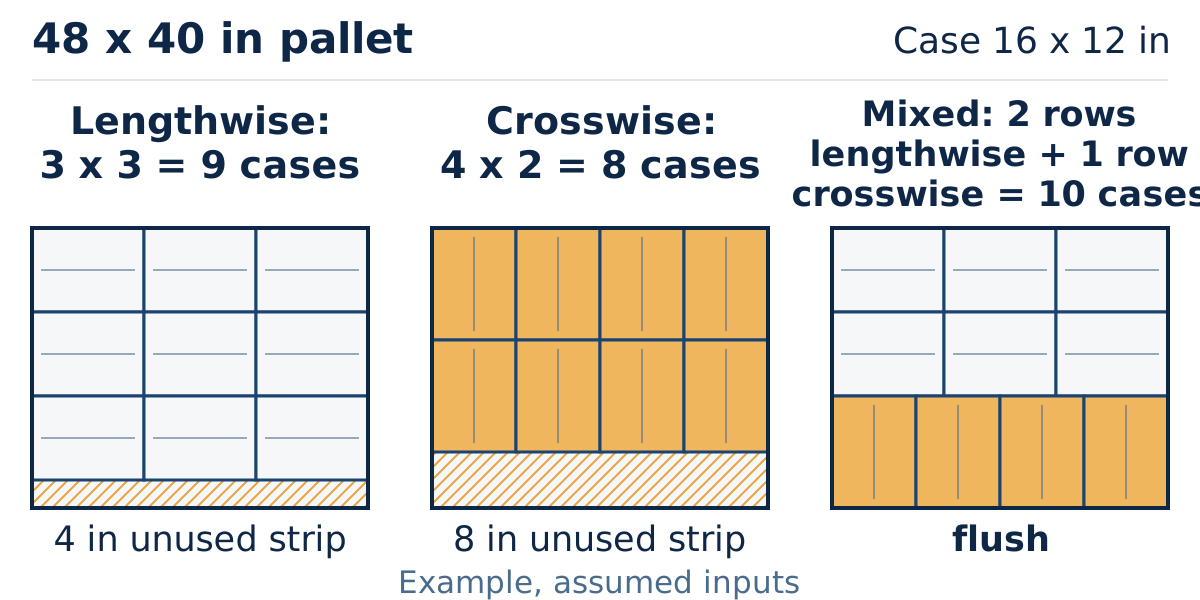
Takeaway: The mixed layer reaches the area ceiling in this assumed example; that establishes geometric fit only.
Overhang, height and weight: what the result does not tell you
The calculation gives a geometric answer. Four checks decide whether you can use it, and none of them can be settled by the calculator.
Overhang. One palletizer manufacturer, BW Packaging, describes overhang as product extending beyond standard pallet dimensions, typically 48 x 40 inches in North America. The company says overhang reduces compression strength and can lead to rejected shipments, and that a quarter-inch error in the first layer can grow to several inches by full height. The calculator assumes perfect placement on a flat deck. Real cases bulge and lean, so leave margin and take the allowed overhang from your customer and carrier in writing. Enter 0 if you have no written allowance.
Height. The maximum load height usually comes from the receiving customer, warehouse racking, trailer doors, and the maximum load height of the palletizer and stretch wrapper. The calculator adds the pallet height but not slip sheets, tier sheets or top caps. If you use them, add their thickness to the case height, or lower the height limit by their total.
Weight. The gross weight limit is the lowest of the pallet’s rating, the handling equipment, the floor or racking, and the customer’s rules. Pallet ratings differ: EPAL, for example, publishes a safe working load of 1,500 kg for its 1,200 x 800 mm Euro pallet and 1,250 kg for its 1,200 x 1,000 mm EPAL 2 pallet. Use the figure for the pallet you actually ship on.
Case strength and stability. The bottom-case load is the weight above each bottom case in a column stack. Compare it with the stacking data your case supplier gives for that board and case design, under your storage and humidity conditions. A stack that fits the height and weight limits can still crush or lean. Interlocked patterns, where alternate layers are rotated, change both stability and how the load travels down to the bottom cases. The case palletizer page explains column and interlocked patterns.
Stacking and shipping rules must be checked with your carrier and the standards your customers apply. Tolerance, height and weight limits must come from your project specifications.
From the pallet pattern to the palletizer
A pallet pattern is half of a palletizer specification. Once the pattern is settled, five numbers from it should go into every supplier enquiry for a palletizing system.
- Layer footprint. Check the layer size, including any overhang, against the pallet sizes and layer area the machine handles.
- Load height. Compare the load height from the calculator with the machine’s maximum load height and with the stretch wrapper’s.
- Case weight and picks. Case weight sets the tooling. In a 2015 Packaging Digest report on a robotic bird seed line with shipping cases of up to 60 lb, the integrator said it originally wanted vacuum grippers but some boxes were too heavy, so the robot used a fork-style gripper that picks a row of typically three to five cases. Give suppliers the heaviest case and the number of cases you expect per pick.
- Orientation and label faces. A mixed layer needs some cases turned. If labels must face out, fewer patterns work. BW Packaging lists a “label out” option among its robotic palletizer’s pattern controls, which shows that suppliers treat label direction as a pattern input. State the requirement in the specification.
- Rate. Cases per minute equal layers per minute times cases per layer. If the line sends 20 cases per minute and the pattern holds 10 cases per layer, the palletizer must complete 2 layers per minute before allowing time for pallet changes. Layer-forming machines are rated this way, as the conventional palletizer page explains.
The palletizer selection guide shows how to turn these numbers into a written specification and compare supplier quotes against it. Where the palletizer sits in the line, and how upstream output reaches it, is covered in packaging line design.
What to record before you hand the pattern on
Use “Copy calculation record” above, or select the record manually. It includes original inputs, units, limit sources, selected arrangement and safety boundaries. Review the following project details with the case supplier and warehouse before using it in a palletizer specification.
- Case outside length, width and height, measured on filled cases, and the heaviest case weight
- Pallet type, length, width, height and weight
- Allowed overhang per side, and who set it
- Maximum load height and maximum gross weight, and where each limit comes from
- The chosen layer: cases per layer, orientation of each row, and footprint
- Layers, total cases, load height and gross weight
- Bottom-case load, and the case supplier’s stacking data it was compared with
- Slip sheets, tier sheets, top caps and label-face requirements
- Target rate in cases per minute and the resulting layers per minute
If a field is unknown, mark it as open for project verification rather than entering a guess. The supplier can then tell you which unknowns change the machine.
Takeaway: Keep the copied geometry record with the written limits and load-validation evidence; unresolved sources require project verification.
Method and sources
The calculator uses rectangular geometry only. It assumes identical rectangular cases, every layer identical, column stacking, and a load centered on the pallet. It tests the two single orientations and every two-block layer that splits the pallet once, along its length or its width. It does not test pinwheel or other multi-block patterns, which can sometimes hold more cases. The area ceiling shows when a better pattern is impossible. When the best layer is below the ceiling, a pattern program or a supplier’s pattern drawing may find more.
ISO 6780:2003 lists 1,219 x 1,016 mm, given as 48 x 40 inches, among its rectangular pallet plan dimensions, alongside 1,200 x 1,000 mm and 1,200 x 800 mm; the standard sets plan sizes, not load ratings. The heights, weights and safe working loads quoted for the 1,200 x 800 mm and 1,200 x 1,000 mm pallets come from the European Pallet Association’s specification pages. The overhang description and the “label out” option come from BW Packaging’s published pages, and the gripper example from Packaging Digest. Manufacturer statements are reported as their claims. All sources were accessed on October 7, 2026, and are listed under References. No load in this guide was built or tested by the editorial team.
The record and tool order were revised October 8, 2026; the original geometry and published source figures are unchanged.