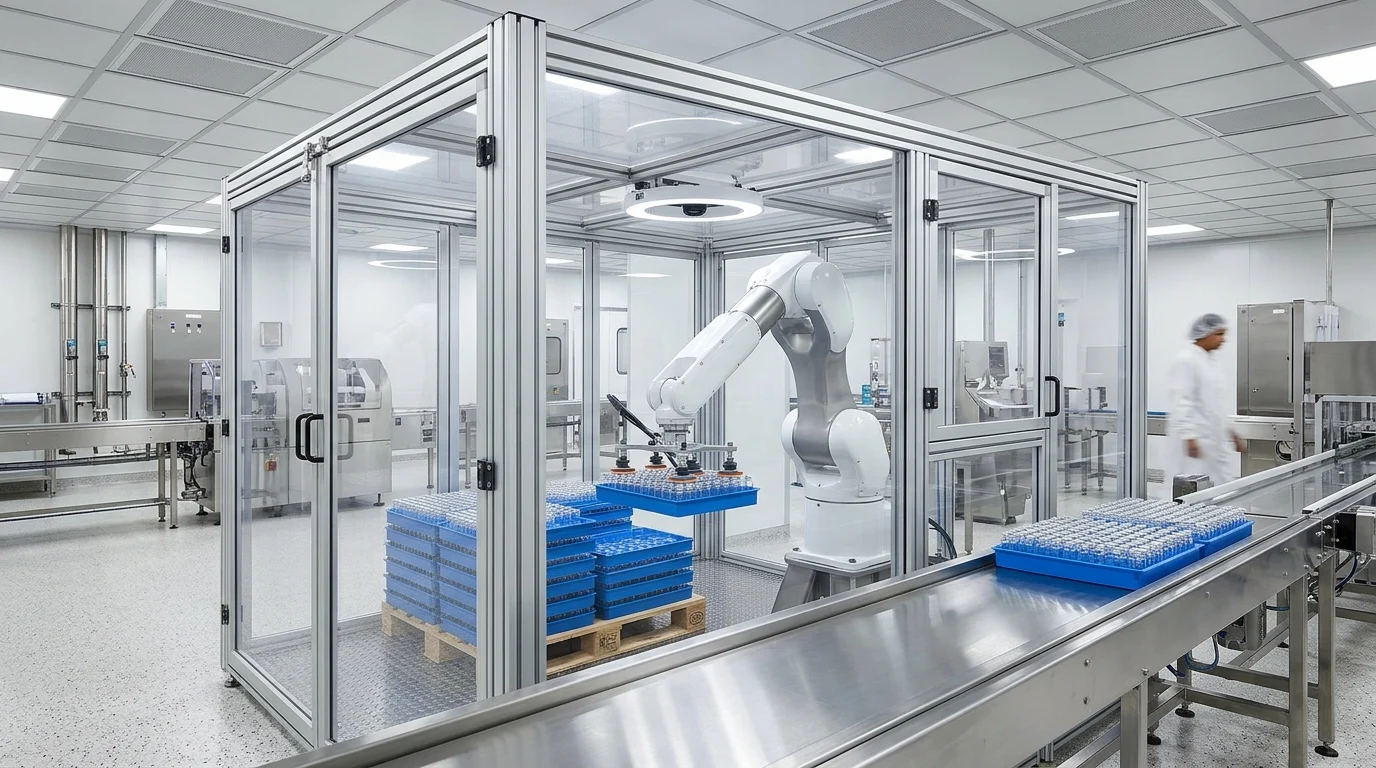
In depalletizer vials in akylux tray projects, Cilyx states that depalletizing syringes in tubs or vials in trays, including Akylux trays which are more flexible and difficult to handle, stored on pallets, is the first step in a fully automated packaging, wrapping, or product inspection line and requires an intelligent vision system to optimize the gripping sequence and identify the most suitably positioned tubs or trays so the robot can place them one by one onto a conveyor. When evaluating a vial depalletizer, a depalletizing machine, or a corrugated polypropylene tray depalletizing system, Cilyx notes that vials are often arranged in a staggered pattern within trays with a varying number of vials per line, and when trays are made of Akylux, their flexibility and slight dimensional variability make vial handling more complex, requiring tailored loading and unloading solutions.
Use this guide alongside our packaging engineering guides, the depalletizing systems overview, our bottle depalletizers equipment reference, and the bulk glass and PET bottle depalletizer selection guide to coordinate upstream unloading with bottle conveyors and commissioning and acceptance.
| Engineering boundary | Published material or process specification | Operational impact on tray and vial depalletizing |
|---|---|---|
| Twin-wall polypropylene sheet range | Akylux twin-wall polypropylene sheet has a standard thickness range of 2 to 14 mm and a grammage of 250 to 3,000 gsm. | Defines the standard thickness and grammage range for Akylux twin-wall polypropylene sheet |
| Sheet dimensional and density tolerances | EcorePack twin-wall corrugated plastic sheets have manufacturing tolerances of ±0.15mm for thickness, ±5% for density, ±2mm for width, and ±5mm for length. | Defines the manufacturing tolerances for thickness, density, width, and length on twin-wall corrugated plastic sheets |
| Closed-edge tray construction | Corplex closed-edge polypropylene fluted sheets prevent delamination, improve resistance to tearing, protect operators against cuts/injuries, and make it easy to slide a flap or tab between walls in pharmaceutical, cosmetics, and food sectors. | Prevents delamination, improves tearing resistance, and makes it easy to slide a flap or tab between walls |
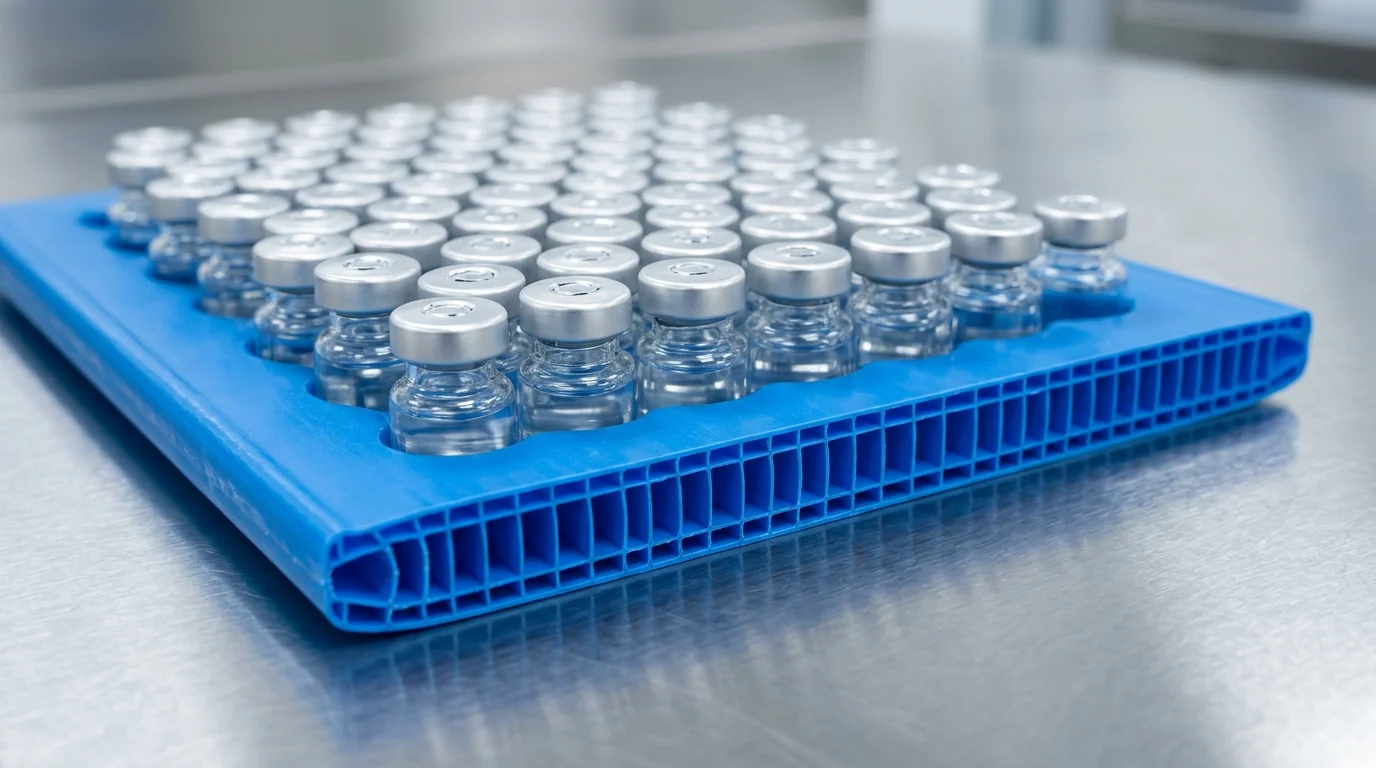
| Staggered vial pattern and tray flexibility | Cilyx notes that vials are often arranged in a staggered pattern within trays with a varying number of vials per line, and when trays are made of Akylux, their flexibility and slight dimensional variability make vial handling more complex, requiring tailored loading and unloading solutions. | Requires tailored loading and unloading solutions for staggered vial patterns in flexible Akylux trays |
| Small-diameter cartridge tipping sensitivity | At Eli Lilly Fegersheim, a cartridge is a small vial with a diameter of around 1 cm that is stored after filling and crimping in an Akylux (alveolar polypropylene) box containing 330 units; the small 1 cm diameter and the flexibility of the Akylux container mean cartridges can tip over easily in response to a slight push. | Explains why 1 cm diameter cartridges in 330-unit Akylux boxes can tip over easily in response to a slight push |
| Cleanroom Material Airlock (MAL) boundary | IMA Group states that a standard Stevanato Group RTU vials pallet holds 12 polypropylene boxes (4 boxes per layer) with each box containing 15 tubs in rows of 3 positioned upside down; because pallets cannot be transported in classified Grade D and C areas, depalletizing and box removal must be completed before transferring boxes through Material Airlocks (MALs), and a high-speed filling line (24,000 and 36,000 units per hour) may require 5 to 6 tubs per minute (300 – 360 tubs per hour, or 20 to 24 boxes per hour). | Requires depalletizing and box removal to be completed before transferring boxes through Material Airlocks (MALs) |
Specify Akylux twin-wall polypropylene sheet gauges, tolerances, and cleanroom surface properties
Before selecting a vial depalletizer or configuring corrugated polypropylene tray depalletizing tooling, review the published sheet gauges, dimensional tolerances, sterilization methods, and edge treatments from twin-wall polypropylene manufacturers:
- Akylux twin-wall polypropylene sheet has a standard thickness range of 2 to 14 mm and a grammage of 250 to 3,000 gsm.
- Akylux twin-wall polypropylene sheet is moisture and water resistant, fiber free for hygienic applications, absorbs impact, chemically inert, and 100% recyclable, and converts into containers, cases, boxes, fittings, dividers, layer pads, and container sleeves.
- Akylux sheet optional treatments include antistatic, conductive or permanent antistatic (<105 Ω/), dissipative treatment (109-1010 Ω/), flame-retardant classification, and Corona treatment on 1 or 2 sides at 40 to 42 dynes/cm.
- Akylux sheet sterilization accepts gamma rays (tested with treatment at 25 KGy), enables ethylene oxide (gas) treatment, and allows heat treatment (e.g. 72 h between 50 and 60 °C depending on conditions of application).
- Akylux raw polypropylene has a Vicat softening point of 145 °C at 10 N (standard ISO R 306) and a melting point of 160-165 °C (DSC).
- EcorePack twin-wall corrugated plastic sheets (polypropylene co-polymer / high density polyethylene) specify a thickness of 2mm-10mm, weight of 250gsm - 2500gsm, and maximum width of 2450mm.
- EcorePack twin-wall corrugated plastic sheets have manufacturing tolerances of ±0.15mm for thickness, ±5% for density, ±2mm for width, and ±5mm for length.
- EcorePack supplies corrugated plastic flat sheets in 2mm, 3mm, 3.5mm, 4mm, 5mm, 6mm, 8mm, and 10mm thicknesses (2mm-10mm) and plastic rolls in 2mm-4mm thicknesses.
- Corplex AkyLux twin-wall polypropylene sheets are non-shedding and washable, making them suited for industries with heightened hygiene requirements and warehouses eliminating airborne particles and dust accumulation.
- Corplex closed-edge polypropylene fluted sheets prevent delamination, improve resistance to tearing, protect operators against cuts/injuries, and make it easy to slide a flap or tab between walls in pharmaceutical, cosmetics, and food sectors.
- Corplex fluted polypropylene sheet specifications list Correx Prime from 2.0mm – 10.0mm (250gsm – 1950gsm), Correx Recycled from 2.0mm – 8.0mm (250gsm – 1700gsm), and Correx Certified from 2.0mm – 3.5mm (250gsm – 700gsm).
Compare these incoming tray and box parameters against the equipment scopes on our bulk depalletizers and case depalletizers pages.
Compare robotic vial depalletizer and Akylux tray unloading architectures
Review the published specifications across vision-guided robotic depalletizers, bulk vial feeding systems, multi-robot cartridge unloading cells, and tray loaders:
Vision-guided tray depalletizing, staggered vial handling, and syringe nesting cells
- Cilyx states that depalletizing syringes in tubs or vials in trays, including Akylux trays which are more flexible and difficult to handle, stored on pallets, requires an intelligent vision system to optimize the gripping sequence and identify the most suitably positioned tubs or trays so the robot can place them one by one onto a conveyor.
- Cilyx states that palletizing tubs and Akylux trays at the end of the line does not require an intelligent vision system and often provides two pallet positions to avoid interrupting the robot during pallet changes.
- Cilyx syringes-in-tubs depalletization and palletization machines achieve speeds from 600 to 1,000 syringes per minute depending on configuration, with a throughput warranty from 150 to 1 000 seringues/min across syringe multiformats of 6,85mm, 8,15mm, and 10,85mm (0.5 – 2,25ml).
- Cilyx syringes-in-tubs depalletization cell specifications list an Inox 304/316L frame, a Siemens S7 – 1500 PLC, a Siemens Simatic HMI TP 1500, a Staübli TX2 60L – CS9 6 axes robot, 3 phases 400V – 25A – 50Hz electricity, and 6 bars pneumatic pressure.
- Cilyx notes that vials are often arranged in a staggered pattern within trays with a varying number of vials per line, and when trays are made of Akylux, their flexibility and slight dimensional variability make vial handling more complex, requiring tailored loading and unloading solutions.
- Cilyx vial tray loading and unloading machines operate at speeds ranging from 100 cycles per minute to 600 cycles per minute (equivalent to 6,000 to 36,000 vials per hour), are CE-certified, and meet all requirements of cGMP and GAMP5 good manufacturing practices.
- Cilyx DN400 denesting machine stages up to 40 trays of pre-filled syringes (each containing up to 100 syringes), handles syringes in groups of 10 using suction cups onto a spiral conveyor at 400 syringes per minute (24,000 syringes per hour), and stacks empty trays and nests in a vertical magazine.
- Cilyx automatic renesting machines operate at average outputs of 150 syringes per minute (9,000 syringes per hour) on the RN150, 300 syringes per minute (18,000 syringes per hour) on the RN300, and 600 syringes per minute (36,000 syringes per hour) on the RN600.
- Cilyx pre-filled syringe nesting and denesting machines ensure the absence of glass-to-glass or glass-to-metal contact between products and operate at speeds from 150 cycles per minute to 1000 cycles per minute (9,000 to 60,000 syringes per hour).
Bulk vial grippers, multi-robot U-tool cartridge extraction, and tray loaders
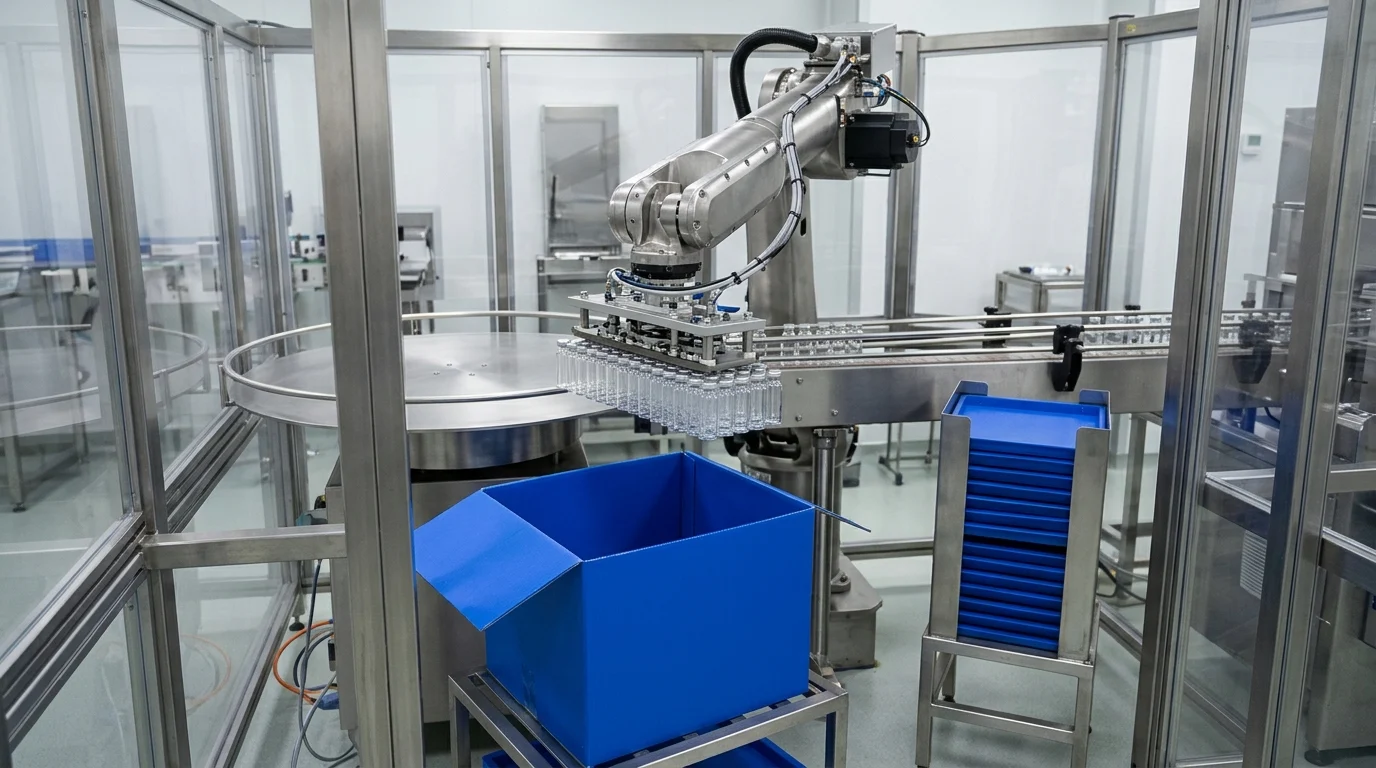
- Goldfuss Automation’s unsorted vial feeding system unpacks vials or plastic bottles from corrugated plastic trays (Akylux boxes without separators) using a specially designed gripper that handles the corrugated plastic trays and lifts grouped vials in bulk onto the infeed of a rotary table or bi-flow conveyor, with 3D vision detecting box position and orientation on the pallet and automatic separation of trays and lids after unloading.
- Goldfuss Automation’s unsorted vial feeding system runs up to 400 vials/min across formats 2R, 6R, 10R, 30ml, and 50ml vials, featuring a quick-change gripper system with centred feedthrough of media, de-palletizing with 3D camera, and optional RFID-coded gripper systems and AGV connection.
- Goldfuss Automation’s De-palletizing Cell Type DP uses 3D sensor technology to pick boxes from pallets at up to 6 de-palletizing cycles/min with 1 robot, a repeatability of 0.1 mm, format change in the minute range, and vacuum, holding clamp, or downside gripping.
- At Eli Lilly Fegersheim, a cartridge is a small vial with a diameter of around 1 cm that is stored after filling and crimping in an Akylux (alveolar polypropylene) box containing 330 units; the small 1 cm diameter and the flexibility of the Akylux container mean cartridges can tip over easily in response to a slight push.
- In the Eli Lilly Fegersheim 3-robot Akylux unloading cell, Robot 1 uses a 3D vision system with millimetre accuracy and a suction-cup tool (fitted with two additional suction cups for base and lid removal) to depalletize Akylux boxes, scan barcodes, and transfer each box onto two blades to cut the sealing label.
- In the Eli Lilly Fegersheim Akylux unloading cell, an AI vision system detects cartridges lying on their side or leaning over, after which Robot 2 inserts a U-shaped tool into the Akylux box using a wiggling movement and robot accuracy to a tenth of a millimetre while alternating with Robot 3 to maintain pressure on the cartridges on the conveyor so they do not fall backwards; collaborative robot safety is governed by ISO/TS 1566 2016 and ISO 10218.
- Pester Pac Automation’s PEWO-flex Robotic Tray Loader feeds non-labeled vials via a sorting plate or infeed conveyor, rejects lying vials, marks caps with an invisible data matrix UV code, transfers vials via a transport screw, feeds empty Akylux trays into the loading station, and loads up to 200 vials/minute into trays via robot (with three machine units realized in 8 months and qualified under EU GMP annexes 11, 15, and ICH Q9).
- Pester Pac Automation’s Pharma Liquid systems form and load vials in cardboard trays, wraparound cases, lidded trays, and Akylux boxes with and without spacers; separately, they depalletize and feed vials in multi-use systems; and their automated handling system handles 400 vials per minute without direct glass-to-glass contact.
- Pharmabotix AG’s robot-assisted tray loader handles vials, bottles, and primary packaging in Akylux trays and boxes (with or without compartments) fed from a magazine or directly from a pallet, using star wheels or screw conveyors for singulation at output rates of up to 300 pieces per minute and tool-free format changeover in under 5 minutes via Siemens Unified HMI with DQ/IQ/OQ/PQ documentation.
- Syntegon’s horizontal vial tray loader GLT processes up to 24,000 vials per hour (400 per minute) using a guide-free vial alignment concept and servo-based vial count, while the cartridge tray loader TLU-C processes up to 36,000 cartridges per hour (600 per minute) with UCI cap/stopper engravement, vision inspection, and tiltable plates.
- IMA Group (IMA BFB) RD Series robotic depalletizers handle trays or containers carrying strips, vials, bottles, jars, and pouches (stand-alone or integrated with TLS Tray Loading Systems) at speeds up to 10 cycles/min, supporting minimum pallet dimensions of 800 x 1200 x 1400 (W x L x H including pallet) and maximum pallet dimensions of 1000 x 1200 x 1400 across TLS-RD2 (2 pallet stations), TLS-RD4 (4 pallet stations), and TLS-RD6 (6 pallet stations).
- IMA Life’s semi-automatic tray and frame loading/unloading system handles vials in trays (vials/bulk) or frames between aseptic filling/capping and freeze dryers at loading and unloading speeds up to 300 vials/minute, is fully compliant with Annex 1 guidelines and pre-arranged for oRABS technologies, and uses an automatic fence with a hooking mechanism around the vial pack.
- Marchesini Group’s MDP 810 automatic pick-and-place depalletizer transfers cases from a pallet in a fixed position using vacuum pickup heads with 360 degrees rotation freedom to a downstream infeed conveyor at an output speed of up to 5 cases/min.
- Marchesini Group’s Ministratus automatic palletizer/depalletizer checks each pick operation every cycle and runs at an output speed of 8 cases/min on Europallets (800 x 1200 and 1000 x 1200) up to 1650 mm high.
| Equipment system | Published rate and format envelope | Vision, gripping, and qualification features |
|---|---|---|
| Goldfuss Automation Vial Feeding System (Unsorted) | Runs up to 400 vials/min across formats 2R, 6R, 10R, 30ml, and 50ml vials | Quick-change gripper system with centred feedthrough of media, de-palletizing with 3D camera, and optional RFID-coded gripper systems and AGV connection |
| Goldfuss Automation De-palletizing Cell Type DP | Up to 6 de-palletizing cycles/min with 1 robot and repeatability of 0.1 mm | 3D sensor technology to pick boxes from pallets, format change in the minute range, and vacuum, holding clamp, or downside gripping |
| Eli Lilly Fegersheim Akylux Unloading Cell | Robot 2 inserts a U-shaped tool into the Akylux box with accuracy to a tenth of a millimetre | AI vision system detects cartridges lying on their side or leaning over, wiggling movement on Robot 2, Robot 3 alternately keeps cartridges upright by exerting pressure so they do not fall backwards, and ISO/TS 1566 2016 and ISO 10218 safety governance |
| Cilyx Vial Tray Loading and Unloading Machines | Speeds ranging from 100 cycles per minute to 600 cycles per minute (equivalent to 6,000 to 36,000 vials per hour) | CE-certified and meet all requirements of cGMP and GAMP5 good manufacturing practices |
| Pester Pac Automation PEWO-flex Robotic Tray Loader | Loads up to 200 vials/minute into trays via robot (three machine units realized in 8 months) | Sorting plate or infeed conveyor, lying-vial rejection, invisible data matrix UV cap code marking, transport screw transfer, empty Akylux tray feed, and EU GMP annexes 11, 15, and ICH Q9 qualification |
| Pester Pac Automation Pharma Liquid Systems | 400 vials per minute without direct glass-to-glass contact | Forms and loads vials in cardboard trays, wraparound cases, lidded trays, and Akylux boxes with and without spacers; depalletizes and feeds vials in multi-use systems |
| Pharmabotix AG Robot-Assisted Tray Loader | Output rates of up to 300 pieces per minute and tool-free format changeover in under 5 minutes | Handles vials, bottles, and primary packaging in Akylux trays and boxes (with or without compartments) from a magazine or pallet using star wheels or screw conveyors via Siemens Unified HMI with DQ/IQ/OQ/PQ documentation |
| Syntegon GLT and TLU-C Tray Loaders | GLT up to 24,000 vials per hour (400 per minute); TLU-C up to 36,000 cartridges per hour (600 per minute) | GLT uses guide-free vial alignment and servo-based vial count; TLU-C uses UCI cap/stopper engravement, vision inspection, and tiltable plates |
| IMA Group (IMA BFB) RD Series | Speeds up to 10 cycles/min on pallet dimensions from 800 x 1200 x 1400 (MIN) to 1000 x 1200 x 1400 (MAX) | Handles trays or containers carrying strips, vials, bottles, jars, and pouches (stand-alone or integrated with TLS) across TLS-RD2 (2 pallet stations), TLS-RD4 (4 pallet stations), and TLS-RD6 (6 pallet stations) |
| IMA Life Semi-Automatic Tray/Frame Loading System | Loading and unloading speeds up to 300 vials/minute between aseptic filling/capping and freeze dryers | Handles vials in trays (vials/bulk) or frames, fully compliant with Annex 1 guidelines, pre-arranged for oRABS technologies, with an automatic fence and hooking mechanism around the vial pack |
To size downstream conveyor buffering between cyclic tray unloading and continuous filling lines, see our accumulation conveyor tables and line buffering guide.
Select vacuum area grippers and review beverage sweep-off baselines
Review the published specifications for compliant sealing-foam vacuum area grippers alongside the mechanical clamping, minimum container diameter, and tray orientation rules of bulk bottle depalletizers:
Compliant foam vacuum area grippers for row picking and deep box dipping
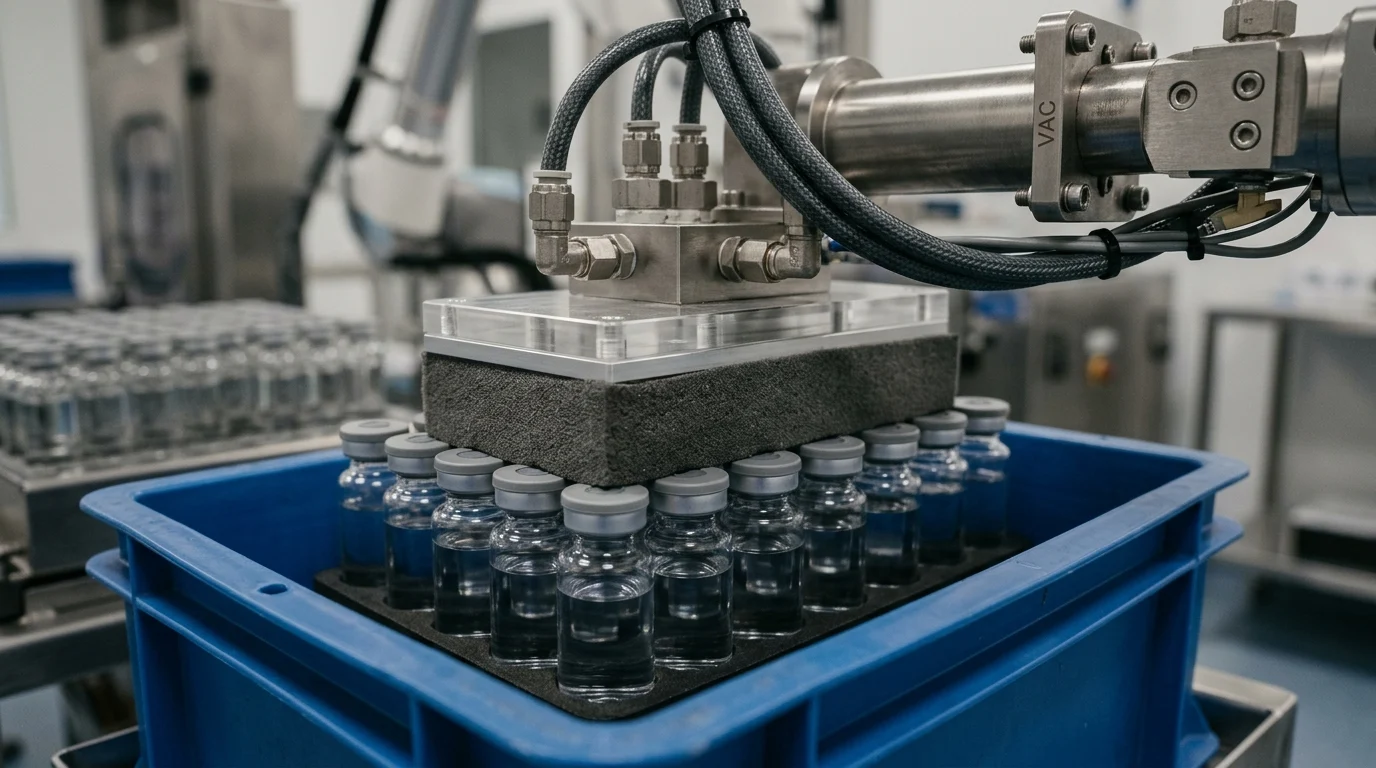
- J. Schmalz GmbH’s FXP-60 and FMP-60 vacuum area grippers measure 60 millimeters wide (compared to the 130-millimeter-wide version), use an aluminum profile with sealing foam as the gripping surface, require a minimum workpiece coverage degree of 50 percent via integrated flow restrictor technology, and scale in 18-millimeter length increments from 316 millimeters (FMP-60) or 388 millimeters (FXP-60) up to 1,972 millimeters.
- J. Schmalz GmbH’s FEL vacuum area gripper has a total installation height of 26.5 millimeters (a 16.5 mm aluminum base profile plus a ten millimeter thick sealing foam), segments into up to four individually controlled suction zones, weighs below three kilograms, supports a load capacity up to 1400 N in a vertical installation position, and comes in dimensions from 300 x 130 to 800 x 130 mm.
Bulk bottle sweep-off baselines, minimum container diameters, and tray cover orientation rules
- On the A-B-C Packaging Model 108 bulk depalletizer, layer-stabilizing mechanisms square both the primary (transferring) and secondary (lower) layers before sweep-off; side-mounted pneumatic steel friction plates clamp the lower layer and four tier-sheet grippers retain the tier sheet; and the sweep carriage encloses the moving layer on all four sides using two adjustable side plates, a rear sweep bar, and an independent VFD/encoder-driven motorized front support bar across a stainless transfer table with a tapered stripper plate.
- The A-B-C Packaging Model 108 bulk depalletizer brochure specifies a 110” maximum load height, 1-1/4” solid shafts on the pallet conveyor and sweep bar drive units, a 1-1/2” shaft on the elevator carriage drive, 8-point location roller bearings, and a 1,500 lb. capacity empty pallet stacker.
- The A-B-C Packaging Model 108 low-level depalletizer encloses over 1600 pounds of counterweight within twin elevator towers and offers optional CAT 3 Safety Circuits PL(d) or PL(e), safety light curtain guarding, locking guard door switches, and Grace Port PLC access.
- Sidel’s Sweepoff-A high-level mobile-pallet depalletizer reaches up to seven layers per minute and 144,000 cph (with pneumatic grippers retaining the layer pad beneath while the layer is pushed onto the table, and U-shaped or Z-shaped discharge routes), handling 1120 x 1420 mm, 1000 x 1200 mm, and 800 x 1200 mm pallets up to 2900 mm high, bottle heights less than 400 mm, and minimum bottle diameters of 45 mm.
- Sidel’s Sweepoff-B fixed-pallet low-level depalletizer reaches up to three layers per minute, stabilizes the lower layer on all four sides with a centering device and pneumatic pad-retaining grippers, lowers swept layers on an intermediate platform to a 1100 mm discharge table (in-line or 90° configuration), and handles 1120 x 1420 mm, 1000 x 1200 mm, and 800 x 1200 mm pallets up to 2900 mm high with bottle heights less than 400 mm and diameters down to 45 mm.
- Autopack / Traktech glass bottle depalletizers handle 1000 x 1200 mm pallets up to 2500 mm tall (lowering bottles via a Side Grip conveyor to 1000 mm filling-line height) at up to 18,000 BPH; the DPI (pusher to inliner) and DPB (bulk pusher to hopper) models work with flat trays or trays with covers facing downwards, whereas the DVI suction-head layer-pick model can only work with trays with the covers facing upwards.
- AND&OR’s fixed-pallet DEPAL bottle depalletizer slides layers onto a motorized intermediate platform for pallets up to 2.8 meters high; the DMAM-E rising-platform sweep depalletizer is limited to pallets up to 1.5 meters high (determined by filling-line input conveyor height); and the RDZ-DMAM Pick&Place columnar gripper robot depalletizer handles pallets up to 2.7 meters high.
- Priority One Packaging’s bulk bottle depalletizer selection guide specifies that empty lightweight 500 mL PET bottles weigh 9 to 28 g with an aspect ratio (H / D_base) of 3.2 to 4.2, whereas empty glass bottles weigh 180 to 550 g for 330–750 mL formats, requiring secondary-layer pneumatic steel friction clamping of 1.5–3.0 bar (22–45 psi), four rear pneumatic grippers, and a tapered stainless knife-edge stripper/dead plate with an effective step of ≤ 3 to 5 mm.
| Tooling or machine model | Published dimensional or speed specification | Tray and container handling boundary |
|---|---|---|
| J. Schmalz FXP-60 and FMP-60 Vacuum Area Grippers | Measure 60 millimeters wide (compared to the 130-millimeter-wide version) and scale in 18-millimeter increments from 316 millimeters (FMP-60) or 388 millimeters (FXP-60) up to 1,972 millimeters | Aluminum profile with sealing foam requiring a minimum workpiece coverage degree of 50 percent via integrated flow restrictor technology |
| J. Schmalz FEL Vacuum Area Gripper | Total installation height of 26.5 millimeters (16.5 mm aluminum base profile plus ten millimeter thick sealing foam), weight below three kilograms, load capacity up to 1400 N in a vertical installation position, and dimensions from 300 x 130 to 800 x 130 mm | Dips deep into transport boxes and segments into up to four individually controlled suction zones |
| A-B-C Packaging Model 108 Low-Level Depalletizer | Layer-stabilizing mechanisms square both transferring and lower layers; four tier-sheet grippers retain the tier sheet | Side-mounted pneumatic steel friction plates clamp the lower layer while two adjustable side plates, a rear sweep bar, and an independent VFD/encoder-driven motorized front support bar sweep across a stainless transfer table with a tapered stripper plate |
| Sidel Sweepoff-A High-Level Depalletizer | Up to seven layers per minute and 144,000 cph on 1120 x 1420 mm, 1000 x 1200 mm, and 800 x 1200 mm pallets up to 2900 mm high | Pneumatic grippers retain the layer pad beneath; U-shaped or Z-shaped discharge routes; limited to bottle heights less than 400 mm and minimum bottle diameters of 45 mm |
| Sidel Sweepoff-B Low-Level Depalletizer | Up to three layers per minute with a 1100 mm discharge table (in-line or 90° configuration) on 1120 x 1420 mm, 1000 x 1200 mm, and 800 x 1200 mm pallets up to 2900 mm high | Centering device and pneumatic pad-retaining grippers stabilize the lower layer on all four sides; limited to bottle heights less than 400 mm and diameters down to 45 mm |
| Autopack / Traktech DVI, DPI, and DPB Depalletizers | Handle 1000 x 1200 mm pallets up to 2500 mm tall (lowering bottles via a Side Grip conveyor to 1000 mm filling-line height) at up to 18,000 BPH | DPI (pusher to inliner) and DPB (bulk pusher to hopper) work with flat trays or trays with covers facing downwards, whereas the DVI suction-head model can only work with trays with the covers facing upwards |
| Priority One Packaging Bulk Bottle Selection Baseline | Empty 500 mL PET bottles weigh 9 to 28 g (aspect ratio H / D_base of 3.2 to 4.2); empty glass bottles weigh 180 to 550 g for 330–750 mL formats | Requires secondary-layer pneumatic steel friction clamping of 1.5–3.0 bar (22–45 psi), four rear pneumatic grippers, and a tapered stainless knife-edge stripper/dead plate with an effective step of ≤ 3 to 5 mm |
Review our bottle handling automation page and the packaging line layout guide when integrating depalletizing cells with downstream transport.
Integrate cleanroom Material Airlocks (MAL), ISO RTU standards, and machine safeguarding
Coordinate cleanroom Material Airlock boundaries, primary container standards, and machine guarding and lockout/tagout rules during plant floor layout and equipment qualification:
- IMA Group’s RTU aseptic white paper cites ISO 14644-1:2015 (air cleanliness), ISO 11040-4:2024 (pre-filled glass syringes), ISO 11040-6:2019 (plastic barrels), ISO 11040-7:2024 (sterilized sub-assembled syringes in tubs and nests, including clause 3.2 insert liner/inlay, clause 3.4 nest, and clause 3.10 tub), ISO 21882:2019 (ready-for-filling glass vials), ISO 21881:2019 (ready-for-filling glass cartridges, including clause 3.11 protective bag and clause 3.12 sealing lid), ISO 2859-1:1999 (AQL sampling), and EU cGMP Annex 1 (published August 2022, effective 25 August 2023).
- IMA Group states that a standard Stevanato Group RTU vials pallet holds 12 polypropylene boxes (4 boxes per layer) with each box containing 15 tubs in rows of 3 positioned upside down; because pallets cannot be transported in classified Grade D and C areas, depalletizing and box removal must be completed before transferring boxes through Material Airlocks (MALs), and a high-speed filling line (24,000 and 36,000 units per hour) may require 5 to 6 tubs per minute (300 – 360 tubs per hour, or 20 to 24 boxes per hour).
- PharmaMachineCN (Finetech) states that Type I borosilicate glass vials contain at least 5% boric oxide for hydrolytic and thermal stability (versus Type II treated soda-lime and Type III untreated soda-lime glass), plastic vials use COP, COC, or PET, USP 660 specifies glass pharmaceutical containers, USP 1661 assesses plastic packaging systems, and ISO 8362 covers global standards for glass vial dimensions, mechanical strength, and resistance properties.
- U.S. OSHA 29 CFR § 1910.212(a)(1) and (a)(3)(ii) require one or more methods of machine guarding (such as barrier guards, two-hand tripping devices, or electronic safety devices) to protect operators and employees in the machine area from point-of-operation hazards, ingoing nip points, rotating parts, and flying chips, and 29 CFR § 1910.212(b) requires fixed machinery to be securely anchored.
- U.S. OSHA 29 CFR § 1910.147(a)(1)(i), (a)(2)(ii), and (c)(1) cover servicing and maintenance (including unjamming) where unexpected energization, start-up, or release of stored energy could injure employees whenever an employee bypasses a guard or places any body part into a point of operation or danger zone, requiring an energy control program with lockout/tagout devices on energy isolating devices for electrical, mechanical, hydraulic, pneumatic, chemical, thermal, or other energy sources.
- PMMI’s revised ANSI/PMMI B155.1-2023 safety standard (released August 31, 2023; first approved by PMMI on Sept. 27, 1972 and ANSI on Aug. 6, 1973) guides packaging machinery suppliers and users through a formal documented risk assessment process, reorganizes Clauses 4 and 5, and includes Whole Body Access Requirements as well as mobile platform, robot, and remote/tele-operation safety requirements.
| Qualification and compliance domain | Applicable standard or benchmark | Requirement to verify during specification and FAT |
|---|---|---|
| Cleanroom air cleanliness and RTU container standards | ISO 14644-1:2015, ISO 11040-4:2024, ISO 11040-6:2019, ISO 11040-7:2024 (clause 3.2, clause 3.4, clause 3.10), ISO 21882:2019, ISO 21881:2019 (clause 3.11, clause 3.12), ISO 2859-1:1999, and EU cGMP Annex 1 (published August 2022, effective 25 August 2023) | Verify RTU glass vial, glass cartridge, plastic barrel, and syringe tub/nest definitions alongside cleanroom classification and sampling rules |
| Stevanato RTU pallet and Material Airlock (MAL) intake rate | 12 polypropylene boxes per pallet (4 boxes per layer) with 15 tubs per box in rows of 3 positioned upside down; 24,000 and 36,000 units per hour may require 5 to 6 tubs per minute (300 – 360 tubs per hour, or 20 to 24 boxes per hour) | Complete pallet depalletizing and box removal outside classified Grade D and C areas before transferring material through Material Airlocks (MALs) |
| Primary glass and plastic vial standards | Type I borosilicate glass (at least 5% boric oxide) versus Type II treated soda-lime and Type III untreated soda-lime glass; plastic vials in COP, COC, or PET; USP 660, USP 1661, and ISO 8362 | Confirm container material class, dimensional tolerances, and mechanical strength before setting gripper force |
| Machine guarding and floor anchoring | U.S. OSHA 29 CFR § 1910.212(a)(1), (a)(3)(ii), and 29 CFR § 1910.212(b) | Provide barrier guards, two-hand tripping devices, or electronic safety devices for point-of-operation, ingoing nip points, rotating parts, and flying chips, and securely anchor fixed machinery |
| Hazardous energy control (Lockout/Tagout) | U.S. OSHA 29 CFR § 1910.147(a)(1)(i), (a)(2)(ii), and (c)(1) | Provide an energy control program with lockout/tagout devices on energy isolating devices for electrical, mechanical, hydraulic, pneumatic, chemical, thermal, or other energy sources for servicing, maintenance, cleaning, or unjamming |
| Packaging machinery risk assessment and robotics | ANSI/PMMI B155.1-2023 (released August 31, 2023; first approved by PMMI on Sept. 27, 1972 and ANSI on Aug. 6, 1973; Clauses 4 and 5) | Execute a formal documented risk assessment covering Whole Body Access Requirements, mobile platforms, robots, and remote/tele-operation |
Sources
- DS Smith Kaysersberg Plastics — Akylux Twin-Wall Polypropylene Sheet Data Sheet
- EcorePack — Corrugated Plastic Sheets Data Sheet
- Corplex — Corrugated Polypropylene Sheets: Correx and AkyLux
- Cilyx — Automated Depalletization of Tubs and Akylux Trays, Loading and Unloading of Vials in Akylux Trays, and Nesting and Denesting of Prefilled Syringes in Tubs
- Goldfuss Automation GmbH — Feeding of Unsorted Vials from Corrugated Plastic Trays and Robotic Depalletizing Cell Technical Data
- French Cleanroom and Parenteral Processing Association — Robotized Loading of Cartridges at Eli Lilly Fegersheim
- Pester Pac Automation GmbH — PEWO-flex Robotic Tray Loading and Pharma Liquid Handling Without Glass-to-Glass Contact
- Pharmabotix AG — Tray Loader and Secondary Packaging
- Syntegon Technology GmbH — Automatic Tray Loading for Safe Pharmaceuticals
- IMA Group — Robotic Depalletizer Series, Semi-Automatic Loading Systems for Trays and Frames, and Managing Ready-to-Use Containers in Aseptic Production Facilities White Paper
- Marchesini Group — Automatic Pick-and-Place Depalletizer and Ministratus Technical Specifications
- J. Schmalz GmbH — Vacuum Area Gripping Systems Technical Data Sheets
- A-B-C Packaging Machine Corporation — Low-Level Bulk Container Depalletizer Specifications and Brochure
- Sidel Group — Sweepoff High-Level and Low-Level Automatic Depalletizer Brochures
- Autopack / Traktech — Depalletizers for Empty Glass Bottles
- AND&OR, S.L.U. — Automatic Depalletizers and Debaggers
- Finetech / PharmaMachineCN — All Types of Vials: The Complete Guide
- PMMI — Safety Standard for Packaging and Processing Machinery Release
- Occupational Safety and Health Administration — General Requirements for All Machines and Control of Hazardous Energy Regulations
- Priority One Packaging — Bulk Depalletizer and Bottle Depalletizer Machine Selection Guide