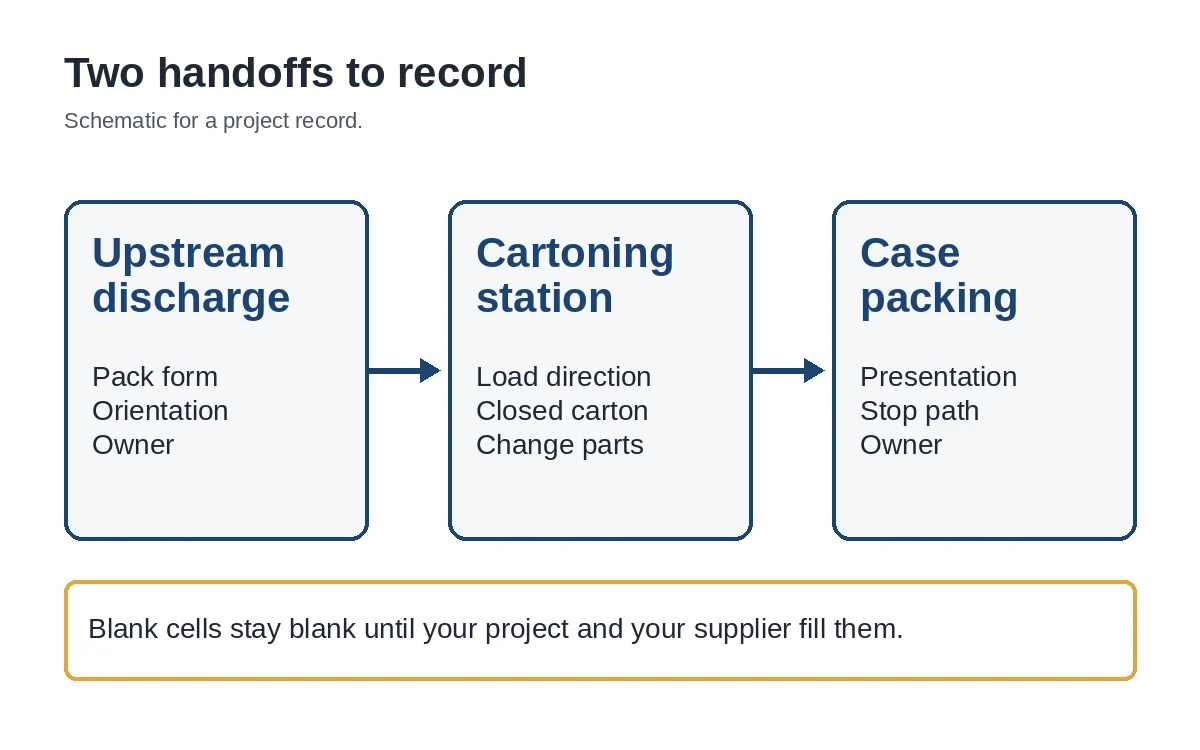
A mismatch between the carton that leaves a cartoning machine and the carton the case packer expects causes downtime and rework. Record the upstream discharge, the load direction into the carton, and the case-packing handoff before you compare supplier proposals.
When you add or replace a retail cartoning station, record both ends before you check a proposal: the discharge that feeds the cartoner, and the closed carton the case packer will receive. Write the pack form, the orientation, the batch demand, the peak demand, the change parts, the path product takes when the station stops, the acceptance samples, and the person responsible for each interface. Cartoning equipment pages often state a carton range and a production figure for one model. The tables below map those statements from one horizontal top-load machine and one horizontal side-load machine onto the fields that remain open. Case packer selection is on the case packing machine page. Whole-line acceptance is on the commissioning page.
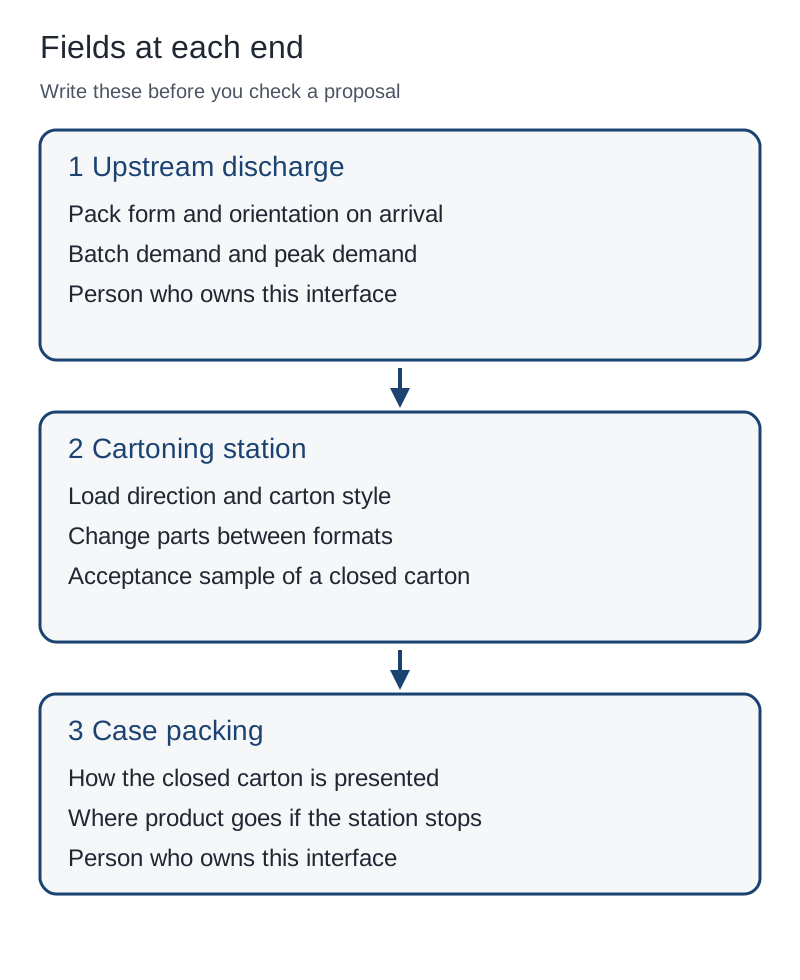
Schematic of the fields at each end. Values come from your line and the supplier.

Illustration: an open carton and unmarked pouches on a bench. Not a supplier line, a shipment, or a measured rate.
What goes on the two-end handoff record?
Copy this record and fill your project. Leave a cell blank when you do not have the value yet. A blank cell is the list of questions for the supplier.
| Field | Your value | Owner |
|---|---|---|
| Pack form: product and carton style, with drawing revision | ||
| Orientation and load direction | ||
| Batch demand, with the unit | ||
| Peak demand, in the same unit | ||
| Change parts between formats, and who changes them | ||
| Where product goes when the station stops | ||
| Acceptance samples: IDs and what a complete carton includes | ||
| Responsible person, upstream interface | ||
| Responsible person, downstream interface |
A published output figure is a manufacturer statement for that model, so your batch rate and your peak rate still have to be written on the handoff record.
The next sections show how two public pages fill some of these cells and leave the rest open. Replace those published cells with your own drawing and your own rates when you use the record on a project.
Where does cartoning stop and case packing start?
On the two public examples below, the cartoning station is specified around a carton measured in millimetres and an output counted in cartons per minute. That carton is the unit the station closes. Case packing is the later job of placing product, including cartons that are already closed, into a shipping case. The handoff in the record above is that closed carton.
The case packing machine page compares the ways a shipping case gets loaded. Use it once the carton leaving the cartoner is defined. Packaging line layout is where the transfers and the service space get drawn to one scale. Packaging line integration is where controls and station ownership are assigned across the line.
An automatic cartoning machine can close cartons in its own cycle and still share the belt with stations someone else owns. Write the upstream owner and the downstream owner on separate rows when they are different people.
What do the published top-load and side-load examples state?
Each page describes a horizontal cartoner machine. The load direction differs. The machine class on each page stays horizontal.
INVpack’s TL6 page, fetched 6 October 2026, calls the TL6 a horizontal Top Load cartoning machine and describes top-load cartoning. Product enters from above. The published class stays horizontal. The page lists carton length 80 to 210 mm, carton width 80 to 300 mm, and carton height 20 to 190 mm. Under output / production it prints 60 ppm. It says the TL6 can be integrated with primary packaging machinery and can handle different product formats. The format list itself is blank. Application sectors on the page are food, pharmaceutical, cosmetics, nutritional, and dairy. The library copy records a JSON-LD publication date of 2026-05-28.
INVpack’s SL3 page, fetched 7 October 2026, calls the SL3 a horizontal side-load cartoner and a horizontal cartoner with a side-load system. Product enters from the side. The page lists box length 70 to 230 mm, box width 25 to 135 mm, and a row it labels “High box” at 15 to 60 mm. It states output of up to 50 cartons per minute and, in the specification list, production of 50 ppm. It says the SL3 can be integrated with primary packaging machinery and describes integration into automated lines. It also mentions a servo-driven system and a touchscreen. Application sectors on that page are food, pharmaceutical, cosmetic, and nutritional. The library copy records the same JSON-LD publication date, 2026-05-28.
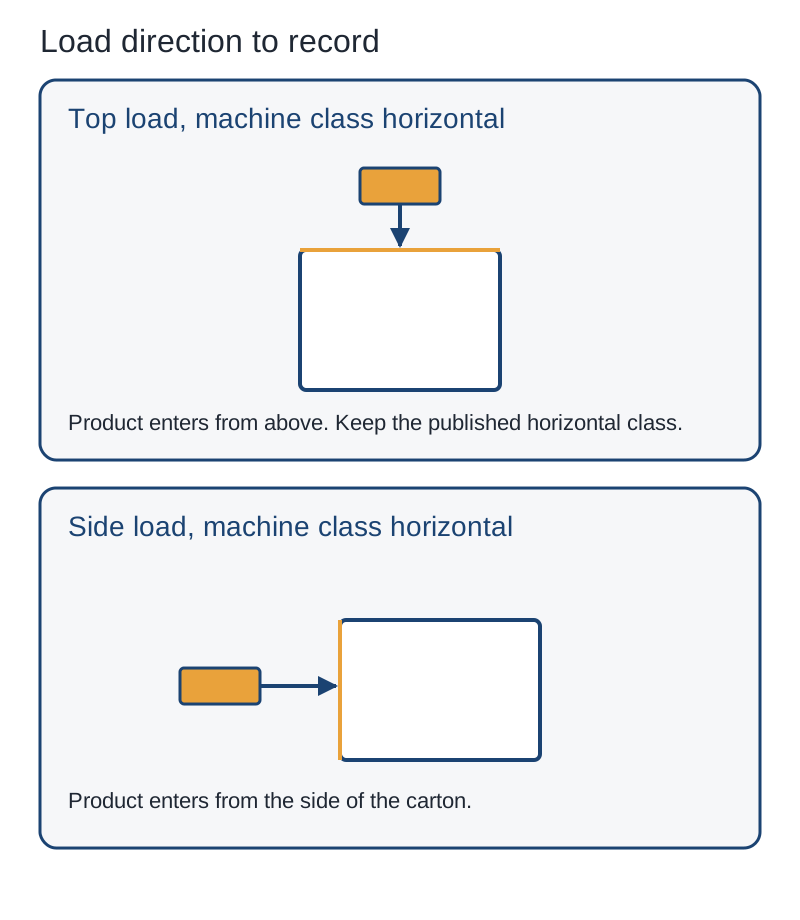
Schematic of the two load directions named on the TL6 and SL3 pages. Confirm the direction on your carton.
A sector name on either page is the manufacturer’s list. Your pack form and your samples remain project fields. Pharmaceutical packaging validation is outside this page.
These ranges describe the cartons named on those two pages. They show how to read a brochure. Your carton drawing still has to go on the handoff record, and a supplier who offers either model still has to check your formats. Each additional format stays on the record until that check is done.
The SL3 page also prints a three-number machine outline with no unit. This page leaves that outline out.
How do public statements map onto fields that are still open?
Read a brochure the way this table reads the two pages. Copy a stated carton range into your notes as that model’s published limit. Keep change parts, the stop path, the samples, and the owner’s name open when the page leaves them blank.
| Field | TL6 page, fetched 6 Oct 2026 | SL3 page, fetched 7 Oct 2026 | Still to confirm |
|---|---|---|---|
| Pack form | Carton length 80 to 210 mm; width 80 to 300 mm; height 20 to 190 mm. Format list is blank. | Box length 70 to 230 mm; width 25 to 135 mm; High box 15 to 60 mm. | Your carton drawing and board. Confirm what High box means before you treat that row as height. |
| Orientation and load direction | Horizontal Top Load. Product enters from above. Class on the page is horizontal. | Horizontal side-load. Product enters from the side. | Your product’s stable orientation, and the closed carton’s exit orientation. |
| Batch demand and peak demand | Output / production: 60 ppm. Product, carton, and counting window are blank. | Up to 50 cartons per minute, and production 50 ppm. The same three items are blank. | Your batch rate and your peak rate, in one unit. |
| Change parts | Blank on the page. | Servo-driven system and touchscreen are stated. Change parts and any changeover time are blank. | The supplier’s parts list for your formats, and who changes them. |
| Where product goes when the station stops | The page says the machine can be integrated with primary packaging machinery. The stop path is blank. | The page says the machine can be integrated with primary packaging machinery. The stop path is blank. | Hold, divert, or clear, and who does it. |
| Acceptance samples | Blank on the page. | Blank on the page. | Sample IDs, and what a complete carton includes. |
| Responsible person | Blank on the page. | Blank on the page. | Names for the upstream interface and the downstream interface. |
The 60 ppm line and the 50 ppm line stay in the wording on each page. Record your product’s batch rate and peak rate in the project specification.
What do you confirm at the three checkpoints?
The handoff record is the list of inputs. The confirmation sheet is what you look at once a supplier runs your cartons. Agree the evidence for each row before the run. Packaging line commissioning covers factory and site acceptance for the whole line. The sheet here stops at the cartoning station’s two ends.
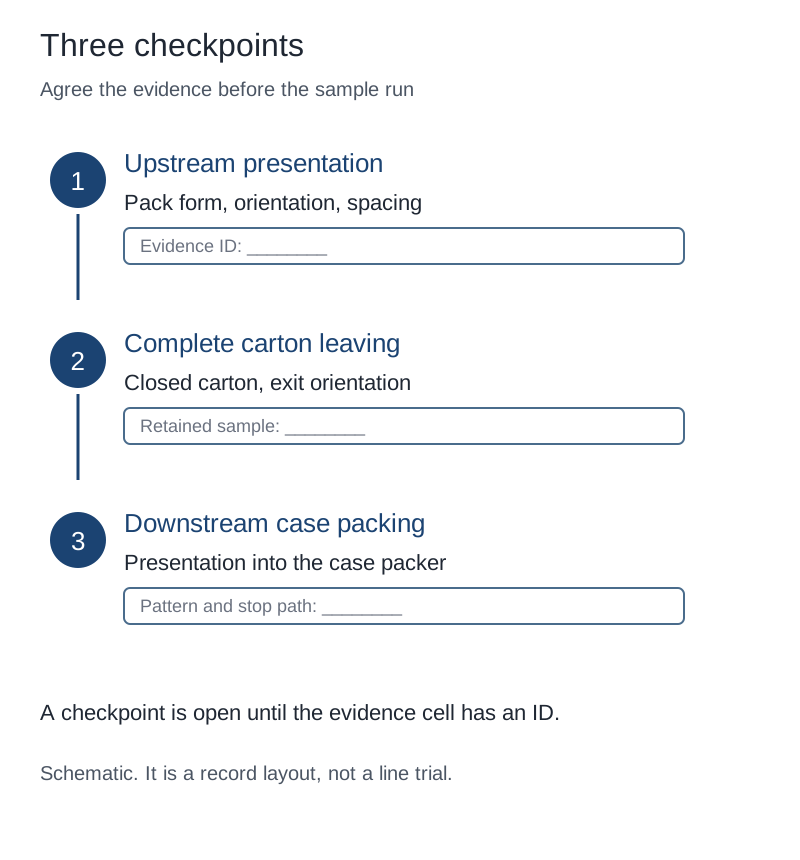
Schematic of the three confirmation checkpoints. Fill the evidence IDs from your run.
| Checkpoint | What you and the supplier accept | Evidence | Owner |
|---|---|---|---|
| Upstream presentation | Product arrives in the pack form and orientation on the handoff record, at the spacing you wrote down | Drawing revision or sample ID, plus the rate note | |
| Complete carton leaving the machine | The carton is closed and in the exit orientation you agreed. Closure style, leaflets, and codes stay blank unless your specification adds them | Retained sample or photo ID of a carton you accept | |
| Downstream case packing | That carton is presented in the orientation and spacing the case-packer collation expects, including the stop path | Marked case pattern and the stop-path note |
The case packing machine page is where the loader type is compared. This checkpoint only records how the closed carton arrives there.
Packaging line layout holds the floor-plan worksheet for the transfer positions. The label-station equivalent of this record is the label application machine line-fit guide, which uses the same idea for a different station: write the handoff, then judge the supplier on your samples.
What to check with your supplier
Take the completed handoff record and the confirmation sheet to your own supplier. Ask them to mark every open cell against the cartons in your specification. This site does not take inquiries and does not review proposals.
Bring these to that meeting:
- The handoff record, with blanks left blank.
- The mapping row for any brochure figure you want the supplier to answer, with your value written beside it.
- Carton drawings, with the revision marked.
- The three confirmation rows, with the evidence ID still empty if the run has not happened.
- The names of the upstream owner and the downstream owner.
For the wider line, packaging line integration covers how stations and responsibilities are tied together, and the packaging guides index lists the other station-fit and layout worksheets.
Method and sources
Compiled on 12 October 2026 from the INVpack TL6 and SL3 product pages accessed on 6 October 2026 and 7 October 2026. Both pages record a JSON-LD publication date of 2026-05-28. Carton ranges and production figures are quoted from those pages and apply to the model and the wording on that page. The SL3 machine-outline string is omitted because it has no unit.