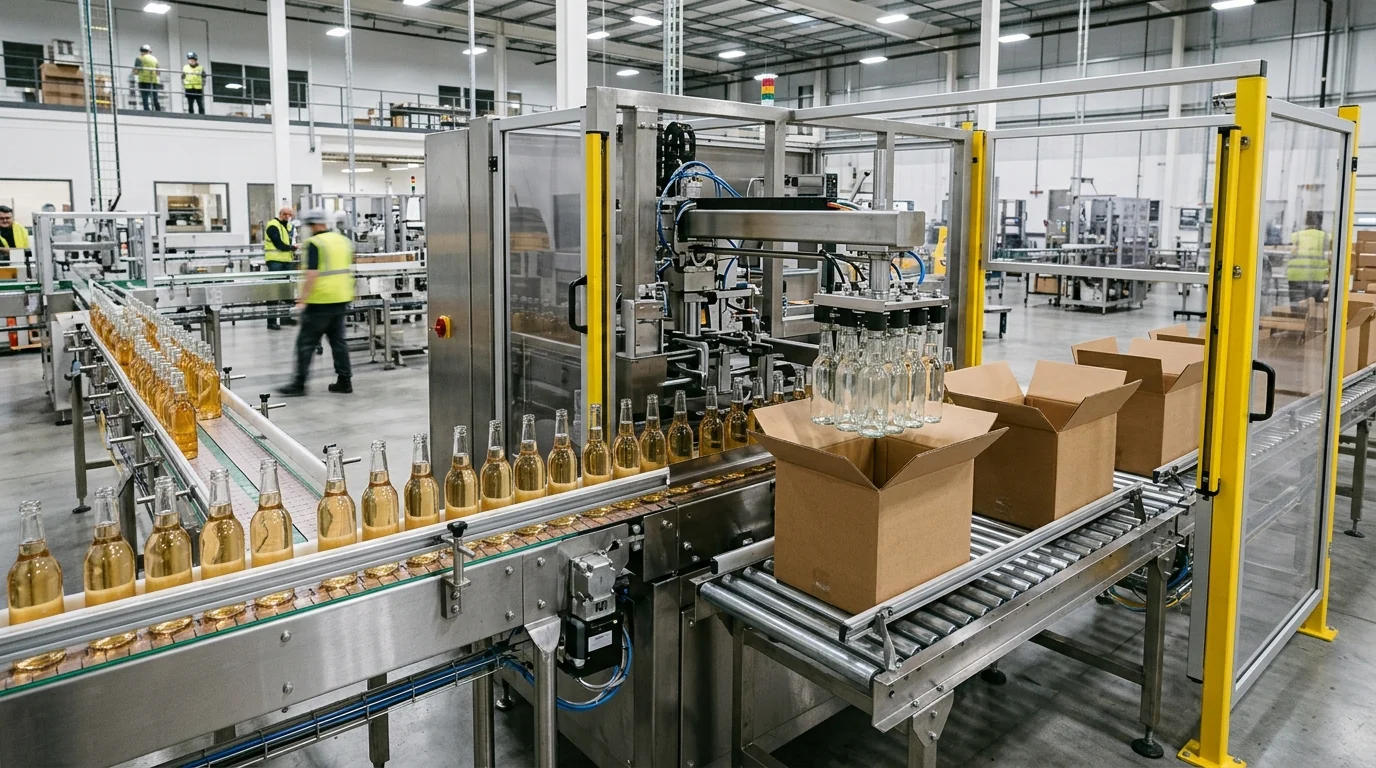
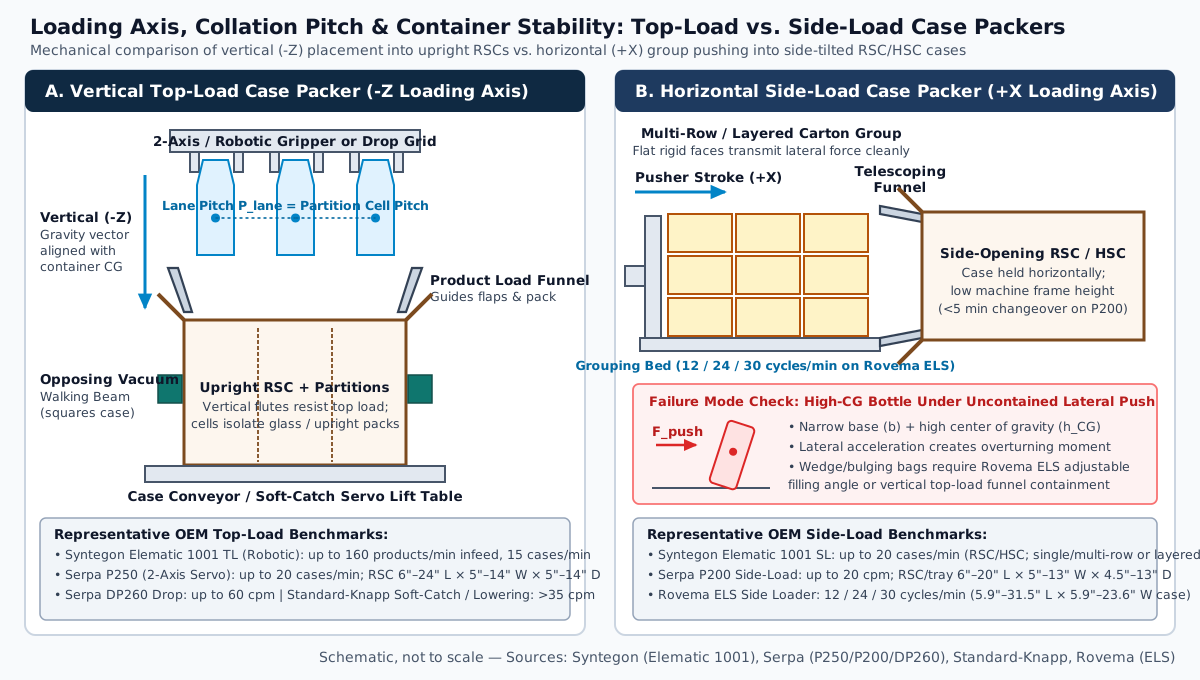
Selecting a top load case packer or a horizontal side-load system by nominal cases-per-minute ratings alone causes fallen-bottle collation jams, product damage, or throughput loss when the loading axis and primary container stability are mismatched. A top loading case packer presents an erected Regular Slotted Container (RSC) or Half Slotted Container (HSC) with its opening facing upward so upright bottles, flexible pouches, or partitioned glass packs enter vertically along their stable axis, whereas a horizontal side-load case packer holds the case on its side and pushes an accumulated product block laterally through a telescoping loading funnel.
Within the broader packaging guides collection, our equipment reference on case packing machine types and selection maps all six end-of-line loader categories—including wraparound and tray systems—while this engineering comparison isolates the mechanical boundary between vertical top-load and horizontal side-load architectures. Use the benchmark table and mechanics below to match case orientation, case packer collation pitch, and container center of gravity before locking your functional specification or reviewing case packer cost and quote scope.
| Architecture & Sub-Type | Loading Axis & Case Presentation | Representative OEM Benchmarks | Primary Container & Case Fit | Dominant Failure Mode | Prevention / Engineering Control |
|---|---|---|---|---|---|
| Top-Load: 2-Axis & Robotic Pick-and-Place | Vertical (-Z) placement through overhead load funnel into upright RSC/HSC |
Syntegon Elematic 1001 TL: up to 160 products/min infeed, up to 15 cases/min output; Serpa P250: 2-axis servo up to 20 cases/min, RSC 6”–24” L × 5”–14” W × 5”–14” D | Flexible bags, flowpacks, fragile cartons, biscuits/chocolate, multi-layer assortments, and upright rigid containers | Cycle-rate bottleneck when long vertical Z-strokes pack single layers of simple flat cartons; flap snagging on entry | Specify multi-row/multi-head EOAT picking and a product load funnel that guides packs past open RSC flaps during descent |
| Top-Load: Servo Soft-Catch & Lowering Head | Vertical (-Z) gripped lowering to case floor or synchronized descending lift table |
Standard-Knapp 939S / 949S Versatron (Soft-Catch servo lift table); 939 / 949 Pic-N-Place & Lowering Head Modules (>35 cases/min selection band) | Partitioned glass spirits, wine/craft beverage bottles, trigger sprayers, and high-value containers sensitive to drop shock | Container shoulder scuffing or partition-top hang-ups if grid pitch drifts out of alignment with corrugated cells | Pair adjustable heavy-duty grippers or lowering heads with positive case squaring and color-coded lane guide change parts |
| Top-Load: Gravity Drop Packer Machine | Vertical (-Z) free-fall release through a lane grid into an open upright RSC |
Serpa DP260 Drop Packer: single or tandem drops up to 60 cases/min; Standard-Knapp standard drop packer band: 20–35 cases/min | Rigid HDPE, PET, and thick-wall containers with stable flat bases running high volumes and few format changes | Bottom-impact bounce, label scuffing, or glass breakage when free-fall drop distance exceeds container shock tolerance | Restrict pure gravity drop to rigid containers verified by sample trials; upgrade to Soft-Catch servo lift table when impact must be damped |
| Horizontal Side-Load (End-Load) Pusher | Horizontal (+X) group push through telescoping funnel into side-tilted RSC/HSC or tray |
Syntegon Elematic 1001 SL: up to 20 cases/min; Serpa P200: up to 20 cases/min, case 6”–20” L × 5”–13” W × 4.5”–13” D; Rovema ELS: 12 / 24 / 30 cycles/min | Flat rigid folding cartons (dry pasta, soap bars, crackers), stackable bricks, and standing or laying flowpacks/bags | Narrow-base upright containers tip forward under lateral pusher acceleration; bulging or wedge-shaped bags jam at case mouth | Reserve horizontal push for flat-faced stackable cartons, or specify Rovema ELS progressively adjustable carton filling angle and telescoping funnel containment |
Case Orientation and Structural Mechanics: Top-Opening RSC vs. Side-Opening RSC and HSC
The foundational mechanical split between a top load case packer and a side-load machine is how the corrugated shipping case is oriented during loading and how its flutes carry downstream pallet compression. In both architectures, standard RSC and HSC blanks are pulled from a magazine, erected, and squared—either inside an integrated monobloc frame (such as the Syntegon Elematic 1001 series and Serpa P250/P200 platforms) or on an upstream standalone case erector.
In a vertical top loading case packer, the erected RSC travels with its bottom flaps sealed (or supported on a dead plate/walking beam) and its four top major and minor flaps flared outward. As Standard-Knapp’s engineering selection guide (Six Factors to Consider When Selecting a Case Packer) documents, top-load RSCs remain the benchmark in beverage, spirits, and household chemical distribution for three structural reasons:
- Vertical stacking compression: Because top-load RSCs are loaded in the same upright orientation in which they are stacked on a pallet, vertical corrugated flutes align directly with warehouse and transit stacking loads.
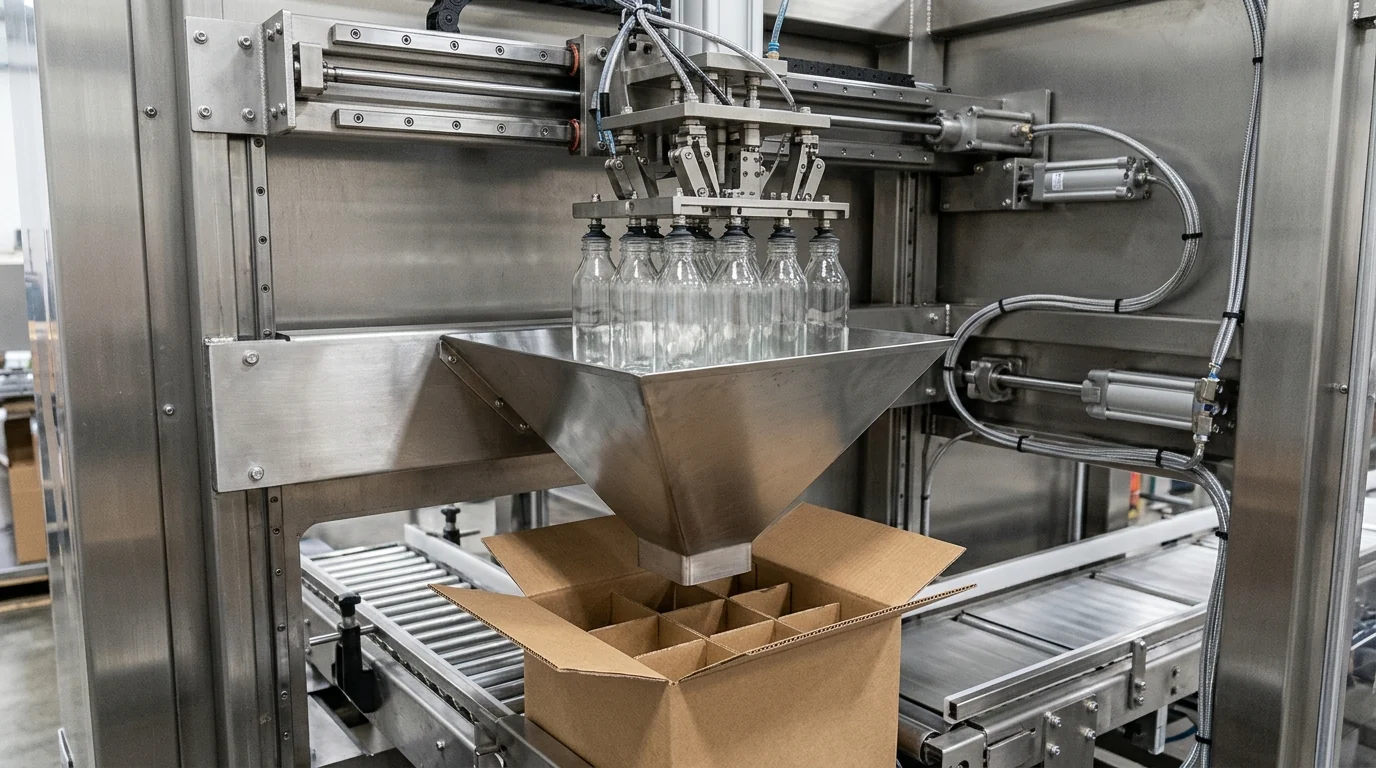
- Internal corrugated partitions: Top-opening access allows pre-inserted or machine-inserted corrugated cell partitions (
2×3,3×4, or4×6matrices) that isolate glass bottles from container-to-container impact and add vertical column strength inside the case. - Compressible and upright primary packages: Flexible stand-up pouches, large PET bottles, personal care containers, and trigger-spray bottles cannot sustain heavy perimeter squeezing or horizontal ramming without buckling, making vertical placement into a rigid four-wall RSC the preferred load path.
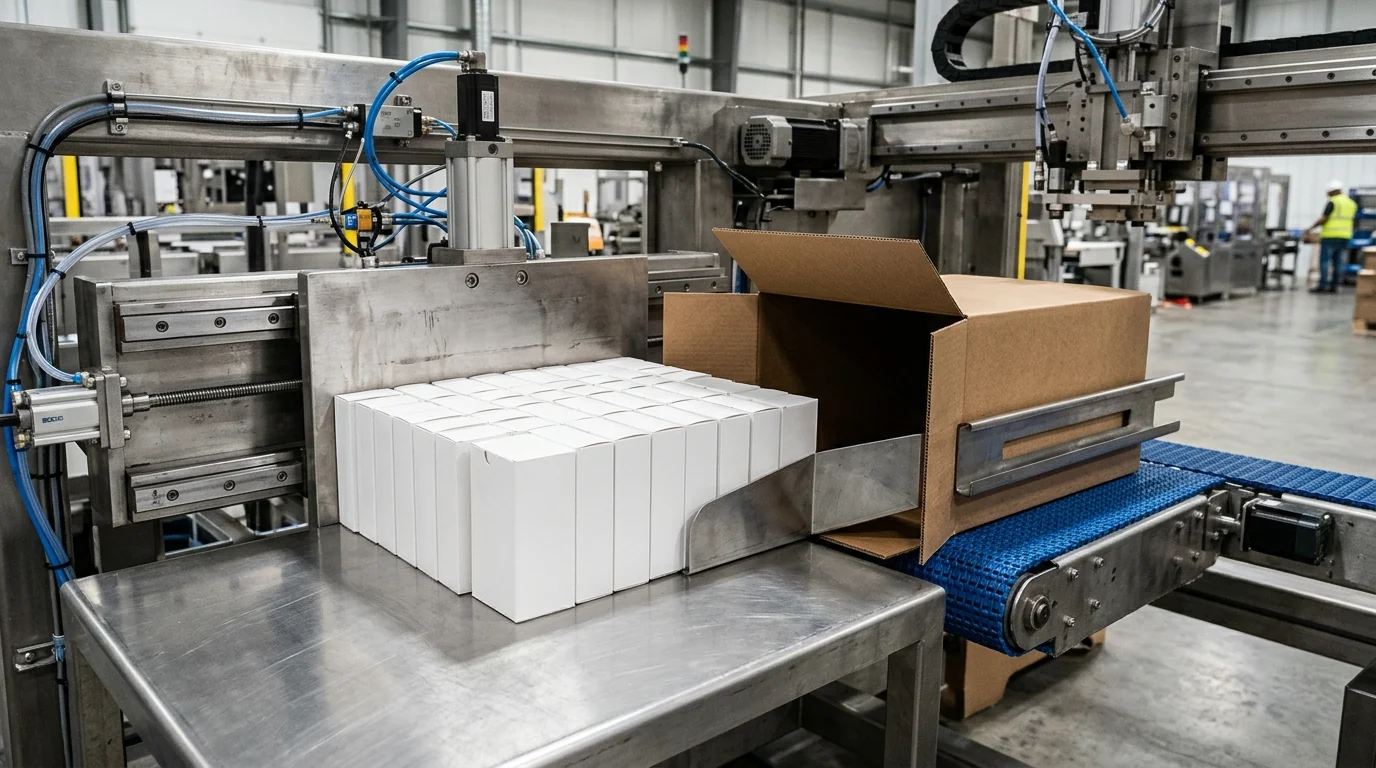
In a horizontal side-load case packer, the erected RSC or HSC is held with its open flaps facing laterally toward the collation bed. Once the product matrix is accumulated, a servo pusher sweeps the entire block sideways (+X axis) through a telescoping loading funnel that confines the group and shields the corrugated flap scores from tearing. On Serpa’s P200 Side Load Case Packer, the machine handles a case dimensional envelope of 6”–20” Length × 5”–13” Width × 4.5”–13” Depth (152.4–508 mm × 127–330.2 mm × 114.3–330.2 mm) at up to 20 cases/min, and can switch between tape-closed RSC cases and hot-melt glue-sealed display trays on the same frame. By comparison, Serpa’s vertical P250 Top Load Case Packer accommodates a longer and deeper RSC envelope of 6”–24” Length × 5”–14” Width × 5”–14” Depth (152.4–609.6 mm × 127–355.6 mm × 127–355.6 mm) at up to 20 cases/min.
Rule of thumb: If the shipping specification mandates full-height corrugated partitions or if retail buyers require a top-opening RSC reshipper (as is standard for bottled spirits and glassware), lock the specification to a vertical top-load architecture before evaluating machine speeds.
Separate the Three Top-Load Mechanisms: Gravity Drop, Servo Soft-Catch, and Pick-and-Place
A recurring procurement error is treating every top load case packer as synonymous with a free-fall drop packer machine, leading buyers to rule out vertical loading for fragile goods. In practice, OEM vertical case packers divide into three distinct kinematic designs with vastly different impact forces, tooling requirements, and speed ceilings:
1. Gravity Drop Packer Machines
In a conventional drop packer machine, single-file containers are divided into parallel lanes on a low-friction tabletop chain conveyor and accumulated onto a dead plate or grid directly above the open RSC. When the full case count is present, pneumatic or servo grid fingers retract and the container array drops vertically under gravity into the case below.
- Speed envelope: Standard-Knapp places conventional drop packers in the 20 to 35 cases/min selection band for single-case machines, while high-speed servo and tandem configurations such as the Serpa DP260 Drop Packer execute single or tandem drops at up to 60 cases/min.
- Application boundary: Gravity drop packers excel on uniform, rigid HDPE jugs, thick-wall PET bottles, and metal or composite cans where container walls and closures tolerate bottom deceleration impact.
2. Servo Soft-Catch Lift Tables and Lowering-Head Packers
When line speeds exceed 35 cases/min or when glass spirits and thin-wall PET containers cannot tolerate free-fall shock, OEMs replace passive gravity drop with synchronized vertical deceleration or full-depth mechanical lowering:
- Soft-Catch servo lift tables: Standard-Knapp’s 939S Versatron (single-case) and 949S Versatron (tandem multi-case) case packers elevate the empty RSC toward the packing grid and accelerate the servo lift table downward in synchronization with the descending bottles—using the same deceleration physics as catching a tossed egg to eliminate bottom-out shock.
- Pic-N-Place and Lowering Head Modules: Standard-Knapp’s 939 and 949 Pic-N-Place soft-placement case packers and modular Lowering Head Modules use adjustable heavy-duty grippers to grasp the collated bottle array from the infeed conveyor, descend completely through the open top of partitioned or partitionless cases, release the bottles at the case floor, and retract. An Adjustable Gripper Head eliminates the cost and storage footprint of dedicated change heads across varying bottle diameters.
3. 2-Axis Servo and Multi-Axis Robotic Pick-and-Place Top Loaders
For flexible bags, pillow pouches, flow-wrapped bars, delicate baked-goods cartons, and multi-layer case assortments that cannot be lane-divided on a bottle grid, a 2-axis servo gantry or multi-axis robot picks collated groups from an infeed belt and places them vertically into the RSC.
- 2-Axis servo pick-and-place: Serpa’s P250 Top Load Case Packer pairs a 2-axis servo pick-and-place assembly with quick-change vacuum or gripper pick heads and a product load funnel for accurate loading into the case at up to 20 cases/min. In top-load pick-and-place stations, the overhead load funnel guides each layer past the open RSC flaps into the case below.
- Robotic top loading: Syntegon’s Elematic 1001 TL robotic top-load RSC case packer accepts bags, flowpacks, and cartons (including biscuits, crackers, chocolate, and snacks) at an infeed rate up to 160 products/min and outputs up to 15 cases/min. When applications require high-speed vision-guided belt picking or multi-SKU mixed layer building, review our dedicated guide to robotic case packing.
Infeed Case Packer Collation Pitch, Lane Dividing, and Horizontal Grouping
As Standard-Knapp emphasizes in its speed selection guidelines, upstream infeed and laning technology frequently determines whether a case packer sustains its nameplate rating in production. Case packer collation converts a single-file or multi-lane primary stream into the exact three-dimensional pack matrix ($n_{\text{lanes}} \times n_{\text{rows}} \times n_{\text{layers}}$) required for one or more shipping cases.
Vertical Top-Load Collation: Lane Dividing vs. Belt Marshaling
Top-load collation splits into two methods depending on whether the primary package is a rigid standing container or a flexible/cartoned item:
- Container lane dividing and pitch control: For upright bottles, cans, and jars feeding a drop packer machine or soft-placement head, a servo lane divider or balanced mass-flow combiner distributes containers into $n_{\text{lanes}}$ parallel guide channels spaced at exact center-to-center lane pitch $P_{\text{lane}}$ matching the RSC partition cell spacing. Pneumatic or servo metering stops release exactly $n_{\text{rows}}$ containers per lane onto the grid dead plate.
- Pick-belt pitch indexing: For pouches, flowpacks, and cartons feeding a robotic or 2-axis top loading case packer (such as the Syntegon
Elematic 1001 TLor SerpaP250), an indexing flighted belt, smart multi-belt race-track, or vacuum pitch belt spaces incoming packs to match the vacuum/gripper head pitch before the overhead carriage executes its vertical pick-and-place stroke.
Horizontal Side-Load Collation: Multi-Layer Stacking and Adjustable Filling Angles
Horizontal side-load case packers eliminate the vertical lift-and-descent arc by building the complete pack block directly in front of the case mouth:
- Single-row, multi-row, and layered grouping: On Syntegon’s Elematic 1001 SL, incoming bags, flowpacks, or cartons are accumulated into single rows, multiple rows, or stacked multi-layer matrices and pushed horizontally into RSC or HSC cases at up to 20 cases/min. When the upstream station is a horizontal or vertical cartoner, lock the discharge orientation and transfer plate elevation using our cartoning machine line handoff guide.
- Stabilizing bulging and wedge-shaped packages: Flexible bags and overfilled cartons often bulge at the center or taper into wedge shapes, causing conventional flat stacks to shingle or jam when pushed sideways. On the Rovema ELS Side Loader (engineered for RSC and HSC cases from 5.9”–31.5” L × 5.9”–23.6” W × 3.9”–11.8” H), intelligent grouping systems pack sale units in either standing or laying position and apply a progressively adjustable carton filling angle with automatic path calculation to keep wedge-shaped or bulging packages stable throughout horizontal insertion.
- Multi-cycle collation scaling: Rather than running the main pusher at excessive linear velocities, horizontal side loaders scale output by filling multiple case groups per machine cycle. Published ratings on the Rovema ELS Side Loader illustrate this scaling directly: 12 cycles/min in single filling, 24 cycles/min in double filling, and 30 cycles/min in triple or quadruple filling (operating on a 6 bar compressed air supply and a 7,700–8,800 lb machine frame).
Quantitative Collation & Cycle-Rate Equation
To verify whether a single-head top load case packer or a horizontal side-load case packer can absorb your primary line speed, calculate the required machine cycle rate ($f_{\text{cycle}}$, cycles/min) from the upstream product flow ($R_{\text{prod}}$, products/min), the pack count per case ($N_{\text{pack}} = n_{\text{lanes}} \times n_{\text{rows}} \times n_{\text{layers}}$), and the number of cases loaded per cycle ($C_{\text{cycle}}$):
$$f_{\text{cycle}} = \frac{R_{\text{prod}}}{N_{\text{pack}} \times C_{\text{cycle}}}$$
Worked Benchmark Comparison (Syntegon Elematic 1001 TL vs. Elematic 1001 SL & Serpa P200/P250): Consider a snack carton or flowpack line running at Syntegon’s rated maximum infeed of $R_{\text{prod}} = 160\text{ products/min}$ into single-case cycles ($C_{\text{cycle}} = 1$):
- Format A (12-count RSC, $2 \times 3 \times 2$ matrix, $N_{\text{pack}} = 12$): The required case output is $160 / 12 = 13.33\text{ cases/min}$. Both the robotic top-load Elematic 1001 TL (rated up to 15 cases/min) and the horizontal side-load Elematic 1001 SL (rated up to 20 cases/min) satisfy the duty rate with margin.
- Format B (8-count RSC, $2 \times 4 \times 1$ matrix, $N_{\text{pack}} = 8$): At the same $160\text{ products/min}$ infeed, the case demand rises to $160 / 8 = 20.0\text{ cases/min}$. A single-case robotic top loader capped at 15 cases/min becomes the line bottleneck unless the pick head is widened to load two cases per cycle ($C_{\text{cycle}} = 2$, cutting cycle frequency to $10.0\text{ cycles/min}$). Conversely, a horizontal side-load Elematic 1001 SL or Serpa P200 (or a 2-axis Serpa P250 rated up to 20 cases/min) matches the $20.0\text{ cases/min}$ ceiling in a single-case footprint.
Product Stability and Core Selection Failure Modes
Matching the loading axis to container geometry prevents the two most expensive specification failures in end-of-line automation:
Failure Mode 1: Uncontained Lateral Pushing of High-CG Upright Containers
Bottles, jars, canisters, and tapered personal-care containers exit upstream fillers, cappers, and labelers standing upright on a narrow base diameter ($b$) with an elevated center of gravity ($h_{\text{CG}}$). If an engineer specifies a standard horizontal side-load pusher for unstable upright containers without full perimeter capture, lateral pusher acceleration ($a_x$) and dead-plate sliding friction ($\mu$) create an overturning moment ($M_{\text{tip}} \propto m \cdot a_x \cdot h_{\text{CG}}$) against the restoring base moment ($m \cdot g \cdot b/2$). A single tipped bottle wedges inside the telescoping funnel and crushes the corrugated RSC mouth.
- Engineering correction: Keep upright containers upright. Route rigid narrow-base bottles to a vertical drop packer machine (
Serpa DP260), a servo soft-catch or lowering-head packer (Standard-Knapp 939S/949S Versatronor939/949 Pic-N-Place), or a 2-axis top loader equipped with a product load funnel (Serpa P250).
Failure Mode 2: Long-Stroke Vertical Top Loading on Simple Flat Cartons
As Standard-Knapp notes, rectangular boxed items such as dry pasta cartons or bars of soap present wide, flat, parallel wall faces that stack cleanly and transmit horizontal pusher forces without tipping or crushing. Specifying a long-stroke articulated or delta robotic top load case packer for uniform rectangular cartons that never require vertical placement wastes Z-axis travel time and overhead frame height.
- Engineering correction: Route uniform, stackable rectangular cartons to a horizontal side-load case packer (
Syntegon Elematic 1001 SL,Serpa P200, orRovema ELS), reserving vertical robotic top loading (Elematic 1001 TL) for crush-sensitive cartons, fragile biscuits/chocolate, or lines that must switch rapidly between stand-up bags, flowpacks, and multi-orientation display packs.
| Package Geometry & Rigidity | Arrival Posture | Recommended Loading Axis | Primary Mechanical Reason |
|---|---|---|---|
| Partitioned glass spirits & wine bottles | Upright single-file | Top-Load (Pic-N-Place / Lowering Head or Soft-Catch) | Vertical entry clears full-height RSC partitions; lowering heads or Soft-Catch servo tables prevent glass-to-glass and bottom impact |
| Rigid HDPE / thick-wall PET jugs & bottles | Upright single-file | Top-Load (Gravity Drop Packer Machine) | Upright lane dividing + gravity grid drop reaches 20–60 cases/min (Standard-Knapp band / Serpa DP260) with minimal moving parts |
| Fragile bags, flowpacks, biscuits & chocolate | Flat or shingled on belt | Top-Load (Robotic or 2-Axis Pick-and-Place) | Vacuum/mechanical grippers place packs vertically without lateral compression (Syntegon Elematic 1001 TL / Serpa P250) |
| Rigid rectangular cartons (dry pasta, soap, pharma) | Flat or on-edge | Horizontal Side-Load Pusher | Flat carton walls stack into multi-row layers and slide through a telescoping funnel at up to 20 cases/min (Elematic 1001 SL / Serpa P200) |
| Bulging pouches or wedge-shaped cartons | Standing or laying | Side-Load with Adjustable Filling Angle or Top-Load Funnel | Either stabilize horizontal entry via Rovema ELS progressively adjustable filling angle or contain packs vertically via a top-load funnel |
Rule of thumb: Never approve a horizontal side-load proposal for non-rectangular, bulging, or narrow-base containers unless the supplier demonstrates sustained multi-cycle loading on unconditioned production samples without shingling or tipping.
Changeover Boundaries, Case-Squaring Mechanics, and Ceiling Clearance
Once product stability and collation rate narrow the shortlist, evaluate three plant-floor integration boundaries: format changeover complexity, case-squaring transport through the closing zone, and building clearance plus safety guarding.
1. Format Changeover Scope and Reproducibility
Standard-Knapp ranks case packer categories by changeover flexibility: robotic packers rank first (storing patterns in HMI recipes with partial automation), drop packers rank second (using simple lane guide adjustments and color-coded change grids), soft-placement and rotary packers sit in the middle due to additional mechanical handling parts, and wraparound packers rank lowest when new aftermarket package sizes are introduced.
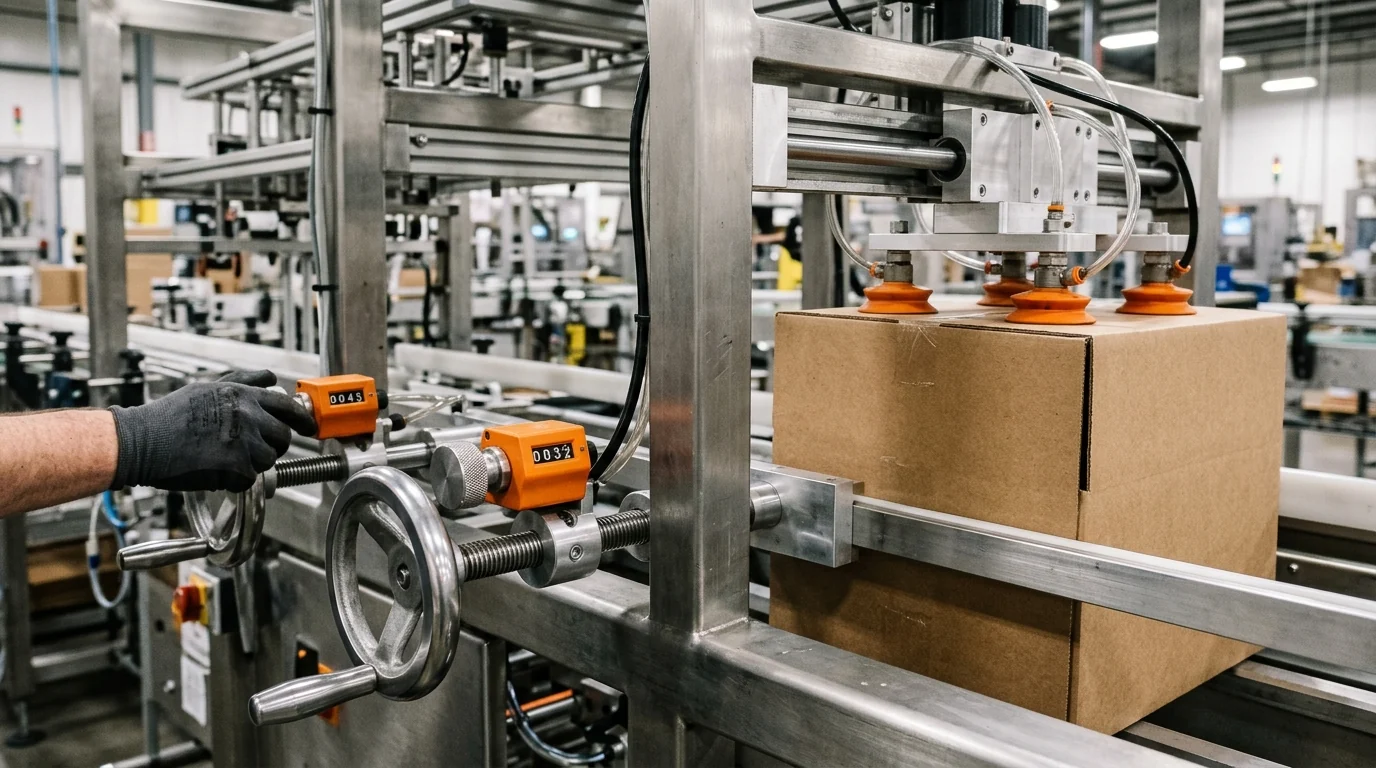
- On monobloc servo platforms, Serpa’s P250 Top Load case packer uses digital gauges and scales with pointers alongside quick-change vacuum or gripper pick heads to achieve no-tool changeovers in under 5 minutes, while Serpa’s P200 Side Load case packer also completes format changeovers in under 5 minutes—including switching between tape-closed RSC cases and glue-sealed trays.
- On Syntegon’s compact Elematic 1001 TL and Elematic 1001 SL RSC case packers, configurable modules and robotic tooling adapt across diverse bag, flowpack, and carton formats; for lines using the larger Elematic 3001 WAH, WA/Midi, and Compact models, Syntegon offers a Centerlining Kit so technicians can reproduce initial format settings during frequent changeovers.
2. Case-Squaring Mechanics: Opposing-Vacuum Walking Beams vs. Flight Lugs
An erected RSC with recycled linerboard or humidified flutes often springs slightly out of a $90^\circ$ rectangle. If a case is pushed by rear flight lugs or pinched between side friction belts, the leading panel can skew—causing a top-load funnel or a side-load telescoping horn to stub against the corrugated edge. Both the Serpa P250 and Serpa P200 eliminate flight lugs by transferring cases via a walking beam with dual-sided opposing vacuum after a positive dual-vacuum case erector (with the P200 explicitly eliminating skewing flight lugs and pinching belts), holding both side panels square all the way through the hot-melt glue or tape case sealer station. Both frames use a walk-in balcony design, and the P200 includes an Easy Case Clear-Out feature so operators can release problem cases rapidly.
3. Overhead Clearance, Floor Layout, and ANSI/PMMI B155.1-2023 Guarding
Because a top load case packer positions its gripper gantry, lowering module, or drop grid directly above the open RSC, it requires more vertical ceiling clearance than a horizontal side-load frame. However, as Standard-Knapp notes, drop packers and soft-placement packers offer narrow frame profiles with flexible inline, counter-flow, or right-angle conveyor layouts that fit tight aisle widths—see our packaging line layout guide for aisle and elevation planning.
Whenever a balcony-style top-load or side-load cell allows an operator to open wide access doors to clear a jam or swap a pick head, the safeguarding specification must comply with ANSI/PMMI B155.1-2023 (Safety Requirements for Packaging and Processing Machinery, published by PMMI). Specifically, require the OEM and integrator to document:
- A formal risk assessment covering all reasonably foreseeable hazards across operating, clearing, and maintenance modes.
- Whole-body access safeguarding provisions (such as safety interlocks, presence-sensing floors/scanners, or lockout/tagout verification) whenever guard openings allow an operator to step inside the frame perimeter.
- Explicit stakeholder safety responsibilities across machinery suppliers, end users, co-packers / co-manufacturers, legacy line modifiers, and remote / tele-operation diagnostics as refined in
ANSI/PMMI B155.1-2023.
Container Posture and Case-Style Matching Matrix (RFQ & FAT Worksheet)
Before issuing a Request for Quotation (RFQ) or signing off on a commissioning and acceptance test, complete the engineering matching worksheet below for every active and planned SKU. Requiring every bidder to quote against the same dimensional envelope, duty cycle, and changeover pair prevents hidden scope gaps.
| Specification Parameter | Plant Input / Target Requirement | Top-Load Verification Check | Side-Load Verification Check | FAT Acceptance Evidence Required |
|---|---|---|---|---|
| 1. Primary Container Geometry & Stability | Dimensions ($L \times W \times H$), filled mass, base width ($b$), CG height ($h_{\text{CG}}$), rigidity | Verify vacuum/mechanical gripper hold or drop-grid clearance; check free-fall vs. Soft-Catch need | Verify flat-wall stacking stability and resistance to lateral pusher acceleration without shingling | Sustained run on unconditioned production containers with zero tipping or wall creasing |
| 2. Upstream Arrival Posture & Infeed Rate ($R_{\text{prod}}$) | Standing vs. laying; single-file vs. multi-lane; sustained & surge products/min | Size lane divider pitch ($P_{\text{lane}}$) or indexing pick belt to match head cycle ($160\text{ ppm}$ benchmark on Elematic 1001 TL) |
Size multi-row/layer grouping bed and single/double/triple filling cycle (12 / 24 / 30 cpm on Rovema ELS) |
Timed rate trial at 100% upstream surge speed including upstream transfer handoffs |
| 3. Case Style, Flute & Partition Spec | RSC vs. HSC vs. tray; board grade; partition cell matrix (if required) | Verify product load funnel accuracy (Serpa P250) or confirm adjustable heavy-duty grippers and lowering heads place product completely into the bottom of partitioned/partitionless cases (Standard-Knapp 939/949 Pic-N-Place) |
Confirm telescoping loading funnel fits side-opening RSC/HSC or tray lip (Serpa P200 / Elematic 1001 SL) |
Run minimum, median, and maximum board calipers and recycled linerboard lots without flap stubbing |
| 4. Case Dimensional Envelope ($L \times W \times D$) | Min and max finished case dimensions in inches and millimeters | Benchmark against OEM top-load range (e.g., Serpa P250: 6”–24” L × 5”–14” W × 5”–14” D) |
Benchmark against OEM side-load range (e.g., Serpa P200: 6”–20” L × 5”–13” W × 4.5”–13” D; Rovema ELS: 5.9”–31.5” L) |
Physical erection, squaring, loading, and sealing test on both smallest and largest case blanks |
| 5. Required Case Rate & Duty Cycle | Target sustained cases/min; case weight; shift schedule (e.g., 50 lb case at 24 hr/day × 7 days/week) | Match rate band: <20 cpm robotic/2-axis, 20–35 cpm drop, >35 cpm Soft-Catch/lowering or DP260 tandem drop (60 cpm) |
Verify single vs. multi-pack per cycle horizontal rate (up to 20 cpm on Elematic 1001 SL & P200) and frame duty rating |
Multi-hour continuous FAT run measuring net good cases/min and frame deflection under full case weight |
| 6. Case Squaring & Closure Integration | Monobloc erector/loader/sealer vs. standalone loader; hot-melt glue vs. tape closure | Verify opposing-vacuum walking beam (Serpa P250) or lugless transport keeps tall RSCs square into top sealing |
Verify side-flap folding sequence, tray-to-case mode switch (Serpa P200), and discharge orientation (90° turn if needed) |
Measure diagonal squareness and flap bond integrity at discharge across all case sizes |
| 7. Changeover Time & Tooling Inventory | Number of active SKUs; target changeover window; operator count | List quick-change vacuum/gripper heads, product load funnels, or color-coded drop grids; verify digital gauges and scales with pointers (<5 min no-tool changeover on Serpa P250) |
List telescoping loading funnels, grouping guide settings, and case-to-tray closure changeover (<5 min changeover on Serpa P200) |
Timed changeover between the hardest format pair executed by plant technicians during FAT |
| 8. Ceiling Height, Footprint & Guarding | Clear overhead height; inline vs. counter-flow vs. right-angle layout; safety standard | Check Z-axis gantry/head height clearance and ANSI/PMMI B155.1-2023 whole-body access interlocks |
Check horizontal grouping bed width and balcony walk-in clear-out access under ANSI/PMMI B155.1-2023 |
Documented ANSI/PMMI B155.1-2023 risk assessment, interlock validation, and E-stop / LOTO verification |