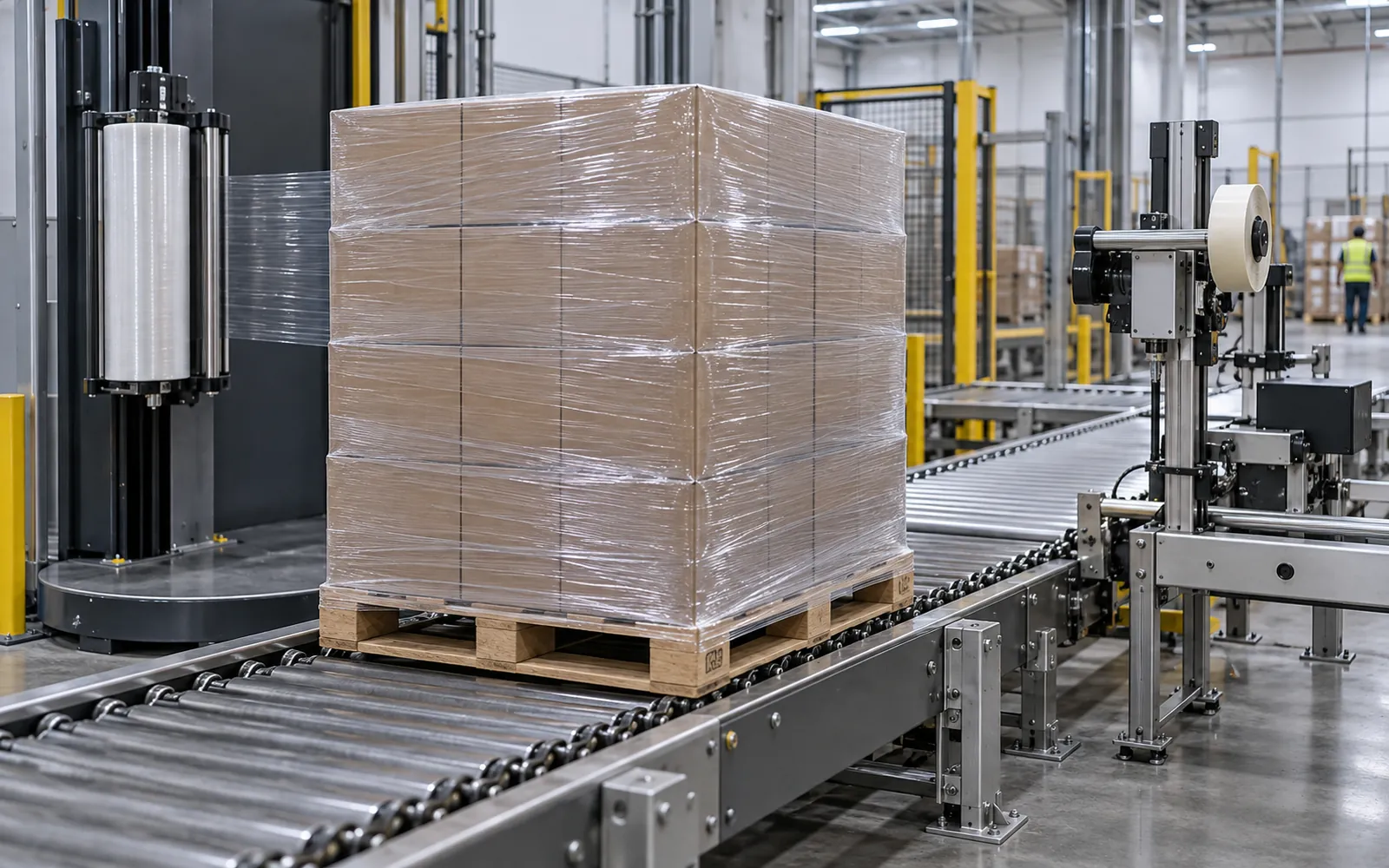
Selecting the wrong automatic pallet dispenser and slip sheet inserter by comparing nominal pallets-per-minute brochure figures alone causes chronic line downtime, deckboard damage, double-picked slip sheets, and 15 to 25 percent throughput losses across palletizing conveyor systems when pooled pallet defects and serial handoff delays starve the downstream palletizer machine. Every end-of-line specification must lock four mechanical and control boundaries before supplier quotes are evaluated: upper-stack separation architecture, dimensional and bottom-board defect envelopes across wood and plastic pallets, vacuum cup porosity and brush stripping physics on the sheet inserter, and the overlapped PLC handshake timing budget at the build station.
While the palletizing systems hub and pallet handling application guide map the end-of-line sequence, and the references on high-level palletizers, low-level palletizers, and robotic palletizers define core stacking mechanics, this guide establishes the engineering specifications and Factory Acceptance Test (FAT) protocols for empty-pallet and sheet-feeding hardware. For container unloading, see the bulk glass and PET bottle depalletizer selection guide.
Match the pallet dispenser architecture to pallet pool quality and palletizer machine cycle rate
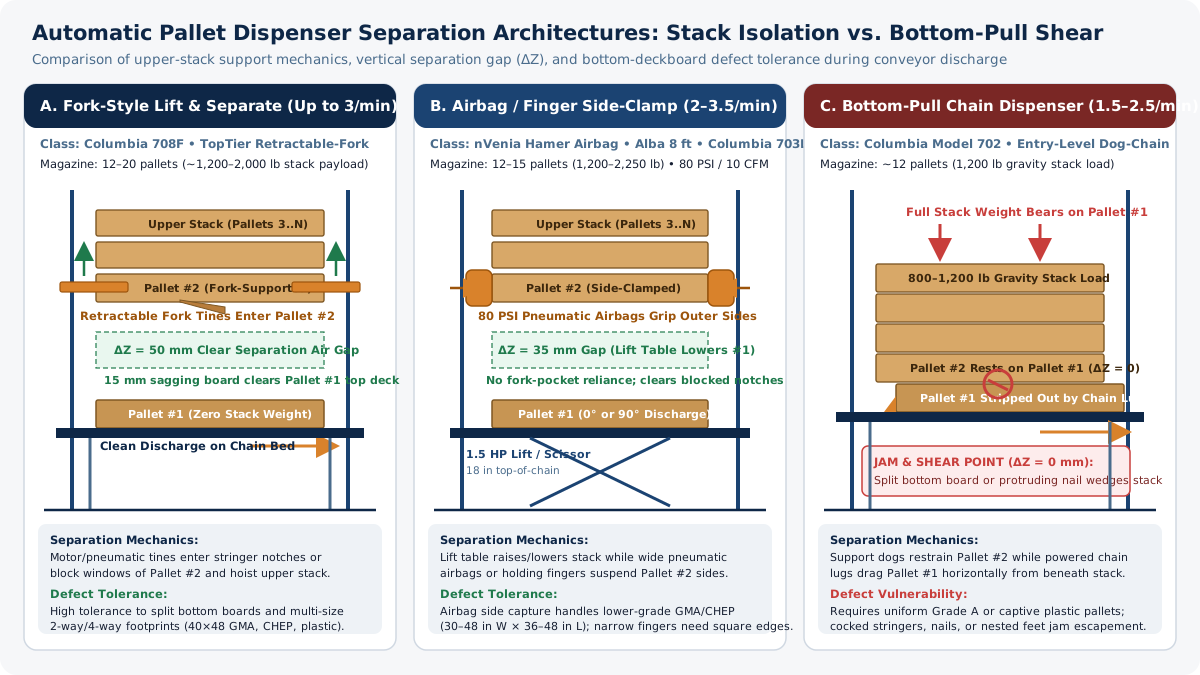
An automatic pallet dispenser indexes single pallets from a 10- to 20-pallet stack onto palletizing conveyor systems upon a PLC call from the palletizer machine. Across Columbia Machine, TopTier Palletizers, nVenia (Hamer Brand), Alba Manufacturing, and Brenton, dispensers divide into four architectures based on whether the mechanism lifts the upper N - 1 stack clear of Pallet #1 before conveying starts, or strips Pallet #1 directly beneath the resting stack.
| Dispenser Architecture | Published Reference Models | Magazine Capacity & Payload | Published Cycle Rate | Separation Mechanics | Defect & Footprint Tolerance |
|---|---|---|---|---|---|
| Fork-Style Lift-and-Separate | Columbia Model 708F; TopTier Lift-and-Separate | TopTier: 12–20 pallets; Columbia 708F: 10–15 pallets (~1,200–2,000 lb) |
Columbia 708F: up to 3 pallets/min (20 s/cycle) |
Forks enter openings of Pallet #2, lift upper N - 1 stack 25–50 mm, and convey Pallet #1 out under zero stack load |
Isolates split bottom boards on Pallet #1; retractable forks run 4-way and 2-way multi-size pallets |
| Side-Clamp / Airbag Lift-and-Separate | nVenia Hamer Brand; Alba Stacker/Dispenser; Columbia 703LS / 704 / LTS-PD | nVenia & Alba: 15 pallets (8 ft frame); 703LS: 12 pallets / 1,200 lb (20 pallets / 4,000 lb on LTS-PD) |
nVenia: 2–3 pallets/min; Alba & 703LS: 2–3.5 pallets/min | Lift table lowers Pallet #1 while 80 PSI side airbags (nVenia) or holding fingers (Alba) clamp Pallet #2, discharging at 0° or 90° |
nVenia airbag grips outer sides without fork pockets (30–48 in W × 36–48 in L × 4.5–5.5 in H); narrow fingers require intact edges |
| Bottom-Pull Chain Escapement | Columbia Model 702 Pallet Dispenser | Columbia 702: 1,200 lb / ~12 pallets |
1.5–2.5 pallets/min (24–40 s/cycle) |
Support dogs restrain Pallet #2 horizontally while chain lugs strip Pallet #1 from beneath stack (ΔZ = 0 mm) |
Lowest cost, but jams when broken bottom boards, nails, or nested plastic feet snag between Pallet #1 and #2 |
| Robotic EOAT Pallet Pick | Brenton RP1000 EOAT hooks; FANUC CRX-30iA cell | Floor stack of 15–20 pallets (60–96 in height) |
Shared robot steals 15–25 s/pallet; dedicated robot 5–10/min | Robot arm lifts top pallet vertically off floor stack with hooks or clamps and places it in build zone | Zero bottom-magazine jams, but sharing the case-stacking robot caps line speed above 18–25 cpm |
Fork-style lift-and-separate dispensers
In a fork-style lift-and-separate pallet dispenser (Columbia Model 708F, TopTier universal lift-and-separate), forks support the upper stack beneath Pallet #2. As TopTier’s options guide documents, CPG pallets vary in wood grade, height, and base consistency, causing jams unless Pallet #1 is isolated from the stack above. TopTier provides three 12 to 20 pallet models: a fixed-tine design for 4-way 40 × 48 in pallets, and two retractable-fork models for 2-way stringer pallets and multiple footprints. The electric motor-driven Columbia Model 708F dispenses or stacks up to 3 pallets/min (20 s/pallet), lifting Pallet #2 by 25 to 50 mm (1.0 to 2.0 in) so Pallet #1 exits under zero vertical load.
Pneumatic airbag, holding-finger, and bottom-pull dispensers
Side-clamp lift-and-separate dispensers grip Pallet #2 externally while a lift table lowers Pallet #1 onto the discharge conveyor:
- Pneumatic airbag side capture (
nVenia Hamer Brand): The nVenia Hamer Pallet Dispenser holds 15 pallets in a structural tube frame (1/4 incross braces) and dispenses at0°or90°at 2 to 3 pallets/min. Pneumatic side airbags (10 CFM @ 80 PSI) and a1.5 HPTEFC lift motor (230/460 VAC, 3-phase) gripPallet #2without needing fork pockets, separating lower-grade 2-way or 4-way GMA and CHEP pallets (30–48 in W × 36–48 in L × 4.5–5.5 in H). - Pneumatic holding fingers (
Alba Manufacturing): The Alba Pallet Stacker/Dispenser holds 15 pallets in an 8 ft (96 in) 3-sided plate-lined magazine. An electric-hydraulic lift and pneumatic holding fingers supportPallet #2while dischargingPallet #1onto a dual-strand drag chain conveyor (18 in top-of-chain, 2 ft 6 in /30 inextension) with an Allen-Bradley MicroLogix PLC handshake; narrow fingers require intact perimeter boards. - Scissor-lift, bottom-pull, and robotic options (
Columbia&Brenton): The Columbia Model 703LS (1,200 lb / 12 pallets) pairs a chain drive with a hydraulic or optional Electric Lift scissor table (OK-1/703LS), Model 704 serves multiple palletizers, and the Columbia LTS-PD Load Transfer Station integrates a 20-pallet side-load dispenser/upstacker (5 HPhydraulic,10,000 lbmass,234 × 60 infootprint) transferring4,000 lbloads in< 60 s. By contrast, the bottom-pull Columbia Model 702 (1,200 lb / ~12 pallets) stripsPallet #1beneath the full stack weight. In robotic palletizers (Brenton RP1000, FANUC CRX-30iA), EOAT pallet hooks work below15–18 cpm, but as shown in our robotic vs conventional palletizer comparison, each EOAT pallet/sheet pick steals 15 to 25 s/load, requiring a mechanical pallet dispenser above 18 to 25 cpm.
Selection takeaway: Specify a fork-style (Columbia 708F, TopTier) or wide pneumatic airbag (nVenia Hamer) lift-and-separate pallet dispenser for pooled GMA and CHEP wood pallets; restrict bottom-pull chain dispensers (Columbia 702) and narrow finger clamps (Alba) to uniform Grade A wood or captive plastic pallets.
Pallet dimensional envelopes and bottom-board failure boundaries: GMA stringer, CHEP block, and ISO 6780 plastic pallets
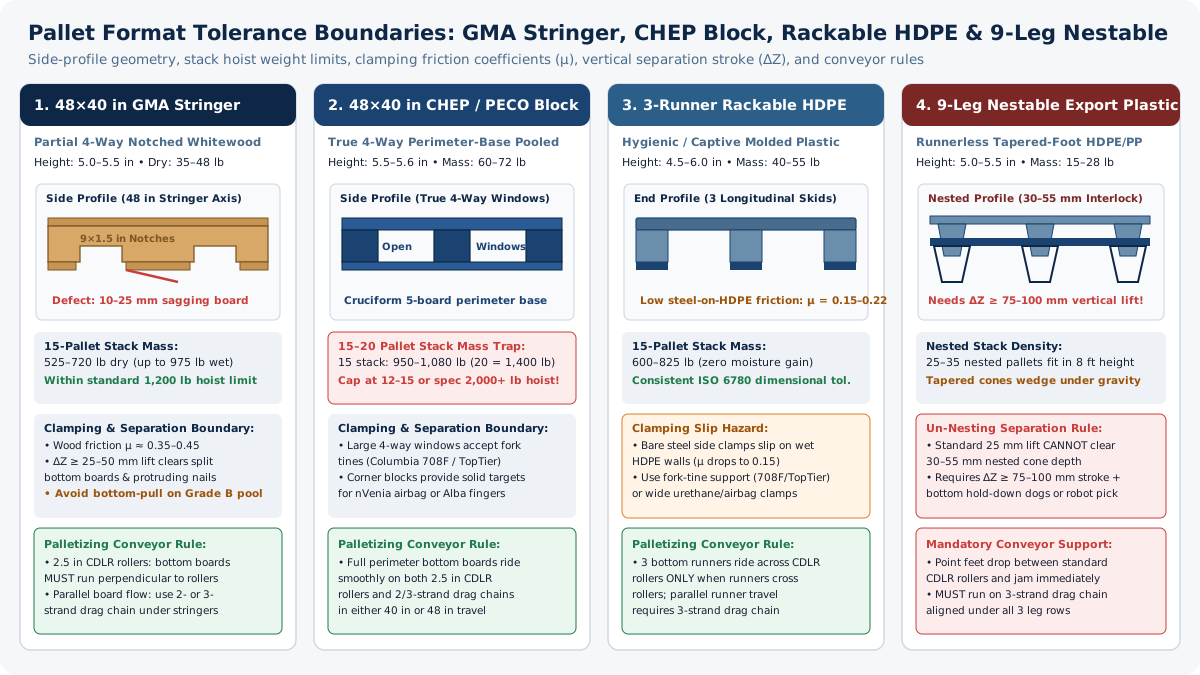
Over 80 percent of automatic pallet dispenser and palletizing conveyor systems stops originate from a mismatch between the plant’s pallet pool and the dispenser’s clamping, hoist payload, and conveyor support envelope across ISO 6780 and ANSI MH1 formats.
| Pallet Format & Standard | Footprint & Height | Unit & 15-Stack Weight | Base Geometry | Clamping & Lift Stroke Boundary | Mandatory Conveyor Rule |
|---|---|---|---|---|---|
| GMA 4-Way Notched Stringer (Whitewood) | 48 × 40 in (1,219 × 1,016 mm); 5.0–5.5 in H |
35–48 lb dry (55–65 lb wet); 15-stack = 525–720 lb dry |
Three stringers with 9 × 1.5 in notches; 3–5 chamfered bottom boards |
Wood μ ≈ 0.35–0.45; needs ΔZ ≥ 25–50 mm lift so 10–25 mm sagging boards clear Pallet #1 |
2.5 in CDLR rollers require boards perpendicular to rollers (≥ 3 rollers); parallel flow needs drag chain |
| CHEP / PECO Pooled Block Pallet | 48 × 40 in (1,219 × 1,016 mm); 5.5–5.6 in H |
60–72 lb; 15-stack = 900–1,080 lb; 20-stack = 1,200–1,440 lb |
9 blocks with 5-board cruciform perimeter bottom deck | 4-way windows fit fork tines (708F, TopTier) and airbags (nVenia); exceeds 1,200 lb above 15–16 pallets |
Cruciform perimeter base rides smoothly in 40 in or 48 in direction on CDLR rollers or drag chains |
| 3-Runner Rackable Plastic (HDPE / PP) | 48 × 40 in or 1,200 × 1,000 mm; 4.5–6.0 in H |
40–55 lb; 15-stack = 600–825 lb |
Molded top deck on 3 longitudinal runners or cruciform frame | Low steel-on-HDPE friction μ ≈ 0.15–0.22 causes bare steel fingers to slip; use fork tines or 80 PSI airbags |
CDLR rollers only when runners cross rollers; parallel travel requires 3-strand drag chain |
| 9-Leg Nestable Export Plastic | 48 × 40 in or 1,200 × 1,000 mm; 5.0–5.5 in H |
15–28 lb; 25-nested stack = 375–700 lb |
Nine tapered hollow cone feet (30–55 mm nesting depth); runnerless |
Needs ΔZ ≥ 75–100 mm vertical un-nesting stroke + bottom hold-down dogs or top robot pick |
Jams on CDLR rollers; mandatory 3-strand drag chain under all 3 leg rows |
Pooled CHEP/PECO stack weight versus magazine hoist limits
Switching from dry whitewood GMA pallets (35 to 48 lb) to pooled CHEP/PECO block pallets (60 to 72 lb, or 75+ lb damp) overloads standard 1,200 lb (12-pallet) hoists like the baseline Columbia Model 702 and 703LS. Loading an 8 ft (96 in) magazine (Alba or TopTier 15–20 pallet bay) with 18 damp CHEP pallets (68 lb) reaches 1,224 lb, tripping relief valves or stalling scissor lifts. For CHEP/PECO pools, set a photoeye interlock capping stacks at 12 to 15 pallets (850–1,050 lb) or specify a 2,000 to 4,000 lb lift (Columbia LTS-PD).
Broken bottom deckboards, plastic friction, and conveyor orientation rules
Three mechanical boundaries govern separation and conveying across pooled and plastic pallets:
- Sagging bottom deckboards (
10–25 mmdrop): A split board hanging10 to 25 mmbelowPallet #2wedges intoPallet #1under800 to 1,200 lbstack load in a bottom-pull dispenser (Columbia 702). Lift-and-separate units (Columbia 708F/703LS, TopTier, nVenia Hamer) open a 25 to 50 mm vertical gap (ΔZ) so damaged boards clearPallet #1. - Low friction (
μ = 0.15–0.22) and cone nesting (30–55 mm) on plastic pallets: In food packaging washdown zones, bare steel clamps slip on HDPE walls (F_clamp ≥ 750 / (2 × 0.18) = 2,083 lbffor a750 lbstack), making fork tines (Columbia 708F, TopTier) or wide airbags (nVenia Hamer) mandatory. For 9-leg nestable pallets (30–55 mmcones), specifyΔZ ≥ 75–100 mmlift stroke plus hold-down dogs. - CDLR roller vs drag-chain orientation: On 2.5 in CDLR rollers, bottom boards must cross roller axes (
≥ 3 rollers). When bottom boards or 3-runner skids run parallel to flow—or on 9-leg pallets—specify a 2- or 3-strand drag chain conveyor (18 intop-of-chain on Alba; 3-strand chain on TopTier).
Selection takeaway: Size hoist payload for damp CHEP weight (60–72 lb/pallet), require ΔZ ≥ 25–50 mm lift clearance for wood pools (ΔZ ≥ 75–100 mm for 9-leg plastic), and use 3-strand drag chains whenever boards or runners travel parallel to flow.
Slip sheet, tie sheet, and freezer sheet inserters: vacuum cup porosity math and double-sheet separation
An automatic sheet dispenser places a bottom liner (slip sheet) onto the empty pallet, inserts tie sheets or freezer separator sheets between layers, or adds a top cap sheet (Columbia Section 1, TopTier Options, nVenia Hamer). On push-pull palletless lines (Apex Material Handling), a kraft, corrugated, or HDPE slip sheet with 1 to 4 pull tabs (3–4 in lips) replaces or sits atop a slave pallet.
| Sheet Material & Format | Thickness & Basis Weight | Porosity & Curl Behavior | Vacuum Source & Cups | Separation Hardware |
|---|---|---|---|---|
| Uncoated Kraft & Chipboard | 180–350 gsm (10–24 pt / 0.25–0.60 mm) |
High air bleed through fiber web; humidity curl | Regenerative blower or high-flow venturi (15 CFM @ 80 PSI); soft bellows cups |
Front separation brushes (nVenia) + vacuum relief valve to stop bleed-through double picks |
| Clay-Coated & Anti-Slip Kraft | 32–60 mil (0.81–1.52 mm / nVenia 32 mil min); COF ≥ 0.50 |
Clay seal reduces bleed; high surface friction | Multi-stage venturi (-35 to -55 kPa); 4–6 bellows cups (D = 40–60 mm) |
Adjustable front separation brushes + blow-off drop pulse |
Single/Double Corrugated (B/C-Flute) |
118–250 mil (3.0–6.35 mm, nVenia 250 mil max) |
Semi-porous liner; 15–40 mm humidity bow |
High-flow venturi/blower (15 CFM @ 80 PSI); 30–50 mm 2.5-fold bellows cups |
Long-stroke spring plungers seal warped board; corner stack guides |
| Extruded HDPE / Freezer Sheets (1–4 Tabs) | 24–100 mil (0.60–2.54 mm); size < 60 in (TopTier) |
Non-porous; moisture-proof; static cling | Venturi (-60 to -75 kPa); flat or 1.5-fold nitrile/Viton cups |
Front bristle brushes + corner peel + ionizing air bar |
Mechanical architectures across nVenia Hamer, Columbia Machine, and TopTier
- Bottom-lift table + timing-belt carriage (
nVenia Hamer Brand): On a PLC pallet-in-place signal, the nVenia Hamer Pallet Slip Sheet Dispenser lifts a 10 in (~600 lb) sheet stack via a flow-controlled pneumatic table to the vacuum cups. A 1/3 HP TEFC motor (230/460 VAC, 3-phase,1.56 A / 0.78 A) drives a timing-belt carriage at 2 sheets/min (30 scycle) using 15 CFM @ 80 PSI air across36 × 36 into48 × 48 insheets from32 mil (0.81 mm)to250 mil (6.35 mm). As nVenia documents, the1/3 HPtiming-belt drive eliminates pneumatic rodless cylinder speed drift, seal wear, and bi-weekly adjustments. - Staged-pallet, servo-arm, and dual-cartridge dispensers (
Columbia Machine): Columbia’s Modifications Catalog specifies Model 1097 (staged-pallet slip sheets), Model 1098 (in-load or discharge slip, tie, or cap sheets with an optional servo-driven linear actuated arm), Model 1091 (FL1000direct build-zone placement), and Models 597 / 6098 (motorized carriage travel on high-level machines). For zero-downtime reloading onHL2000,HL4000,SP4000,HL6000,HL6200,HL7200, andHL9200palletizers, Columbia offers a scissor-lift Bulk Loading Sheet Dispenser and a 2-Cartridge Sheet Cartridge Loading Option. - Horizontal liner vs 2-axis tie-sheet gantries (
TopTier Palletizers): TopTier offers a horizontal vacuum carriage for bottom liners and a 2-axis vertical + horizontal gantry that places bottom liners, tie sheets, freezer sheets, 2-, 3-, or 4-tab slip sheets, and top caps (< 60 in, up to 3 pick positions) across60 in,90 in, or110 inloads (TopTier Modular Systems). An 18 in stack sits in a floor pull-out drawer (Low Infeed) or dual-bin mezzanine magazine (High Infeed) for non-stop reloading.
Vacuum holding force equation and porous-board sizing calculation
Total holding force F_hold across N_cups cups of effective diameter D_cup (m) at gauge vacuum ΔP (Pa) with safety factor S (S = 2.0 horizontal non-porous; S = 4.0 porous board and shear) must satisfy:
F_hold = (N_cups × (π × D_cup² / 4) × ΔP) / S ≥ m_sheet × (g + a_z)
Worked calculation: For a 48 × 48 in corrugated pad or 150 mil slip sheet (m_sheet = 1.80 kg) lifted at a_z = 2.50 m/s² (g = 9.81 m/s²) with S = 4.0:
- Required force:
F_req = 1.80 × (9.81 + 2.50) × 4.0 = 88.6 N (19.9 lbf). - Cup sizing at
ΔP = 35 kPa (10.3 inHg): Four50 mmcups (A_total = 7.854 × 10⁻³ m²) yield68.7 Nsafe force (< 88.6 N), whereas4 × 60 mm(0.060 m) 2.5-fold bellows cups (A_total = 1.131 × 10⁻² m²) deliver99.0 Nsafe force (> 88.6 NPASS). Pairing60 mmbellows cups with nVenia’s front separation brushes strips clinging second sheets on porous kraft and static-charged HDPE.
Selection takeaway: Specify a motor-driven timing-belt or servo linear sheet carriage (nVenia 1/3 HP TEFC, Columbia 1098, TopTier) with 50 to 60 mm bellows cups sized at S ≥ 4.0 (15 CFM @ 80 PSI) and front separation brushes.
PLC handshake and palletizing conveyor systems timing budget: preventing palletizer machine starvation
Running a pallet dispenser (3 pallets/min) and slip-sheet inserter (2 sheets/min) sequentially after full-load discharge starves any palletizer machine above 25 to 30 cpm. Preventing starvation requires overlapping empty-pallet staging and sheet pickup with active case stacking (packaging line design).
| PLC Handshake State | Trigger Permissive | Machine Action | Serial Time | Overlapped Time | Fault Interlock |
|---|---|---|---|---|---|
| 1. Pre-Stage Pallet & Pick Sheet | Layer counter reaches Layer L - 1 |
Dispenser indexes Pallet #1 onto 30 in buffer (Alba); sheet carriage picks Sheet #1 and waits above deck |
0.0 s (not pre-staged) |
0.0 s dead time (background) |
Low-pallet / low-sheet photoeye alarm; vacuum switch (< -25 kPa) single retry |
| 2. Simultaneous Load Swap | Final layer down; discharge zone clear | Full pallet exits while pre-staged empty pallet indexes from 30 in buffer into build zone |
6.0 s exit + 14.0 s dispense = 20.0 s |
5.0 s |
Transfer timer (> 8.0 s) jam alarm; discharge muting light curtain check |
| 3. Pallet Square & Sheet Drop | Empty pallet against build-zone stops | Pusher squares pallet (TopTier); waiting carriage pulses blow-off to drop Sheet #1 |
10.0 s (lift + pick + travel + drop) |
2.5 s |
Squaring over-travel fault; sheet-present photoeye (PE_Sheet = 1) |
| 4. Arm Home & Layer 1 Ready | PE_Sheet = 1 + SW_Home = 1 |
Carriage retracts; PLC sets Build_Station_Ready = 1 for Layer 1 deposit |
2.0 s |
1.5 s |
Hoist/robot inhibited until SW_Home = 1 and PE_Sheet = 1 |
Total Exchange (t_exchange) |
Final layer deposit to Build_Station_Ready |
Complete pallet and base slip-sheet exchange | 32.0 s |
9.0 s |
Saves 23.0 s/pallet (71.9% reduction) |
Worked cycle-time starvation proof (48 cpm palletizer machine)
Evaluate a palletizer machine at R_case = 48 cases/min (0.80 cases/s) building N_layer = 10 cases/layer across L = 6 layers (60 cases/pallet), with a single-layer upper storage bed (high-level palletizers or Columbia FL3000):
- Layer and build intervals: One 10-case layer forms every
t_layer = 10 / 0.80 = 12.5 s, and a 60-case pallet builds inT_build = 6 × 12.5 s = 75.0 s (1.25 min). Because the upper forming bed buffers at most one layer (12.5 s) during pallet exchange, upstream accumulation conveyors back up whenevert_exchange > 12.5 s. - Unbuffered serial exchange (
t_exchange = 32.0 s): Running full-load exit (6.0 s), non-pre-staged pallet dispense (14.0 s), and serial sheet pick/drop (12.0 s) after build completion starves the line fort_starve = 32.0 - 12.5 = 19.5 sper pallet (15.6 casesblocked), cutting net output toQ_eff = 60 / ((75.0 + 19.5) / 60) = 38.1 cpm(-20.6%loss; on an 8-layer / 80-case load whereT_build = 100.0 s, output drops to40.2 cpm). - Pre-staged overlapped exchange (
t_exchange = 9.0 s): Pre-staging an empty pallet on the30 in(2 ft 6 in) outfeed chain extension (Alba / Columbia 1097) and pre-pickingSheet #1during Layer 6 deposit compresses the swap to5.0 s + 2.5 s + 1.5 s = 9.0 s(≤ 12.5 s), sustaining48.0 cpm (100%).
Rule of thumb: If build-station exchange time t_exchange exceeds single-layer formation time t_layer (t_exchange > 12.5 s at 48 cpm), add a 30 in pre-staged pallet buffer extension and overlap slip-sheet pickup prior to final layer deposit.
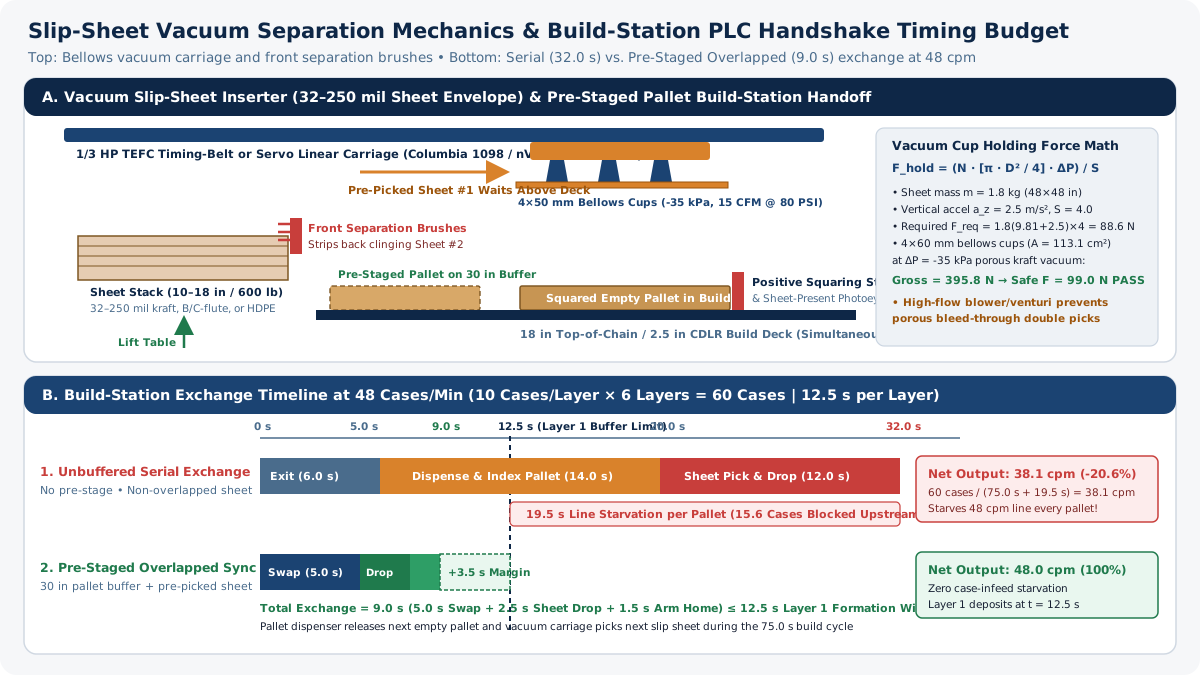
Selection takeaway: Require a pre-staged empty-pallet buffer zone (≥ 30 in chain extension) and overlapped vacuum sheet pick in the PLC sequence so t_exchange stays shorter than t_layer.
Magazine loading ergonomics, 90-degree vs inline conveyor layouts, and ASME B20.1 / ANSI B155.1 safeguarding
Fitting a pallet dispenser and slip-sheet magazine into packaging line layouts requires coordinating fork-truck aisles, sheet-loading ergonomics, and multi-zone safety interlocks.
Inline (0°/180°) versus right-angle (90°) discharge and load transfer stations
Both the Alba 8 ft Pallet Dispenser and nVenia Hamer Pallet Dispenser support fork-truck loading and conveyor discharge in-line (0°/180°) or at right angles (90°):
- Right-angle (
90°) loading & sheet replenishment: Orienting the bay at90°keeps fork trucks in the warehouse aisle. For sheet replenishment, specify a floor pull-out drawer (TopTier18 indrawer) or bottom lift table (nVenia10 in / 600 lbstack) on floor-level cells, and Columbia’s Scissor-Lift Bulk Loader or 2-Cartridge Sheet Loader or TopTier’s dual-bin mezzanine magazine on high-level beverage packaging lines. - Load transfer & unified controls: To swap captive plant pallets for shipping CHEP, GMA, or slip sheets in
< 60 s, integrate the Columbia LTS-PD Load Transfer Station (20 pallets,4,000 lb). Unify all dispenser, sheet, and conveyor handshakes in one Allen-Bradley CompactLogix/ControlLogix PLC and PanelView Plus HMI (Brenton, Columbia), and coordinate downstream zones with the automatic pallet wrapper line-fit guide and strapping and pallet banding line integration guide.
Safeguarding under ASME B20.1-2024, ANSI/PMMI B155.1-2023, and OSHA 29 CFR 1910.212 / 1910.147
Per ASME B20.1-2024, ANSI/PMMI B155.1-2023, and OSHA 29 CFR 1910.212 / 1910.147, specify four safety subsystems:
- Category 3
PL(d)perimeter guarding: Full-height barrier fencing with dual-circuit safety interlocks (Allen-Bradley SensaGuard on Columbia palletizers and TopTier Controlled Entry Protocol). - Muted loading-bay light curtains: Safety light curtains at the loading bay (TopTier, Columbia) so fork-truck restocking isolates the lift without stopping the palletizer machine.
- Hoist protection pins & external reset: Automatic hoist protection pins on
80 Pitchchains (Columbia) and external line-of-sight reset stations per ANSI/PMMI B155.1-2023. - Gravity, hydraulic & pneumatic LOTO (
29 CFR 1910.147): Lockable pneumatic dump valves (80 PSIbleed), hydraulic velocity fuses, and mechanical lift-table blocking bars.
Selection takeaway: Require Category 3 PL(d) interlocked guarding, muted loading-bay light curtains for non-stop replenishment, and mechanical stack-support locking pins for 29 CFR 1910.147 LOTO compliance.
RFQ specification and Factory Acceptance Test (FAT) qualification checklist
Before signing off on commissioning and acceptance, bind the supplier to a measured FAT—patterned on Columbia’s 12-hour dry-cycle run plus at-speed customer FAT and Brenton’s single-facility full-system FAT. Pair the how to choose a palletizer guide with this matrix.
| Qualification Boundary | Worst-Case FAT Input | Measurement Protocol | Binding Acceptance Criterion |
|---|---|---|---|
| Dry-Cycle Endurance | Continuous dry run of lift, clamps/forks, conveyor, and sheet carriage | Columbia 12-hour continuous dry-cycle run | Zero mechanical binds, fastener loosening, or PLC faults over 12 hours |
| Grade B & CHEP Separation | 30-pallet stack with sagging boards (15–25 mm drop), nails, and damp 68–72 lb CHEP pallets |
Dispense 30 pallets at 2–3 pallets/min |
100% clean separation (0 jams); hoist lifts 15-pallet CHEP stack (≥ 1,050 lb) |
| Plastic Friction & Un-Nesting | Wet 3-runner HDPE (μ ≈ 0.18) and 9-leg nestable pallets (30–55 mm cones) |
Run 20 separation and 3-strand chain cycles | Zero side-clamp slip (≤ 2 mm creep); 100% un-nesting at ΔZ ≥ 75–100 mm |
| Slip Sheet Porosity & Curl | 50 cycles each of 180 gsm kraft, warped B/C-flute (25 mm bow), and 40 mil HDPE |
Measure vacuum (ΔP), brush strip, and centering |
100% single-sheet pick (0 double picks, 0 drops); centered within ± 6 mm |
| Overlapped PLC Exchange | Full-speed palletizing (R_case) across 5 loads with slip-sheet insertion |
Log time from final layer down to Build_Station_Ready = 1 |
Total exchange t_exchange ≤ 9.0–11.0 s (< t_layer); zero line starvation |
Muted Bay & Cat 3 PL(d) LOTO |
Reload pallet bay and sheet cartridge during active run; trip interlock | Verify light-curtain muting, SensaGuard trip, and air dump | Palletizer runs uninterrupted during reload; curtain breach stops motion in < 0.5 s |
Selection takeaway: Attach this six-point FAT matrix to the purchase order and require at-speed qualification using the plant’s worst-case pooled pallets and highest-porosity or most warped slip sheets before shipment.