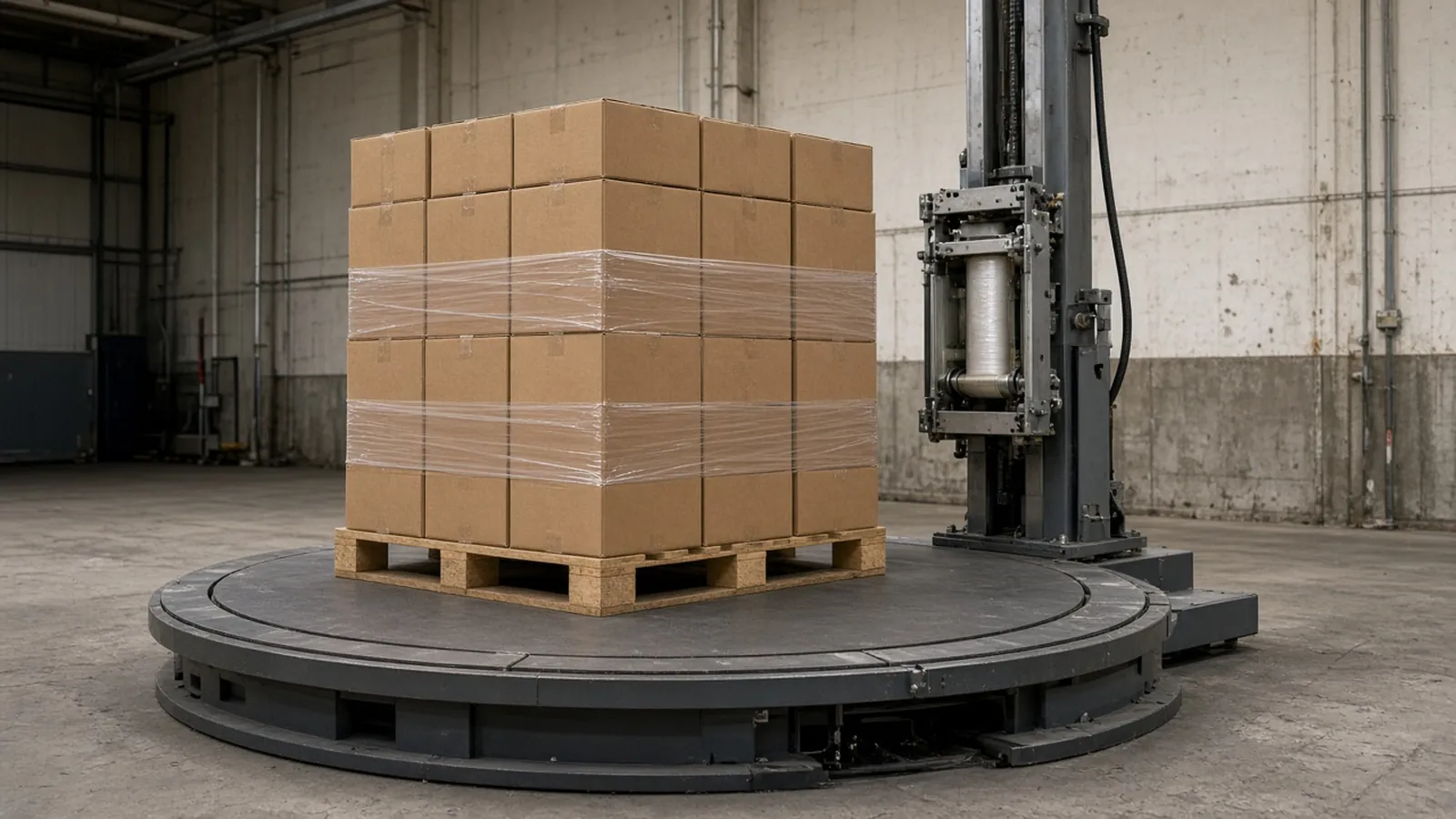
A pallet that leaves the wrapper with a loose film tail, or a cycle that still needs a driver to cut the film, stops the next move even when the brochure calls the machine automatic. Write the motion and the remaining person-steps before you compare an automatic pallet wrapping machine with the line that has to take the load.
When you automate pallet wrapping after the load is built, write down whether the pallet turns or stays still, and which steps a person still does. Record who brings the pallet in, who positions it, who starts the cycle, who attaches the film, who handles the tail, who may take the pallet away, and who owns each interface. Public pages fill some of those cells for turntable and rotary-arm classes, including one rotary-arm model described for an AMR. An empty cell stays empty until your supplier marks it against your load. This page does not calculate film use, compare stretch wrap with shrink wrap, or set a loads-per-hour cutoff. Pallet flow around the wrapper is on the pallet handling page. Drawing the positions is on the packaging line layout guide.
What goes on the wrapper line-fit record?
Copy this record and fill your project. Leave a cell empty when you do not have the value yet. An empty cell is the list of questions for the supplier.
| Field | Your value | Owner |
|---|---|---|
| What moves: the pallet, or the film around a still pallet | ||
| Who brings the pallet in: forklift, pallet jack, conveyor, or AMR | ||
| Deck or pass-line height, and whether a pallet jack must drive on | ||
| Who positions the pallet, and which sensor does it if a sensor is named | ||
| Who starts the cycle | ||
| Who attaches the leading film | ||
| Who cuts or secures the film tail, and what the tail must look like before the pallet may leave | ||
| Who may take the pallet away, and the signal that says it is clear | ||
| Rate on the proposal, with the load and the counting window | ||
| Load weight limit, and whether that limit is a turntable rating or the floor | ||
| Film width. Leave thickness empty unless the proposal prints it | ||
| Footprint and wrap height | ||
| Where the pallet goes when the station stops | ||
| Responsible person, upstream of the wrapper | ||
| Responsible person, downstream of the wrapper | ||
| AMR only: approach path, and the signals for present, wrap complete, tail secured, and clear to depart |
A published hourly figure is a manufacturer statement for that class or that model. Your rate still goes on this record, in one unit you name.
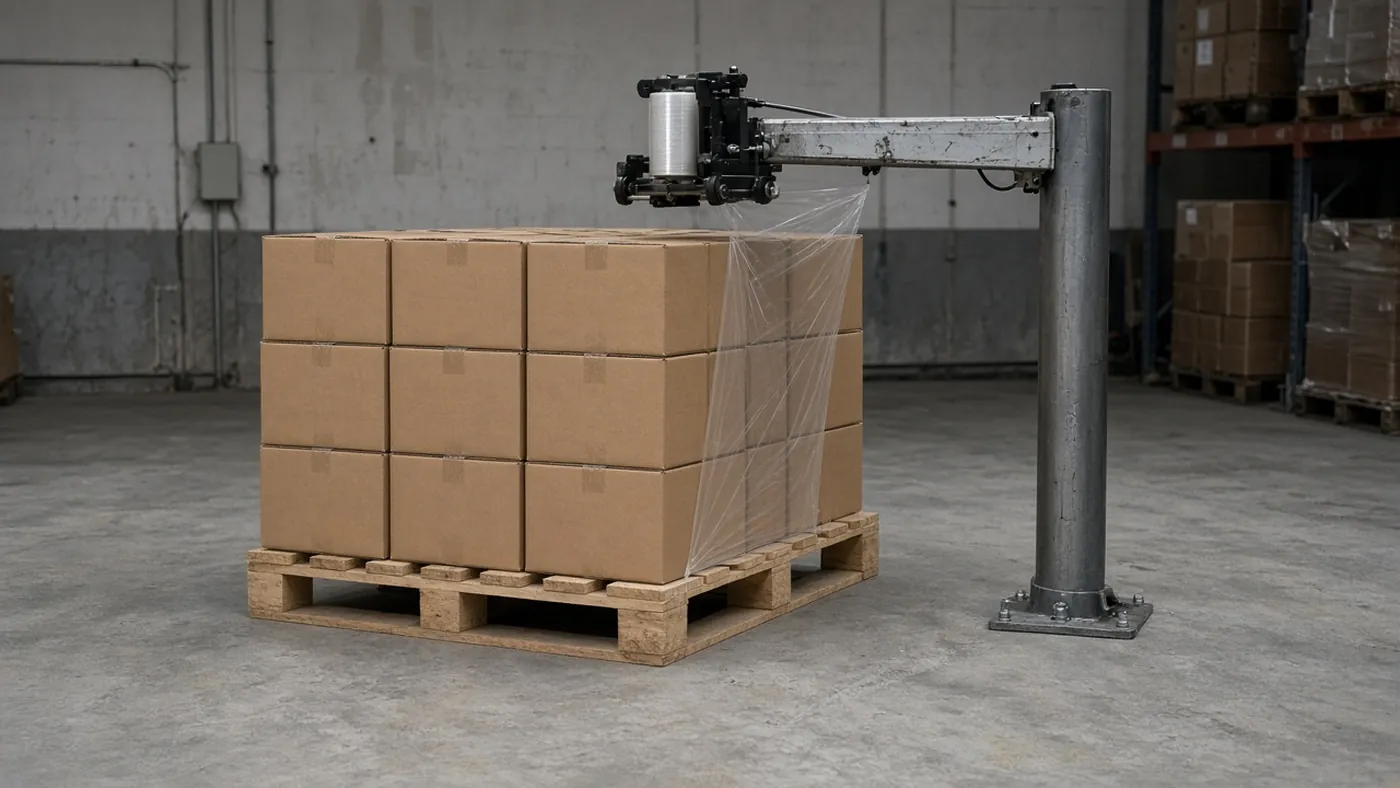
A pallet of plain brown boxes on a concrete floor, with a film carriage on a steel arm and a sheet of clear film between the carriage and the boxes.
Which motion is on the page, and which person still acts?
A turntable rotates the pallet. A rotary arm leaves the pallet where it is and moves the film around it. Those two sentences are the split on the pages below. The same pages then say, class by class, whether a person still brings the pallet, starts the cycle, attaches the film, or cuts the tail. Read the row that matches the class on your proposal. A blank cell was not stated in the sentences used here.
Tinsley Company’s automated pallet wrappers page, saved 11 October 2026, says turntable machines turn or rotate the pallet load as it is wrapped. It says rotary-arm machines are used when you want to keep a pallet load stationary. Arbon Equipment’s stretch and pallet wrapping page, saved the same day, says a rotary-arm automatic machine wraps loads while they stay stationary and the stretch film rotates around the pallet load.
| Class on the page | What moves | Who brings the pallet | Who starts | Leading film | Film tail |
|---|---|---|---|---|---|
| Tinsley, turntable, semi-automatic, pallet jack or forklift | The pallet rotates on the turntable | An operator, by pallet jack or forklift | A push button | ||
| Tinsley, turntable, fully automatic, pallet jack or forklift | The pallet rotates on the turntable | An operator transports it to the turntable | Wireless remote, or the control panel | An A-arm attaches the film | An A-arm cuts it. The page says the operator need not leave the forklift to cut |
| Tinsley, turntable on a conveyor | Turntable | Stand-alone: wireless remote or control panel. In-line: interface relays and logic connected to the conveyor | One model uses an A-arm. Other models use a clamp | A-arm cut, or a clamp, cut, and wipe | |
| Tinsley, rotary arm, semi-automatic | The arm moves around a pallet that rests on the floor | An operator places it on the floor by forklift or pallet jack | A push button on the control panel | ||
| Tinsley, rotary arm, fully automatic, pallet jack or forklift | The arm moves around a pallet on the floor | An operator transports the pallet | Control panel or wireless remote | A pneumatic film clamp. An all-electric clamp is listed as optional | An electro-mechanical tail cut or wiper, and an impulse hot-wire cutoff |
| Tinsley, rotary arm over a conveyor | The arm moves around the load in the wrap zone | The page says loads are conveyed automatically to the wrap zone | A pneumatic film clamp | A film-tail cut or wiper | |
| Arbon, turntable, automatic | From the forklift, with a wireless remote | ||||
| Arbon, turntable, semi-automatic | Forklift or pallet jack | ||||
| Arbon, rotary arm, automatic | The load stays still. The film rotates around it | A wireless remote is listed as something the machine can have | A cutting system. The page says the operator does not physically end the cycle | ||
| Arbon, rotary arm, semi-automatic | Personnel cut the film by hand at the end of the cycle |
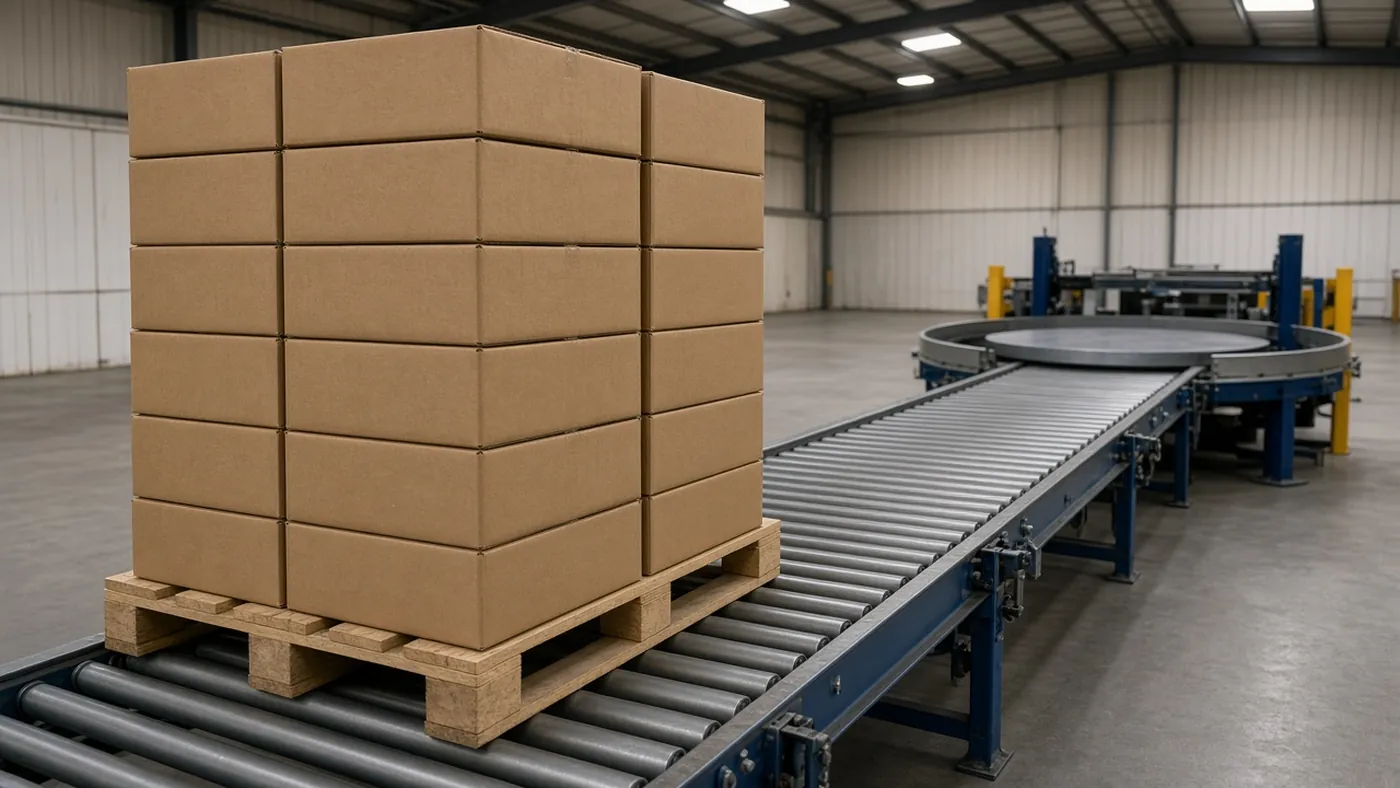
An unwrapped pallet of plain brown boxes on a roller conveyor, with a turntable at the far end of the conveyor.
The Tinsley conveyor-turntable row does not say who places each pallet onto that conveyor. That cell stays blank. The basic system on that subsection can hold 2 pallets. That is a holding count for the system described there, not a headcount and not your buffer.
Arbon’s rotary-arm semi-automatic paragraph says the speed of rotation can be customized based on the pallet size and the type of wrapping, and it calls that class suitable for heavy, unstable, or wet or wash-down loads. That suitability line is Arbon’s wording for that class. It is not a rule that every unstable load must use a rotary arm. Tinsley’s rotary-arm introduction says the same stationary-load idea for tall, very heavy, very light, or unstable loads, and for wash-down lines because there are no drives or parts at floor level. Copy the sentence that belongs to the class on your proposal.
The load is built before it reaches this station. Conventional palletizers cover layer machines. The handshakes between the palletizer, the conveyors, and the wrapper are on the pallet handling page.
What do the printed hourly lines actually decide?
Tinsley’s page prints “35-45 pallets an hour or less” for turntable machines and “up to 35-95 pallets per hour” for rotary-arm machines. The two printed hourly ranges overlap, so neither range is a cutoff between a turntable and a rotary arm.
The same page then prints different hourly lines under different subsections. The semi-automatic turntable subsection prints approximately 35 loads per hour. The conveyor turntable subsection prints approximately 35-45 loads per hour. The semi-automatic rotary-arm subsection prints approximately 30-40 loads per hour. The rotary arm over a conveyor prints approximately 45-95 loads per hour, depending on the type of automated bagging system or production line. Those lines stay on their subsections. They do not replace the rate, the load, and the counting window on your record.
Lantech’s SL400AMR page, with publication metadata of 29 September 2026 and fetched 7 October 2026, prints a peak production speed of up to 40 loads per hour for that one rotary-arm model. That peak stays on that model. It is not a class cutoff, and it is not a promise that an AMR line will hold that rate.
Where do deck height, film tail, and one AMR model fit?
Tinsley’s semi-automatic turntable subsection prints two deck heights. The low-profile turntable is 57 inches in diameter and 2.75 inches from the floor. The high-profile turntable is a 48 inch octagon, 11 inches from the floor. The same introduction says low-profile turntables are for pallet jacks and high-profile wrappers are for forklift loading. Those heights belong to that subsection. Other subsections on the page print other sizes. Write the deck height and the truck type from the proposal, and leave the cell empty until you have them.
The same semi-automatic turntable subsection prints a rotating load capacity of 4,000 lb. The fully automatic turntable subsection, still loaded by forklift or pallet jack, prints 4500# load capacity. The semi-automatic rotary-arm subsection prints the words “Unlimited load capacity (floor supported).” That phrase is the page’s wording. It is not a floor rating for your building. Ask for the written limit on the proposal and the floor rating on your drawing. Leave the cell empty if either one is missing.
On the conveyor turntable subsection, Tinsley lists automatic load-staging photo-eyes. On the semi-automatic rotary-arm subsection, it lists a triple-beam automatic load-height sensing photo-eye and says it detects dark or shiny loads. Those are sensors named on those subsections. The pages used here do not say those sensors center the pallet. If your proposal names a centering sensor, write that name on the record. If it does not, leave the cell empty.
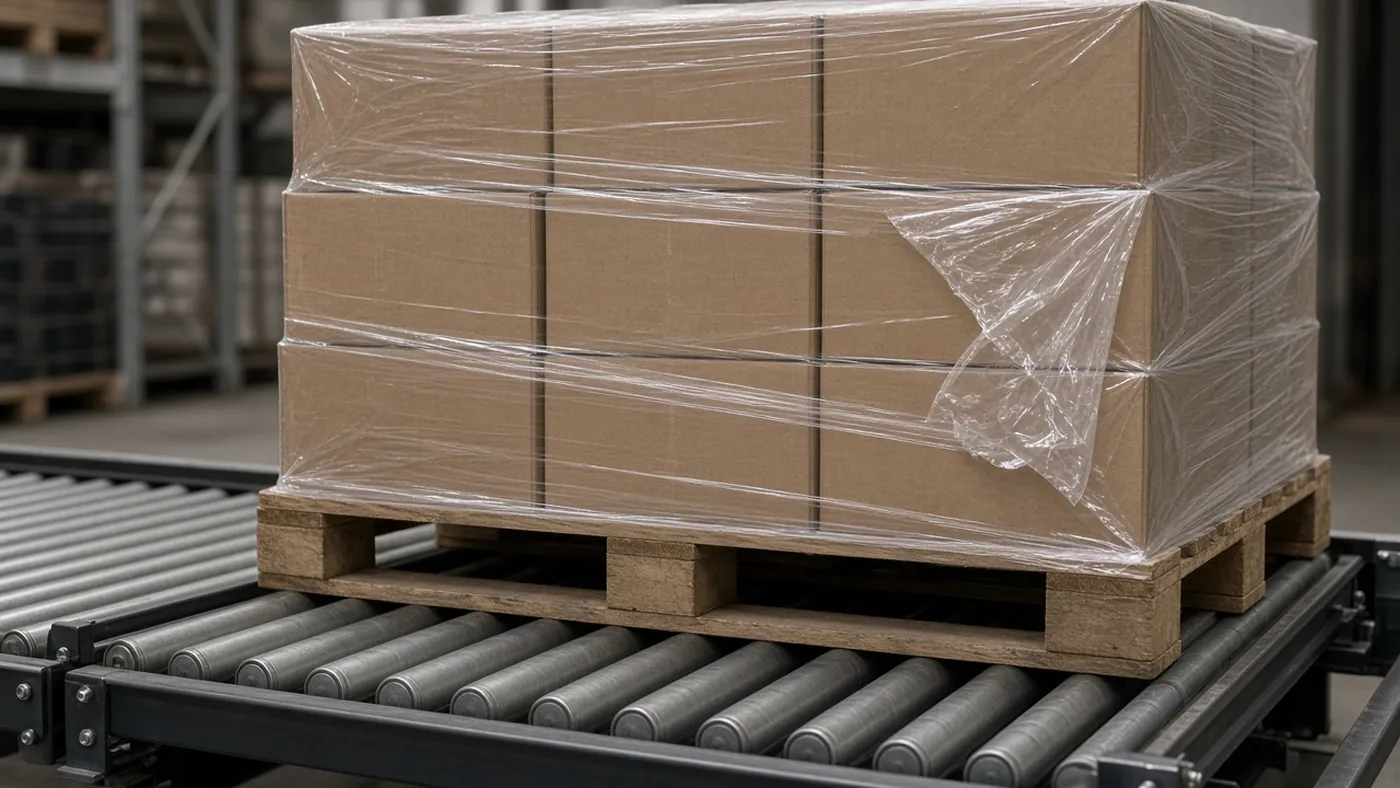
A wrapped pallet of plain brown boxes on a steel roller conveyor, with a loose film end against the side of the load.
Lantech’s QL Series page, with publication metadata of 17 March 2025 and fetched 7 October 2026, is a selector for semi-automatic wrappers. It says the QL400 comes with an automatic film cut-off as an option, and the QL400XT includes the XT cut-and-clamp. On that page, “semi-automatic” does not by itself tell you whether a person still cuts the film. Match the option list on the proposal to the film-tail row above, and leave the cell empty when the option is not named.
Lantech’s SL400AMR page is a rotary-arm model, filed under rotary arm on that site. The page says the machine is for fully automated environments and describes a predictable pallet interface and AMR-friendly machine access. It says TurboTak uses two blasts of air to put the film tail on the load, so a dragging tail does not falsely trigger AMR sensors, and that the device does not use heat. It says the Load Seeking Clamp moves to the side of the load to capture the leading film tail. Those sentences are about this model. They are not a statement that every wrapper will accept every AMR.
Printed interface lines on that same SL400AMR page, and only that page:
| Item | Printed line |
|---|---|
| Peak production speed | Up to 40 loads per hour |
| Recommended load diagonal | 1931 mm (76 in) |
| Maximum load wrap height | 2032 mm (80 in) |
| Maximum load weight | Floor capacity |
| Standard film width | 508 mm (20 in). No film thickness is printed |
| Wrap arm speed | 15 RPM |
| Machine size | 4801 mm x 3810 mm x 3073 mm (189 in L x 150 in W x 121 in H) |
| Pneumatic | 5.5 bar (80 psi) |
| Electric service | 208-240 VAC / 16 A / 1 phase / 50-60 Hz |
The extended wrap-height option on that page is omitted here because the printed units conflict. Do not fill your wrap-height cell from that option. Film thickness is not on the page, so the thickness cell on your record stays empty unless your proposal prints one.
The page does not print the signal names for pallet present, wrap complete, tail secured, or clear to depart. Those four cells stay empty until the proposal names them, and they stay empty if the project has no AMR. Lantech’s article “User-Friendly Stretch Wrappers,” which prints the date Dec 30, 2025 and was fetched 7 October 2026, asks how many decisions the operator makes per pallet and what happens if a step is skipped. Use those two questions on the rows you are about to mark. They are questions, not measured results from this site.
Whole-line acceptance sits outside this record. Packaging line commissioning covers factory and site acceptance for the line. This sheet stops at the wrapper’s infeed, the tail, and the release.
What do you take to your supplier?
Take the completed line-fit record to your own supplier. Ask them to mark every empty cell against the load in your specification. This site does not take inquiries and does not review proposals.
Bring these to that meeting:
- The line-fit record, with empty cells left empty.
- The class row from the table above if a brochure uses one of those names, with your value written beside it.
- The load you will actually wrap: pallet type, load size, and weight, with the revision marked.
- The film-tail condition you will accept before the pallet may leave.
- The names of the upstream owner and the downstream owner.
- If an AMR is in the project, the approach path and the four signal names. Leave them blank if the proposal has not named them.
The packaging guides index lists the other station-fit worksheets. Palletizer selection, including the wrapper interface as a scope item, is on the palletizer selection guide.
Method and sources
Compiled on 14 October 2026 from the Tinsley automated pallet wrappers page and the Arbon stretch and pallet wrapping page saved with the US English desktop search snapshot on 11 October 2026, and from library copies of three Lantech pages fetched on 7 October 2026. The SL400AMR copy’s publication metadata says 29 September 2026. The QL Series copy’s publication metadata says 17 March 2025. The user-friendly article prints Dec 30, 2025. Figures are quoted from the page named in the sentence and apply to that wording. No sample run was performed for this page. The photographs show plain boxes, a turntable, an arm, and a roller conveyor. They are not a named machine, a measured rate, or a customer shipment. The search snapshot was used to see which explanations already exist. A distributor page in that snapshot listed robot prices. Those prices are not used here. Manufacturer speed lines are quoted only with the class or model that prints them, and they are not used as a cutoff.