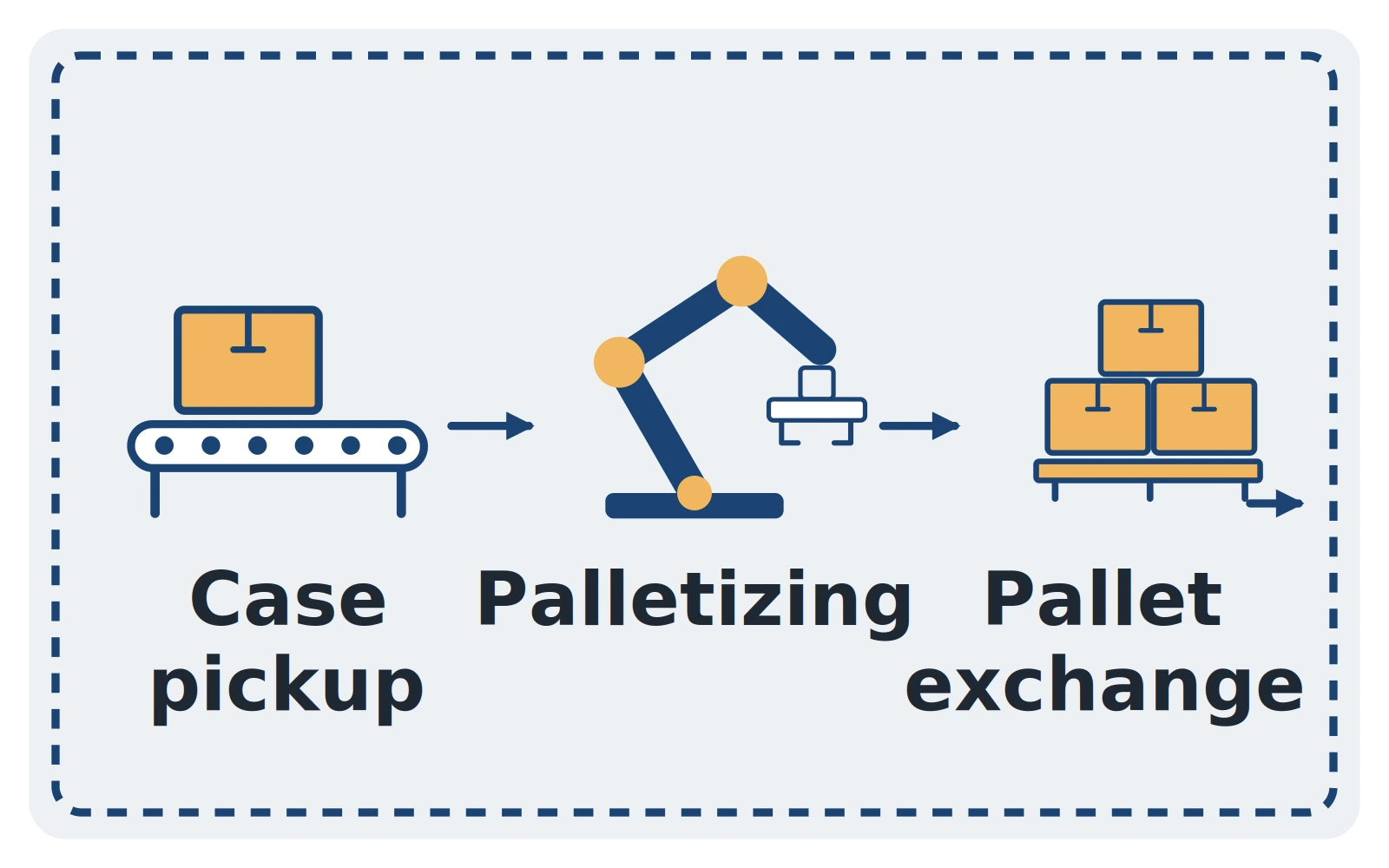
A missing palletizing-rate commitment can cause costly upstream delays. Evaluate the FANUC CRX-30iA palletizer announcement at the complete-cell boundary: case pickup, loaded motion, placement, pallet exchange and upstream stop response.
Applied Manufacturing Technologies (AMT) announced a CRX-30iA-based collaborative palletizing solution in supplier-submitted material published by Packaging World on September 25, 2026. The useful next step is to request a cell-level operating point for your cases and pallet pattern. Robot payload and reach do not provide cases per minute, and the announcement does not publish the system’s throughput. Define the filled-case sample, gripping load, stack height, pallet-exchange sequence and accepted output before comparing the proposal with another palletizing approach. The announcement establishes what AMT said, not independent performance or a verified payback.
Key points:
- Separate robot specifications from complete-cell commitments.
- Test the required case and pattern rather than inferring rate from payload.
- Include pallet exchange and upstream waiting in the operating sequence.
- Review the application after relocation, including interfaces and safeguarding.
What was announced, and who should investigate it?
The supplier-submitted announcement describes a palletizing cell with a custom interface for entering case dimensions and selecting patterns, and says the equipment can move between lines. For operations teams considering a change to manual case stacking, those claims suggest topics to investigate: recipe handling, redeployment and the handoff from the existing case conveyor.
| Public record | Date | Evidence status |
|---|---|---|
| AMT announcement published by Packaging World | September 25, 2026 | Supplier-submitted material; not a media trial |
| FANUC robot specifications | Checked October 8, 2026 | Manufacturer component specifications |
| Project throughput, installed scope and delivery | Subject to integrator quote | Requires integrator’s project documents |
| Project situation | What the announcement prompts | Evidence before choosing |
|---|---|---|
| Frequent case changes | Review recipe entry and tooling changes | Demonstration with the required case family |
| Proposed use on several lines | Review relocation and restart work | Each receiving-line interface and layout |
| Space-constrained end of line | Review complete working area | Cell drawing, pallet access and service space |
| Manual stacking replacement | Review achievable accepted-case output | Cell performance commitment and run record |
Use the palletizing overview for the equipment context and the selection guide to organize the case inputs. This article interprets one announcement; it does not rank integrators or imply a recommendation based on the robot brand.
Takeaway: Use the announcement to identify a testable project scope, not to choose a winner.
Which published numbers belong to the robot, and which belong to the cell?
FANUC’s technical specifications identify robot payload and reach, but the application needs separate commitments for case weight, tooling, movement and completed output. Put the component values beside the missing cell fields. This prevents a purchasing requirement from quietly changing from “handles this case” into “has this nominal robot payload.”
| Field | Public source reviewed October 8, 2026 | Use in this review |
|---|---|---|
| Robot payload | FANUC technical table: 30 kg | Component specification; not a stated maximum case weight |
| Robot reach | FANUC technical table: 1,756 mm | Starting point for a layout request, not proof of every stack position |
| Reach in AMT announcement | Supplier reports 1,889 mm; unconfirmed against FANUC’s table | Resolve with integrator’s current drawing and datasheet |
| Actual filled-case limit | Not stated in the announcement | Obtain with the selected end effector and motion |
| Accepted cases/minute | Not stated in the announcement | Obtain for the intended pattern and operating conditions |
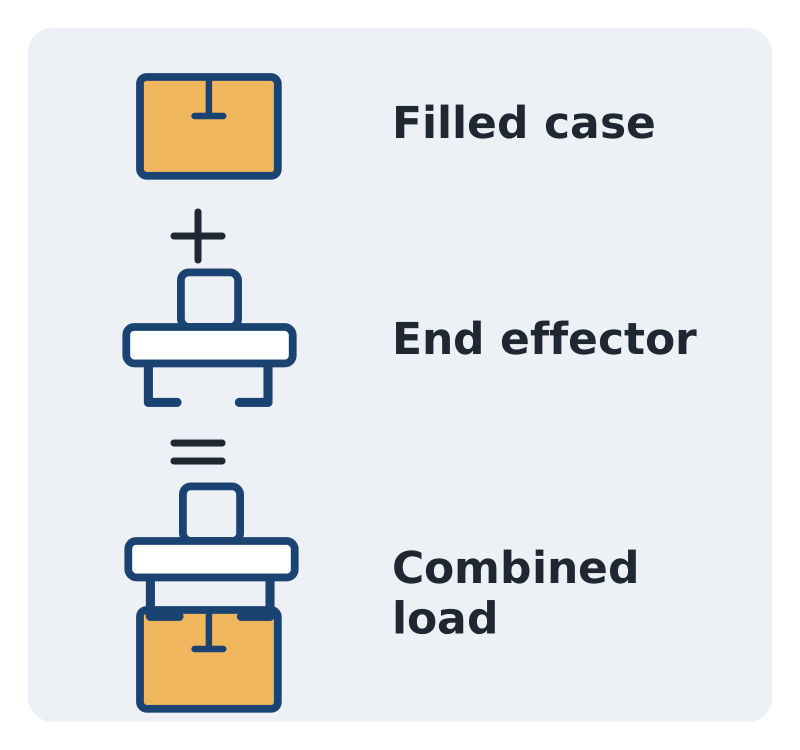
The official page also promotes a higher payload in palletizing mode elsewhere. Do not assume that option is the configuration in this proposal. Ask the integrator to specify the robot mode and the permitted combined load of cases, end effector and attached equipment, with the applicable limits.
Use the robotic-palletizer guide for the case-handling context. A source discrepancy is not resolved by choosing the larger number; the evidence should identify the installed component and configuration.
Common mistake: Treating the robot’s nominal payload as the allowable weight of the case alone.
Takeaway: Obtain a case-plus-tooling operating envelope for the quoted cell.
What rate should the upstream case conveyor be designed around?
Request a sustained accepted-case rate for your case dimensions, grip, pallet pattern and stack height. Include pallet exchange and any operator interventions in the agreed observation window. With no published system rate in the announcement, the conveyor or holding section cannot be sized from the robot’s reach, payload or user-interface description.
| Rate input | Obtain from | Question for the acceptance plan |
|---|---|---|
| Cases arriving at pickup | Production requirement | Where are arrivals counted? |
| Cases placed on the pallet | Integrator commitment | What cases and pattern are used? |
| Exchange interruptions | Agreed cell sequence | Is the interval included in output measurement? |
| Rejected or reworked cases | Quality criteria | Which placements count as accepted? |
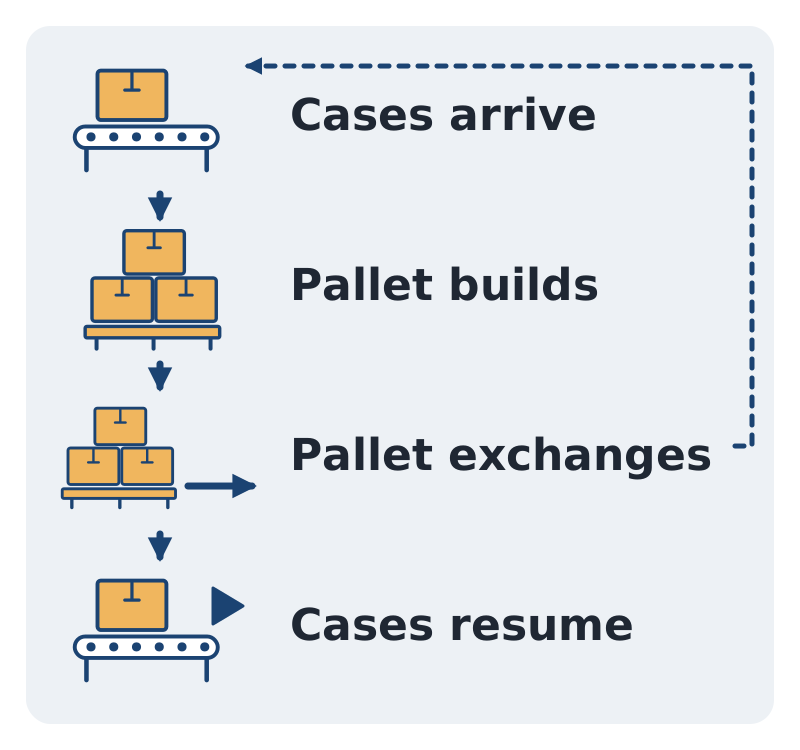
| Recovery after an interruption | Integration plan | When can upstream release resume? |
The case-conveyor guide helps define arrival conditions. The case-palletizer guide explains the receiving stage. When a proposal needs a buffer, describe how many actual cases can wait, where they wait and how release is controlled; use the accumulation-conveyor guide to distinguish storage from ordinary transport.
Use this request table to assign stop response; the entries are proposed review fields, not confirmed AMT functions or a safety-control design.
| Event to review | Upstream response to agree | Responsible party to agree | Restart condition to record | Acceptance evidence |
|---|---|---|---|---|
| Pallet exchange | Where cases wait and who holds release | Integrator and upstream controls owner | Receiving pallet ready under agreed procedure | Exchange sequence and counted run |
| Pickup blockage | How arrivals are held or diverted | Integrator and conveyor supplier | Pickup restored and release authorized | Interface test record |
| Cell interruption | How upstream learns that reception is unavailable | Integrator and plant integration lead | Agreed restart authorization | Stop-and-restart record |
Takeaway: Base the upstream specification on an agreed complete-cell run, including the chosen exchange boundary.
What needs to change when the cell moves to another line?
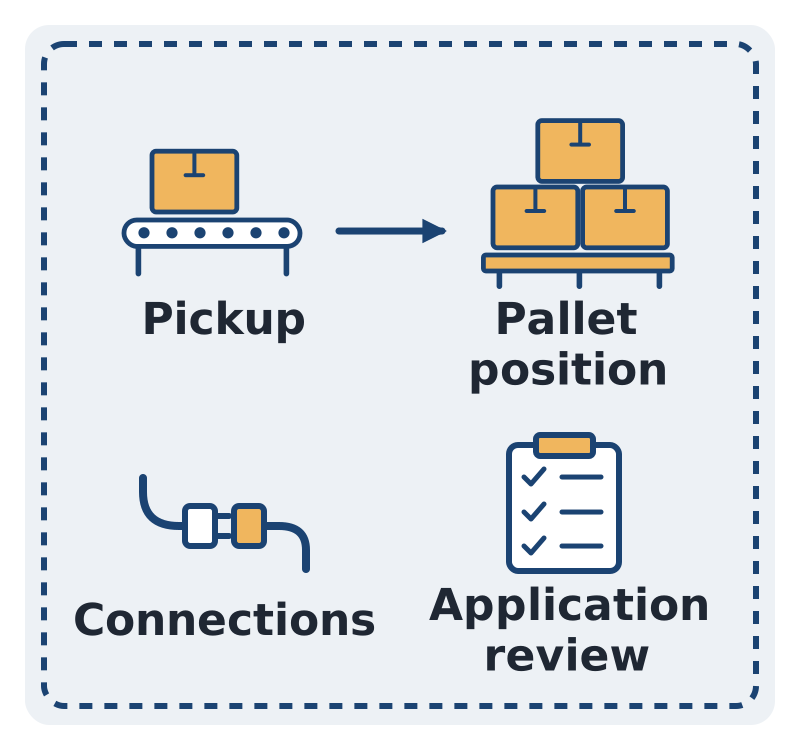
Treat relocation as a new interface review, not only a wheeled-equipment move. Record where cases arrive, where pallets sit, which utilities connect, how recipes are selected and who permits restart. AMT’s mobility description does not establish compatibility with every receiving line or a validated move-and-restart time for your plant.
| Receiving-line item | Review artifact | Acceptance question |
|---|---|---|
| Pickup location and orientation | Coordinated drawing | Can each case arrive in the specified position? |
| Pallet location and finished-load route | Layout and load-handling plan | Can exchange occur under the agreed procedure? |
| Recipe and tooling | Configuration record | Is the correct case family selected? |
| Utilities and control signals | Interface schedule | Are connections and stop responses verified? |
| People and adjacent equipment | Application review | Are protective measures validated for this arrangement? |
The line-layout guide supports the spatial review. Use the floor-plan worksheet to keep receiving-line versions separate and the line-design guide to assign control-interface responsibilities.
For safeguarding, OSHA’s robot-system technical manual treats the application as more than the robot and discusses task-based risk assessment. Have the responsible integrator and safety team assess the complete arrangement. A collaborative robot designation does not itself approve the gripper, handled case, pallet-exchange activity or interaction with adjacent machinery.
Takeaway: Make each receiving-line configuration a documented review and acceptance item.
How should pattern changes and first-load acceptance be demonstrated?
Ask an intended operator to enter or select the actual case recipe, perform any tooling changes and produce the agreed accepted load under the defined procedure. This tests the proposed workflow rather than relying on the interface’s description. Keep the geometry check separate from grip reliability and physical load stability.
Start with outside dimensions and measured filled-case weights. The pallet calculator can help record cases per layer and geometric limits. It does not establish that a robot can reach all placements or that the stacked cases resist the handling loads expected later.
For each recipe demonstration, record selected settings, tooling identification, pallet position, accepted cases and interventions. For a line-change test, add the receiving-line setup and the point at which upstream case release resumes. The commissioning guide gives context for acceptance records and responsibility assignments.
Common mistake: Calling a successfully entered pattern a successfully accepted palletizing application.
Takeaway: Demonstrate the whole recipe-to-load workflow with the actual cases and acceptance criteria.
How should the investment claim be evaluated, and when should the team act?
Evaluate the proposal when there is a defined case-handling task and enough operating data to compare scope. The supplier article claims a short payback but does not publish a reproducible calculation. Use your own cost and staffing records, and distinguish an advertised starting scope from the entire installed project; no price quote is reproduced here.
A practical time to begin is the next end-of-line automation budget review or a difficulty staffing manual palletizing. Gather shift coverage, actual staffing cost, required case rate and changeover frequency. These are editorial evaluation triggers, not an ordering deadline; supplier delivery and availability still need confirmation.
A preliminary simple-payback worksheet uses:
Simple payback in years = total installed investment ÷ annual net cash benefit
This is an editorial arithmetic definition, not a measured result or financial recommendation. Define annual net cash benefit as cash savings or contribution reasonably attributable to the installation, less its additional recurring costs. If that benefit is zero or negative, the division does not establish a positive payback period.
| Worksheet input | Record to obtain | Avoid assuming |
|---|---|---|
| Installed investment | Itemized equipment and installation scope | Starting scope includes everything |
| Labor cash change | Actual staffing and budget plan | Every reassigned hour becomes cash savings |
| Additional output contribution | Demonstrated demand and line constraint | More nominal capacity creates sales |
| Recurring cost changes | Maintenance, energy and tooling assumptions | Ongoing operation is cost-free |
| Delivery and production transition | Supplier and plant schedule | Announcement date is availability |
The palletizer-cost guide helps separate cost scope. Ask the integrator for delivery, included safety work and support responsibilities before budgeting a production transition.
Takeaway: Test the supplier’s investment story against your installed scope and attributable cash benefit.
When this does not apply
This review cannot approve safe collaborative operation, a universal case-weight limit, an exact working footprint or a promised return. It also does not compare named integrator products whose test conditions differ or are unpublished. Obtain compatible operating points before making a rate comparison, and have the responsible teams assess and validate the application.
Takeaway: Component similarity is not enough for a complete-cell performance or safety comparison.
Method and sources
This article is part of the packaging equipment guides. This article uses the September 25, 2026 supplier-submitted announcement, FANUC’s official robot technical table and OSHA’s robot-system guidance, reviewed October 8, 2026. The announcement is one supplier origin, not an independent review. Robot specifications are attributed; incomplete or conflicting system fields remain unresolved. The project tables and simple-payback definition are editorial aids, not customer results, equipment approval or an investment promise.