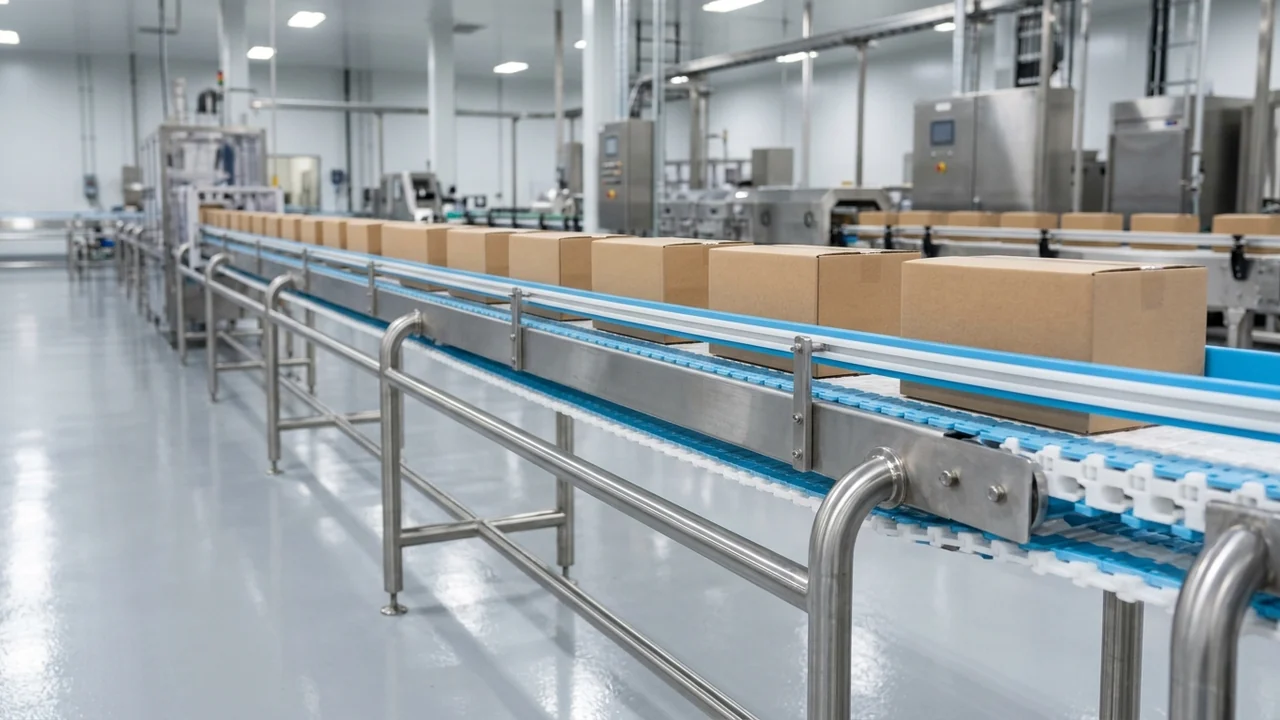
A modular belt conveyor carries packages on interlocking plastic modules joined by hinge rods into a continuous surface and driven by sprocket engagement rather than fabric pulley tension. That construction tolerates curves, wet areas, and frequent washdown, open styles drain, and a damaged section can be replaced without replacing the entire belt. Designed catenary sag on the return supplies the small tension needed for sprocket engagement and accommodates length change. At every machine handoff, pitch, sprocket or nose geometry, and package support limit the transfer, and where a belt touches exposed food, the belt supplier rather than the conveyor builder alone should state which food-contact rules the material meets.
Within our packaging engineering guides, use these pre-purchase checks to align belt construction, sanitation rules, and guarding before a purchase request. Compare conveyor families across packaging conveyor systems, keep fabric belt tension and pulley alignment on the belt conveyor materials and tracking guide, review open-frame geometry and weld continuity in the sanitary conveyor washdown guide, and assign interface responsibility under packaging line integration.
What Is a Modular Belt Conveyor and How Does It Work?
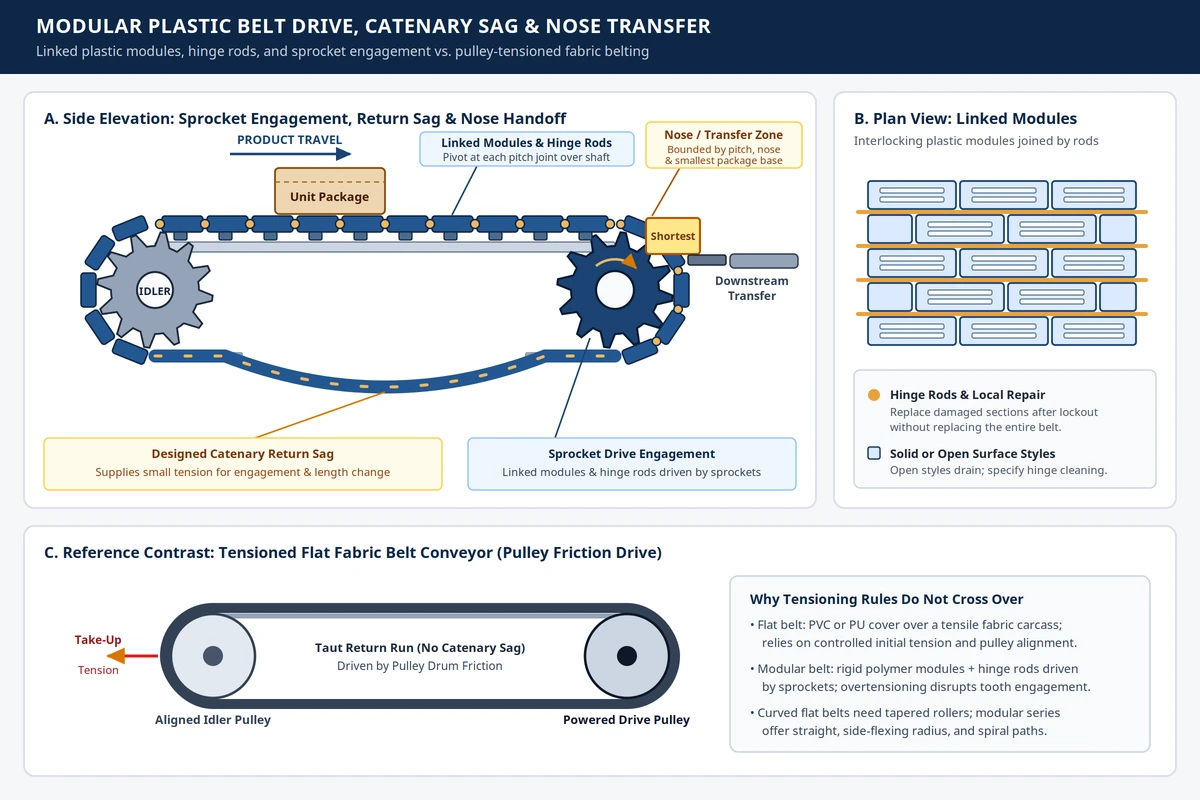
A plastic modular belt conveyor transports goods on interlocking plastic modules joined by hinge rods to form a continuous carrying surface across many widths and surface styles. Sprockets drive the linked modules and hinge rods, while designed catenary sag supplies the small tension needed for engagement and accommodates length change. Tightening a modular plastic belt like a fabric friction-drive belt changes that engagement and return behavior. By contrast, Wikipedia defines a belt conveyor system around two or more pulleys or drums with a closed loop of carrying medium rotating between a powered drive pulley and an unpowered idler pulley. In conveyor specifications, PVC and polyurethane describe cover materials, whereas modular describes the linked-module belt construction itself, with Wikipedia dating a first registered patent for all-plastic modular belting to 1970.
Modular Belt Conveyor vs Flat Belt Conveyor: When Should You Switch?
A modular plastic belt tolerates curves, wet areas, and frequent washdown, drains through an open style, and allows a damaged section to be replaced without replacing the entire belt. A commercial conveyor article states that PVC and rubberized cloth belts lack a gear drive, leading to belt wobbling and skidding over time, whereas sprockets drive linked plastic modules. Corner routing also separates the two constructions, because curved flat-belt sections use tapered rollers and curved belting while modular plastic belts are available in straight-running, radius, and spiral designs. Keep controlled initial tension, aligned pulleys, and remaining take-up travel checks on our belt conveyor materials and tracking guide.
| Selection factor | Tensioned flat fabric belt | Modular plastic belt | Line decision impact |
|---|---|---|---|
| Belt construction | PVC or polyurethane cover materials | Interlocking plastic modules joined by hinge rods | Separates cover-material selection from linked-module construction |
| Drive and tensioning | Powered drive pulley and idler pulley with controlled initial tension | Sprocket engagement paired with designed catenary return sag | Tightening a modular belt like a fabric friction-drive belt changes that engagement and return behavior |
| Corner routing | Curved belting running over tapered rollers | Straight-running, radius, or spiral modular belt designs | Supports curved transport paths on interlocking plastic modules |
| Drainage and washdown | PVC or polyurethane cover material | Solid or open module styles where open styles drain | Pairs a solid or open surface with how the hinges and underside will be cleaned |
| Belt repair method | Replacing the entire belt is the contrast named for a damaged section | Damaged interlocking sections replaced after lockout | Replaces a damaged section without replacing the entire belt |
Modular Belt Conveyor vs Tabletop Chain and Roller Conveyors
On packaging lines, many facilities use tabletop chain for single-file container flow through a filler and a modular belt conveyor for wider mass flow and accumulation downstream. Tabletop chain conveyors use a chain of hinged plates as a flat running surface rather than interlocking plastic modules joined by rods. Canadian Centre for Occupational Safety and Health conveyor safety guidance groups belts alongside live rollers, slats, and buckets among powered conveyors. A commercial design article contrasts roller conveyors with plastic modular belts by stating that plastic modular belts incorporate transmission and conveying into a single plane, eliminating the need for chains, bearings, and additional heavy components, and that statement is the article’s contrast with roller conveyors, while a modular belt conveyor still uses sprockets and hinge rods. When label scanning or machine infeed orientation requires a decision among a curve, a transfer, a turner, and an upender, check our case conveyors page, because the wrong case-turn method can hide a label from the scanner or fail the next machine’s infeed, and keep air conveyors on the packaging conveyor systems hub because ASME B20.1-2024 specifically excludes any conveyor designed, installed, or used primarily for the movement of people and does not apply to pneumatic conveyors.
How Do Pitch, Nose Geometry, and Resins Shape Conveyor Design?
Modular belt conveyor design brings together pitch, sprocket or nose geometry, and whether the surface is solid or open with how the hinges and underside will be cleaned. Pitch, sprocket or nose geometry, and package support limit each modular belt transfer across connected machines. Engineers should specify whether the modular belt surface is solid or open and how the hinges and underside will be cleaned, pairing belt selection with the open-frame geometry, weld continuity, tool-less disassembly, and bearing protection covered in our sanitary conveyor washdown guide.
Where a belt touches exposed food, 21 CFR 117.40 says all plant equipment and utensils used in manufacturing, processing, packing, or holding food must be adequately cleanable and must be adequately maintained to protect against allergen cross-contact and contamination, food-contact surfaces must be corrosion-resistant when in contact with food, food-contact surfaces must be made of nontoxic materials and designed to withstand the environment of their intended use and the action of food and, if applicable, cleaning compounds, sanitizing agents, and cleaning procedures, seams on food-contact surfaces must be smoothly bonded or maintained so as to minimize accumulation of food particles, dirt, and organic matter, and holding, conveying, and manufacturing systems, including gravimetric, pneumatic, closed, and automated systems, must be of a design and construction that enables them to be maintained in an appropriate clean and sanitary condition. Commercial modular belts are made from plastics such as polypropylene, polyethylene, and acetal, yet where a belt touches exposed food, the belt supplier rather than the conveyor builder alone should state which food-contact rules the material meets. Under federal polymer regulations, 21 CFR 177.1520 says the olefin polymers listed in that section may be safely used as articles or components of articles intended for use in contact with food, subject to the provisions of that section, and in that section polypropylene consists of basic polymers manufactured by the catalytic polymerization of propylene and polyethylene consists of basic polymers manufactured by the catalytic polymerization of ethylene, whereas 21 CFR 177.2470 says the polyoxymethylene copolymer identified in that section may be safely used for food-contact use under prescribed conditions, including repeated use, a use temperature that shall not exceed 250 °F, and thorough cleansing of finished articles before their first use in contact with food. Repeated-use rubber articles such as food conveyor belts may be safely used under 21 CFR 177.2600 in producing, manufacturing, packing, processing, preparing, treating, packaging, transporting, or holding food, subject to the provisions of that section, and the 3-A resource paper 3-A Requirements for Rubber Materials names compliance with 21 CFR 177.2600 as a primary requisite of the 3-A standard. The 3-A resource paper Cleanability of Equipment states it is not accurate that all equipment meeting 3-A Sanitary Standards or Accepted Practices is suitable for clean-in-place cleaning, noting fabrication criteria to reduce cracks and crevices and to provide sufficiently large radii in internal angles, and that where product can seep into a crevice and cleaning solution cannot reach it, those areas have to be identified for disassembly for manual cleaning. For European hygienic guidance, EHEDG Doc. 43 (First Edition, April 2016) addresses belt conveyors where wet cleaning is mandatory while pointing dry applications to EHEDG document 22, and its October 2016 press note covers friction-driven and positively driven conveyors and fabric, modular, metal and wire, and round- and V-profile belts, quoting the working group that quite a few of those conveyor and component examples have shortfalls from a hygienic design viewpoint, while the same note says the main objectives of hygienic design for open processes are easy cleanability, protecting the product from contamination, and avoiding accumulation of soil, microorganisms, insects, and vermin.
How Are Modular Belt Conveyors Guarded, Locked Out, and Repaired?
Interlocking belt segments allow maintenance crews to replace damaged sections without replacing the entire belt, provided the conveyor is locked out before any stuck item is removed or servicing begins. ASME B20.1-2024 was approved by ANSI on August 7, 2024, this edition is a revision to ASME B20.1-2021, the date of issuance is September 10, 2024, and its provisions shall apply to equipment installed 1 yr after the date of issuance; its intent is to provide for safe operation and maintenance of conveying equipment; it applies to the design, construction, installation, maintenance, inspection, and operation of conveyors and conveying systems in relation to hazards, and those conveyors may be of the bulk material, package, or unit-handling types, where the installation is designed for permanent, temporary, or portable operation; it is a performance standard that describes the end result without a limiting design specification and without finite material selection or dimensions; many definitions were extracted from the latest revision of CEMA 102; and its reference list names 29 CFR 1910.147. Its preview defines accessible as applying to hazardous objects not guarded or isolated and likely to be contacted inadvertently. Under 29 CFR 1910.212, one or more methods of machine guarding shall be provided to protect the operator and other employees in the machine area from hazards such as those created by point of operation, ingoing nip points, and rotating parts, guards shall be affixed to the machine where possible and shall not offer an accident hazard in themselves, and machines designed for a fixed location shall be securely anchored to prevent walking or moving, although the machines which usually require point-of-operation guarding are named as guillotine cutters, shears, alligator shears, power presses, milling machines, power saws, jointers, portable power tools, and forming rolls and calenders, and that list does not name conveyors. On conveyors, in-running nip points occur where a belt meets a drive, tail, or snub pulley and where a chain meets a sprocket, while CCOHS guidance says to keep guards in place for all moving parts of the drive system and in all zones where hazards such as in-running nip are present, including above, at the sides, and below the conveyor, to guard all pinch points between the conveyor system and fixed objects, not to alter or remove guards or safety devices, and to locate emergency stop cut-off switches near the operator and along the length of the conveyor at approximately 30 metres (100 feet) apart or closer.
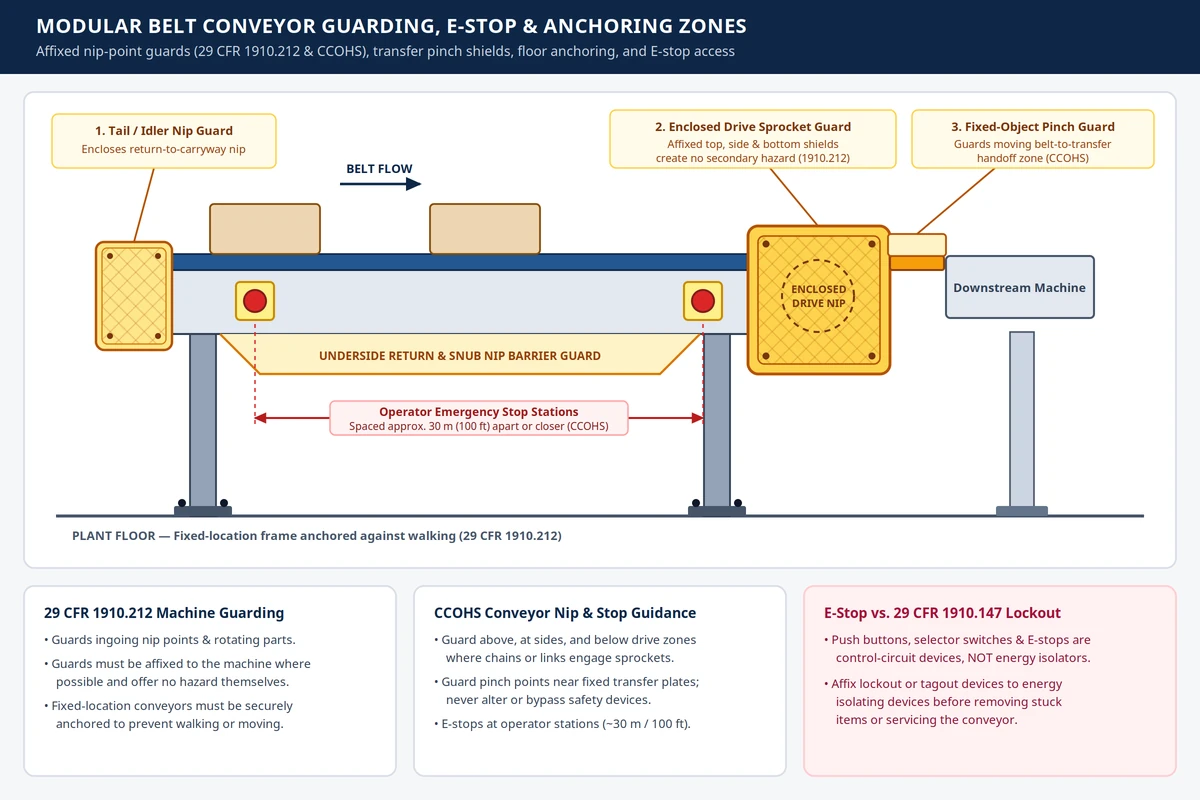
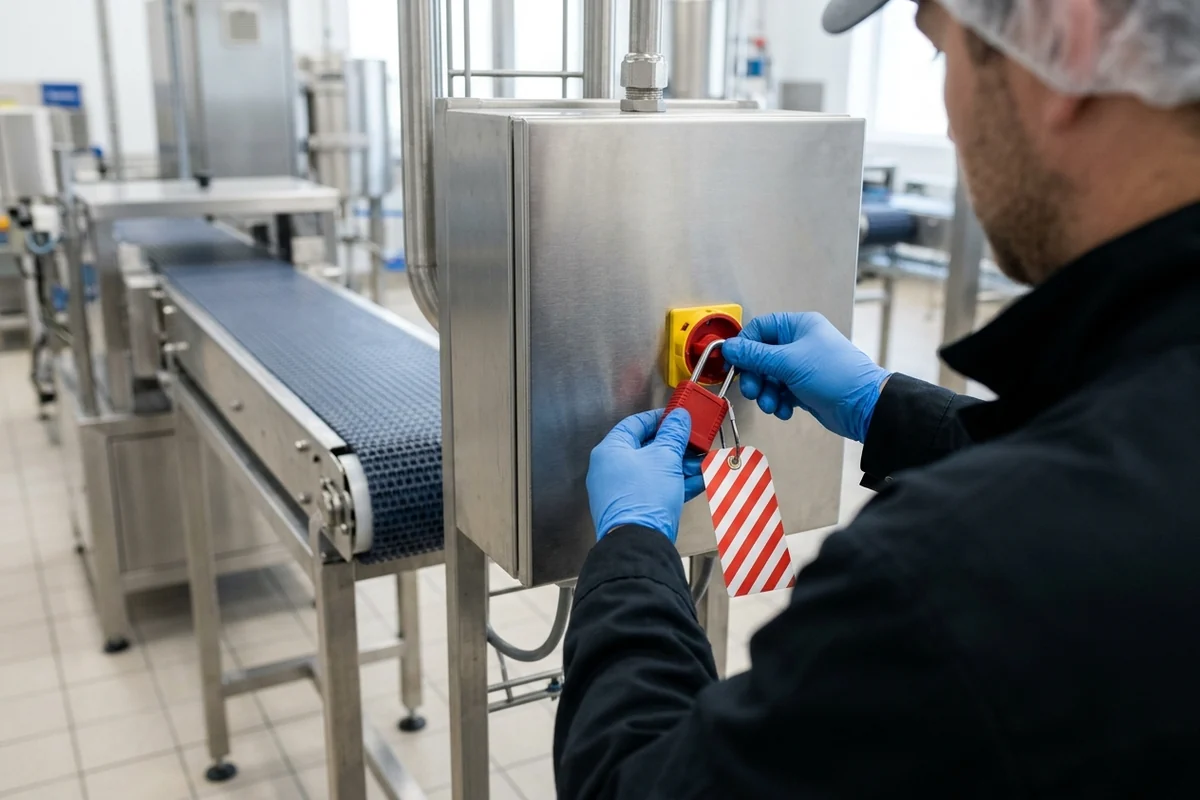
CCOHS guidance says not to remove stuck items or debris until the conveyor is locked out and not to service the conveyor without lock-out procedures, while 29 CFR 1910.147 applies to the control of energy during servicing and maintenance where the unexpected energization or start up of the machines or equipment, or release of stored energy, could cause injury, and requires employers to establish a program and use procedures for affixing lockout or tagout devices to energy isolating devices. Under 29 CFR 1910.147, push buttons, selector switches, and other control circuit type devices are not energy isolating devices, and the same section requires employers to establish a program and utilize procedures for affixing lockout or tagout devices to energy isolating devices.
What Checklist Should You Send Modular Belt Conveyor Manufacturers?
Because ASME B20.1-2024 describes the end result without finite dimensions, pre-purchase evaluation asks each supplier, before you commit, for the pitch, whether the surface is solid or open, the straight-running, radius, or spiral design, and the sprocket or nose geometry and package support that limit the transfer. Assign mechanical, controls, safety, and acceptance responsibility between connected machines through packaging line integration before issuing purchase requests. Send the checklist below to the conveyor builder and the belt supplier so the request covers package handling, cleaning, and lockout scope.
| Checklist item | What to request from the supplier | Line verification check |
|---|---|---|
| Series pitch | Belt series designation, module pitch, hinge-rod specification, and straight-running, radius, or spiral path | Confirm sprocket engagement and designed catenary return sag on the layout |
| Open area and cleaning | Solid versus open surface style, series open-area specification, and hinge and underside cleaning method | Identify crevices where product can seep and cleaning solution cannot reach them, then disassemble those areas for manual cleaning |
| Turn radius and path | Series curve limits for straight-running, radius, or spiral configurations | Check whether the layout only curves the route or needs leading-face or resting-face changes on case conveyors |
| Smallest package vs transfer | Pitch and sprocket or nose geometry matched to the smallest package base support | Verify smallest-package support across each transfer handoff |
| Food-contact declaration | A belt-supplier statement of which food-contact rule the material meets among 21 CFR 177.1520, 21 CFR 177.2470, and 21 CFR 177.2600 | Food-contact surfaces must withstand the action of food and, if applicable, cleaning compounds and sanitizing agents under 21 CFR 117.40, and finished polyoxymethylene copolymer articles are thoroughly cleansed before their first use in contact with food |
| Nip and transfer guarding | Guard coverage above, at the sides, and below drive and nip zones, plus pinch-point guards between the conveyor and fixed objects | Confirm that machines designed for a fixed location are securely anchored to prevent walking or moving under 29 CFR 1910.212, and that CCOHS emergency stop cut-off switches sit near the operator and along the conveyor at approximately 30 metres (100 feet) apart or closer |
| Lockout before module change | Energy-isolating device locations and lockout procedure before segment replacement | Confirm 29 CFR 1910.147 lockout or tagout on energy isolating devices rather than push buttons or selector switches |
Sources
- Occupational Safety and Health Administration, 29 CFR 1910.212 General Requirements for All Machines and 29 CFR 1910.147 The Control of Hazardous Energy.
- Canadian Centre for Occupational Safety and Health, Conveyor Safety OSH Answers.
- Electronic Code of Federal Regulations, 21 CFR 117.40 Equipment and Utensils, 21 CFR 177.1520 Olefin Polymers, 21 CFR 177.2470 Polyoxymethylene Copolymer, and 21 CFR 177.2600 Rubber Articles Intended for Repeated Use, with text mirror at Cornell LII 21 CFR 117.40.
- Wikipedia, Conveyor belt.
- American Society of Mechanical Engineers, ASME B20.1-2024 Safety Standard for Conveyors and Related Equipment public preview, and Conveyor Equipment Manufacturers Association, CEMA 102 Conveyor Terms and Definitions.
- 3-A Sanitary Standards resource papers, 3-A Requirements for Rubber Materials and Cleanability of Equipment, plus European Hygienic Engineering and Design Group, EHEDG Doc. 43 (First Edition, April 2016, and October 2016 press note) and EHEDG guideline document 22.