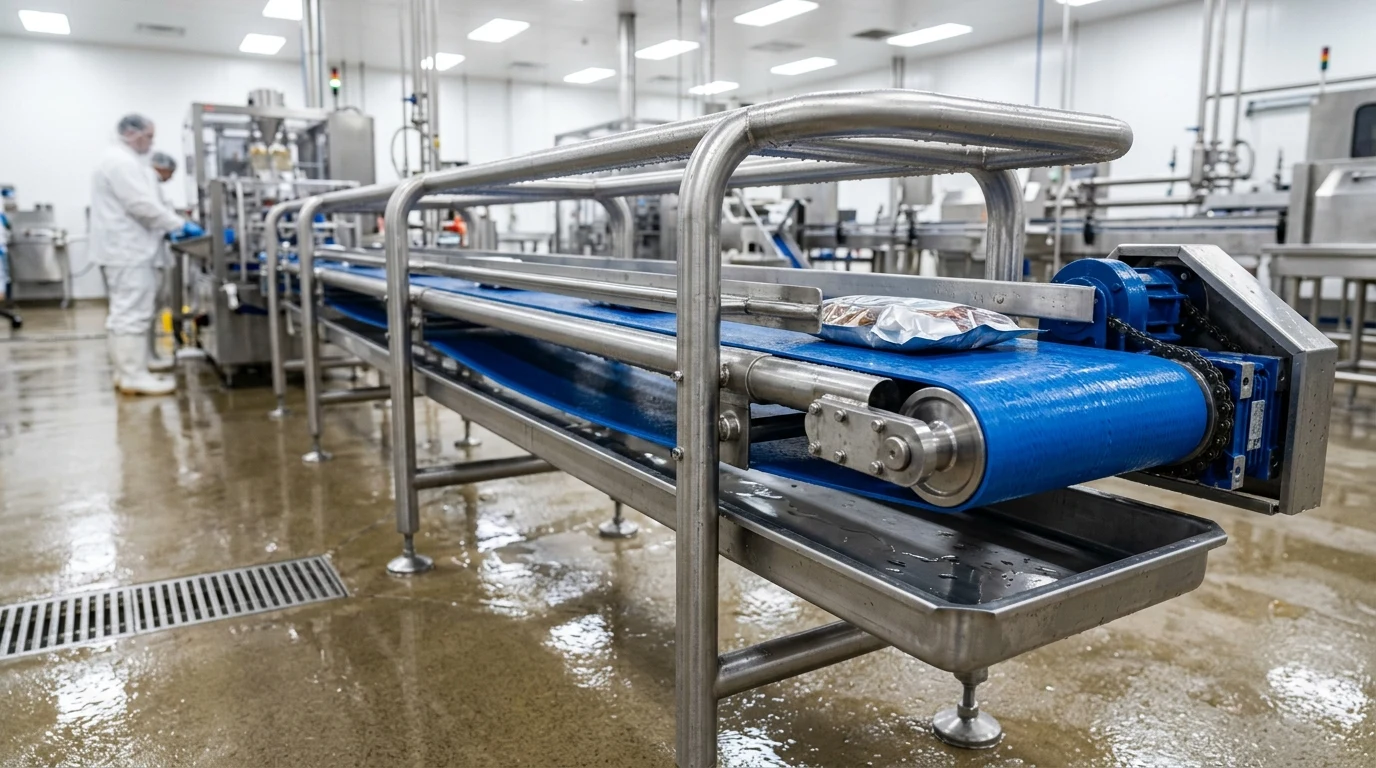
Specifying a sanitary conveyor for a wet food processing room or a primary packaging line requires evaluating how water, cleaning chemicals, and product residue interact with every joint on the machine. Buyers searching for a washdown sanitary conveyor, an open frame stainless steel conveyor, or a hygienic food packaging conveyor encounter industrial frames built from stainless sheet metal that still leave food particles in crevices of bolted plate-on-plate frame sections, and retain fastener harbor points in the food zone.
Before comparing supplier proposals, separate your line into distinct sanitation zones and screen each conveyor across structural geometry, regulatory cleanability, hygienic construction tier, tool-less disassembly mechanics, belting material, and support stand spacing. For broader transport equipment architecture, review our overview of packaging conveyor systems and explore the full collection of packaging engineering guides to align conveyor selection with downstream food packaging automation.
| Screening boundary | What to inspect on candidate equipment | Decision it governs on the packaging line |
|---|---|---|
| Regulatory cleanability and access | Food-contact material smoothness, seam bonding, lubricant containment, and visual inspection access | Whether the conveyor frame satisfies food safety and plant inspection rules |
| Frame geometry and weld style | Rounded cross-members, open drop-through bed, continuous welds versus stitch welds, and absence of hollow tubing | Whether high-pressure washdown sheds water or traps biofilm in capillary crevices |
| Hygienic tier and enclosure class | Dry mild steel, bolted stainless washdown, open-frame continuous-weld sanitary tiers, and motor enclosure build | Matching equipment construction and capital cost to packaged versus unpackaged food zones |
| Disassembly and tensioning mechanics | Tool-less belt lifters, tip-up pulley tails, pull-pin wearstrips, and threadless or pneumatic belt tensioners | Daily sanitation turnaround time and operator reassembly accuracy |
| Belting and transfer geometry | Wet fabric belt grades, solid urethane positive-drive lugs, modular curve openings, and small-package nose transfers | Preventing fabric edge fray, bacterial wicking, drive slip, and transfer jams |
| Support spans and bearing care | Drive-end, intermediate, and idler-end support spacing, frame-joint brackets, and bearing lubrication rules | Preventing frame sag, floor walking, and premature bearing failure under frequent washing |
Establish the regulatory baseline for hygienic food packaging conveyors
Every hygienic food packaging conveyor and upstream processing line operates under federal sanitation, inspection accessibility, and machine guarding rules. Rather than treating food-grade suitability as a generic brochure label, engineering teams should map each regulatory requirement directly to mechanical conveyor features on their specification sheet:
- Under 21 CFR § 117.40, all plant equipment and utensils used in manufacturing, processing, packing, or holding food must be designed and of such material and workmanship as to be adequately cleanable, and maintained to protect against allergen cross-contact and contamination.
- Under 21 CFR § 117.40, equipment and utensils must be designed, constructed, and used appropriately to avoid the adulteration of food with lubricants, fuel, metal fragments, contaminated water, or any other contaminants.
- Under 21 CFR § 117.40, equipment must be installed so as to facilitate the cleaning and maintenance of the equipment and of adjacent spaces.
- Under 21 CFR § 117.40, food-contact surfaces must be corrosion-resistant when in contact with food.
- Under 21 CFR § 117.40, food-contact surfaces must be made of nontoxic materials and designed to withstand the environment of their intended use and the action of food, and, if applicable, cleaning compounds, sanitizing agents, and cleaning procedures.
- Under 21 CFR § 117.40, seams on food-contact surfaces must be smoothly bonded or maintained so as to minimize accumulation of food particles, dirt, and organic matter and thus minimize the opportunity for growth of microorganisms and allergen cross-contact.
- Under 21 CFR § 117.40, equipment in food manufacturing, processing, packing, or holding areas that does not come into contact with food must be so constructed that it can be kept in a clean and sanitary condition.
- Under 21 CFR § 117.40, holding, conveying, and manufacturing systems, including gravimetric, pneumatic, closed, and automated systems, must be of a design and construction that enables them to be maintained in an appropriate clean and sanitary condition.
- Under 21 CFR § 117.40, compressed air or other gases mechanically introduced into food or used to clean food-contact surfaces or equipment must be treated in such a way that food is not contaminated with unlawful indirect food additives.
When a conveyor handles meat, poultry, or egg products—or operates inside a facility subject to federal meat and poultry inspection—additional sanitation provisions govern material selection and physical inspection access:
- Under 9 CFR § 416.3, equipment and utensils used for processing or handling edible product or ingredients must be of such material and construction to facilitate thorough cleaning and ensure that their use will not cause the adulteration of product.
- Under 9 CFR § 416.3, equipment and utensils must not be constructed, located, or operated in a manner that prevents FSIS inspection program employees from inspecting the equipment or utensils to determine whether they are in sanitary condition.
Alongside hygienic cleanability, workplace machine safety rules govern nip-point protection around drive pulleys, return rollers, and floor mounting:
- Under 29 CFR § 1910.212, machine guarding shall be provided to protect the operator and other employees in the machine area from hazards such as those created by point of operation, ingoing nip points, rotating parts, flying chips and sparks.
- Under 29 CFR § 1910.212, machines designed for a fixed location shall be securely anchored to prevent walking or moving.
Record both the sanitation access provisions and the physical guarding and anchoring checks in your packaging line layout so aisles around the conveyor allow unimpeded washdown and inspection.
Compare open frame stainless steel conveyor design against conventional stainless frames
A common procurement mistake is assuming that fabricating an industrial slider-bed conveyor out of stainless steel sheet creates a sanitary conveyor. Bolted plate-on-plate frame sections that do not allow the user to take them apart for cleaning leave food particles collecting in the crevices.
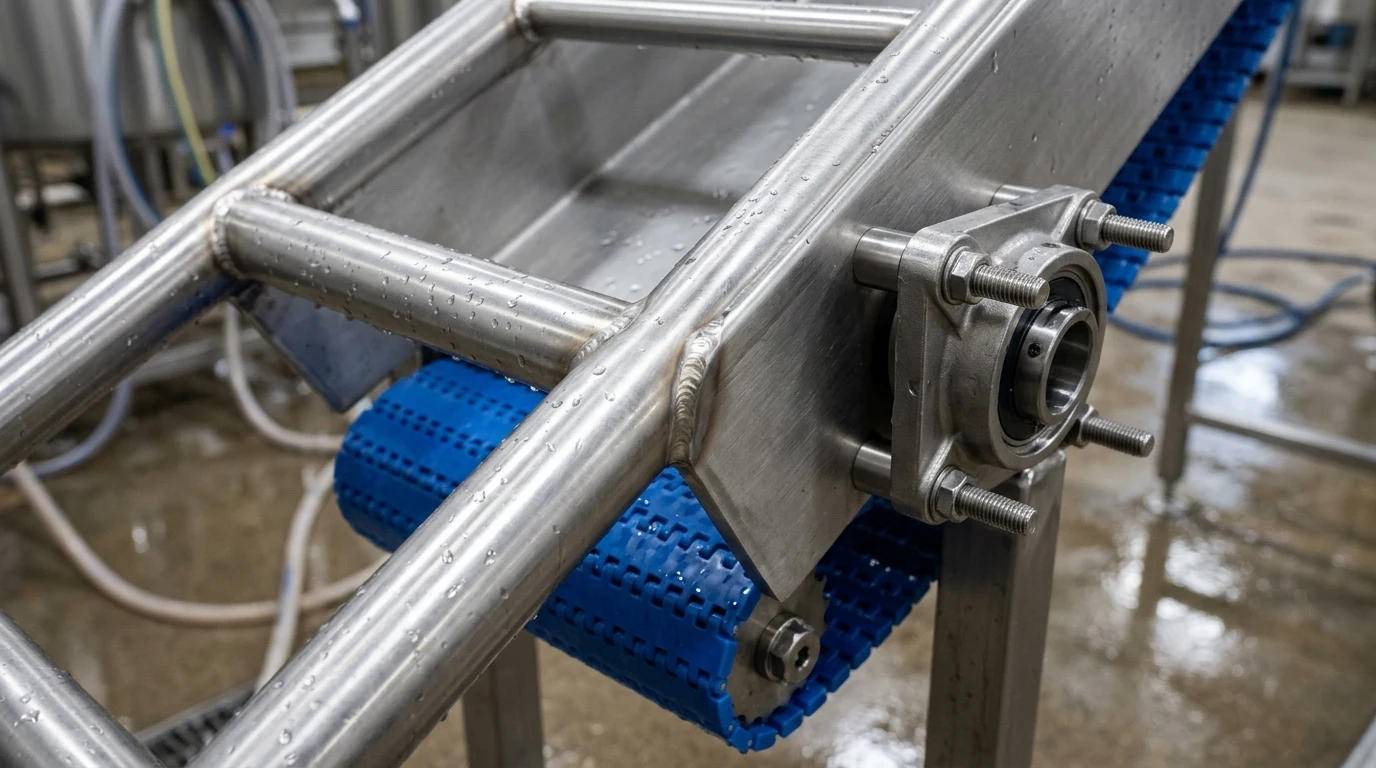
An open frame stainless steel conveyor eliminates those hidden reservoirs by restructuring the frame cross-section, weld joints, wearstrips, and fastener strategy. Compare these published engineering design principles across manufacturer documentation:
- A sanitary conveyor removes harbor points, blind spots, and flat level surfaces within the frame structure, replacing them with rounded cross members preventing food and water from accumulating.
- The overall openness of a sanitary conveyor frame is designed so that any product that falls off the belt will land either in a catch pan below or on the floor, so nothing gets trapped within the frame.
- Sanitary conveyors remove plate-on-plate frame manufacturing where frame sections bolted together with fasteners do not allow the user to take them apart for cleaning.
- In sanitary conveyors, fasteners—which are harbor points for contamination—are removed from the conveyor’s food zone and replaced with welds where necessary.
- Downstream conveyors moving sealed and packaged food often accumulate corrugated dust from cardboard packaging, which can be cleaned by washing or simply wiping down the conveyor.
- Nercon HydroCore hygienic clean-in-place (CIP) and sanitary clean-out-of-place (COP) equipment eliminates tubular components to reduce bacterial harborage points.
- Nercon HydroCore conveyors use no fasteners and tool-less disassembly to cut time and complication out of sanitation, and removable parts have unique identifiers for fast, easy, and accurate reassembly.
- Nercon HydroCore conveyors provide single-side access for easy maintenance and a guide rails and wear strips design that eliminates fasteners for less contamination.
- VBS Systems Food-Grade Sanitary Conveyors under-bend side channels to less than 90 degrees so less water accumulates on the conveyor after washdown, and use modular 10-ft sections to accommodate 20-70-ft (or 40-ft and longer) conveyors.
- Multi-Conveyor sanitary washdown conveyors include removable NTR (no tool required) components for cleaning, gasketed areas to keep contaminants from getting behind wear strips, critical radius welds and radius bushings, tool-less removable CIP components, USDA-approved urethane belts for tight transfers, and plastic washers behind all fasteners.
- QC Conveyors HydroClean Series HC200 sanitary conveyors require no tools for disassembly and can be completely disassembled or re-assembled in a few minutes for daily washdown in an SQF-certified ice bagging plant handling 7 lb, 22 lb, and 50 lb bags.
| Structural feature | Conventional industrial stainless conveyor | Open-frame washdown sanitary conveyor | Sanitation impact during washdown |
|---|---|---|---|
| Frame cross-members | Flat level surfaces | Rounded cross-members | Prevents food and water from accumulating |
| Frame section joints | Bolted plate-on-plate sandwich joints with internal crevices | Continuous welds or standoff-spaced joints with radiused corners | Eliminates capillary gaps where moisture and biofilm accumulate |
| Food-zone hardware | Threaded bolts, nuts, and lock washers exposed in the product path | Welded internal structure with tool-less pull-pin wearstrips and guides | Removes exposed threads from the food path and speeds part removal |
| Fallen product path | Enclosed slider pan or return tray that traps spilled product | Open drop-through frame over a removable catch pan or plant floor drain | Prevents product buildup between the carrying run and return belt |
| Removable COP parts | — | Tool-less removable guide rails and wearstrips | Rapid COP washing; accurate reassembly when parts are uniquely identified (Nercon HydroCore) |
When your line transitions from wet primary processing into dry secondary case handling, compare these open-frame features with conventional case conveyors and bottle conveyors so each zone uses the appropriate frame architecture.
Match washdown sanitary conveyor tiers to plant cleaning regimes and budgets
Not every packaging station requires the same level of hygienic fabrication. Over-specifying a full direct-food-contact frame for dry secondary cartons inflates capital cost, while Nercon Sanitary Level I is not suitable for unpackaged ready-to-eat products.
To structure your specification and align with your packaging conveyor cost worksheet, review how conveyor manufacturers divide dry, washdown, and sanitary construction into progressive tiers.
Nercon hygienic levels and relative cost step-ups
Review the published Nercon hygienic framework and cost comparisons when separating dry packaging, low-pressure caustic washdown, and high-pressure CIP/COP zones:
- Nercon Dry Level I uses 12 GA mild steel powder-coated bolted construction with stitch welds, optional bolted stand-offs, 2” x 2” formed angle support, painted IP55 reducers, and NEMA 12 mild steel enclosures.
- Nercon Dry Level II and Wash-Down tiers use 12 GA stainless steel polished #4 with bolted construction, stitch welds, optional bolted stand-offs, and 2” x 2” formed angle support.
- Nercon Wash-Down tier is for moderate to high moisture with low-pressure spray wash where caustics are OK, using polymer-body bearings with stainless steel inserts, washdown painted motors and reducers, and NEMA 4X stainless steel enclosures.
- Nercon Sanitary Level I is for high-pressure spray wash and CIP and COP procedures, featuring 12 GA stainless steel polished #4, open-frame design, bolted construction, continuous welds, standard bolted stand-offs, removable UHMW guide rails and wearstrips, and 2” x 3” sanitary channel support.
- Nercon Sanitary Level I conveyors are designed for sensitive packaged ready-to-eat (RTE) foods, are not suitable for unpackaged RTE, and carry approximately a 25% increased cost compared to the washdown level.
- Nercon Sanitary Level II upgrades from Sanitary Level I to welded construction with standard welded stand-offs, stainless steel motors, stainless steel reducers, and NEMA 4X stainless steel enclosures.
- Nercon Sanitary Level 2 removes all bolted internal components and upgrades to welded construction for raw or open food products, adding 12% to 15% to the cost over the Sanitary Level I design.
- Nercon Sanitary Level III uses 12 GA stainless steel with a 2B finish, open-frame design, welded construction, continuous welds, and welded stand-offs.
For an additional perspective on weld progression across food-grade styles, compare the VBS Systems classification:
- VBS Systems classifies sanitary conveyor construction into 5 styles: Style 3 uses stitch weld on one side with washdown stainless steel bearings and epoxy-painted NEMA-4X motor and gearbox; Style 4 uses continuous weld on one side; and Style 5 (direct food contact) uses continuous weld inside and outside with ground and polished exterior welds.
Dorner AquaGard and AquaPruf sanitary series specifications
When comparing roll-formed, open-frame wipe-down, high-pressure chlorinated washdown, and dairy or meat inspection tiers, record the published Dorner series specifications separately by model family:
- Standard Dorner sanitary conveyors are BISSC and USDA certified, use FDA-approved materials and components, and ship in as little as 10 business days.
- Dorner AquaGard 7100 flexible and cleated flexible chain conveyors use a 300 Series stainless steel bolt-together frame and support loads up to 318 kg (700 lbs).
- Dorner AquaGard 7100 conveyors have widths from 114 mm (4.5 in) to 305 mm (12 in) and lengths up to 30,480 mm (100 ft).
- Dorner AquaGard 7200 and 7300 conveyors use an 11 gauge 304 stainless steel roll-formed single-piece frame polished to a #4 finish and provide a quick five-minute belt change.
- Dorner AquaGard 7200 and 7300 conveyors support loads up to 27 kg (60 lbs), widths from 44 mm (1.75 in) to 457 mm (18 in), and lengths from 610 mm (2 ft) to 5,486 mm (18 ft).
- In Dorner’s Sanitary Conveyors brochure, AquaGard 7350 conveyors feature a TIG-welded 304 stainless steel open-design frame with minimal horizontal surfaces, rated for wipe down and occasional pressurized liquid spray cleaning up to 100 psi.
- In Dorner’s Sanitary Conveyors brochure, AquaGard 7350 conveyors support loads up to 341 kg (750 lbs), widths from 102 mm (4 in) to 914 mm (36 in), and lengths from 914 mm (3 ft) to 25,298 mm (83 ft).
- Dorner’s 7350 Series is backed by a 10-year warranty, an ISO Quality Management System, and BISSC certification.
- In Dorner’s Sanitary Conveyors brochure, AquaPruf 7400 and 7600 conveyors use a continuous TIG-welded 304 stainless steel frame with #4 polish on outside surfaces and no horizontal surfaces, designed to withstand high-pressure (100-1,500 psi) spray and chlorinated solutions.
- In Dorner’s Sanitary Conveyors brochure, AquaPruf 7400 and 7600 conveyors support loads up to 98 kg/m2 (20 lbs/square foot) of belt, widths from 152 mm (6 in) to 1,524 mm (60 in), and lengths from 914 mm (36 in) to 25,375 mm (999 in).
- Dorner AquaPruf 7400 and 7600 Ultimate conveyors feature USDA-approved belting and plastic components, meet USDA, NSF, and AMI design specifications, and are USDA red meat and poultry accepted equipment.
- Dorner AquaPruf Ultimate conveyors are 3-A Certified, polish all surfaces on internal frame components to 32 microinch (except belted product), and locate all bearings external to the conveyor and a minimum of 25 mm away from the food zone.
- On Dorner AquaPruf Ultimate conveyors, all support stands use sanitary threadless feet designs and radii on all internal components meet the 6 mm (0.25”) standard requirement.
- Dorner AquaPruf VBT (Vertical Belt Technology) conveyors handle bulk product with widths from 305 mm (12 in) to 610 mm (24 in), heights up to 6,096 mm (240 in), and a continuous TIG-welded 304 stainless steel open-frame design with #4 polish.
Keep each washdown pressure figure, surface polish value, bearing offset, and internal radius tied strictly to the exact conveyor series in your procurement documents.
Verify tool-less belt lift, tip-up tails, tensioning, and bearing protection
A washdown sanitary conveyor only achieves its sanitation potential if crews can open the belt loop, expose the slider bed and return rollers, and clean both sides of the belt without wrenches. In daily operations, tool-less belt lifters, tip-up pulley tails, threadless cam tensioners, and pull-pin guide rails govern how quickly the line turns over between production shifts.
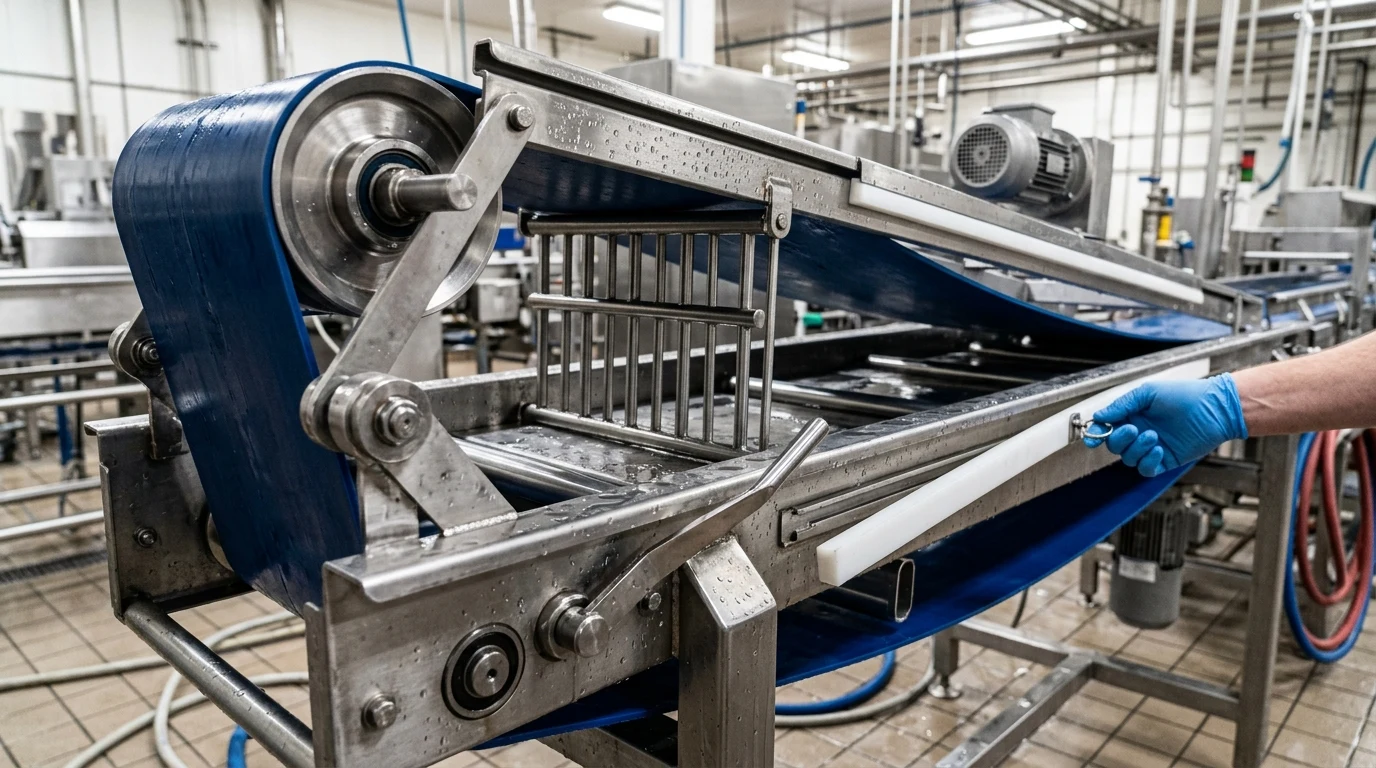
Review these published disassembly, tensioning, return hardware, and bearing maintenance specifications across the Dorner manuals and product specifications:
- On Dorner’s AquaPruf product page, the conveyor provides tool-less disassembly with cleaning prep in under a minute and complete disassembly in less than 3 minutes, spiral cam belt tensioning with thread-less design, and a gearless, oil-free iDrive2 sanitary motorized roller.
- On Dorner 7400 Series End Drive conveyors, belt sag measured from the top of the returns should not exceed 4” (102 mm), and mounting block bolts are tightened to 20 in-lb (2 Nm).
- For daily routine cleaning of the inside and outside of Dorner 7400 Series End Drive conveyors, operators remove guide pull pins, use the lifter handle to raise the lifters and raise the tip-up tail, lock out power, and must not submerge or soak bearing assemblies.
- On Dorner 7400 Series End Drive conveyors, although bearings are sealed, re-greasing via the zerk fitting on the exterior of the bearing shaft assembly with an H-1 food grade grease is recommended to increase bearing life, and re-greasing frequency increases with conveyor washing frequency.
- On Dorner 7350 Series Version 2 Belted conveyors, no bearing lubrication is required and bearings are replaced if worn.
- On Dorner 7350 Series Version 2 Belted conveyors, flat belt returns 508 mm wide and wider use a shaft, retaining plate, spacer, and puck, whereas cleated belt and flat belt returns under 508 mm wide use a spacer, puck, and stub shaft.
- On Dorner 7350 Series Version 2 Center Drive conveyors with pneumatic tensioning, suggested maximum tensioning air pressure is 15-30 psi (103-207 kPa) for 6” (152 mm) width, 15-40 psi (103-276 kPa) for 8” (203 mm), and 15-50 psi (103-345 kPa) for 10” (254 mm).
- On Dorner 7350 Series Version 2 Center Drive conveyors with pneumatic tensioning, suggested maximum tensioning air pressure is 15-60 psi (103-414 kPa) for 14” (356 mm) width, 15-70 psi (103-483 kPa) for 18” (457 mm), and 15-80 psi (103-552 kPa) for 24” (610 mm) and wider.
- On Dorner 7350 Series Version 2 Center Drive conveyors with manual tensioning, the tension knob is turned clockwise until the spring is behind the spring cover with approximately a 1/8” gap, and retightened when the spring is exposed over 1/2” or if belt slippage occurs; if tension cannot be achieved before the out-of-tension indicator turns red, the belt must be replaced.
| Sanitation or maintenance task | Mechanical feature to verify | Operational guardrail for plant crews |
|---|---|---|
| Electrical and pneumatic isolation | Lockout disconnect switch and air dump valve | Lock out power before touching belt lifters, tail plates, or pull pins |
| Tension release and tail access | Threadless spiral cam tensioner, manual spring knob, or pneumatic cylinder | Release tension and raise the tip-up tail assembly before lifting the belt |
| Guide rail and wearstrip removal | Tool-less pull pins and uniquely identified UHMW wearstrips | Pull out guide pins and place wearstrips on a dedicated clean-out-of-place rack |
| Inside-belt washdown prep | External lifter handle linked to internal stainless lift bars | Rotate the lifter handle so the belt loop clears the frame bed and return pucks |
| Bearing washdown protection | Sealed external bearing housings or greaseless polymer bearings | Never submerge or soak bearing assemblies; follow the manual re-greasing or replacement rule |
For broader belt tracking and take-up alignment fundamentals across dry and wet packaging lines, see our belt conveyor materials, tensioning, and tracking guide.
Select belting, positive-drive sprockets, modular curves, and tight transfers
Even a continuously welded open frame can fail sanitation or line-rate requirements if paired with an unsealed fabric belt that wicks water or a curve chain with wide pinch openings. Match belt construction, drive engagement, curve geometry, and transfer nose size to the product and cleaning method:
- On Dorner’s AquaGard 7350 product page, optional powered transfer allows end transfer of product as small as 75 mm (3 in) long, and specifications list loads up to 341 kg (750 lbs), widths from 152 mm (6 in) to 914 mm (36 in), and lengths from 914 mm (3 ft) to 25000 mm (82 ft).
- Dorner AquaGard 7350 conveyors feature V-guided belt tracking on belted models, a positive-drive belt with drive sprockets, tip-up tails, and chain openings less than 4 mm even on curves with capacity for up to 4 curves on a single conveyor.
- In Dorner’s 7350 Series refresher, the sideflexing modular curve belt makes multiple turns at a 1.6x radius, has no large edge openings compared to 7-1/2” and 12” tabletop chain, and meets the international standard for maximum 4 mm openings.
- On Dorner’s AquaPruf product page, specifications list capability for 3 curves on one gearmotor, loads up to 98 kg per square meter (20 lbs per square foot), speeds up to 100 mpm (328 fpm), widths from 152 mm (6 in) to 1,524 mm (60 in), and lengths from 914 mm (36 in) to 25,375 mm (999 in).
- On Dorner AquaPruf fabric-belt conveyors, wet applications are limited to specialty belt types 54, 55, 69, and 70 only, while positive-drive belting uses solid urethane material with drive lugs on 25 mm (1 in) spacing in blue or white.
- For Dorner 7400 Series End Drive conveyors, belt width is 6” (152 mm) to 60” (1524 mm) in 2” (51 mm) increments, and straight conveyor length is 36” (914 mm) to 999” (25.4 m) in 1” (25 mm) increments.
- For Dorner 7400 Series End Drive LPZ conveyors, LPZ section length is 24” (610 mm) to 252” (6401 mm) in 1” (25 mm) increments, and total LPZ conveyor length (L1 + L2 + L3) is maximum 38’ (11.6 m).
- For Dorner 7400 Series End Drive conveyors, maximum conveyor load is 20 lb/ft2 (97 kg/m2) with a maximum of 1000 lb/ft2 (4882 kg/m2), belt travel is 12” (305 mm) per revolution of pulley, maximum belt speed is 233 ft/minute (71 m/minute), and belt take-up is 2” (51 mm); maximum loads are based on non-accumulating product, product moving toward the gearmotor, horizontal mounting, a dry environment, and a standard belt.
- For Dorner 7350 Series Version 2 Belted conveyors, belt widths range from 152 mm (6”) to 914 mm (36”), and conveyor length is 915 mm (36”) to 12190 mm (480”) in 5 mm (.20”) increments.
- For Dorner 7350 Series Version 2 Belted conveyors, maximum conveyor load is 97 kg/m2 (20 lbs./ft2) with a maximum of 227 kg (500 lbs.), belt travel is 229 mm (9”) per revolution of pulley, and maximum belt speed is 91 m/minute (300 ft/minute); maximum loads are based on non-accumulating product, product moving toward the gearmotor, horizontal mounting, a dry environment, and a standard belt.
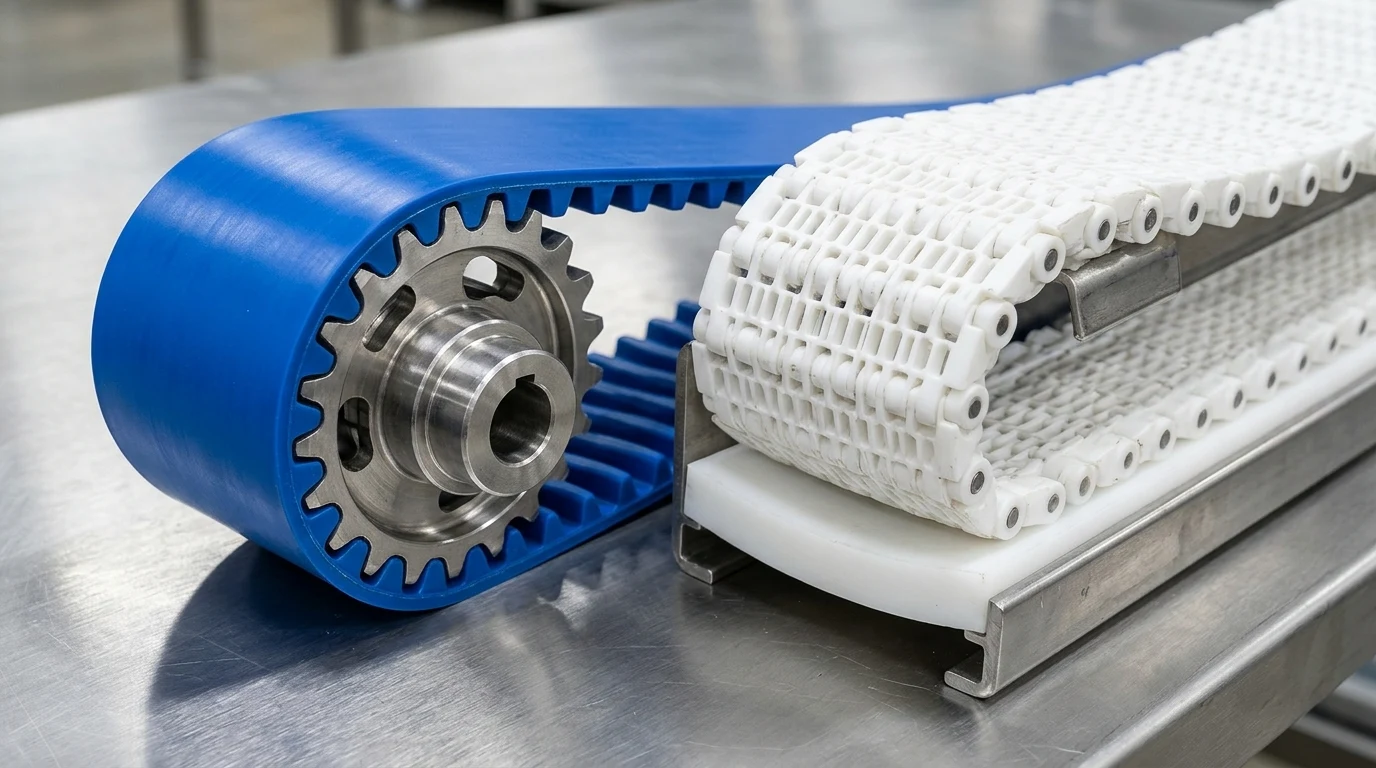
When routing packages around floor columns or linking upstream fillers to downstream accumulation conveyors, multi-curve modular belts consolidate drives by running multiple turns on a single gearmotor while keeping chain openings tight for operator safety and small-package stability.
Plan support stand spans, frame joints, and commissioning acceptance checks
Long sanitary conveyor runs are shipped in modular frame sections that must be supported at the ends, across intermediate spans, and directly under frame joints.
Verify these published support stand distances and frame connecting plate torque specifications during floor layout planning and installation:
- For Dorner 7400 Series End Drive conveyors, maximum support stand distances are 3 ft (914 mm) at the ends and 8 ft (2438 mm) between supports, and conveyors longer than 10 ft (3.05 m) require a support installed at the frame joint.
- For Dorner 7350 Series Version 2 Belted conveyors, maximum support stand distances are 610 mm (24”) on the drive end, 2438 mm (8 ft) between support stands, and 762 mm (30”) on the idler end, with a stand mount kit installed at the frame joint for conveyors longer than 3048 mm (10 ft).
- On Dorner 7350 Series Version 2 Belted conveyors longer than 10 ft (3048 mm), connecting plates are installed with four screws on both sides tightened to 14-16 ft-lbs (19-22 Nm).
Sanitary conveyor washdown acceptance checklist
Agree on the sanitation tier, disassembly time, belt construction, and installation checks before issuing a purchase order, then record trial observations during Factory Acceptance Testing and on-site commissioning and acceptance testing.
| Verification item | Requirement to define in the specification | Acceptance observation to record |
|---|---|---|
| Regulatory and zone scope | Food-contact versus non-food-contact zone, washdown chemicals, and inspection access | Visual verification of smooth seams, lubricant containment, and inspector sightlines |
| Open-frame structure | Rounded cross-members, absence of plate-on-plate joints and hollow tubes, and continuous welds | Water-shedding test confirming no pooling on frame members and clean drop-through to catch pan |
| Hygienic tier and enclosures | Selected manufacturer hygienic tier, weld finish, bearing body, and motor enclosure class | Component audit matching delivered frame finish, stand-offs, and motor enclosures to the quote |
| Tool-less COP and CIP access | Belt lifter operation, tip-up tail release, pull-pin wearstrips, and part identification markings | Timed disassembly and reassembly trial performed by plant sanitation operators without tools |
| Belting and transfer trial | Exact belt type, positive-drive lug or V-guide tracking, curve openings, and small-pack transfer | Loaded run with smallest package format across transfers and curves under wet and dry conditions |
| Support spans and guarding | End overhang, intermediate stand spacing, frame-joint support, floor anchoring, and nip guarding | Physical measurement of stand locations, joint fastener torque, anchor bolts, and guard interlocks |
Download the sanitary conveyor washdown acceptance checklist (CSV) to record your zone requirements, candidate conveyor specifications, disassembly trials, and pass/fail commissioning sign-offs.
Sources
- United States Food and Drug Administration — Current Good Manufacturing Practice for Human Food Equipment and Utensils Regulation
- United States Department of Agriculture Food Safety and Inspection Service — Sanitation Performance Requirements for Official Meat and Poultry Establishments
- Occupational Safety and Health Administration — Machinery and Machine Guarding General Requirements Regulation
- Dorner — Sanitary Versus Stainless Steel Conveyors Engineering Guide
- Dorner — Sanitary Conveyors Brochure
- Dorner — AquaGard Sanitary Conveyor Product Specifications and Technical Refresher
- Dorner — AquaPruf and AquaPruf Ultimate Sanitary Conveyor Product Specifications
- Dorner — End Drive and Belted Sanitary Conveyors Installation and Maintenance Manuals
- Nercon — HydroCore Conveying Systems Sell Sheet
- Nercon — Hygienic Levels Sell Sheet and Choosing the Right Sanitary Conveyor for the Food Industry Guide
- VBS Systems — Food-Grade Sanitary Conveyors Construction Styles Guide
- Multi-Conveyor — Sanitary Washdown Conveyor Solutions Overview
- QC Conveyors — HydroClean Sanitary Conveyor Case Study