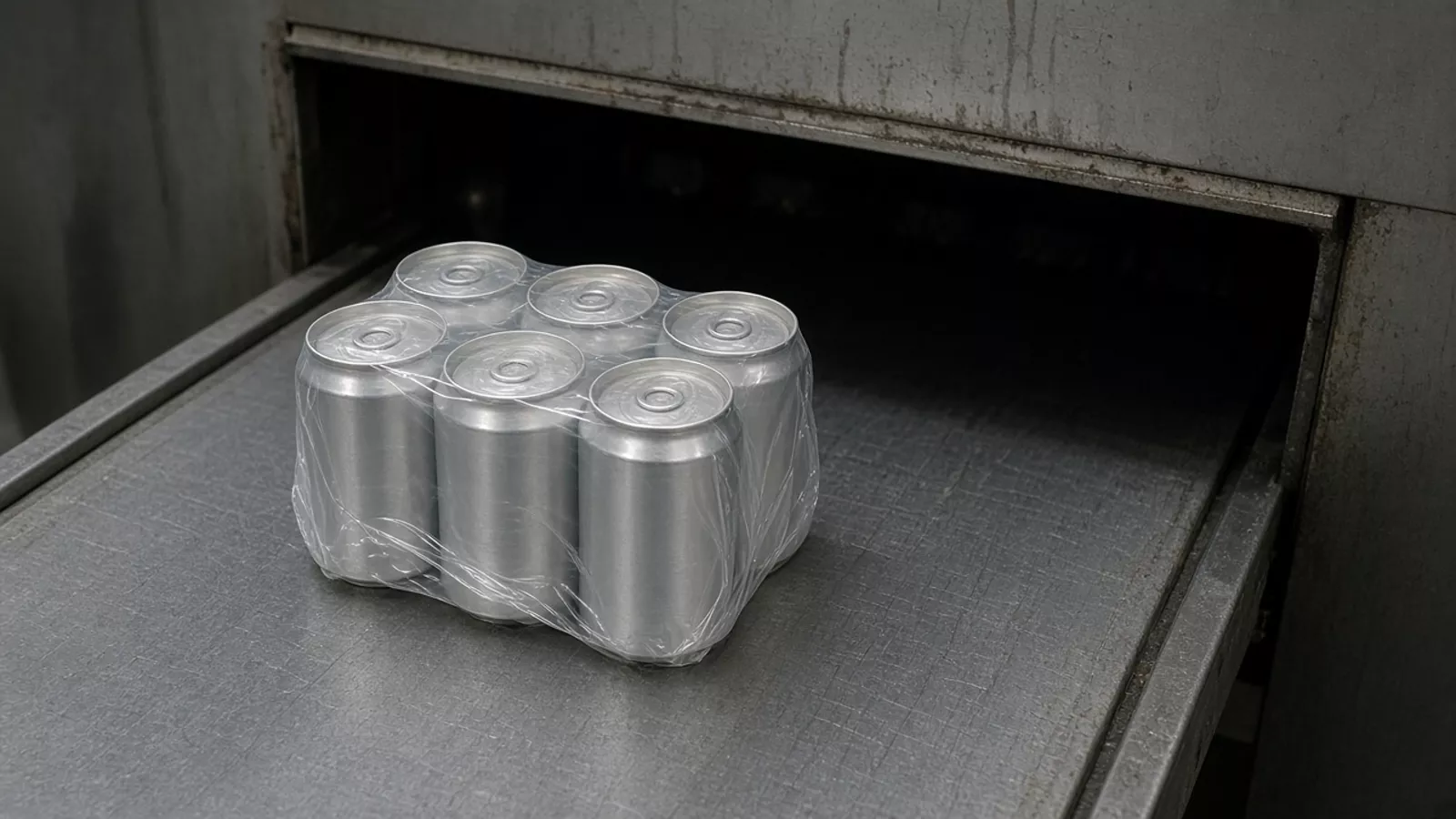
A bundle that leaves a shrink tunnel open at the seal, soft in the film, or still hot causes downtime and rework on the conveyor and at the palletizer. Record the bundle pattern, the film, the support through the seal gap, and the cooling exit before you compare a shrink wrap packaging machine with the line that has to take the pack.
When you add a shrink wrap packaging machine between loose containers and the conveyor, write the bundle and the tunnel exit before you compare proposals. Record the arrangement, the film the supplier will run, the support through the seal gap, the tunnel chamber, the cooling exit, the path product takes when the station stops, the acceptance samples, and the person who owns each interface. Public pages fill some of those cells for one right-angle bundler, two shrink tunnels, one horizontal top-seal flow wrapper, and two manufacturers’ splits between a single-item seal and a multi-item sleeve. An empty cell on this page is a question for your supplier. Full-pallet stretch wrap is outside this page. Loading a shipping case is on the case packing machine page. A soft film pack on a belt is on the case conveyor page.
What goes on the bundle and tunnel handoff record?
Copy this record and fill your project. Leave a cell empty when you do not have the value yet. An empty cell is the list of questions for the supplier.
| Field | Your value | Owner |
|---|---|---|
| Bundle pattern: container, count, and arrangement, with the drawing revision | ||
| Film: polymer, thickness, width, and clear or print | ||
| Support through the seal gap | ||
| Tunnel chamber and belt | ||
| Cooling or compression at the tunnel exit | ||
| Where product goes when the station stops | ||
| Acceptance samples: IDs and what a finished pack includes | ||
| Responsible person, infeed | ||
| Responsible person, downstream conveyor |
A published output figure is a manufacturer statement for that model. Your batch rate and your peak rate still go on this record, in one unit you name.
Six plain cans in two rows on a steel table, with a loose sheet of clear film beside them.
The next sections show how public pages fill some of these cells and leave the rest empty. Replace a published cell with your own drawing and your own rate when you use the record on a project.
Where does a single-item seal stop and a multi-item bundle start?
A single-item sealer closes film around one product. A bundler collates several containers into one pack, then seals and shrinks that group. The pages below keep those jobs apart. They do not share one speed, one film width, or one cooling distance.
Benison’s heat shrink packaging machine category page, saved 11 October 2026, says the series includes semi-automatic and fully automatic L-bar sealers, side sealers, and sleeve wrapping machines. It says the model follows product dimensions, packaging format, film type, and production speed. The same page says the machines wrap and seal with shrink film, then convey the pack through a shrink tunnel. It says L-bar sealers suit individual and bundled products, side sealers use continuous sealing and suit varying lengths, higher-output work, and long items, and sleeve wrapping machines are for multi-pack bundling and large products. It names POF and PE shrink film. It does not print a speed, a film width, or a bundle count. Those three class names are that catalog’s wording. Your quote still has to name which class it is.
Zappe’s shrink wrapping machine page, saved the same day, says the product is wrapped in film, sealed at both sides, and then sent through a shrink tunnel. It says that, depending on the model, the machine can do sleeve wrapping or full wrap-around packaging. The semi-automatic machines named on the page are HVM, BPA, and VMS: a sealing machine with a shrink tunnel, a double roll film carrier for two widths or two films, a height-adjustable sealing table, and a goods filling plate. A cooling blower at the end of the shrink tunnel appears in the additional-equipment list that follows the HVM, BPA, and VMS description. The fully automatic machine named VPVA has pneumatically operated sealing bars, a product retainer that fixes the package in the sealing station, electromechanical feeding of the top and bottom film for light or sensitive products, and top and bottom film rolls. A selector switch for sleeve wrapping or full wrapping is listed under additional equipment. The page names a Siemens PLC S7 1200 and a KTP touch display on the VPVA. It states no packages-per-minute figure and no film width.
Redpack’s NTS-BMS page, published 16 September 2024 and fetched 8 October 2026, calls the NTS-BMS a horizontal top seal flow wrapping machine with a box motion end crimp configured for shrink wrapping. The page says operators adjust bag length, print registration, end crimp slow down, infeed position, and machine speed, and that those settings can be saved. The same page says the machine is especially suited to vacuum packing products such as fresh produce and dairy. It prints no bundle arrangement, no film width, and no speed. Treat it as a single-product flow wrapper until a supplier shows a collator and a tunnel on the same quote. The vacuum-packing sentence is not a can-bundle specification.
nVenia’s Arpac Brand AGR Model page, published 24 June 2021 and fetched 8 October 2026, describes a compact right-angle infeed shrink bundling system. It collates and over-wraps arrangements of scrounds, rounds, squares, pints, quarts, cans, and other food containers in a single lane or a dual lane. The page says the model is designed for the dairy and frozen food industry. The published collation options are pints 3×2 and 4×2, quarts 3×2 and 2×3, tubs 2×1 and 2×2, and scrounds, rounds, and squares at 3×1 and 3×2. That list belongs to the AGR page. It becomes your bundle only after your drawing is checked against it.
A film bundle on these pages is not a corrugated case. The case packing machine page compares how a shipping case is loaded. Case conveyors cover a soft film base on a belt. The same kind of record for a different station is the cartoning machine line handoff guide.
What do the published bundler and tunnel pages state?
Keep each number with the model and the date. The AGR package rate is not a tunnel belt speed.
nVenia’s AGR page states an output speed of up to 25 packages per minute. It does not name the product, the arrangement, or the counting window for that figure. Electrical power is 460VAC, 3 phase, 60 Hz. Compressed air is 80 psi at 10 SCFM. Film width is 27 inches maximum. Film roll diameter is up to 14 inches with a 3 inch core. Film type is 1-2 mil low density polyethylene, clear or print registered. Standard features on the page include a transfer bridge plate for product transition through the seal gap, a product hold-down for light or unstable product, a triple insulated high velocity shrink tunnel, a cooling section at the tunnel exit for immediate product handling, and NEMA 4X electrical controls and cabinets. Options include custom product collation infeeds, a servo driven main ram or a servo driven seal frame, and an automatic product inverter. The transfer bridge, the hold-down, and the cooling section are listed for this model. They are not a description of every shrink wrapper.
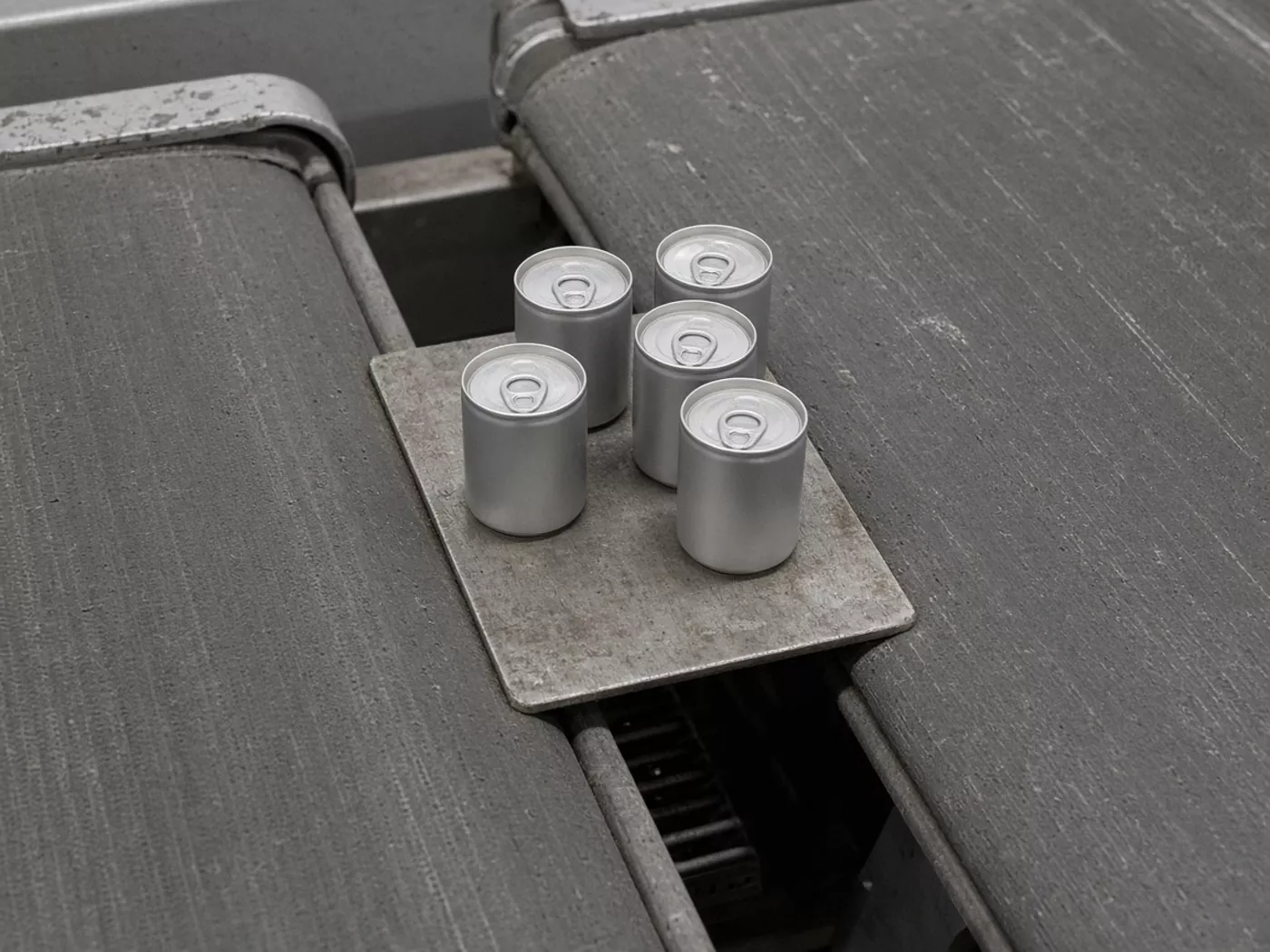
Plain cans on a metal plate that spans a gap between two conveyor belts.
nVenia’s MPD Model shrink tunnel page, at the URL path /equipment/mt-model/, was published 23 June 2021 and fetched 8 October 2026. The page calls it a bottom air flow shrink tunnel with a mesh belt, and says it is designed to shrink polyethylene, polyolefin, and PVC. It describes variable speed blowers, a recirculating air system, and a Teflon coated mesh fiberglass conveyor. Controls named on the page cover temperature, air velocity, and conveyor speed. Options include additional zones for a longer shrink time, and custom widths, lengths, and heights. The printed chambers are MT18 at 12 in high by 22 in wide by 60 in long, MT30 at 16 in high by 30 in wide by 60 in long, MT18-EXT at 12 in high by 22 in wide by 90 in long, and MT30-EXT at 16 in high by 30 in wide by 90 in long. The standard speed line is up to 110 feet per minute. Power is 240/480VAC, 3 phase, 60 Hz. The page does not print a packages-per-minute rate or a film width.
nVenia’s HVP Model shrink tunnel page, published 23 June 2021 and fetched 8 October 2026, describes a COHRlastic belt and a high velocity recirculation air system. It says hot plate shrink tunnels pull seal lines to the bottom or the sides of the package, and it names pizzas, stationery, greeting cards, and calendars as typical applications. Options are a hot plate under the conveyor belt, turbo cooling for product shrink assist, and spring loaded side compression rollers at the discharge. The printed chamber HVP4/488 is 20 in high by 40 in wide by 60 in long, with a total length of 83 in. The electrical line is 240VAC, 3 phase, 60 Hz, 52 A. The air line is no air required. Conveyor speed is 0 to 85 FPM. Machine dimensions are 61 in wide by 96 in long by 83 in high. Shipping weight is about 1500 lb, as the page prints it. The page says the tunnels are equipped with UL listed control panels. That sentence is the manufacturer’s statement about those panels.
The AGR page states 80 psi at 10 SCFM. The HVP page states that no air is required. The AGR air line and the HVP air line are both on the pages and they do not match, because they describe different machines. Copy the line that belongs to the model in the quote, and leave the other empty.
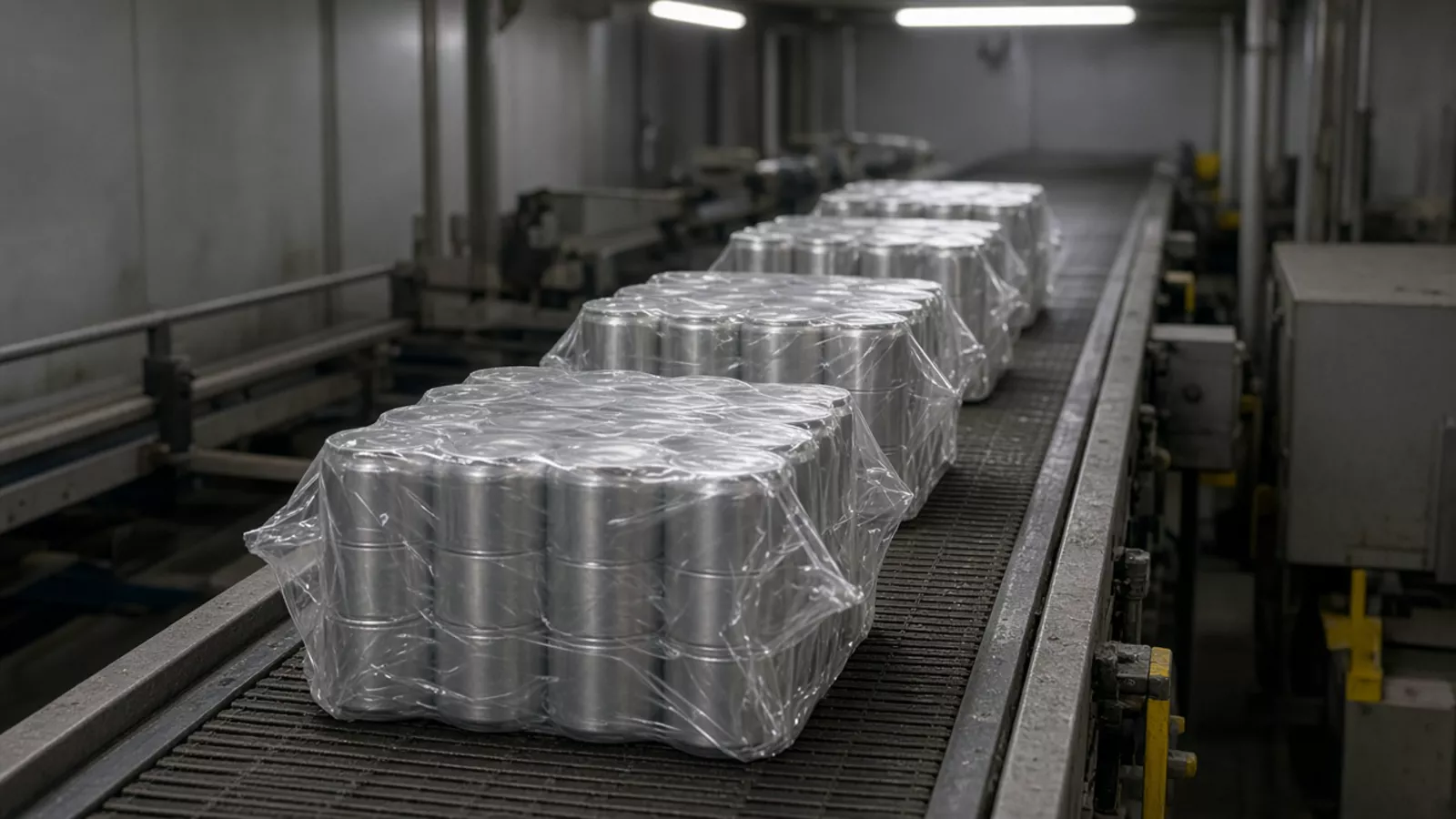
Film-wrapped groups of plain cans on an open belt conveyor.
How do those statements map onto fields that are still open?
Read a brochure the way this table reads the pages. Copy a stated figure into your notes as that model’s published limit. An empty cell was not printed on that page.
| Field | AGR page, fetched 8 Oct 2026 | MPD tunnel page, fetched 8 Oct 2026 | HVP tunnel page, fetched 8 Oct 2026 | NTS-BMS page, fetched 8 Oct 2026 | Still to confirm |
|---|---|---|---|---|---|
| Bundle pattern | Pints 3×2 and 4×2; quarts 3×2 and 2×3; tubs 2×1 and 2×2; scrounds, rounds, and squares 3×1 and 3×2. Single or dual lane. | Your container drawing and count. | |||
| Film | 1-2 mil LDPE, clear or print registered. Width 27 in maximum. Roll up to 14 in on a 3 in core. | Polyethylene, polyolefin, and PVC named. Width not printed. | The film on your quote. Benison’s category page, saved 11 Oct 2026, names POF and PE and prints no width. | ||
| Support through the seal gap | Transfer bridge plate through the seal gap. Product hold-down for light or unstable product. | Whether the quote includes that bridge and hold-down. Zappe’s VPVA page, saved 11 Oct 2026, names a product retainer in the sealing station. | |||
| Tunnel chamber | Triple insulated high velocity shrink tunnel. Chamber size not printed. | MT18 12 × 22 × 60 in; MT30 16 × 30 × 60 in; MT18-EXT 12 × 22 × 90 in; MT30-EXT 16 × 30 × 90 in. Dimensions are height × width × length. | HVP4/488 is 20 × 40 × 60 in, total length 83 in. | Which chamber the pack fits. Custom sizes are an MPD option, not a measured size for your product. | |
| Belt or output speed | Up to 25 packages per minute. Product, arrangement, and counting window not printed. | Up to 110 feet per minute. | 0 to 85 FPM. | Machine speed is a saved setting. No number is printed. | Your batch rate and peak rate, in one unit. |
| Cooling or compression at the exit | Cooling section at the tunnel exit, listed as standard. No length or time is printed. | Turbo cooling and spring loaded side compression rollers at discharge, both listed as options. No length or time is printed. | Whether your machine has them. On the Zappe page, a cooling blower at the tunnel end is in the additional-equipment list after the HVM, BPA, and VMS description. | ||
| Where product goes when the station stops | Hold, divert, or clear, and who does it. | ||||
| Acceptance samples and owners | Sample IDs, and the names for the infeed and the downstream conveyor. |
The 25 packages per minute line stays on the AGR page. The feet-per-minute lines stay on the tunnel pages. Your rate stays on the handoff record.
What do you record at the four trial checkpoints?
The handoff record is the list of inputs. This sheet is what you look at once a supplier runs your containers. Agree the evidence for each row before the run. Packaging line commissioning covers factory and site acceptance for the whole line. This sheet stops at the bundler’s infeed and the conveyor that takes the pack.
| Checkpoint | What you and the supplier accept | Evidence | Owner |
|---|---|---|---|
| Infeed and bundle pattern | Containers arrive in the arrangement on the handoff record | ||
| Seal gap | Product crosses the seal gap on the support written on the record | ||
| Heat tunnel | The pack leaves the chamber in the film condition you agreed. Temperature and dwell stay empty unless the run sheet prints them | ||
| Cooling exit and downstream conveyor | The pack is in the condition the next conveyor can take, on the stop path you wrote |
Packaging line layout is where the transfer positions are drawn. This checkpoint only records the pack that leaves the tunnel.
What to check with your supplier
Take the completed handoff record and the four checkpoint rows to your own supplier. Ask them to mark every empty cell against the containers in your specification. This site does not take inquiries and does not review proposals.
Bring these to that meeting:
- The handoff record, with empty cells left empty.
- The mapping row for any brochure figure you want answered, with your value written beside it.
- Container drawings, with the revision marked.
- The four checkpoint rows, with the evidence ID still empty if the run has not happened.
- The names of the infeed owner and the downstream owner.
The packaging guides index lists the other station-fit worksheets.
Method and sources
Compiled on 14 October 2026 from library copies of the nVenia AGR, MPD, and HVP pages and the Redpack NTS-BMS page, each fetched on 8 October 2026. Publication dates on those copies are 24 June 2021 for the AGR page, 23 June 2021 for the MPD and HVP pages, and 16 September 2024 for the NTS-BMS page. The Benison category page and the Zappe shrink wrapping machine page are the copies saved with the US English desktop search snapshot for “shrink wrap packaging machine” on 11 October 2026. Figures are quoted from the page named in the sentence and apply to that wording. No sample run was performed for this page. The photographs show plain cans, film, a bridge plate, and a conveyor. They are not a named machine, a measured rate, or a customer shipment. The search snapshot was used to see which explanations already exist. Catalog and definition pages in that snapshot supplied no specifications used here.