
Treating “heavy loads take strapping and mixed loads take stretch wrap” as a finished engineering rule causes crushed carton corners, shifted layers, or wasted equipment spend when a supplier prices the wrong material. Separate narrow banding film from rigid pallet strapping first, then evaluate full-web stretch wrapping, strapping, and combined stations against the same pallet load, contact zone, and handling path.
Before comparing equipment or consumable proposals, fix one reference load and record how each candidate touches the product, what stays exposed, and which measurement or shipping trial proves the hold. This guide defines the three materials sold under the stretch wrap and banding names, maps where surface film and narrow straps apply force, and provides a blank same-load evidence checklist. It does not rank material brands, set a universal load-weight cutoff, or replace transport testing.
| Input or item | Value or source to record | Why it matters |
|---|---|---|
| Terminology on the request | Narrow bundling film, full-web pallet stretch film, or rigid strapping (PP, PET, steel) | Prevents comparing a hand bundling roll against a pallet strapping machine |
| Reference pallet load | Dated pallet drawing: dimensions, gross weight, layer pattern, and primary package | Keeps every option on the same physical load |
| Edge and surface limits | Carton crush sensitivity, sharp corners, bag overhang, and label scan zones | Determines whether corner boards, roping, or reduced corner tension are required |
| Environmental exposure | Indoor staging, covered trailer, dust, moisture, or outdoor storage | Separates lateral film barrier coverage from open strap gaps |
| Pallet base condition | Stringer or block spec, deck board spacing, and inspection rules | Neither film nor strap fixes a broken or warped pallet underneath |
| Verification evidence | Containment force by zone, strap tension and seal record, or shipping trial report | Turns general vendor claims into checkable project criteria |
If your project already points toward an automated wrapper and you need to document turntable versus rotary-arm motion and operator steps, record those station handoffs on the automatic pallet wrapper line-fit guide. When you are ready to separate machine price, installation duties, and consumable budgets across competing wrapper offers, pair this checklist with the stretch wrapper cost and quote-scope worksheet.
Which material does “banding” mean in your specification?
Clear the naming overlap before speaking with suppliers. In US industrial packaging searches and catalogs, “banding” points to two different products that perform different mechanical jobs.
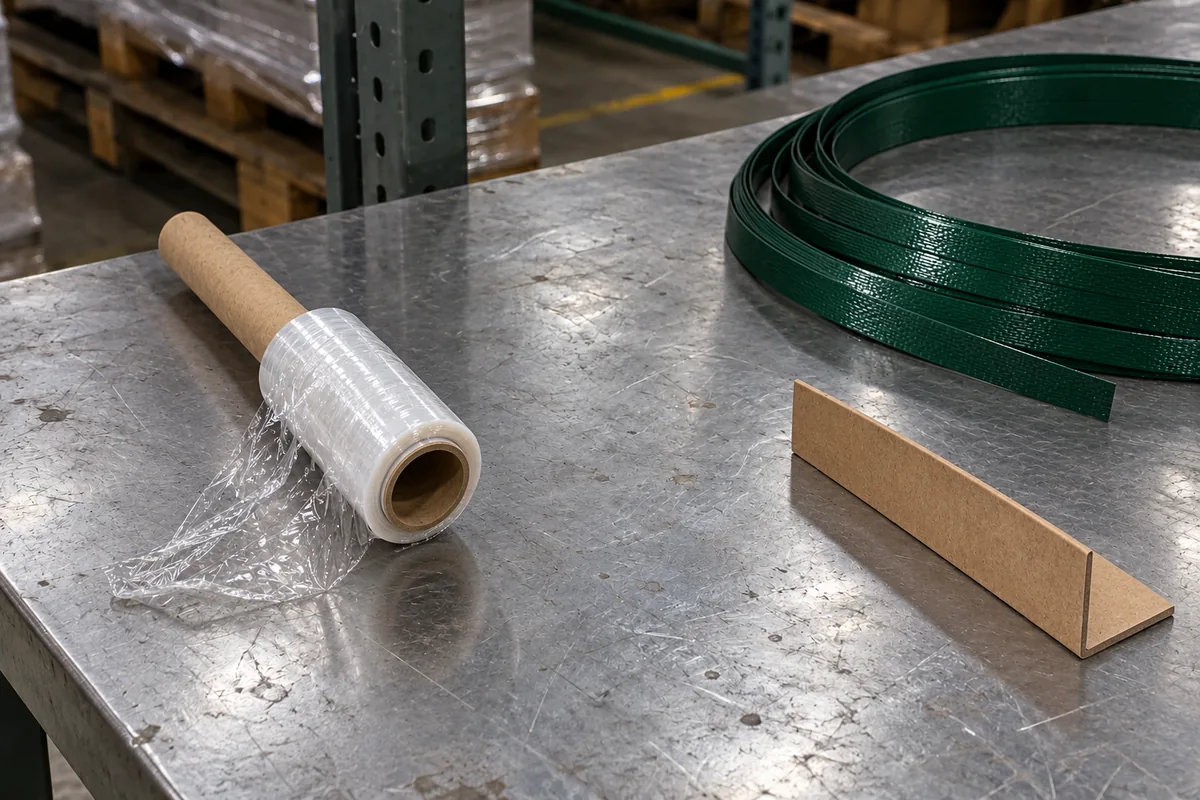
A narrow roll of clear bundling film with an extended core handle on the left, shown beside a green polyester strapping coil and a kraft paperboard edge protector on a steel workbench.
On distributor catalog pages such as Chu’s Packaging Supplies’ banding stretch film listing (accessed 17 October 2026), banding stretch film—also called bundling film—is narrow cast stretch film wound on an extended core handle, listed in standard sizes such as 3 in × 1,000 ft and 5 in × 1,000 ft at 80 gauge. Rutan Poly Industries’ manufacturing film comparison (published 31 December 2025, accessed 17 October 2026) notes that bundling film groups small parts, components, or product sets into a single unit for internal handling without boxes or tape, whereas pallet stretch film stabilizes full palletized loads for storage or movement.
By contrast, on pallet-securing pages from AAA Polymer, Skid Management Services (published 29 August 2026), and Innova Maquinaria Industrial (all saved 11 October 2026), banding is used as a synonym for pallet strapping: narrow, high-tensile polypropylene (PP), polyester (PET), or steel bands pulled taut by a tensioner or strapping head and joined by a heat seal, ultrasonic weld, or metal seal.
| Material term | Typical form in cited sources | How it holds the load | Primary role |
|---|---|---|---|
| Narrow banding / bundling film | Narrow LLDPE stretch film roll (for example, 3 in or 5 in width at 80 gauge on an extended core) | Elastic recovery and film-to-film cling around a small bundle or narrow zone | Grouping sub-packs, long parts, or small shipments; temporary layer holding |
| Full-web pallet stretch wrap | Wide LLDPE film web (for example, 20 in standard machine roll on Lantech’s SL400AMR sheet) | Continuous multi-layer inward containment force across the pallet perimeter and base | Unitizing mixed or uniform pallet loads and shielding lateral faces from dust |
| Horizontal pallet strapping | PP, PET, or steel strap applied in horizontal loops at selected heights | Direct perimeter compression along narrow strap lines | Compacting tiers horizontally to limit box shifting on the pallet |
| Vertical pallet strapping | PP, PET, or steel strap routed vertically through the pallet deck and over the top | Rigid vertical tension tying the top of the stack to the pallet base | Locking heavy or rigid loads to the pallet base for handling and stacking |
Write the exact material name, width, and direction on your request. Asking a vendor for “pallet banding” without stating whether you mean a 3-inch hand bundling film, a roped band formed on a stretch wrapper, or a tensioned PET strap invites incompatible quotes.
How do contact area, sharp edges, and exposed cargo differ on the same load?
Once narrow bundling film is set aside, the engineering comparison between pallet stretch wrapping and pallet strapping comes down to where the restraining force touches the product and what happens between those contact zones.

Schematic view of load contact zones on plain corrugated cartons: a kraft corner board distributes the narrow line load of horizontal polyester straps, while clear stretch film spreads contact across the lower box faces and pallet base.
Stretch film spreads holding pressure across a broad vertical web, whereas strapping concentrates tension along a narrow band path. Neither contact pattern is automatically gentler or stronger without checking the primary package:
- Carton corners and soft packages under stretch film: Robopac USA’s guide on how stretch film works with stretch wrappers (published 31 May 2023, accessed 17 October 2026) notes that pallet corners are a primary failure zone: if film is applied too tightly, it crushes carton corners or tears on sharp edges, leaving an unsafe load. Robopac describes multi-level variable containment force (up to nine programmable levels per load under its CUBE control) and proactive corner compensation as machine methods to reduce corner crushing and film breaks.
- Localized strap lines and corner-board distribution: AAA Polymer’s comparison page (saved 11 October 2026) notes that high-tension strapping applies direct force along the strap line and can dent or deform softer goods if applied directly to delicate packages. Packaging Europe’s report on PAC Strapping Products’ PSS733 pallet strapping system (published 5 October 2026, accessed 17 October 2026) describes placing vertical or horizontal protective corner boards across pallet edges before the strapping cycle starts; the report notes that reinforcing corners and edges is intended to distribute strap tension evenly across the load and prevent crushing, splintering, or compression damage.
- Horizontal versus vertical load paths: Innova Maquinaria’s comparison of stretch wrapping and strapping systems (saved 11 October 2026) separates two strapping directions that solve different movement problems. Horizontal strapping compacts a load at selected heights to prevent boxes from shifting sideways, while vertical strapping joins the load to the pallet base. Stretch wrapping holds the load horizontally across its sides, locks the base during bottom wraps, and can use a roping attachment that gathers the film into a reinforcing cord acting like a strap.
- Exposed faces, dust, and label visibility: Stretch film forms a continuous lateral barrier against dust and light surface moisture, though Innova notes that full top protection still requires a top cover or hood. Strapping leaves the product faces between straps open to dust and weather, which keeps ventilated or heat-dissipating loads open and leaves carton barcodes uncovered wherever a strap does not cross the label zone.
- Pallet base dependency and receiving removal: Skid Management Services’ comparison (published 29 August 2026, saved 11 October 2026) emphasizes two boundary conditions that apply regardless of which material wins on paper. First, a cracked deck board, damaged stringer, or inconsistent block pallet undermines both film tension and strap compression. Second, tensioned straps store mechanical energy that can snap back when cut, requiring eye protection, gloves, and purpose-built cutters at the receiving dock.
Copy the same-load option and evidence matrix
Use one matrix for each distinct pallet family rather than averaging light mixed cartons and heavy rigid bundles into a single plant-wide rule. Download the blank stretch wrap vs banding evidence checklist (CSV). It includes the candidate rows and evidence columns below so your team and your suppliers can record what is proven and what remains To confirm.
Keep unknown cells blank or marked To confirm. Do not insert an assumed film gauge, strap break strength, or pallets-per-hour figure to make a comparison table look complete.
| Candidate option on the same load | Load and package condition to check | Contact and edge protection required | Exposed-surface and barcode effect | Measurement or trial evidence to attach | Station and conveyor interface | Responsible owner | Unresolved items (To confirm) |
|---|---|---|---|---|---|---|---|
| Narrow banding / bundling film (hand or bundle roll) | Small sub-packs, pipes, or internal staging; not a substitute for full-pallet base locking | Film clings to itself; check whether narrow band necks down into soft cartons | Leaves most of the load uncovered; no pallet-base lock unless wrapped to deck | Sample bundle handling check; confirm whether receiver accepts banded sub-units | Manual dispenser or upstream bundler before case packing or palletizing | ||
| Full-web pallet stretch wrap only | Mixed, irregular, or uniform cased loads where lateral containment and dust barrier are needed | Check corner crush resistance and sharp pallet or product edges; specify corner compensation or roping if used | Covers lateral sides; add top sheet if top coverage is required; check film haze or overlap over pallet label | Measured containment force at top, middle, and bottom with named tool; film weight and revolutions per load | Turntable or rotary-arm wrapper; pallet rotation vs stationary load; film-tail clamp, cut, and wipe | ||
| Horizontal pallet strapping only | Tiered cases or rigid units that need horizontal compaction at set heights | Check whether strap cuts into case walls; add vertical corner boards to spread line tension | Open between straps; no dust or moisture barrier; verify strap heights clear barcode labels | Strap material (PP, PET, steel), width, applied tension, joint/seal test, and retained tension after staging | Horizontal strapping frame and vertical travel stops; pallet conveyor stop accuracy | ||
| Vertical pallet strapping only | Rigid or stackable loads that must be locked down to the pallet base | Top edge and bottom deck contact; check whether top edge boards are needed under strap | Open sides and top; requires sound pallet stringers and deck boards under strap path | Strap spec, bayonet/lance path through pallet voids, seal strength, and fork-entry clearance check | Under-pallet strap lance or chute aligned with pallet openings on roller or chain conveyor | ||
| Corner boards + horizontal or vertical strapping | Loads where strap compression is needed but bare edges crush, dent, or lose tension | Vertical or horizontal corner boards placed before tensioning; verify board leg width, caliper, and sensor alignment | Corners covered by board; side faces remain open unless wrapped afterward | Trial showing zero carton corner collapse at target strap tension; board magazine reload interval | Manual placement or automatic corner-board applicator with load and alignment sensors | ||
| Combined strapping + full-web stretch wrap | Heavy, fragile, or multi-stage shipments needing rigid base/tier lock plus continuous lateral containment | Sequence matters: typically corner boards and strapping first, then stretch wrap over the stabilized stack | Full lateral film coverage over straps; confirm film does not snag on strap seals or corner board tips | Combined shipping or vibration/handling trial record; separate fault recovery for strap head and wrapper | Two stations or integrated cell; accumulation positions and handshakes between palletizer, strapper, and wrapper |
What measurement and trial evidence should a supplier show?
A brochure statement that a system “provides maximum stability” is not project evidence. Ask each supplier which measurements they record on your actual load and how they verify that the load survives your handling path.
For pallet stretch wrapping, Lantech’s sustainability and optimization page (published 12 December 2025, library copy fetched 7 October 2026) and its containment force guide (updated 21 April 2026, accessed 17 October 2026) define the core engineering metric and the machine data points behind it:
- Containment force definition: Lantech defines containment force as Wrap Force × Film Layers—the total inward squeezing pressure exerted by all layers of film around the load.
- Where and how to measure: Lantech advises measuring containment force at the top, middle, and bottom of the load using a dedicated containment force tool, and checking at least one load per shift once in production. Its guide explicitly warns against comparing readings from one type of containment force tool to another because different tools vary in measurement values.
- Six wrapper data points to log by load type: Lantech’s optimization page lists load dimensions (height and girth), film revolutions per load, film tension, pre-stretch, film weight, and containment force as the six data points used to set and track film targets by load type.
For pallet strapping and corner-board combinations, public manufacturer and trade sources point to a different set of verification items:
- Strap orientation, count, and seal method: Specify whether straps are horizontal (and at which heights), vertical (and through which pallet openings), or both, along with the strap material (PP, PET, or steel) and sealing method (such as heat seal, friction weld, ultrasonic seal, or metal clip).
- Corner-board placement before tensioning: When edge boards are included, Packaging Europe’s 5 October 2026 report on the PSS733 system highlights two machine checks to confirm on an automated applicator: load-detection sensors that trigger placement only when a pallet is in position, and alignment sensors that verify board positioning before the strapping cycle tensions the strap.
- Receiving-end cut and disposal check: Record how the receiving facility removes the restraint, what tools are required to cut tensioned bands safely, and whether mixed materials (paperboard corners, PET strap, and LLDPE film) must be separated at unpacking.
Until a supplier runs your load or provides a dated test report on an agreed reference load, keep the measurement column marked To confirm.
How do station interfaces change when you combine strapping and wrapping?
Choosing between stretch wrap, strapping, or both is also a layout and line-control decision. Adding a second securing method changes conveyor handoffs, accumulation requirements, and operator recovery steps at the end of the line.

A pallet load with vertical kraft corner boards and horizontal polyester straps riding a powered roller conveyor toward a turntable stretch wrapper.
Check four physical interfaces against the pallet handling system and the packaging line layout guide before freezing the floor plan:
- Pallet orientation and under-deck access: A vertical strapping lance must pass cleanly through the pallet’s void openings without hitting a conveyor roller, chain strand, or bottom deck board. Verify pallet orientation leaving the conventional palletizer or robotic palletizer so the strap chute and the wrapper receive the pallet on the intended axis.
- Station sequence and loose tails: When a line combines corner boards, strapping, and stretch wrapping, record the exact station order. Confirm that strap seals or corner-board ends do not puncture the stretch film during wrapping, and that the wrapper’s film tail is clamped, cut, and wiped so it does not foul downstream photo-eyes or vehicle sensors.
- Consumable reload and fault stops: Combining corner boards, strap coils, and stretch film rolls means three separate consumable magazines can empty or fault. Use the full-pallet discharge buffer method on the pallet handling page to check whether holding positions between the palletizer, strapper, and wrapper prevent a single coil or roll change from stopping upstream case flow.
- Acceptance boundary across vendors: If the strapping unit and the stretch wrapper come from different suppliers, define who owns the conveyor section, stop sensors, safety interlocks, and combined cycle test in your packaging line commissioning and acceptance checklist.
What to take to your suppliers
Bring the completed same-load matrix to your film, strapping, and machinery suppliers so every proposal answers the same engineering questions. This independent editorial site does not sell equipment, supply consumables, or review quotes.
- The reference load sheet: Pallet dimensions, deck and stringer drawing, gross weight range, primary package type, and layer pattern.
- Your contact and exposure limits: Maximum allowable carton corner indentation, sharp edges on the load or pallet, dust or moisture exposure during transit, and barcode label zones that must remain readable.
- The blank option × evidence matrix: Ask each supplier to mark which candidate configuration they propose and to fill in the measurement method, tool name, or trial report they will use to verify containment on your load.
- The line interface record: Pass-line height, conveyor type (chain or roller), pallet orientation, consumable reload access, and who owns the handoff signals between stations.
Return to the packaging guides hub when you need the companion worksheets for palletizer selection, wrapper line fit, or quote-scope budgeting.
Method and sources
Updated October 2026. This comparison guide and blank evidence matrix were compiled on 17 October 2026 from US English search results saved on 11 October 2026 (AAA Polymer, Innova Maquinaria Industrial, Skid Management Services, and U.S. Packaging & Wrapping), a library copy of Lantech’s sustainability and film optimization page fetched on 7 October 2026 (published 12 December 2025), and live fetches on 17 October 2026 of Chu’s Packaging Supplies’ banding film specification, Rutan Poly Industries’ bundling versus stretch film article (published 31 December 2025), Lantech’s containment force article (updated 21 April 2026), Robopac USA’s stretch wrapper film guide (published 31 May 2023), and Packaging Europe’s report on PAC Strapping Products’ PSS733 corner-board and strapping system (published 5 October 2026). All product dimensions and control descriptions apply only to the cited source pages. No laboratory pull tests, containment-force measurements, or transport trials were performed by this site. The warehouse photographs illustrate generic unprinted cartons, kraft corner boards, polyester strapping, narrow bundling film, and a roller conveyor; they are schematic visual aids, not documentation of a certified load test or named plant installation.