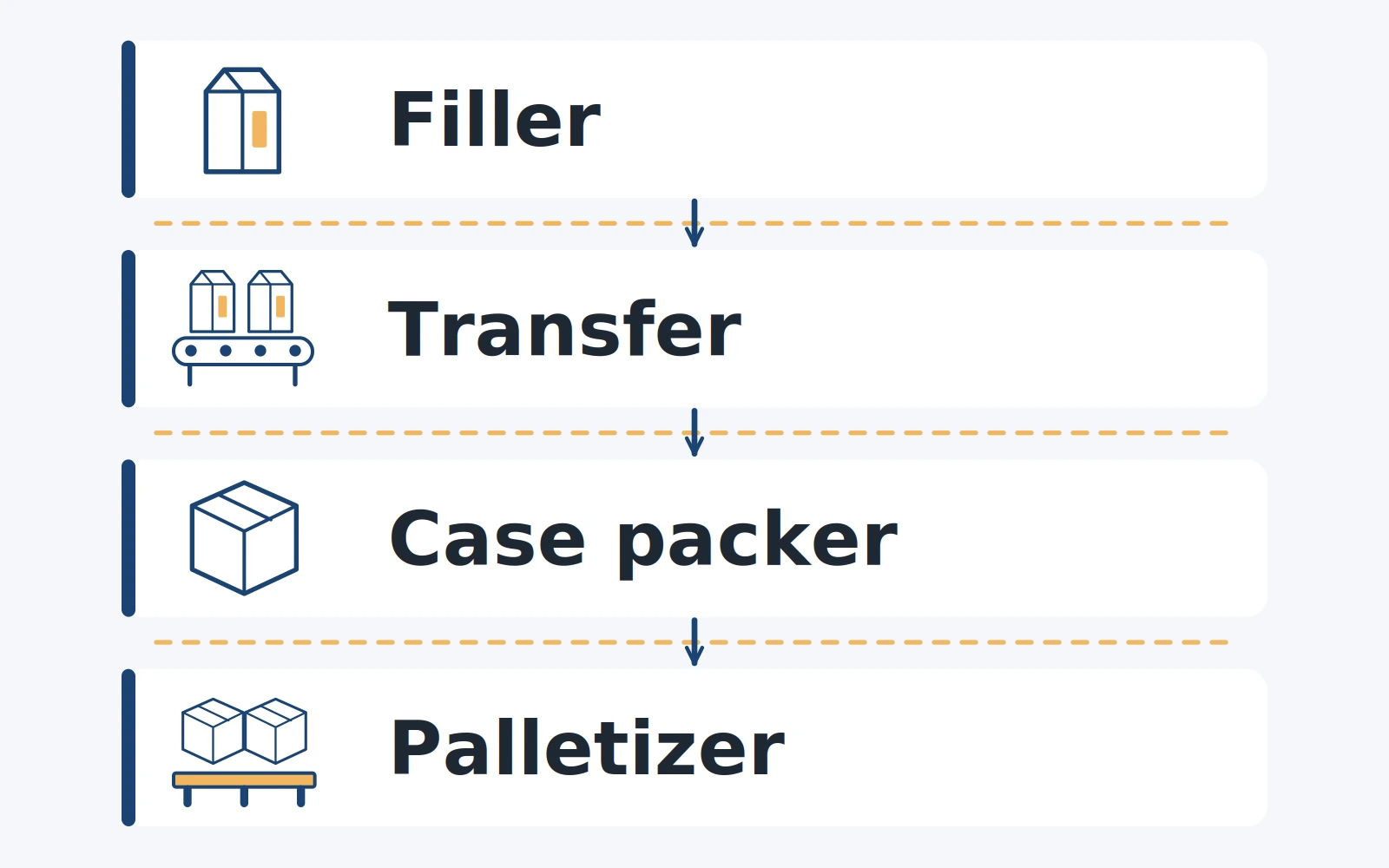
A faster filler can create costly stoppages at the case-packing section. Treat the SIG Neo aseptic carton filler announcement as a reason to review the discharge-to-pallet flow before changing the line specification.
For an end-of-line project, the useful question is whether the proposed carton mix can travel, accumulate, pack and leave the line at the required rate. SIG announced new single-serve and multi-serve fillers on October 1, 2026; those published filling rates are manufacturer claims, not evidence of your finished-line output. Use the announcement to request a format-by-format interface schedule, a stop-and-restart description and an acceptance plan. Keep the filler specification separate from the downstream equipment specification until both suppliers agree on the same products, counting points and operating conditions.
Key points:
- Convert cartons per hour into cases per minute using your actual pack count.
- Identify where acceptable cartons can wait when the case packer stops.
- Compare changeovers across the complete product route.
- Ask for the baseline behind percentage claims and the documents needed for acceptance.
What did SIG announce, and who should review the line?
SIG’s October 1 release describes two additions with different carton families. For downstream teams, this means two separate handling studies rather than a single “Neo” conveyor specification. The announcement is relevant when an expansion changes carton dimensions, case counts or the required flow into an existing packing section.
| Announced machine | SIG’s published scope, October 1, 2026 | Downstream review input |
|---|---|---|
| SIG Neo XSlim 32 Aseptic | 32,000 XSlimBloc cartons/hour; nine pack sizes | Actual carton dimensions, pack count and discharge arrangement for each SKU |
| SIG Neo Midi 15 Aseptic | 15,000 MidiBloc or MidiFit cartons/hour; three sizes for each format | Shape-specific guides, case arrangement and change parts |
These are statements in the manufacturer’s release, listed in References. They do not establish which configurations are available for a US project.
| Project owner | What may change | What to request |
|---|---|---|
| Production planning | Required case flow after a filling expansion | SKU schedule and target good output |
| Packaging engineering | Carton transfer and group formation | Dimensioned packages and discharge drawing |
| Operations | Stop recovery and coordinated format changes | Operating sequence and restart responsibilities |
| Quality | Acceptance of packs after a disturbance | Agreed inspection and disposition criteria |
Use the end-of-line automation overview to place each operation in the project scope. The case-packer guide helps distinguish carton handling from the equipment that loads the outer case.
Takeaway: Start with the carton family and packing recipe, not the platform name.
How should the published filling rate become a case-flow requirement?
Divide a rate in cartons per hour by sixty to express cartons per minute, then divide by the number of cartons packed in each case. This unit conversion is an editorial calculation. It gives a theoretical incoming case equivalent only; it does not measure production, reject losses or the downstream machine’s capability.
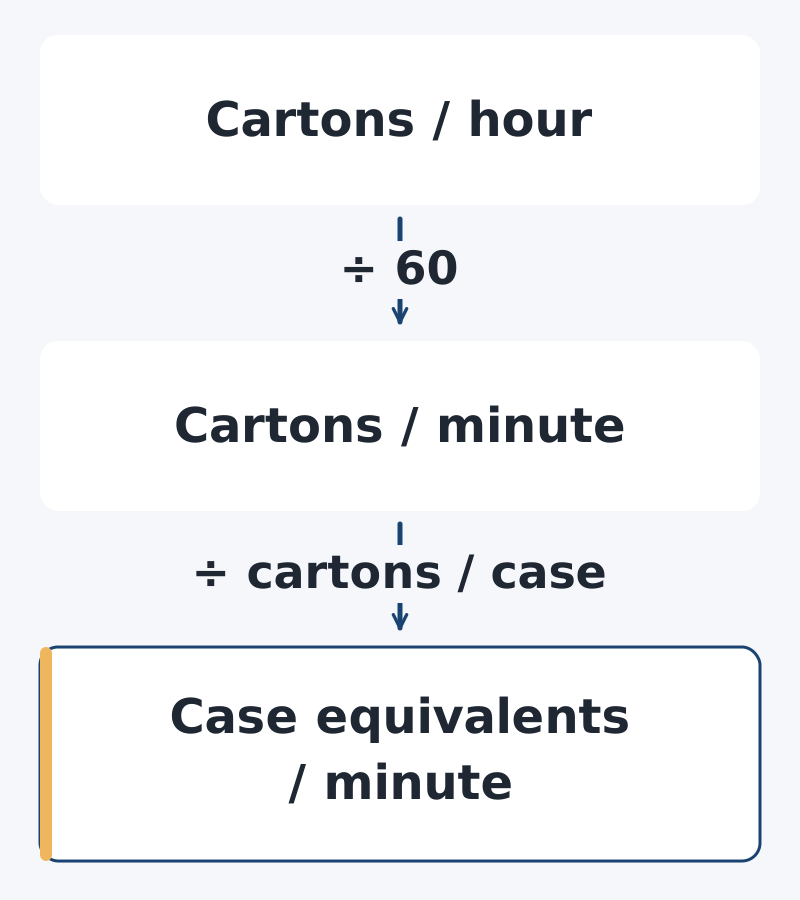
Case equivalents/minute = cartons/hour ÷ 60 ÷ cartons/case
Keep the pack count as an input from the approved packing recipe. A tray, a wraparound case and a regular slotted case can need different grouping and transfer arrangements even when they hold the same number of cartons. Record the actual grouping arrangement beside the calculation rather than reducing the specification to one rate.
Ask the packing-equipment supplier to state its sustained good-case output for that recipe, including the handoff conditions. The case-conveyor guide covers the next handling stage; the case-sealer guide identifies the closing operation that may need its own rate check.
Common mistake: Comparing a carton-per-hour headline directly with a case-per-minute specification.
Takeaway: Put units, pack count and counting point on every rate comparison.
Does the one-third claim identify the right comparison baseline?
The release claims a one-third increase in output and output per square meter without identifying a specific baseline machine. Ask for the comparison model and measurement boundary. The published catalog can support a transparent arithmetic check, but choosing a catalog denominator does not identify the manufacturer’s intended comparator.
The official carton-filling catalog, checked October 8, 2026, lists SIG Smile at 24,000 packs/hour and standard medium-size equipment at up to 12,000 packs/hour. Using those catalog figures as assumed comparison inputs gives:
| Illustrative catalog pairing | This site’s arithmetic | What remains unresolved |
|---|---|---|
| XSlim 32 announcement versus Smile catalog | (32,000 − 24,000) ÷ 24,000 = 33.3% | Whether the formats, configuration and comparison baseline match |
| Midi 15 announcement versus standard medium-size catalog category | (15,000 − 12,000) ÷ 12,000 = 25% | Exact standard model and intended denominator |
These are our hypothetical comparisons of manufacturer-published figures, not SIG’s comparison statement or measured improvements. The catalog and release URLs are in References. Neither calculation establishes output per unit of installed line area. A machine footprint excludes whatever service access and downstream equipment the project requires.
For the spatial review, use the line-layout principles to identify the boundaries and the floor-plan worksheet to record equipment and access separately.
Takeaway: An arithmetic match is a question for SIG, not proof of the announced baseline.
Where should cartons wait during a downstream stop?
Request an explicit stop sequence from the filler discharge through the packing section. Show which device senses a blockage, which equipment slows or stops, and where cartons remain during recovery. Do not assume that a faster filler can discharge continuously into the existing conveyor while the downstream section is unavailable.
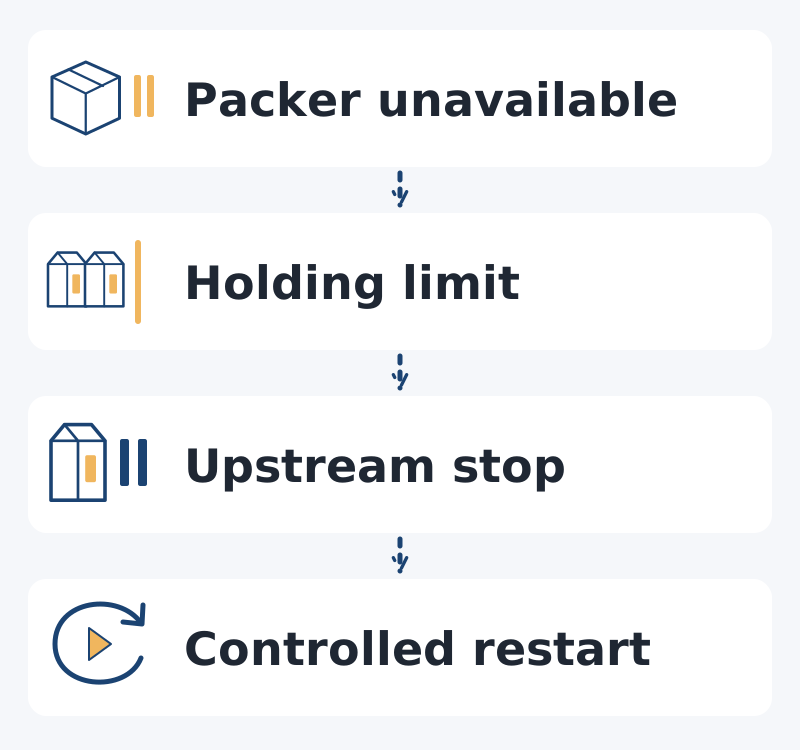
Use a simple ownership table in the interface meeting:
| Condition to discuss | Question to resolve | Record to keep |
|---|---|---|
| Case packer unavailable | Who commands the upstream slowdown or stop? | Signal and sequence description |
| Holding area reaches its agreed limit | What prevents further discharge? | Detection point and response |
| Downstream equipment restarts | Who authorizes carton release? | Restart logic and operator action |
| Mixed or suspect cartons remain | Where are they diverted or held? | Product disposition rule |
The accumulation-conveyor guide helps frame holding versus transport. Specify the holding method with actual cartons and the packaging-equipment suppliers; do not assign a universal buffer duration from the announcement. Include the packer’s recovery rate and the production schedule in the discussion.
Takeaway: Draw where cartons go during a stop before selecting more conveyor length.
What counts as a complete changeover and acceptance test?
Agree on the start and finish of a line changeover, including downstream guides, pack recipes, case supply and the first accepted finished case. A filling-machine changeover claim has a different boundary from a complete packaging-line change. Testing against a shared boundary lets both teams explain what their quoted time includes.
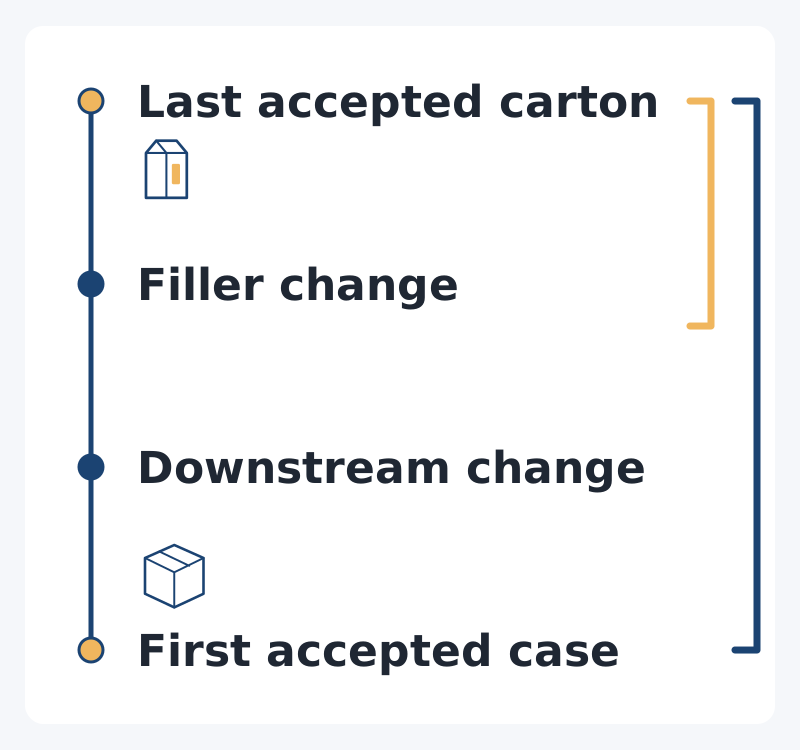
SIG’s October 1 release claims size or format changes in less than 15 minutes without changing machine parts. That is a manufacturer statement about the filler, not an independently verified complete-line changeover; confirm the scope for the proposed SKU transition.
Ask for a record containing the previous SKU, next SKU, last accepted pack of the old run, first accepted case of the new run, interventions and rejected material. Use the line-design guide to assign interface ownership and the commissioning guide to organize the agreed acceptance records.
For the receiving end, define the case pattern and completed-load handling. The case-palletizer guide separates the palletizing stage from packing; the pallet calculator checks case-count geometry once the outside case dimensions are available. Its geometric output does not validate the load’s physical stability.
Common mistake: Treating the first carton from the filler as the end of the whole-line changeover.
Takeaway: Time and count at the point where the project promises an accepted finished output.
When should the project act, and what remains unconfirmed?
Use the announcement during requirements review, before committing the downstream scope. The reviewed release contains no US order, trial or delivery schedule. Separate the announcement date from procurement milestones, and have the equipment supplier confirm supply, installation and acceptance dates in project documents before adding them to the schedule.
| Milestone | Date or status | Source or next document |
|---|---|---|
| New-machine announcement | October 1, 2026 | SIG release |
| This source review | October 8, 2026 | Review of release and catalog |
| US availability and local support | Subject to supplier quote | Supplier’s regional offer and service scope |
| Trial, delivery and commissioning | Subject to supplier quote | Agreed project schedule |
The unresolved items are actionable: obtain exact carton volumes and dimensions from the format schedule; obtain retrofit and packaging-material compatibility from the supplier’s written scope; obtain price and included equipment from an itemized offer; obtain percentage-comparison conditions from the technical explanation. No availability date or investment return is inferred here.
Takeaway: Turn the news into a dated document request, not a delivery commitment.
When this does not apply
This review addresses downstream integration around the announced carton formats. It does not assess aseptic-process validation, food safety or suitability for a particular product. Bring those questions to the responsible process and quality specialists. It also cannot certify existing-line compatibility from a catalog entry or an announcement.
Takeaway: Keep the downstream interface review distinct from process approval.
Method and sources
This article is part of the packaging equipment guides. This is an independent news explanation compiled from SIG’s announcement and its official filling catalog, reviewed October 8, 2026. The two documents are from the same manufacturer; neither is an independent performance test. Published rates remain attributed claims. Calculations are labeled hypothetical, while the interface tables are editorial recommendations for project review. No customer results, supplier ranking or US availability claim is made.