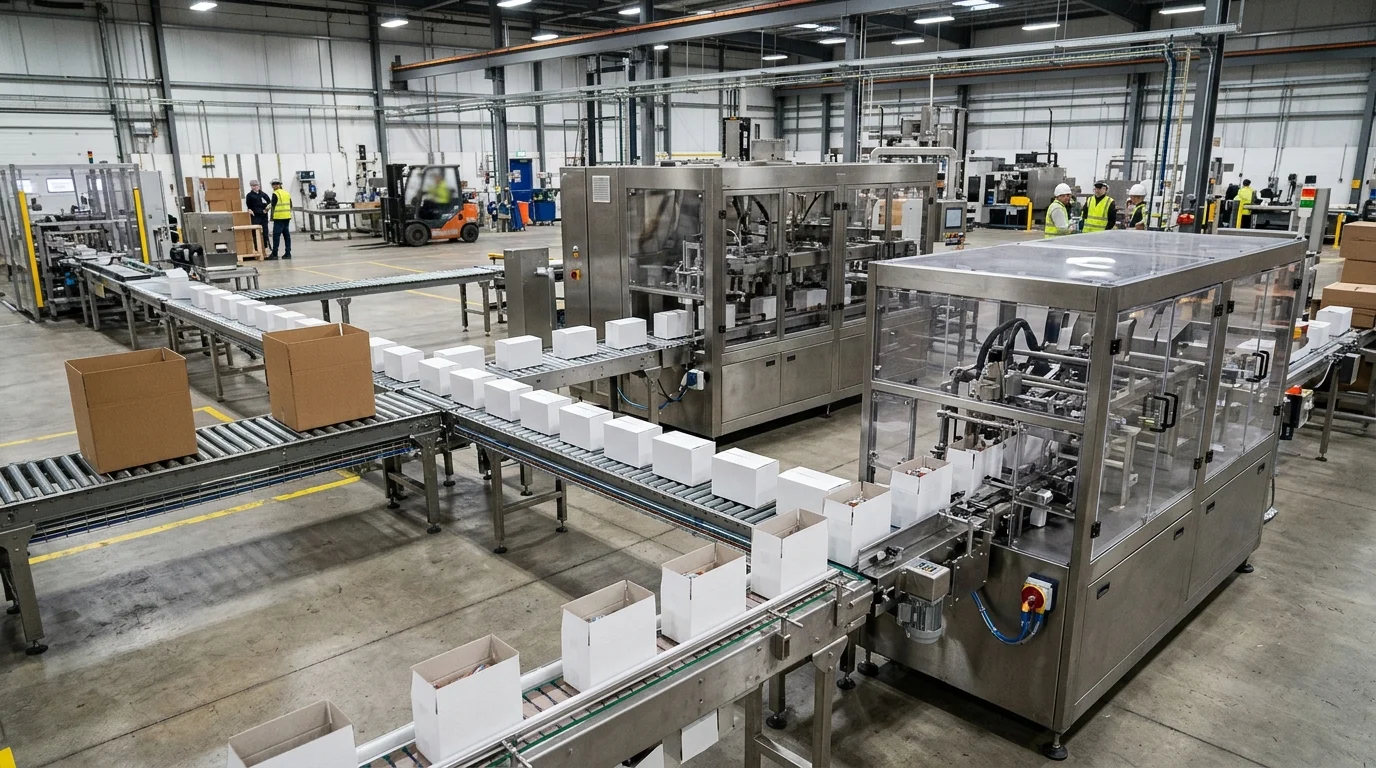
In cartoner vs case packer project scoping, evaluating the difference between cartoner and case packer stations means comparing a cartoning machine vs case packing machine across secondary vs tertiary packaging equipment. Aagard states that a cartoner and a case packer do two different jobs: a cartoner packages individual products into cartons, while a case packer groups those cartons (or primary products) into shipping cases, and in most lines you will have both—one for retail packaging and one for distribution. Soontrue states that secondary packaging is about grouping and presenting multiple primary packs, and the machines used in this layer include cartoning machines, sleevers, shrink bundlers, and sometimes robotic loading systems that pick up primary packs and place them into cartons or trays. Soontrue states that tertiary packaging involves master cases, corrugated shipping boxes, pallet loads, and stretch-wrapped units that protect multiple secondary packs during long-distance transport and stacked storage, with typical equipment including case erectors, robotic case packers, checkweighers, case sealers, roller conveyors, and palletizing robots.
Within our packaging guides library, use this comparison alongside the case packing machine types and selection equipment page, the cartoning machine line handoffs guide, and the top-load vs. side-load case packer comparison before locking your packaging line integration and commissioning and acceptance scope.
| Packaging layer or equipment boundary | Published material, machine, or rate benchmark | Operational role in line architecture |
|---|---|---|
| Secondary packaging layer scope | Soontrue states that secondary packaging is about grouping and presenting multiple primary packs using cartoning machines, sleevers, shrink bundlers, and sometimes robotic loading systems that pick up primary packs and place them into cartons or trays. | Groups and presents multiple primary packs in cartons or trays |
| Tertiary packaging layer scope | Soontrue states that tertiary packaging involves master cases, corrugated shipping boxes, pallet loads, and stretch-wrapped units that protect multiple secondary packs during long-distance transport and stacked storage, with typical equipment including case erectors, robotic case packers, checkweighers, case sealers, roller conveyors, and palletizing robots. | Protects multiple secondary packs in master cases and corrugated shipping boxes |
| Retail vs. distribution job division | Aagard states that a cartoner and a case packer do two different jobs: a cartoner packages individual products into cartons, while a case packer groups those cartons (or primary products) into shipping cases, and in most lines you will have both—one for retail packaging and one for distribution. | Separates retail carton packaging from distribution shipping case grouping |
| Folding carton paperboard caliper benchmark | Graphic Packaging’s PaceSetter Ridgeline uncoated recycled paperboard for folding cartons is made from 100% recycled fibre with at least 45% post-consumer recycled content and is available in 14- to 30-point calipers. | Defines uncoated recycled paperboard caliper range for folding cartons |
| Dual-substrate vertical cartoning exception | Serpa’s P120 vertical cartoner provides over 9 Feet of hand load area, also runs corrugate cases, and features an orbital carton erector with positive carton prebreak feature, changeover in less than 10 minutes, and tuck or glue closing. | Allows a vertical cartoner with positive carton prebreak to run corrugate cases |
| High-speed wrap-around corrugated packing | OCME USA states that its Altair HT wrap-around carton packer can reach 100 cartons per minute and produce tight, compact cartons, where the result is a robust corrugated box ready for shipping or retail display. | Forms a corrugated box around products from a flat blank at up to 100 cartons per minute |
Separate secondary folding cartons from tertiary corrugated shipping cases
Before comparing machine speeds or floor layouts, define the packaging layer, board substrate, and closure method at each station:
- Soontrue states that secondary packaging is about grouping and presenting multiple primary packs, and the machines used in this layer include cartoning machines, sleevers, shrink bundlers, and sometimes robotic loading systems that pick up primary packs and place them into cartons or trays.
- Soontrue states that tertiary packaging involves master cases, corrugated shipping boxes, pallet loads, and stretch-wrapped units that protect multiple secondary packs during long-distance transport and stacked storage, with typical equipment including case erectors, robotic case packers, checkweighers, case sealers, roller conveyors, and palletizing robots.
- Aagard states that a cartoner and a case packer do two different jobs: a cartoner packages individual products into cartons, while a case packer groups those cartons (or primary products) into shipping cases, and in most lines you will have both—one for retail packaging and one for distribution.
- Graphic Packaging describes its PaceSetter Ridgeline uncoated recycled paperboard as a solution for folding cartons, laminations, edge protectors, tubes and cores, and other speciality purposes, made from 100% recycled fibre with at least 45% post-consumer recycled content and available in 14- to 30-point calipers.
- Serpa’s P120 vertical cartoner provides over 9 Feet of hand load area, also runs corrugate cases, and includes an orbital carton erector with positive carton prebreak feature, fast and accurate changeover in less than 10 minutes, and tuck or glue closing.
- OCME USA states that wrap-around case packers use a flat blank to form the case around the product in one motion, that its Altair HT wrap-around packer can reach 100 cartons per minute and produce tight, compact cartons, and that in both pick-and-place and wrap-around packing the result is a robust corrugated box ready for shipping or retail display.
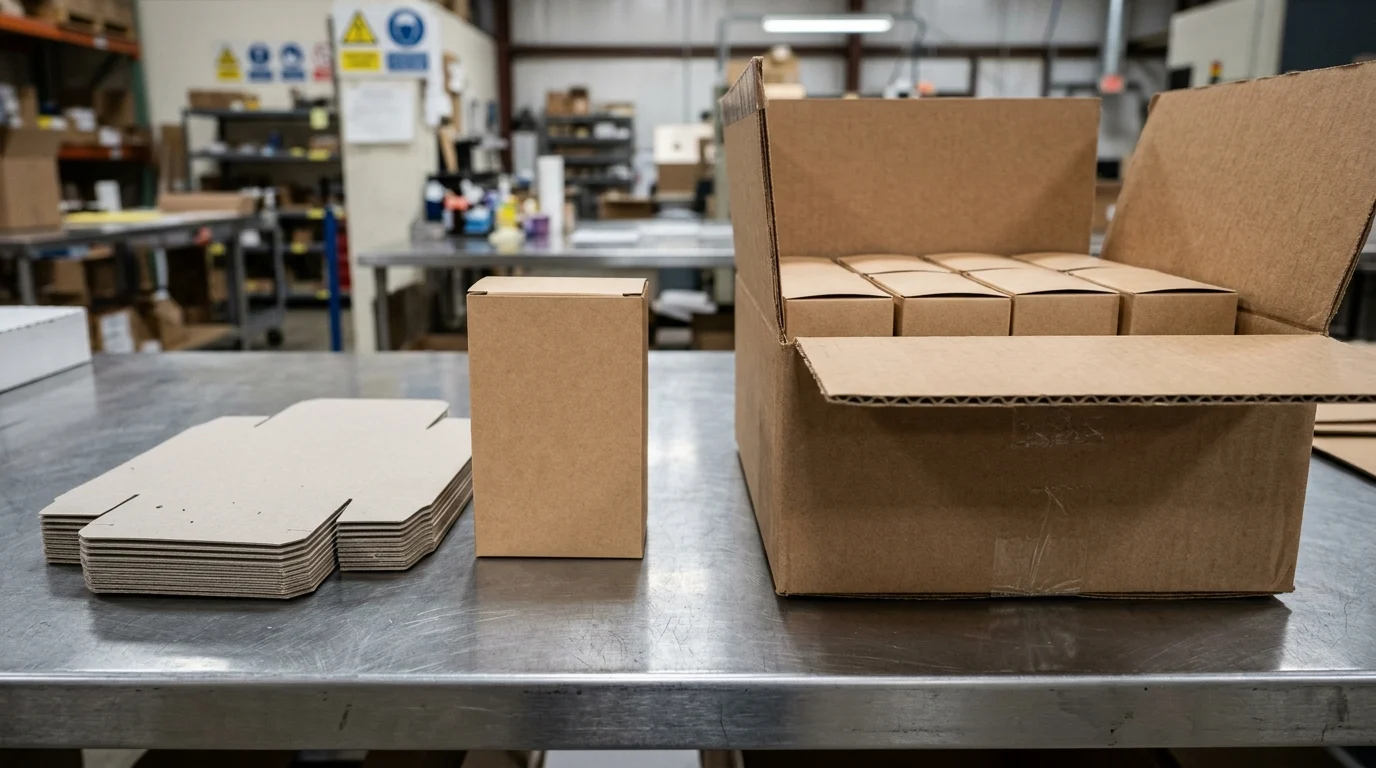
Review our case erectors and case sealers equipment pages when separating secondary carton forming from standalone tertiary case erection and sealing.
Compare cartoning machines across Rovema, Syntegon, Serpa, and INVpack
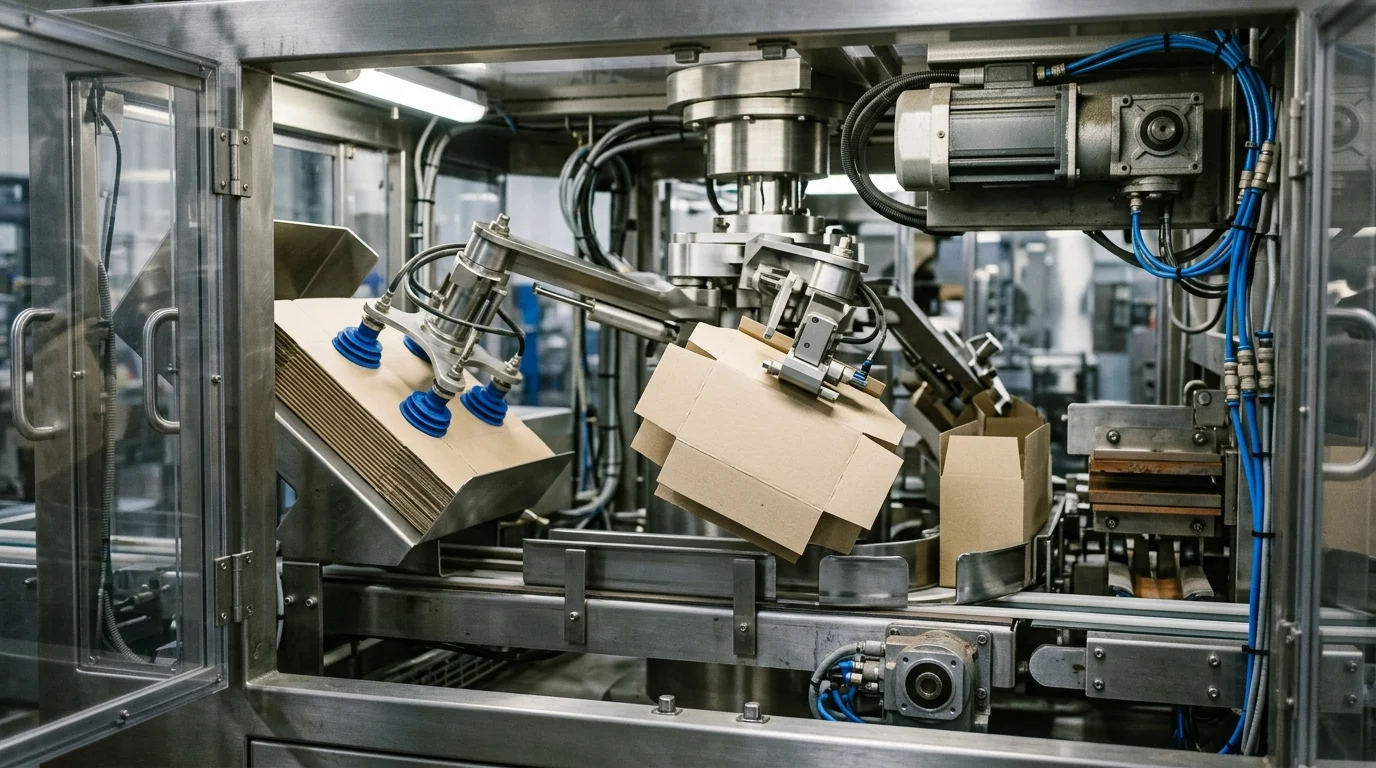
When evaluating a cartoning machine vs case packing machine, review the published horizontal, vertical, and top-load cartoner specifications from Rovema, Syntegon, Serpa, and INVpack:
Rovema continuous-motion horizontal and direct-filling vertical cartoners
- Rovema’s CMH-C 7,5” continuous motion horizontal cartoning machine processes folding Box size A of 85–165 mm (min./max.), Box size B of 30–120 mm (min./max.), and Box size H of 110–300 mm (min./max.) at an output of 225 cartons/min.
- Rovema’s CMH-C 9” continuous motion horizontal cartoning machine processes folding Box size A of 85–210 mm (min./max.), Box size B of 30–120 mm (min./max.), and Box size H of 110–300 mm (min./max.) at an output of 190 cartons/min.
- Rovema’s CMH-C 12” continuous motion horizontal cartoning machine processes folding Box size A of 105–280 mm (min./max.), Box size B of 30–120 mm (min./max.), and Box size H of 110–300 mm (min./max.) at an output of 140 cartons/min.
- Rovema’s CMH-C 13,5” continuous motion horizontal cartoning machine processes folding Box size A of 125–315 mm (min./max.), Box size B of 30–120 mm (min./max.), and Box size H of 110–300 mm (min./max.) at an output of 125 cartons/min.
- Rovema’s vertical cartoning machine CMV Direct Filling can pack up to 200 folding boxes per minute and is designed for the direct packing of free-flowing and dusting products into boxes, with a continuously revolving filling module located at the center of the machine.
Syntegon TTM integrated topload cartoners and Delta robot cells
- Syntegon states that quick-lock interfaces and pre-set format rods ensure that changeovers at a TTM integrated topload cartoner are all 100% reproducible, allowing a changeover with vertical restart in about 10 minutes.
- Syntegon’s TTMD top-load cartoner combines a TTM1 or TTM2 top load cartoner with one or more integrated Delta robot cells and a camera-based vision system at a maximum output of 150 cartons per minute, where each Delta robot typically performs between 60 and 90 picks per minute and the maximum pick rate is up to 120 products per minute.
- Syntegon’s TTM product comparison rates infeed performance and carton performance at maximum 800 ppm and maximum 30 cpm on the TTME, maximum 1500 ppm and maximum 100 cpm on the TTM1, maximum 1500 ppm and maximum 200 cpm on the TTM2, maximum 150 cpm on the TTMD, and maximum 1500 ppm and maximum 150 cpm on the TTML.
- Syntegon states that its TTM top load cartoners are capable of forming both lock-style and glue-style cartons (including tray and hood) with 100% blank control throughout the entire forming process, supporting up to 6 lanes per former and up to 2 formers per machine, with more than 650 TTM cartoning machines installed worldwide.
Serpa and INVpack horizontal, vertical, beverage, and top/side-load cartoners
- Serpa’s P100 continuous motion horizontal cartoner features a robust build that allows for 24/7 operation built to last 20+ years, an orbital carton erector with pre-break, toolless changeover, an active glue compression system that prevents carton reject at startup, 24-hour turnaround time on emergency parts, and a 98% Uptime Guarantee.
- The Serpa P120 vertical cartoner supports a metric carton size range (Length × Width × Depth) from Standard Minimum 25.4mm × 19.05mm × 79.38mm to Standard Maximum 114.3mm × 88.9mm × 225.4mm and Custom Maximum 300.0mm × 208.0mm × 304.8mm.
- Serpa’s P150 Intermittent Cartoner is an intermittent cartoner that can operate at up to 80 cartons per minute.
- Serpa’s FM100 continuous motion horizontal cartoner features a balcony design with walk-in access, tool-less changeover in less than 10 minutes, 18” maximum reach points, positive carton erecting with prebreak, and available stainless steel washdown construction with NEMA 4X.
- Serpa’s FM150 intermittent motion beverage cartoner features tool-less changeover in less than 10 minutes and handles carton dimensions (Length × Width × Depth) from a minimum of 108 mm × 88.9 mm × 95.3 mm (4 1/4” × 3 1/2” × 3 3/4”, 2x2 pack pattern) to a maximum of 254 mm × 165 mm × 406 mm (10” × 6 1/2” × 16”, 3x6 pack pattern).
- The INVpack SL3 horizontal cartoner with side-load system achieves an output of up to 50 cartons per minute (Production: 50 ppm) at a low noise level of <70 dB, handling box length of 70–230 mm, box width of 25–135 mm, and High box of 15–60 mm.
- INVpack’s TL6 horizontal top-load cartoner operates at 60 ppm Output / Production, handling carton length of 80–210 mm, carton width of 80–300 mm, and carton height of 20–190 mm, at 6 bar compressed air, 2,500 kg weight, and 4400 x 2900 x 2000 mm overall dimensions.
| Cartoner model | Published output and infeed ratings | Carton dimension range or changeover features |
|---|---|---|
| Rovema CMH-C 7,5” | Output of 225 cartons/min | Folding Box size A of 85–165 mm (min./max.), Box size B of 30–120 mm (min./max.), and Box size H of 110–300 mm (min./max.) |
| Rovema CMH-C 9” | Output of 190 cartons/min | Folding Box size A of 85–210 mm (min./max.), Box size B of 30–120 mm (min./max.), and Box size H of 110–300 mm (min./max.) |
| Rovema CMH-C 12” | Output of 140 cartons/min | Folding Box size A of 105–280 mm (min./max.), Box size B of 30–120 mm (min./max.), and Box size H of 110–300 mm (min./max.) |
| Rovema CMH-C 13,5” | Output of 125 cartons/min | Folding Box size A of 125–315 mm (min./max.), Box size B of 30–120 mm (min./max.), and Box size H of 110–300 mm (min./max.) |
| Rovema CMV Direct Filling | Packs up to 200 folding boxes per minute | Vertical cartoning machine for direct packing of free-flowing and dusting products into boxes |
| Syntegon TTME, TTM1, TTM2, and TTML | TTME maximum 800 ppm infeed and maximum 30 cpm carton performance; TTM1 maximum 1500 ppm and maximum 100 cpm; TTM2 maximum 1500 ppm and maximum 200 cpm; TTML maximum 1500 ppm and maximum 150 cpm | Scalable top-load cartoner series across TTME, TTM1, TTM2, TTMD, and TTML platforms |
| Syntegon TTMD Top-Load Cartoner | Maximum output of 150 cartons per minute; each Delta robot typically performs between 60 and 90 picks per minute and up to 120 products per minute maximum | Combines a TTM1 or TTM2 top load cartoner with integrated Delta robot cells and a camera-based vision system |
| Serpa P100 Continuous Motion Horizontal Cartoner | Built for 24/7 operation to last 20+ years with a 98% Uptime Guarantee | Orbital carton erector with pre-break, toolless changeover, active glue compression preventing carton reject at startup, and 24-hour emergency parts turnaround |
| Serpa P120 Vertical Cartoner | Metric carton size range from Standard Minimum 25.4mm x 19.05mm x 79.38mm | Standard Maximum 114.3mm x 88.9mm x 225.4mm and Custom Maximum 300.0mm x 208.0mm x 304.8mm |
| Serpa P150 Intermittent Cartoner | Operates at up to 80 cartons per minute | Intermittent cartoner that can operate at up to 80 cartons per minute |
| Serpa FM100 Continuous Motion Cartoner | Tool-less changeover in less than 10 minutes | Balcony design with walk-in access, 18” maximum reach points, and available stainless steel washdown construction with NEMA 4X |
| Serpa FM150 Beverage Cartoner | Tool-less changeover in less than 10 minutes | Handles 108 mm x 88.9 mm x 95.3 mm (4 1/4” x 3 1/2” x 3 3/4”, 2x2) to 254 mm x 165 mm x 406 mm (10” x 6 1/2” x 16”, 3x6) |
| INVpack SL3 Horizontal Cartoner | Side-load output up to 50 cartons per minute (50 ppm) at <70 dB | Box length 70–230 mm, box width 25–135 mm, and High box 15–60 mm |
| INVpack TL6 Horizontal Cartoner | Top-load Output / Production of 60 ppm | Carton length 80–210 mm, width 80–300 mm, height 20–190 mm, 6 bar air, 2,500 kg weight, 4400 x 2900 x 2000 mm dimensions |
Compare case packing machines across Rovema, Syntegon, Serpa, and Standard-Knapp
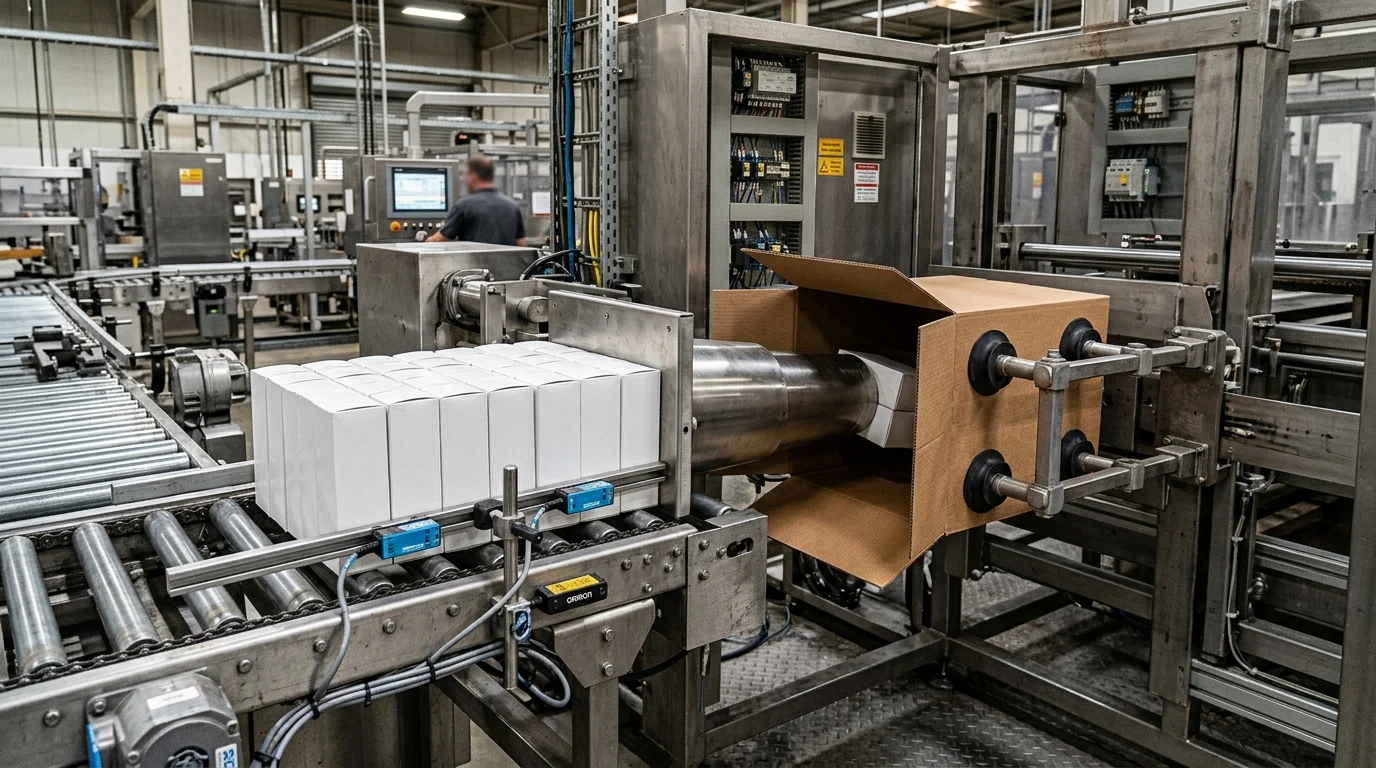
To see how tertiary case packers pair with upstream cartoners within the same manufacturer portfolios, review the published specifications from Rovema, Syntegon, Serpa, and Standard-Knapp:
Rovema and Syntegon side-load, top-load, and end-of-line case packers
- Rovema’s ELS side-loader final packaging machine accepts an infeed performance of up to 200/min across models ELS 643 (case dimensions LxBxH of 600 x 400 x 300 mm), ELS 664 (600 x 600 x 400 mm), and ELS 864 (800 x 600 x 400 mm).
- The Rovema ELD Flex end-of-line case packer handles maximum product feed rates up to 160 bags/min (vertical) or up to 120 bags/min (horizontal) and outputs bis zu 15 Kartons/min (vertical) or up to 20 cartons/min (horizontal) with a max. carton size (D x C x H) of 600 x 400 x 300 mm.
- Syntegon’s Elematic 1001 TL robotic top-load RSC case packer handles an infeed of up to 160 products/min and an output of up to 15 cases/min for sensitive products in bags, flowpacks, or cartons.
- Syntegon’s Elematic 1001 SL horizontal side-load case packer packs bags, flowpacks, and cartons—grouped in single rows, multiple rows, or layered configurations into RSC or HSC cases—at an output of up to 20 cases/min.
- On Syntegon’s flexible flat and on-pile biscuit/cracker packaging system with vibratory channels (up to 10,000 crackers or biscuits capacity), flow wrappers run up to 270 pile packs per minute (flat stacked) or up to 145 slug packs per minute (on-edge slug), and the sideload case packer loads up to 160 packs into 20 cases per minute.
Serpa and Standard-Knapp case packers, drop packers, and budget bands
- Serpa’s P200 side-load case and tray packer picks and erects cases at speeds up to 20 cases per minute using a positive dual vacuum case erector and vacuum-assisted walking beam with no skewing flight lugs or pinching belts, completing changeovers in less than 5 minutes with hot glue or tape sealing.
- The Serpa P200 side-load case packer handles a corrugated case range (Length × Width × Depth) from a minimum of 152.4mm × 127mm × 114.3mm (6” × 5” × 4.5”) to a maximum of 508mm × 330.2mm × 330.2mm (20” × 13” × 13”).
- The Serpa P250 top-load case packer picks and erects cases at speeds up to 20 cases per minute with a 2-axis servo pick & place assembly and changeover in less than 5 minutes, handling metric cases (Length × Width × Depth) from 152.4mm × 127mm × 127mm up to 609.6mm × 355.6mm × 355.6mm.
- The Serpa P220 wrap-around case packer picks case blanks at speeds up to 20 cases per minute with changeover in less than 5 minutes and hot glue sealing, handling metric case ranges (Length × Width × Depth) from 152.4mm × 76.2mm × 127mm up to 508mm × 304.8mm × 381mm.
- The Serpa Integrated Case Packer/Palletizer provides 98% uptime, guaranteed, and delivers 40% footprint savings compared to a standalone case packer and palletizer with changeover in less than 5 minutes, handling metric case sizes (Length × Width × Depth) from 153mm × 127mm × 115mm up to 508mm × 355mm × 381mm.
- Serpa’s DP260 Drop Packer can handle single or tandem drops depending on the application requirements and can achieve speeds up to 60 cases per minute.
- Standard-Knapp states that case packers can range from $50,000 to $750,000: speeds below 20 cases per minute can be done effectively with side-load packers, bottom-load, or robotic packers; speeds from 20 to 35 cases per minute use drop packers or intermittent-motion wraparound packers; and speeds above 35 cases per minute are handled by soft-placement packers, servo drop packers, rotary packers, and continuous-motion wraparound packers.
- Standard-Knapp’s machine-load evaluation asks whether a filled case weight is 50 pounds with a production demand of 24 hrs/day x 7 days/week, noting that if so, this requires a truly robust solution.
| Case packer model or benchmark | Published speed and infeed ratings | Case dimension envelope or architecture scope |
|---|---|---|
| Rovema ELS 643, ELS 664, and ELS 864 Side Loaders | Infeed performance up to 200/min across all three models | Case dimensions (LxBxH) of 600 x 400 x 300 mm (ELS 643), 600 x 600 x 400 mm (ELS 664), and 800 x 600 x 400 mm (ELS 864) |
| Rovema ELD Flex End-of-Line Case Packer | Feed rates up to 160 bags/min (vertical) or 120 bags/min (horizontal); outputs bis zu 15 Kartons/min (vertical) or up to 20 cartons/min (horizontal) | Max. carton size (D x C x H) of 600 x 400 x 300 mm |
| Syntegon Elematic 1001 TL | Infeed up to 160 products/min and output up to 15 cases/min | Robotic top-load RSC case packing machine for sensitive products |
| Syntegon Elematic 1001 SL | Output up to 20 cases/min | Horizontal side-load case packing of bags, flowpacks, and cartons into RSC or HSC cases |
| Syntegon Cookie and Cracker Line Sideload Case Packer | Loads up to 160 packs into 20 cases per minute | Paired with vibratory channels (up to 10,000 crackers or biscuits) and flow wrappers at up to 270 pile packs per minute or 145 slug packs per minute |
| Serpa P200 Side-Load Case and Tray Packer | Corrugated case range from 6” x 5” x 4.5” minimum to 20” x 13” x 13” maximum | Metric case range 152.4mm x 127mm x 114.3mm minimum to 508mm x 330.2mm x 330.2mm maximum |
| Serpa P250 Top-Load Case Packer | Picks and erects cases at speeds up to 20 cases per minute with <5 minutes changeover | 2-axis servo pick & place; metric case range 152.4mm x 127mm x 127mm minimum to 609.6mm x 355.6mm x 355.6mm maximum |
| Serpa P220 Wrap-Around Case Packer | Picks case blanks at speeds up to 20 cases per minute with <5 minutes changeover | Hot glue sealing; metric case range 152.4mm x 76.2mm x 127mm minimum to 508mm x 304.8mm x 381mm maximum |
| Serpa Integrated Case Packer/Palletizer | Guarantees 98% uptime with changeover in less than 5 minutes | Delivers 40% footprint savings and handles metric case sizes from 153mm x 127mm x 115mm up to 508mm x 355mm x 381mm |
| Serpa DP260 Drop Packer | Achieves speeds up to 60 cases per minute | Handles single or tandem drops depending on application requirements |
| OCME Altair HT Wrap-Around Packer | Reaches 100 cartons per minute | Uses a flat blank to form a tight, compact corrugated box ready for shipping or retail display |
| Standard-Knapp Selection Bands | Price range from $50,000 to $750,000 across <20, 20 to 35, and >35 cases per minute tiers | Matches side-load, bottom-load, or robotic (<20 cases per minute), drop or intermittent wraparound (20 to 35 cases per minute), and soft-placement, servo drop, rotary, and continuous wraparound (>35 cases per minute) |
For deeper analysis of robotic pick-and-place cells and capital budgeting, consult our robotic case packing page and the case packer cost guide.
Balance upstream and downstream line speeds, accumulation buffers, and safety controls
Synchronizing upstream and downstream stations requires converting unit flow into case cycle time, sizing accumulation buffering for micro-stops, and applying safety standards across connected machinery:
Pack-count speed conversion, robotic multi-pick math, and shared-line merging
- Smartpack states that an upstream VFFS machine running at 100 bags per minute produces one bag every 0.6 seconds; if each case holds 12 bags, the packing team must complete a case every 7.2 seconds.
- Smartpack calculates required case packer speed as Required cases/min = accepted bags/min ÷ bags per case: at a 120/min bag flow, 6 bags per case requires 20 cases per minute (3 seconds per case), 12 bags per case requires 10 cases per minute (6 seconds per case), and 24 bags per case requires 5 cases per minute (12 seconds per case).
- Smartpack states that case packers must be sized around the fastest verified bag flow for each SKU rather than a shift average, and for a Delta robot at 120 bags per minute, one bag per pick means 120 successful picks per minute whereas two bags per pick means 60 picks per minute, provided the bags can be grouped and gripped reliably.
- Smartpack states that when two VFFS machines at 90 accepted bags per minute each feed one packer (producing 180 bags per minute total) at 12 bags per case, the packer needs at least 15 cases per minute plus capacity to recover from short stops, whereas a packer rated at 12 cases per minute falls behind by 36 bags each minute.
Accumulation buffer sizing, over-speed recovery math, and handshake signals
- Smartpack sizes accumulation buffer capacity between upstream packaging and the case packer by Buffer bags = VFFS bags/min × stop time in minutes; at 100 bags per minute, a 15-second stop adds 25 bags to the buffer.
- Smartpack states that clearing an accumulation buffer requires downstream spare capacity: if the case packer can accept 120 bags per minute while the VFFS continues at 100 bags per minute, its spare capacity is 20 bags per minute and clearing 25 buffered bags takes about 75 seconds, whereas if both machines run at 100 bags per minute, the backlog cannot clear without slowing the VFFS.
- Smartpack states that in coordinated stop-and-restart line control, when the case packer stops, the buffer fills, a high-level signal warns the line, and a full-buffer signal requests a controlled VFFS stop before bags back up at its discharge.
Accumulation conveyor hardware and machinery safety compliance
- Roach Conveyors’ Model 596PRA Powered Roller Zero Pressure Accumulating Conveyor carries 15 lbs per roller or up to 70 lbs per zone at 60 FPM constant speed on 3 in. roller centers with 24 in. photoeye-actuated zone length and a 24V DC powered roller motor drive.
- BW Packaging brings over 50 years of conveyor expertise and supplies advanced conveyor systems for cans, bottles, cases, and pallets, including Ambec MINI Buffer Accumulation and the Ambec Series of Single File, First In-First Out (FIFO) Accumulators.
- PMMI’s newly revised ANSI/PMMI B155.1-2023 safety standard (released August 31, 2023) defines safety requirements for packaging and processing machinery, guiding suppliers and users through a formal, documented risk assessment process, reorganizing Clauses 4 and 5, and including Whole Body Access Requirements.
| Line-balancing or integration parameter | Published equation, rate, or hardware specification | Engineering impact on upstream-to-downstream coupling |
|---|---|---|
| Upstream cycle time to case completion | At 100 bags per minute (one bag every 0.6 seconds) and 12 bags per case, a case must be completed every 7.2 seconds | Converts single-unit discharge intervals into full-case cycle time |
| Pack-count rate conversion at 120/min | Required cases/min = accepted bags/min ÷ bags per case: at 120/min flow, 6 bags/case = 20 cases/min (3 seconds), 12 bags/case = 10 cases/min (6 seconds), and 24 bags/case = 5 cases/min (12 seconds) | Shows how increasing pack count per case lowers required cases per minute |
| Peak flow sizing and Delta robot pick rate | Size around the fastest verified bag flow for each SKU; at 120 bags per minute, one bag per pick requires 120 successful picks per minute and two bags per pick requires 60 picks per minute | Halves required robot cycle rate when two units are grouped and gripped per pick |
| Dual-machine shared packer sizing | Two VFFS machines at 90 accepted bags per minute each produce 180 bags per minute, requiring at least 15 cases per minute at 12 bags per case; a packer rated at 12 cases per minute falls behind by 36 bags each minute | Prevents chronic buffer overflow when merging two upstream machines into one case packer |
| Accumulation buffer capacity formula | Buffer bags = VFFS bags/min × stop time in minutes; at 100 bags per minute, a 15-second stop adds 25 bags to the buffer | Defines minimum usable holding capacity required to absorb a short case packer stop |
| Over-speed buffer pull-down recovery | At 120 bags per minute case packer acceptance vs. 100 bags per minute upstream flow (20 bags per minute spare capacity), clearing 25 buffered bags takes about 75 seconds; at equal 100 bags per minute rates, the backlog cannot clear without slowing the VFFS | Explains why downstream case packers require over-speed spare capacity above upstream flow |
| Buffer level handshake signals | When the case packer stops and the buffer fills, a high-level signal warns the line and a full-buffer signal requests a controlled VFFS stop before bags back up at its discharge | Coordinates stop and restart sequences across connected controls |
| Roach 596PRA zero-pressure accumulator | Carries 15 lbs per roller or up to 70 lbs per zone at 60 FPM constant speed | 3 in. roller centers, 24 in. photoeye-actuated zone length, and 24V DC drive |
| ANSI/PMMI B155.1-2023 machinery safety | Released August 31, 2023; reorganizes Clauses 4 and 5 and includes Whole Body Access Requirements | Guides suppliers and users through a formal, documented risk assessment process |
When laying out accumulation zones and transfer conveyors between stations, see our accumulation conveyors and case conveyors equipment pages, the accumulation conveyor tables and line buffering guide, and the packaging line layout guide.
Sources
- Soontrue — Primary, Secondary & Tertiary Packaging Explained
- Packaging Europe — Graphic Packaging Unveils First Uncoated Recycled Paperboard PaceSetter Ridgeline
- Aagard — Case Packers: Complete Buyer’s Guide
- OCME USA — Case Packing vs. Carton Packing: Understanding the Key Differences
- Rovema GmbH — Horizontal Cartoning Machine, Vertical Cartoning Machine, Side-Loader, and End-of-Line Packaging Machine Technical Data
- Syntegon Technology GmbH — Integrated Topload Cartoning, Robotic and Side-Load RSC Case Packing, and Flexible Biscuit and Cracker Packaging
- Serpa Packaging Solutions — Continuous and Intermittent Horizontal Cartoners, Vertical Cartoners, Beverage Cartoners, and Case Packers Technical Specifications
- INVpack — Horizontal Side-Load and Top-Load Cartoning Machine Technical Specifications
- Standard-Knapp, Inc. — White Paper: Six Factors to Consider When Selecting a Case Packer
- Smartpack Machine — Matching a Case Packer to a High-Speed VFFS Line
- Roach Conveyors — Powered Roller Zero Pressure Accumulating Conveyor Technical Specifications
- BW Packaging — Conveying, Accumulation, and Buffering Systems
- PMMI — PMMI Releases Newly Revised Packaging and Processing Machinery Safety Standard